Tainan, Taiwan: The Island’s Oldest City, Deepest Food Culture, and Most Layered History
If Taipei is where Taiwan is going, Tainan, Taiwan is where Taiwan came from. This is the island’s oldest city — the place where Dutch merchants built a fort in 1624, where a Ming loyalist warlord kicked them out 38 years later, where the Qing empire ran the whole island from a single walled town, and where Japanese architects dropped red-brick department stores next to 300-year-old temples. Five different governments in four centuries, and the wild part is that you can still walk past all of them in an afternoon.
Search Tainan Taiwan and you’ll get a dozen listicles: go here, eat this, photograph that. Useful, but it misses the point. Tainan isn’t a checklist city — it’s a layered one. The temple on the corner is there because of a 1683 surrender. The noodles you’re eating exist because a fisherman needed income during typhoon season. The brick facade above the bubble tea shop was a Japanese colonial bank. Once you can read the layers, the whole city opens up. So this guide gives you both: the story and the practical stuff — what to eat, where to walk, when to go, and how to get there from Taipei.
Tainan Taiwan 101: Five Regimes, 400 Years, One Walkable City
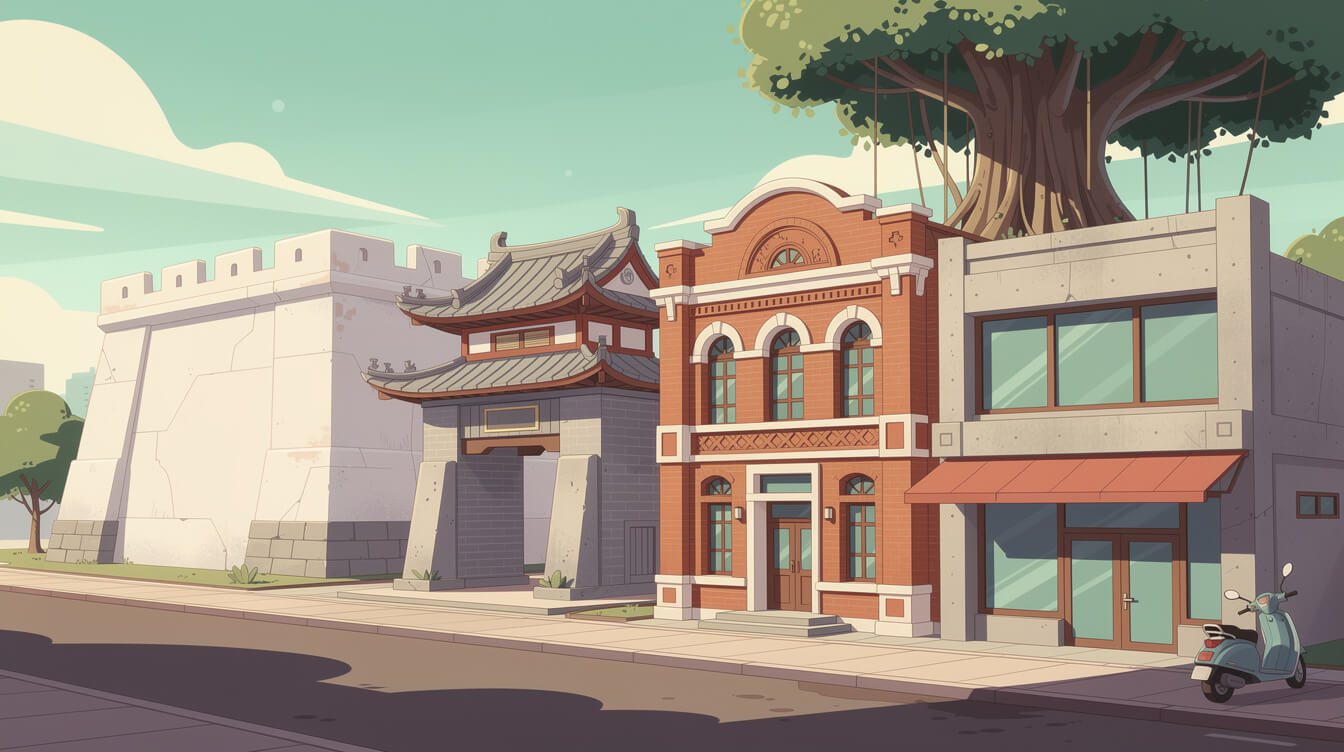
Tainan sits on the southwest coast of Taiwan, roughly two-thirds of the way down the island. It’s home to about 1.86 million people, making it Taiwan’s sixth-largest municipality — big enough to have real depth, small enough that the historic core is genuinely walkable. In 2010 the old Tainan City and the surrounding Tainan County merged into a single special municipality, which is why the city limits now stretch from salt flats on the coast all the way up into mountain villages.
The quick facts
- Founded: 1624, when the Dutch East India Company built a fort at a sandbar called Tayouan — a name that eventually became “Taiwan.”
- Was the capital for: roughly 200 years, until the administrative center moved north in the 1880s.
- Known as: 府城 (Fǔchéng), “the prefecture city” — locals still use it.
- Temples: well over 1,600 registered, more than any other city in Taiwan.
- Reputation: Taiwan’s food capital, and the country’s sweetest cuisine (literally — Tainan cooks use more sugar).
- Weather: the sunniest, driest big city in Taiwan.
The five regimes, in order
1. The Dutch (1624–1662). The Dutch East India Company wanted a trading base between Japan and the Chinese mainland. They built Fort Zeelandia on a coastal sandbar at what is now Anping, then Fort Provintia inland. They imported labor, taxed deer hides, and ran the place like a corporate outpost — because it was one.
2. The Kingdom of Tungning (1662–1683). Zheng Chenggong — known in the West as Koxinga — was a Ming loyalist who had just lost his war against the incoming Qing dynasty. He needed a base. In 1661 he landed with a fleet, laid siege to Fort Zeelandia for nine months, and the Dutch surrendered in February 1662. Koxinga died a few months later, but his family ran Taiwan as an independent kingdom for two decades, built the island’s first Confucian temple, and made Tainan a real city rather than a trading post.
3. The Qing (1683–1895). The Qing navy defeated the Zheng fleet at Penghu in 1683 and annexed Taiwan. Tainan — then called Taiwan-fu — became the administrative capital of the entire island for the next two centuries. The city walls, the official temples, the grid of the old town: that’s Qing-era Tainan, and it’s the layer that gives the city its bones.
4. The Japanese (1895–1945). After the Qing ceded Taiwan, Japanese planners went to work: wide boulevards, a railway, a modern water system, red-brick civic buildings, and in 1932 the Hayashi Department Store, which had Taiwan’s second elevator and a small Shinto shrine on the roof. Much of it survives, restored and reused.
5. The Republic of China (1945–present). Post-1945 Tainan became a mid-size industrial and university city, quietly overshadowed by Taipei’s boom — which is precisely why so much of the old fabric never got bulldozed. Tainan’s “underrated” status is an accident of economics, and it’s the best thing that ever happened to the city’s architecture.
If you want the other half of that story, our guide to the capital of Taiwan explains how and why the center of gravity shifted north — Tainan’s loss was Taipei’s gain.
Anping: Fort Zeelandia, the Treehouse, and the Harbor That Started Everything
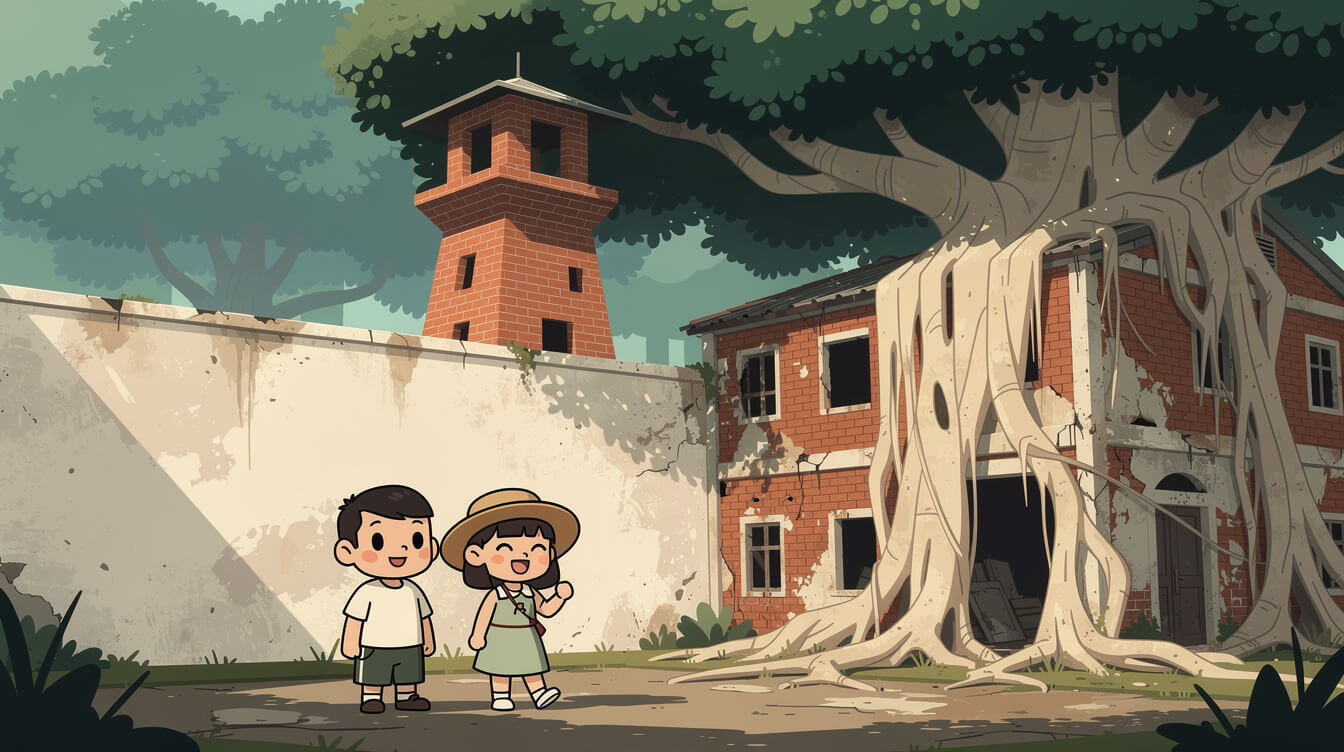
Anping is where Taiwan’s recorded history begins, and it’s about 20 minutes west of the old town by bus or scooter. Give it half a day minimum.
Anping Old Fort (安平古堡) is what’s left of Fort Zeelandia. Be honest with yourself before you go: most of the Dutch structure is gone, replaced by a Japanese-era customs building and an observation tower. But one original stretch of thick, sun-bleached wall survives, patched with banyan roots, and standing next to it is a genuinely strange feeling. That wall watched a nine-month siege.
The Anping Treehouse (安平樹屋) next door is the single best sight in Tainan and it costs almost nothing. It’s a 19th-century Tait & Co. warehouse that was abandoned, and over decades a banyan tree simply ate it — roots pouring over the brickwork like wax, branches punching through the roof, the whole thing now threaded with elevated walkways so you can wander through the collision. It’s Angkor Wat energy at neighborhood scale.
Anping Old Street (延平街) claims the title of Taiwan’s oldest street, and it’s now a dense, cheerful snack alley — shrimp crackers, dried squid, candied fruit, tourists everywhere. Go for the energy and the food, not for solitude.
Anping Kaitai Tianhou Temple is one of Taiwan’s oldest Matsu temples, and Eternal Golden Castle (億載金城) — a moated Qing fort from 1876, designed by a French engineer after a war scare — is a ten-minute ride away with cannons you can climb on.
The thread connecting all of it: Anping was the harbor. Every regime that ever ran Taiwan came ashore near here first.
Temple Capital: Why Tainan Has More Gods Per Block Than Anywhere in Taiwan
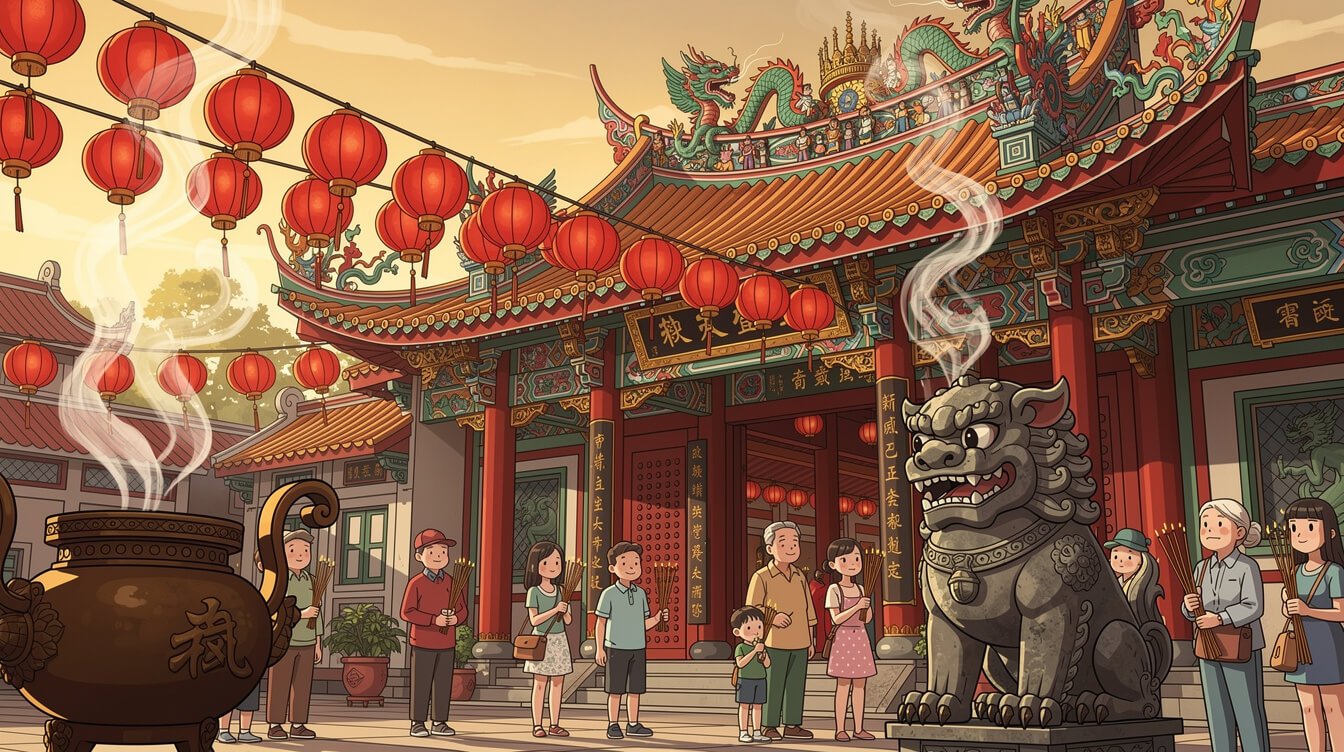
Over 1,600 registered temples in one municipality sounds like a statistic until you’re walking down an ordinary residential lane and pass three of them in four minutes. Here’s why the density is so extreme.
Tainan was the capital when Taiwan’s temple culture was being established, which meant the official state temples were built here first. Then there’s immigration: settlers arrived from different counties in Fujian and Guangdong, and each community brought its own hometown deity and built its own temple — so you get overlapping networks rather than one civic religion. Add the fact that Tainan never had a Taipei-scale redevelopment boom, and the temples simply stayed.
The ones worth your time:
- Tainan Confucius Temple (1665) — Taiwan’s first, and still nicknamed 全臺首學, “the first academy in all Taiwan.” A quiet, red-walled compound with old trees and a completely different atmosphere from the folk temples. Start here.
- Grand Matsu Temple (大天后宮) — the first official Matsu temple in Taiwan, converted in 1683 from the residence of a Ming prince. The layers again: a palace became a temple the moment the dynasty changed.
- Chihkan Tower (赤崁樓) — technically the site of Dutch Fort Provintia (1653), now topped with Qing-era pavilions and stone turtle steles. Dutch foundations, Chinese roof: the most literal image of Tainan’s layering you’ll find.
- Wufei Temple (五妃廟) — a small, moving shrine to five consorts who died with the Ningjing Prince in 1683 rather than surrender. Rarely crowded.
Temple etiquette, briefly: enter through the right-hand door and exit through the left (never the center), don’t point at statues, ask before photographing worshippers, and if someone hands you incense, it’s an invitation, not an obligation.
The Tainan Food Bible: Danzai Noodles, Beef Soup, Coffin Bread, and Milkfish
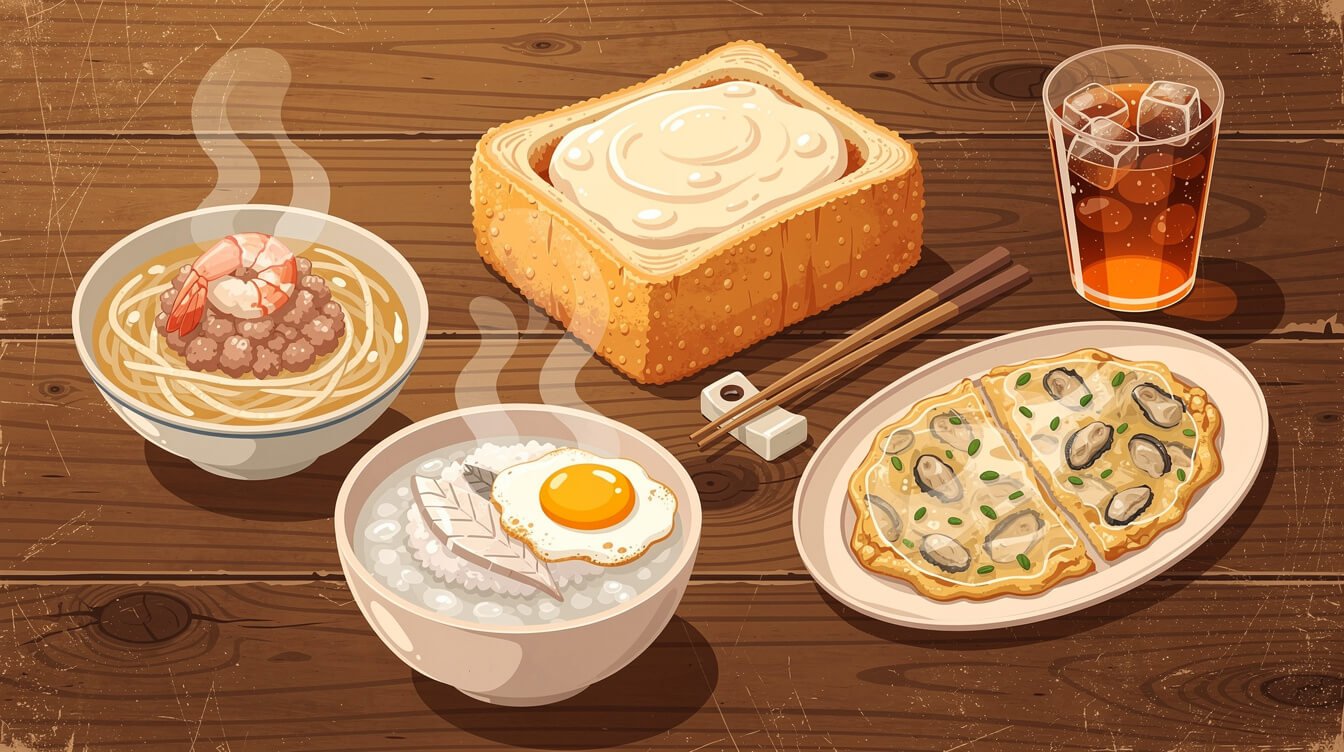
Taiwanese people from other cities travel to Tainan specifically to eat. Not as a side activity — as the entire trip. Here’s what makes the food scene different, and what to actually order.
Tainan food is sweeter. This is a real, documented regional trait, and locals will tell you about it unprompted. The usual explanation points to the region’s sugar-producing history — when sugar is cheap and local, it ends up in everything, including savory dishes. Braised pork, soups, even sauces run sweeter here than in Taipei.
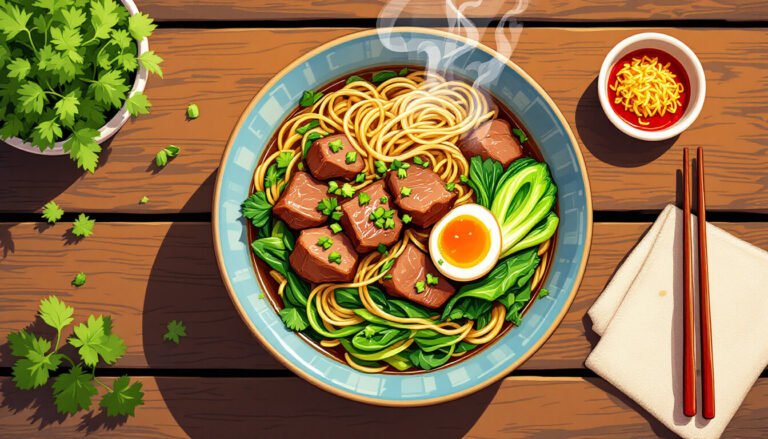
Danzai noodles (擔仔麵)
A small bowl of thin noodles in clear shrimp-and-pork broth, topped with minced pork, a single shrimp, and a splash of black vinegar. The portion is deliberately tiny — this was snack food. The origin story is the good part: it was created in 1895 by a fisherman who couldn’t fish during the stormy off-months, so he carried a shoulder pole (擔仔) of noodles through the streets to get through the lean season. The original shop is still called Du Xiao Yue 度小月 — “getting through the slack months.” A recipe that is literally named after making rent.
Beef soup (牛肉湯)
Tainan’s signature breakfast and the thing locals will insist you do properly, which means early. Paper-thin slices of raw local beef go into a bowl and boiling broth is poured over the top, cooking it in seconds. It arrives blushing pink, clean-tasting, with ginger on the side. Many of the best shops open at dawn and sell out by mid-morning. If you do one Tainan food thing before 7am, make it this.
Coffin bread (棺材板)
A thick slab of white bread, deep-fried until it’s a golden box, hollowed out, filled with creamy seafood or chicken chowder, then lidded. It started in the 1940s as “chicken liver board” until an archaeologist eating at the stall joked that it looked like a coffin — the owner liked it enough to rename the dish. Extremely Tainan: the morbid name is the marketing.
Milkfish (虱目魚)
Tainan’s aquaculture ponds have farmed milkfish for centuries, and the city eats it for breakfast — as congee, as soup, as a pan-fried belly fillet. There’s a beloved folk story that Koxinga asked what the fish was called and the reply in Taiwanese, “sam-mih hî” (“what fish?”), stuck as its name. Almost certainly a legend. Everyone tells it anyway.
Also order: oyster omelette, oyster vermicelli, shrimp rolls (蝦捲), rice pudding (碗粿), eel noodles, and tofu pudding. And head to Guohua Street (國華街) — a few blocks that function as an open-air greatest-hits album of Tainan snacks.
A note on timing that catches visitors out: many legendary Tainan shops are breakfast-and-lunch operations that close by 2pm, and plenty shut one weekday for rest. Check hours the night before. If you want the wider context, our guide to Taiwan street food city by city covers how Tainan’s scene compares to Taipei and Kaohsiung, and Tainan has been part of the Taiwan Michelin Guide since the inspectors expanded south — mostly in the Bib Gourmand category, which is exactly where this city belongs.
Shennong Street, Blueprint, and Tainan’s Creative Quarter
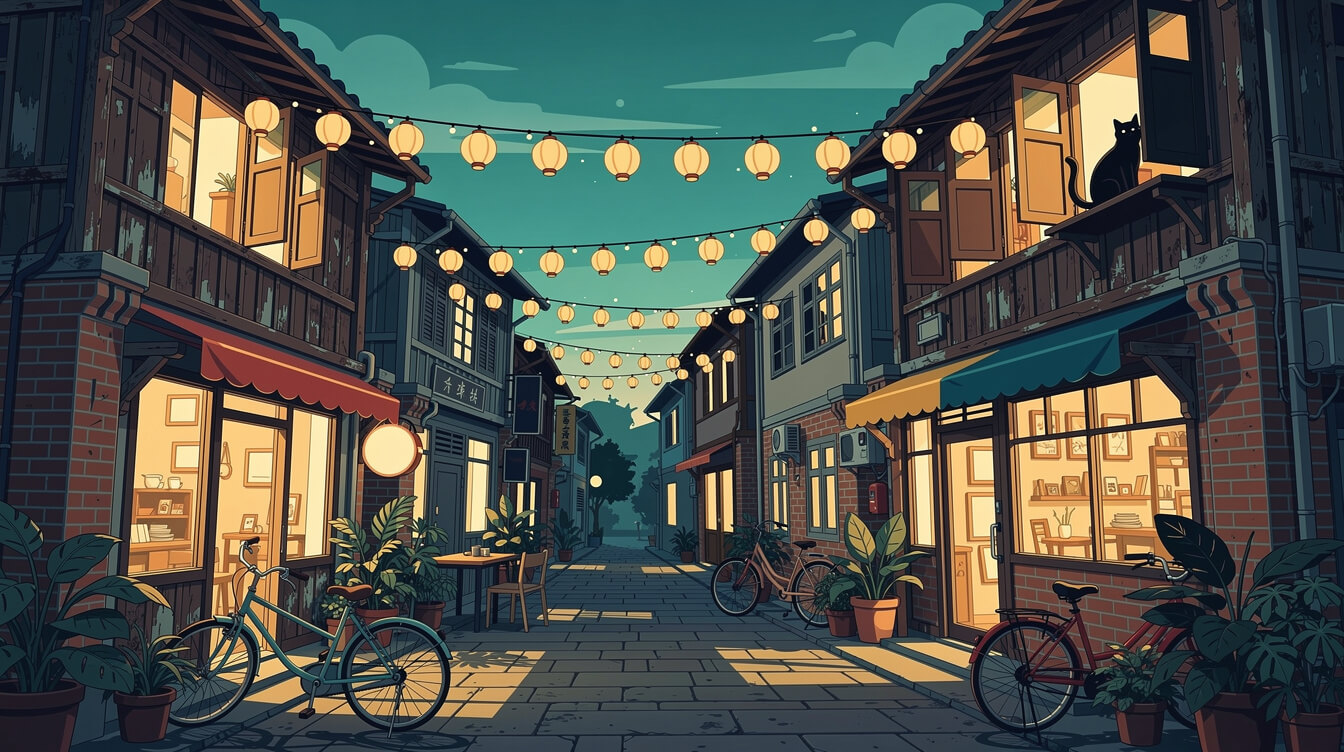
Here’s the thing nobody expects from a 400-year-old city: Tainan has one of the best independent creative scenes in Taiwan, and it grew directly out of the old buildings.
Shennong Street (神農街) is the centerpiece — a single narrow Qing-era lane, formerly a wharf street in the Five Channels district, lined with two-storey wooden-fronted shophouses. Rather than being demolished or turned into a museum, they got taken over by bars, ceramic studios, coffee roasters, and design shops. Go at dusk when the lanterns come on and the street is maybe six meters wide and glowing. It’s the most photographed lane in Tainan for good reason.
Blueprint Culture & Creative Park (藍晒圖文創園區) occupies a former judicial staff dormitory complex, reopened in 2015 as studios, indie retail, and a large-scale blueprint-style art installation. It’s where you’ll find young Tainan designers actually selling their work.
Hayashi Department Store (林百貨), the restored 1932 Japanese-era store, is now six floors of Taiwanese design goods — and the rooftop Shinto shrine is still there, quietly, above the gift shop.
Tainan Art Museum runs across two buildings: Building 1 is the elegant 1931 former police station; Building 2 is a crisp white fractal-roofed structure by Japanese architect Shigeru Ban, opened in 2019. Old city, new confidence, one ticket.
If you leave Tainan wanting to carry a bit of that civic pride home, our I Love Tainan Taiwan Flag Heart T-Shirt puts the 台南 characters and a flag-styled heart on a tee — it’s the shirt that gets a nod of recognition from every Tainan local who spots it.
Sicao Green Tunnel and the Wild Side of Tainan

Tainan’s coastline is a wetland, and that’s not a footnote — it’s one of the most rewarding half-days in the city.
The Sicao Green Tunnel (四草綠色隧道) is a narrow waterway inside Taijiang National Park where mangrove branches arch overhead and meet in the middle, forming a tunnel that reflects perfectly in still green water. You ride it on a flat covered boat, wearing a conical hat, in about 30 minutes. It’s touristy, it’s completely worth it, and it is not a secret — go on a weekday morning or plan to wait in line. Tickets are first-come, in person.
Nearby, the Taijiang mangrove wetlands are a serious birding area — black-faced spoonbills, an endangered species with a global population in the low thousands, winter in this part of Taiwan between roughly October and March. The Qigu Salt Mountain (七股鹽山) is exactly what it sounds like: a white mountain of salt left from the region’s salt-farming industry, which you can climb. And the coast here delivers some of the best sunsets on the island, straight over the Taiwan Strait.
If wetlands and mountains are your thing more broadly, our guides to Kenting National Park further south and Chiayi, the gateway to Alishan just north, pair naturally with a Tainan stop.
Visiting Tainan Taiwan: When to Go, How Long to Stay, and Getting There

When to go
October through March is the sweet spot. Tainan is the driest, sunniest major city in Taiwan, and in these months you get warm days, low humidity, and very little rain — ideal for a city you’ll explore mostly on foot. April and May are pleasant but heating up. June through September is genuinely hot and humid, with afternoon downpours and typhoon risk; if you come in summer, do your walking before 10am and after 5pm, and lean into the air-conditioned museums in between.
One date worth planning around: the Yanshui Beehive Fireworks Festival (鹽水蜂炮) in Tainan’s Yanshui District, held around Lantern Festival in the first months of the lunar year. Towers of bottle rockets are fired horizontally into a crowd wearing motorcycle helmets and thick jackets. It is one of the most extreme folk festivals on earth, it is not for everyone, and it is unforgettable.
How long to stay
- One day: doable but rushed — old town temples, Chihkan Tower, Guohua Street food, Shennong Street at dusk.
- Two days: the realistic minimum. Add Anping and the treehouse.
- Three days: the right answer. Add Sicao Green Tunnel, the art museum, a proper beef-soup breakfast, and time to get lost in lanes.
Getting there
From Taipei by high-speed rail: the fastest trains reach Tainan in well under two hours. Note that the HSR station is at Shalun, outside the city — a short connecting local train (about 12 minutes) drops you at Tainan main station in the center. Budget for that transfer; plenty of first-timers don’t.
By conventional train: slower and cheaper, but Tainan main station sits right in the old town, which can be the better trade for a short trip.
By air: most international visitors fly into Taoyuan and take the HSR south. From southern Taiwan, Kaohsiung International Airport is under an hour away.
Getting around
Tainan has no metro. The historic core is walkable, city buses cover the main sights, and taxis are affordable. Scooter rental is the local way but requires the right license. There’s also a public bike-share system for short hops. A practical approach: walk the old town, bus or taxi to Anping, and book a half-day for the Sicao area. For budgets and broader route planning, our Taiwan trip planner breaks down costs across the island.

Wear 400 Years of Taiwan
The Tainan City Emblem Tee puts the city’s phoenix crest and bold 臺南 characters on soft cotton — a quiet nod to the oldest city on the island, for people who know exactly what it means.
Tainan Taiwan FAQ
Is Tainan worth visiting if I only have a week in Taiwan?
Yes — and it’s the strongest case for leaving Taipei. Two or three days in Tainan gives you a completely different Taiwan: older, slower, warmer, and far more food-focused. If your week is Taipei-only, you’ll have seen the country’s present but not its past.
How many days do you need in Tainan?
Three is the sweet spot. Two is workable. One day means picking between the old town and Anping, and you’ll wish you hadn’t had to.
Is Tainan easy to visit without speaking Chinese?
Easier than you’d think. Major sights have English signage, the HSR and trains are fully bilingual, and younger staff often speak some English. Small food stalls generally don’t — a translation app and pointing gets you very far, and stall owners are used to it. Learning “xièxie” (thank you) goes further than you’d expect.
What is Tainan most famous for?
Three things, in roughly this order: food, temples, and history. It’s Taiwan’s food capital, it holds more temples than any other Taiwanese city, and it’s the island’s oldest city and former capital.
What food is Tainan known for?
Danzai noodles, beef soup for breakfast, coffin bread, milkfish congee, oyster omelette, shrimp rolls, and rice pudding. Tainan cuisine is also noticeably sweeter than the rest of Taiwan.
Is Tainan the old capital of Taiwan?
Yes. From 1683 to the 1880s, Tainan was the administrative capital of the entire island, and it functioned as the seat of power under the Zheng family before that — roughly two centuries of running Taiwan from one walled town.
How do I get from Taipei to Tainan?
High-speed rail is the default: under two hours to Shalun HSR station, then a 12-minute connecting local train into the city center. Conventional trains take longer but arrive right in the old town.
What’s the best time of year to visit Tainan?
October through March. Warm, dry, sunny, low humidity — perfect walking weather in a city you’ll walk a lot.
Final Thoughts: The City That Rewards Slowing Down
Tainan doesn’t announce itself. There’s no skyline moment, no single landmark that fits in a square photo. What it has instead is density of meaning — a city where a wall, a noodle bowl, and a rooftop shrine are all pieces of the same 400-year story, and where you can eat your way through that story in three days.
Go for the beef soup at sunrise. Stay for the temple that’s been on that corner since before the United States existed. Wander Shennong Street after dark. And when someone back home asks which part of Taiwan they should visit, you’ll have an answer that isn’t Taipei — and you’ll be right.
Ready to keep exploring? Dig into Taiwan’s night market ecosystem next, or read up on why Taiwanese breakfast is a culture of its own — a habit Tainan takes more seriously than anywhere else on the island.
A Postcard From Taiwan, Every Week
Culture stories, food deep-dives, travel tips, and first looks at new designs — straight to your inbox. No spam, just Taiwan.

Grab a Free Taiwan Sticker!
Drop your email and we’ll send you a limited-edition Taiwan sticker — plus insider access to new merch drops and island vibes.
No spam. Unsubscribe anytime.