Maokong Taipei: The Complete Guide to the City’s Tea Mountain
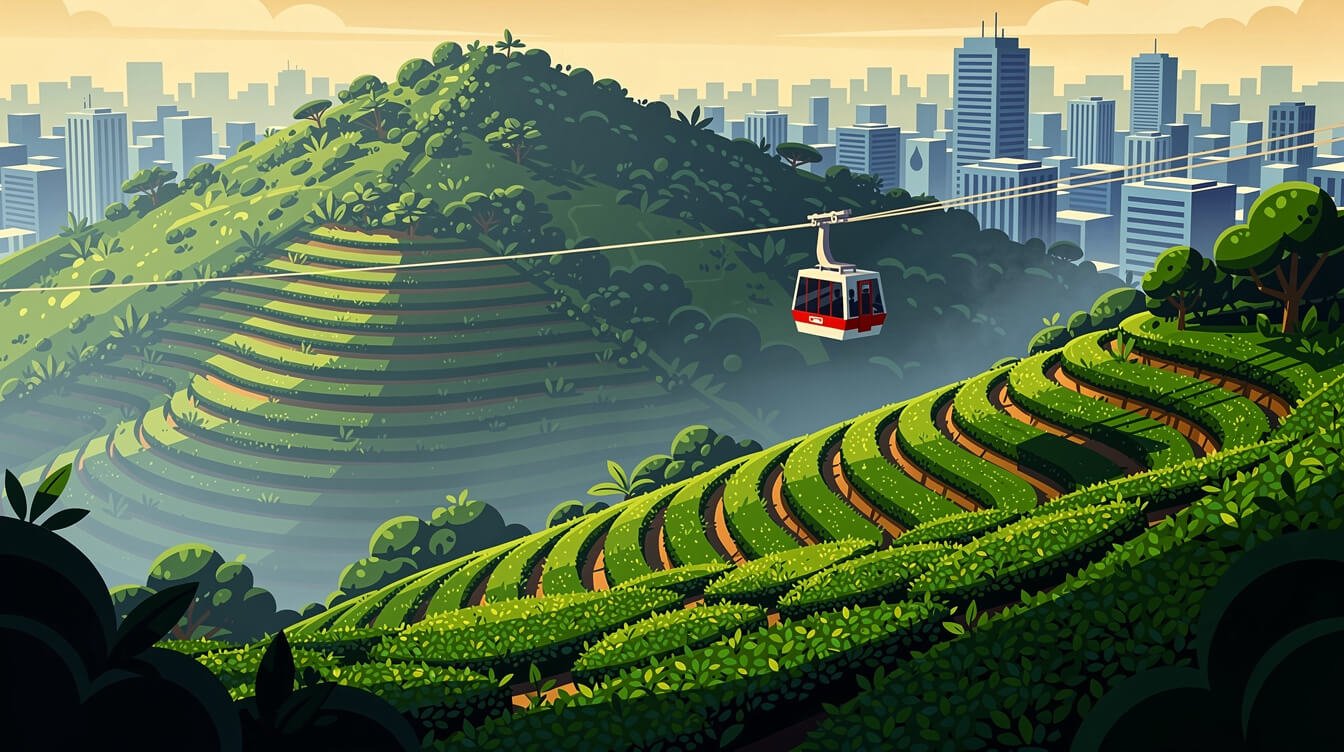
There is a mountain inside Taipei where the city simply stops. Ride the brown MRT line to its last stop, step into a cable car, and eight minutes later the traffic noise is gone and you are looking down on terraced tea bushes, a creek full of scoured stone bowls, and a basin of six million people laid out like a circuit board. That is Maokong Taipei — the capital’s last working tea mountain, still inside the city limits, still growing the tea it was famous for two hundred years ago.
Almost everything written about Maokong Taipei in English is a cable car guide. Fair enough: the gondola is the fun part. But the gondola has only existed since 2007, and the mountain has been making tea since the Qing dynasty. The result is that you can read three of the top-ranking pages on the internet and still not know what Muzha Tieguanyin actually is, why a teahouse hands you a kettle instead of a cup, why the teahouses are there at all, or what the name means. One of those pages will even tell you Maokong means “cat holes” — which is the one thing we can say with confidence it does not mean.
So here is the whole mountain: the geography, the tea, the linguistics, the gondola’s two lost years, how to order without embarrassing yourself, and when to go. Cats included, just not where you’d expect.
What and Where Is Maokong Taipei?
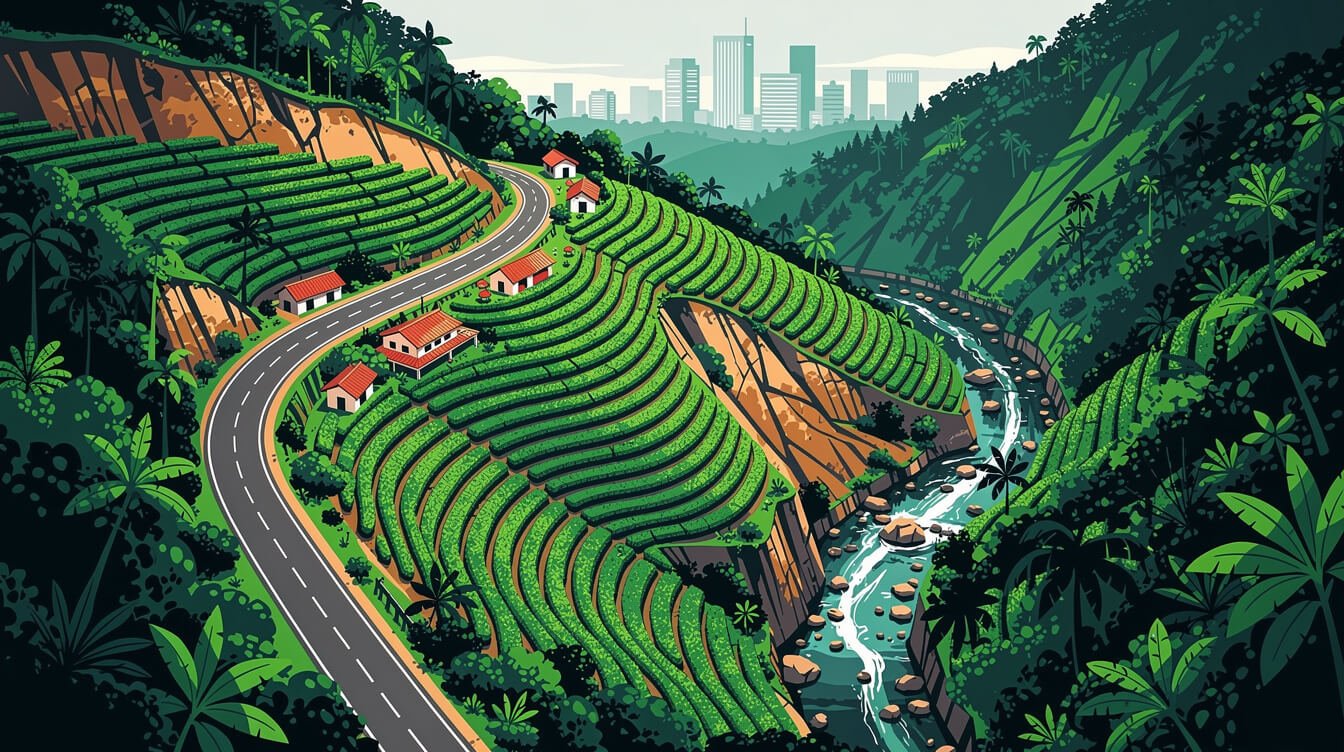
Maokong Taipei — 貓空 on the map — is a tea-growing district in Wenshan District, the green southern corner of the capital, spread across the ridges of the Erge Mountain system (二格山). Administratively you are still in the capital. Practically, you are in farmland: the valley holds one of the largest tea-producing areas the city has, and the slopes are stitched with tea terraces, single-lane roads and old stone footpaths.
The area most people mean when they say Maokong Taipei is the stretch of Zhinan Road Section 3 that runs along the ridge, plus the lanes branching off it. Taiwan’s tourism administration lists the sightseeing tea farms as clustering around Lanes 34, 38 and 40 of that road — which is a useful thing to know, because the good stuff is rarely on the main road. Walk ten minutes down a numbered lane and you will find a family operation with four tables and a better view than the place with the car park.
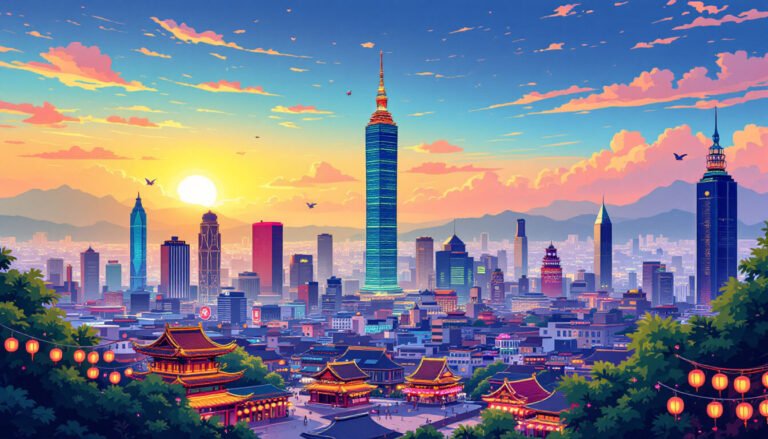
Maokong Taipei is genuinely close to the city. From Taipei 101 you are looking at well under an hour door to door. From the last stop on the Wenhu (brown) line you are looking at minutes. That proximity is the entire character of the place: this is not a remote highland tea region that takes a day to reach, it is a mountain that office workers go up on a Tuesday evening because the tea is good and the city looks better from above.
The elevation is modest — roughly 300 metres, nothing like the 1,000-metre-plus high-mountain estates — and that matters enormously for what grows here, which we will come to. If you are orienting yourself around the wider city first, our neighborhood-by-neighborhood guide to Taipei attractions puts Wenshan in context with everywhere else you might be going.
The Cat That Was Never There: What “Maokong” Actually Means
Here is the fun part, and the part page one of Google gets wrong.
貓 (māo) means cat in Mandarin. 空 (kōng) means empty or hollow. So English-language guides confidently translate 貓空 as “cat hollow” or “cat holes”, and some go further and explain that the hills were once full of civets. There are cat statues at the gondola station, cat-shaped cookies in the shops, and cat-faced tea soft-serve. The whole mountain leans into it.
The name is not about cats. It is a phonetic transcription, and the characters were chosen for their sound, not their meaning.
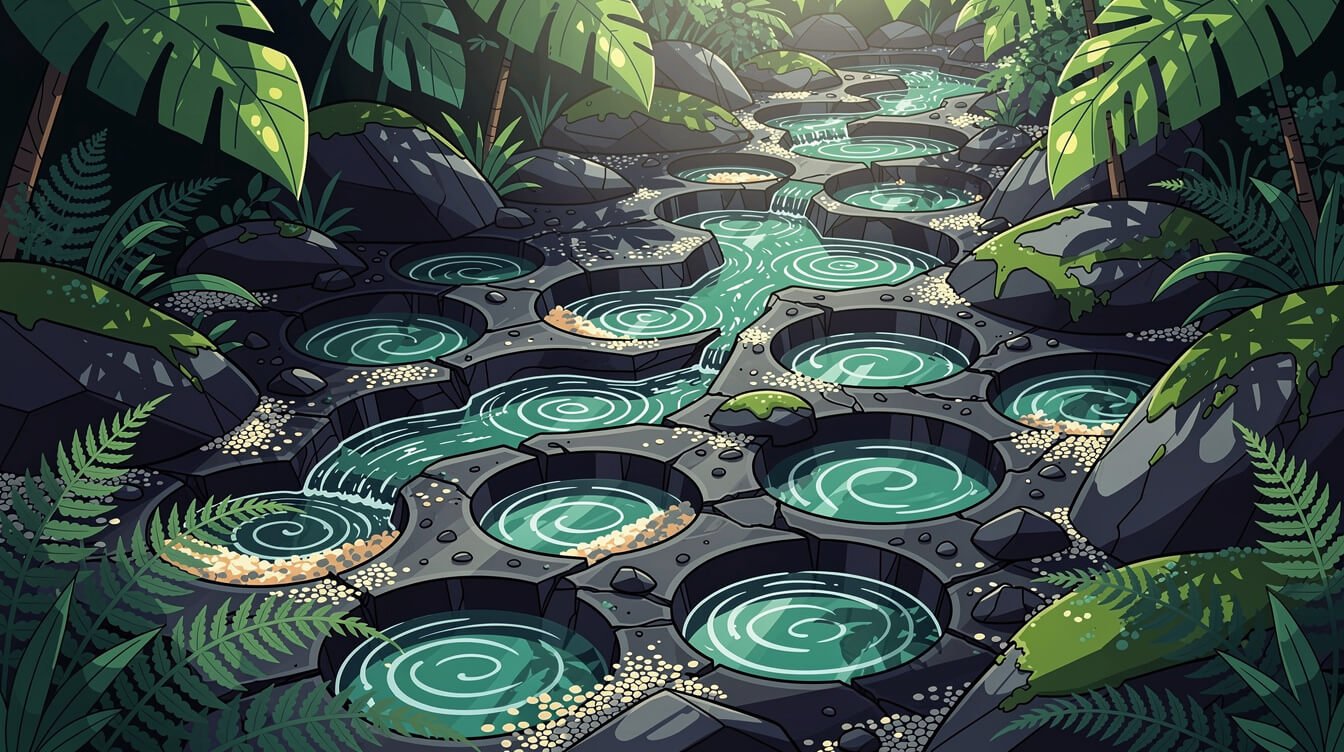
The mainstream explanation starts with the creek. Water carrying sand and grit swirls in a depression in the bedrock and grinds it into a smooth round bowl; do that for a few thousand years and you get a streambed pocked with them. Geologists call these potholes; in Chinese they are 壺穴, “kettle holes”. The Zhinan stream through Maokong has a spectacular set of them, and you can still walk to them today.
Taiwan’s own tourism administration puts it plainly: the formations “are called Lokang (wrinkled hole) in the Taiwanese language”, and “Japanese authorities during the colonial era gave it a similar-sounding name of Maokong.” The Chinese-language reference literature runs the same argument with more linguistic detail — that Taiwanese uses 眑 (niau) for a pitted, pockmarked surface, that 眑 and 貓 are homophones in one of Taiwanese’s two readings of the character, and that the pitted rock face therefore got written down with the cat character by accident of sound.
There is a respectable dissenting view. The Japanese-era cadastral maps record the place name pronounced Bâ-khang, and the historians Weng Chia-yin and Tsao Ming-tsung have argued that the pothole story is a stretch — that 貓 in Taiwanese is also read bâ, which is the word for the masked palm civet, and that Bâ-khang most likely meant the valley (khang) where the civets were. Their version at least gets you an animal.
Notice what both versions agree on, though. The characters 貓空 are a phonetic spelling of a Taiwanese-language place name — either “pitted rock” or “civet valley” — and in neither reading does anybody mean a house cat. The “cat” is an artifact of reading Taiwanese characters in Mandarin, roughly the way an English speaker might decide that Cannes has something to do with tin.
Which, if you sell cat-motif merchandise for a living, is our favourite kind of fact. The cats of Maokong Taipei are a pun the mountain made about itself and then decided to keep. Go and eat the cat cookie. Just know that the mountain was named for the holes in a creek.
Muzha Tieguanyin: The Tea That Made the Mountain
If you take one thing from this guide, take this: the tea grown in Maokong Taipei is not the tea most visitors think of when they think of Taiwanese oolong.
The famous Taiwanese oolongs — Alishan, Lishan, Shanlinxi — are high-mountain teas. They are lightly oxidised, barely roasted, and they taste green, creamy and floral. Maokong Taipei sits at about 300 metres, which by those standards is sea level. It cannot compete on altitude and it never tried to. It went the other way entirely.
Tieguanyin (鐵觀音)
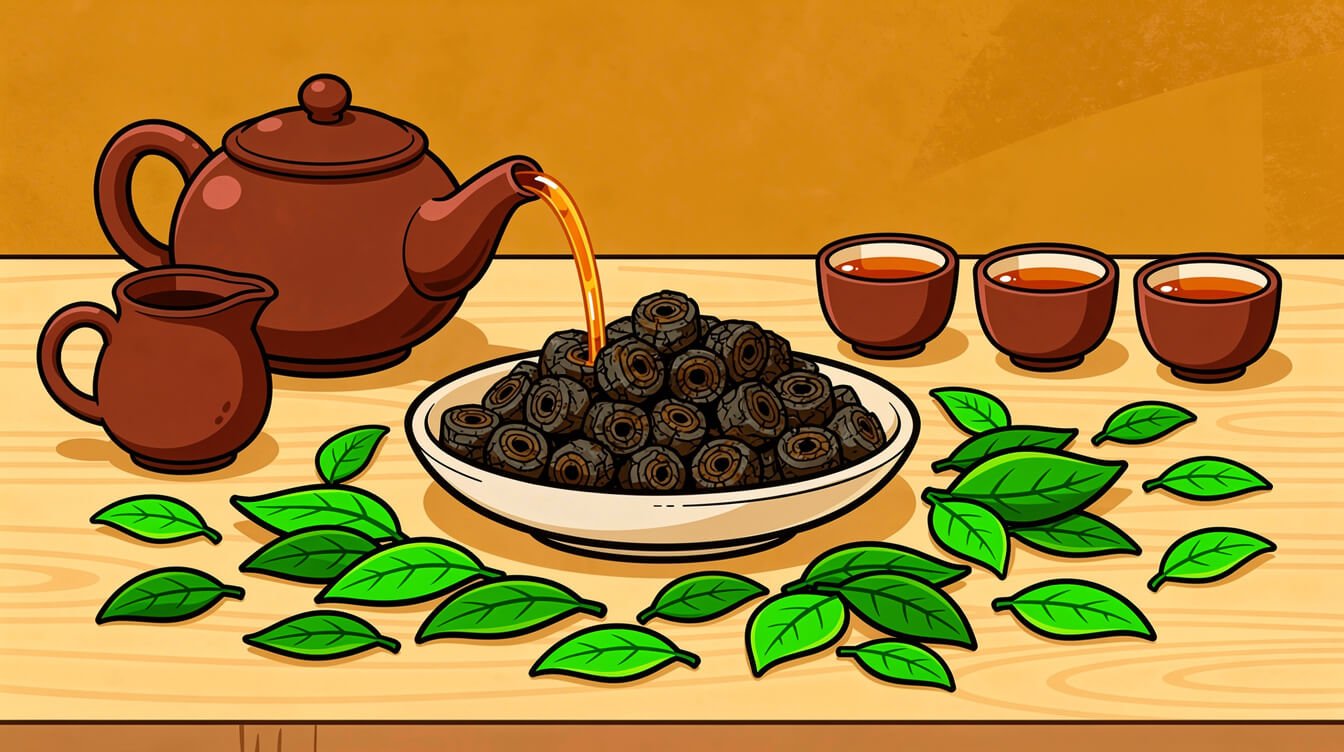
Muzha Tieguanyin — “Iron Goddess of Mercy” — is the signature. The leaves are oxidised much further than a high-mountain oolong, rolled into tight dark pellets, and then roasted over charcoal, repeatedly, over a long period. That roasting is the whole point. It drives off the green, grassy notes and replaces them with something closer to baked stone fruit, toasted grain, caramelised sugar and a dry mineral finish. A good one has a sourness underneath the roast that the Chinese tea vocabulary calls 觀音韻 — the “Guanyin rhyme” — and it is what separates a real one from a merely dark one.
There is a distinction worth learning before you buy. 正欉鐵觀音 (zhèngcóng, “true bush”) means the tea was made from the actual Tieguanyin cultivar, a famously stubborn, low-yielding plant. Plenty of tea sold as Tieguanyin is Tieguanyin processing applied to a more cooperative cultivar. Both can be good; only one is expensive for a reason. Ask which you are drinking — the question alone will change how the shop talks to you.
Wenshan Baozhong (文山包種)
The district’s other classic is the opposite in every respect: barely oxidised, not rolled into balls but left in loose twisted strips, unroasted, and intensely floral — lilac, orchid, fresh cut grass. Baozhong is the lightest thing in the oolong family, closer to a green tea than to Tieguanyin, and Wenshan is its heartland. Order both in the same sitting and you will learn more about oxidation in twenty minutes than from any amount of reading.
Harvest runs in the familiar Taiwanese rhythm — a spring pick and a winter pick are the ones connoisseurs chase, with summer leaf generally destined for heavier roasting. If you want the full family tree of what Taiwan grows and why, we have a complete guide to Taiwanese tea, and a dedicated oolong buying guide for when you are standing in front of a wall of tins with no idea what to do.
One free stop worth building in: the Taipei Tea Promotion Center for Tieguanyin and Baozhong Tea, run by the Liu-Kung Agricultural Foundation. It has a display area walking through how the leaf is processed, stored and brewed, an outdoor instructional garden and an ecological pond. It is the only place on the mountain that will teach you the tea rather than sell it to you.
How a Working Tea Farm Became Taipei’s Teahouse District
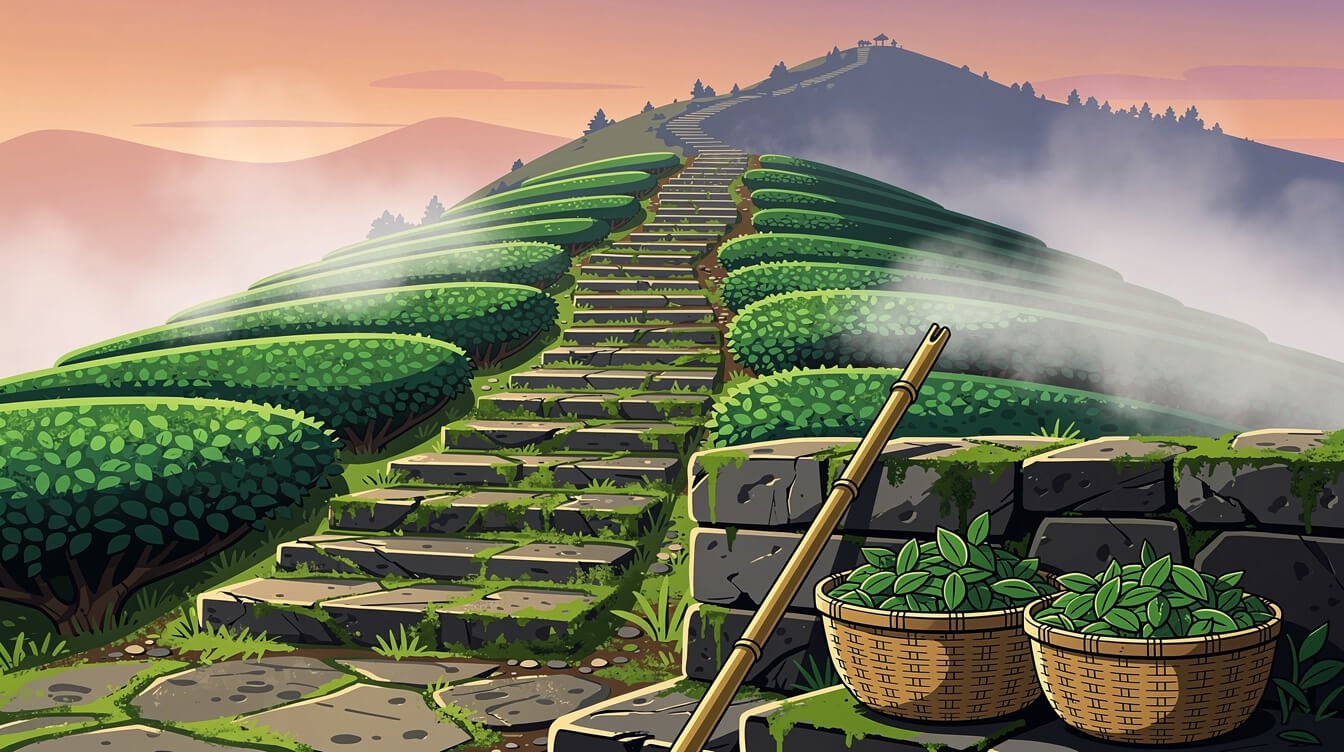
Tea did not come to Maokong Taipei for tourists. It came because the slopes, the acidic soil and the near-permanent mist suited the plant, and because Taipei was a port. The old stone footpaths threading the ridges — the 古道, literally “ancient ways” — were not scenic trails. They were freight infrastructure, cut so that porters could carry the harvest down the mountain on shoulder poles to where it could be sold and shipped.
So how did a working agricultural district end up covered in teahouses with fairy lights and menus?
The answer sits at the bottom of the hill, and no English-language guide seems to mention it. National Chengchi University is Maokong’s immediate neighbour. Taiwan’s tourism administration credits the university’s proximity directly: students went up the mountain in the evenings, and that steady flow of young people with time and a bit of money turned into what it calls the district’s “very special brand of tea tourism”. Farmers who had been selling leaf wholesale realised they could sell brewed tea, then tea with food, then tea with food and a view, to people who were going to come anyway.
From the 1980s onward the city formalised it, and the working farms became 觀光茶園 — sightseeing tea gardens, licensed to host visitors. Many families kept farming and added a kitchen. Others gave up the leaf entirely and went into country cooking, raising mountain chicken, or running a café. That is why Maokong Taipei feels like a farm district wearing a restaurant district’s clothes: because that is exactly what happened to it, within living memory, driven by undergraduates looking for somewhere to go at night.
It also explains the hours. Maokong Taipei is one of the few genuinely late-night destinations in Taipei that isn’t a night market — there is a teahouse up here that never closes — and that habit was set by students, not tourists.
Riding the Maokong Gondola: Tickets, Timing, and the Two Years It Didn’t Run
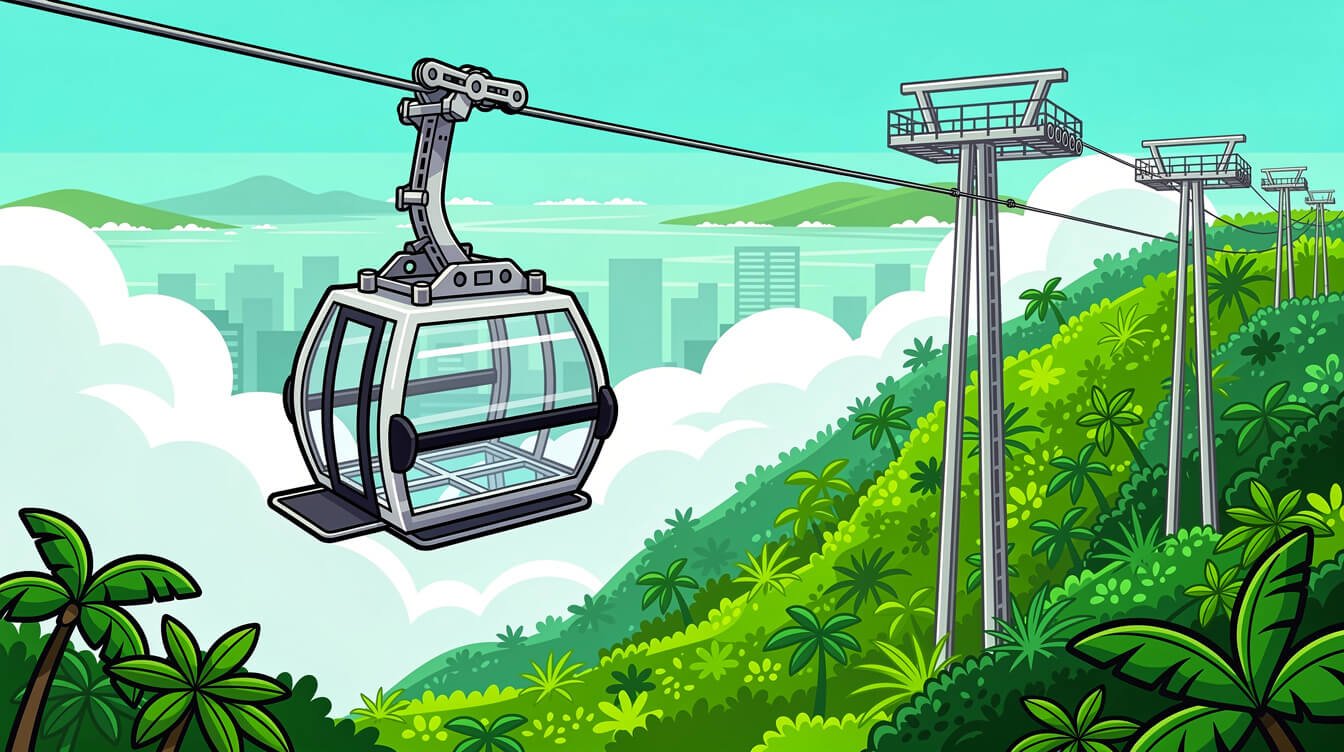
The Maokong Gondola opened on 4 July 2007, Taiwan’s first cable car built purely to carry sightseers rather than skiers, running 4.03 kilometres from the edge of the city up over the ridge. It has four stations:
- Taipei Zoo Station — a short walk from Taipei Zoo MRT on the brown Wenhu line. This is where you get on.
- Taipei Zoo South Station — inside the zoo’s grounds; only useful if you are combining the two.
- Zhinan Temple Station — the stop for the temple complex, and the best place to start if you want to walk the last stretch to Maokong on foot.
- Maokong Station — the top, with a visitor information centre that hands out a teahouse map, a convenience store and toilets. Everything in this guide is a walk from here.
Some cabins are the standard type and some are Crystal Cabins with a transparent glass floor, which are worth queueing the extra time for if you are remotely interested in looking straight down at a forest canopy from a hundred metres up. The full-route fare is modest — on the order of NT$120 end to end, with shorter hops cheaper — and you tap in with an EasyCard exactly as you would on the MRT, which is by far the easiest way to pay.
The part nobody tells you
For about eighteen months, this cable car did not exist as a functioning thing.
In late September 2008, Typhoon Jangmi tore across northern Taiwan and the slope under tower 16 gave way — the foundation was seriously eroded by the storm. The line was suspended on 1 October 2008. It did not carry passengers again until 26 March 2010, after the tower was relocated and the slopes reinforced. Eighteen months of closure, on a system barely a year old.
That history is the reason the operation is conservative today, and it is genuinely useful for planning. The gondola shuts for high wind, lightning and heavy rain, and it does so readily. If a typhoon is anywhere near the island, assume the cable car is not running — our typhoon season guide covers what actually closes and when. There is also a regular Monday maintenance closure (typically waived when the Monday is a public holiday, in which case the closure shifts).
Opening hours run from mid-morning to late evening and stretch later on Fridays, weekends and holidays, but they shift often enough that the only sane advice is to check the operator’s own page the morning you go. We could not reach the official gondola site while writing this, so the specifics above are drawn from the tourism administration’s and the reference literature’s accounts rather than from the operator’s live timetable — treat the times as shape, not gospel, and the fare as approximate.
If the gondola is closed, the mountain is not. City buses climb Zhinan Road to Maokong from the Taipei Zoo MRT area, and a taxi from the MRT station is a genuinely short ride. Plenty of locals never take the cable car at all. Our Taipei MRT guide covers getting to the brown line from wherever you are staying, and we wrote a short piece on the gondola itself a few months back if you want the cable car story on its own.
How to Actually Order Tea at a Maokong Teahouse

This is where first-time visitors get stuck, and it is the single most useful thing in this guide.
At a traditional Maokong teahouse, you do not order a cup of tea. You order leaves, and then you make the tea yourself.
Here is the shape of it. You sit down — often at a low table on a terrace — and choose a tea from the list, usually priced by weight or as a portion for one or two people. The staff bring you the dry leaf, a small clay or porcelain pot, a fairness pitcher, a set of tiny cups, and a thermos or a kettle on a burner. From then on you are the one brewing: rinse the leaves, short steeps, pour out completely each time, top the kettle up as you go. Nobody hovers. Nobody brings a bill until you ask.
A few practical notes:
- There is usually a water or table charge (茶水費) on top of the leaf, often per person. This is normal and not a scam — you are renting the table and the view for as long as you like.
- Some places have a minimum spend, particularly the ones with the best night views. Two people ordering one small portion of tea may be asked to add a snack.
- Smaller parties should look for per-person sets. Several teahouses do an individual or couple’s set — roughly NT$200–350 a head at the time of writing — which is the friendliest option if there are only one or two of you and you don’t want half a jin of leaf.
- Refills of hot water are free and expected. A good oolong gives you six, eight, ten infusions. Running out of water is not the end of the session; it is the middle of it.
- There is no time limit. People sit for three hours. This is the intended use.
Then there is the food. Maokong invented its own cuisine category — tea meals (茶餐), where the leaf goes into the cooking rather than the cup. Expect tea-oil noodles, fried rice studded with Tieguanyin leaf, tea-smoked chicken, tempura-fried tea leaves that eat like a crisp, and tea-leaf omelette. The tea soft-serve is everywhere and genuinely good. If you want the broader map of what Taiwan drinks and why, our guide to Taiwanese drinks runs from this kind of tea all the way to the stuff in a plastic cup with pearls in it.
And if you come home converted — which happens — you will want something to brew it in that isn’t a mug from the office kitchen. Our Taiwan Cultural Mosaic Pattern Mug has survived a great deal of morning oolong in our own kitchen, which is the only product test we really trust.
Trails, Night Views, and the Best Time to Visit Maokong Taipei
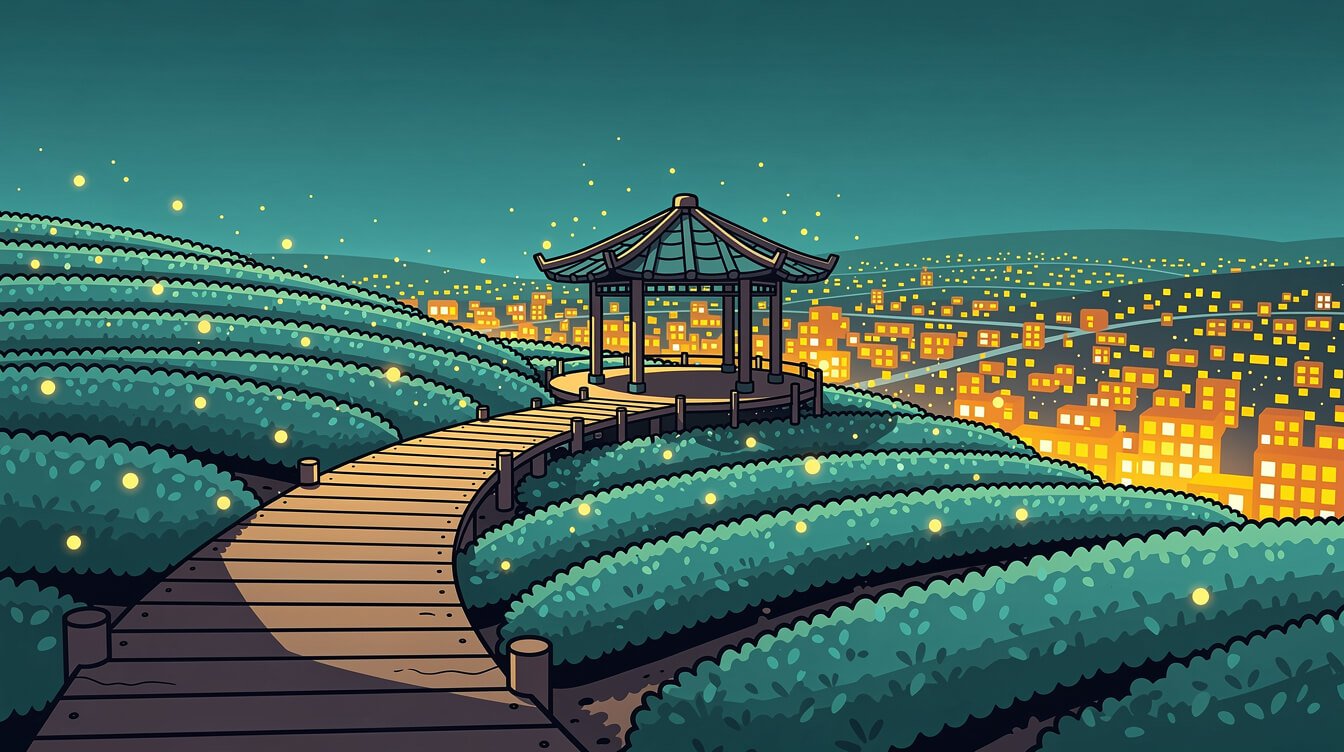
Maokong Taipei is small enough to walk and steep enough that walking it feels like something. Three routes cover most of what people come for.
The Camphor Tree Trail (樟樹步道)
The easy one, and the one to do at dusk. A broad, largely flat path loops through open tea terraces with the whole Taipei basin on one side, passing the Caiyun Pavilion and a scattering of restored farm structures. It is pushchair-friendly in most sections, it takes under an hour at a stroll, and it is where the classic Maokong photograph comes from. In late spring — roughly April into May — this is also firefly country, and the tea terraces after dark fill up with drifting points of light. Bring a red-filtered torch or none at all; white light ruins it for everyone.
The creek trail and the potholes
The path that runs down beside the stream from near the tea promotion centre follows the water past small falls and — pay attention here — the actual 貓空壺穴, the pothole formations the whole mountain is named after. It is a short, shaded, slightly scrambly walk and almost nobody does it, which tells you how little the naming story has penetrated. Go and stand in the thing the place is called after. It costs nothing.
Zhinan Temple (指南宮)
A large, ornate Taoist temple complex on the ridge below Maokong, reachable by its own gondola station or by a long stone staircase of well over a thousand steps from the road below. It is a serious piece of religious architecture with a century of history and a famous piece of local lore attached: couples are traditionally warned off visiting together, on the grounds that the resident deity Lü Dongbin takes a dim view of romantic happiness. Treat it as folklore, not a forecast. For temple etiquette generally, our Longshan Temple guide covers how to behave in an active place of worship.
When to go
Time of day matters more than season. The single best window is arriving about ninety minutes before sunset: you get the tea terraces in daylight, the sunset from a terrace, and then the city switching on below you. That is the whole experience in one sitting, and it is why the teahouses run so late.
Season-wise: spring gives you the harvest and the fireflies, and the most mist. Autumn is the most reliably clear — best odds of an actual view. Winter is cold, damp and atmospheric, and a charcoal-roasted Tieguanyin tastes better in it than at any other time of year; our Taiwan in December guide has more on the northern winter. Summer is hot, humid and the peak of typhoon risk, so keep the plan flexible.
Weekends and public holiday afternoons produce genuine gondola queues of an hour or more. Weekday evenings are close to empty. If you have any flexibility at all, use it there — it is the difference between an hour in a ticket line and walking straight on. For fitting it into a wider itinerary, our things to do in Taipei guide has the rest of the city mapped out.
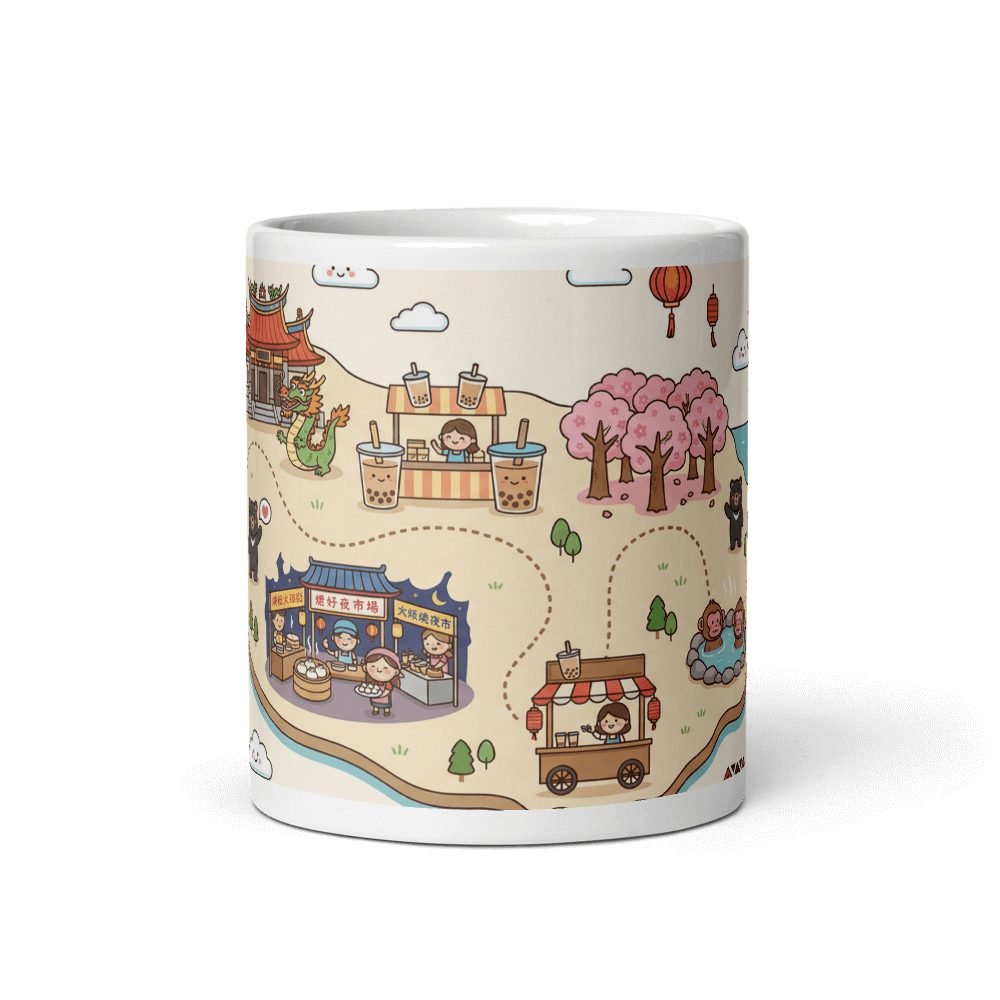
Drink Your Oolong Out of the Island Itself
The Taiwan Illustrated Treasure Map Mug — every corner of the island drawn out in one hand-illustrated design, sized for the kind of long, unhurried brew they’d approve of up on the tea mountain.
Maokong Taipei FAQ
Is Maokong worth visiting?
Yes, with one condition: go for the tea and the evening, not for a checklist attraction. If you treat Maokong Taipei as a cable car ride, you will be up and down in ninety minutes and mildly underwhelmed. If you treat it as an evening — ride up late afternoon, walk the Camphor Tree Trail, sit down at a teahouse and brew for two hours while the city lights come on — it is one of the best things Taipei offers, and it costs almost nothing.
How much is the Maokong Gondola?
The full end-to-end fare is in the region of NT$120, with shorter single-section hops costing less, and you can tap through with an EasyCard. Concession rates apply for children and seniors. Because fares and passes do get revised, check the operator’s page before you travel rather than trusting any guide, including this one.
How long does the gondola ride take?
Roughly 20 to 30 minutes for the full 4.03-kilometre run from Taipei Zoo Station to Maokong Station, depending on line speed and whether you stop off. The single hop from Zhinan Temple Station to the top is only a few minutes.
Should I do Taipei Zoo or the gondola first?
Zoo first, gondola second — and it is not close. The zoo is an all-day walk best done in the morning while it is cooler, and the gondola’s whole payoff is the late-afternoon-into-night sequence at the top. Doing it the other way round means riding back down in the dark having seen the best part too early, or rushing the tea.
Is the Maokong Gondola open on Mondays?
Usually not — Monday is the standard maintenance closure, though it is normally waived when that Monday falls on a public holiday, with the closure moved to another day. The mountain itself is always open: buses and taxis run up Zhinan Road regardless, so a Monday visit is perfectly possible without the cable car.
What happens if it rains?
Light rain is fine and arguably better — mist through tea terraces is the local aesthetic, and the teahouses are covered. High wind, thunderstorms and typhoon conditions will stop the gondola, so have the bus plan ready in storm season.
Do I need to book a teahouse?
Not for most places on a weekday. For a specific terrace table with a view on a Friday or Saturday night, calling ahead is worth it — the good tables go first and Taipei knows it.
How long should I spend in Maokong Taipei?
Four hours is the sweet spot: an hour of travel and queueing, an hour walking a trail, and two hours sitting still with a pot of tea. You can do it in two hours. You will not enjoy it as much.
Final Thoughts: A Mountain Named After Holes in a Creek
Maokong Taipei is a strange survival. It is a functioning agricultural district that never left the capital, growing a tea that deliberately went the opposite direction from everything fashionable in Taiwanese oolong — down in altitude, up in roast — and turning itself into a nightlife destination because the university at the bottom of the hill kept sending students up it.
And it is named, almost certainly, after the holes that water and grit ground into a streambed, transcribed into a cat by two languages passing each other in the dark. The mountain found out, shrugged, and started selling cat-shaped cookies anyway. That is an extremely Taiwanese response to a linguistic accident, and it is why we like the place.
So go up in the late afternoon. Find a lane with a number on it. Order something charcoal-roasted, take the kettle, and stop checking your phone for a couple of hours while a city of six million switches its lights on underneath you. Then walk down to the creek and look at the potholes, because you will be one of the very few visitors who knows what they are.
A Postcard From Taiwan, Every Week
Culture stories, food deep-dives, travel tips, and first looks at new designs — straight to your inbox. No spam, just Taiwan.

Grab a Free Taiwan Sticker!
Drop your email and we’ll send you a limited-edition Taiwan sticker — plus insider access to new merch drops and island vibes.
No spam. Unsubscribe anytime.