Taiwan Traditional Clothing: The Complete Guide to What the Island Actually Wore
Search for Taiwan traditional clothing and you’ll get a mess: stock photos of Chinese qipao, a Pinterest board of Japanese kimono, and at least one article confidently listing garments from ethnic groups that have never lived on the island. It’s one of the most misinformed corners of the internet about Taiwan — and it’s a shame, because the real answer is far more interesting than the fake one.
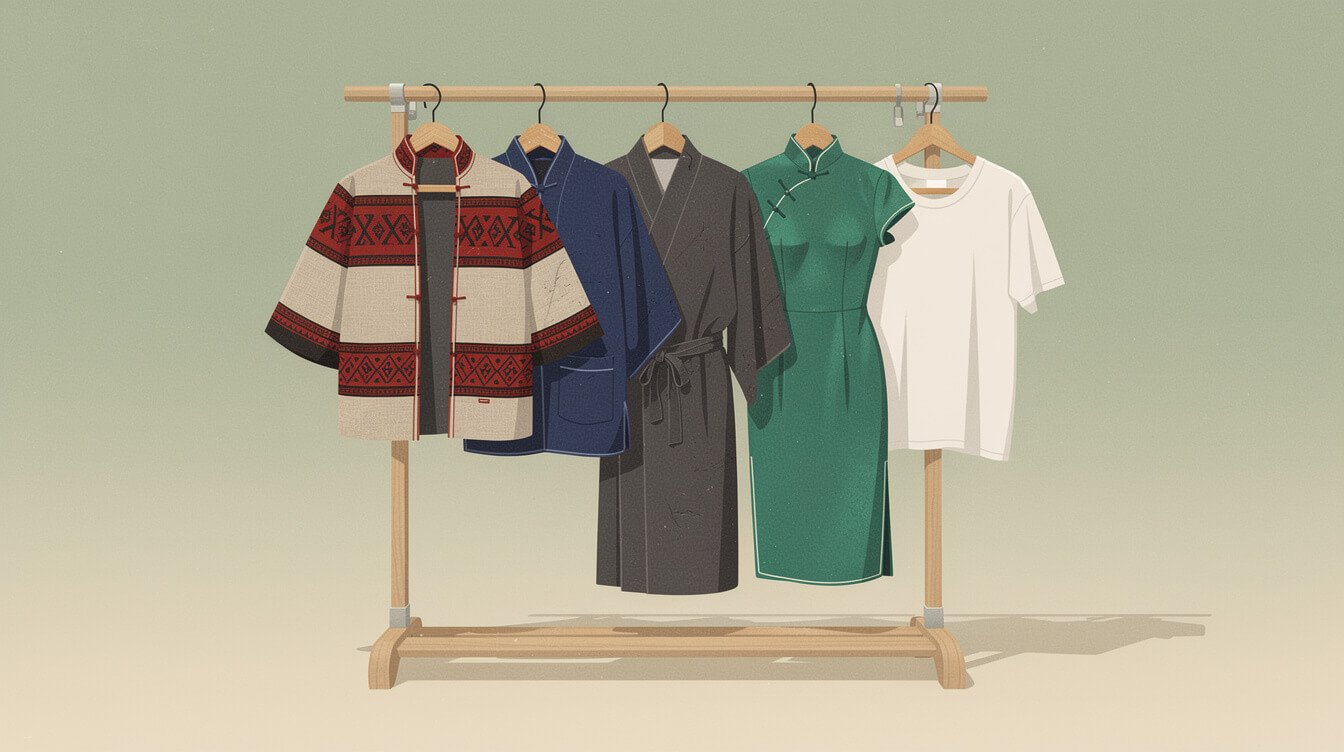
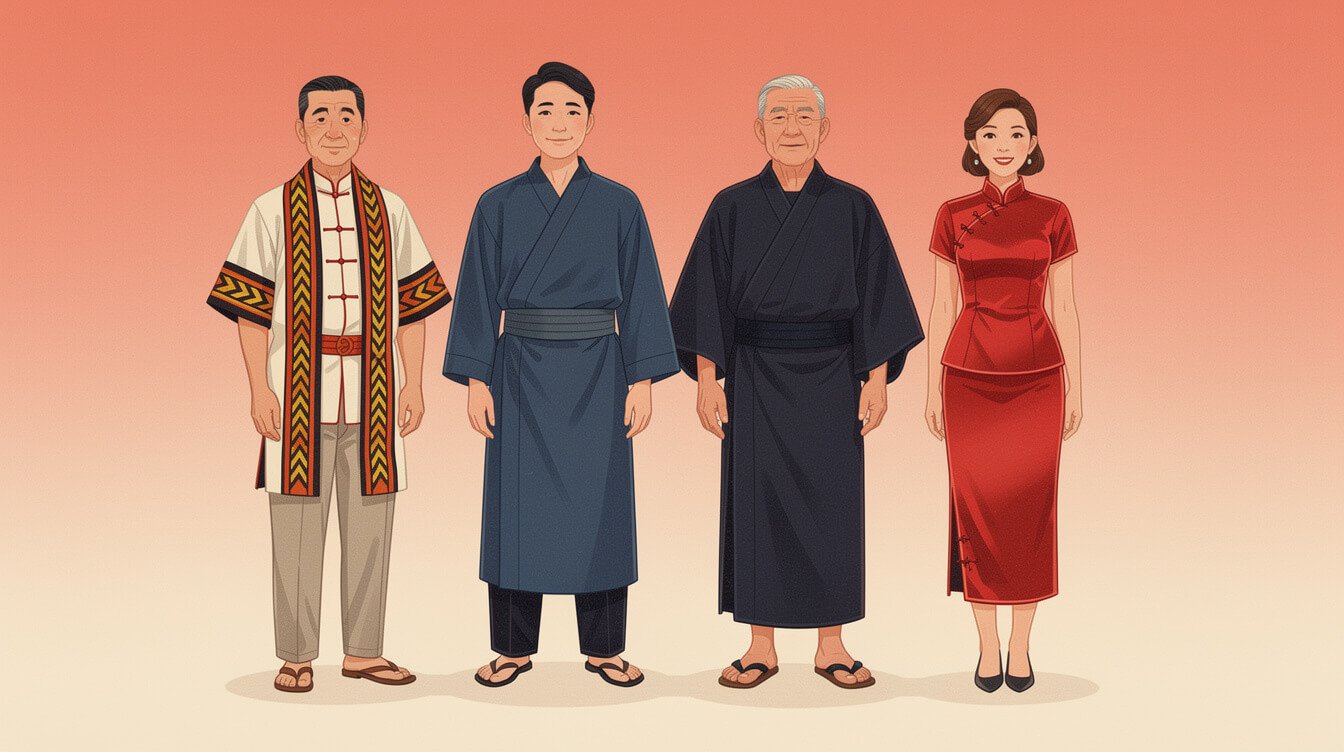
Here’s the honest version. Taiwan has no single national costume. What it has instead is a wardrobe stacked in layers: Austronesian weaving traditions that predate every written record on the island, Hoklo and Hakka farming clothes carried across the strait from Fujian and Guangdong, fifty years of Japanese rule that put yukata and Western suits on the same street, and a Shanghai silhouette that arrived by ship in 1949 and became the island’s formal dress by default.
This guide walks through all of it — what each garment actually is, who wore it and why, what the internet keeps getting wrong, and where you can see, rent, or respectfully wear these clothes in Taiwan today. By the end you’ll be able to look at a photo of a Taiwanese festival and name what you’re looking at.
Why Taiwan Traditional Clothing Isn’t One Outfit
Most countries with a famous national dress got one the same way: a long stretch of political continuity, plus a moment when somebody decided to standardise it. Japan had centuries to converge on the kimono. Korea codified the hanbok. Taiwan never got that stretch of continuity — the island changed hands roughly every two generations for four hundred years.
Run the timeline and you can see the problem. Austronesian peoples had been weaving here for thousands of years before anyone else showed up. The Dutch ran a trading colony at Tainan from 1624. Koxinga pushed them out in 1662. The Qing empire annexed the island in 1683 and spent two centuries treating it as a frontier for Hoklo and Hakka settlers. Japan took it as a colony in 1895 and held it until 1945. The Republic of China government relocated here in 1949 with two million mainland refugees and a very different idea of what “proper” clothing looked like.
Every one of those regimes brought a wardrobe. None of them lasted long enough to erase the one before. So instead of a single garment, Taiwan traditional clothing is a stack — and the whole stack is still visible if you know where to look. You’ll see indigenous regalia at harvest festivals in Hualien, Hakka blue tunics in the Meinong countryside, Japanese-era architecture full of people renting yukata for photos, and qipao on grandmothers at Lunar New Year.
That layering isn’t a failure to have a culture. It is the culture. The same instinct that produced this wardrobe produced Taiwanese street food, a cuisine that absorbed Fujianese, Hakka, Japanese, and Cantonese cooking and turned the result into something nobody else makes.
Indigenous Regalia: Sixteen Peoples, Sixteen Wardrobes
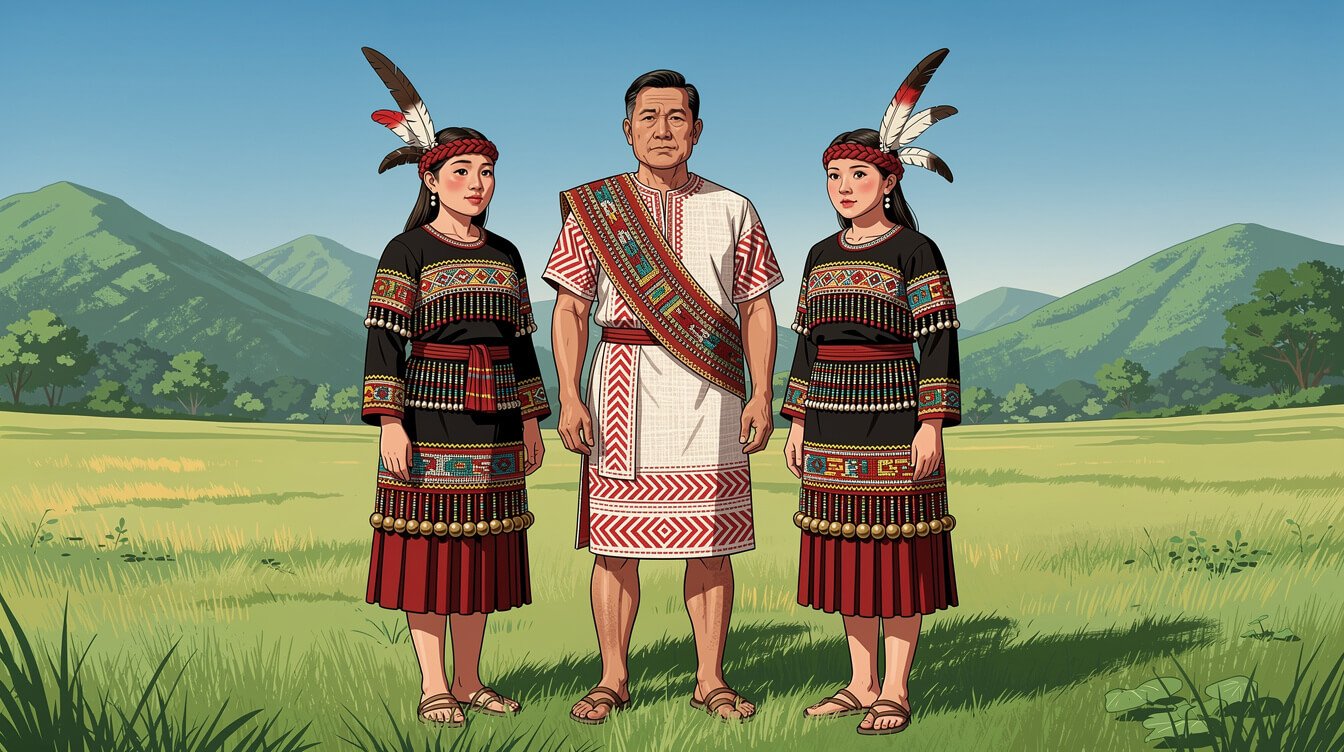
Start at the bottom of the stack, because this is the layer that’s genuinely, exclusively Taiwanese. Taiwan’s indigenous peoples are Austronesian — linguists broadly agree the island is the origin point of the Austronesian language family that eventually reached Madagascar, Hawai’i, and New Zealand. Sixteen peoples are officially recognised today, the most recent two (the Hla’alua and Kanakanavu) gaining recognition in 2014. Together they number more than half a million people, roughly 2.5 percent of Taiwan’s population.
Sixteen peoples means sixteen distinct clothing traditions, not one generic “tribal” look. If any single thread in Taiwan traditional clothing deserves to be called native, it’s this one. A few of the most visually distinctive:
Atayal — the weavers of the north
Atayal cloth is made from ramie, a nettle-family plant that has to be stripped, split, boiled, dyed, sun-dried, and spun before it ever touches a loom. The classic result is a white ground crossed with dense red bands. Weaving wasn’t a hobby; it was a qualification. An Atayal woman’s facial tattoo — the horizontal bands across the cheeks — was earned, and weaving skill was the thing that earned it. Men earned theirs through hunting.
Amis (Pangcah) — red, black, and bells
The largest indigenous group, concentrated along the east coast. Amis ceremonial dress runs to deep red and black with dense glass-bead panels, and it’s built to be heard as well as seen: small brass bells sewn at the hem turn a line of dancers into a percussion section. You’ll see it at Ilisin, the harvest festival held across east-coast communities in July and August.
Paiwan and Rukai — clothing as a class system
In the south, dress was legally and socially restricted. Paiwan and Rukai societies were stratified, and certain motifs were the property of noble houses: the hundred-pace viper, the sun, the human figure. A commoner wearing a chief’s motif wasn’t making a fashion choice, they were making a claim. Ancient glass beads (qata) functioned as heirloom wealth and bride price, and Rukai men who had taken a boar — and women recognised for their standing — earned the right to wear lily blossoms in their headdress.
Bunun — leather, herringbone, and a red shirt you had to earn
Bunun clothing in the central mountains used hides from Taiwan serow, sambar deer, and Reeves’s muntjac alongside handspun ramie, typically a white ground with red, yellow, and purple or red, yellow, and white. The herringbone pattern is a signature. And there’s a detail Yushan National Park’s own archives preserve: a red undershirt worn by a Bunun man wasn’t decorative. It marked a man who had taken a boar, a deer, or a head. Weaving, meanwhile, was a Bunun woman’s marriage prerequisite — a girl who couldn’t weave struggled to find a match.
Tao — Orchid Island’s silver helmets
The Tao of Lanyu (Orchid Island) sit apart from the mainland-Taiwan groups in almost every respect, including dress. Men’s traditional clothing was minimal and built for the sea, and the ceremonial standout is a beaten silver helmet worn during boat launches and flying-fish season rituals — an object with no parallel anywhere else on the island.
The correction the internet needs: a widely-shared “guide to Taiwanese clothing” currently ranking at the top of Google lists a Miao men’s jacket as indigenous Taiwanese dress. The Miao (Hmong) are a mainland Chinese ethnic group. They are not one of Taiwan’s sixteen recognised peoples and never have been. If a page tells you otherwise, close the tab.
One more layer worth knowing: the Pingpu, or plains indigenous peoples, including the Siraya around Tainan. Largely assimilated during the Qing period, they spent decades without legal recognition. In 2022 Taiwan’s Constitutional Court ruled that plains groups are entitled to indigenous status, and the legislative follow-through is still working its way through. Their clothing traditions survive mainly through museum collections and community revival projects, and you’ll find traces of that history woven through Tainan, the island’s oldest city.
Han Settler Dress: The Hakka Blue Shirt and the Floral Fabric Myth
The second layer of Taiwan traditional clothing arrived by boat. From the 1600s onward, Hoklo settlers from southern Fujian and Hakka settlers from Guangdong crossed the strait in large numbers. They didn’t bring court robes; they brought working clothes. The everyday Qing-era outfit for both men and women was some version of shan-ku (衫褲) — a side-fastening jacket over loose trousers, cut wide, made of cotton or ramie, fastened with hand-knotted cloth buttons rather than anything metal.
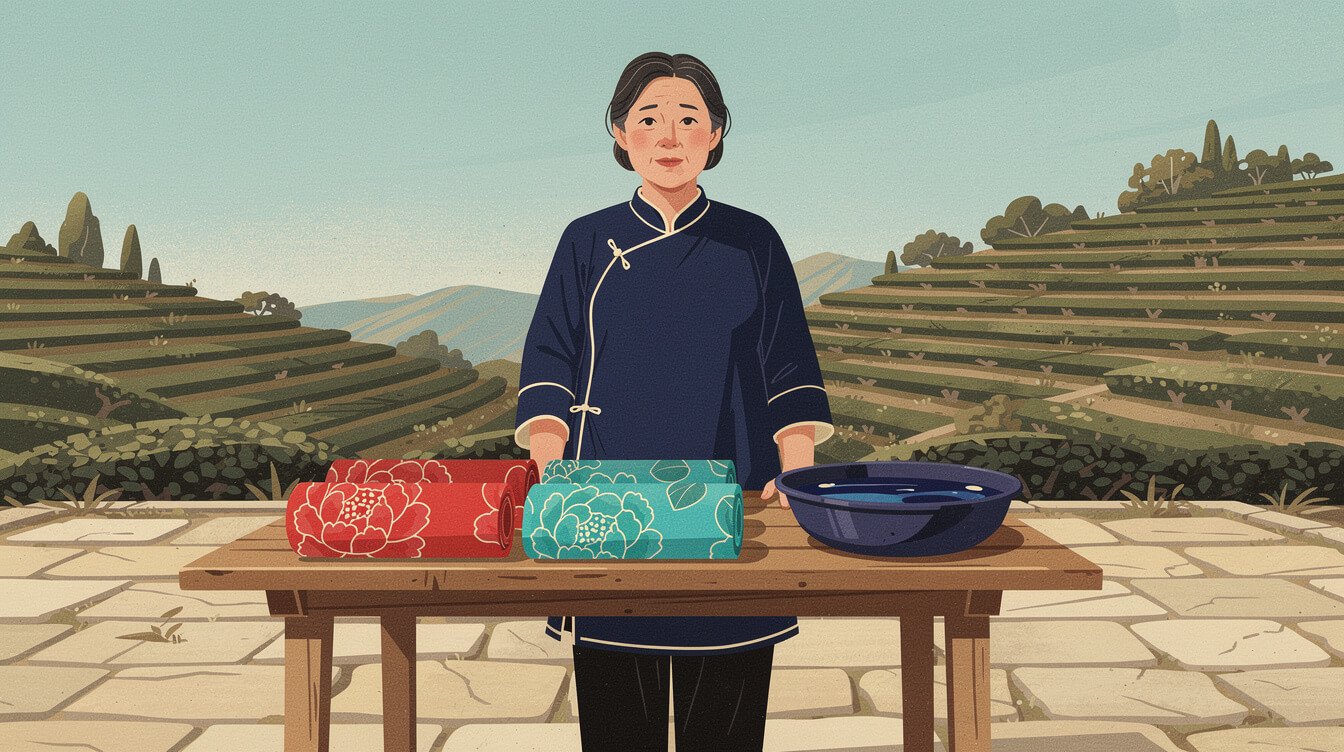
The Hakka version has a name and a following: the lan shan (藍衫), the indigo blue tunic. It’s long, side-fastening, cut generously through the body, and dyed with indigo grown and processed locally — a colour that hides field dirt and holds up to river washing. The sleeves are the clever part. Wide and turned back at the cuff, they doubled as pockets: a Hakka farm woman could carry seeds, coins, or a snack in her sleeve and keep both hands free. It’s a garment designed by people who worked, and it reads as unmistakably Hakka to this day.
Now the myth. Ask most people to picture “Hakka fabric” and they’ll describe the loud red-and-turquoise cotton covered in oversized peonies you see on tote bags, aprons, and souvenir cushions all over Hsinchu and Miaoli. It’s marketed as Hakka floral cloth (客家花布), and it is genuinely beloved — but it isn’t an ancient Hakka textile. The big-peony print entered Taiwan through Japanese-influenced textile manufacturing in the mid-20th century, showed up in ordinary households across the island as quilt covers and curtains, and only got rebranded as specifically Hakka in the 2000s through cultural tourism campaigns.
That doesn’t make it fake. Traditions get invented all the time, and a fifty-year-old tradition that a community has genuinely adopted is still a tradition. It just means the honest caption is “20th-century Hakka design icon,” not “ancient Hakka weaving.” Historically, actual Hakka dress was overwhelmingly plain indigo — the exact opposite of the print that now represents it.
Hoklo dress followed a similar arc, with more variation by class. Wealthy merchant families in ports like Lukang and Tainan wore silk changshan robes and, for women, embroidered jackets over pleated skirts. Farming families wore the same cotton shan-ku year after year, patched until they fell apart. The formalwear survived in photographs and family albums; the workwear mostly didn’t, which is a big reason the internet’s picture of Taiwan traditional clothing skews so aristocratic.
The Japanese Era: When Taiwan Wore Three Wardrobes at Once
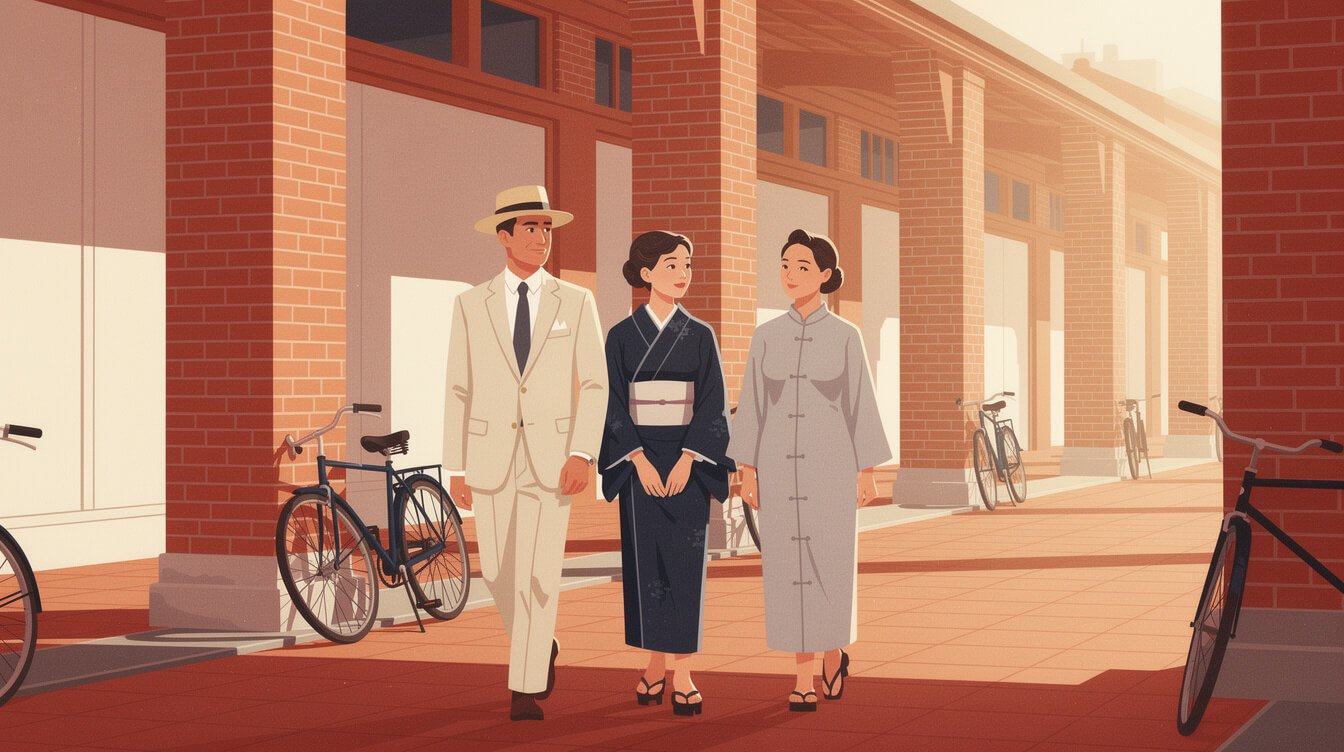
Japan governed Taiwan from 1895 to 1945, and clothing is where you can see the colonial period most clearly — it’s also the layer of Taiwan traditional clothing that visitors most often mistake for something imported yesterday. Photographs of 1930s Taipei show something genuinely strange to modern eyes: three completely different dress codes sharing the same red-brick arcade. A businessman in a white linen Western suit and straw boater. A young woman in a navy yukata and geta. Her friend in a grey side-fastening changshan. Nobody in the frame finds this odd.
The pattern followed function, roughly. Western suits signalled modernity, education, and professional standing, and they became standard for men in offices, schools, and government. Japanese dress spread through schools, public ceremonies, and the growing hot-spring and leisure culture — which is why so many of Taiwan’s Japanese-era resort towns still run kimono rentals today. Chinese-style dress stayed dominant for older generations, temple occasions, and family rituals.
Then it hardened. From 1937, the kōminka “imperialisation” campaign pushed Japanese language, names, and dress much more aggressively as Japan geared up for war. Wartime austerity put women across the island into monpe — baggy work trousers gathered at the ankle, practical and unglamorous. Two generations grew up with Japanese clothing as an ordinary part of daily life, which is a large part of why the Japanese aesthetic still sits so comfortably in Taiwanese design today. You can read the same influence in Wufenpu, Taipei’s thousand-stall wholesale fashion maze, where Japanese street styles arrive and get remixed faster than almost anywhere in Asia.
When the war ended in 1945, Japanese dress didn’t vanish — it retreated to leisure and nostalgia. Which is exactly where you’ll find it now: in the Beitou hot spring valley, in Jiufen’s lantern-lit lanes, in restored Japanese wooden houses that rent yukata by the hour.
The Qipao: How a Shanghai Silhouette Became Taiwan’s Formal Dress
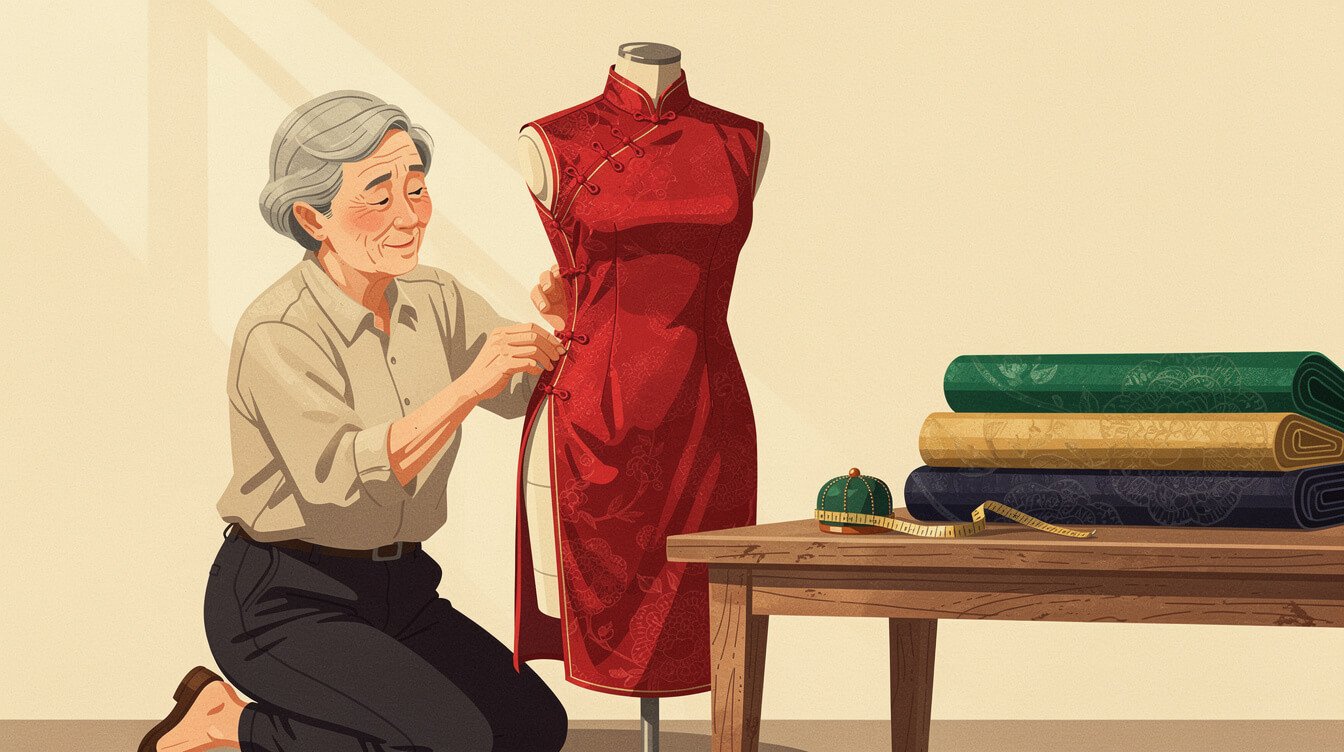
The qipao (旗袍), known in Cantonese as the cheongsam, is the garment most people picture when they think of Chinese-style dress: high mandarin collar, hand-knotted frog buttons down one side, close-fitting body, side slits. It’s also the garment most often mislabelled as Taiwanese in origin. It isn’t.
The modern qipao took shape in 1920s and 1930s Shanghai, evolving out of Manchu-influenced dress into something slim, tailored, and self-consciously modern. It reached Taiwan in force after 1949, when the Republic of China government relocated to the island along with roughly two million people — and with them, Shanghai tailors, Shanghai fabric merchants, and Shanghai standards for what a woman wore to a wedding.
What happened next is the interesting part. Taiwan didn’t just import the qipao; it built an industry around it. Dadaocheng’s Yongle Fabric Market in Taipei became — and remains — the beating heart of it, several floors of silk, brocade, and lace with tailors working the upper levels who will still cut a qipao to measure over a few fittings. Through the 1950s and 60s the qipao was everyday formal wear: teachers, hotel staff, wedding guests, first ladies. By the 1980s it had receded to special occasions, where it comfortably sits today.
The modern Taiwanese wedding shows the layering perfectly. A bride will often wear a white Western gown for the ceremony, then change into a red qipao or an embroidered longfeng gua jacket for the banquet and tea ceremony, then possibly a third outfit before the night is over. Lunar New Year brings out qipao and tangzhuang jackets across generations, and if you’re navigating the etiquette of any of these occasions, our guide to Taiwanese gift-giving rules and taboos covers what to bring and what to absolutely avoid.
Not planning on a bespoke fitting at Yongle? The modern everyday version of dressing Taiwanese is a lot simpler. Our Ming General Boba Warrior Tee puts a chibi guardian in full gold-and-crimson Chinese armour on soft cotton — historical dress, considerably less ironing.
Where to See, Rent, and Wear Taiwan Traditional Clothing Today
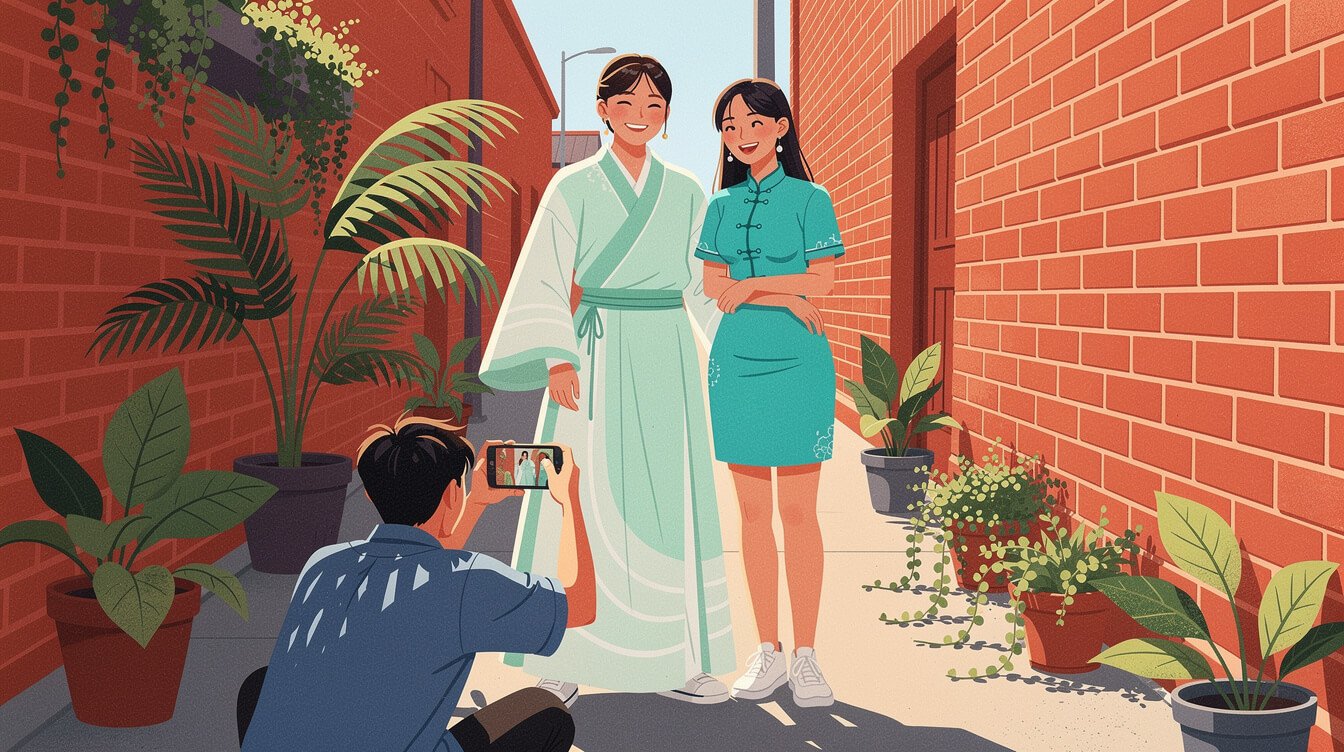
This is the part the encyclopaedia entries skip. Taiwan traditional clothing isn’t only museum material — there’s an active rental and photography culture, and locals are entirely relaxed about visitors joining in.
Rent it
Taipei’s Dadaocheng Visitor Center on Dihua Street is the classic starting point: rent a 1920s-style outfit and walk straight out into the historic shophouse district it was designed for. The Lin Family Mansion and Garden in Banqiao offers qipao and hanfu rental inside a genuine Qing-era garden compound. Beitou and Jiaoxi lean Japanese, with kimono and yukata rentals built around the hot-spring architecture. Jiufen, Tainan, and the Zhang Family Garden in Hualien all run their own versions. Most shops include hair styling and accessories, and most run two to four hours for the price of a decent lunch.
Buy it
For a made-to-measure qipao, Yongle Fabric Market in Dadaocheng is the answer — pick your cloth downstairs, get measured upstairs, allow a week and at least one fitting. For indigenous textiles, buy directly from indigenous makers: community weaving cooperatives in Hualien and Taitung, the shops attached to indigenous cultural parks, and the growing number of indigenous designers producing contemporary clothing using traditional motifs with their own communities’ consent. That last distinction matters more than any other line in this guide.
See it in the wild
Festivals beat shops every time. Amis harvest festivals (Ilisin) run along the east coast through July and August. The Bunun Ear-Shooting Festival falls in spring. Paiwan and Rukai ceremonies bring out beadwork you will never see in a rental shop. Temple processions across the island — including the year-round pageantry around Longshan Temple in Taipei — put deity-costume performers, palanquin crews, and traditional troupes on the street in full dress. And on Double Ten Day, indigenous delegations perform in regalia in front of the Presidential Office.
The one etiquette rule that actually matters
Renting hanfu, qipao, or a yukata for photos is fine. Taiwanese people do it constantly and nobody will blink at a visitor doing the same. Indigenous ceremonial regalia is a different category entirely: those garments encode rank, achievement, and family lineage, and specific motifs belong to specific houses. Buying an indigenous-made piece from an indigenous maker and wearing it with respect is welcomed. Buying a mass-produced “tribal costume” and wearing it as a party outfit is not. At festivals, watch first, ask before photographing people up close, and follow whatever the community tells you.
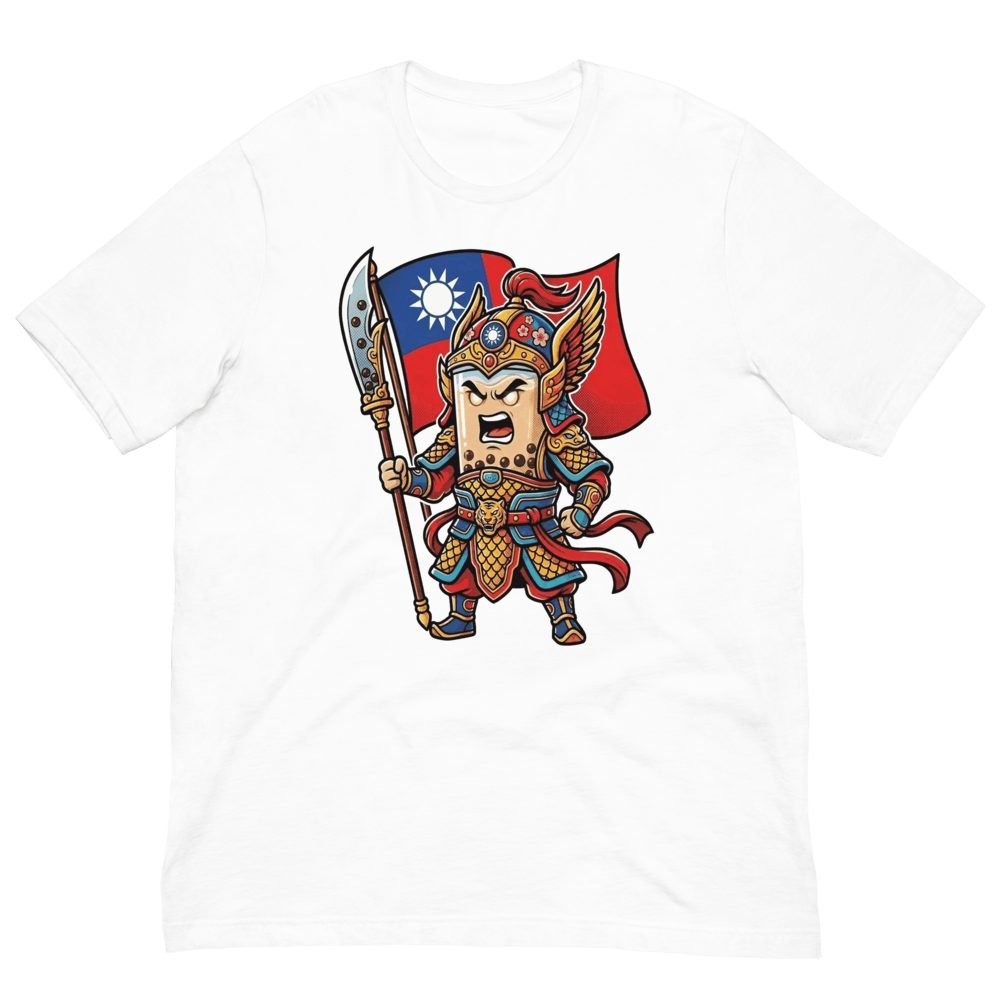
Traditional Armour, Modern Cotton
A chibi Ming-dynasty general in gold-and-crimson plate, halberd up, boba in hand. Four hundred years of Taiwanese layering, condensed into one very comfortable tee.
Taiwan Traditional Clothing: Frequently Asked Questions
Does Taiwan have a national dress?
No — and that’s a historical fact rather than a gap. Four centuries of changing rulers left Taiwan with layers of traditional dress instead of one standardised costume. If you forced an answer, indigenous regalia is the only clothing tradition unique to the island, while the qipao is the garment most often used to represent Taiwan formally abroad.
Is the qipao Taiwanese or Chinese?
Chinese in origin, Taiwanese in adoption. The modern qipao developed in 1920s–30s Shanghai and arrived in Taiwan in volume after 1949. Taiwan then built its own tailoring tradition around it, centred on Dadaocheng, and it’s been standard formal wear for weddings and Lunar New Year for seventy years.
Can tourists wear traditional Taiwanese clothing?
Yes for hanfu, qipao, and kimono rentals — it’s a mainstream local activity and rental shops exist specifically for it. Indigenous ceremonial regalia is the exception: it signals rank and lineage, and it shouldn’t be worn as a costume. Buy from indigenous makers if you want the real thing.
What’s the difference between hanfu, qipao, and a kimono?
Hanfu is a broad revival category covering pre-Qing Han Chinese styles — flowing robes, wide sleeves, a high waistband, no mandarin collar. The qipao is the fitted one-piece dress with a mandarin collar and frog buttons. A kimono is Japanese: a T-shaped wrapped robe closed left-over-right and belted with a wide obi. All three are rentable in Taiwan, often from the same shop.
What is the Hakka blue shirt?
The lan shan — a long indigo-dyed, side-fastening tunic worn by Hakka women and men for farm work, with wide turned-back sleeves that doubled as pockets. It’s the most distinctively Hakka garment in Taiwan and considerably older than the peony-print “Hakka floral cloth” that now represents Hakka culture on souvenirs.
What do Taiwanese people actually wear day to day?
Exactly what you’d wear: t-shirts, jeans, sneakers, and — this being Taiwan — a lot of Japanese-influenced streetwear. Traditional clothing comes out for weddings, Lunar New Year, temple festivals, indigenous ceremonies, graduation photos, and rental photoshoots. It is worn with real affection, just not on a Tuesday.
Where can I buy Taiwan traditional clothing?
Yongle Fabric Market in Taipei’s Dadaocheng district for made-to-measure qipao. Indigenous weaving cooperatives and cultural parks in Hualien and Taitung for indigenous textiles from the communities that make them. Hakka cultural centres in Hsinchu and Miaoli for indigo pieces and floral-cloth goods. Skip the airport gift shop.
Final Thoughts: A Wardrobe With Nothing to Prove
There’s a version of the Taiwan traditional clothing question that treats the island’s missing national costume as a deficiency — as if a place isn’t fully itself until it can hand you one outfit and say this is us. Spend any time with the actual history and that framing collapses. A single national dress usually means somebody had the power to pick one and enough uninterrupted time to enforce it. Taiwan never had either, and what grew instead is a wardrobe that holds Austronesian weaving, Fujianese workwear, Hakka indigo, Japanese leisure dress, and Shanghai tailoring all at once, without any of them cancelling out the others.
So the useful answer to “what is Taiwan traditional clothing” isn’t a garment. It’s a stack of them, each still worn by somebody, somewhere on the island, this weekend. Learn to read the layers and Taiwanese festivals stop being colourful blurs and start being legible.
Keep going: our guide to the best Taiwan souvenirs covers what’s actually worth carrying home, and things to do in Taipei will point you at Dadaocheng, Beitou, and the rest of the neighbourhoods where this history is still standing.
A Postcard From Taiwan, Every Week
Culture stories, food deep-dives, travel tips, and first looks at new designs — straight to your inbox. No spam, just Taiwan.
Grab a Free Taiwan Sticker!
Drop your email and we’ll send you a limited-edition Taiwan sticker — plus insider access to new merch drops and island vibes.
No spam. Unsubscribe anytime.