Longshan Temple, Taipei: The Complete Guide to the 100 Deities, Yue Lao’s Red Thread & the 1945 WWII Miracle
Ask any Taipei local where a foreign visitor should start understanding Taiwanese spirituality, and the answer comes back so fast it feels rehearsed: Longshan Temple. But calling this Wanhua landmark a “temple” is like calling a coral reef “a rock.” Since 1738, this Taipei temple — Longshan Si, or Dragon Mountain Temple — has been stacking gods on top of gods until it houses over one hundred deities from three separate religious traditions under one gloriously ornate roof. It is a Buddhist temple. It is a Taoist temple. It is a folk-religion temple. It is a place where a scientist can go pray for a promotion at nine in the morning and a heartbroken twenty-two-year-old can go request a soulmate at nine in the evening, and neither will feel out of place.
Longshan is also where you can watch a US Air Force bombing miracle unfold in ceramic detail, tug on Yue Lao’s famous red thread until the moon blocks say yes, and step out the Tiger Gate straight into Snake Alley and one of the most historically layered street-food neighborhoods in the entire country. This is the guide most travelers wish they had before their first visit — the deities decoded, the rituals explained beat by beat, the neighborhood mapped, and the temple positioned honestly against Baoan and Xingtian so you know exactly why this one matters.
The 1738 Origin Story: Fujian Immigrants, a Guanyin Painting, and Wanhua’s Spiritual Heart
To understand why Longshan Temple exists at all, you have to go back nearly three hundred years, across the Taiwan Strait to the coastal Chinese province of Fujian. In the early eighteenth century, waves of immigrants from three specific counties — Jinjiang, Nan’an, and Hui’an — began crossing to the boggy, malarial settlement then called Manka (now Wanhua District). They came for farmland and camphor money, but they carried something else in their luggage: an unshakeable devotion to Guanyin, the bodhisattva of compassion, whose home shrine was a temple called Longshan back in seventh-century Jinjiang.
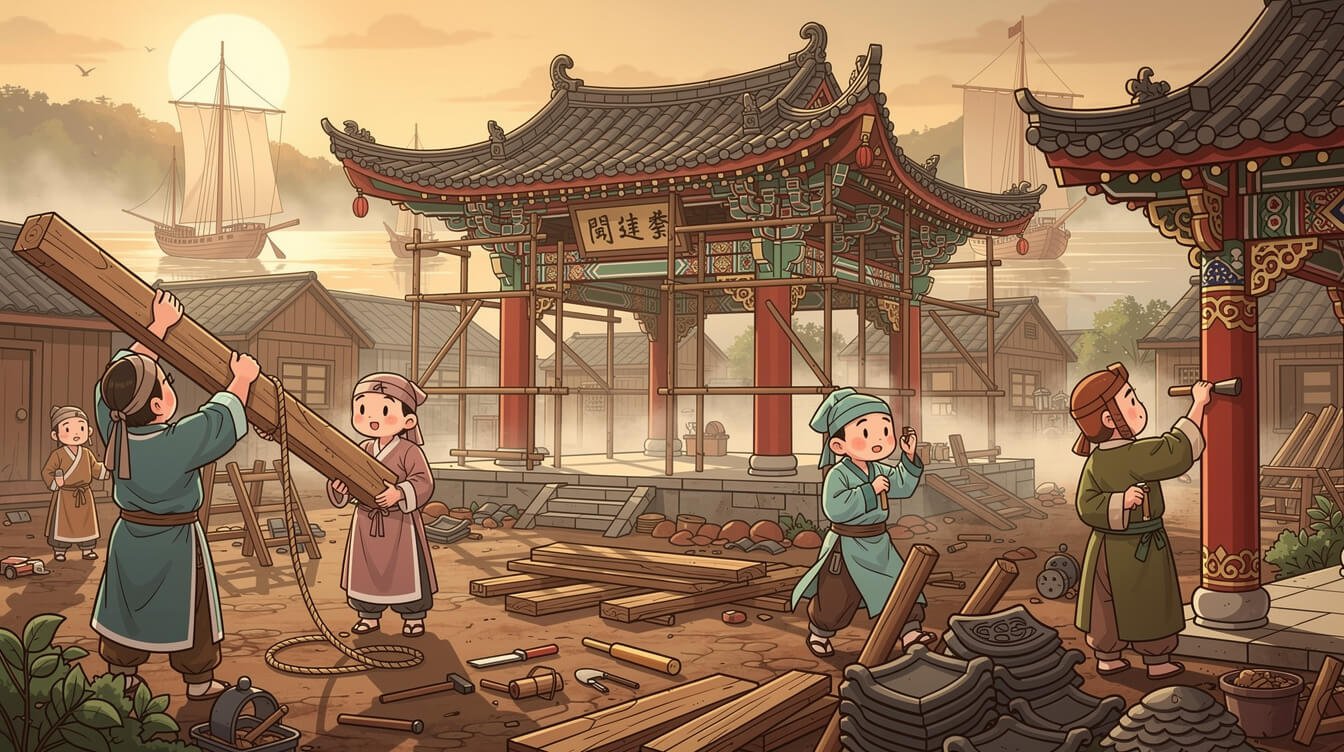
These immigrants pooled their money, cleared a plot of low-lying land near the Tamsui River, and in 1738 raised a branch temple named after their spiritual mother house. The story that has calcified into official temple lore is that a passing traveler hung a small pouch containing a Guanyin amulet on a tree branch near the site. When he returned, he forgot it. That night, locals reported seeing the tree glow. The land was deemed miraculously auspicious, and construction commenced. Whether or not you buy the miracle, the strategic logic was sound: Longshan sat at the geographic and commercial center of Manka, giving newly arrived immigrants a place to pray, socialize, and organize community defense — the three functions Taiwanese temples still perform today.
The building you see now is not the 1738 original. Earthquakes, fires, typhoons, and one very consequential wartime bombing raid have flattened Longshan repeatedly. The current structure was rebuilt during Japanese colonial rule beginning in 1919 and completed in 1924, which is why the temple’s spectacular ceramic jiannian (cut-and-paste porcelain) sculptures show late-Qing craftsmanship at its peak. Every time Taipei’s residents rebuilt this temple, they did it bigger, prettier, and more elaborate than the version before. That collective stubbornness is a huge part of why Longshan feels so alive when you visit — it is a monument to a community’s refusal to let its spiritual center die.
100+ Deities Under One Roof: Longshan as Taiwan’s Most Syncretic Temple
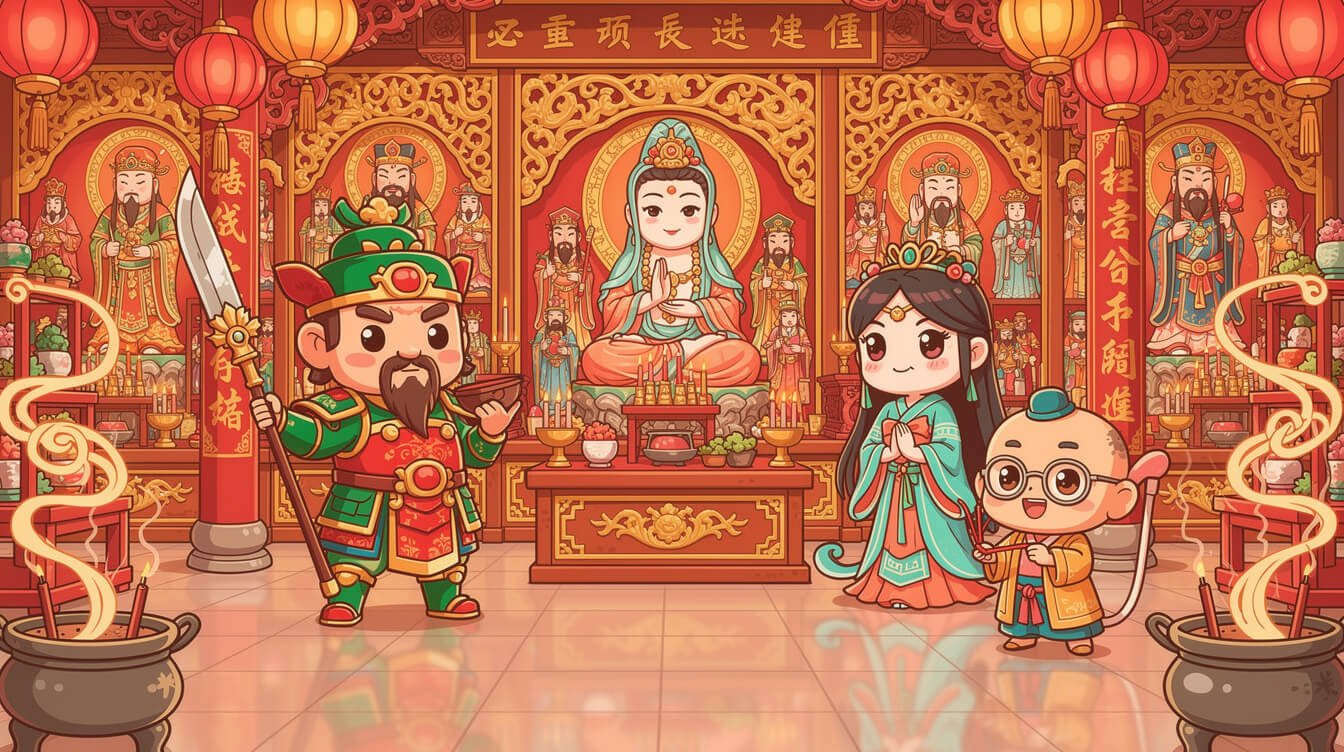
If you have ever wondered what makes Taiwanese folk religion so distinctive, Longshan Temple is the answer laid out spatially in three halls and one very crowded courtyard. Most temples worldwide pick a lane. A Buddhist temple enshrines buddhas and bodhisattvas. A Taoist temple enshrines Taoist immortals. A folk shrine enshrines local heroes. Longshan enshrines all of it — more than a hundred distinct deities pulled from Chinese Buddhism, religious Taoism, Confucian philosophy, and centuries of localized folk practice. The theological word for this mash-up is syncretism, and Longshan is arguably its most refined expression on Earth.
The layout is designed to walk you through the pantheon in order. The front hall (Sanchuan Hall, literally “three-river hall”) is Buddhist territory. Here you greet three of the most important bodhisattvas of Mahayana Buddhism: Avalokiteshvara (Guanyin herself, the compassionate one), Manjushri (wisdom and learning), and Samantabhadra (virtue in action). Place your first stick of incense here.
The main hall is Guanyin’s inner sanctum — a serene, gold-lacquered central chamber where the entire building’s spiritual gravity concentrates. After bowing to Guanyin, tradition has you turn a full one-hundred-and-eighty degrees to face the front hall and pray upward through the roof to the Jade Emperor (Yudi), the supreme deity of the Taoist pantheon. This one turn tells you everything about Longshan’s approach: Buddhism at the center, Taoism looming above, and no perceived contradiction between them.
Then comes the rear hall — the folk-religion smorgasbord that makes Longshan feel like a spiritual shopping mall. Five distinct shrines stretch across the back of the compound, each one dedicated to a deity who specializes in a very specific slice of daily life:
- Hua Tuo Hall — The legendary Han-dynasty physician, patron of doctors, nurses, and anyone recovering from illness. Come here to pray for a family member’s surgery.
- Wenchang Emperor Hall — The god of literature and imperial exams. Every February and June you will see high-school students and their parents leaving pencils, exam papers, and calligraphy scrolls as offerings before gaokao and university entrance tests.
- Mazu Hall (Tianshang Shengmu) — The Taiwanese sea goddess who is arguably the island’s most beloved folk deity. Sailors, fishermen, and anyone traveling by ocean pray to her.
- Guan Di Hall — The deified general Guan Yu (also spelled Kuan Kung) from the Three Kingdoms era. Businesspeople, police officers, and martial artists worship him for loyalty, courage, and commercial success.
- Yue Lao Hall — The Old Man Under the Moon, matchmaker of the cosmos and reason Longshan is world-famous with anyone under thirty. He deserves — and gets — his own section below.
What makes this arrangement radical is not that so many gods coexist — that happens elsewhere in Asia — but that ordinary Taiwanese worshippers move seamlessly between them in a single visit. A grandmother might pray to Guanyin for her grandson’s health, Wenchang for his SATs, Mazu for his flight home from Los Angeles, and Yue Lao for a good spouse, all before lunch. This is what a mature syncretic religion looks like in practice.
Yue Lao’s Red Thread: The Complete Step-by-Step Love-Prayer Ritual
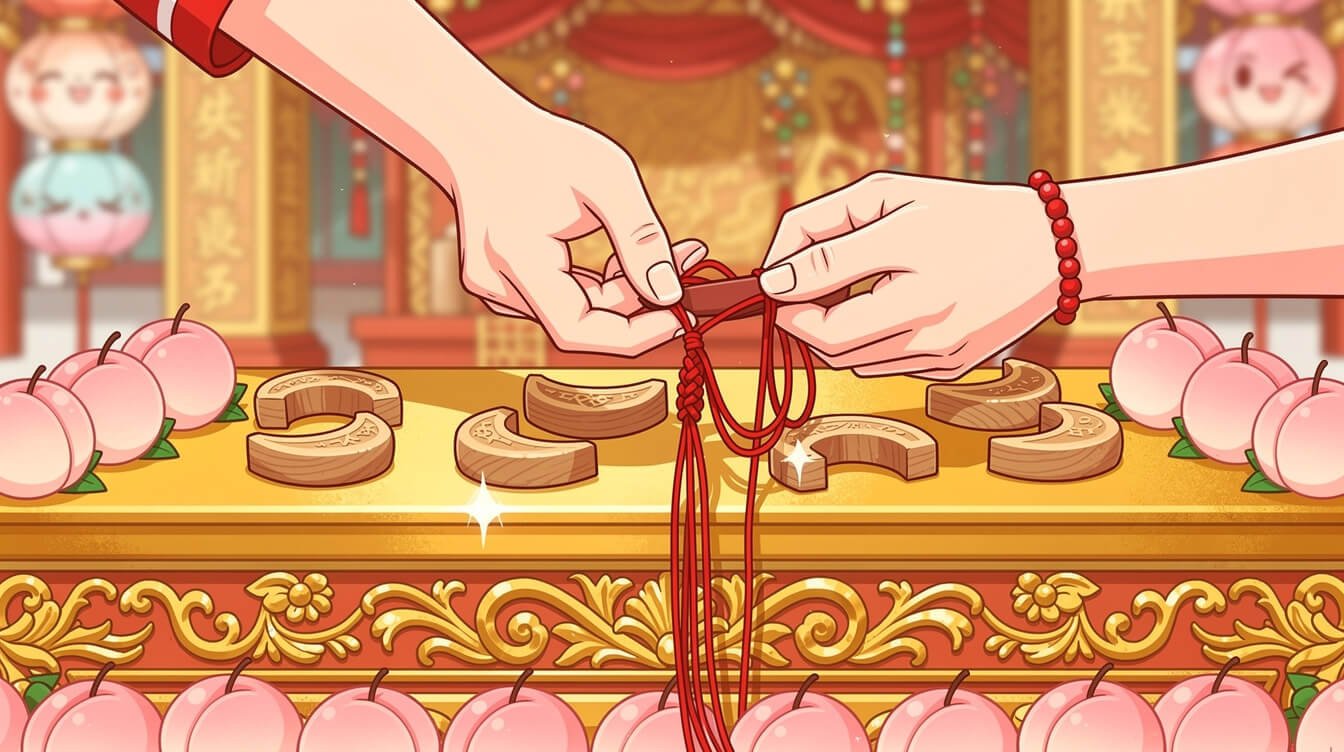
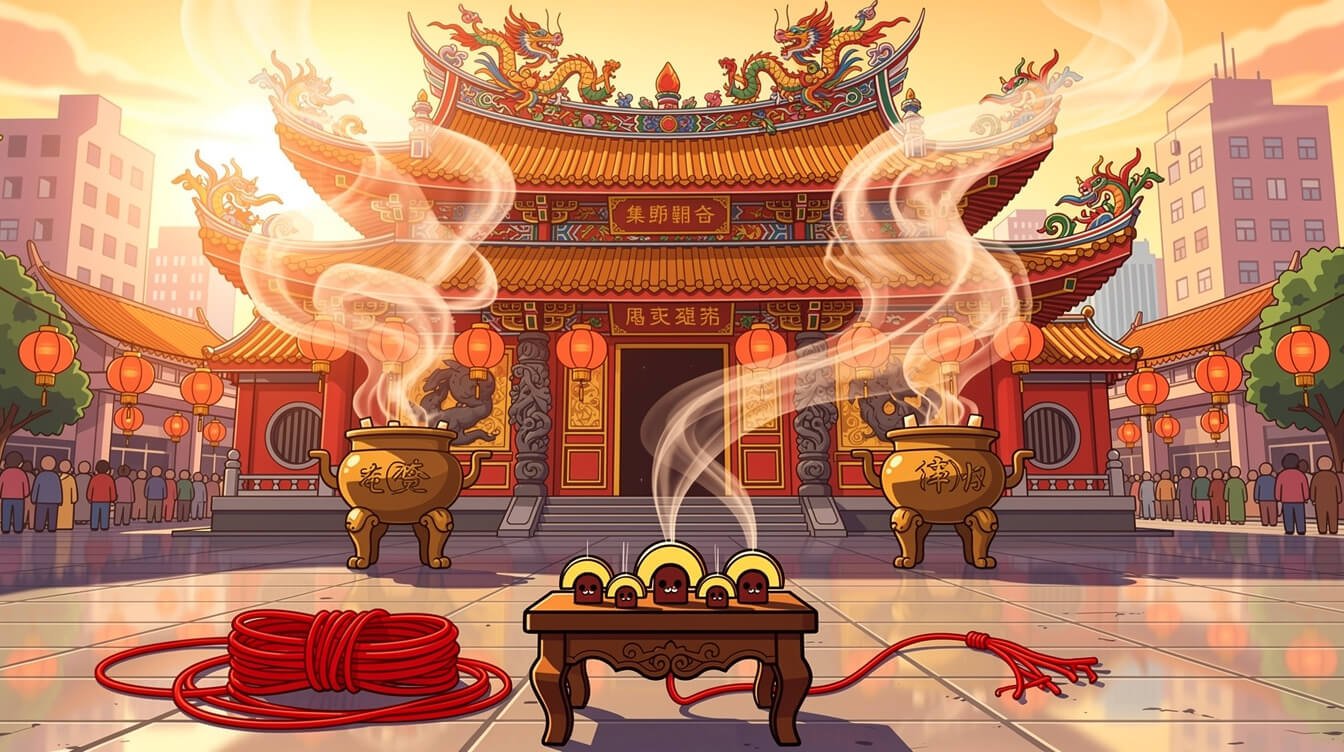
Longshan Temple’s global reputation as the go-to spot for love prayers has one source: Yue Lao, the white-bearded Taoist deity who, according to legend, keeps a giant book listing every predestined couple in the universe and ties invisible red threads between their ankles at birth. Come to Longshan on a Friday night and the Yue Lao shrine in the rear hall will be packed with Taipei singles doing something incredibly specific: tugging on tiny bright-red threads, whispering wishes, and throwing wooden crescents on the floor. Here is exactly how the ritual works so you can do it correctly instead of doing what most tourists do, which is stand there looking confused.
Step 1: Buy the offering set. A small counter in the rear hall sells packages containing incense, joss paper, a wish card, and sometimes symbolic offerings like red dates and peanuts (whose Chinese names pun into blessings for early sons and abundance). You can also bring your own fruit — peaches, oranges, and pineapples are all appropriate.
Step 2: Introduce yourself formally. Stand before Yue Lao’s altar, hold your incense in both hands at forehead level, and state four things aloud: your full name, your date of birth, your current address, and your specific wish. Taiwanese temples treat deities like busy officials — they need identifying information to route the request. If you are visiting from abroad, use your hotel address. Yue Lao does not care that you are jet-lagged.
Step 3: Describe your ideal partner. This is the moment you can be as specific or as vague as you want. Some worshippers list character traits (patient, ambitious, funny). Others list logistics (Taiwanese national, resident of Taipei, non-smoker). Yue Lao is a matchmaker; he needs a brief.
Step 4: Throw the jiaobei. Pick up the pair of red-lacquered wooden crescents known as jiaobei (moon blocks) from the altar. Hold them together with the flat sides pressed against each other, raise them to forehead height, and drop them on the floor. The way they land is Yue Lao’s answer:
- One flat side up, one round side up = Sacred Answer. Yes. Yue Lao agrees.
- Both round sides up = Laughing Answer. Yue Lao is amused — either you were not specific enough, or the question is silly. Rephrase and try again.
- Both flat sides up = Angry Answer. No. Move on or come back another day.
You need three consecutive Sacred Answers to receive Yue Lao’s official blessing. If you get a rejection on any throw, reset and go again from the top.
Step 5: Claim your red thread. Once you have your three yeses, take one of the small red threads that the temple provides free of charge from the altar. Loop it around your wrist, tie it loosely, and wear it continuously. Tradition holds that when you meet the person Yue Lao intends for you, the thread will naturally break or fall off. Do not cut it deliberately — that is considered rude to the deity.
Step 6: Complete the paperwork. Some worshippers also fill out a small wish card describing their ideal match and pin it to the designated board near the shrine. Others burn the joss paper in the outdoor furnace as a final offering. Both are optional; the red thread is the core deliverable.
Does it work? Ask around. Every Taipei household seems to have one cousin who swears their spouse showed up within a year of a Longshan visit, and one who swears the thread frayed on a subway commute and then nothing happened for a decade. What the ritual definitely does is force you to articulate what you actually want in a partner — which is not the worst preparation for finding one.
The WWII Miracle: How the 1945 US Bombing Destroyed the Main Hall — But Not the Guanyin
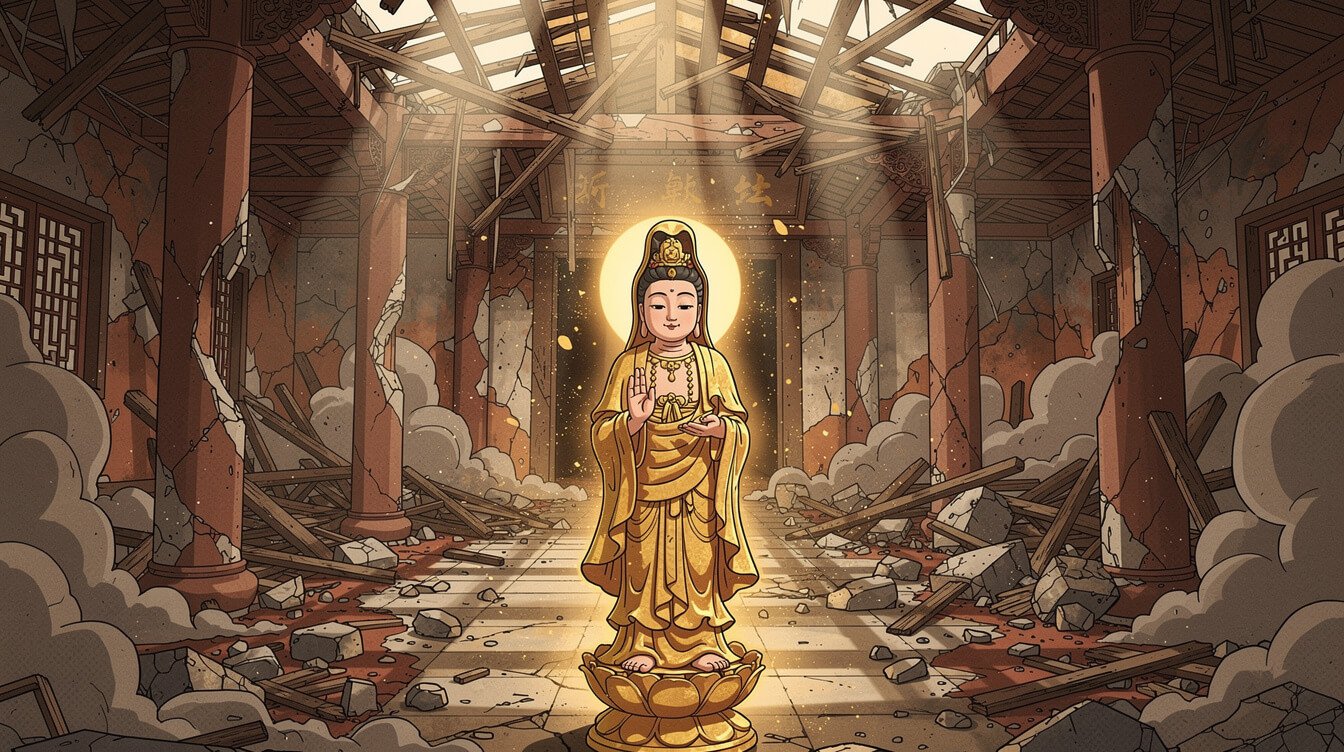
On the night of May 31, 1945, US Army Air Forces bombers hit Taipei in the largest Allied air raid on Taiwan during World War II, the Taihoku Air Raid. Taiwan was Japanese-ruled colonial territory at the time, and Japanese forces had reportedly stashed weapons inside Longshan Temple, betting — incorrectly — that a religious site would be off-limits to Allied targeting. It was not. Bombs slammed into the main hall and the left corridor. Roof beams collapsed. Priceless statues shattered. The famous Statue of Shakyamuni Emerging, a treasured Buddhist artwork, was obliterated along with an entire side hall.
Then something strange happened, or so the story goes. When the smoke cleared and neighborhood residents crept back to inspect the damage, they found the central Guanyin statue — the emotional and spiritual centerpiece of the entire temple — standing untouched. The roof above her had collapsed. The pillars around her were splintered. She was still there, gold gilt intact, expression unchanged, as though the bombs had swerved. Locals immediately took this as proof of divine protection, and word spread through Wanhua that Guanyin had saved not just her own statue but every resident who had taken refuge inside the temple during the raid.
Whether you take that as a literal miracle or a story that a traumatized community desperately needed after a night of violence, the survival of the Guanyin statue became foundational to Longshan’s modern identity. When reconstruction began after the war, the shape of the campaign was clear: rebuild everything around her. The current main hall was designed to enshrine the surviving statue as its centerpiece, and worshippers still light incense there specifically to thank Guanyin for the intervention. If you look closely at the temple’s official histories, the 1945 event is treated less as a tragedy and more as a founding-scale miracle — the reason Longshan feels less like a museum and more like a living relationship between neighborhood and deity.
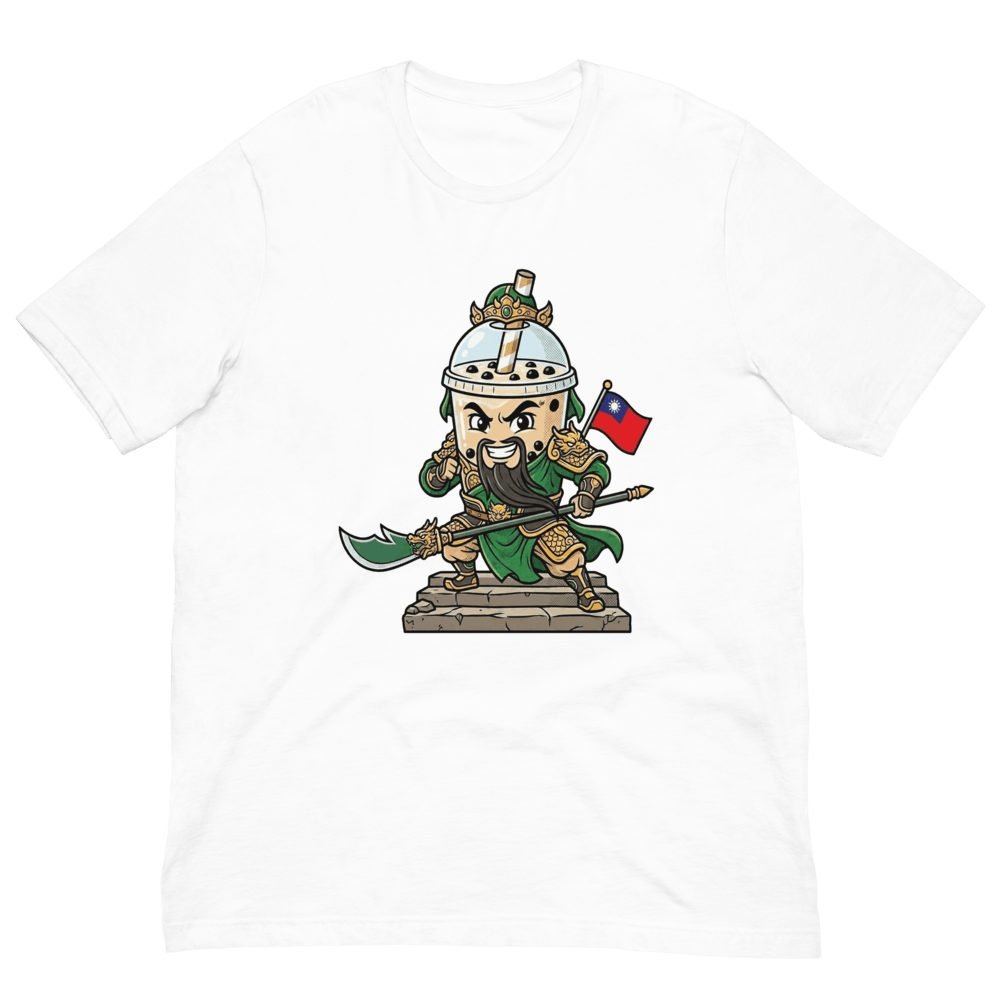
Speaking of Taiwan’s cultural pride and its knack for wearing devotion on its sleeve, one of our most popular tees is a stylized tribute to Guan Yu, the God of War worshipped in Longshan’s rear hall, reimagined as a boba-clutching warrior. It is our small way of keeping the temple’s deities in daily rotation outside the incense clouds.
Longshan vs Baoan vs Xingtian: Which Taipei Temple Should You Actually Visit?
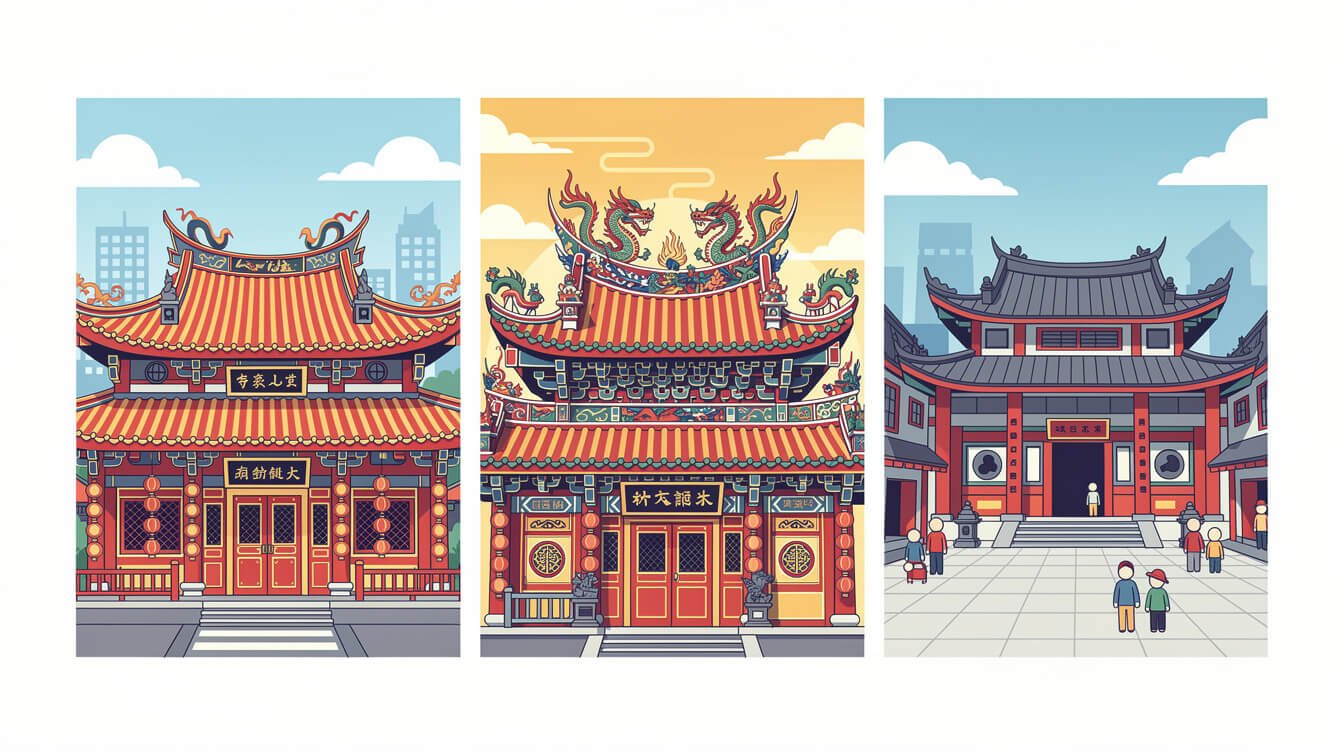
Every first-time visitor to Taipei asks the same question after five minutes of searching: “There are three big temples — which one should I actually go to?” Here is the honest answer, based on what each one does best and what kind of experience you are looking for.
Longshan Temple — The One for First-Timers and Love-Seekers
Go to Longshan if you want the most spectacular ornamental architecture in Taipei (those dragon-column carvings and porcelain rooftops are genuinely world-class), the deepest ritual density (people are actively worshipping every hour the temple is open), and if you have any interest at all in the Yue Lao love ritual. Longshan is also the easiest to reach — the MRT station is literally named after it — and its Wanhua location puts you next to Snake Alley and some of the best old-Taipei street food. Downside: it can get genuinely crowded, especially on weekends and lunar holidays. Come at 7am or after 8pm for atmosphere without shoulder-jostling.
Baoan Temple — The One for Architecture Nerds and Quiet Contemplation
Baoan sits north of the Datong District and is Longshan’s much calmer, arguably more refined cousin. Its main deity is Baosheng Dadi, the god of medicine, so this is the temple you visit if you are recovering from illness, praying for someone in the hospital, or just want a serene atmosphere without the tourist crush. Baoan won a UNESCO Asia-Pacific Heritage Award in 2003 for its extraordinary restoration work, and the temple grounds include a beautiful garden pond. Aesthetically it may edge out Longshan for craftsmanship purists.
Xingtian Temple — The One for Working Professionals
Xingtian is the newest and most utilitarian of the three, built in 1967 in a modern district. Its main deity is Guan Yu (the same warrior god who has a shrine in Longshan’s rear hall), and it draws a huge crowd of businesspeople, entrepreneurs, and office workers praying for career success and financial protection. The signature ritual here is shoujing — blue-robed volunteer masters wave incense over supplicants’ bodies in a soul-cleansing rite believed to remove bad energy. It is free and open to anyone. Xingtian is also the strictest of the three: no burning of joss paper, no animal offerings, no photography of the deities.
The Verdict
If you can only visit one, make it Longshan. It gives you the most complete introduction to Taiwanese folk religion in a single stop, the ritual life is at its most vivid, and the surrounding neighborhood is a bonus destination in itself. If you have time for two, add Baoan for the architecture contrast. Save Xingtian for a return trip when you want to experience the shoujing cleansing ritual.
What to Do in Wanhua After the Temple: Bopiliao, Snake Alley, and Guangzhou Street Night Market
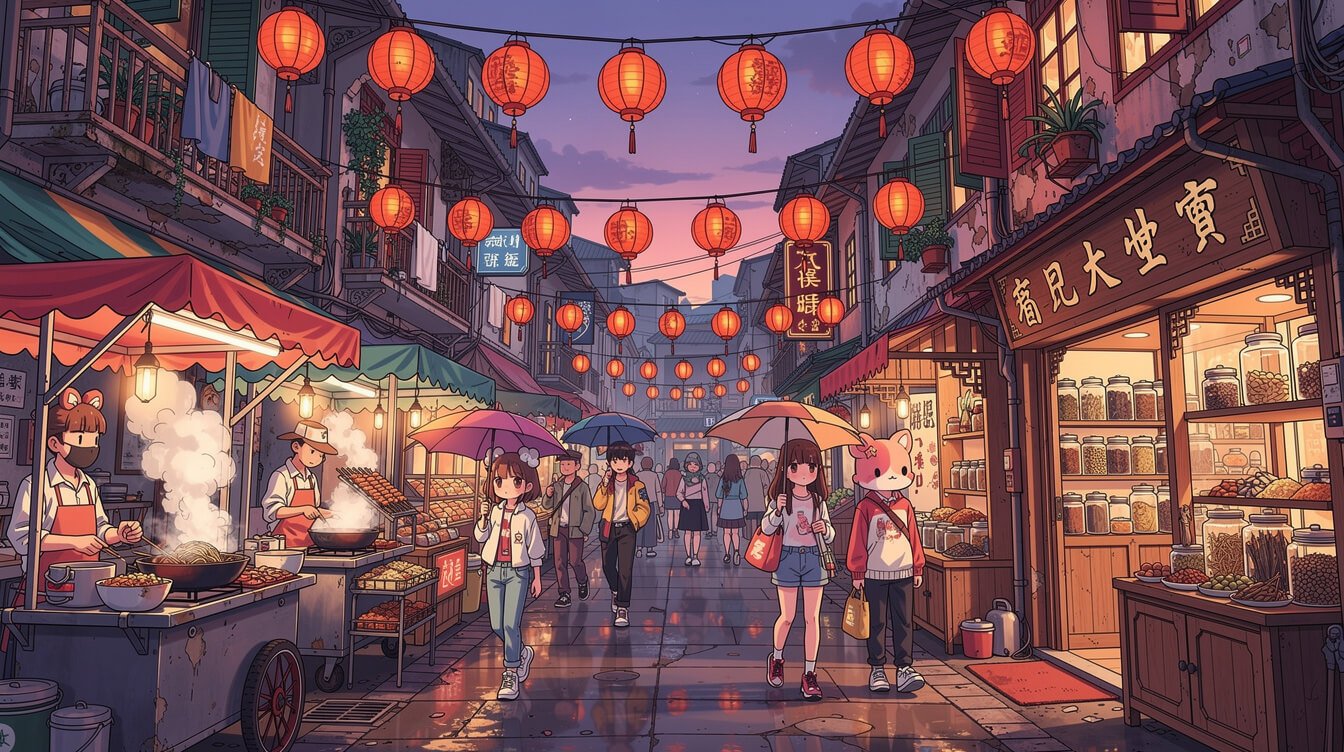
One of the underrated pleasures of visiting Longshan Temple is that it drops you in the middle of Wanhua, Taipei’s oldest continuously inhabited neighborhood and easily its most historically layered. Do not just Uber back to your hotel after the temple — walk out the Tiger Gate and give yourself two hours to explore. Here is the loop most locals would recommend.
Bopiliao Historic Block is a five-minute walk east from the temple — a preserved stretch of Qing- and Japanese-era shophouses turned into a walk-through open-air museum documenting Wanhua’s history. The red-brick arcades, calligraphy signs, and old herbal medicine displays are photogenic on any day, and rotating exhibits often feature traditional crafts and Taiwanese cinema history (parts of the movie Monga were filmed here).
Huaxi Street Night Market, better known internationally as Snake Alley, sits directly north of Longshan and is one of the strangest, most old-school night markets in all of Taipei. Its glory days as a red-light and snake-blood-tonic district are behind it, but the covered arcade still hosts herbal teahouses, seafood stalls, and a small handful of traditional-medicine practitioners doing brisk business. Come here specifically for the atmosphere of an older Taiwan that is quickly disappearing.
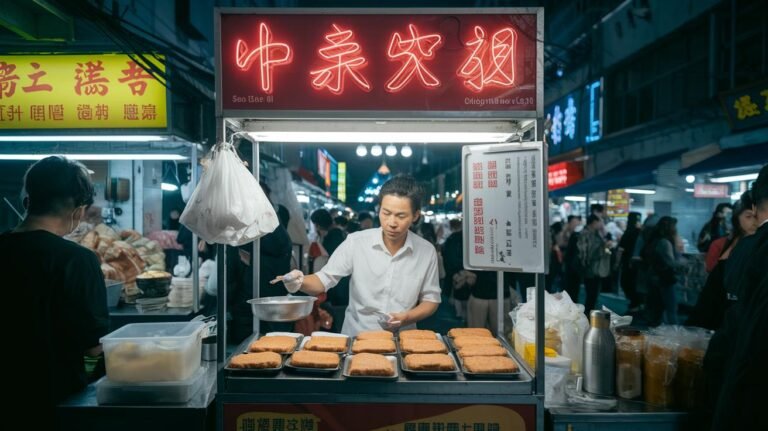
Guangzhou Street Night Market, which runs perpendicular to Snake Alley, is where the actual food action is. Look for Zhou Ji Xiaoye (a legendary rice porridge stall open until 4am), oyster vermicelli, salted crispy chicken, and slow-braised pork rice bowls. Bring cash. Bring an appetite. Bring napkins.
Herb Alley (Xichang Street) is the last stop worth making — a narrow lane packed with traditional Chinese medicine shops selling everything from ginseng roots the size of forearms to preserved lizards and a hundred varieties of dried mushroom. Even if you buy nothing, the smell alone is worth the walk.
Together, Longshan Temple plus this Wanhua loop is probably the single densest half-day of authentic Taipei culture you can plan. If you want to see more of Taipei’s neighborhoods beyond Wanhua, our Taipei map guide to districts and hidden gems breaks down what makes each neighborhood distinctive, and our list of essential things to do in Taipei plots out full-day itineraries for first-timers.
Practical Visitor Playbook: Hours, Etiquette, MRT Access, and Photography Rules
Now the logistics, because a good spiritual experience begins with not accidentally offending anyone.
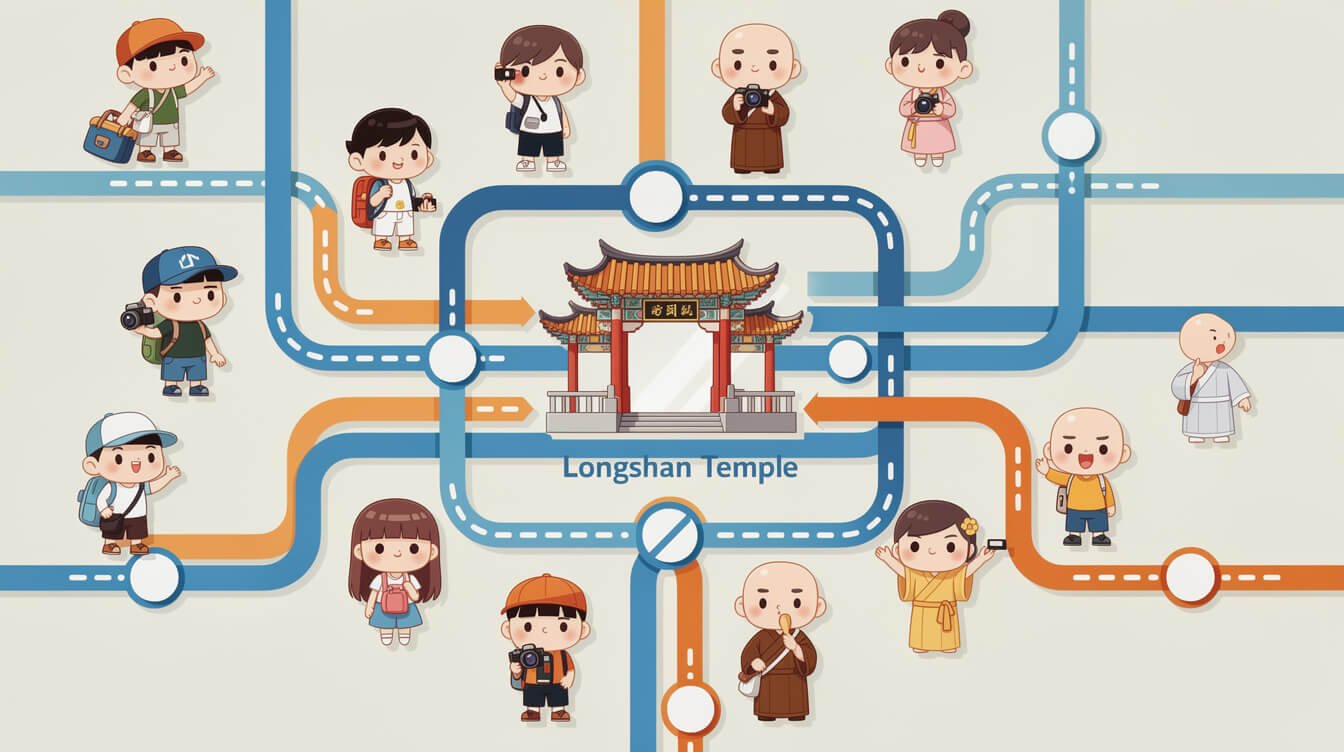
Getting there. Take the Taipei MRT Bannan (Blue) Line to Longshan Temple Station and take Exit 1. The temple is a two-minute walk across a small plaza. You cannot miss it — the red pillars and glazed-tile roof announce themselves from a block away. From Taipei Main Station, the ride is four stops and takes about eight minutes.
Opening hours. Longshan is open 6:00am to 9:40pm daily, every day of the year including public holidays. There is no admission fee. The two peak experience windows are the early-morning chanting sessions (roughly 6:00am to 7:00am) and the evening chanting session (starting around 5:30pm), when temple staff and devotees perform sung sutras that transform the whole compound into what feels like an acoustic instrument.
Entrance and exit protocol. Enter through the Dragon Gate on the right (facing the temple) and exit through the Tiger Gate on the left. Do not step on the raised wooden threshold at any doorway — step over it. Some traditions hold that the height of your step shows respect to the gods; others say the threshold marks the boundary between mundane and sacred space.
Prayer order. If you want to worship properly, follow the ritual order: front hall (three bodhisattvas), main hall (Guanyin, then turn to Jade Emperor), then rear hall (whichever specialist deity fits your request). Incense is provided free at the entrance to each hall; three sticks is the standard bundle. Light them from a communal candle, bow three times before each altar, and place them upright in the incense burner.
Photography. Photography is generally allowed in the courtyards and of the exterior. Do not photograph directly into the faces of the deity statues in the main hall or rear hall shrines — a growing convention in Taiwanese temple etiquette treats this as disrespectful. Never use flash near worshippers mid-ritual. When in doubt, ask a temple volunteer wearing the yellow vest.
Dress code. There is no formal dress code, but common sense applies: shoulders and knees covered is safest, especially in the main hall. Hats off inside sanctum halls. No eating or drinking inside the temple grounds.
What to bring. Cash for offerings (small bills for donation boxes and bigger bills if you want to buy amulets or wish cards). A phone with the Google Translate camera feature helps decode the fortune slip if you draw one. A small notebook to record which deity you prayed to for which request — this becomes surprisingly meaningful a year later when you look back.
When to visit. Weekday mornings before 9am are the calmest. Weekends and lunar holidays (especially the fifteenth day of the lunar seventh month, mid-Ghost Month) are the busiest. The temple is spectacular during Lunar New Year, but be prepared for genuinely intense crowds. Full-moon and new-moon days always see a bump in worshippers because those are traditional offering days.
Final Thoughts: Why This Taipei Temple Belongs at the Top of Your List
Longshan Temple is not the biggest religious site in Taiwan, nor the oldest, nor even the most architecturally pristine. What it is — better than any other single spot in Taipei — is a living demonstration of what makes Taiwanese spirituality unique: the easy coexistence of Buddhism, Taoism, and folk religion under one roof, animated daily by real people asking real deities for help with real problems. Whether you come as a devout worshipper, a curious tourist, or a cynical academic, Longshan has a way of quieting the internal chatter and reminding you that some human needs — love, health, guidance, community — are old enough that we built entire buildings around them and kept rebuilding whenever war or weather knocked them down.
Go early. Bring cash. Throw the moon blocks. Wear the red thread. And when you leave through the Tiger Gate, keep the temple’s syncretism in mind: in Taipei, the answer to almost any question is usually “yes, and.”
Wear the God of War, Longshan-Style
Guan Yu holds down a shrine in Longshan’s rear hall — and now he holds a boba too. Our Guan Yu Taiwan Boba Tea Warrior tee is a playful tribute to the deity worshipped for loyalty, courage, and (unofficially) getting through Monday.
Get Taiwan in Your Inbox
Weekly stories on Taiwanese culture, food, temples, and hidden neighborhoods — plus first dibs on new tees and collabs. No spam, just a proper Taiwan fix.
Grab a Free Taiwan Sticker!
Drop your email and we’ll send you a limited-edition Taiwan sticker — plus insider access to new merch drops and island vibes.
No spam. Unsubscribe anytime.