Did You Know? The Pheasant-Tailed Jacana Came Back Because Taiwan Kept Eating Water Caltrop
Mid-Autumn was yesterday, which in Tainan means one thing beyond the barbecue smoke: the water caltrop (菱角) harvest is on. From now through November, the flooded ponds of Guantian District fill with farmers in waders, flipping leaves by hand to find the horned black seed pods hanging underneath.
Walking across those same leaves is the reason those ponds still exist at all.
Three nicknames, all of them about the leaves
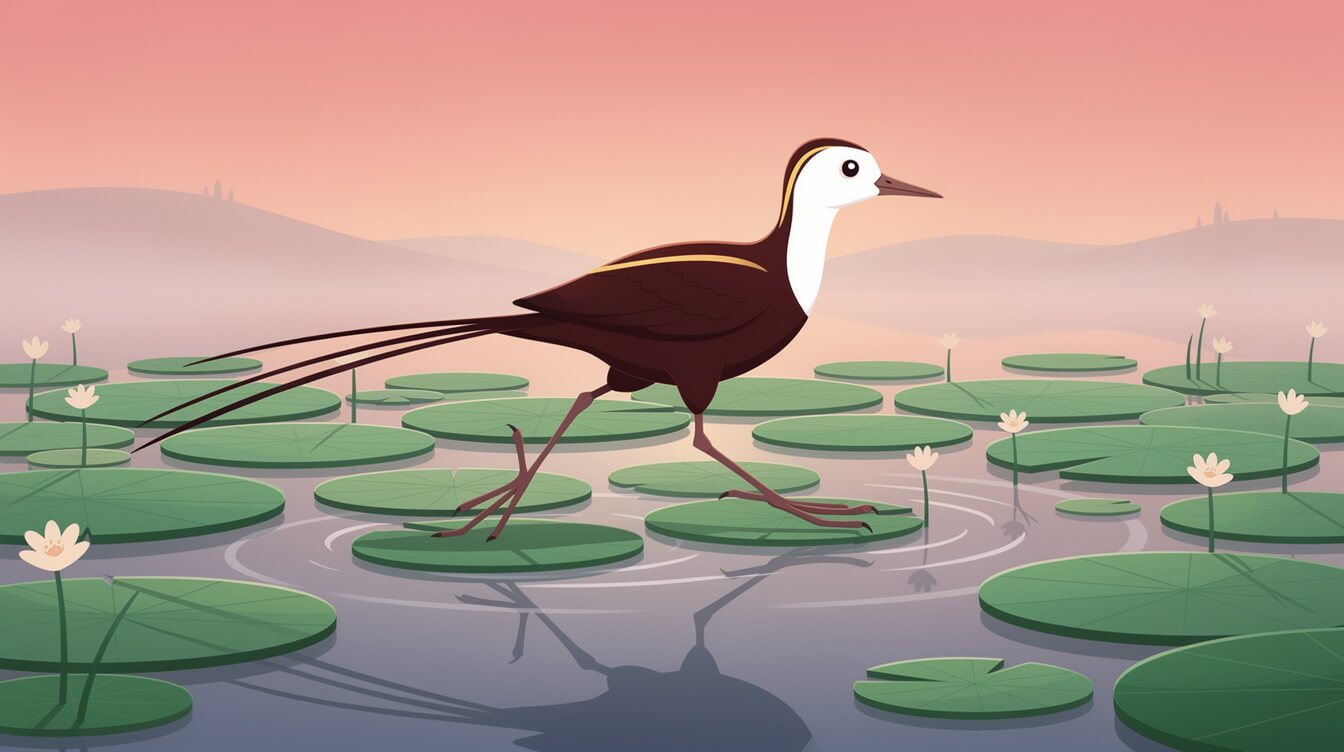
The pheasant-tailed jacana (水雉) is a slim chocolate-brown wading bird with a bright white face, a gold stripe down the back of its neck, and — in breeding season — a tail that trails half a meter behind it. Taiwan gave it three nicknames, and every one is about the way it moves: 菱角鳥, the water caltrop bird; 葉行者, the leaf walker; and 凌波仙子, roughly “the fairy who skims the waves.”
The trick is its feet. The toes are absurdly long and it spreads them wide, so its weight lands across several floating leaves at once instead of punching through one. A pheasant-tailed jacana does not paddle across a caltrop pond. It walks.
Down to fewer than 50
A 1998 survey found fewer than 50 pheasant-tailed jacanas left in all of Taiwan. Their breeding ponds were being drained and built over, and the high-speed rail route drawn up in 1990 ran straight through the best of what was left. The fight over that route produced a mitigation deal: 15 hectares of the Chianan Plain set aside as a jacana restoration area, which grew into today’s Jacana Ecological Education Park in Guantian, Tainan.
It nearly came undone anyway. In 2009, staff found 85 jacanas dead of poisoning — they had been eating direct-seeded rice coated with pesticide.
The fix turned out to be a shopping decision
Instead of fencing the birds off from the farms, conservationists tied the two together. A green conservation certification, run with the Tse-Xin Organic Agriculture Foundation from 2009, pays caltrop and rice farmers to drop those pesticides. In 2020 the park went a step further and put its own eco-friendly caltrop brand — 官田菱雉菱 — onto supermarket shelves nationwide, so the bird’s survival came with a barcode.
It worked. Tainan’s jacana count has stayed above 1,000 every year since 2016, and the summer 2026 survey, reported in August, counted 1,737 birds — 62.9% of them in Guantian alone. It is the same shape of comeback as the Formosan black bear’s: slow, unglamorous, and built on a count that somebody kept doing every single year.
And the fathers do all of it
Here is the fact that wins dinner parties. Female jacanas hold and defend the territory; the males do everything else. A male incubates the clutch for about 25 to 27 days, then raises the chicks alone — and the chicks can walk within hours of hatching. One female may lay as many as ten clutches in a season, each handed off to a different male.
The takeaway
Guantian grows roughly two-thirds of Taiwan’s water caltrop, and the peak of the season is right now, September into October. If you pass a roadside cart of boiled 菱角 this autumn, buy a bag: split the shell with your thumbs, eat the white nut inside — somewhere between a chestnut and a potato — and know that the pond it came from is also somebody’s nursery. It is the same seasonal logic as the pomelo that tastes better after it wrinkles: in Taiwan, the calendar is written in produce.
Love the island’s weird and wonderful wildlife? We put Taiwan’s creatures, snacks and street corners on things you can actually wear. Shop Taiwan Merch.

Grab a Free Taiwan Sticker!
Drop your email and we’ll send you a limited-edition Taiwan sticker — plus insider access to new merch drops and island vibes.
No spam. Unsubscribe anytime.