Taiwan Oyster Omelette (蚵仔煎): Recipe, the Pink Sauce, and Its Family Tree Across Asia
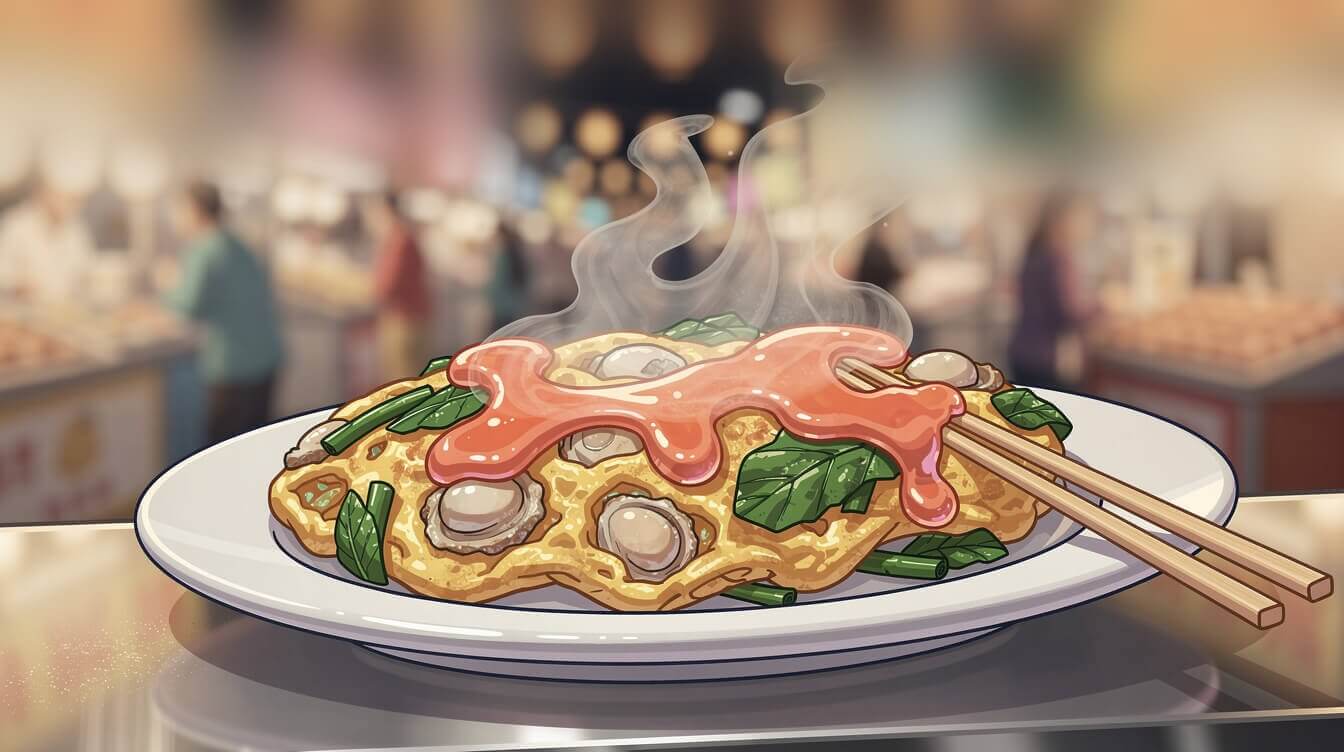
At almost every night market in Taiwan, there’s a stall where the griddle never stops hissing. A cook ladles out a puddle of milky batter, drops in a handful of tiny oysters, cracks an egg over the top, piles on some greens, and finishes the whole thing with a glossy pink sauce. That’s the Taiwan oyster omelette, or 蚵仔煎 (ô-á-tsian in Taiwanese Hokkien, usually spelled o-a-jian). It’s chewy, a little messy, and one of the island’s most loved street foods.
This guide covers the whole dish. You’ll get a home recipe with the batter ratio written out, a from-scratch version of the pink sauce that most recipes skip, and a side-by-side look at its cousins in Xiamen, Chaozhou and Singapore. Then we’ll look at where Taiwan’s oysters actually come from and where to eat a great one. If you only want the short version first, our quick oyster omelette explainer is a two-minute read.
What Is a Taiwan Oyster Omelette?
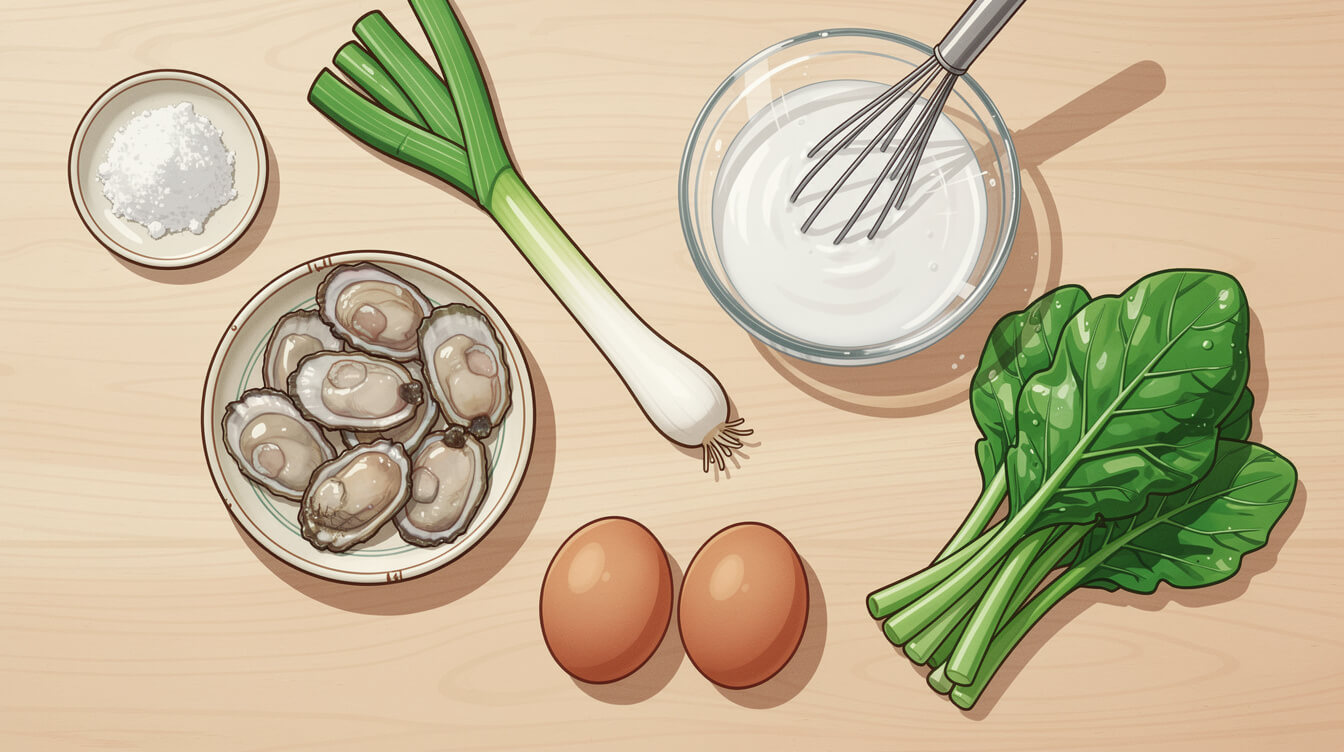
The English name is a little misleading. A Taiwan oyster omelette isn’t mostly egg. Its body is a starch pancake, made from sweet potato starch (地瓜粉) whisked into water and fried until it sets into a translucent, springy sheet. Egg is cooked into the top, and the oysters and greens are folded through it. Taiwan’s Ministry of Education Taiwanese dictionary describes it almost exactly like that: fresh oysters plus sweet potato starch mixed with water to the right thickness, pan-fried with greens and egg.
The texture is what Taiwanese people call QQ: soft, bouncy and slightly chewy, with edges that can crisp up a little where they touch the griddle. If you were expecting a fluffy French omelette, the first bite will surprise you. Think of it as halfway between a crêpe and mochi, with seafood in it.
The four building blocks
- Oysters. Taiwanese oysters are small, usually about the size of a thumbnail, with a sweet, briny flavor. You want lots of little ones, not a few big ones.
- Starch slurry. Sweet potato starch gives the signature chew. Many cooks cut it with a little potato starch for a smoother set.
- Egg. One per omelette, cracked straight onto the batter and broken up so it marbles through.
- Greens. These change by region. Food writer coverage on TVBS describes northern and southern stalls using 小白菜 (baby bok choy), southern ones adding plenty of bean sprouts, and central Taiwan using water spinach with garlic chives in the batter. Some stalls switch to chrysanthemum greens (茼蒿) in winter.
Then comes the sauce, which is half the flavor. We’ll get to it in its own section, because no Taiwan oyster omelette is finished without it.
Taiwan Oyster Omelette Recipe (蚵仔煎)

Most online recipes say “mix some starch with water” and leave you to guess. The ratio below comes from a Taiwanese high school cooking handout from Taipei Municipal Chenggong High School, which is about as no-nonsense as sources get. It works out to roughly 1 part starch to 2 parts water by volume, with sweet potato starch outnumbering potato starch three to one.
Ingredients (makes 2 to 3 omelettes in a 10-inch pan)
Batter
- 9 tablespoons sweet potato starch (地瓜粉; look for the fine powder, not the coarse “thick” grade)
- 3 tablespoons potato starch (sold in Taiwan as 太白粉)
- 1½ cups water
- ¼ teaspoon salt
Filling
- About 150 g (5 oz) small shucked oysters
- 1 egg per omelette
- 2 big handfuls of baby bok choy or chrysanthemum greens, cut into 2-inch pieces
- Neutral oil or lard for frying
- The pink sauce (next section)
Method
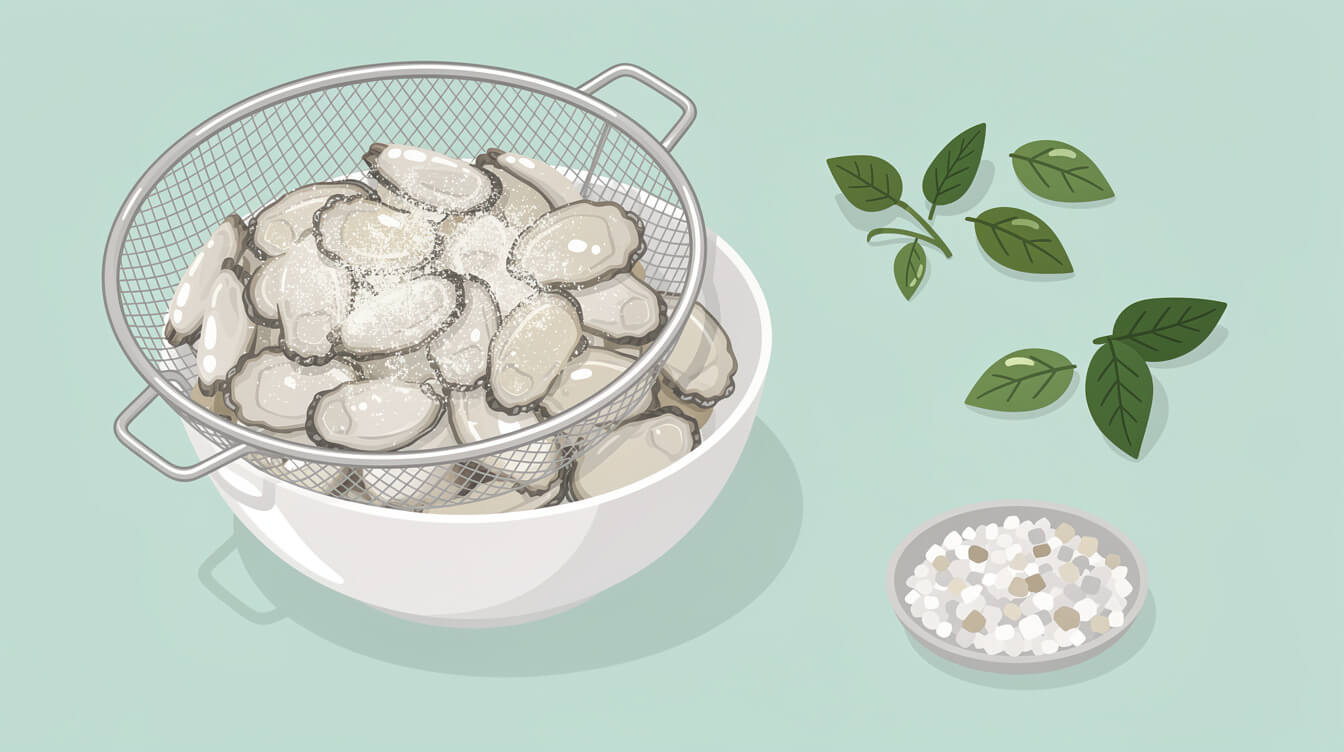
- Clean the oysters. Toss them gently with a spoonful of starch or salt, then rinse in cold water and pick out any bits of shell. Drain well and pat dry. Wet oysters make the batter watery.
- Mix the batter. Whisk the starches, water and salt together. Starch sinks fast, so stir it again right before every pour. This is the step home cooks most often miss.
- Heat the pan. Get a nonstick or well-seasoned cast iron pan hot over medium-high heat with about 2 tablespoons of oil. Stalls use a lot of fat, which is where the crisp edges come from.
- Oysters first. Scatter a third of the oysters in the pan and let them cook for about 30 seconds.
- Pour the batter. Ladle about a third of the batter over and around them. It will look milky and white at first.
- Wait for it to clear. When the edges turn translucent, crack an egg on top and break the yolk with your spatula so it spreads across the surface.
- Add the greens. Pile them on top while the egg is still wet. They’ll wilt from the steam.
- Flip. Once the bottom is set and the edges are golden, flip the whole thing. Give it another minute or two, until the greens are tender and the batter is fully clear with no white patches.
- Serve. Slide it onto a plate greens side up and spoon plenty of sauce over the top. Eat immediately, because the starch firms up as it cools.
How to tell it’s done: raw starch is opaque and chalky, and cooked starch is glassy and translucent. If you see white streaks, it needs more time.
If you enjoy cooking Taiwanese food at home, this pairs well with the dishes in our Taiwan food recipe guide and our lu rou fan recipe. Together they make a very convincing night-market dinner.
The Pink Sauce: How to Make It at Home
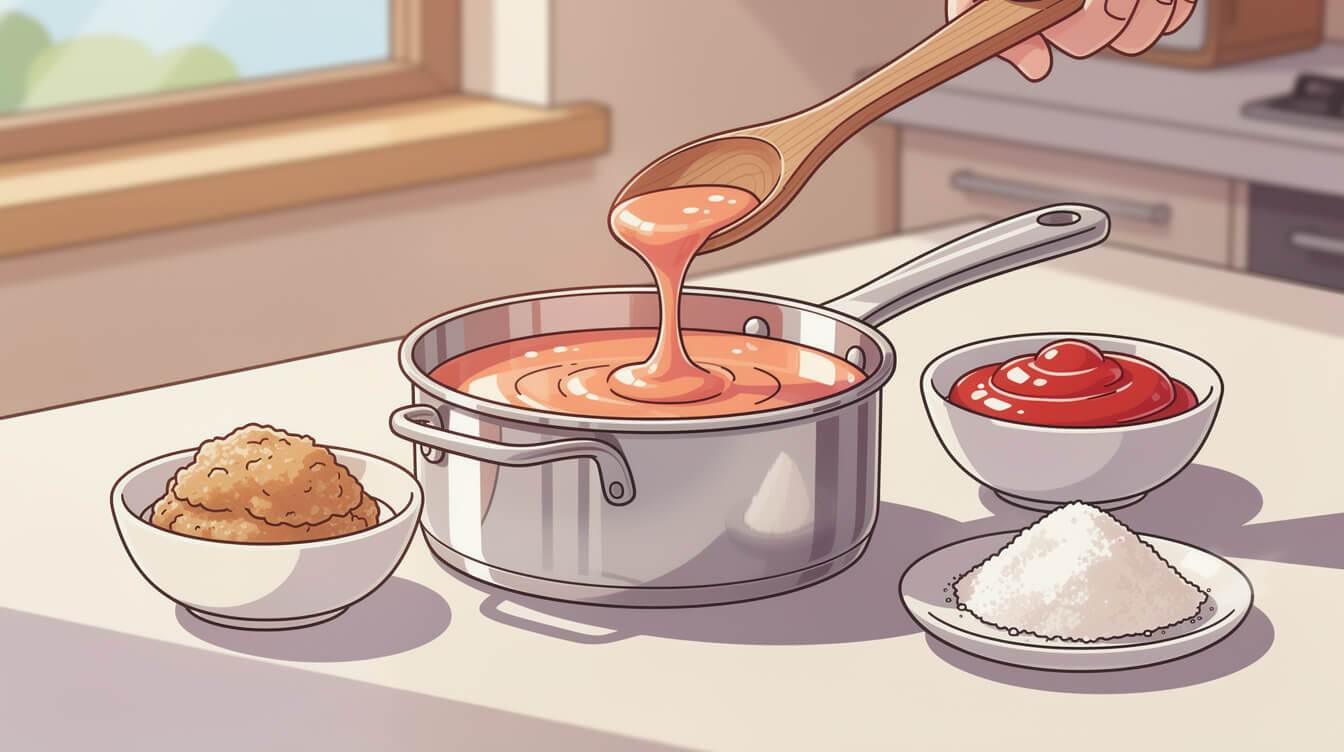
The sauce is the part people remember, and it’s also the part most recipes skip or replace with bottled sweet chili. In Taiwan it’s often called 海山醬 (hai shan jiang), the same pinkish sweet sauce you’ll find on ba-wan meatballs. Food site foodNEXT notes that much of what’s sold under that name is really a thickened sweet chili sauce. There are a couple of folk stories about the name, from “covering mountain and sea” to a pun on seafood sauce, and none of them is settled.
What is settled is the flavor: sweet first, then savory and gently tangy, with a glossy, spoonable body. This version follows the Chenggong High School handout:
Ingredients (enough for 3 to 4 omelettes)
- 4 tablespoons sweet chili sauce (甜辣醬)
- 2 tablespoons miso
- 1 tablespoon ketchup
- 1 tablespoon sugar
- 2 cups water
- A few drops of sesame oil
- Slurry: 1½ tablespoons potato starch stirred into 3 tablespoons water
Method
- Whisk the sweet chili sauce, miso, ketchup, sugar and water in a small saucepan until the miso dissolves.
- Bring it to a simmer over medium heat.
- Stir the slurry, then pour it in slowly while whisking. Keep stirring until the sauce turns glossy and thick enough to coat a spoon, about a minute.
- Take it off the heat and add the sesame oil. Taste and adjust: more sugar for a southern-style sweetness, or a little more miso for depth.
North vs south
Every stall guards its own version, but there are regional habits. According to TVBS, southern cooks lean on ketchup, which gives a redder, sweeter sauce, while northern stalls tend to add soy paste (醬油膏), so their sauce comes out browner. If you’ve had both and wondered why the color changed between Taipei and Tainan, that’s why.
Make a double batch, because it keeps in the fridge for a few days and it’s great on scallion pancakes too. (Here’s our Taiwan scallion pancake guide if you want a second project.)
One Dish, Four Coastlines: Taiwan vs Xiamen vs Teochew vs Singapore

The Taiwan oyster omelette has relatives all around the South China Sea, carried by Hokkien (Minnan) and Teochew-speaking communities wherever they settled. They share the same basic idea (oysters, egg and a starchy batter), but they’ve drifted apart in texture and especially in how they’re sauced. It’s not a Taiwanese invention: Quanzhou and Xiamen across the strait make the same dish under the same Minnan name. What Taiwan did was make it its own.
| Version | Starch & texture | Extras | Sauce |
|---|---|---|---|
| Taiwan 蚵仔煎 (ô-á-tsian) | Sweet potato starch slurry; soft, chewy, translucent | Leafy greens or bean sprouts, one egg | Pink sweet-savory sauce poured over the top |
| Xiamen / Quanzhou 海蛎煎 | Sweet potato starch, fried in lard | Chopped green garlic, duck or chicken egg | Served on the side: ketchup, sweet chili, shacha, pickled radish |
| Teochew (Chaozhou) 蚝烙 | Sweet potato starch only, fried in lard; fragrant-crisp but still chewy | Chicken and duck egg, scallion, coriander, pepper | Dipped in Teochew fish sauce |
| Singapore / Malaysia orh luak, orh jian, or chien | Starchy-and-chewy vs crispy-egg camps | Plenty of egg | Chili sauce, often garlicky, sometimes with lime |
Fujian: the closest cousin
A cultural heritage site run out of Quanzhou describes the Minnan version as oysters, egg, sweet potato starch and green garlic fried in lard, then eaten with ketchup, sweet chili, shacha sauce and pickled radish. Green garlic is the giveaway. If your plate smells of it, you’re probably eating the Fujian style.
Teochew: the crispy one
In a recipe for the Michelin Guide’s Hong Kong site, a Teochew chef explains that ho lua uses only sweet potato starch and is seasoned only at the table, with a dip of Teochew fish sauce. He describes the Taiwanese version as oilier and heavier on sauce, which is a fair summary of the difference. Teochew cooks want a crisp, fragrant crust. Taiwanese cooks want the soft, bouncy middle.
Singapore and Penang: the egg-forward ones
In Singapore the dish goes by its Teochew name, orh luak, or the Hokkien orh jian. Hawker fans tend to split into two camps: starchy and chewy, or crispy egg. Penang’s or chien is similarly divided, and both usually come with a punchy chili sauce rather than anything sweet. So if your Singaporean friend tells you the Taiwanese one is “too soft,” that’s not an insult. It’s a different school.
And the Koxinga story?
You’ll often read that the dish was invented in 1661, when Koxinga’s soldiers ran short of rice while fighting the Dutch and improvised with oysters and sweet potato starch. It’s a great story, and it gets repeated on both sides of the strait, but it’s a legend, not documented history. Enjoy it as one.
Where Taiwan’s Oysters Come From

Those little oysters are farmed along Taiwan’s shallow, muddy west coast. According to the Fisheries Agency’s 2025 yearbook, Taiwan produced 14,249 tonnes of oysters that year, almost all of it from aquaculture. Chiayi County led with 6,141 tonnes, followed by Tainan (4,062), Yunlin (1,628), Penghu (1,388) and Changhua (641).
Farmers use two broad approaches. On tidal flats they use fixed racks: oyster shells strung on lines and hung from bamboo frames, or bamboo stakes driven into the mud. In deeper lagoons and sheltered water they use floating rafts and longlines. Drive along the coast at Dongshi in Chiayi or Qigu in Tainan at low tide and you’ll see rows of racks running out toward the horizon. Chiayi’s fishermen’s association even holds an oyster culture festival at the Dongshi fish market. The July 2026 edition included a 377-person oyster-shucking contest.
Changhua is small by volume, but it has the most famous oyster scene on the island. In Fangyuan, farmers still drive ox carts out across the mudflats at low tide to harvest their racks. We told that story in our piece on Fangyuan’s sea cattle. If that corner of the coast has a special place in your heart, our I Love Changhua Taiwan Flag Heart T-Shirt is a small way to show it.
This is also why Taiwanese cooks insist on small oysters. The local ones are small and sweet, and a Taiwan oyster omelette is built around lots of tiny bites rather than a few big ones.
Where to Eat Oyster Omelette in Taiwan
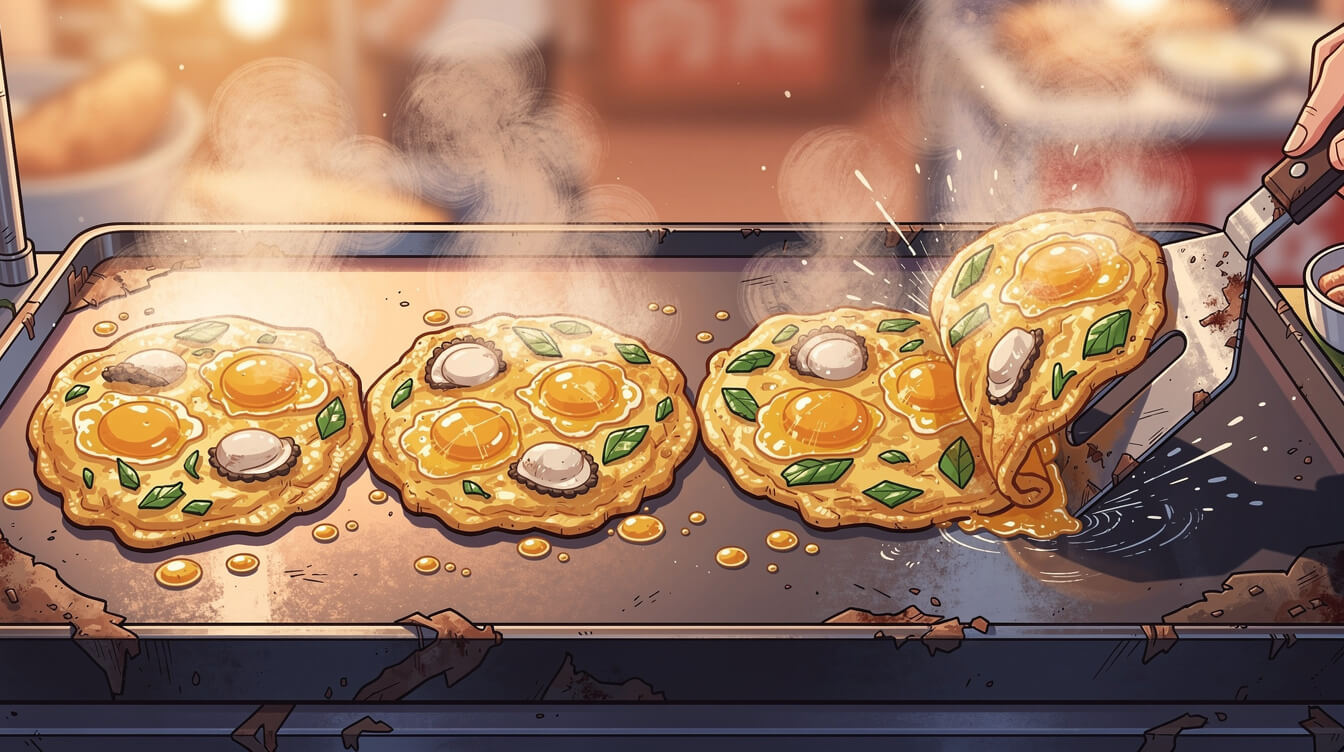
Almost every night market has an oyster omelette stall, and plenty of locals will tell you their neighborhood one is the best. A few places are worth going out of your way for. One honesty note first: you’ll see blogs calling various stalls “multi-year Michelin Bib Gourmand winners.” We checked, and no oyster omelette stall is on the 2026 Bib Gourmand list.
Yuan Huan Pien Oyster Omelette (圓環邊蚵仔煎), Ningxia, Taipei
At 46 Ningxia Road, this is the name everyone mentions. The Michelin Guide’s own listing notes it has been running since 1965, with homemade sweet-hot sauce and oysters from Tainan. It was a Bib Gourmand in Taipei’s first guide in 2018, and in the 2026 guide it appears as a Michelin Selected restaurant. Its name means “beside the circle,” a nod to the old Jiancheng traffic circle and its food stalls just down the road, which is part of why Ningxia feels like Taipei’s street-food archive. Plan the rest of your evening with our Ningxia Night Market guide.
Lai Ji Oyster Omelette (賴雞蛋蚵仔煎), Ningxia area
On Minsheng West Road, just off the Ningxia strip, Lai Ji is the other big name. It’s known for crisp edges around a chewy middle and shows up in a lot of food videos. It has no Michelin listing that we could find, so judge it by the queue.
Shilin Night Market, Taipei
Shilin has several oyster omelette stalls in and around its food court, so it’s easy to compare a few. Follow the locals rather than the loudest signs. Our Shilin Night Market insider’s guide has the full strategy.
Miaokou Night Market, Keelung
Stall 36 at Keelung’s Miaokou cooks its oyster omelettes over charcoal instead of a flat steel griddle, which gives them a smoky edge you won’t find in Taipei. Keelung isn’t covered by the Michelin Guide, so this one is pure word of mouth. Here’s our Keelung Miaokou Night Market guide.
Tainan and the southwest coast
Tainan is Taiwan’s second-biggest oyster producer, and Anping’s old streets are lined with oyster omelettes and other oyster snacks. The sauce here leans sweeter and redder, as you’d expect in the south. Start with our Tainan guide, and keep our Taiwan street food A–Z handy for everything else on the menu.
How to order like a local
- Pick the stall where the cook is making omelettes to order, not stacking them up in advance.
- Eat it on the spot. It doesn’t travel, because the starch tightens up as it cools.
- Want an egg-only version? Many stalls also sell 蝦仁煎 (shrimp) or 蛋煎 (egg only) from the same griddle, which is handy if someone in your group doesn’t eat oysters.
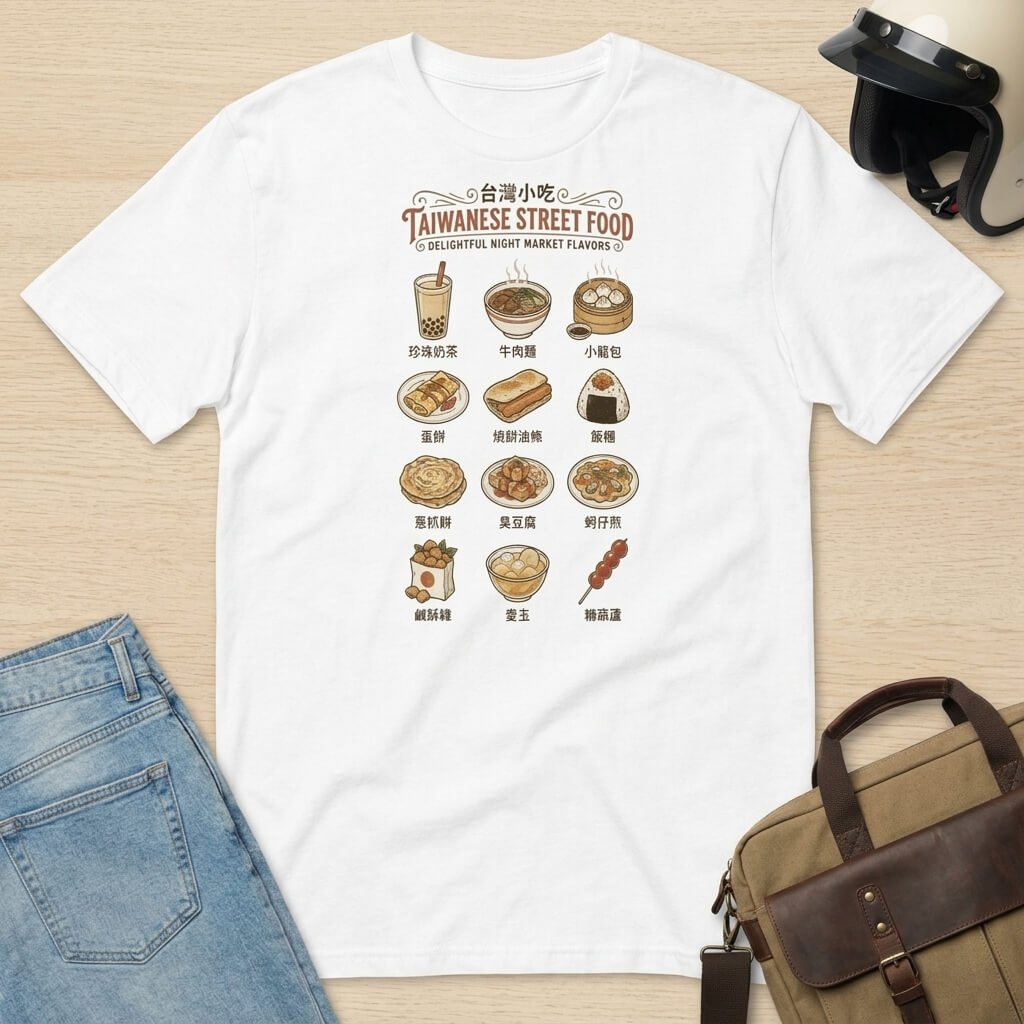
Put the Oyster Omelette on Your Shirt
Our Taiwanese Street Food Guide tee is a vintage-style poster of twelve night-market classics, and 蚵仔煎 has its own spot on the grid, right next to stinky tofu. It’s made for the friend who plans whole trips around what to eat.
Taiwan Oyster Omelette FAQ
How do you pronounce 蚵仔煎?
In Taiwanese Hokkien it’s ô-á-tsian, roughly “oh-ah-jen.” 蚵仔 (ô-á) means oyster and 煎 means pan-fried. In Mandarin you’ll hear ke zai jian, but many Taiwanese people switch to the Hokkien name for this dish even when they’re speaking Mandarin.
Can I use frozen oysters?
Yes. Thaw them in the fridge, rinse, and drain them very well on paper towels. Look for the smallest ones you can find, or cut large ones in half. Jarred oysters work in a pinch too.
Is a Taiwan oyster omelette gluten-free?
The pancake is, since sweet potato starch and potato starch contain no gluten. The sauce usually isn’t. Soy paste (醬油膏) is normally brewed with wheat, and some miso contains barley. At home, use a gluten-free miso and sweet chili sauce, and skip the soy paste. At a stall, assume the sauce contains gluten. For more on navigating this in Taiwan, our gluten-free boba guide includes phrases you can show a vendor.
Can I use only potato starch or tapioca starch?
You can, and many Western recipes use tapioca. The result is still tasty, but it’s smoother and less bouncy. For the authentic chew, use mostly sweet potato starch, which you’ll find in Asian grocery stores, often labeled “sweet potato starch” or 地瓜粉.
Why is my batter gummy or white in the middle?
Either the pan wasn’t hot enough or the batter layer was too thick. Use less batter per omelette, keep the heat at medium-high, and cook until no white patches remain.
What does it taste like?
Briny oysters, a soft and slightly crisp-edged pancake, rich egg, fresh greens, and a sweet-tangy sauce over everything. It’s comfort food, and it’s best eaten standing at a night-market counter.
Final Thoughts: Small Oysters, Big Personality
The Taiwan oyster omelette is a lesson in how a shared dish becomes a local one. Its relatives in Xiamen, Chaozhou and Singapore use the same oysters, egg and starch. Taiwan made it soft and chewy, piled on the greens, and gave it a pink sauce that every stall argues about. Behind each plate are the farmers on Chiayi’s tidal flats and the cooks who’ve worked the same griddle since the 1960s.
So mix your starch, stir it again, and give it a try at home. Then, next time you’re in Taiwan, find the stall with the longest line of locals and order one fresh off the griddle.
A Postcard From Taiwan, Every Week
Night-market recipes, food stories and the little Taiwan traditions worth knowing, sent straight to your inbox. No spam, and you can unsubscribe anytime.

Grab a Free Taiwan Sticker!
Drop your email and we’ll send you a limited-edition Taiwan sticker — plus insider access to new merch drops and island vibes.
No spam. Unsubscribe anytime.