Hakka People in Taiwan: Who the Hakka Are, Where They Live, and What They Eat
Drive an hour south of Taipei into the hills of Hsinchu County and something shifts. The tea bushes climb in tidy rows, the farmhouses are red brick with grey tile roofs, the stir-fry on your plate has dried squid in it, and the old man at the next table is speaking a language that is neither Mandarin nor Taiwanese. You’ve arrived in Hakka Taiwan. The Hakka people (客家, Hakka literally means “guest families”) are one of the island’s largest communities, and in some counties they are the majority.
Most English guides to the Hakka people tell the mainland story: migrations out of northern China, round earthen tulou in Fujian, famous Hakka politicians. Taiwan gets a line in a list. But Taiwan is the place where Hakka is a legal national language, where there’s a cabinet-level ministry and a 24-hour TV channel for it, and where Hakka villages still plant tea, dry radishes and paint paper umbrellas. This guide is about that Taiwan: who the Hakka are, how they got here, where they live, what they cook, and how to visit.
Who Are the Hakka People?

The Hakka people are a Han Chinese group with their own language, food and customs. Their ancestors are generally described as northern Chinese who moved south in waves over many centuries, eventually settling the hilly border country where Guangdong, Fujian and Jiangxi meet. Because the best lowland was usually already farmed by the time they arrived, they were the “guests,” and the name stuck.
That outsider history shaped a reputation for thrift, hard work and stubbornness. Hakka people in Taiwan call it the “hard neck” spirit (硬頸). Interestingly, the Hakka Affairs Council notes the phrase started out as an insult meaning “pig-headed” and only became a badge of pride in the 1980s, when Hakka activists began fighting for their language.
Today the Hakka people live all over the world, from Malaysia and Singapore to Mauritius, Jamaica and Toronto. Taiwan has one of the largest and best-organized Hakka communities anywhere. The Hakka Affairs Council’s most recent national survey (2021) estimated 4,669,192 Hakka people in Taiwan, about 19.8% of the population. That figure uses the legal definition in the Hakka Basic Act: you have Hakka ancestry and you identify as Hakka. The council runs the survey about every five years.
So roughly one in five people in Taiwan is Hakka. If you’ve spent any time here, you’ve almost certainly eaten Hakka food, ridden an MRT car that announces stations in Hakka, or met someone with a Hakka grandmother.
How the Hakka People Came to Taiwan (and Why They Ended Up in the Hills)
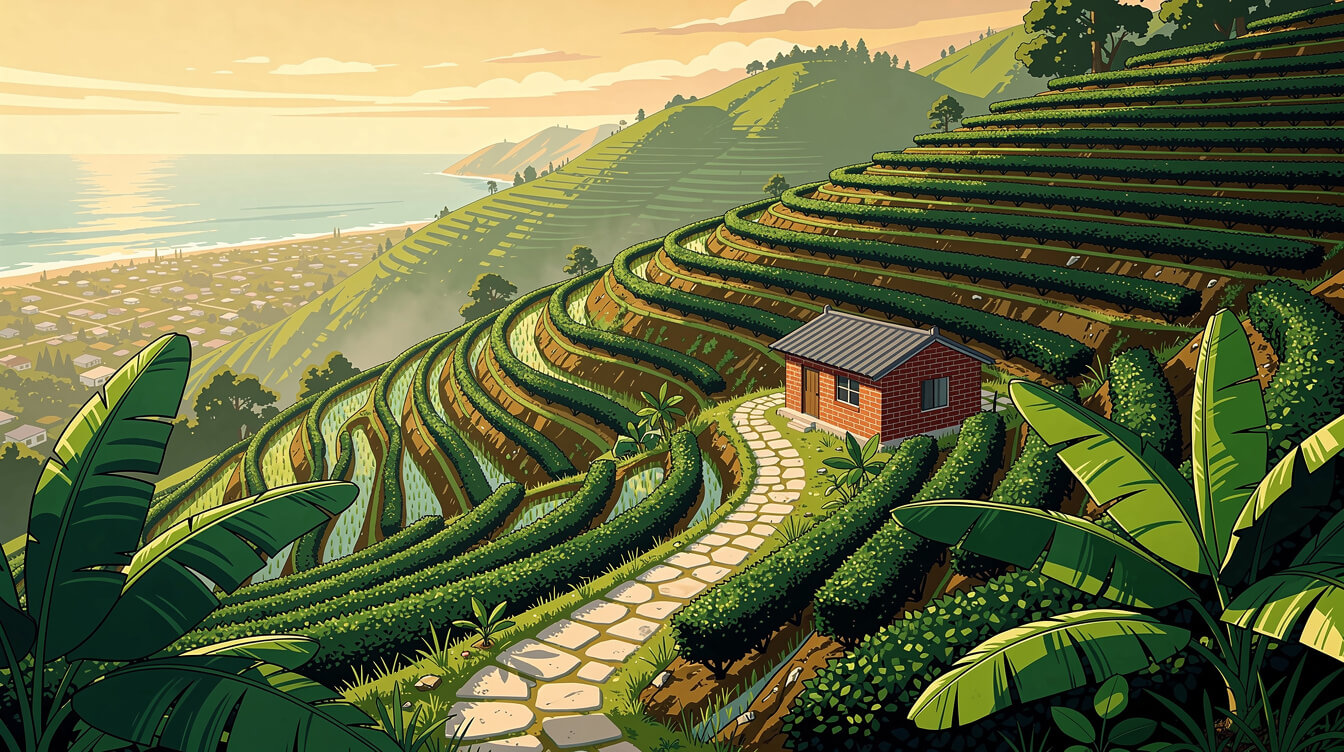
Most of Taiwan’s Hakka families trace their arrival to the Qing dynasty, which ruled Taiwan from 1683. Settlers crossed the strait through the 1700s and 1800s, mainly from eastern Guangdong (around Jiaying, today’s Meizhou) and from Hakka pockets of western and southern Fujian. Many Hoklo settlers from southern Fujian had already taken the coastal plains, so Hakka families often farmed the river terraces and foothills inland. Our short history of Taiwan covers the wider Qing-era picture.
Frontier life was rough. Settler groups fought each other, the Qing government, and Indigenous nations whose land they were moving onto. Two episodes still shape Hakka identity in Taiwan:
The Liudui militia of the south (1721)
When the Zhu Yigui uprising swept southern Taiwan in 1721, Hakka villages on the Pingtung plain organized a self-defense militia, meeting at the Mazu temple in Neipu. That militia grew into the Liudui (六堆), the “Six Divisions”: Front, Rear, Left, Right, Center and Vanguard. The name outlived the fighting and still describes the Hakka townships of Pingtung and Kaohsiung. Meinong is in the Right Division, Neipu the Rear, Zhutian the Center and Wanluan the Vanguard. Locals still say “Liudui” when they mean southern Hakka country, the way someone might say “the Bay Area.”
The Yimin, “righteous people” of the north (1786–1788)
During the Lin Shuangwen uprising of 1786, Hakka volunteers in the north fought on the Qing side, and many died. Their remains were buried together in Xinpu, Hsinchu County, and the Xinpu Yimin Temple (新埔褒忠義民廟) was built over the grave between 1788 and 1790. The temple became the spiritual center of northern Hakka Taiwan, and its yearly festival is still the biggest Hakka religious event on the island (more on that below).
Later waves added to the map. From the late 19th century and through the Japanese era, many Hakka families from the crowded northwest moved again, to the East Rift Valley of Hualien and Taitung. Others came after 1949 from Guangdong with the Nationalist government. That’s why Hakka Taiwan isn’t one region but a scatter of them.
Where Hakka Taiwan Is: Hsinchu, Miaoli, Taoyuan, Liudui and the East

The 2021 survey has a county-by-county breakdown, and it’s the best map of Hakka Taiwan you’ll find:
- Hsinchu County: 67.8% Hakka. The most Hakka county in Taiwan. Zhubei, Xinpu, Beipu, Emei, Hengshan (with Neiwan) and Guanxi are all here.
- Miaoli County: 62.5%. Rolling hills, tung forests, Sanyi woodcarving, and the “Hakka capital” feel of Miaoli City and Gongguan.
- Taoyuan: 39.9%. By raw numbers, Taoyuan has the most Hakka residents of any city, about 905,000, centered on Zhongli, Pingzhen, Yangmei, Longtan and Xinwu.
- Hualien: 34.2%. The east-coast migrants’ descendants, especially in Fenglin, Yuli and Ji’an.
- Hsinchu City: 30.3%, and Pingtung: 23.1%, where the Liudui townships sit.
New Taipei has around 672,000 Hakka residents too, but they’re spread through a huge city, so you’d never notice. The places to go if you want to feel Hakka Taiwan are the hill towns of Hsinchu and Miaoli, and Meinong in the south.
Meinong (美濃), in Kaohsiung’s hills, deserves its own mention. It’s the Liudui’s cultural heart: a valley of rice paddies under a ridge of green mountains, dotted with the old brick tobacco-curing barns that once powered the local economy. It’s also Taiwan’s oil-paper umbrella town, and our guide to rural Taiwan without a car covers how to reach it and the rest of the countryside.
The Hakka Language Today: A National Language With Its Own TV Channel
For decades, Hakka was pushed out of public life. Under martial-law-era language policy, Mandarin ruled schools and broadcasting, and local languages were treated as something to grow out of. Then on December 28, 1988, Hakka people marched through Taipei in the “Return My Mother Tongue” movement (還我母語運動), demanding Hakka on radio and TV and in schools. It’s one of the founding moments of modern Hakka identity in Taiwan.
What followed is a remarkable turnaround:
- 2001: the cabinet-level Hakka Affairs Council (客家委員會) was founded on June 14, 2001. A national ministry for the Hakka people is a rare thing anywhere in the world.
- 2003: Hakka TV went on air on July 1, 2003, often described as the world’s first Hakka-language TV channel.
- 2010: the Hakka Basic Act was passed. Its 2018 revision made it explicit: “Hakka is one of the national languages, equal to the languages of other ethnic groups.”
- 2019: the Development of National Languages Act (January 9, 2019) put Hakka, Taiwanese Hokkien, the Indigenous languages, Matsu and Taiwan Sign Language alongside Mandarin.
In 2022, the council moved National Hakka Day to December 28, the anniversary of the 1988 march. It used to fall on Tianchuan Day (天穿日, the 20th day of the first lunar month), but that’s mainly a northern Hakka custom, so the council picked a date that every Hakka community shares. If you’re reading this in late 2026, the next one is Monday, December 28.
Five dialects, one language
Taiwan’s law names five main Hakka varieties, remembered by the mnemonic 四海大平安: Sixian (四縣), Hailu (海陸), Dapu (大埔), Raoping (饒平) and Zhao’an (詔安). Sixian is the most widely used, with Hailu second and strongest in Hsinchu. The language tests also count a sixth, Southern Sixian, which is spoken in Liudui.
The language is still in trouble, though. In the 2021 survey, 56.4% of Hakka people could understand Hakka and only 38.3% could speak it, down from 64.3% and 46.8% in 2016. Plenty of Hakka families now speak Mandarin at home. If you want to try a word, the standard Hakka greeting in the Ministry of Education dictionary is 恁早, “good morning,” and an older Hakka speaker will love you for attempting it. For how Hakka fits with Mandarin, Taiwanese and the Indigenous languages, see our guides to what languages you’ll actually hear in Taiwan and Taiwan’s official languages.
Hakka Food in Taiwan: Stir-Fry, Flat Noodles and Pickled Greens
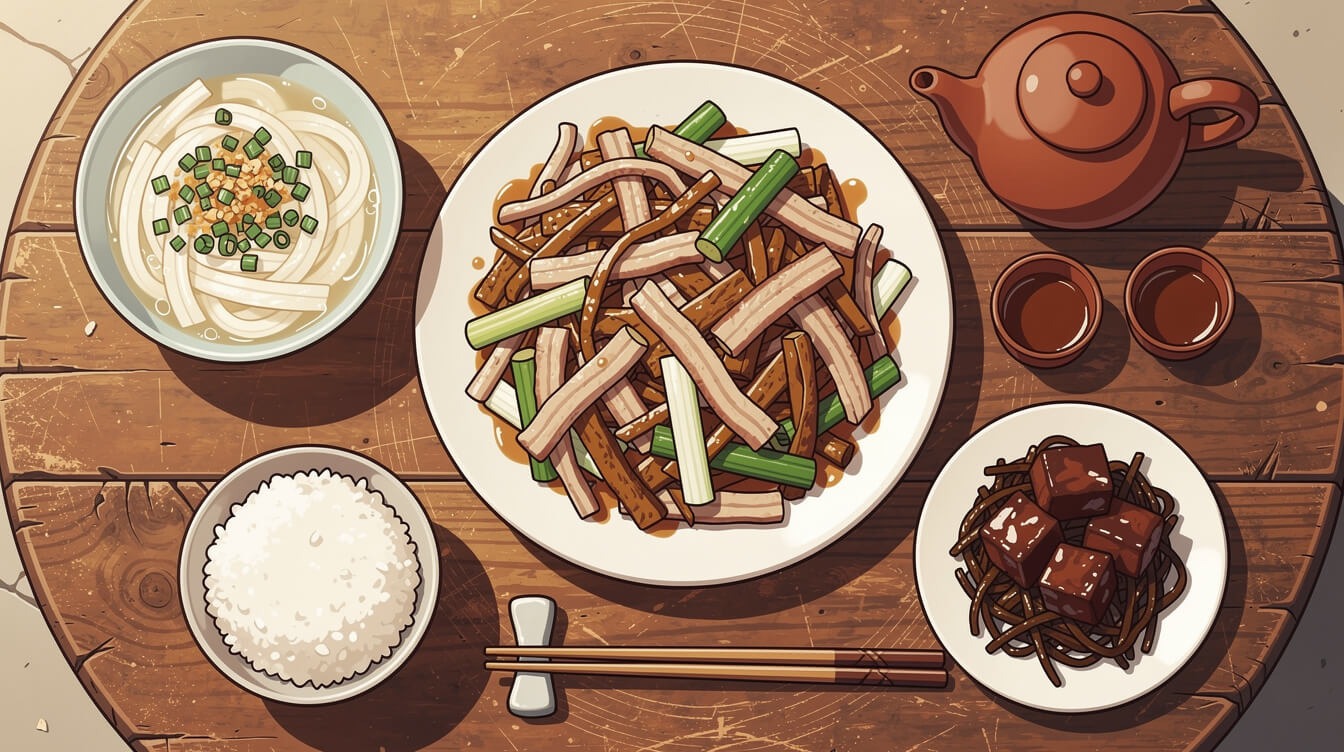
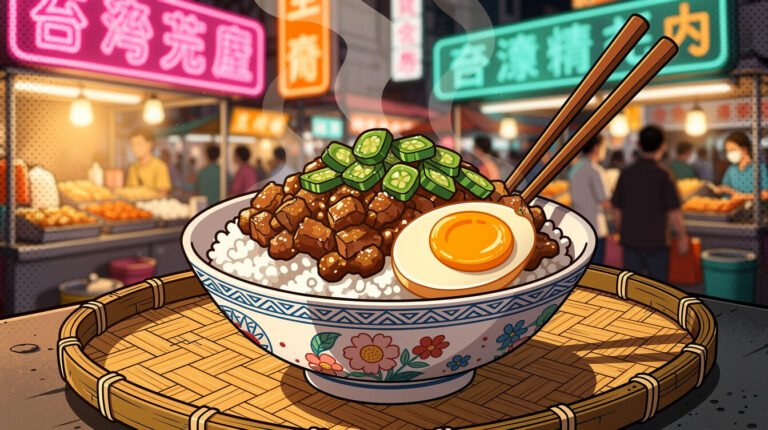
Ask anyone in Taiwan what Hakka food tastes like and you’ll hear the same three words: salty, fatty, fragrant (鹹、肥、香). It’s farm food, built for people who worked the hills all day and couldn’t waste anything. Preserving was everything: salted pork, dried radish, and above all, mustard greens in three forms. Hakka cooks talk about 四炆四炒, “four braises and four stir-fries,” as the backbone of a proper Hakka meal. Here’s what to order:
Hakka stir-fry (客家小炒)
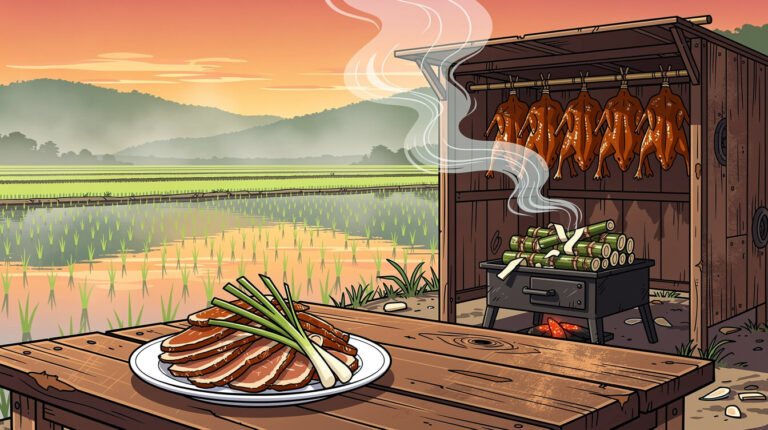
The dish everyone in Taiwan associates with the Hakka people. Strips of pork belly, dried squid and dried tofu are stir-fried with celery and scallions or garlic leaves in soy sauce. It began as a way to use up the pork and squid from ancestral offerings, and it’s so central to Hakka identity that the Hakka Affairs Council runs a national Hakka stir-fry cooking contest. Every Hakka restaurant in Taiwan has it, and it’s perfect with a cold beer.
Ban tiao (粄條), Meinong’s flat rice noodles
Wide, slippery, white noodles made from steamed indica-rice batter cut into ribbons. Northern Hakka towns serve them too, but Meinong is famous for them. In the south they’re also called 面帕粄, “towel noodles,” because the steamed sheets look like folded hand towels, and southern makers add sweet potato starch for extra chew. Order them in soup or dry-tossed with fried shallot oil. Our Taiwan noodles guide has more on them.
One mustard green, three pickles
Hakka households turn a single vegetable, leaf mustard (芥菜), into three different pantry staples. Salted and fermented, it’s suancai or xiancai (酸菜/鹹菜). Sun-dried and packed into bottles to ferment again for months, it becomes fucai (福菜). Dried all the way, it’s meigancai (梅乾菜), the dark, savory leaves braised under fatty pork belly in 梅乾扣肉, one of the great Hakka banquet dishes. Fucai soup with pork ribs is the cozy winter version.
Lei cha (擂茶), with an honest footnote
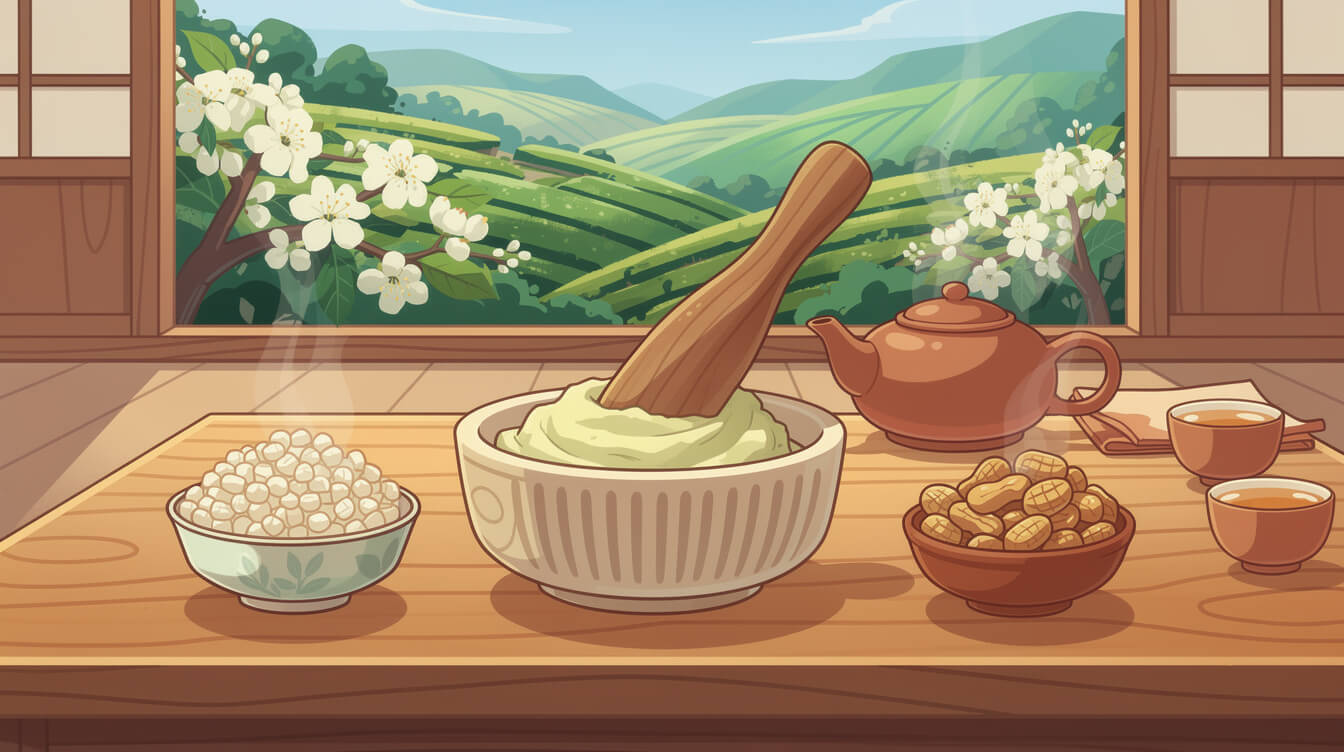
In Beipu you’ll be invited to grind your own lei cha: tea leaves, sesame, peanuts and grains pounded in a ridged ceramic bowl with a wooden pestle, then topped up with hot water and puffed rice. It’s fun and delicious, but it isn’t an ancient Beipu tradition. The sweet, tourist-friendly version was promoted from 1998 by Beipu’s farmers’ association and took off in the media from 1999. Researchers still argue about how far back the custom goes in Taiwan. One study on the Hakka Affairs Council’s site traces a savory home version to families who came from Guangdong’s Hepo area after 1949. So enjoy it, and know you’re drinking a 1990s revival of a much older idea.
Hakka cooking also shows up at other times of year. On the winter solstice, Hakka families make savory tangyuan in a peppery broth with crown daisy greens, and the hills around Beipu and Emei grow Oriental Beauty tea, the oolong that only exists because a bug bit it.
Hakka Festivals and Craft: Yimin, Tung Blossoms, Indigo and Floral Cloth
The Yimin Festival (義民節)
Held at the Xinpu Yimin Temple on the 20th day of the seventh lunar month (usually late August or September), this is the big one for northern Hakka people. Fifteen districts take turns hosting, so each community’s turn comes around once every fifteen years, and the host district goes all out. The festival is known for its offerings, including the famous (and controversial) contest of giant ceremonial pigs. It’s also a homecoming: Hakka families from Taipei and Taoyuan drive back to their ancestral villages for it.
Tung Blossom Festival (客家桐花祭)
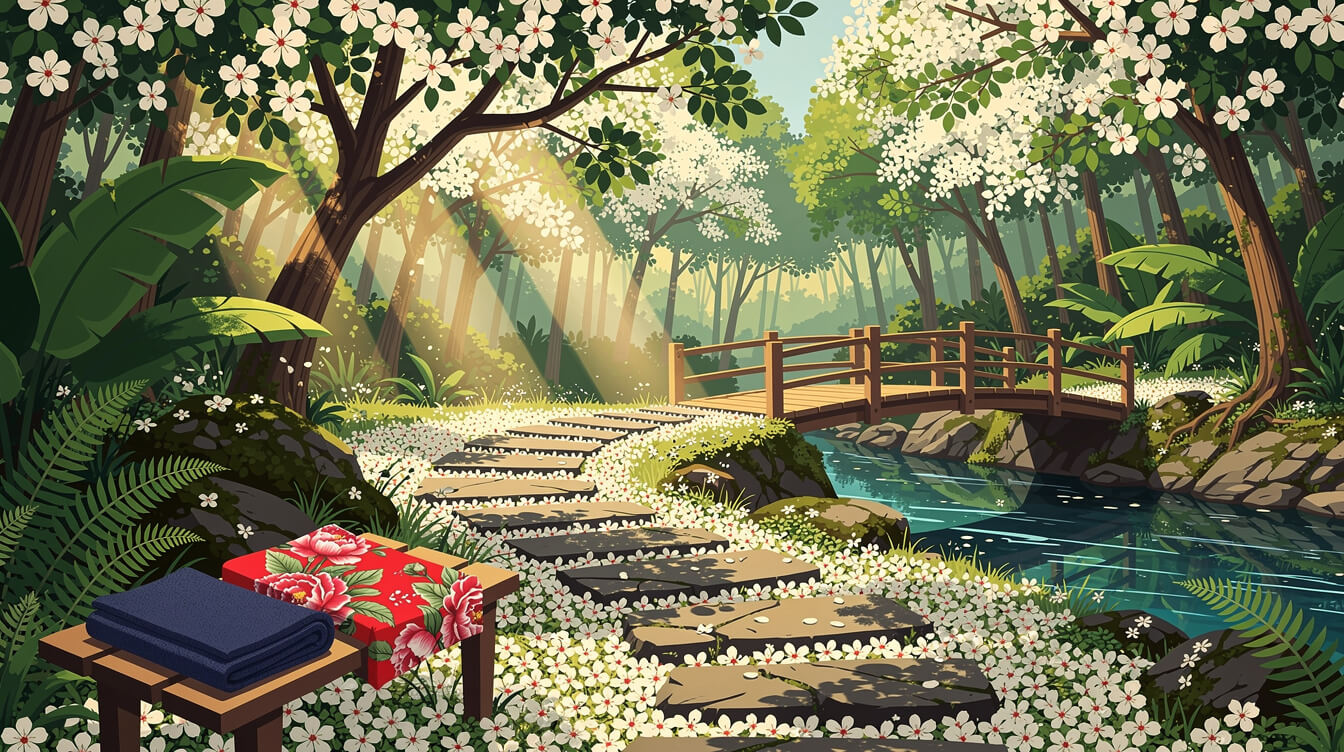
Every April and May, the tung trees on the Hakka hills drop white flowers so thickly that the trails look snowed on. The Hakka Affairs Council turned the bloom into a festival in 2002, and 2026 was its 25th year. Expect blossom walks, Hakka food stalls and concerts all over Miaoli, Hsinchu and Taoyuan. Our daily on Taiwan’s tung blossom season covers where to see it.
Indigo shirts and the famous floral print
Traditional Hakka clothing was practical and plain: the long blue indigo shirt (藍衫) worn by Hakka women for field work. The bold red-and-pink peony print you now see on everything labeled “Hakka” has a more modern story. As our Taiwan traditional clothing guide explains, the big-flower fabric was a mid-20th-century household print used for quilts and curtains across Taiwan, and it was rebranded as Hakka in the 2000s through cultural promotion. Today it’s a genuine, much-loved Hakka design icon, just a young one. You’ll see it on bags, aprons, tea cozies and festival banners in every Hakka town.

Wear the Hakka Flower Print
The bold peony print that became the face of Hakka Taiwan, all over a tank top. Bright, loud and made for Taiwan summers, or for anyone with a Hakka grandma.
Visiting Hakka Taiwan: Beipu, Neiwan and Meinong
You can see Hakka Taiwan on a day trip from Taipei. These three are the easiest and most rewarding:
Beipu (北埔), Hsinchu County
A compact old town built around the Citian Temple, with Qing-era family halls and lanes full of persimmon cakes, Oriental Beauty tea and lei cha shops. Beipu began in the 1830s as a fortified frontier settlement run by a joint Hakka–Hoklo land company called Jinguangfu (金廣福), and its old headquarters still stands near the temple. Take the train or High Speed Rail to Zhubei, then a bus. Our Hsinchu guide covers Beipu alongside the city’s rice noodles and glass.
Neiwan (內灣), Hsinchu County
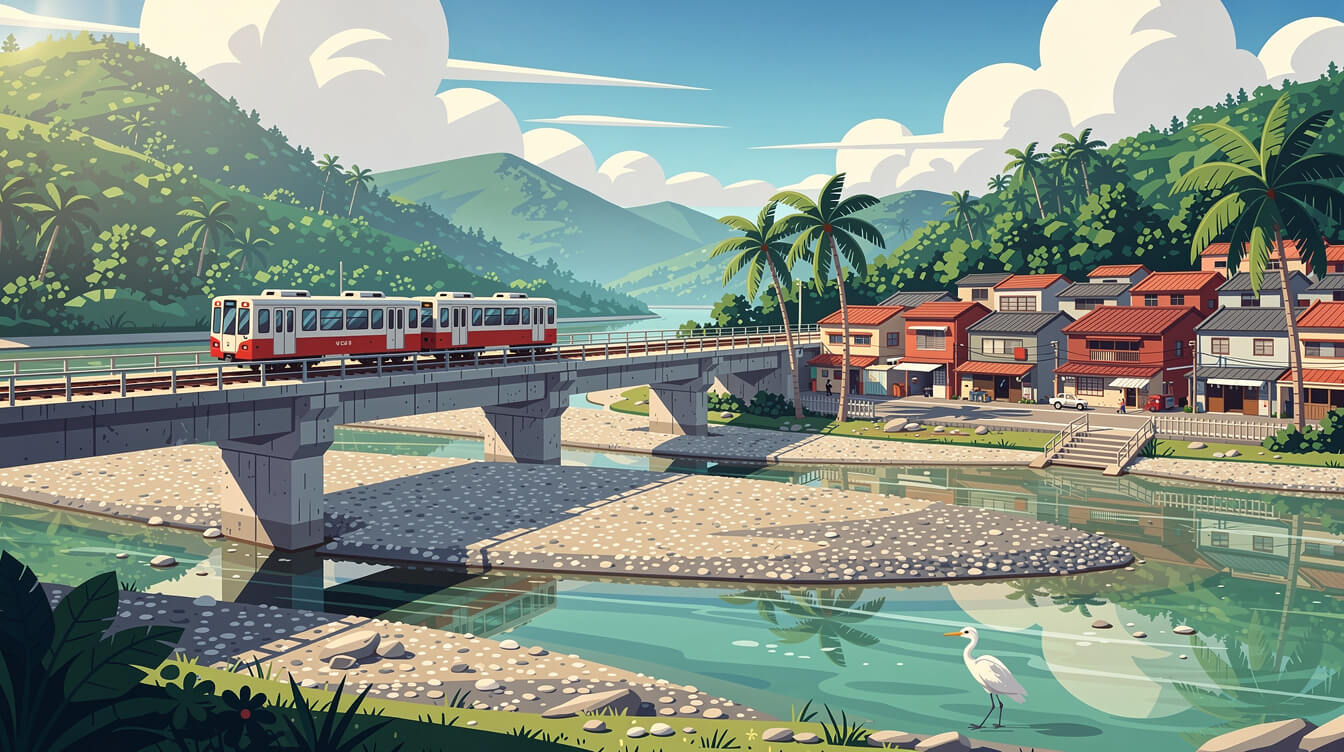
The end of the Neiwan branch line, a little rail line that winds up a river valley from Hsinchu into the hills. Neiwan’s old street is busy on weekends with Hakka snacks, wild-ginger-flower rice dumplings and grass jelly. Ride the train for the views, eat your way up the street, and catch the train back before dark.
Meinong (美濃), Kaohsiung
The southern Hakka heartland. Cycle the paddy roads, see the old tobacco barns, watch artisans paint oil-paper umbrellas, then sit down to a bowl of ban tiao. Meinong is roughly an hour by car or bus from central Kaohsiung, so give it a full day.
If you’re road-tripping the northwest, Miaoli’s hill towns (Gongguan, Nanzhuang, Sanyi) are worth a detour too, especially during tung blossom season. And if you leave a little bit in love with those hills, our I Love Miaoli Taiwan Flag Heart T-Shirt and the matching I Love Hsinchu County tee are made for people who’ve been there.
Hakka People FAQ
Are Taiwanese people Hakka?
Some are. About one in five people in Taiwan is Hakka (19.8% in the 2021 government survey). Most Taiwanese are Hoklo, whose ancestors came from southern Fujian, and Taiwan is also home to 17 officially recognized Indigenous peoples and many post-1949 and newer immigrant families. Plenty of people have mixed Hakka and Hoklo ancestry.
Where are Hakka people originally from?
Hakka people are generally described as descendants of northern Han Chinese who moved south over many centuries and settled the hill country where Guangdong, Fujian and Jiangxi meet. Taiwan’s Hakka families mostly came from eastern Guangdong and western Fujian during the Qing dynasty.
Are Hakka people Cantonese?
No. Many Hakka people live in Guangdong province, but Hakka and Cantonese are different groups with different languages that aren’t mutually intelligible. In Taiwan, Hakka is also distinct from Taiwanese Hokkien.
Is Hakka a different language from Mandarin?
Yes. Hakka is its own Chinese language, and a Mandarin speaker won’t understand it without learning it. In Taiwan it’s a legal national language with five recognized dialects.
When is National Hakka Day?
December 28, the anniversary of the 1988 “Return My Mother Tongue” march. It moved there in 2022 from Tianchuan Day in the lunar calendar.
What is the most famous Hakka dish in Taiwan?
Hakka stir-fry (客家小炒), the pork belly, dried squid and dried tofu stir-fry. Close behind: ban tiao flat rice noodles, braised pork with meigancai, and lei cha.
Final Thoughts: The Guests Who Made Themselves at Home
The name says “guest families,” but in Taiwan the Hakka people have been home for three centuries. They terraced the hills, defended their villages, fought for the right to speak their own language on TV, and won it. Today you can take a Hakka-language test, watch Hakka dramas, and order Hakka stir-fry in almost any Taiwanese town.
The best way to understand Hakka Taiwan is to go. Take the slow train to Neiwan, grind a bowl of lei cha in Beipu, eat ban tiao in Meinong, and listen for that unfamiliar language at the next table. Then say 恁早 and see what happens. For more about the island’s people and places, start with our guide to Taiwan culture.
A Postcard From Taiwan, Every Week
Festival dates, food stories and the little Taiwan traditions worth knowing, straight to your inbox. No spam, unsubscribe anytime.

Grab a Free Taiwan Sticker!
Drop your email and we’ll send you a limited-edition Taiwan sticker — plus insider access to new merch drops and island vibes.
No spam. Unsubscribe anytime.