Taiwan Noodles: Every Noodle Type on the Island and the Dish You Should Eat It In
Ask for taiwan noodles in a Taipei shop and you will not get one thing — you will get a question back. Soup or dry? Which strand? And that is the part almost nobody explains. Every guide on the internet hands you a single recipe: dan dan noodles, sesame noodles, beef noodle soup. Useful, but it is like answering “what is Italian pasta?” with a carbonara recipe.
Taiwan does not have a noodle dish. It has a noodle system — roughly seven distinct strands, each with its own texture and its own natural home, recombined across a hundred regional dishes. Once you can tell 米粉 from 麵線 from 板條, a Taiwanese menu stops being a wall of characters and becomes a grid you can read.
This guide covers all of it: the strands themselves, the dishes built on them, where each one comes from, and — the bit visitors actually need at 9pm outside a shop with no English menu — how to order. By the end you will be able to walk into a noodle shop anywhere on the island and order the right bowl on purpose.
Taiwan Noodles vs Taiwanese Noodle Dishes: The Distinction That Makes a Menu Readable
Here is the single most useful idea in this entire guide, and it takes about thirty seconds to absorb.
On a Taiwanese menu, the noodle and the dish are separate decisions. The strand is the raw material — a specific dough, cut and dried a specific way, with a specific bite. The dish is what a cook does with it: which broth, which topping, dry or in soup. The same strand shows up in a hundred-year-old Tainan classic and in a five-minute weeknight bowl, and it is still the same strand.
Chinese-language menus reflect this openly. 牛肉麵 is “beef + noodle” — beef noodle soup. 蚵仔麵線 is “oyster + thread noodle.” 炒米粉 is “stir-fried + rice vermicelli.” The name is usually just topping + strand, sometimes with a cooking verb bolted on the front. Learn perhaps eight characters and a large fraction of the menu decodes itself.
English-language coverage collapses this. It translates everything to “noodles,” so a reader ends up thinking beef noodle soup and oyster mianxian are two entries on a list of five Taiwanese dishes, rather than two completely different strands serving two completely different social functions — one a sit-down national dish, the other a paper bowl eaten standing up with a plastic spoon.
So as you read the rest of this: the next section is strands. Everything after it is dishes. Keeping those two apart is the whole skill.
The Strands: A Field Guide to Taiwan Noodles
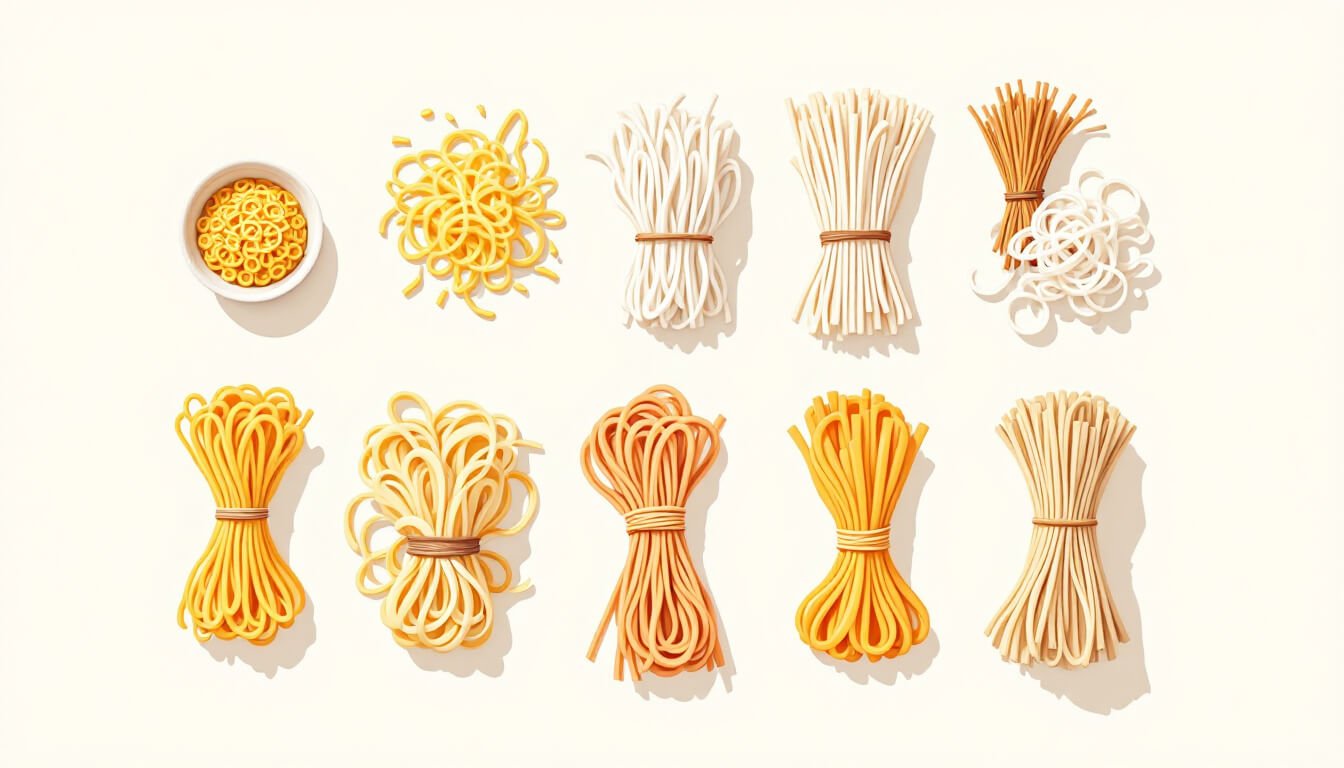
Seven strands do most of the work across every bowl of Taiwan noodles you will ever meet. Two are wheat, three are rice, one is a bean-starch outlier, and one is a category of its own. Learn these and you have the vocabulary.
油麵 You Mian — Oil Noodles
Springy, distinctly yellow, faintly alkaline, and sold already cooked. Alkaline salts give you mian its colour and its bounce; a light coat of oil keeps the pre-cooked strands from fusing in the tray. Because it arrives cooked, a vendor only needs to dunk it in boiling water for a few seconds — which is exactly why it underpins the fastest street food on the island, from 擔仔麵 to Taiwanese cold noodles. If a bowl lands in front of you within forty seconds of ordering, you are eating you mian.
米粉 Mi Fen — Rice Vermicelli
Thin, white, made from rice flour, and the strand most associated with a single city: Hsinchu. Hsinchu sits in the path of the northeast monsoon, and those dry winter winds are genuinely part of the production process — the noodles were traditionally wind-dried on racks, which is why 新竹米粉 became a protected regional name rather than a generic. Mi fen turns up stir-fried with cabbage, dried shrimp and shiitake (炒米粉), and in a milky pork-bone soup (米粉湯) sold alongside a tray of braised offal.
米苔目 Mi Tai Mu — Thick Rice Noodle
Short, fat, translucent, slippery, with a satisfying snap. Hakka in origin, and uniquely double-lived: in a savoury pork broth in winter, and in summer piled into shaved ice with brown sugar syrup as a dessert. It is the only strand on this list you will meet in both a soup bowl and an ice bowl, and finding it sweet the first time is genuinely disorienting.
意麵 Yi Mian — Wavy Flat Noodle
A flat, crimped wheat noodle, often made with egg and no water, associated above all with Tainan and with the little town of Yanshui. Yi mian fries beautifully — 鱔魚意麵, stir-fried eel over yi mian in a sweet-sour sauce with serious wok heat, is one of Tainan’s signature plates. The claypot version, 鍋燒意麵, arrives bubbling with seafood and a cracked egg.
板條 Ban Tiao — Flat Rice Ribbon
Wide, soft, white rice ribbons, written 粄條 in Hakka. This is Hakka comfort food, and Meinong in Kaohsiung is its heartland. Served dry with fried shallots, garlic chives and shredded pork, or in a clear soup. Silkier and more yielding than the wheat noodles — it does not fight back.
麵線 Mian Xian — Thread Noodle
Extremely fine hand-pulled wheat threads, salted and dried. Two versions matter. White mian xian is what goes into 麻油麵線, sesame oil thread noodles — a birthday and postpartum dish, because long unbroken noodles mean long life. Red mian xian (紅麵線) is steamed much longer, which darkens it and, crucially, stops it dissolving in liquid. That is the one in oyster mianxian.
刀削麵 Dao Xiao Mian — Knife-Shaved Noodle
Thick, irregular, chewy wheat noodles shaved off a block of dough straight into the pot. These came to Taiwan with northern Chinese migrants after 1949 and stayed. Rough-edged and uneven on purpose — the ridges hold sauce.
One honourable mention: 冬粉 (dong fen), mung bean glass noodles. Not wheat, not rice, and technically a different food group, but they show up constantly in hot pot and in soups, so they belong in your mental index.
Beef Noodle Soup: The Bowl Taiwan Measures Itself By
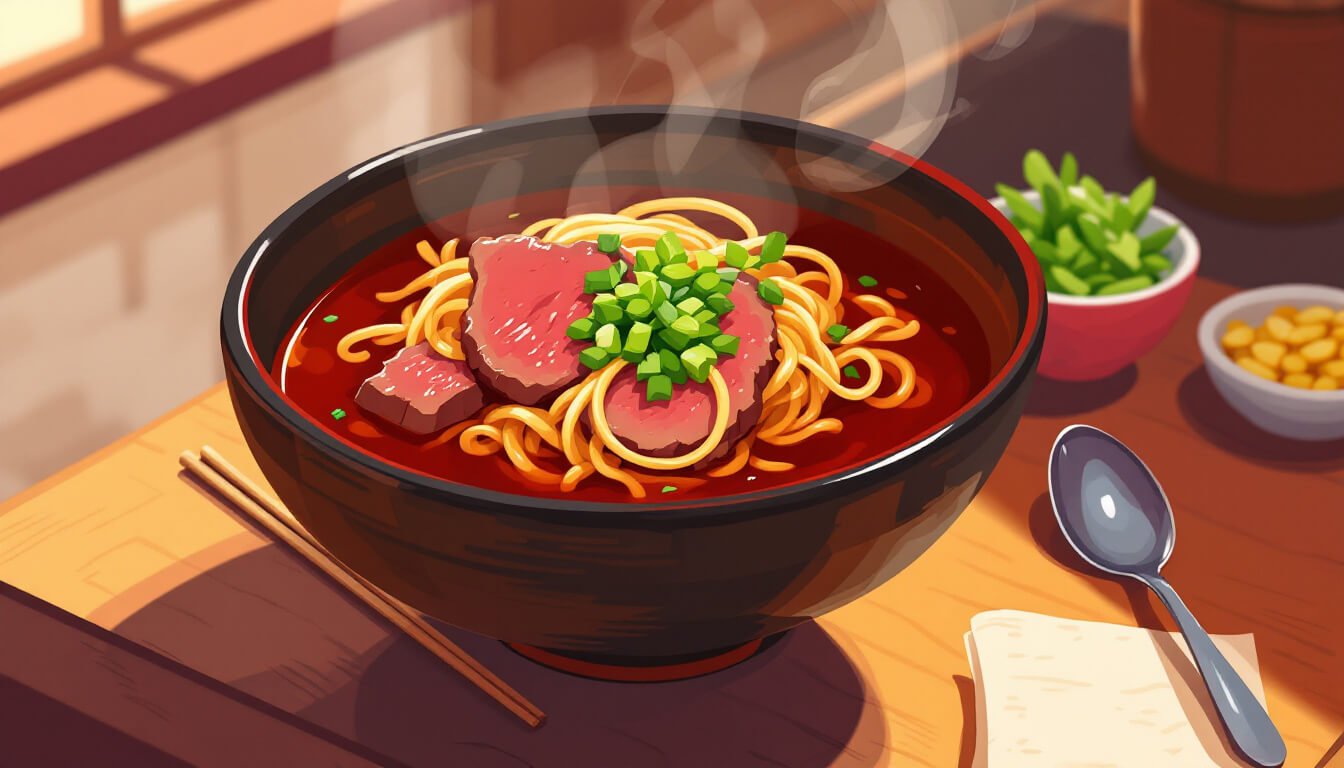
If one bowl defines Taiwan noodles for outsiders, it is this one. 牛肉麵 is the national dish, and its origin is more recent and more specific than most people assume. It was not inherited from imperial China. It was invented in Taiwan, in the military dependents’ villages (眷村) around Gangshan in Kaohsiung, by Sichuanese veterans who arrived after 1949 and built a beef broth out of what was available — including the local Gangshan broad bean chilli paste. Beef was barely eaten in Taiwan before this; the island’s cattle were working animals. The national dish is, in other words, a refugee dish, roughly seventy-five years old. We covered that history in more detail in how beef noodle soup was born in military refugee villages.
There are two schools, and shops pick a side:
- 紅燒 (hongshao), braised — dark, deep, soy-and-spice-driven, usually with chilli and doubanjiang. Rich enough to coat the mouth. This is the default and the one most visitors mean.
- 清燉 (qingdun), clear — a pale, long-simmered broth that tastes of beef and aromatics and nothing else. Less dramatic, much harder to fake. Shops that do it well are proud of it.
The strand is usually a thick chewy wheat noodle or knife-shaved noodle, because the broth is heavy and needs something that will not go limp in it. The garnish is fixed: scallions, and a self-serve tub of 酸菜 (pickled mustard greens) on the counter that you add yourself, in quantity, for acid and crunch. Do not skip it — it is not a decoration, it is the dish’s brake pedal.
Expect NT$140–200 for a standard bowl in 2026, NT$300 and up in the famous Yongkang Street shops in Taipei, and considerably more for imported-beef “premium” bowls. Taipei runs an annual beef noodle festival, which tells you how seriously this is taken. If you want to build one at home, our authentic hongshao beef noodle soup recipe walks through the full braise.
If your affection for this stuff runs deep enough to wear it, our Taiwanese Street Food Guide T-Shirt lays out twelve island classics as a vintage food poster — beef noodle soup very much included.
Danzai Noodles: Tainan’s Hundred-Year-Old Small Bowl
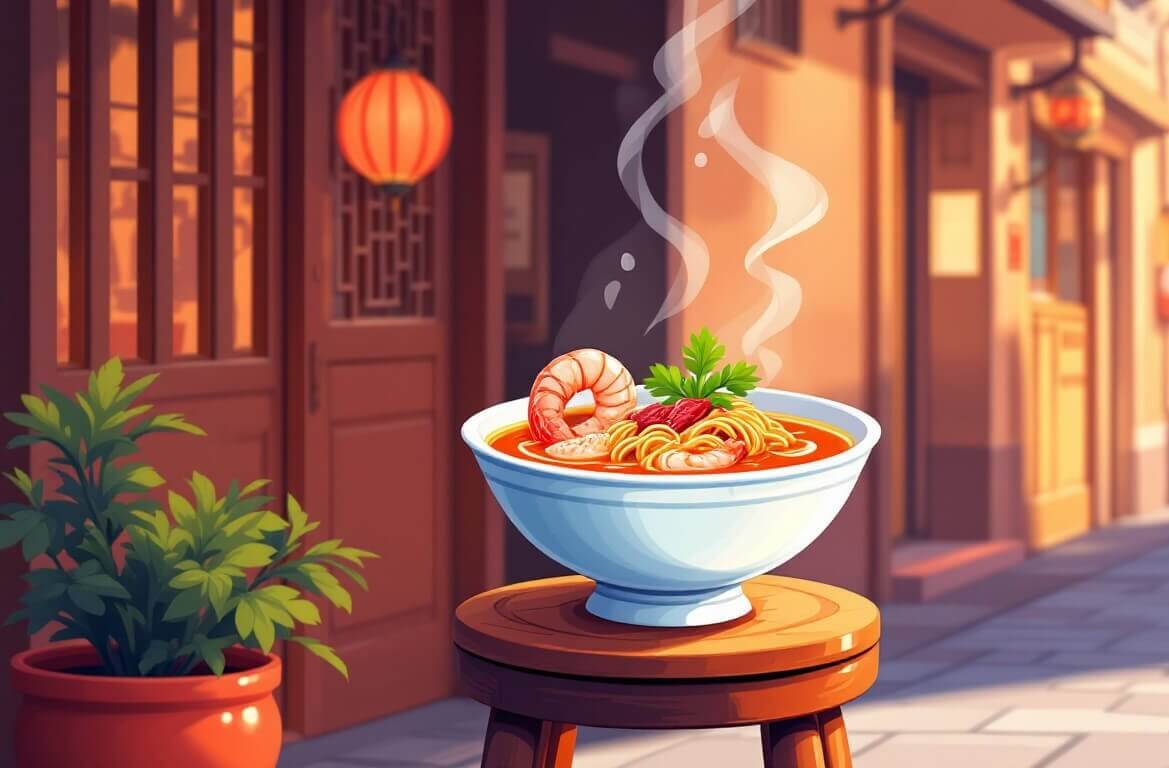
擔仔麵 comes in a bowl so small that first-timers assume a mistake has been made. It has not. The portion is the point.
The dish was born in Tainan in the 1890s, invented by a fisherman who needed income during the typhoon months when he could not go out. He carried noodles on a shoulder pole — 擔 (dan) is that pole — and sold them to get through the lean season. The original shop’s name, 度小月, literally means “getting through the slow months,” and it is still operating. Read more on the city that produced it in our guide to Tainan.
What is in it: a small nest of you mian, a clear amber shrimp-and-pork broth, a spoonful of 肉燥 (savoury minced pork), one whole shrimp, minced garlic, coriander, and a splash of black vinegar. That is all. It costs NT$50–70 and takes four minutes to eat.
The reason it is tiny is that it was never a meal — it was a snack between meals, sold from a pole to hungry people who would buy something else too. That logic still governs how Tainan eats: many small things in sequence rather than one large thing. Order two bowls if you want. Everyone does. We wrote about the bowl’s typhoon-season origins in more depth in our piece on danzai noodles and the Tainan typhoon.
Oyster Mianxian: The Thread Noodle Everyone Photographs
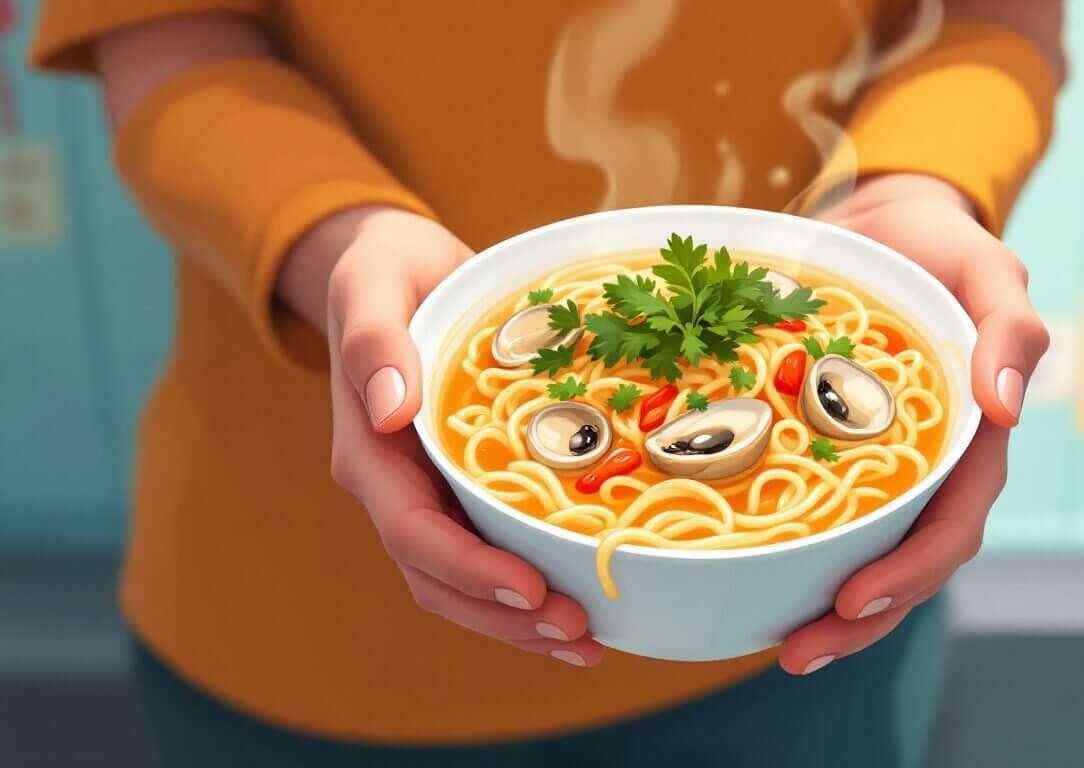
蚵仔麵線 does not behave like a noodle soup. It is thick — sweet potato starch turns the broth into something between soup and gravy — and the thread noodles are cut short, so you eat it with a spoon and no chopsticks at all. It arrives in a paper bowl, from a stall, and you eat it standing on the pavement.
The red mian xian is essential here. Ordinary white thread noodles would dissolve into paste; the longer-steamed red version holds its shape in a hot thickened liquid. Into it go small oysters dusted in sweet potato starch and briefly blanched, or braised pork intestine (大腸麵線), or both. Then the finish, which is not optional: black vinegar, minced garlic, a squeeze of chilli sauce, and coriander.
The single phrase worth memorising if you do not like coriander is 不要香菜 (bú yào xiāng cài) — “no coriander.” Say it before they assemble the bowl, not after.
Prices sit around NT$50–80 depending on whether you take oysters, intestine or both. It is the most reliably excellent NT$60 on the island, and you will find a stall selling it near essentially every MRT exit and market edge. See our city-by-city Taiwan street food guide for where to look.
Home Noodles: Ma Jiang Mian and Soy Sauce Noodles
Here is what the recipe blogs get right and the travel guides miss entirely: the Taiwan noodles people here actually eat most often are not the famous ones. They are two five-minute bowls made at home, and they are gloriously simple.
麻醬麵 (ma jiang mian), sesame noodles. Sesame paste, usually cut with a little peanut butter, loosened with a spoonful of the starchy noodle water, plus soy sauce, sugar, black vinegar and raw minced garlic. Toss with hot noodles. That is the entire dish. The noodle water is the trick — it emulsifies the paste into a sauce that clings instead of clumping. Shops sell it as 乾麵 (dry noodles) with a small bowl of clear soup alongside.
醬油拌麵, soy sauce noodles. Even shorter: soy sauce, a slick of lard or shallot oil, white pepper, scallions. Sometimes a raw egg yolk stirred through while the noodles are still hot enough to cook it. The whole thing takes as long as the water takes to boil.
The summer variant deserves its own mention. 涼麵 (liang mian), Taiwanese cold noodles, uses chilled you mian under a thick sesame sauce with shredded cucumber and sometimes shredded chicken — sold in the morning, from breakfast shops, alongside miso soup, which sounds wrong and is completely correct. We went deep on it in why cold sesame noodles are Taiwan’s summer default, and the broader morning menu is covered in our Taiwan breakfast food guide.
If you only cook one thing from this article, cook ma jiang mian. It costs almost nothing and it is the single most representative bowl of home food on the island.
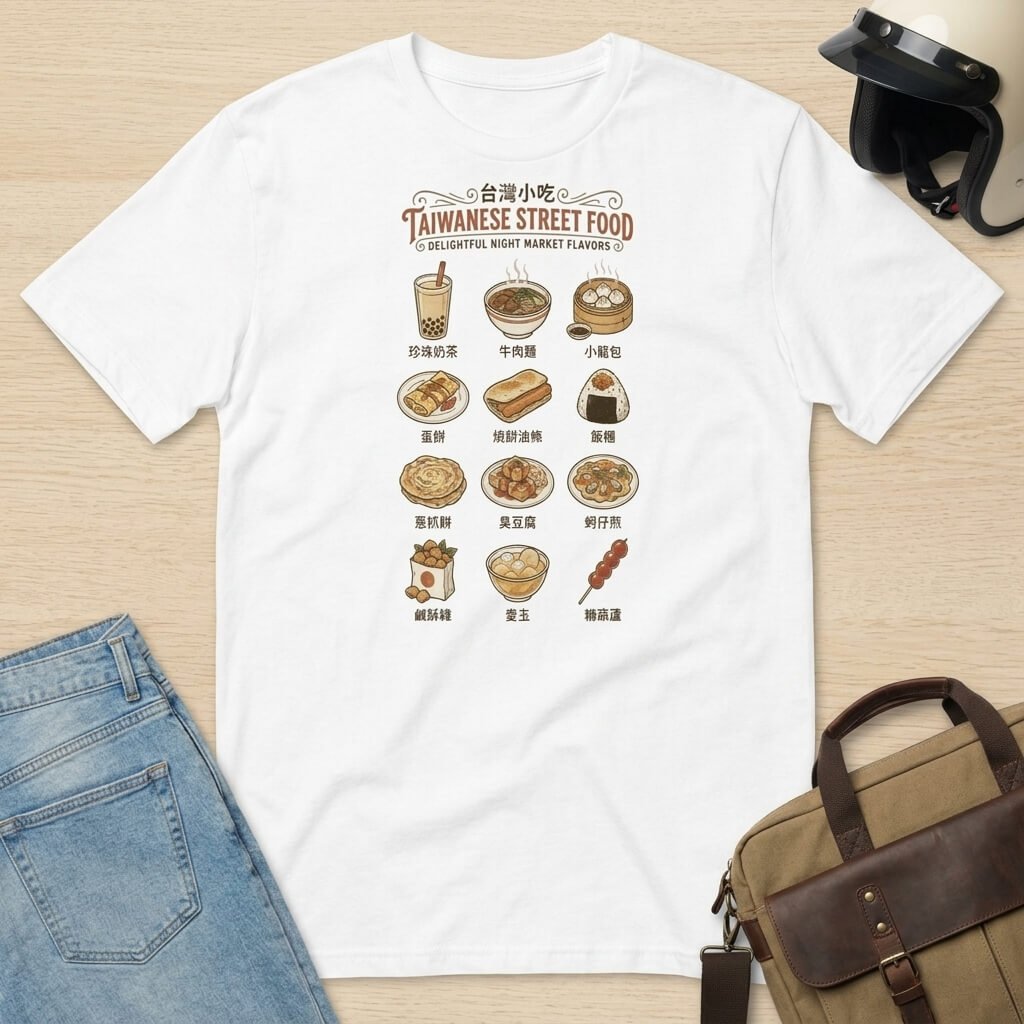
Twelve Classics, One Tee
A vintage food-poster layout of twelve island icons, labelled in Chinese — the fastest way to find out who else in the room has eaten their way through a night market.
Hakka Ban Tiao and Hsinchu Mi Fen: The Regional Specialists
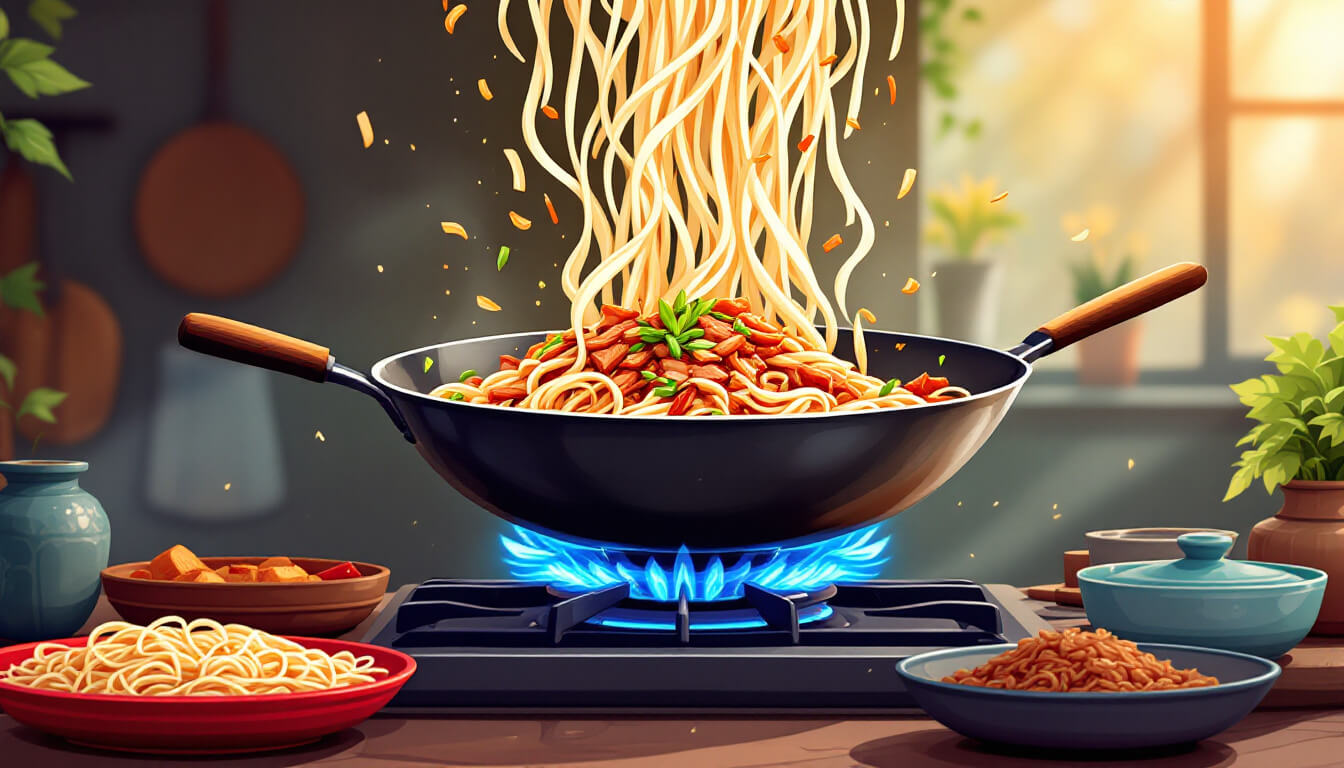
Two strands are so tied to specific communities that ordering them is a small act of regional literacy.
粄條 (ban tiao) belongs to the Hakka, the migrant group whose settlements run down Taiwan’s inland hill belt through Taoyuan, Hsinchu, Miaoli and into Meinong in Kaohsiung. Hakka cooking is salty, fatty and fragrant — built for farm labour, not for delicacy — and ban tiao is its flagship. The canonical version is dry: wide rice ribbons tossed with lard, fried shallots, shredded pork, garlic chives and a scatter of dried shrimp. Soft, savoury, and absolutely not spicy. Meinong has a street of shops doing nothing else.
新竹米粉 (Hsinchu mi fen) is the other. Hsinchu’s winter monsoon earned the city its nickname 風城, the windy city, and those winds are the reason its rice vermicelli became famous — racks of noodles drying in dry, moving air. Locally you will be offered 炒米粉 (stir-fried, dense with cabbage and dried shrimp) or 米粉湯 (in a cloudy pork-bone broth, ordered alongside a tray of braised sides).
A Taiwan Noodles Map, North to South
- Taipei & New Taipei — beef noodle soup above all, plus 切仔麵 (blanched oil noodles with bean sprouts and sliced pork) in Luzhou, and 排骨麵 with a fried pork chop on top.
- Hsinchu — mi fen, in both directions, with a bowl of springy pork meatball soup beside it.
- Miaoli & the Hakka hill belt — ban tiao, dry, with fried shallots.
- Taichung — 大麵羹, a thick alkaline noodle broth that essentially does not exist outside the city.
- Changhua — 貓鼠麵, “cat-mouse noodles,” named after a nickname of the original vendor rather than anything in the bowl.
- Tainan — 擔仔麵, 鱔魚意麵, 鍋燒意麵. Yi mian territory, and sweeter across the board than the north.
- Kaohsiung — Meinong ban tiao, and Gangshan, where beef noodle soup began.
- Keelung — 鼎邊趖, rice batter poured around the rim of a searing wok so it sets into curls, then dropped into broth. Keelung Miaokou market is the place.
How to Order Taiwan Noodles Like You Live There

This is the section the recipe blogs cannot write for you. Ordering Taiwan noodles is a workflow, and once you know the workflow the lack of an English menu stops mattering.
1. Dry or soup — decide first
Nearly every noodle on the menu is available 乾 (gān, dry — tossed in sauce) or 湯 (tāng, in soup). Same strand, same shop, two different dishes. Dry noodles arrive with a small bowl of clear broth on the side, so ordering dry does not mean going without soup. If you are asked exactly one question after you point at something, this is the question.
2. Take the order slip
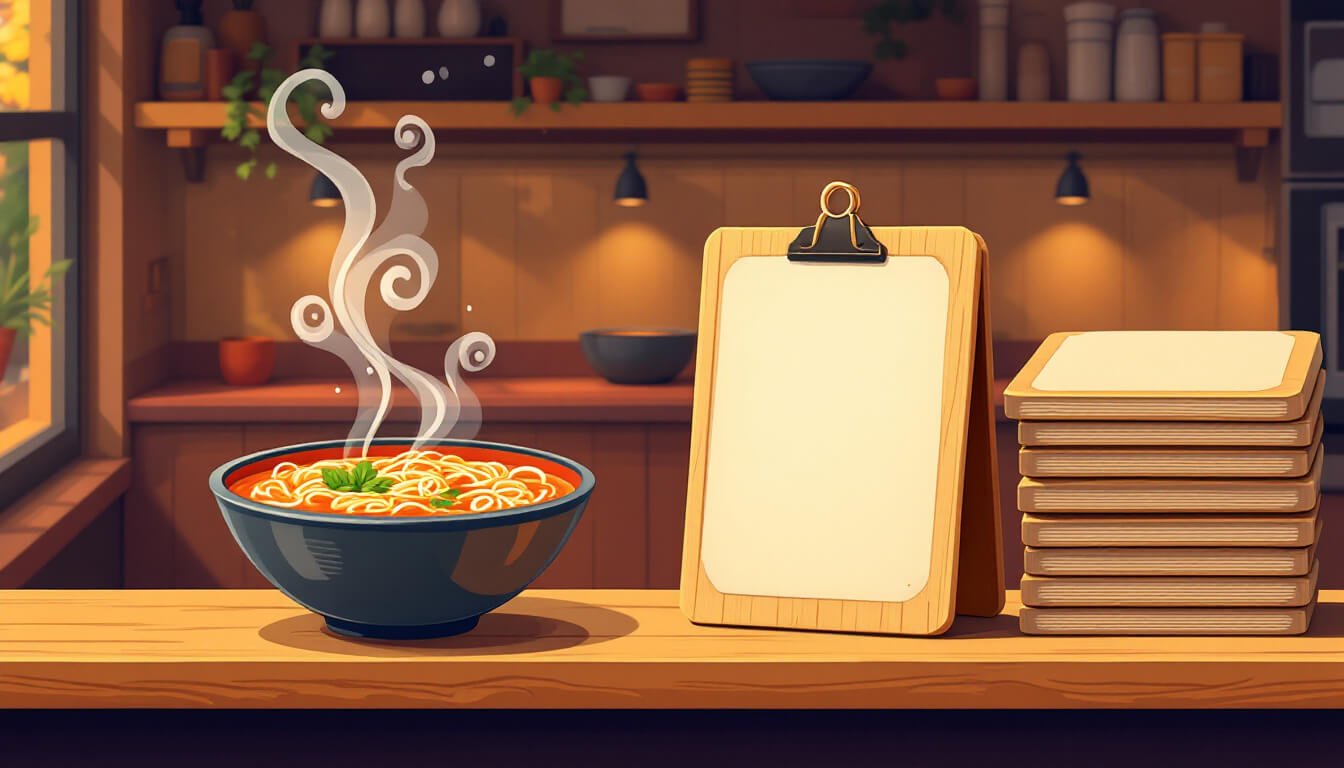
Most shops hand you a paper slip, or leave a stack and a pencil on each table. You mark quantities in the boxes next to each item and hand it to the counter — no conversation required, which is a gift when you cannot read the whole menu. 大 is large, 小 is small. 加麵 means extra noodles.
3. Raid the side-dish counter
The glass case or cold tray by the door is 小菜 (xiǎo cài) and it is half the reason to be there: braised eggs, dried tofu, seaweed knots, bamboo shoots, pig ear, cold cucumber, and a pot of blanched greens (燙青菜) with fried shallots and soy. You point, they plate, they add it to your slip. Two or three small plates plus one bowl of noodles is how a local actually eats lunch.
4. Finish the bowl yourself
The condiment tray is not decorative. Chilli sauce, black vinegar (烏醋), white vinegar, soy, garlic paste, white pepper, and at beef noodle shops a communal tub of pickled mustard greens. Taiwanese diners season aggressively at the table. A bowl arriving under-seasoned is often deliberate.
5. Practical notes
Many shops take payment when you order; some when you leave — watch what the person ahead of you does. There is no tipping. Slurping is fine. Bones and shells go on the small dish provided, or onto a napkin on the table, not back into the bowl. And peak hours are genuinely peak: 12pm–1pm and 6pm–7:30pm will mean a queue, which is usually a recommendation. For the market context around all of this, see our complete guide to Taiwan’s night markets and the Shilin insider’s guide. At the other end of the scale, several noodle shops now hold Michelin recognition — our Taiwan Michelin Guide 2026 covers which ones.
Taiwan Noodles FAQ
What is the most famous noodle dish in Taiwan?
牛肉麵, beef noodle soup. It is the bowl most people mean when they say Taiwan noodles, Taipei holds an annual festival for it, and the braised (紅燒) version is the benchmark every noodle shop is implicitly judged against.
How many types of Taiwan noodles are there?
Seven strands cover nearly everything you will meet: you mian (oil noodles), mi fen (rice vermicelli), mi tai mu (thick rice noodle), yi mian (wavy flat noodle), ban tiao (flat rice ribbon), mian xian (thread noodle) and dao xiao mian (knife-shaved). Add 冬粉 mung bean glass noodles and you can read almost any menu on the island.
Are Taiwanese noodles the same as Chinese noodles?
They overlap and then diverge. Knife-shaved noodles arrived with post-1949 migration from northern China and are still recognisably that tradition. But you mian, the rice-based strands, and thread noodles reflect Hokkien and Hakka cooking plus fifty years of Japanese rule, and dishes like danzai noodles and oyster mianxian were invented in Taiwan and exist nowhere else in that form.
Is Taiwanese beef noodle soup spicy?
Braised hongshao bowls are mildly spicy by default — chilli and broad bean paste are in the braise. Clear 清燉 broth is not spicy at all. Either way you control the final heat from the chilli sauce on the table.
What is the difference between mian xian and mi fen?
Mian xian is wheat, extremely fine, hand-pulled and salted; mi fen is rice, slightly thicker, and much less fragile. Mian xian goes into thickened soups and sesame oil dishes; mi fen gets stir-fried or dropped in pork broth. They look similar in a bowl and behave completely differently.
Are Taiwan noodles vegetarian-friendly?
The strands themselves usually are, but the broths and sauces frequently are not — lard, dried shrimp, pork bone and minced pork are everywhere. Taiwan does have an unusually strong Buddhist vegetarian food culture, though: look for the character 素 (sù) on a sign, which marks a vegetarian shop, and those kitchens do excellent noodle bowls.
What does 乾麵 mean on a menu?
Dry noodles — tossed in sauce rather than served in broth, with a small bowl of clear soup on the side. The soup version of the same item is 湯麵.
How much does a bowl of noodles cost in Taiwan?
As of 2026, expect roughly NT$40–60 for 切仔麵 or a simple dry noodle, NT$50–70 for danzai noodles, NT$50–80 for oyster mianxian, NT$60–90 for ban tiao, and NT$140–200 for a standard bowl of beef noodle soup — rising to NT$300 and beyond at famous Taipei shops.
Can you get gluten-free noodles in Taiwan?
Plenty of Taiwan noodles are gluten-free by nature — mi fen, mi tai mu and ban tiao are all rice-based, and 冬粉 is mung bean. The catch is soy sauce, which almost always contains wheat, so a rice noodle in a standard Taiwanese sauce is not gluten-free. Cross-contamination awareness is also limited, so coeliac diners should ask carefully rather than assume.
Final Thoughts: Read the Strand, Then Order the Bowl
Almost everything written in English about Taiwan noodles picks one bowl and explains it beautifully. That is genuinely useful right up until you are standing in front of a menu with forty items on it and no idea which four words matter.
So carry the short version. There are about seven strands. The dish name is usually just the topping plus the strand. Everything comes dry or in soup, and dry still gets you soup. The side-dish counter is half the meal. The condiment tray is the other half, and it is yours to use.
Do that and something shifts. You stop ordering the one dish you recognised and start ordering what the region you are standing in is actually good at — ban tiao in Meinong, mi fen in Hsinchu, yi mian in Tainan, a small bowl of danzai noodles you already know to order two of. Taiwan noodles are not a list of five famous dishes. They are a grammar, and it takes an afternoon to learn.
A Postcard From Taiwan, Every Week
Culture stories, food deep-dives, travel tips, and first looks at new designs — straight to your inbox. No spam, just Taiwan.

Grab a Free Taiwan Sticker!
Drop your email and we’ll send you a limited-edition Taiwan sticker — plus insider access to new merch drops and island vibes.
No spam. Unsubscribe anytime.