Taiwan Breakfast Food: The Complete Guide to the Island’s Best Meal
Ask anyone who has lived in Taiwan what they miss most and you will get the same answer with suspicious frequency: breakfast. Not brunch, not a pastry and a coffee — actual Taiwan breakfast food, eaten standing up at 7 a.m. from a paper bag, washed down with soy milk out of a plastic cup. It is one of the last genuinely daily food rituals left in a modern Asian economy, and it looks nothing like the congee-and-dim-sum stereotype most visitors arrive expecting.
This guide covers the whole landscape: the traditional canon and the modern griddle menu, what the neighborhood breakfast shop actually is, how the food changes as you move down the island, what everything costs in 2026, and exactly how to order without freezing at the counter. By the end you will be able to walk into any shop in Taiwan before 9 a.m. and get exactly what you want.
What Makes Taiwan Breakfast Food Different
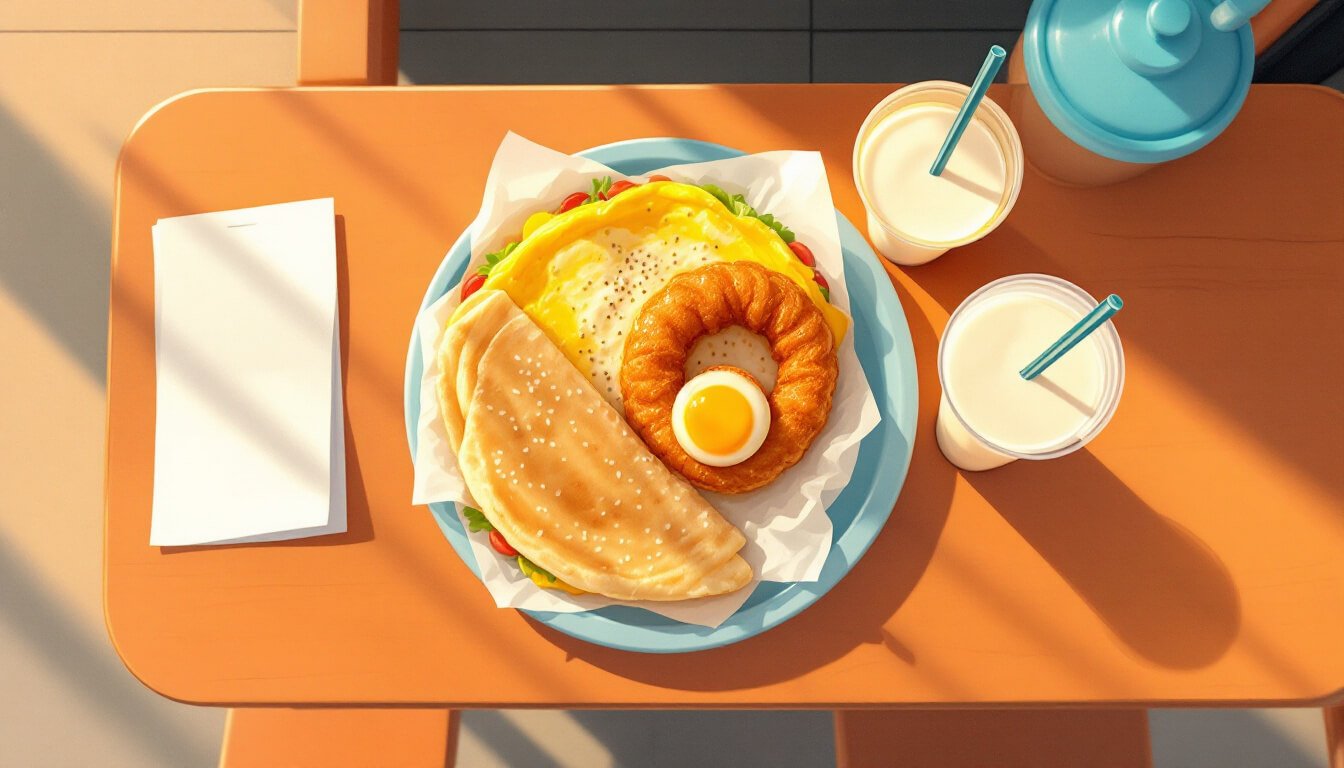
The single most important thing to understand is that Taiwan breakfast food is bought, not made. In most of the world, breakfast is the meal you make at home and lunch is the one you buy. Taiwan inverted that. An overwhelming share of the island eats breakfast from a shop — a five-minute walk, forty to a hundred New Taiwan dollars, handed over in a bag while the griddle is still hissing behind the counter.
That inversion is not laziness. It is the product of a dense, low-rise, mixed-use urban form where the ground floor of nearly every residential block is commercial, combined with decades of long working hours and a food-safety culture that made cheap prepared food trustworthy. When there is a shop selling a hot, fresh, made-to-order egg crepe forty meters from your front door for the price of a bag of flour, home cooking loses on every axis.
The second difference is the flavor profile. Taiwanese breakfast is not sweet by default. The core of it is savory: soy, sesame, scallion, white pepper, soy sauce paste, pickled radish, dried shrimp. Sweetness exists — sweetened soy milk, condensed-milk toast, jam on a thick slice — but it sits alongside the savory rather than dominating, and it is common to eat both in the same meal.
Third, and this is where most outside guides get it wrong: Taiwanese breakfast is not Chinese breakfast, and it is not one tradition. It is at least three braided together. There is a Hokkien and Japanese-era base of rice porridge and small salted dishes. There is a northern Chinese layer — the flatbreads, crullers, and soy milk that arrived with the roughly one to two million people who crossed from the mainland after 1949. And there is a Taiwanese-American hybrid layer invented locally in the 1980s, which is why you can order a hamburger and a plate of iron-plate noodles at 6:30 in the morning and nobody blinks.
Understanding those three layers is the key to reading any menu on the island. Almost every item you will see belongs to one of them.
Inside the Zaocandian: Taiwan’s Breakfast Shop Institution
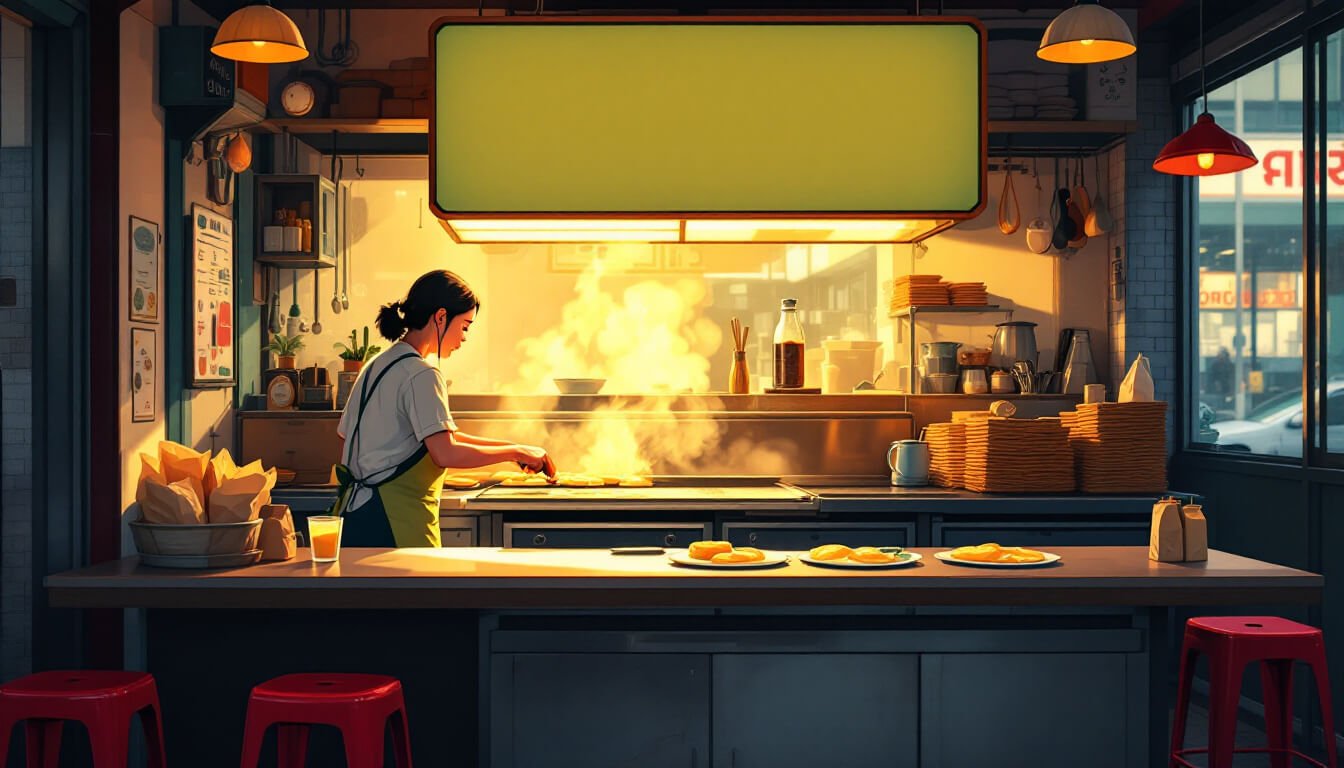
The word to know is 早餐店 (zǎo cān diàn) — literally “morning meal shop.” These are small, family-run or lightly franchised storefronts, usually one griddle, one fryer, one drinks station, a few stools, and an owner who has been standing in the same spot since before sunrise. There are tens of thousands of them across the island. In a normal Taipei neighborhood you will pass three or four in a single block.
They split into two broad species, and knowing which one you are standing in front of determines what you can order.
The traditional soy milk shop
豆漿店 (dòu jiāng diàn) are the old guard. Steel steamers, a tandoor-style clay oven for flatbreads, vats of hot soy milk, and a queue. This is the northern Chinese layer, and its spiritual home is Yonghe in New Taipei City — a district so associated with soy milk that “Yonghe Soy Milk” became a generic shop name across the entire Chinese-speaking world, the way “Champagne” escaped its region. The most famous single example is Fu Hang Dou Jiang in Taipei’s Huashan Market, where the line reliably runs down a flight of stairs and out into the street before 8 a.m.
Traditional shops open early — often 5:30 or 6 a.m. — and, crucially, they close early. Many are done by 10 or 11 a.m., and the best items sell out well before that. If you plan to visit one at noon you will be photographing a shuttered roller door.
The Western-style breakfast shop
The other species is the flat-griddle shop, and it is a genuine Taiwanese invention. Starting in the 1980s, franchise chains — Mei-Er-Mei and the wave of imitators that followed it, later Good Morning Beautiful City, Laya Burger, and Hong Ye — took the American diner griddle and rebuilt it around Taiwanese tastes. The result is a menu of hamburgers, club sandwiches, hash browns, and thick toast sitting cheerfully next to egg crepes and iron-plate noodles, with iced black tea instead of coffee as the default drink.
These shops open around 6 and often run to noon or later. They are cheaper, faster, air-conditioned, and where most working Taiwanese people actually eat on a Tuesday. Purists will tell you the traditional shop is the real thing. In practice both are the real thing, and most locals eat at both depending on the morning.
One more piece of the institution worth naming: the owner. The lǎo bǎn niáng — the boss lady — running the griddle is a genuine cultural figure, and the shorthand address you will hear customers use, měi nǚ (beautiful woman) and shuài gē (handsome guy), is standard breakfast-shop banter rather than flirtation. Being called handsome by a woman flipping four egg crepes at once is a rite of passage.
The Traditional Canon: Taiwan Breakfast Foods to Know
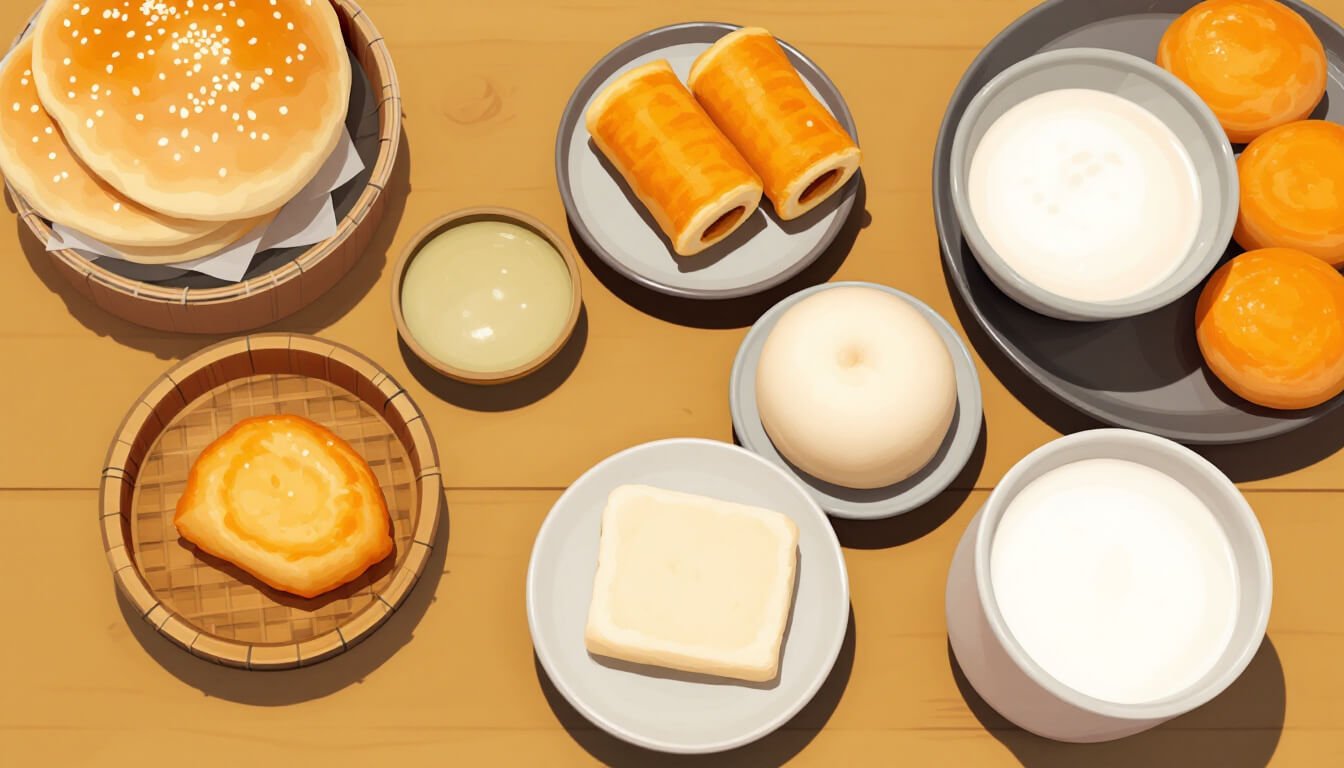
These are the Taiwan breakfast food items that define the traditional side of the menu. Learn these ten and you can order confidently anywhere on the island.
Doujiang — soy milk
豆漿 (dòu jiāng) is the foundation. Freshly ground, served hot in a bowl or cold in a cup, sweetened or unsweetened. Good shops grind their own and the difference is enormous — real soy milk is thick, faintly grassy, and nothing like the shelf-stable cartons sold abroad.
Xian doujiang — savory soy milk
鹹豆漿 (xián dòu jiāng) is the item that converts skeptics, and the one most visitors have never heard of. Hot soy milk is poured over a bowl containing vinegar, soy sauce, dried baby shrimp, pickled radish, scallions, and torn pieces of fried cruller. The acid curdles the soy protein on contact, so what arrives is not a drink at all but a bowl of silky, barely-set curds in savory broth, with the cruller pieces going soft at the edges. Order this once and it will haunt you.
Youtiao — fried dough cruller
油條 (yóu tiáo) are long, hollow, blistered sticks of fried dough. Barely salted, never sweet. They are structurally engineered for dunking, and eating one dry is missing the point.
Shaobing — clay oven flatbread
燒餅 (shāo bǐng) is a layered, sesame-topped flatbread baked against the wall of a hot oven until it shatters into flakes. The canonical order is 燒餅油條 — a cruller folded inside a flatbread, a carbohydrate inside a carbohydrate, and one of the great texture combinations in Asian food. Ask for it with an egg or a slice of scallion omelet folded in.
Danbing — egg crepe
蛋餅 (dàn bǐng) is, by a wide margin, the most-ordered breakfast item in Taiwan. A thin batter crepe is laid on the griddle, an egg cracked and spread over it, the whole thing rolled and cut into segments with scissors, then drizzled with soy sauce paste and chili. It comes plain or with add-ins: corn, cheese, bacon, pork floss, tuna, basil. The base is around NT$30 and every addition is a few dollars more.
Fantuan — sticky rice roll
飯糰 (fàn tuán) is glutinous rice compressed by hand around a filling and squeezed into a dense torpedo, traditionally with a cruller, pickled radish, and pork floss inside. It is the most portable breakfast on the island and easily the most filling. A purple-rice version is standard at most stalls now.
Luobo gao — radish cake
蘿蔔糕 (luó bo gāo) is shredded daikon set into a rice-flour block, sliced and pan-fried until the outside crusts and the inside stays custardy. Eaten with soy sauce paste, usually with a fried egg on top.
Jiucai he — chive pocket
韭菜盒 (jiǔ cài hé) is a half-moon pastry stuffed with garlic chives, glass noodles, and egg, then pan-fried flat. Intensely savory and underrated.
Mantou and baozi — steamed buns
饅頭 (mán tóu) is a plain steamed bun, frequently split and filled with a fried egg and a slice of ham. 包子 (bāo zi) is its filled cousin — pork and cabbage, or a sweet custard or red bean version.
Mijiang — rice and peanut milk
米漿 (mǐ jiāng) is the drink locals order when they want something richer than soy milk. Ground rice and roasted peanuts, served hot, sweet and nutty, somewhere between a drink and a thin porridge. It is the single most comforting thing on the menu on a cold morning.
Alongside these you will sometimes find 清粥小菜 — plain rice porridge with a spread of salted small dishes — which is the oldest layer of all, and closest to what Taiwanese families actually ate at home a century ago.
The Modern Griddle Menu
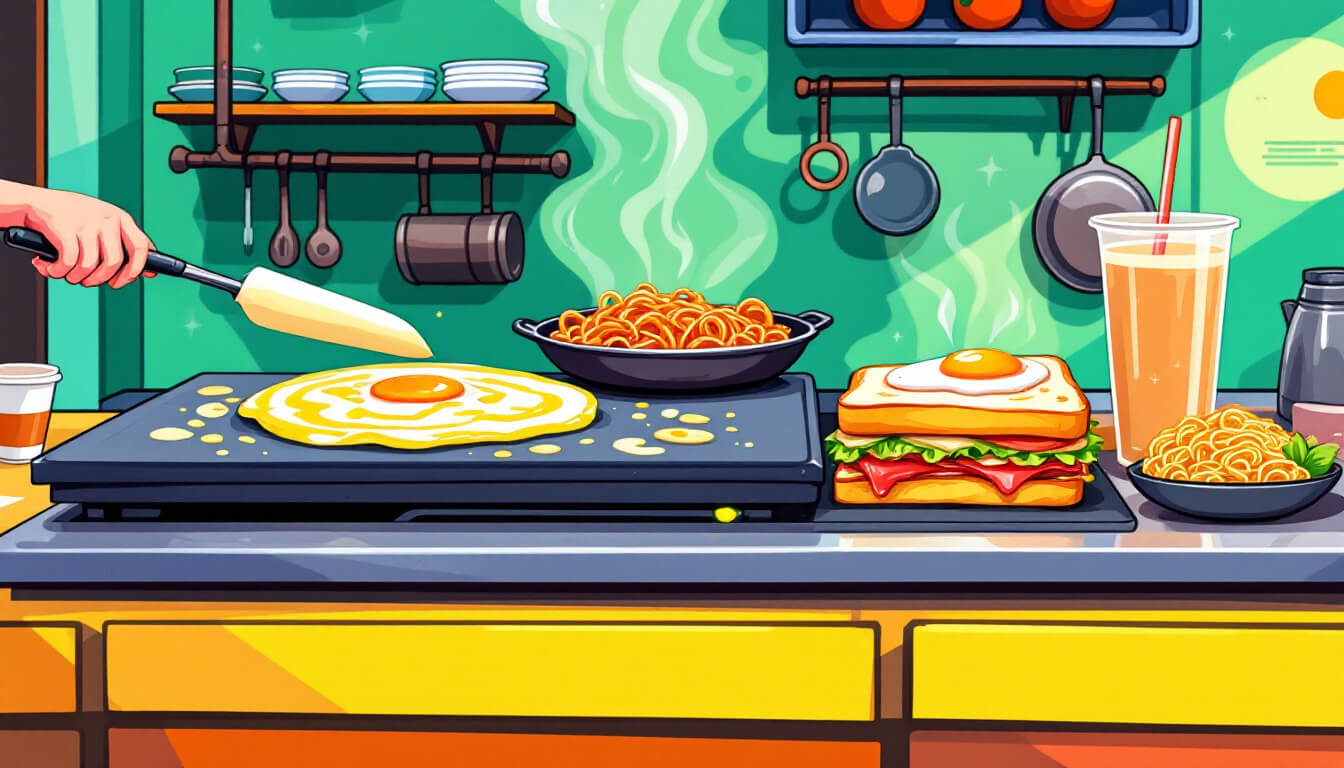
Walk into a Western-style shop and the board looks, at a glance, like an American diner ran into a Taiwanese kitchen at speed. That is exactly what happened, and the hybrids are now more traditional than most people realize — an entire generation grew up on them.
鐵板麵 (tiě bǎn miàn), iron-plate noodles, is the standout. Springy yellow noodles are cooked flat on the griddle and drowned in either black pepper sauce or mushroom sauce, with a fried egg slid on top. It is the most Taiwanese non-Taiwanese food imaginable, exists nowhere else, and is a legitimate national comfort dish.
漢堡 (hàn bǎo) is the breakfast burger — a thin pork or chicken patty, egg, lettuce, cucumber, and a sweet mayonnaise on a soft bun. It shares a name with the American original and almost nothing else. 厚片吐司 (hòu piàn tǔ sī) is inch-thick toast, griddled in butter and topped with condensed milk, peanut butter, taro paste, or garlic spread. 薯餅 (shǔ bǐng) is the hash brown that gets added to everything, including, gloriously, inside the egg crepe.
Then there are the drinks, which is where things get interesting. The default is not coffee — it is 紅茶 (hóng chá), a strong, sweet, deliberately astringent iced black tea served in a sealed cup, or 奶茶 (nǎi chá), the milk tea version. This is the same tea culture that eventually produced the island’s most successful export; if you want that story, we covered how bubble tea was actually invented in Taiwan and which two tea houses still argue about it.
That morning-tea habit is a genuine part of the national character, and it is the reason our Pearl Gang Boba Tapioca Kawaii T-Shirt keeps selling out — it is a small tribute to the people who consider tapioca pearls a legitimate food group before 9 a.m.
Regional Taiwan Breakfast Food: Beyond Taipei
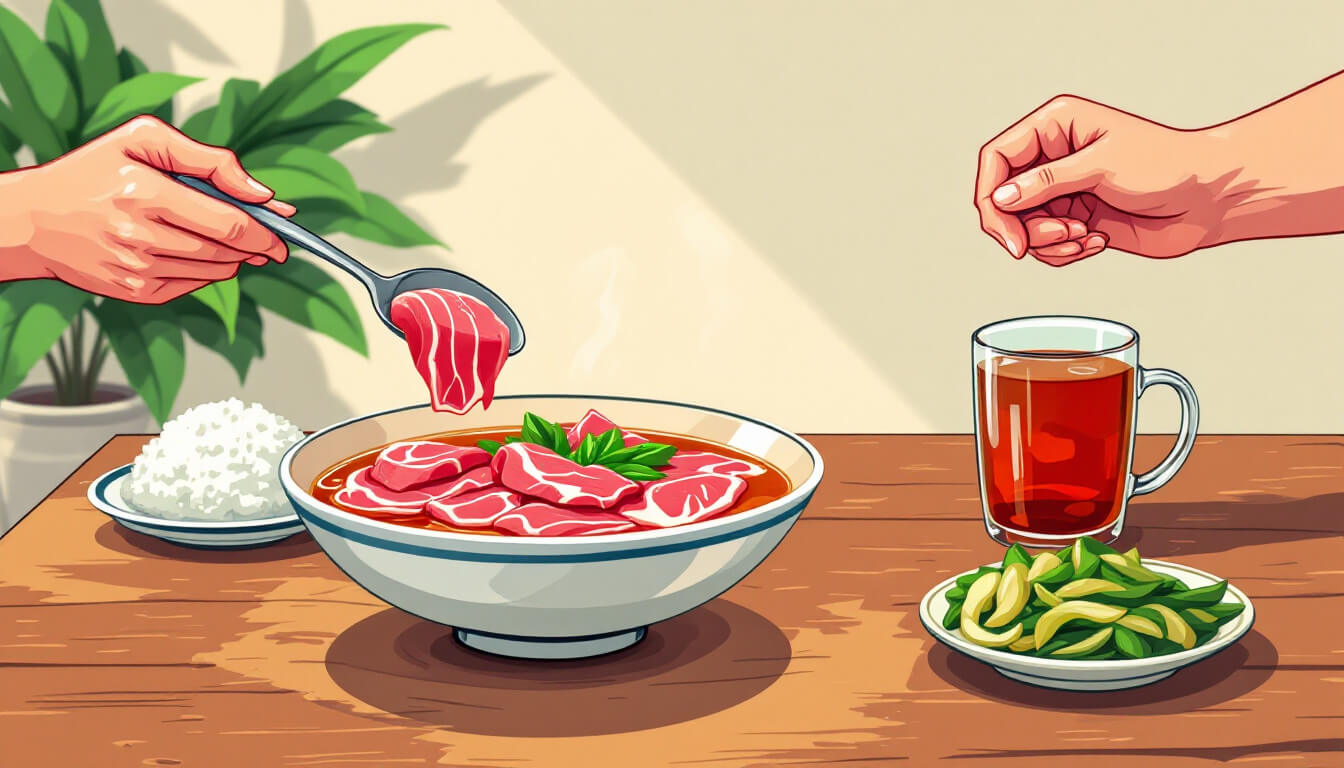
Nearly every English-language guide to Taiwan breakfast food is secretly a guide to Taipei breakfast food. Head south and the entire premise changes — the soy milk and flatbread axis weakens, and rice, soup, and seafood take over.
Tainan is the most dramatic break. The city’s signature breakfast is 牛肉湯 (niú ròu tāng), beef soup: paper-thin slices of raw, never-frozen local beef in a bowl, with boiling broth poured over them at the table so they cook in the twenty seconds it takes to reach you. It is served with a bowl of 肉燥飯, braised minced pork over rice, and it is eaten at 6 a.m. because that is when the beef arrives from the morning slaughter. The other Tainan classic is 虱目魚粥 — milkfish porridge, made with a fish farmed in the surrounding ponds for four centuries, deboned by hand into a rice soup with ginger and celery. If you are heading that way, our full guide to Tainan, the island’s oldest city goes much deeper on why the food there operates by its own rules.
Changhua starts the day with 爌肉飯 — a glossy slab of braised pork belly over rice, at an hour most countries reserve for cereal. Hsinchu leans on pork ball soup and rice vermicelli, the two things the city is famous for manufacturing. In the Hakka areas of Miaoli and inland Hsinchu, breakfast is often 板條, wide flat rice noodles in broth or stir-fried with dried shrimp and shallots.
And on the east coast, in Hualien and Taitung, indigenous and Japanese-era influences show up in ways the west coast never sees — millet, wild greens, and glutinous rice preparations that predate every other layer on this page.
The practical takeaway: do not eat the same breakfast in Kaohsiung that you ate in Taipei. You will be eating a Taipei import while a four-hundred-year-old local tradition operates two streets away. The same logic applies to eating across the island generally, which is why we built a city-by-city breakdown in our Taiwan street food guide.
How to Order: Hours, Prices, and What to Say
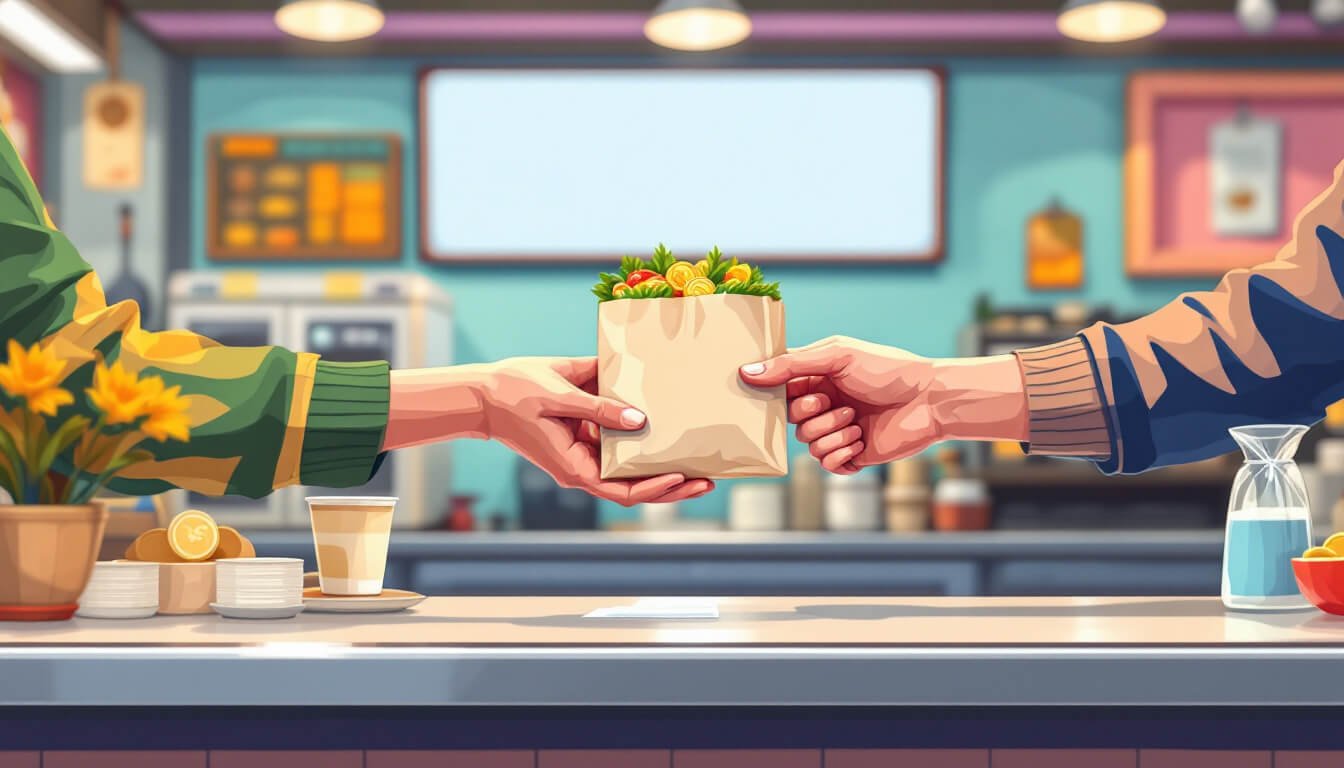
Here is the part almost no guide gives you, and the part that determines whether your first attempt at Taiwan breakfast food goes well.
Timing
Traditional soy milk shops: roughly 5:30 a.m. to 10 or 11 a.m., with popular items gone by 8:30. Western-style shops: roughly 6 a.m. to noon, some until 1 or 2 p.m. If your plan involves a famous breakfast shop, arrive before 8. Sunday mornings are the busiest of the week, and many independent shops take Monday off.
What it costs in 2026
- Soy milk (hot or iced): NT$20–35
- Savory soy milk: NT$35–50
- Egg crepe, plain: NT$30–45; with add-ins NT$45–70
- Flatbread with cruller: NT$40–55
- Sticky rice roll: NT$40–65
- Iron-plate noodles with egg: NT$50–70
- Breakfast burger or sandwich: NT$40–65
- Iced black tea or milk tea: NT$20–35
A genuinely large breakfast for one person lands around NT$80–120 — call it US$2.50 to US$4. This is one of the great remaining food bargains anywhere in the developed world.
The script
You need four phrases and a pointing finger. Nèi yòng (內用) means dine in; wài dài (外帶) means takeaway, and you will be asked this first, every time. Zhè ge (這個) plus a point at the board handles everything else. Bīng (冰) is iced, rè (熱) is hot. Jiā dàn (加蛋) adds an egg, which is almost always the right call.
Two practical notes. Many traditional shops are still cash-only, so carry small bills; chain shops increasingly take EasyCard and mobile payment. And if the shop is slammed, order, pay, then step aside and wait to be handed your bag — hovering at the register is the one thing that will get you a look.
Eating vegetarian
Taiwan is one of the easiest places in Asia to eat vegetarian, but breakfast has traps. Savory soy milk almost always contains dried shrimp. Sticky rice rolls usually hide pork floss. Radish cake is often fried on the same griddle as bacon. The useful words are 素食 (sù shí, vegetarian), 蛋奶素 (ovo-lacto), and 全素 (quán sù, fully vegan and typically also without onion or garlic). Plain soy milk, rice-peanut milk, plain flatbread, steamed buns, and a plain egg crepe are all reliably safe.
Start Your Morning the Taiwanese Way
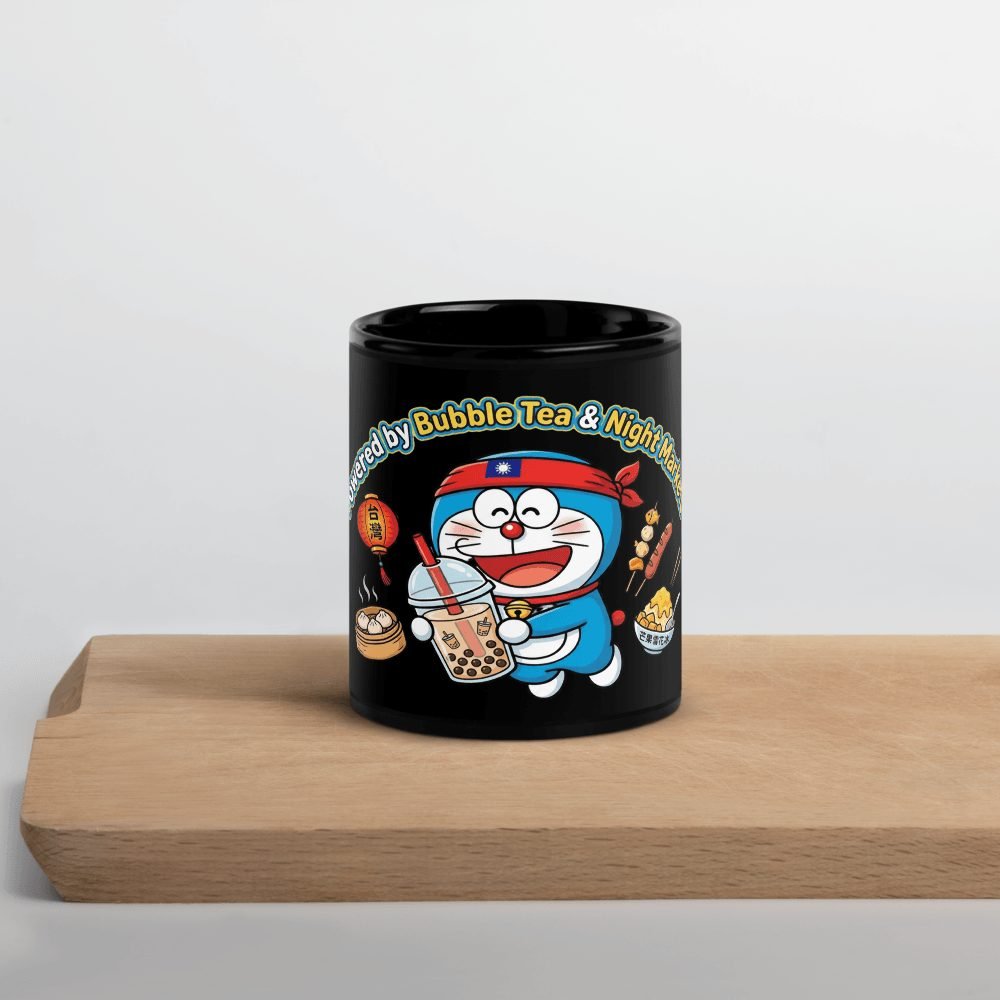
Can’t get to a breakfast shop in Taipei? Our Powered by Bubble Tea mug brings a little night-market energy to whatever you are drinking at 7 a.m. — soy milk optional.
Taiwan Breakfast Food FAQ
What is the most popular Taiwan breakfast food?
The most popular Taiwan breakfast food is the egg crepe, danbing, without serious competition. It is on the menu at essentially every breakfast shop of either type, costs about NT$35, takes ninety seconds to cook, and takes endless variations. If you eat one thing in Taiwan before 9 a.m., eat this.
Is Taiwanese breakfast the same as Chinese breakfast?
No, though they overlap. Soy milk, crullers, and flatbreads are northern Chinese in origin and arrived in numbers after 1949. But the porridge-and-small-dishes base is Hokkien and Japanese-era Taiwanese, the regional southern breakfasts have no mainland equivalent at all, and the Western-style griddle shop with its iron-plate noodles is a purely Taiwanese invention. You cannot get a Taiwanese breakfast in Beijing.
Is Taiwanese breakfast healthy?
It varies enormously. Plain soy milk with a sticky rice roll or steamed bun is a reasonable, protein-forward start to the day. A hash brown inside an egg crepe next to iron-plate noodles in black pepper sauce is not, and locals know it — it is comfort food, eaten as such. The traditional side of the menu is generally the lighter side.
What time do breakfast shops close?
Earlier than you think. Traditional soy milk shops commonly close between 10 and 11 a.m. and sell out of popular items before that. Western-style chain shops usually run until noon or a little later. Breakfast in Taiwan is a genuine morning event, not an all-day menu category.
Can you eat Taiwanese breakfast at a convenience store?
You can, and plenty of people do — tea eggs, rice balls, hot soy milk, and steamed buns are all standard at 7-Eleven and FamilyMart, which are open around the clock. It is a real fallback rather than a real substitute. Taiwan’s convenience stores are a genuine cultural institution in their own right; we wrote about why Taiwan’s 7-Eleven functions as a community hub if you want the full picture. For a quick primer on the breakfast canon itself, our short companion piece on Taiwan’s breakfast culture covers the highlights in five minutes.
Can I find real Taiwanese breakfast outside Taiwan?
Increasingly, yes. Diaspora communities in Southern California, the Bay Area, New York, Toronto, Vancouver, and Sydney all have dedicated Taiwanese breakfast shops, and several Taiwanese chains have opened overseas branches. Look for shops advertising savory soy milk specifically — it is the item nobody makes unless they are serious.
Final Thoughts: The Meal Taiwan Refuses to Skip
Plenty of countries have a famous breakfast dish. Taiwan breakfast food is something else. Very few still have a breakfast economy — tens of thousands of small shops, most of them independent, opening before dawn, selling a hot cooked meal for the price of a coffee, to a population that could easily afford to eat somewhere fancier and mostly chooses not to.
That is what makes Taiwan breakfast food worth understanding rather than just eating. It is a daily, unglamorous, entirely functional tradition that survived industrialization, franchising, and the arrival of every global chain, and came out the other side with iron-plate noodles bolted onto it. The clay oven and the flat griddle are both still running, four streets apart, at 6:30 tomorrow morning.
So set an alarm. Go before eight. Point at something you cannot identify, say jia dan, and eat it standing up.
Keep exploring: our guide to Taiwan’s iconic packaged snacks covers what to bring home, and things to do in Taipei will fill in the hours after breakfast.
A Postcard From Taiwan, Every Week
Culture stories, food deep-dives, travel tips, and first looks at new designs — straight to your inbox. No spam, just Taiwan.

Grab a Free Taiwan Sticker!
Drop your email and we’ll send you a limited-edition Taiwan sticker — plus insider access to new merch drops and island vibes.
No spam. Unsubscribe anytime.