Taiwanese Liangmian: Why Cold Sesame Noodles Are Taiwan’s Summer Breakfast Champion
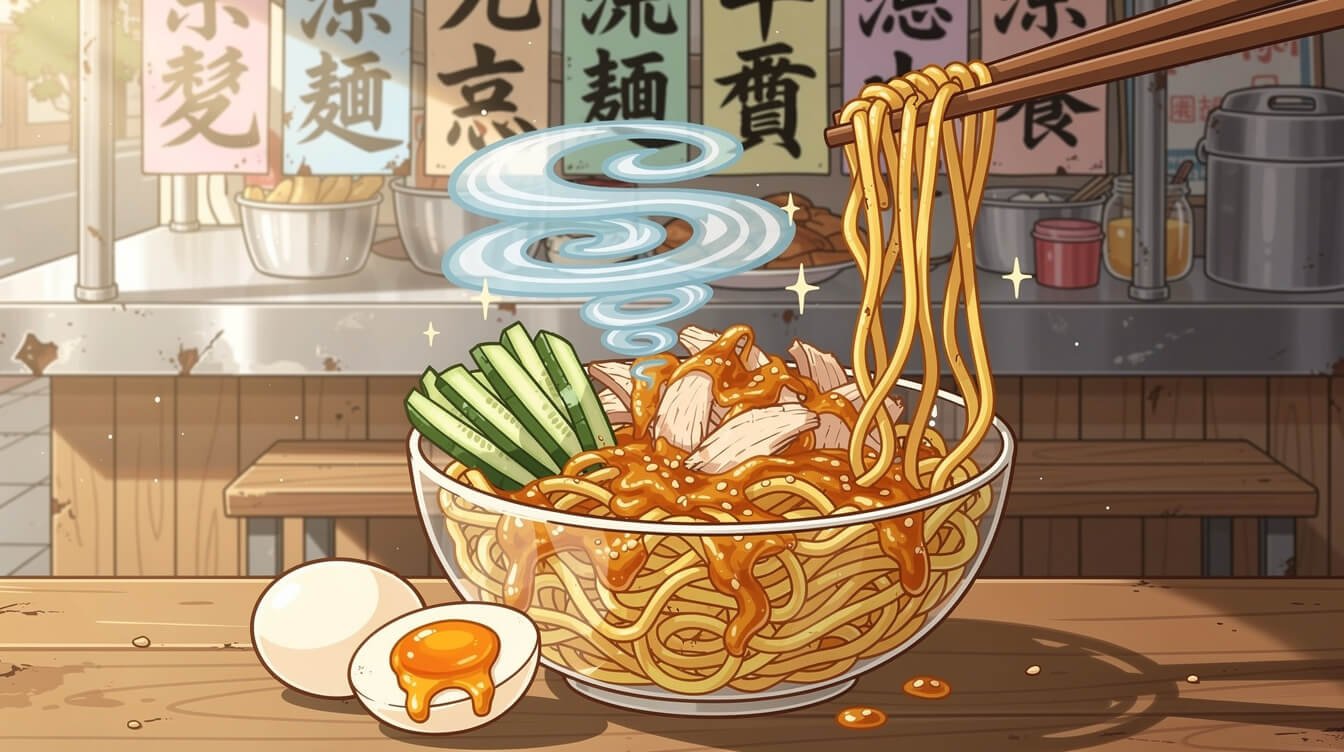
It’s 7:30 AM in Taipei. The mercury is already past 30°C, the cicadas have been screaming since dawn, and you’re hunting breakfast. Across most of East Asia, this is a hot-bowl moment — congee, soy milk, steamed buns. In Taiwan? You queue at a breakfast stall and order a bowl of liangmian (涼麵) — noodles served stone cold, drowning in peanut-sesame sauce, with a side of cold miso soup that has a raw egg yolk floating in it.
This is summer breakfast on the island. And it’s brilliant.
What’s actually in the bowl
Taiwanese liangmian starts with jianshui mian (鹼水麵) — those curly, springy yellow oil noodles you’ve seen in ramen and chow mein. They’re boiled, rinsed in ice water, tossed with a little oil to keep them from clumping, and refrigerated until you order.
Then comes the sauce, which is where Taiwan diverges hard from mainland Chinese cold noodles. Instead of a thin sesame paste, it’s a thick, glossy slurry of peanut butter, sesame paste, soy sauce, black vinegar, garlic water, sugar, and a hit of sesame oil. Some shops add a dab of pickled mustard or chili oil. The whole thing gets spooned over the noodles, topped with julienned cucumber and shredded poached chicken, and you mix it yourself at the counter.
On the side: a small bowl of miso soup with raw egg yolk and seaweed (味噌蛋花湯), served warm — not hot. The contrast between cold noodles and warm miso is the whole point. Your body cools down; your stomach stays settled.
How it ended up on Taiwan’s breakfast table
Liangmian isn’t ancient Taiwanese cuisine. It arrived in the late 1940s with the wave of mainland refugees who came over with the KMT — specifically Sichuanese and northern Chinese chefs who’d grown up eating regional cold noodle dishes (川味涼麵, “Sichuan-style liangmian”).
Those original versions were spicier, oilier, made with mung bean or buckwheat noodles. But Taiwan’s brutal subtropical summers demanded something more refreshing. Local cooks swapped in the cheaper, more available yellow oil noodles, dialed back the chili, and leaned hard into the peanut-sesame combo — peanuts being a Taiwanese pantry staple thanks to the island’s huge southern peanut crop.
By the 1970s, breakfast shops across Taipei were serving it. By the 2000s, every 7-Eleven in Taiwan was selling a chilled, packaged version in the cooler aisle from June to September.
Where to find the real thing
Famous Taipei spots include Pengjia Liangmian (彭家園涼麵) near Nanjing East Road, open since 1981 and still served from the same metal counters. Liu Shandong Beef Noodle (劉山東牛肉麵) does a celebrated summer-only version. And Chen Jia Liangmian (陳家涼麵) in Linyi Street stays open 24 hours — because in Taiwan, “cold noodles at 3 AM” is a legitimate life choice.
The 7-Eleven version is honestly not bad. About NT$55 (around US$1.80), comes with a sealed sauce packet you squeeze on yourself. Good enough that even locals grab it on hurried mornings.
The Taiwan move: order it with mustard
When the stall owner asks “要不要芥末?” — “Do you want mustard?” — say yes. Taiwanese liangmian often comes with a tiny dab of yellow Japanese-style mustard (a holdover from the Japanese colonial era) that gives the sauce a horseradish-like sinus-clearing kick. It cuts through the richness of the peanut paste in a way nothing else does.
It’s the kind of small, weird, perfect detail that makes Taiwanese food culture what it is — a quiet remix of Chinese, Japanese, and tropical-island sensibilities that ended up tasting like nothing else in Asia.
Now you know what to order tomorrow morning.
Loving Taiwan’s food culture? Check out our Taiwan-themed apparel collection — including night market designs, bubble tea graphics, and food-inspired tees that celebrate the island’s incredible cuisine.

Grab a Free Taiwan Sticker!
Drop your email and we’ll send you a limited-edition Taiwan sticker — plus insider access to new merch drops and island vibes.
No spam. Unsubscribe anytime.