
Vegan Taiwan: How 素食 Culture Makes the Island Easy to Eat In
Here is the thing nobody tells you about vegan Taiwan: it is not hard. It is not a hunt. You are not going to spend your trip negotiating with confused waiters or living on convenience-store bananas. Taiwan has a nationwide network of meat-free restaurants that has been quietly running for decades, and it exists for a reason that has almost nothing to do with the plant-based boom of the last ten years.
The reason is religion. Buddhist and Yiguandao vegetarian practice built that infrastructure long before anybody in Taipei had heard the word vegan, and once you understand how it works, you can read a Taiwanese street the way a local does — spotting which places will feed you from the far end of the block.
This guide to vegan Taiwan is about that reading skill. We will cover the one character you need to recognise, the five words Taiwanese people use to describe degrees of vegetarianism, the food-labelling rule that makes Taiwan unusually legible to a plant-based shopper, the dishes that are already vegan, the handful that pretend to be, and the exact phrases to keep on your phone. Specific, practical, and current as of October 2026.
Why Vegan Taiwan Is Easier Than You Expect — and It Isn’t the Trendy Cafés

Most write-ups answer the question “is Taiwan good for vegans?” with a list of hip Taipei cafés. Those cafés are lovely. They are also completely beside the point, because they are not what makes vegan Taiwan work.
What makes it easy is that a meaningful slice of the Taiwanese population has been eating meat-free for religious reasons for generations, and a slice that size generates infrastructure. Restaurants. Suppliers. A mock-meat industry. Vegetarian aisles in ordinary supermarkets. Temple kitchens that feed hundreds. By the time Western veganism arrived in Taiwan it was not building something from scratch — it was plugging into something that already worked.
Two religious traditions did most of that work. The first is Buddhism, which in its Chinese Mahayana form treats a vegetarian diet as an expression of 不殺生 — non-harming — and which has an enormous institutional presence in Taiwan. Taiwan’s big Buddhist organisations run hospitals, universities, publishing houses and disaster-relief operations, and their canteens, bookshops and pilgrimage sites all serve 素食. If you have visited one of the island’s major Buddhist temples, you have almost certainly walked past a vegetarian kitchen without registering it.
The second is less famous outside Taiwan and far more interesting: Yiguandao (一貫道), a syncretic religious movement that blends Confucian, Daoist and Buddhist elements and asks committed members to keep a vegetarian diet. It was banned outright under martial law and only legalised in 1987 — within living memory — and in the decades since it has become a substantial presence in Taiwanese life, including in the restaurant trade. A lot of the unassuming 素食 places you will eat in are run by Yiguandao families.
Yiguandao is also a useful lesson in how to read Taiwanese religious statistics. The Ministry of the Interior’s registered-believer figures put it in the tens of thousands; outside estimates of actual practitioners run to several hundred thousand. Both numbers are “true” — they count different things, formal membership versus actual practice. Treat any single percentage you read about Taiwanese vegetarianism the same way.
The most frequently cited figure comes from Taiwan Business TOPICS, the American Chamber of Commerce in Taiwan’s magazine, which reported in January 2019 that roughly 13% of the population was vegetarian and that around 6,000 vegetarian restaurants were operating nationwide. Other sources published since put the share closer to 14% and the headcount above three million. We quote the dated one on purpose: every guide to vegan Taiwan repeats one of these numbers without saying where it came from or when. The honest version is a lot — enough that the infrastructure is real — and nobody has a precise current count.
素食 vs 蔬食 vs Vegan: What the Words Actually Promise
This is the section that will save you the most trouble in vegan Taiwan, because the island uses several different words that all get translated into English as “vegetarian” and they promise meaningfully different things.
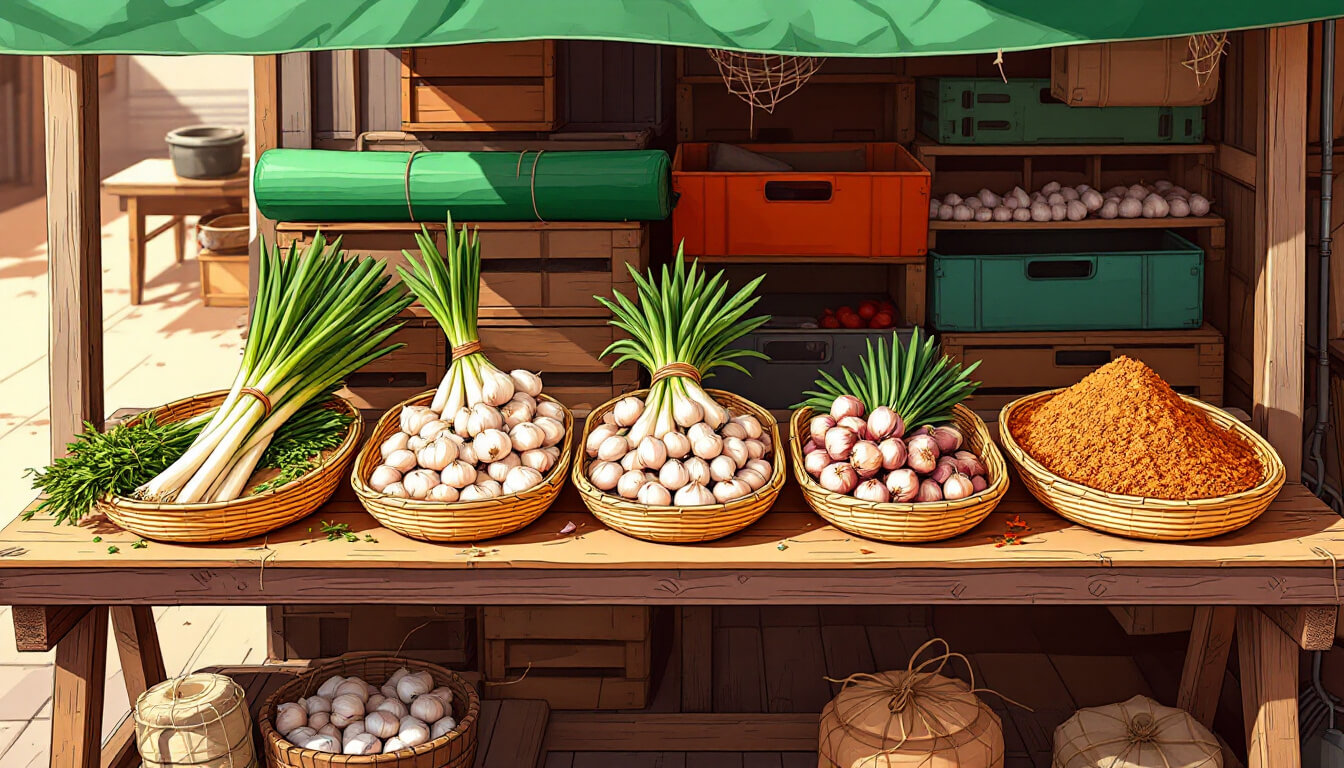
Start with the big one. 素食 (sùshí, literally “plain food”) is the traditional religious term, and the thing a Western vegan needs to know is that strict 素食 excludes more than meat. It also excludes the 五辛 — the five pungent roots. In Chinese Buddhist practice these are considered stimulating in a way that interferes with meditation, so a strict 素食 kitchen cooks without them.
And here is where Taiwan does something no other country does, which is write the list into law.
The five legal categories of vegetarian
In 2008 Taiwan’s health authority issued a regulation with the gloriously bureaucratic name 「包裝食品宣稱為素食之標示規定」 — Labelling Requirements for Packaged Foods Claiming to Be Vegetarian. It was announced on 1 July 2008 and took effect, by manufacturing date, on 1 July 2009. If a packaged food sold in Taiwan calls itself vegetarian, it must display one of five specific categories prominently on the packet:
- 全素 or 純素 (quánsù / chúnsù) — plant-based food containing none of the five pungent roots. This is the strictest category and the closest thing to “vegan” on a Taiwanese label.
- 蛋素 (dànsù) — 全素 plus egg products.
- 奶素 (nǎisù) — 全素 plus dairy products.
- 奶蛋素 (nǎidànsù) — 全素 plus both dairy and egg.
- 植物五辛素 (zhíwù wǔxīn sù) — plant-based food that does contain the five pungent roots. No meat, no dairy, no egg — but garlic and onions are in.
The Ministry of Health and Welfare names the five roots explicitly in the definition: 蔥 (scallion), 蒜 (garlic), 韭 (Chinese chives), 蕎 (a shallot-like allium, also written 薤) and 興渠 (asafoetida). This is not a guideline. Labelling a packet wrongly carries a fine of NT$30,000 to NT$3,000,000, and labelling it falsely carries NT$40,000 to NT$4,000,000.
For a vegan Taiwan shopper, the practical upshot is this: 植物五辛素 is your category. It is plant-based, it includes allium, and it is exactly what most Western vegans actually eat. 全素 works too and is stricter than you need. 奶素, 蛋素 and 奶蛋素 are not vegan.
Two caveats, and they matter. First, the regulation covers packaged food only. A restaurant is not bound by it, so the categories are a shopping tool, not a dining tool. Second, the categories describe ingredients — not how carefully the kitchen separates things.
蔬食, 鍋邊素 and 方便素 — the words for flexible
Three more terms you will hear, none of which are legal categories and all of which are in daily use.
蔬食 (shūshí, “vegetable food”) is the modern, secular, lifestyle-flavoured word. A 蔬食 restaurant is usually a stylish plant-based place that cooks with garlic and onion freely and may use dairy and egg. It signals “plant-based by choice” rather than “meat-free by religious observance” — which often means better coffee and a worse chance of the dish being strictly vegan. Ask.
鍋邊素 (guōbiān sù, “pot-edge vegetarian”) describes eating the vegetables out of a dish that was cooked with meat. Company dinner, one vegetarian at the table, everything already on the lazy Susan — you eat around it. It is a social accommodation, not a standard.
方便素 (fāngbiàn sù, “convenient vegetarian”) is one step up: you are at a non-vegetarian restaurant, you tell the kitchen before you order, and they cook you something meat-free — ideally in a washed wok. Plenty of Taiwanese vegetarians live on 方便素 when travelling or eating with family.
Knowing these two words is quietly powerful, because they let you ask for exactly the thing you want in a normal restaurant instead of hoping. “方便素可以嗎?” — “would convenient-vegetarian be possible?” — is a completely ordinary request in Taiwan and is understood instantly.
How to Spot a Vegetarian Restaurant on Sight

Now the street-reading skill that makes vegan Taiwan easy. There are three visual tells, and once you know them you will start seeing vegetarian restaurants in neighbourhoods you thought had none.
1. The character 素. This is the one to memorise. 素 on a sign, an awning, a menu board or a sticker on the window means the food inside is vegetarian. It is often large, often the only character you need, and it appears on everything from a glossy restaurant frontage to a laminated A4 sheet taped to a food cart. Learn its shape — a short horizontal stroke over a grid-like top half, sitting on what looks like a small silk-thread radical — and the island rearranges itself around you.
2. Green, and the 卍 symbol. Vegetarian places lean heavily on green in their signage and awnings; it is a convention rather than a rule, but it holds often enough to be a useful first filter. More reliably, traditional Buddhist vegetarian restaurants frequently display the Buddhist 卍 — a left-facing swastika, an ancient auspicious symbol in Buddhism with no relationship whatsoever to the twentieth-century European one. If you see 卍 next to 素, you are looking at a strict kitchen: no meat, no allium, usually no alcohol.
3. The 自助餐 counter. This is the format that makes everything easy. 自助餐 (zìzhùcān) means “self-service meal” — a long steam table of thirty-odd prepared dishes, you take a tray and tongs, you pick what you want, and you pay by weight at the till. Taiwan has these everywhere, and the vegetarian version — a 素食自助餐 — is the single best place a plant-based traveller can eat.
Why? Because in a vegan Taiwan buffet you are choosing with your eyes instead of your Mandarin. No menu, no ordering, no ambiguity. In a vegetarian 自助餐 everything on the table is already meat-free, so the only remaining question is egg and dairy, which you can usually see. Lunch costs very little, the turnover is fast so the food is fresh, and you can eat a genuinely varied plate — braised dried tofu, water spinach, bamboo shoots, pumpkin, pickles, mushrooms, brown rice — in about four minutes.
One wrinkle worth knowing: 自助餐 counters in Taiwan are usually a lunch phenomenon. Many open late morning, peak at noon and have packed away the trays by mid-afternoon. Plan your big vegetarian meal for the middle of the day and you will eat better and cheaper than you will at dinner.
Taiwanese Dishes That Are Already Vegan — and Three That Pretend To Be
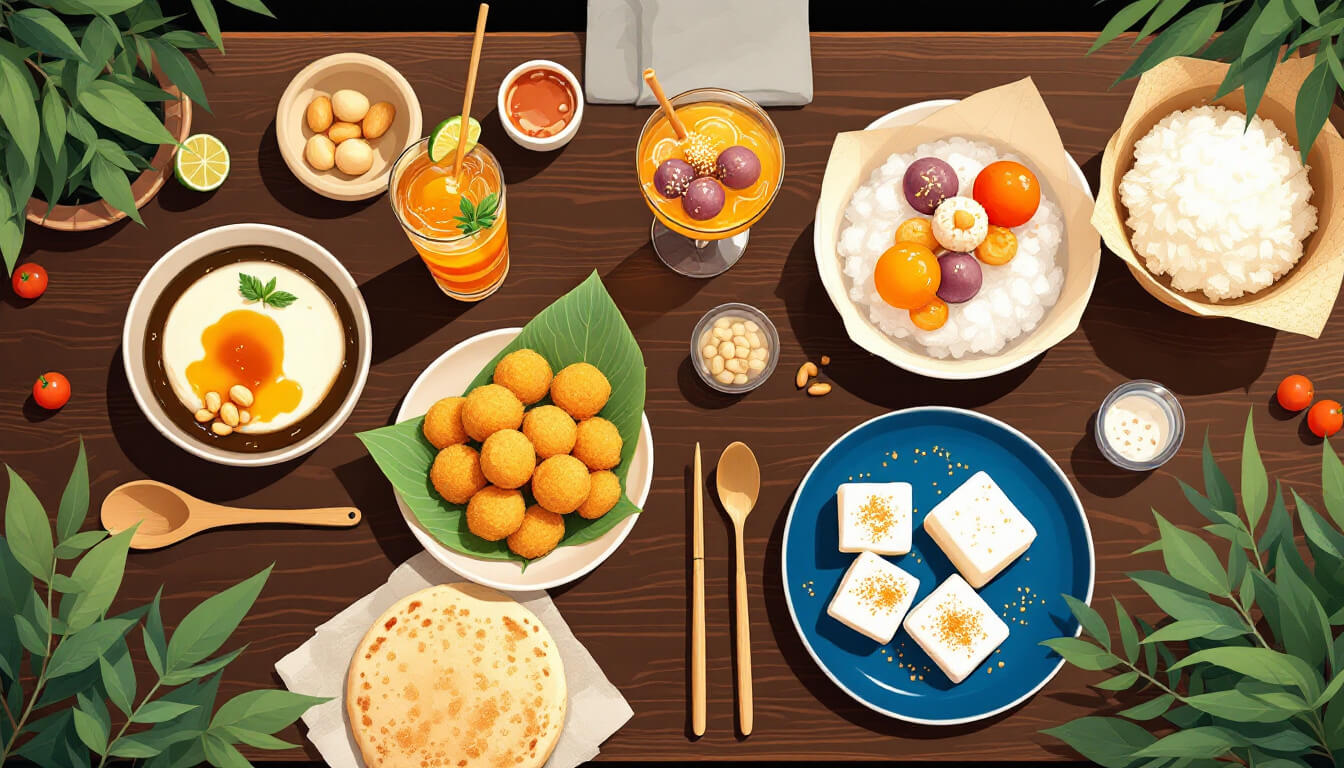
A surprising amount of everyday Taiwanese food is plant-based by default rather than by adaptation, and this list is the backbone of any vegan Taiwan trip. These are not “vegan versions” of anything. They are just what the dish is.
- 豆花 (dòuhuā) — silky tofu pudding in a thin sugar syrup, served warm in winter and over ice in summer, with toppings you choose: peanuts, red beans, mung beans, taro balls, tapioca pearls. Naturally vegan. Check that the syrup is plain sugar rather than honey.
- 愛玉 (àiyù) — a translucent amber jelly set from the seeds of a Taiwanese climbing fig, Ficus pumila var. awkeotsang, which are rubbed in water until the pectin releases. No gelatine, no animal anything. The usual serving is with lime and syrup, but plenty of stalls sweeten it with honey, so this is worth one question.
- 地瓜球 (dìguāqiú) — sweet potato balls, fried till they puff and go chewy. Flour, sweet potato, sugar, oil. Vegan, and one of the great night-market foods.
- 芋圓 / 地瓜圓 — taro and sweet potato balls, usually served in shaved ice or a warm sweet soup. Starch and root vegetable. Vegan.
- 花生捲 and 麻糬 — peanut-powder mochi and the peanut roll. Glutinous rice, peanut, sugar. The ice-cream peanut roll adds taro or sweet-potato ice cream that may contain dairy, but the plain versions are fine.
- 涼麵 (liángmiàn) — cold sesame noodles with shredded cucumber and carrot. Usually vegan, but the sauce sometimes carries a little meat stock and some shops add shredded egg, so this is a 方便素 conversation rather than an assumption.
- 素食牛肉麵 — vegetarian “beef” noodle soup. Taiwan’s national dish, remade with braised mushroom, gluten or soy protein in a dark aromatic broth. At a good 素食 restaurant this is genuinely excellent rather than a consolation prize. If you want to understand the original, our guide to every noodle type on the island explains what the vegetarian versions are imitating.
And the three that look vegan but often aren’t
蔥抓餅 (scallion pancake). Flour, oil, scallions — it should be the easiest win on the street. Two problems. The first is that the default at most stalls now is to crack an egg onto it; you have to say you don’t want one. The second is subtler: 蔥 is one of the five pungent roots, so a scallion pancake is not 素食 in the strict religious sense even though it is entirely plant-based. If you are vegan rather than Buddhist, it is fine. If you are ordering inside a strict 素食 restaurant, you will not find it on the menu, and now you know why.
臭豆腐 (stinky tofu). This is the one that catches people out, and almost nobody explains it properly. The tofu is tofu. The question is the 臭滷水 — the fermenting brine it sits in. Traditional brine recipes build the ferment from amaranth stalks, cabbage, bamboo shoots and tofu, but a great many of them also include shell-on shrimp and fish, which is exactly what gives the classic version its depth. Some vendors make a fully plant-based brine and some do not, and you cannot tell by looking. Order it at a 素食 stall and it is vegan by definition; order it at a general night-market stall and you are guessing.
Anything braised in 滷 (lǔ) liquid. The dark, star-anise-scented braising liquid that tea eggs, dried tofu and braised vegetables sit in at a 滷味 counter is frequently a shared pot that has had pork or chicken in it. The vegetables are vegetables; the liquid is not. Look for a dedicated 素滷味 counter instead — they exist, and they are common.
Night Market Survival: The Traps Hiding in the Vegetable Dishes

Night markets are where vegan Taiwan visitors get the most anxious and, honestly, where they should be a little careful. Taiwanese cooking uses a handful of animal ingredients as background seasoning rather than as the point of the dish, which means a plate can look entirely vegetable and not be. Four to watch for:
豬油 (lard). Still the fat of choice for a lot of traditional cooking — in 滷肉飯 obviously, but also brushed onto rice rolls, stirred into noodle sauces and used to fry vegetables. The giveaway is a certain glossy richness in something that looks plain.
肉鬆 (pork floss). The fluffy, sweet, pale-brown shredded pork that gets sprinkled over sticky-rice rolls, sandwiches, congee and even some breads. It reads visually as a dry topping rather than as meat, which is precisely the trap. There is a vegetarian version made from soy, labelled 素肉鬆, and it is common in vegetarian shops.
柴魚 (bonito). Dried fish flakes and fish stock sit underneath an enormous amount of soup, and particularly underneath anything pale and savoury — the broth around tempura-style 甜不辣, misozuke-style soups, some noodle soups. A clear light broth with vegetables in it is the single most likely thing on a night-market menu to secretly contain fish.
蝦米 (dried shrimp). Tiny, orange, used by the spoonful to season radish cake, sticky rice, and fried cabbage. Visible if you look, easy to miss if you don’t.
The good news is that night markets also contain the easiest vegan Taiwan wins on the island: roasted sweet potato, grilled king oyster mushrooms, corn on the cob, fresh fruit cups, sweet potato balls, douhua, aiyu, and increasingly a dedicated vegetarian stall or two. Our complete guide to Taiwan’s night market ecosystem covers how the markets are organised; this is just the plant-based overlay on top of it.
And there is one more thing worth planning around: Taiwan has a fully vegetarian travelling night market, 素食小夜市, a roving convoy of a dozen-odd stalls doing vegetarian burgers, takoyaki, fried chicken and the rest of the night-market canon with no meat anywhere. It has no fixed home — it announces the coming week’s locations on its Facebook group and Threads account, usually on a Monday. If it happens to be near you, reorganise your evening around it.
Breakfast, Convenience Stores, and the Easiest Meals of the Day

If you are tired, jet-lagged, and not up for negotiating anything, breakfast is where Taiwan quietly carries you. The traditional 豆漿店 — soy milk shop — opens around dawn and most of its menu is plant-based before anyone adapts it.
Warm unsweetened soy milk (無糖豆漿) with a fried dough stick (油條). Sesame flatbread (燒餅) on its own or wrapped around the dough stick. Sticky-rice rolls (飯糰), which are vegan if you ask for them without the pork floss and the egg — say 不要肉鬆, 不要蛋. Pan-fried radish cake (蘿蔔糕), excellent, though it sometimes contains dried shrimp. Steamed buns with vegetable or mushroom fillings. For the full picture of what a Taiwanese morning actually looks like, we went deep on it in our guide to Taiwan breakfast food.
Then there is the convenience store, which is the real vegan Taiwan safety net. Taiwan has one of the densest 7-Eleven and FamilyMart networks on earth, and this is the one place where that packaged-food labelling rule becomes genuinely useful: pick up a snack, turn it over, and look for 全素, 純素 or 植物五辛素 in the ingredients panel. No conversation required, no ambiguity, no hoping. Bananas, roasted sweet potatoes, rice crackers, nut bars, plain soy milk, instant noodles with a vegetarian seasoning packet, aiyu jelly cups.
Incidentally, the packaged-snack aisle is where you meet 乖乖 (Guai Guai), the puffed corn snack whose blue-haired mascot has been on Taiwanese shelves since 1968 and whose green coconut-flavour bag famously gets placed on top of office servers and hospital machines as a good-luck charm to stop them misbehaving. We put him on a shirt, because of course we did — the 乖乖 Guai Guai Taiwan Snack Mascot Retro T-Shirt is one of those designs that gets recognised instantly by anybody who grew up with the bag.
The Phrases to Have on Your Phone
Screenshot this section — it is the most portable part of this vegan Taiwan guide. Showing a phrase to someone works far better than attempting the tones, and Taiwanese service staff are extremely good at meeting you halfway.
- 我吃素 — wǒ chī sù — “I eat vegetarian.” The single most useful sentence. It is understood everywhere and carries the religious-vegetarian connotation, so people take it seriously.
- 我吃全素 / 我吃純素 — wǒ chī quánsù / chúnsù — “I eat strict vegetarian / vegan.” Use this if egg and dairy matter to you.
- 我不吃肉 — wǒ bù chī ròu — “I don’t eat meat.” Plainer and sometimes clearer than 素 to someone who is not familiar with vegetarian practice.
- 有沒有素食? — yǒu méiyǒu sùshí? — “Do you have anything vegetarian?”
- 方便素可以嗎? — fāngbiàn sù kěyǐ ma? — “Would convenient-vegetarian be okay?” The polite way to ask a non-vegetarian kitchen to cook you something meat-free.
- 不要加蛋 — bùyào jiā dàn — “No egg, please.”
- 不要加肉鬆 — bùyào jiā ròusōng — “No pork floss, please.” Unglamorous, and it will save you more meals than anything else on this list.
- 這個有沒有肉或魚? — zhège yǒu méiyǒu ròu huò yú? — “Does this have meat or fish in it?” The fish half matters; a lot of people ask only about meat.
- 這個有沒有蔥蒜? — zhège yǒu méiyǒu cōngsuàn? — “Does this have scallion or garlic?” Only needed if you are keeping strict 素食.
One cultural note that makes all of this easier: saying 我吃素 in Taiwan does not read as a lifestyle statement or an inconvenience. It reads as an ordinary thing a lot of people’s grandmothers do. Nobody is going to raise an eyebrow.
Where the Vegetarian Clusters Are, City by City

Almost every English-language vegan Taiwan guide is really a guide to eating plant-based in Taipei. That is a shame, because the religious infrastructure this article is about is strongest in exactly the places those guides skip.
Taipei and New Taipei. The deepest and most varied scene, and the only one where you will find fully vegan — rather than vegetarian — restaurants in any number, along with vegan bakeries, plant-based milk-tea shops and the stylish 蔬食 end of the market. Worth knowing: the temple districts are their own food ecosystem. Around Longshan Temple in Wanhua, vegetarian stalls and 素食自助餐 counters cluster within a couple of streets of the temple itself, because that is who the customers are. Our guide to Longshan Temple covers the neighbourhood, and the district-by-district Taipei restaurant playbook is the wider map.
Taichung. Underrated and excellent. Taichung has a large and visible Buddhist and Yiguandao presence, a lot of 素食自助餐 counters in ordinary residential neighbourhoods, and a university-driven younger plant-based scene layered on top. It is the city where the “just walk until you see 素” method works best.
Tainan. The oldest city on the island, the densest concentration of temples, and a food culture that takes itself seriously. Tainan food famously runs sweet and leans hard on pork and seafood, so the general street-food scene is harder than Taipei’s — but the dedicated vegetarian restaurants are correspondingly well established and often very old. Seek out the 素食 places rather than trying to adapt the famous dishes.
Kaohsiung. Big, flat, easy to get around, and with a genuinely strong vegetarian scene anchored partly by the enormous Fo Guang Shan monastery complex out at Dashu, whose visitor facilities serve vegetarian food to very large numbers of people. The city itself has plenty of ordinary 素食自助餐 counters.
Anywhere with a big temple. This is the general vegan Taiwan rule that replaces memorising a list. A large, active temple produces a congregation that eats meat-free on the first and fifteenth of the lunar month, and that congregation supports restaurants within walking distance. If you are in an unfamiliar Taiwanese town and you want a vegetarian lunch, find the main temple on a map and walk the four streets around it. It works more often than it has any right to.
One timing tip that follows from the same logic: on 初一 and 十五 — the first and fifteenth days of the lunar month — a noticeably larger share of Taiwanese people eat vegetarian for religious observance. Vegetarian restaurants are busier, more buffet counters open, and ordinary restaurants are more likely to have a meat-free option ready. It is the easiest day of the month to eat plant-based in Taiwan, and nobody tells visitors about it.

Wear the Food Map
Our Taiwanese Street Food Guide tee is a vintage food poster of the island’s greatest hits — sweet potato balls, douhua and all. Half of them are already vegan.
Vegan Taiwan: Frequently Asked Questions
Is Taiwan really one of the easiest countries in Asia to eat vegan in?
For a traveller who learns the character 素 and is willing to eat at ordinary local restaurants rather than only at Western-style vegan cafés, yes — it is among the easiest, and the reason is the religious infrastructure rather than the modern plant-based trend. The caveat is that “vegetarian” in the traditional Taiwanese sense sometimes includes egg and dairy, and strict 素食 excludes garlic and onion. You are navigating a different set of lines, not fewer of them.
What does 素食 mean exactly?
素食 is the traditional religious term for vegetarian food. In its strict form it excludes meat, fish, and also the 五辛 — scallion, garlic, Chinese chives, shallot and asafoetida. It may or may not exclude egg and dairy depending on the establishment, which is why the packaged-food labelling categories exist.
Is 蔬食 the same as 素食?
No. 蔬食 is the modern, secular “plant-based” term and almost always permits garlic and onion. It frequently permits dairy and egg too. A 蔬食 café is more likely to have oat-milk lattes and less likely to be strictly vegan than a traditional 素食 restaurant. Always ask rather than assume.
Which label should a vegan look for on packaged food in Taiwan?
植物五辛素 and 全素 / 純素 are both free of meat, fish, dairy and egg. 植物五辛素 contains allium; 全素 / 純素 does not. Avoid 奶素, 蛋素 and 奶蛋素, which contain dairy, egg or both. These five categories have been mandatory on packaged food claiming to be vegetarian since 1 July 2009.
Do Taiwanese restaurants have to follow the same labelling rules?
No — the regulation covers packaged food only. Restaurants are not bound by it, which is why signage, the 素 character and simply asking remain the tools you use when eating out.
Is stinky tofu vegetarian?
Not reliably. The tofu is plant-based but the fermenting brine it is soaked in often includes shrimp and fish. At a dedicated 素食 stall it will be vegetarian; at a general night-market stall it depends entirely on whose brine it is.
Is bubble tea vegan in Taiwan?
The tapioca pearls themselves are, and so is the tea. The problem is usually the milk — most shops default to dairy or to a non-dairy creamer that contains milk derivatives. Plant milks are increasingly available in Taipei and increasingly not elsewhere. Ordering the tea without milk, or with fresh fruit, is the reliable route.
What is the single most useful thing to learn before a vegan Taiwan trip?
The character 素, and the phrase 我吃素. Between them they solve most of the problem, and both take about thirty seconds to learn.
Final Thoughts: Eat Like It’s Normal, Because It Is
The mistake people make with vegan Taiwan is treating it as a restriction to be managed — researching three restaurants a day in advance, carrying printed cards, approaching every meal as a negotiation. You can do that. It will work. You will also have a slightly exhausting trip.
The better move is to learn one character, two phrases and the shape of a 自助餐 counter, and then relax into the fact that a meaningful slice of the country around you is eating the same way for reasons far older than yours. Walk the streets near a temple. Eat your big meal at lunch. Look for green. Ask the question. Turn the packet over.
Vegan Taiwan is not a trend the island is trying out. Taiwan has been quietly good at this since long before anyone was counting, and it is not performing for visitors. That is exactly what makes it easy. 吃飽沒? — have you eaten yet? You will have.
A Postcard From Taiwan, Every Week
Culture stories, food deep-dives, travel tips, and first looks at new designs — straight to your inbox. No spam, just Taiwan.

Grab a Free Taiwan Sticker!
Drop your email and we’ll send you a limited-edition Taiwan sticker — plus insider access to new merch drops and island vibes.
No spam. Unsubscribe anytime.