Did You Know? Taiwan Still Paints Its Movie Posters by Hand
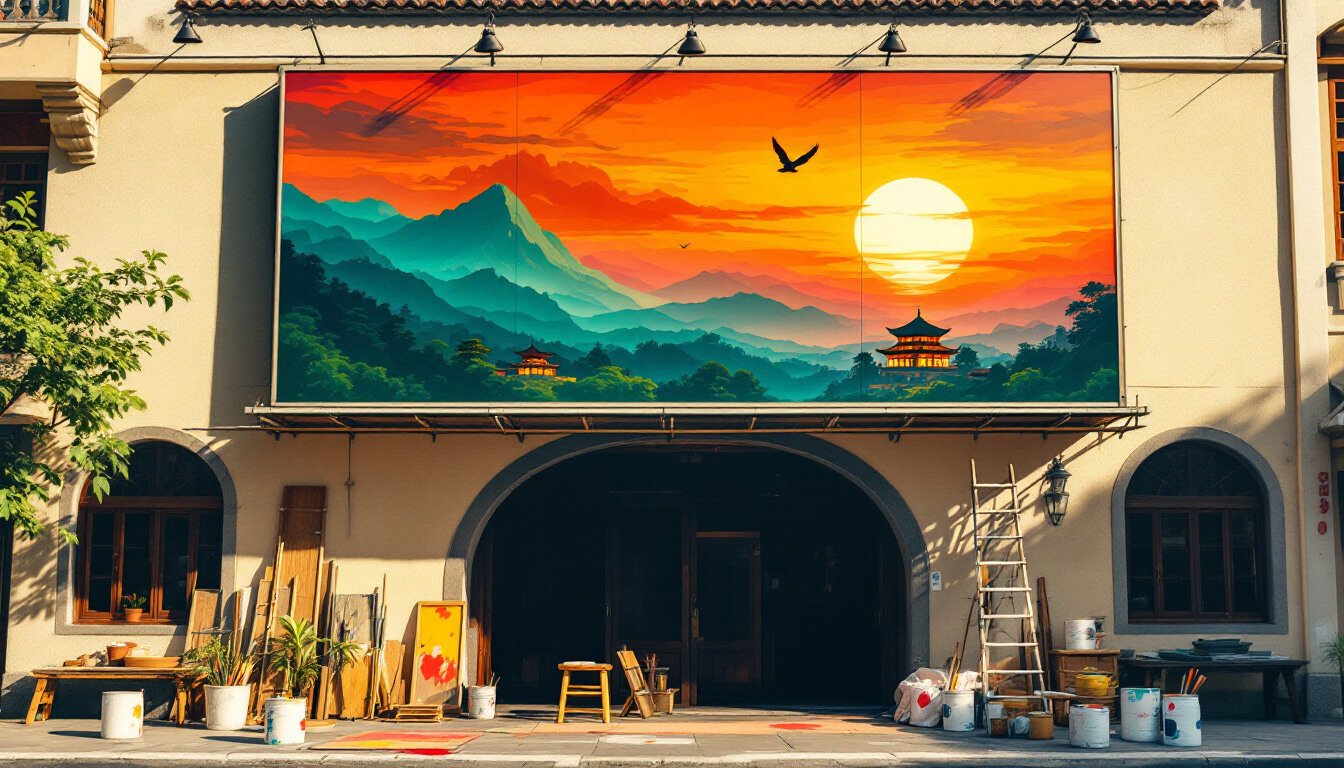
There is a cinema on Yongfu Road in Tainan where the poster above the door was not printed. It was painted — by hand, in acrylic, on canvas panels bolted together into one picture the width of the building. When the film changes, the old picture gets painted over.
Here’s the fact: Taiwan is one of the last places on earth where hand-painted movie billboards still go up over a working cinema, and for more than fifty years almost all of them came from a single pair of hands.
The theatre that Ang Lee grew up in
Chin Men Theater (全美戲院) opened in 1950 — arched windows, dark roof tiles, a second-run house showing films that had already finished their run everywhere else, two at a time, for the price of one ticket. A Tainan high-schooler named Ang Lee spent a lot of hours in those seats, and he has since talked about the place as part of what pointed him toward making films at all.
Seventy-six years later it is still open, still second-run, still cheap. And it is still the reason people photograph a cinema entrance instead of the movie.
200 billboards a month, drawn by eye
Yan Jhen-fa (顏振發) started as an apprentice at eighteen, under a well-known poster painter named Chen Feng-yong. What he learned there was the grid method: rule a small reference image into squares, rule the giant canvas into the same squares, then enlarge it square by square with a long-handled brush. No projector, no printer, no tracing.
At the height of Taiwan’s cinema boom, when hundreds of theatres across the island each kept their own billboard painter on staff, Yan was turning out as many as 200 boards a month. Over his career he painted more than a thousand for Chin Men alone. Decades of that close, precise work cost him the sight in his right eye.
What happened next is the good part
In 2024 the Taipei Film Festival gave Yan its Outstanding Contribution Award — the kind of honour that usually goes to directors, handed to the man who painted their names ten feet tall. That same year he stepped away from the theatre, and at 71 he opened his first solo exhibition in Tainan: twenty original oil paintings, no film titles on any of them. He had swapped the acrylics he used on billboards for oils, which he describes as softer, needing layer on layer to get the depth he wants.
The craft did not leave with him. By his own count Yan has taught the grid method to more than 500 students through billboard workshops, and his work turns up in places that have nothing to do with cinema — including a wall in Taipei’s Ximending where he reproduced the cover of Coldplay’s Everyday Life by hand, at building scale.
If you go
Chin Men is a few minutes’ walk from Tainan’s Confucius Temple, which makes it easy to fold into a day in Tainan — the island’s oldest city and, conveniently, its best eating. Look up before you go in. Then look at the brushwork close: the seams between panels, the places where a colour was mixed slightly differently on a different day.
The takeaway: a printed poster is identical everywhere in the world. A painted one exists exactly once, gets painted over in a fortnight, and someone had to climb a ladder to make it. That is a very Taiwanese way to treat something disposable — and it sits comfortably alongside the island’s other handmade traditions, most of which survived the same way: one stubborn person, several hundred students.
If the idea of art you can walk past appeals to you, so will art you can wear. Our Taiwan-themed tees, prints and accessories run on the same instinct — island culture, put somewhere people will actually see it. Smaller ladder.

Grab a Free Taiwan Sticker!
Drop your email and we’ll send you a limited-edition Taiwan sticker — plus insider access to new merch drops and island vibes.
No spam. Unsubscribe anytime.