Chiang Kai-shek Memorial Hall Taipei: The Complete 2026 Guide (History, Renaming, Changing of the Guard)
Few landmarks pack more Taiwanese history into one skyline silhouette than the Taipei Chiang Kai-shek Memorial Hall — a white marble monument crowned by a blue octagonal roof that mirrors the colors of the ROC flag. It sits inside Liberty Square, the largest public plaza on the island, and it is arguably the most contested piece of architecture in the country. Depending on who you ask, it’s a shrine to a founding father, a monument to a dictator, a lightning rod for the democracy movement, or simply the best free morning in Taipei.
This guide walks you through everything you actually need to know before you go — the real history, the ongoing renaming debate, the newly relocated 2024 Changing of the Guard ceremony, the free museum inside, plus opening hours, MRT directions, admission, and the best time of day to show up. Whether you have 20 minutes or 2 hours, we’ll make sure you leave knowing exactly what you looked at.
What Makes the Taipei Chiang Kai-shek Memorial Hall Different
The Taipei Chiang Kai-shek Memorial Hall (中正紀念堂, often shortened to CKS Memorial Hall) is a national monument built to honor Chiang Kai-shek, the former Republic of China president who ruled Taiwan under martial law from 1949 until his death in 1975. Officially opened in 1980, the complex is one of the most-visited attractions in Taipei — but calling it a “memorial” undersells what actually happens on those 240,000 square meters of white marble.
On any given morning, the plaza hosts tai chi classes, drone photographers, wedding shoots, plum blossom pilgrims in February, protest rallies, and streams of tourists arriving for the hourly Changing of the Guard. Inside the memorial itself is a completely free museum tracing Chiang’s life and the ROC’s twentieth century. Flanking the plaza are the twin National Theater and National Concert Hall, both built in traditional Chinese palace style with sweeping yellow-tiled roofs that look like they were airlifted straight out of the Forbidden City.
The site works on three levels at once: as a memorial, as a public park, and — increasingly since Taiwan’s democratization — as a monument to the very freedoms Chiang himself never granted. That tension is what makes a visit here so much more interesting than a standard capital-city landmark.
A Brief History: From 1975 Funeral to 1980 Opening
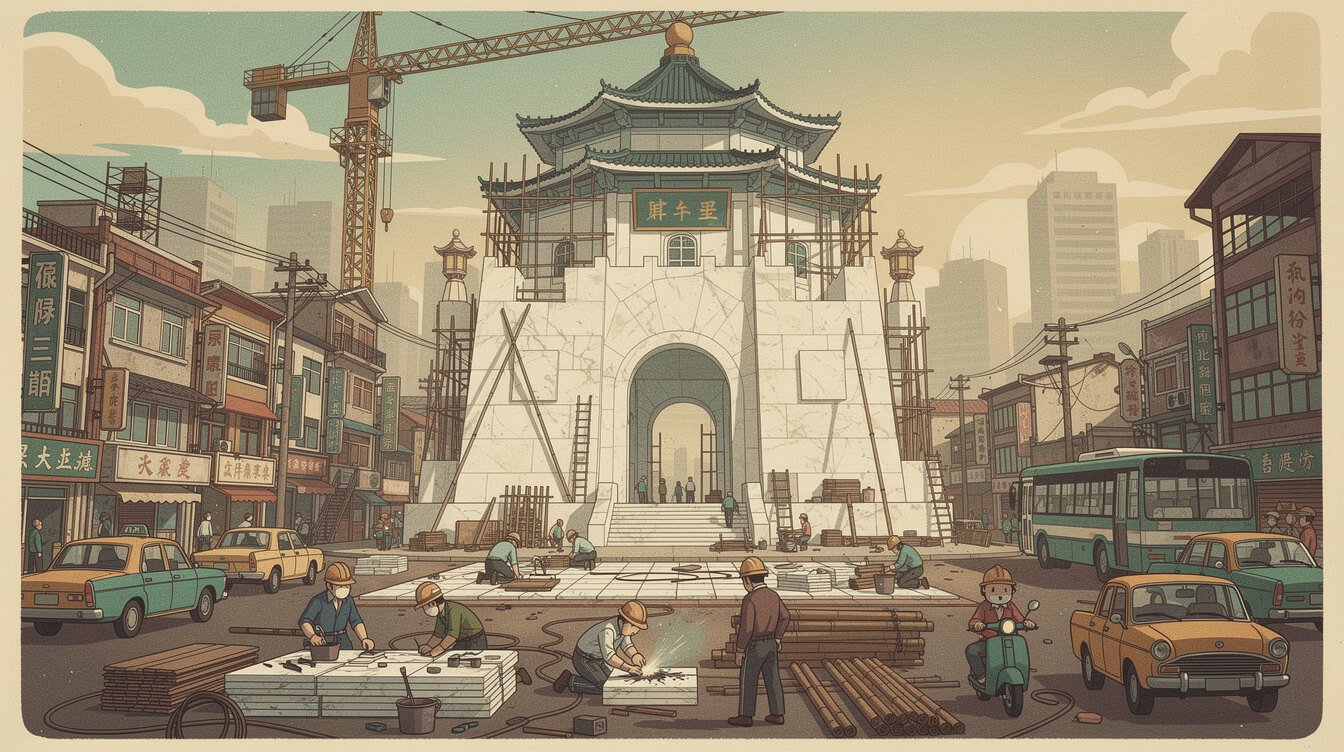
Chiang Kai-shek died on April 5, 1975, at age 87, ending nearly three decades of authoritarian rule over Taiwan. Within weeks, the KMT-led government announced plans for a national monument on a plot of former military-camp land in what is now Zhongzheng District — a neighborhood pointedly named after Chiang himself (Zhongzheng, 中正, is his adopted given name).
A design competition was held, and the winning architect was Yang Cho-cheng, whose plan drew heavily from the Sun Yat-sen Mausoleum in Nanjing, China — a symbolic gesture linking Chiang to the founder of the Republic of China. Yang’s design leaned into ROC symbolism at every scale: white marble walls topped with a deep-blue octagonal roof echoing the party emblem, a red carpet ascending through the interior, and 89 white stone steps from the plaza to the main entrance, one for each year of Chiang’s life.
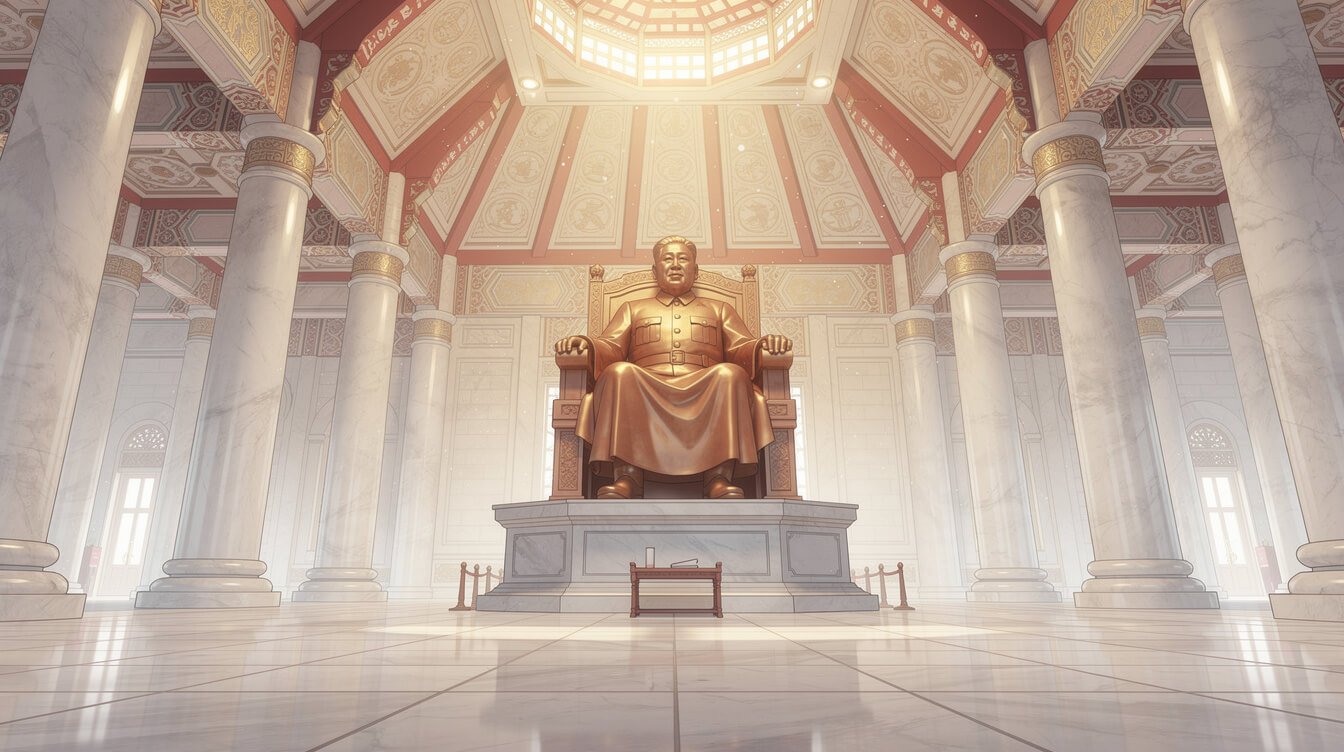
Construction began in 1976 and the memorial was officially opened on April 5, 1980 — the fifth anniversary of Chiang’s death. The bronze seated statue of Chiang inside — modeled on the Lincoln Memorial’s pose — weighs roughly 25 tons. From day one, uniformed honor guards from the three branches of the ROC military stood watch, changing on the hour throughout the day.
For a fuller picture of the era Chiang ruled — martial law, the White Terror, the transition to democracy in the late 1980s — pair this with our History of Taiwan in nine stories and our long-read on Green Island’s political-prisoner past.
The Renaming Controversy: Liberty Square, Democracy Hall & the Cult of Personality
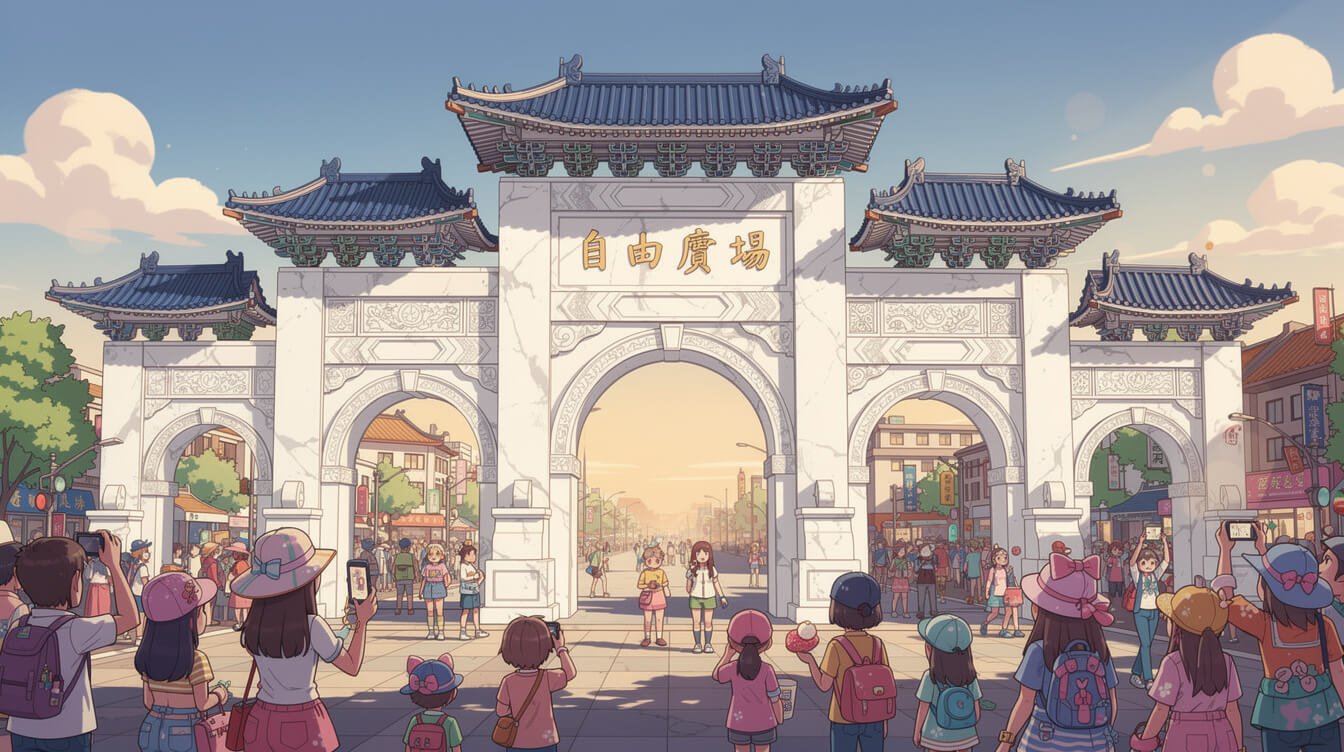
Nothing about this site has been more politically charged than what you call it. When it opened in 1980, the massive five-arch gateway on Zhongshan South Road was engraved with the phrase 大中至正 (“Great Centrality and Perfect Uprightness”) — a Confucian double-play on Chiang’s given name. That name stood for 27 years without controversy, because Taiwan was still coming to terms with dismantling its authoritarian past.
That changed in 2007, when Chen Shui-bian — the first non-KMT president in the ROC’s modern history — ordered the arch’s characters removed and replaced with 自由廣場 (“Liberty Square”). At the same time, he officially rebranded the entire complex as the “National Taiwan Democracy Memorial Hall.” Photographs from that summer show workers with long poles literally prying the old brass characters off the marble while crowds cheered or protested on the plaza below.
When the KMT’s Ma Ying-jeou won the presidency in 2008, one of his first acts was to revert the memorial hall’s official name back to Chiang Kai-shek Memorial Hall. But the arch’s new name — Liberty Square — was politically radioactive to reverse, and it stayed. That awkward compromise is exactly what you see today: you walk through a gate that reads “Liberty Square” to enter a memorial to the man who suspended civil liberties for 38 years.
The rebalancing didn’t stop there. In July 2024, the Ministry of Culture moved the Changing of the Guard ceremony down from the upper floor of the hall — where guards had stood at attention beside Chiang’s statue for 44 years — to the ground-level plaza outside. The stated goal was “reducing the cult of personality.” Depending on your politics, it was either overdue or an insult. Either way, if you visited before 2024, the ceremony you’ll see now is completely different.
The Changing of the Guard: Hourly Ceremony (2026 Updated Schedule)
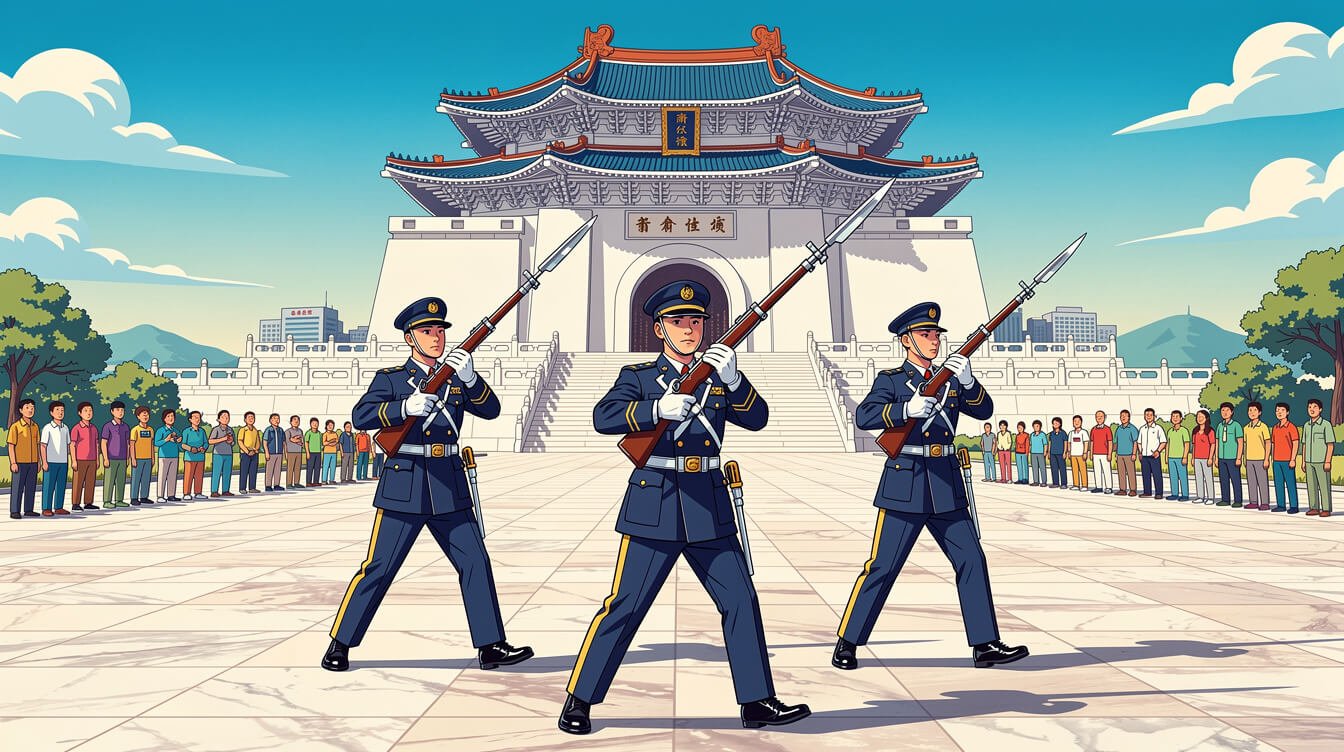
The Changing of the Guard is the single most photographed thing that happens at CKS Memorial Hall, and it’s the reason a lot of visitors show up in the first place. It’s a genuinely impressive piece of ceremonial drill — three honor guards in dress uniform, white gloves, chrome-tipped rifles, and precisely synchronized footwork. The whole thing takes about ten minutes and includes rifle-spinning, marching, and the formal handover.
2026 Ceremony Times
Since the 2024 relocation, the ceremony happens on the plaza in front of the memorial hall at the following times, every day the hall is open:
- 9:00 AM (first ceremony of the day)
- 10:00 AM
- 11:00 AM
- 12:00 PM
- 1:00 PM
- 2:00 PM
- 3:00 PM
- 4:00 PM
- 5:00 PM (final ceremony of the day)
That’s nine ceremonies a day, on the hour. Arrive about 10–15 minutes early to grab a spot near the front — the 11 AM and noon slots are the most crowded, especially in high season. If you want breathing room, the first ceremony at 9 AM is usually the quietest, and the light is spectacular.
Flag Raising and Lowering
Separate from the guard change, the ROC flag is raised in the plaza at 6:00 AM from April to September and 6:30 AM from October to March. Flag lowering happens at 6:10 PM in summer and 5:10 PM in winter. If you’re an early riser, this is a genuinely moving 5-minute experience — and you’ll be surrounded almost entirely by locals doing morning exercises.
Note: the ceremony can be canceled without notice for weather (heavy rain, typhoons), holidays, or special political occasions. If you’re building your Taipei day around it, check the official CKS Memorial Hall site the morning of your visit.
What to See at the Taipei Chiang Kai-shek Memorial Hall
Most first-time visitors budget 20 minutes and end up staying two hours. Here’s what’s actually worth your time on the grounds, in the order you’ll likely encounter them.
Liberty Square Arch
Your entry point from Zhongshan South Road. Five white marble archways under a sweeping blue-tile roof, topped by the gilded 自由廣場 characters. Turn around after you walk through and you’ll see the memorial hall framed dead-center — that’s the money shot.
The Twin Palaces: National Theater & Concert Hall
Flanking the plaza to your left (Concert Hall) and right (National Theater), these are Taiwan’s premier performing-arts venues and legitimate architectural marvels in their own right. Both were completed in 1987, both use the traditional palace style, and both are worth walking around even if you’re not seeing a show.
The 89 Steps and the Statue
The long climb — one step for every year of Chiang’s life — leads to the main hall. Inside, the 25-ton bronze statue of a seated Chiang Kai-shek stares out through the massive front doors, framed to look directly at Liberty Arch and, in the distance, the Presidential Office Building. It’s a deliberate line of sight.
The Museum (Ground Floor, Free)
The best-kept secret at CKS is the completely free museum on the ground floor, which houses Chiang’s memorabilia — his 1955 Cadillac, his sedan chair, his uniforms, gifts from foreign heads of state — plus rotating exhibits on Taiwan’s twentieth-century history that have grown noticeably more critical since 2008. Bring your kid or your history-nerd friend.
Gardens, Ponds & Corridors
Ringing the main hall are two symmetrical Chinese-style gardens with lily ponds, arched footbridges, and a covered roofed corridor that’s a lifesaver during a Taipei summer downpour. If you visit in February, the plum blossoms are extraordinary; in late March, the cherry blossoms take over.
If you’re stitching this into a bigger Taipei day, our things to do in Taipei guide has full neighborhood itineraries — pair CKS with Yongkang Street for lunch, or push north to Zhongshan for evening bars. And if you want to wear your Taipei pride while you sightsee, our Taipei 101 “Built to Sway” T-shirt is basically the same minimalist Taipei-landmark energy in tee form.
How to Visit: Hours, Admission, MRT & Best Time
Opening Hours (2026)
- Memorial hall & museum: 9:00 AM – 6:00 PM, daily
- Liberty Square (outdoor plaza): open 24 hours, illuminated until midnight
- Closed: Lunar New Year’s Eve, Lunar New Year’s Day, and February 28 (Peace Memorial Day). Occasional closures for maintenance or typhoons.
Admission
Completely free. No ticket, no reservation, no line. That includes the memorial hall itself, the museum, and the plaza. This is one of the best-value cultural stops in Taipei.
Getting There by MRT
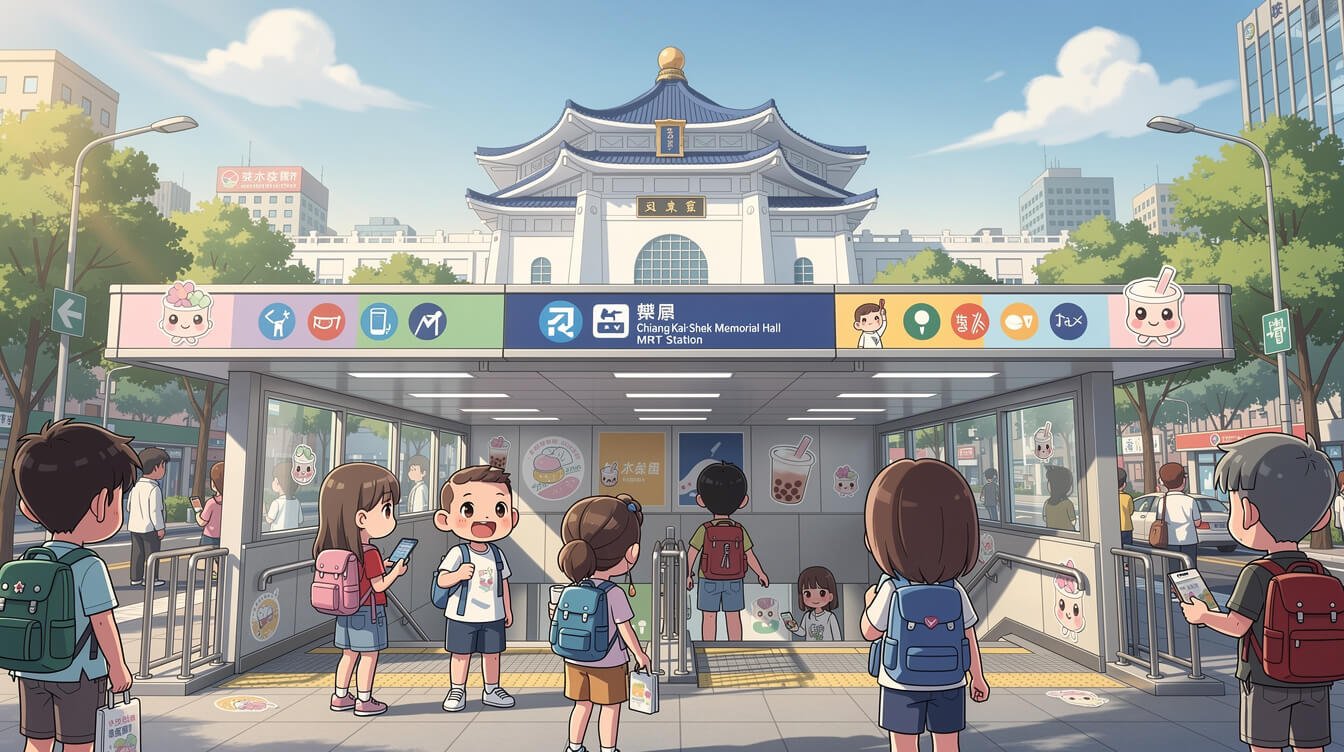
Take the Taipei Metro to Chiang Kai-shek Memorial Hall Station (中正紀念堂站) — served by both the Green Line (Songshan-Xindian) and the Red Line (Tamsui-Xinyi). Take Exit 5 and you’ll come up directly at the base of Liberty Square Arch. The whole complex is a 3-minute walk from the turnstiles. Any Taipei MRT stored-value card (EasyCard, iPass) works.
Best Time of Day to Visit
- 6:00–9:00 AM: Coolest, quietest, best light. Locals doing tai chi. Flag-raising ceremony at 6 AM in summer.
- 9:00 AM ceremony: First guard change with the smallest crowd.
- Late afternoon (4–6 PM): Beautiful low light for photos of the marble and the roofline.
- After sunset: The hall and both theaters are floodlit until midnight and photograph beautifully against a dark sky.
Avoid midday in July and August — Taipei summer sun on white marble is genuinely brutal, and the plaza has no shade.
How Long to Budget
Plan for 1–2 hours total: 30 minutes for the plaza and arch, 15 for a guard change, 30 for the museum, and 15 more for the gardens. Add another hour if you want to walk over to Yongkang Street for dumplings.
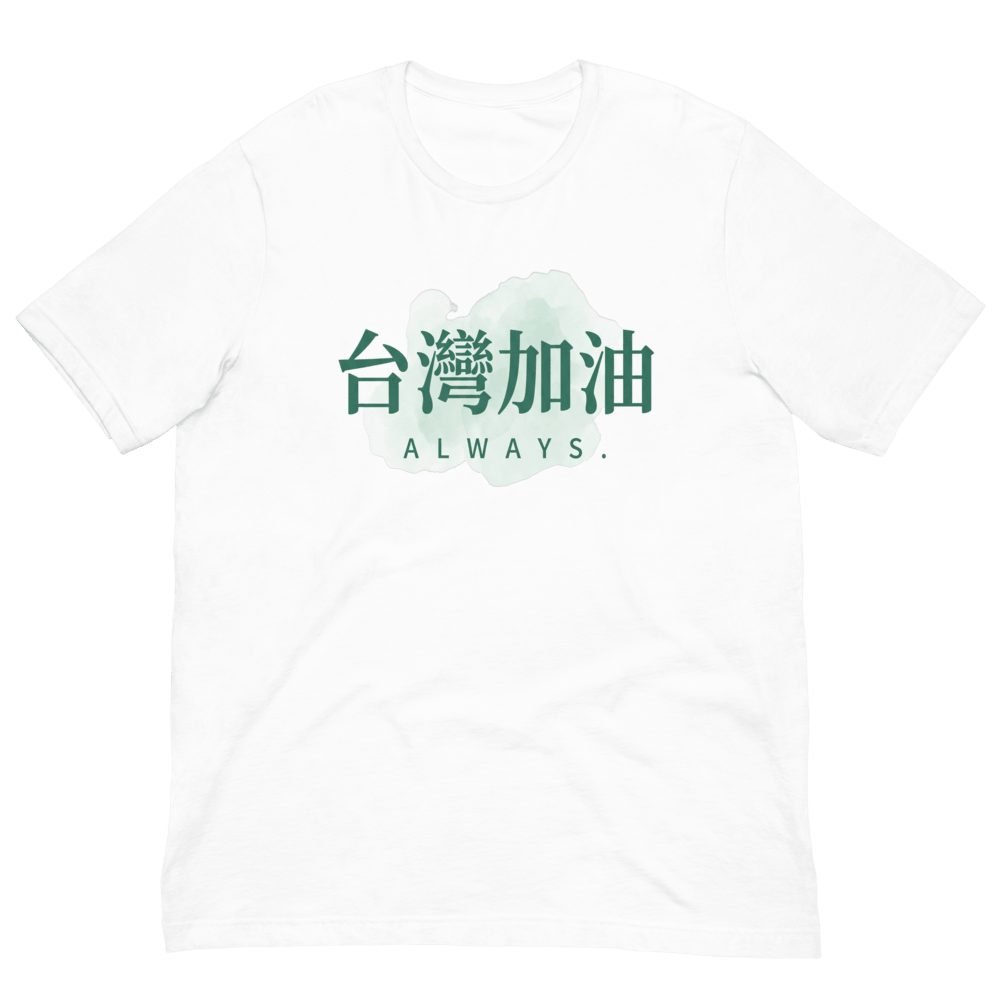
Wear Your Taiwan Pride to the Plaza
Whether you’re posing for photos in Liberty Square or watching the guards march, our Taiwan Jiayou 台灣加油 Always tee is the perfect low-key way to show up for Taipei’s most iconic landmark. Soft cotton, kawaii-meets-classic design, ships worldwide.
Frequently Asked Questions About Chiang Kai-shek Memorial Hall
Is Chiang Kai-shek Memorial Hall free?
Yes — the memorial hall, the ground-floor museum, and the entire Liberty Square plaza are all completely free to enter. There is no ticket, no reservation, and no fee.
How long does the Changing of the Guard take?
About 10 minutes per ceremony. The full sequence includes the outgoing guards’ march-out, the incoming guards’ march-in, rifle drill, and the formal handover. Arrive 10–15 minutes early if you want a spot near the front.
When does the Changing of the Guard happen?
Nine times a day, on the hour, from 9:00 AM to 5:00 PM. Since 2024, the ceremony takes place at ground level on the plaza in front of the memorial hall — no longer on the upper floor next to the statue.
Why is it inside “Liberty Square”?
In 2007, President Chen Shui-bian officially renamed the plaza’s entry arch from “Great Centrality and Perfect Uprightness” (a nod to Chiang) to “Liberty Square” (自由廣場). The complex itself has flip-flopped in name — briefly called the “National Taiwan Democracy Memorial Hall” — but the arch has stayed Liberty Square through every administration since. It’s a deliberate acknowledgment of the pro-democracy movement that helped end martial law.
Is it worth visiting? Isn’t it controversial?
Yes, and yes. That’s exactly why it’s worth visiting. Few sites in Taipei tell the full arc of Taiwan’s twentieth century — from authoritarian rule to full democracy — in one physical space. Coming here doesn’t require endorsing Chiang’s legacy; it means engaging with it.
What’s the closest MRT station?
Chiang Kai-shek Memorial Hall Station (中正紀念堂站), served by both the Green Line (Songshan-Xindian) and the Red Line (Tamsui-Xinyi). Take Exit 5 for direct access to Liberty Square Arch.
Can I visit at night?
Yes — the outdoor plaza is open 24 hours and the buildings are floodlit until midnight. The memorial hall interior itself closes at 6 PM, but nighttime is arguably the most photogenic time to be on the plaza.
Is CKS Memorial Hall the same as the capital’s most important landmark?
Taipei has several icons — Taipei 101, Longshan Temple, the Presidential Office — but CKS Memorial Hall is the most politically loaded of them all. For a fuller picture of Taipei’s role in the country, see our guide on the capital of Taiwan and why Taipei is the answer.
Final Thoughts: Why This Site Is Essential Taipei
You can visit Taipei and skip Chiang Kai-shek Memorial Hall. Plenty of people do. But if you’re trying to actually understand the island you’re standing on — how a garrison state governed by martial law became one of Asia’s most vibrant democracies in a single generation — no other single stop in the city does more work in less time. The white marble, the blue octagonal roof, the honor guards, the free museum, the arch that reads Liberty Square instead of Chiang’s name: every piece of it is a compressed history lesson.
Go for the guard change. Stay for the museum. Come back at night for the photos. And take a moment on those 89 steps to think about the man they were counting, the country he ruled, and the country his memorial now sits in the middle of. That gap — between the two Taiwans, before and after democracy — is what you actually came here to see.
Get the Taiwan Culture Weekly
One short email a week with Taiwan travel guides, food deep-dives, and our newest merch drops. No spam, unsubscribe anytime.

Grab a Free Taiwan Sticker!
Drop your email and we’ll send you a limited-edition Taiwan sticker — plus insider access to new merch drops and island vibes.
No spam. Unsubscribe anytime.