Did You Know? Penghu Catches Fish With Walls of Stone, and Has Nearly 600 of Them
On the outer islands of Penghu, people have been fishing for centuries without boats, bait or nets. They used walls. Out on the reef flats are long, low curves of piled stone called 石滬 (shí hù), or stone fish weirs. Penghu has more of them packed into its coastline than anywhere else on Earth.
A trap that runs on the tide
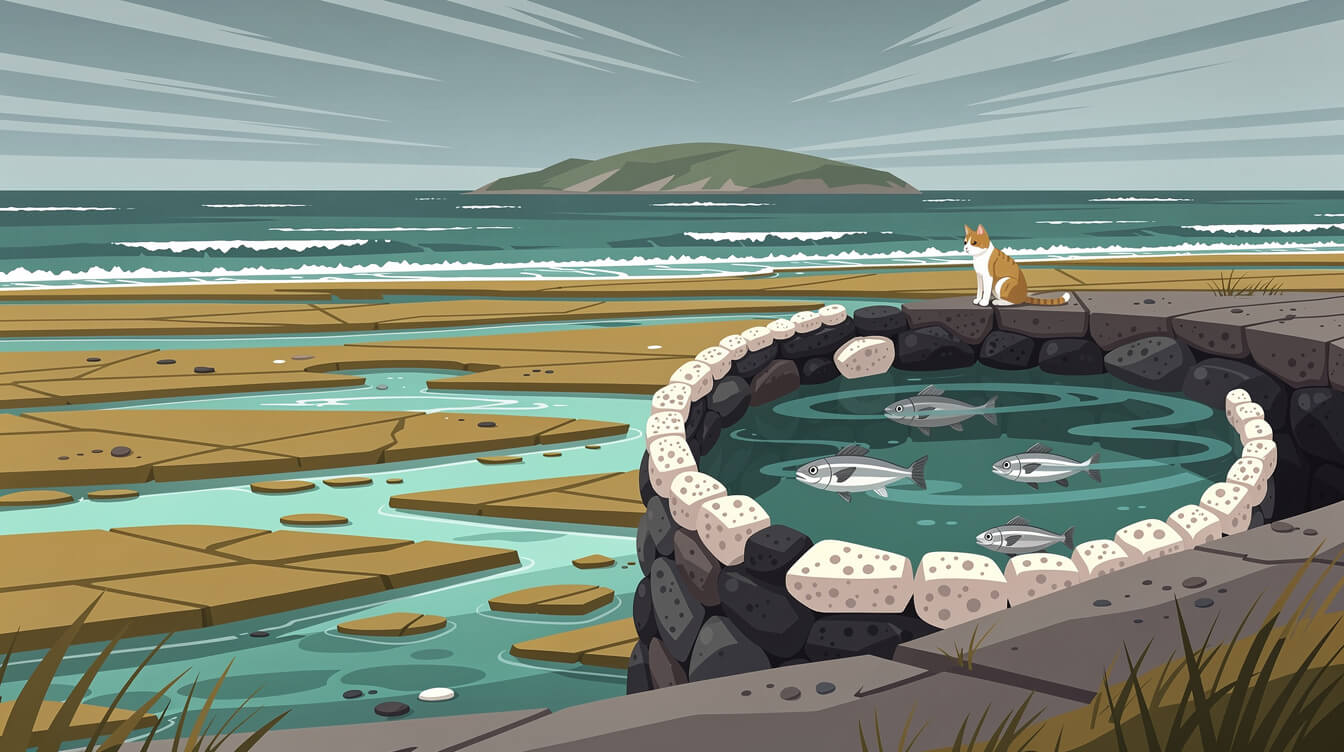
The idea is simple. Each weir is a dry-stone wall built across the intertidal reef, running out from the shallows into deeper water and curling back on itself at the far end. At high tide the sea covers the wall completely, and fish swim in to graze on seaweed. When the tide goes out, the wall rises above the water and the fish are left in a pool with no exit.
The deeper weirs add a smaller, rounded collecting chamber called a 滬房 (hù fáng, “weir room”) where the fish end up, so the catch can be scooped out in one place. Builders used whatever the islands provided: heavy dark basalt, plus pale, porous coral stone to wedge into the gaps. There’s no mortar. The stones are locked together by careful stacking, so seawater can pass through the wall and the fish can’t. The biggest stones weigh well over 50 kilograms each, and teams hoisted them into place with rope nets.
Nearly 600 of them, and a 1696 paper trail
Penghu has roughly 570 to 600 surviving weirs, depending on who’s counting. Taiwan’s Ministry of Culture describes that as the highest number and density in the world. The thickest cluster surrounds Jibei (吉貝), an island locals call “the hometown of stone weirs.” Weirs already appear in a Qing-era gazetteer of Taiwan from 1696, and they stayed one of Penghu’s most important ways of fishing the tidal flats until the mid-20th century.
Here’s our favorite detail: a weir was run like a little company. Families raised shares, often around ten per weir, and took turns working it. On your day you were the 滬主 (hù zhǔ, “weir master”), with first claim to everything the tide left behind.
Why October is weir season
You might expect summer to be the best time, but it isn’t. Weirs work best when the waves are rough and push fish toward the wall. In autumn and winter, Penghu’s northeast monsoon whips up the strait, and catches traditionally beat the calm summer months. So right now, as the wind picks up, is when the walls do their best work.
The Twin Hearts is younger than you think
Penghu’s most photographed weir is the Twin Hearts on Qimei Island: two heart-shaped chambers, one tucked inside the other. Plenty of travel writing calls it ancient, including some of our own older posts. The heart shape actually dates to 1937. After a typhoon wrecked the old weir, a master builder from Jibei rebuilt it and added the second chamber. It became a registered cultural landscape in 2006. The Jibei weir cluster followed in 2008, and in 2010 the craft of building weirs was itself registered as a protected traditional skill.
Seeing them for yourself
- Check the tide table first. At high tide most weirs are simply invisible.
- Look from above. The Twin Hearts viewpoint sits on the clifftop above it. On Jibei, the weirs show up best from higher ground and on the boat ride in.
- Stay on the walls only where it’s allowed. Many weirs are still owned and maintained, and wet coral stone is slippery.
Our Penghu county guide and island-hopping guide cover getting to Qimei and Jibei. If you liked this, it pairs well with our look at Changhua’s oyster oxcarts, another Taiwan livelihood that runs on the tide. And for your next island-hopping trip, our Taiwan Beer beach towel is ready for the reef.

Grab a Free Taiwan Sticker!
Drop your email and we’ll send you a limited-edition Taiwan sticker — plus insider access to new merch drops and island vibes.
No spam. Unsubscribe anytime.