Gua Bao: Taiwan’s ‘Tiger Bites Pig’ Bun, the Year-End Banquet Tradition, and How to Make It at Home
Gua bao is the bun that looks like it’s grinning at you. A soft, folded pillow of steamed dough clamps down on a slab of soy-braised pork belly, with tangy pickled mustard greens, a snowfall of sweet peanut powder and a tuft of cilantro spilling out the sides. If you’ve had a “pork belly bao” at a trendy restaurant, you’ve met its descendant. This is the original, and in Taiwan it carries a lot more than pork.
Most recipes online stop at the ingredients. This guide covers the parts the recipe sites leave out. You’ll learn why Taiwanese call it “tiger bites pig,” why it’s the official snack of the year-end banquet (the next one falls on Saturday, January 23, 2027), how it differs from every other bao, where Taipei locals actually line up for it, and how to make a proper Taiwanese-style version at home.
What Is Gua Bao? Taiwan’s Folded Pork Belly Bun
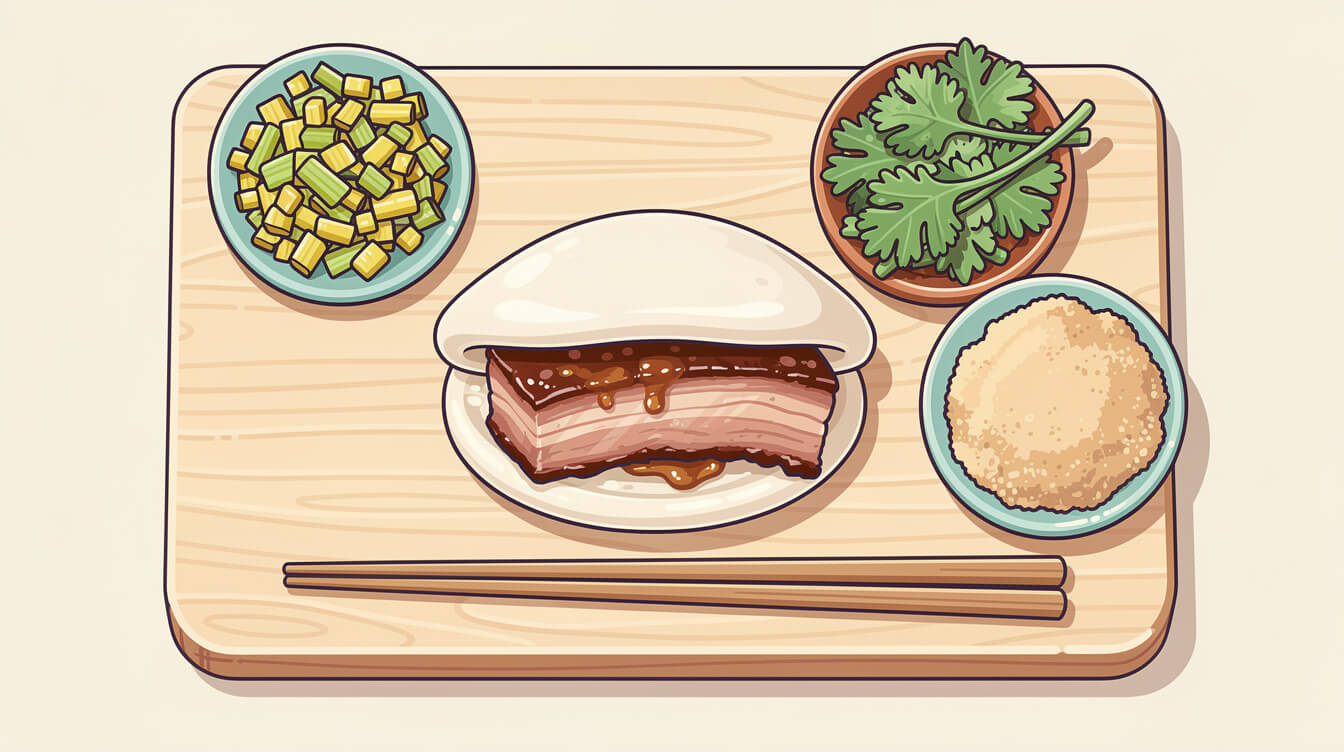
Gua bao (割包 or 刈包) is a Taiwanese street snack made from a flat, oval steamed bun folded in half like a clamshell and stuffed with braised pork belly. The classic filling has four parts, and each one does a job:
- Braised pork belly (滷五花肉): slow-cooked in soy sauce, rice wine, sugar and aromatics until the fat turns silky. This is the rich, salty heart of the bun.
- Pickled mustard greens (酸菜, suan cai): chopped fine and stir-fried, usually with a little sugar. They bring sourness and crunch to cut through the fat.
- Peanut powder with sugar (花生粉): ground roasted peanuts mixed with sugar. This is the ingredient that surprises first-timers and the one most Western versions skip.
- Cilantro (香菜): a fresh, green, slightly peppery finish.
Put together, one bite is fatty, salty, sour, sweet, nutty and herbal at the same time. That balance is why people sometimes call it the “Taiwanese hamburger,” though the comparison undersells it. A burger doesn’t come with a folk tale attached.
How do you say gua bao?
Say it like “GWAH-bow.” The English spelling comes from Taiwanese Hokkien, where Taiwan’s Ministry of Education dictionary romanizes 割包 as kuah-pau (you’ll also see the older spelling koah-pau). That’s why you’ll sometimes see it written 掛包 (guà bāo) on signs. In standard Mandarin the 刈包 spelling is actually read yì bāo, but almost nobody in Taiwan orders it that way. You’ll hear the Hokkien sound at the counter.
Is it Chinese or Taiwanese?
The folded bun shape exists elsewhere. Chinese Wikipedia traces the prototype to the lotus-leaf bun (荷葉包) of Fuzhou, across the strait in Fujian. But the bun as Taiwan knows it, with braised belly, suan cai, sugared peanut powder and cilantro, is a Taiwanese street food. It’s sold at night markets and bun shops around the island and tied to Taiwanese customs you won’t find attached to the plain lotus-leaf bun. It’s about as Taiwanese as lu rou fan, and it shares a lot of DNA with it, since both depend on the same soy-braised pork.
Tiger Bites Pig: The Name, the Wallet and the Luck

In Taiwan, the bun has a nickname: 虎咬豬, “tiger bites pig” (in Hokkien, hóo-kā-ti). Look at one side-on and you’ll see why. The folded bun is the tiger’s open jaw, and the pork belly is the pig caught in it. The Ministry of Education’s Taiwanese dictionary describes the bun the same way, as two connected half-moons shaped like a tiger’s mouth.
The nickname is more than a cute visual. Taiwanese food culture loves a lucky pun, and this one has a popular one attached. “Tiger bites tight” (虎咬住) sounds a lot like “bite down on good fortune” (福咬住) in Taiwanese. So eating one is a small, delicious way of locking in luck. Treat the pun as folk wordplay rather than etymology. It’s the kind of joke people tell over the bun, not something a dictionary signs off on. It’s still part of why the bun gets passed around when luck matters.
The wallet shape
There’s a second symbol hiding in plain sight. A stuffed bun looks like a wallet or coin purse bulging with money. The dictionary entry spells out the custom directly: people eat it at the year-end banquet because it’s shaped like a wallet, a wish for wealth in the year ahead.
A tiger’s mouth that holds on tight, plus a fat wallet. It’s easy to see why this bun became the snack of the Taiwanese year-end party. If you love decoding the lucky symbols behind Taiwanese food and gifts, our Taiwan gift-giving etiquette guide covers the same kind of wordplay, from lucky numbers to the gifts you should never give.
Wei Ya (尾牙): Why Taiwan Eats Gua Bao at the Year-End Banquet

To understand the bun’s big night, you need to meet Tudi Gong (土地公), the Earth God who looks after neighborhoods and businesses. Traditionally, shopkeepers make an offering to him called zuo ya (做牙) on the 2nd and 16th day of every lunar month. The first one of the year is tou ya (頭牙). The last one, on the 16th day of the 12th lunar month, is wei ya (尾牙), literally the “tail” offering.
Wei ya grew from a thank-you to the Earth God into a thank-you to the staff. Today it’s Taiwan’s company year-end banquet: big round tables, a stage, speeches, plenty of drinks, and a lucky-draw raffle that employees follow very closely. We covered Tudi Gong’s three big days on the farming calendar in our Tudi Gong story. Wei ya is the one everyone knows.
Where the bun fits in
Gua bao is the traditional wei ya food, for all the reasons above: the tiger that holds on to luck and the wallet stuffed with the year’s earnings. Bun shops take big pre-orders, and the busiest specialists in Taipei get swamped the week of the 16th. In northern Taiwan, runbing (潤餅, a fresh spring-roll wrap) also shows up at wei ya. Further south, the tiger-bites-pig bun is the main event.
The chicken-head warning
Wei ya comes with a famous bit of folklore. At old-style banquets, the story goes, whoever the boss pointed the head of the whole chicken toward should start worrying about their job next year. Taiwan’s national Cultural Memory Bank (國家文化記憶庫) records it as a classic wei ya custom, and today it’s told as a joke rather than practiced. Still, nobody really wants to sit across from the chicken.
When is wei ya in 2027?
Because wei ya follows the lunar calendar, its date moves every year. The next one, the 16th day of the 12th lunar month, falls on Saturday, January 23, 2027, two weeks before Lunar New Year’s Day on February 6, 2027. (For reference, the last wei ya was Tuesday, February 3, 2026.) Many companies hold their banquet on a nearby Friday or weekend, so the season stretches across most of January. Then the whole island rolls straight into Lunar New Year.
If you’re throwing your own wei ya-style dinner abroad, a tray of homemade buns is the most authentic thing you can serve. A few bottles of Taiwan Beer usually make the rounds at the real thing. If you’d rather wear yours, our Taiwan Beer Draft 18 Days Icon T-Shirt is the one Taiwan expats spot from across the room.
Gua Bao vs Pork Belly Bao Bun vs Other Bao

“Bao” (包) just means something wrapped, so the word covers a lot of different foods. Here’s how the folded bun compares with its relatives.
Gua bao vs baozi
A baozi (包子) is a round, closed bun with the filling sealed inside, pinched shut with pleats at the top. Think pork buns at a breakfast shop. The folded bun is the opposite: a flat oval of dough folded open like a taco, with the filling on display. Same dough family, completely different eating experience.
Mantou, the plain cousin
Mantou (饅頭) is a plain steamed bun with no filling at all, eaten on its own or with savory sides. You’ll find it at Taiwanese breakfast shops next to soy milk.
Gua bao vs the “pork belly bao bun”
This is where the confusion comes from. The pork belly bao bun on menus in New York, London or Melbourne is a gua bao that traveled. Two restaurants made it famous in the US:
- Momofuku Noodle Bar (New York, opened 2004). David Chang added a pork belly bun inspired by Peking duck buns, and it became the restaurant’s best seller. It kicked off the global “bao bun” craze, though its toppings lean away from the Taiwanese original.
- Baohaus. Taiwanese-American chef Eddie Huang opened it on New York’s Lower East Side in December 2009, built around Taiwanese-style buns. It moved to East 14th Street in 2011, closed in October 2020, and reopened on St. Mark’s Place in March 2026. Huang’s 2013 memoir, Fresh Off the Boat, did a lot to put Taiwanese food culture on the American map.
The main differences: restaurant pork belly buns often swap the suan cai for pickled cucumber, skip the sugared peanut powder, and lean on hoisin or chili mayo. The Taiwanese original keeps the peanut-and-pickle combination that makes it what it is. If you’ve only had the restaurant version, the street version will taste familiar and new at once.
Are bao and momos the same?
No. Bao are made from a leavened (yeasted) dough that steams up fluffy and soft. Momos are Tibetan and Nepali dumplings with a thin, usually unleavened wrapper, closer to a dumpling than a bun. Both get steamed, and that’s where the resemblance ends.
How to Make Taiwanese Gua Bao at Home

Making them at home is a weekend project, not a weeknight one, but every part can be made ahead. The braise actually tastes better the next day. This recipe makes about 10 buns.
1. The braised pork belly
- 1 kg (about 2.2 lb) skin-on pork belly, cut into slices about 1.5–2 cm (¾ in) thick
- 4–5 shallots, sliced, and 4 cloves garlic, smashed
- 3 slices ginger and 2 scallions
- 1 star anise and a small piece of cinnamon (optional)
- 80 ml (⅓ cup) soy sauce, 2 tbsp dark soy sauce for color
- 60 ml (¼ cup) Taiwanese rice wine (米酒) or Shaoxing wine
- 30 g rock sugar (or 2 tbsp brown sugar)
Blanch the pork in boiling water for 3 minutes, then rinse. In a heavy pot, brown the slices in a little oil, then add the shallots, garlic, ginger and scallions and fry until fragrant. Add the sugar and let it melt and coat the meat, then pour in the wine, both soy sauces, the spices and enough water to barely cover. Simmer, lid slightly ajar, for 60–90 minutes until a chopstick slides through the fat. Let it cool in the liquid.
2. The pickled mustard greens
Buy Taiwanese or Chinese pickled mustard greens (酸菜) from an Asian grocery. Rinse them well and soak for 10–15 minutes to tame the salt, then squeeze dry and chop finely. Dry-fry them in a wok to drive off moisture, then add a splash of oil, a little garlic, a chili if you like, and 1–2 tablespoons of sugar. Stir-fry until glossy. The finished greens should taste sour, salty and a bit sweet.
3. The peanut powder
Blitz roasted unsalted peanuts with sugar in a food processor, roughly three parts peanuts to one part sugar, until you get a sandy powder. Pulse rather than run it continuously, or you’ll make peanut butter.
4. The buns
- 300 g all-purpose flour (or a bao/low-protein flour for whiter, softer buns)
- 3 g instant yeast and ½ tsp baking powder
- 20 g sugar
- About 160 ml warm milk or water
- 10 g neutral oil, plus extra for brushing
Mix everything into a smooth dough and knead for 8–10 minutes. Let it rise until roughly doubled, about an hour depending on your kitchen. Punch it down and divide into 10 pieces. Roll each into an oval about 4 mm thick, brush the top lightly with oil, and fold it in half over a small strip of parchment so the halves don’t stick. Rest the shaped buns for 20–30 minutes, then steam over medium heat for 10–12 minutes. Turn off the heat and wait a few minutes before lifting the lid, so the buns don’t collapse.
5. Assemble the buns
Warm the pork slices in a little of their braising liquid. Open a hot bun, lay in one thick slice of belly, add a spoonful of greens, shower it with peanut powder and finish with cilantro. Eat it right away, with your hands.
Make-ahead tip: steamed buns freeze very well. Re-steam them from frozen for 8–10 minutes and they’ll taste freshly made.
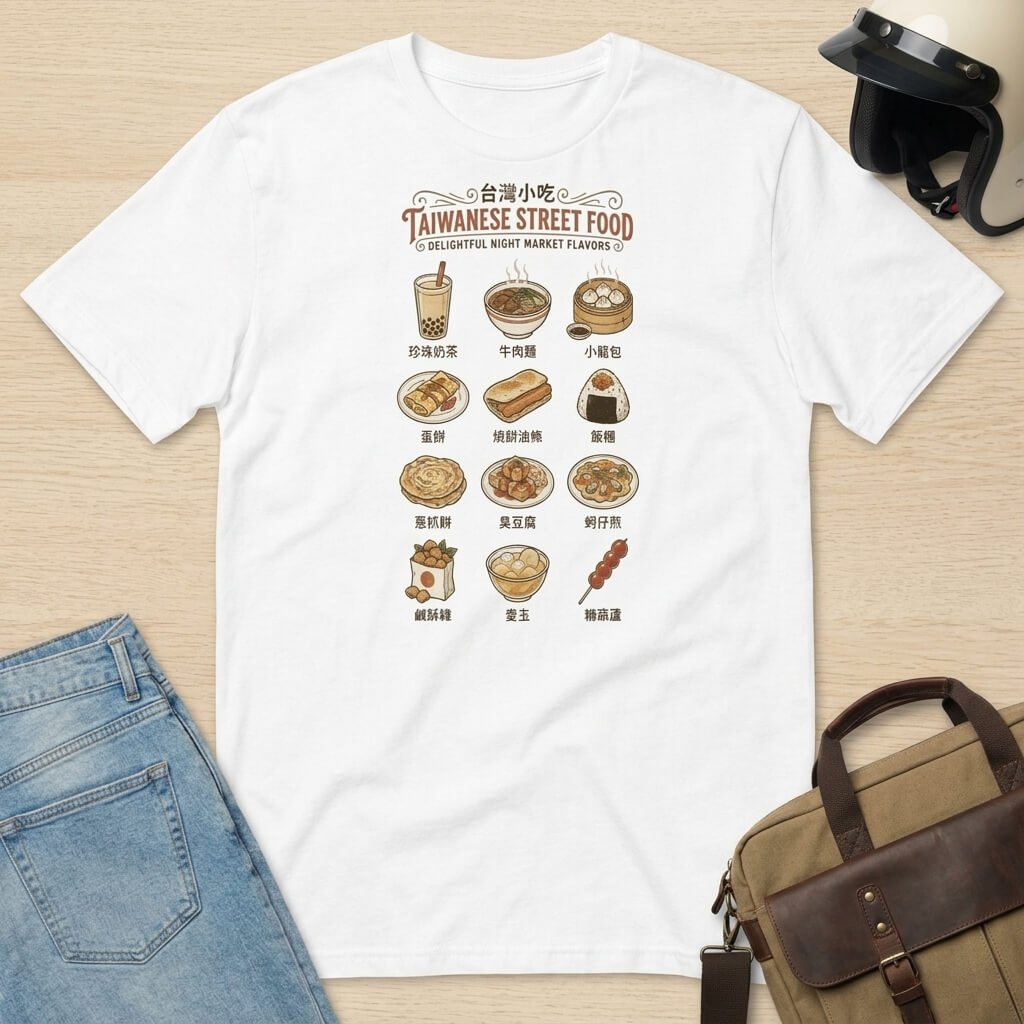
Wear the Night Market Menu
Our Taiwanese Street Food Guide tee is a vintage-poster menu of 12 island classics, from bubble tea and beef noodles to stinky tofu and oyster omelets. The bun’s night-market neighbors, all in one place.
Where to Eat Gua Bao in Taipei

You’ll find it at most night markets, but a few long-running shops are worth crossing the city for. As a rough guide, most Taipei shops charged about NT$50–80 per bun in 2025. Hours shift, so check a shop’s latest listing before you make a special trip.
Lan Jia Gua Bao (藍家割包), Gongguan
The famous one. Lan Jia started as a roadside stall near National Taiwan University around three decades ago and still sits in a lane off Roosevelt Road, a short walk from Gongguan MRT station. It has been recognized in the Michelin Guide’s Bib Gourmand selection. What makes it fun is the ordering: you choose your cut of pork from five options: fatty (肥), lean (瘦), half-and-half (半肥半瘦), mixed leaning fatty (綜合偏肥) or mixed leaning lean (綜合偏瘦). A bun was about NT$70 in early 2025. It’s closed on Mondays, and it’s slammed in the run-up to wei ya.
Yuan Fang Gua Bao (源芳刈包), Wanhua
Founded in 1955, Yuan Fang is the old-timer, on Huaxi Street about a seven-minute walk from Longshan Temple MRT station. Pair it with a visit to Longshan Temple and the surrounding old streets. A bun was about NT$65 in early 2025.
Shih Jia Gua Bao (石家割包), Linjiang Night Market
A long-running stall at Linjiang (Tonghua) Night Market, near Xinyi Anhe MRT station, Shih Jia has been featured by Taiwanese food site Supertaste. It’s a good choice if you want your bun as one stop on a longer grazing night. Our Linjiang Night Market guide maps out what to eat before and after.
For more of the city’s best bites, see our Taipei street food guide. If you’re heading beyond the capital, our city-by-city Taiwan street food guide covers what to eat in every region.
Gua Bao FAQ
What does gua bao taste like?
Rich, savory braised pork with a sweet edge, balanced by sour pickled greens, nutty sweet peanut powder and fresh cilantro, all wrapped in a soft, slightly sweet bun. It’s a sweet-salty-sour combination that’s very Taiwanese.
What is it called in English?
It’s usually called a Taiwanese pork belly bun, a “bao bun,” or sometimes the “Taiwanese hamburger.” In Taiwan, it’s also nicknamed “tiger bites pig.”
Why add peanut powder?
The sugared peanut powder adds sweetness and nuttiness that balance the salty pork and sour greens. It’s a signature Taiwanese touch and the easiest way to tell a street version from a restaurant pork belly bun.
Can I make gua bao without pork?
Yes. Braised tofu, shiitake mushrooms, fried chicken or braised beef all work, and many cafés now offer them. Keep the pickled greens and peanut powder and it will still taste like the real thing.
Is it a breakfast food?
Not usually. In Taiwan it’s eaten as a snack or light meal, mostly at lunch, in the afternoon or at night markets. For morning food, try the classics in our Taiwan breakfast guide.
When is the best time to eat one in Taiwan?
Any time, but the wei ya season in January is when it really shines. In 2027, wei ya falls on January 23.
Final Thoughts: More Than a Pork Belly Bun
It looks simple: a bun, some pork, a few toppings. But in Taiwan, every part of it means something. The tiger’s jaw holds on to luck, the bun looks like a wallet full of the year’s earnings, and the whole thing turns up on wei ya night to say thank you for another year. The bao bun that conquered restaurant menus worldwide started out as all of that.
So whether you’re queuing at Lan Jia, grazing through a night market or steaming a batch at home for your own year-end party, make it the Taiwanese way, with the peanut powder. And if you want to keep exploring, the A–Z of Taiwan street food and our big-sausage-wraps-small-sausage explainer are two good next bites.

A Postcard From Taiwan, Every Week
Street food stories, lucky traditions and the little Taiwan details worth knowing, straight to your inbox. No spam, unsubscribe anytime.

Grab a Free Taiwan Sticker!
Drop your email and we’ll send you a limited-edition Taiwan sticker — plus insider access to new merch drops and island vibes.
No spam. Unsubscribe anytime.