Taro Bubble Tea: Why It’s Purple, What Taro Really Tastes Like, and How Taiwan Actually Drinks It
Order a taro bubble tea in Los Angeles and you get a cup of vivid cartoon purple. Order one in Taichung and you might get something the colour of wet cement with flecks in it — and the Taiwanese person next to you will tell you that yours is the good one. Both cups are real. Only one of them tastes like taro.
This is the guide the internet is missing. Search taro bubble tea and you will find American recipe blogs, a franchise explainer and a supply store selling powder by the kilo. Not one of the top-ranking pages mentions Taiwan — the island where bubble tea was invented and where taro has been a staple food for generations. They reach for Filipino ube as the reference point instead, which is a bit like explaining pizza by talking about naan.
So: what taro actually is, why your cup is purple when the root is not, how to tell fresh from powder before you take the first sip, how to order it properly at a Taiwanese drink stand, and how to make a genuinely good one at home. Let’s get into it.
What Is Taro Bubble Tea, Really?
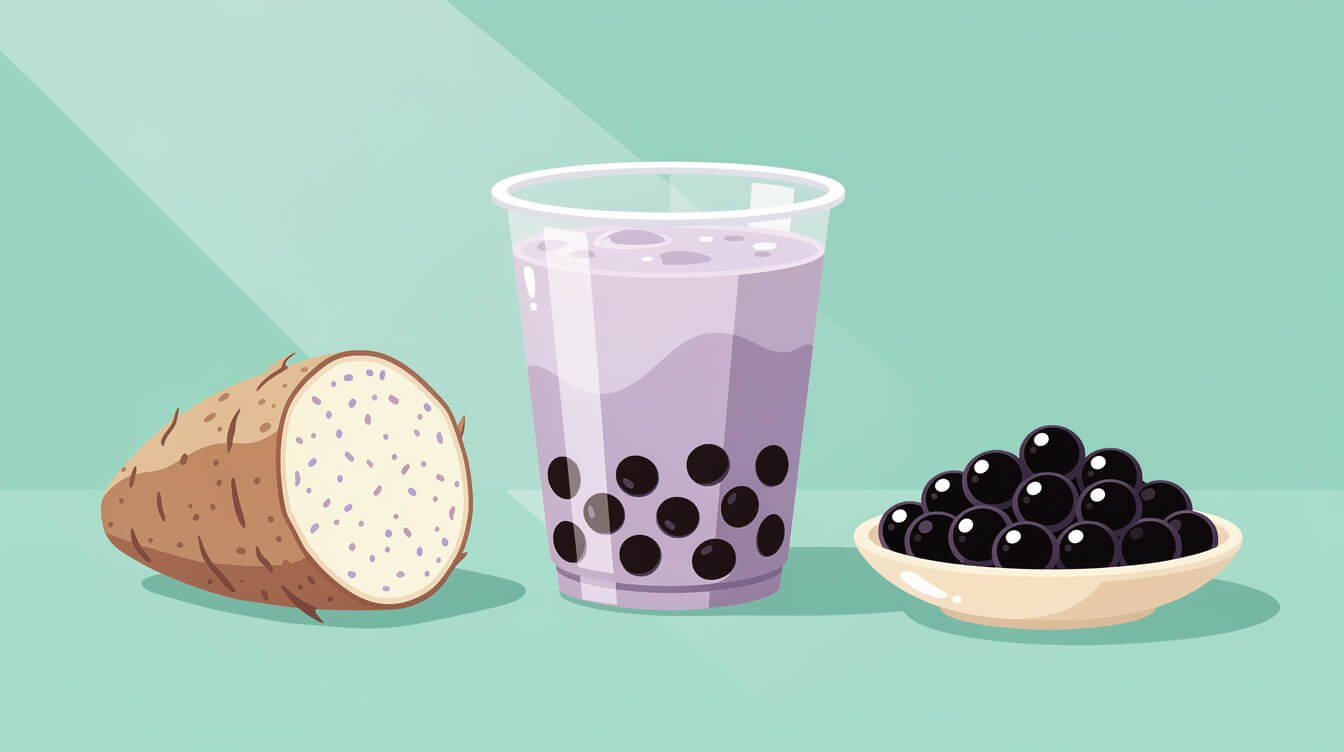
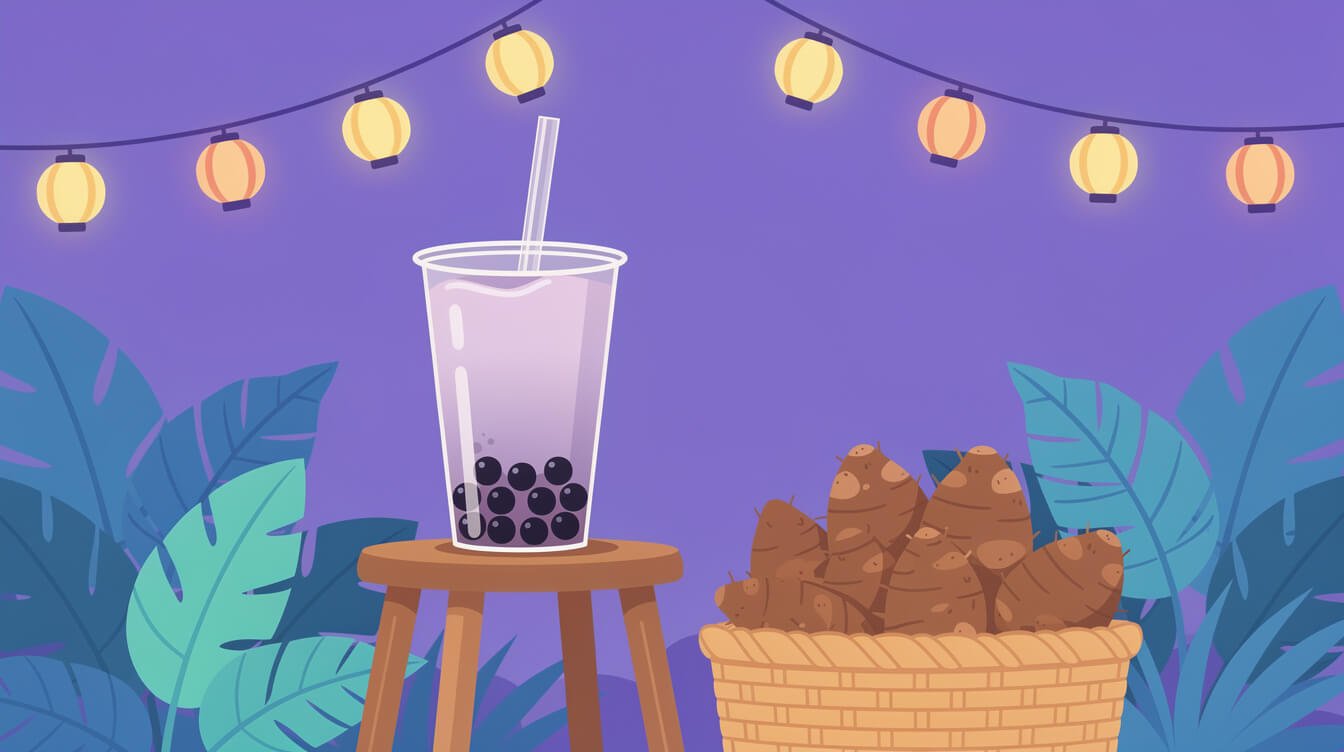
Taro bubble tea is a milk tea flavoured with taro — a starchy tropical corm — and served with chewy tapioca pearls at the bottom of the cup. That is the whole definition. Everything else is a variable: the tea base, whether the taro is fresh or powdered, how sweet it is, and how much ice.
Taro itself is Colocasia esculenta, a root vegetable grown across Asia, the Pacific and the Caribbean. In Mandarin it is 芋頭 (yùtóu). It is nutty, mildly sweet, faintly vanilla-ish, and when cooked properly it goes soft and powdery in a way that makes it behave more like a dessert ingredient than a vegetable. Think somewhere between a sweet potato and a chestnut, with a texture closer to a steamed bun.
The bubbles in a taro bubble tea are not the taro. They are tapioca pearls — 珍珠 (zhēnzhū), literally “pearls” — made from cassava starch, boiled until chewy and steeped in sugar syrup. If you want the full breakdown of pearls, toppings and tea bases, our complete Taiwan boba tea guide covers the mechanics. And yes, the drink genuinely was invented in Taiwan in the 1980s — two Taichung tea houses still argue about which one did it first, a story we untangle in this piece on bubble tea’s Taiwanese origins.
What makes taro bubble tea different from most boba flavours is that it is not a tea flavour at all. It is a food flavour. Jasmine, oolong, assam — those are teas. Taro is a starchy root that happens to make an outstanding milkshake. That distinction explains almost everything about how the drink behaves: it is thicker than other boba, it can be gritty in a good way, and it is the one flavour where the shop’s ingredient shortcut is immediately obvious to anyone who has eaten the real thing.
Why Is Taro Bubble Tea Purple — And Why Real Taro Isn’t
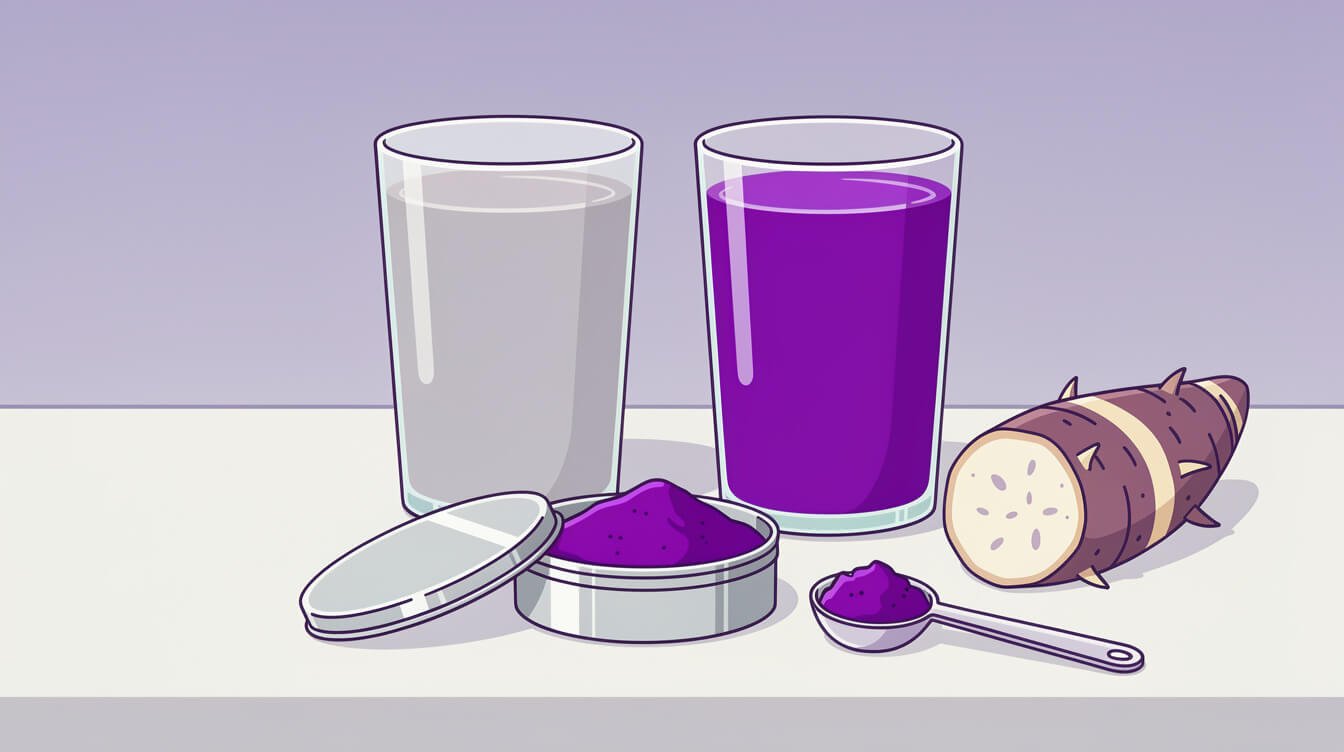
Here is the thing nobody on page one of Google will tell you plainly, so we will: real taro is not purple.
Cut open a taro corm and the flesh is creamy white to pale beige-grey, speckled with small purple-brown flecks where the fibres run. Cook it and mash it for taro bubble tea and you get a pale, slightly mauve-grey paste — the colour of a lavender that has been left in the sun. It is a lovely colour. It is not Instagram purple.
The vivid violet you get in most shops comes from the powder. Commercial taro powders and pastes are typically blended with colouring so that every cup looks identical, in every branch, on every day of the year. The purple is a consistency decision, not a taro decision. There is nothing sinister about it — food colouring in a drink mix is about as ordinary as it gets — but you deserve to know that the colour in the cup is a branding choice rather than evidence of what is inside it.
This is also where the ube confusion comes from. Ube is a genuinely, spectacularly purple Filipino yam — a different plant in a different genus — and it really does turn things that electric violet without help. Because American food blogs write about ube constantly, they tend to describe taro as “the purple one,” and then the purple has to come from somewhere. So the powder delivers it.
If your taro bubble tea is the same purple as a highlighter pen, it is powder. If it is the colour of a dusty grey-lilac and the shade drifts slightly between visits, something fresh is going on in that kitchen.
None of this makes powdered taro bubble tea bad. Plenty of Taiwanese shops use it, and a well-made powder drink is a perfectly pleasant thing to hold on a hot afternoon in Kaohsiung. But powdered and fresh taro bubble tea are not the same product, and the whole industry has quietly agreed not to mention it.
Taro in Taiwanese Food, Long Before Boba
Taro was not invented as a boba flavour in 2015. In Taiwan it is a staple that turns up across the entire food calendar, and understanding that is the difference between drinking taro bubble tea and actually tasting it.
Taro balls in the mountains
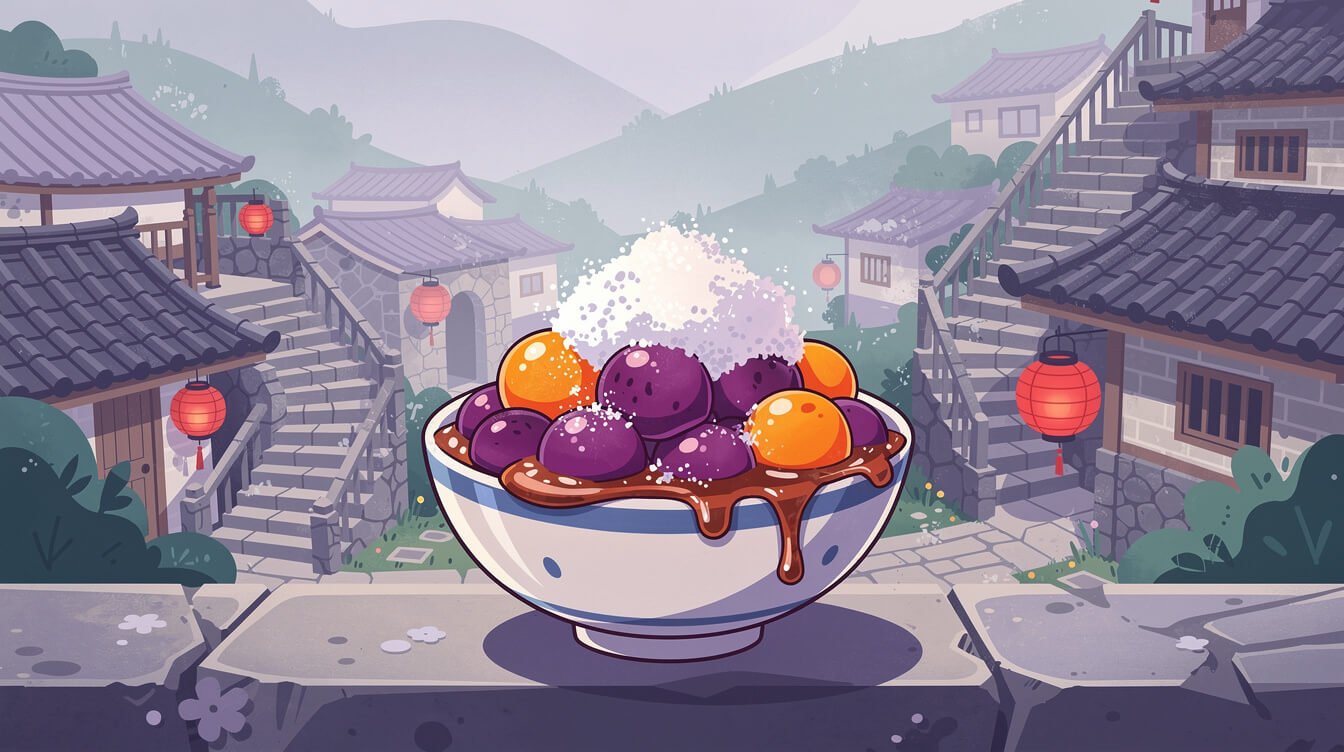
The purest expression of taro in Taiwan is 芋圓 (yùyuán) — taro balls. Steamed taro is mashed with sweet potato starch, rolled, cut into stubby little cylinders and boiled until they are dense and chewy, somewhere between gnocchi and mochi. They are served hot in a thin sweet soup in winter, or cold over shaved ice in summer, usually alongside sweet potato balls, red beans and taro-adjacent extras.
The town that owns them is Jiufen, the old gold-mining settlement in the hills above the northeast coast, where the teahouse terraces look out over the ocean and every third shop sells a bowl. We wrote a whole piece on Jiufen taro balls and why that mountain town turned a root vegetable into a pilgrimage, and if you are planning the trip itself, the full Jiufen guide has the timing advice you will want.
Taro on ice, in cake, and in the night market
Beyond taro balls, taro shows up as a topping on Taiwanese shaved ice in soft simmered chunks, as 芋泥 (yùní) taro paste folded into buns and tarts, as taro cake — a savoury steamed slab studded with dried shrimp and shallot, cousin to the better-known radish cake — and as deep-fried taro croquettes sold from carts. Our guide to Taiwanese desserts maps most of these, and you will meet half of them on any lap of a decent Taiwan night market.
Where the taro grows
If you ask a Taiwanese person where good taro comes from, most will say Dajia — a coastal district of Taichung whose sandy soil the city government markets as the island’s taro heartland, with a harvest running roughly from August through April. It is the famous name behind a lot of Taiwan’s best taro bubble tea, though it is not the whole map: a great deal of Taiwan’s taro acreage sits further south and inland, in Pingtung, Miaoli and the hill districts of Kaohsiung, where the town of Jiaxian is taro-famous in its own right.
Dajia being in Taichung is a small, satisfying coincidence, because Taichung is also where bubble tea was born. The city that gave the world boba is a short drive from the district that grows the taro. Our Taichung guide makes the case that this is not the coincidence it looks like.
Fresh Taro vs Taro Powder: What’s Actually in Your Taro Bubble Tea
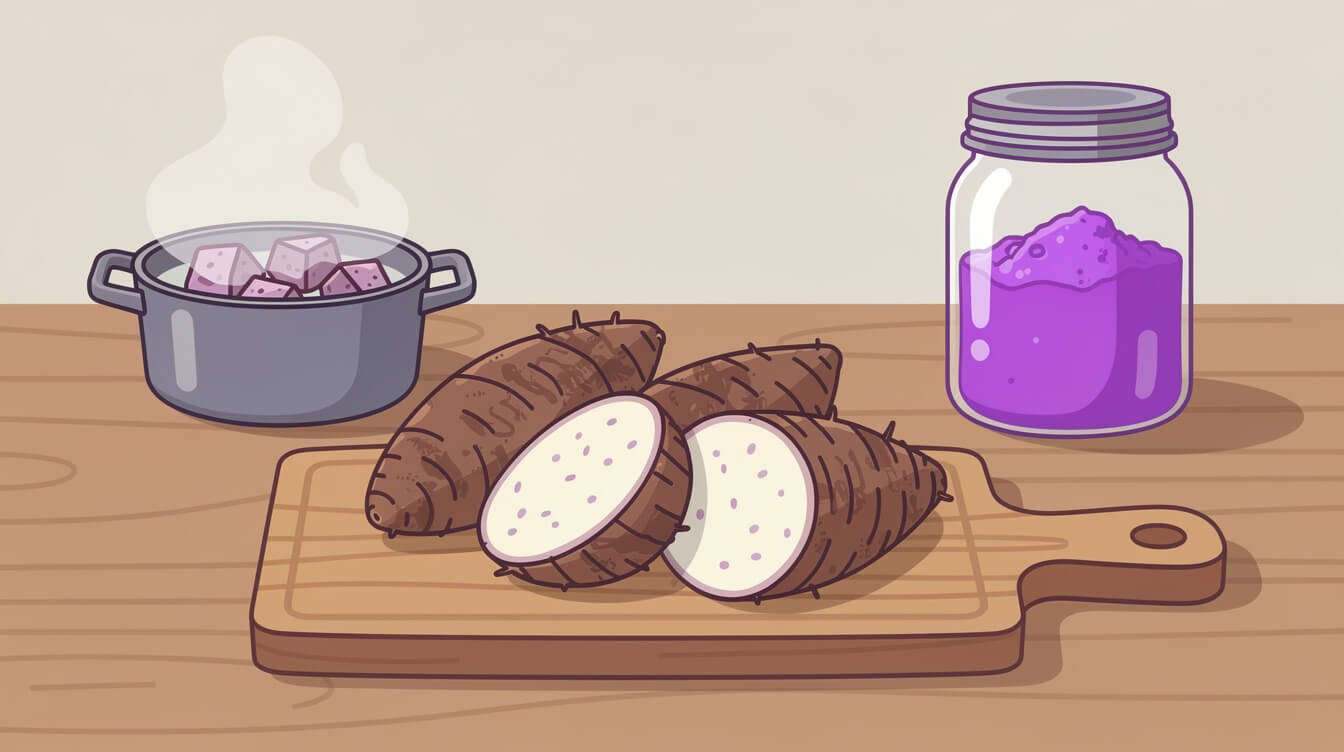
Every cup of taro bubble tea is made one of three ways, and you can usually work out which before you finish the first mouthful.
1. Fresh taro, cooked in-house
The shop steams or boils real taro, mashes it with sugar and sometimes condensed milk, and spoons that paste into the cup. You will see visible flecks and small lumps, the drink will be noticeably thick, the colour will be muted grey-lilac, and it will taste starchy and nutty rather than sweet-and-perfumed. It also tends to cost more and sell out, because someone had to peel actual roots that morning.
2. Taro powder
An instant mix of taro solids, milk powder, sugar, thickener and colouring, whisked with hot water. Uniform colour, no flecks, thinner body, and a sweetness that arrives before the taro does. This is the industry default worldwide and it is what most chains outside Taiwan pour.
3. The hybrid
Fresh taro paste for texture and flavour, a scoop of powder for colour and consistency. Common in Taiwan, and honestly the pragmatic choice — you get real taro chunks with a cup that looks the same every time.
How to tell, in about four seconds
- Look at the colour. Uniform bright violet means powder. Muted, slightly uneven grey-lavender means something fresh went in.
- Look for solids. Flecks, lumps and a paste layer that settles at the bottom of the cup are the tell. Powder drinks are smooth all the way down.
- Check the straw. If a fat boba straw pulls the drink up slowly and you have to work at it, there is real mashed root in there.
- Taste for the finish. Fresh taro leaves a dry, starchy, faintly chestnut finish. Powder finishes sweet and slightly floral, closer to a vanilla milkshake.
- Read the menu wording. In Taiwan, look for 鮮芋 (xiānyù, “fresh taro”) or 芋泥 (yùní, “taro paste”). Those words are a promise shops do not make lightly.
One practical warning if you go hunting for the fresh version: the good stuff is made in batches and the shop stops when it runs out. A taro bubble tea ordered at 9pm from a stand that has been open since noon is more likely to be powder, whatever the menu says.
How to Order Taro Milk Tea in Taiwan
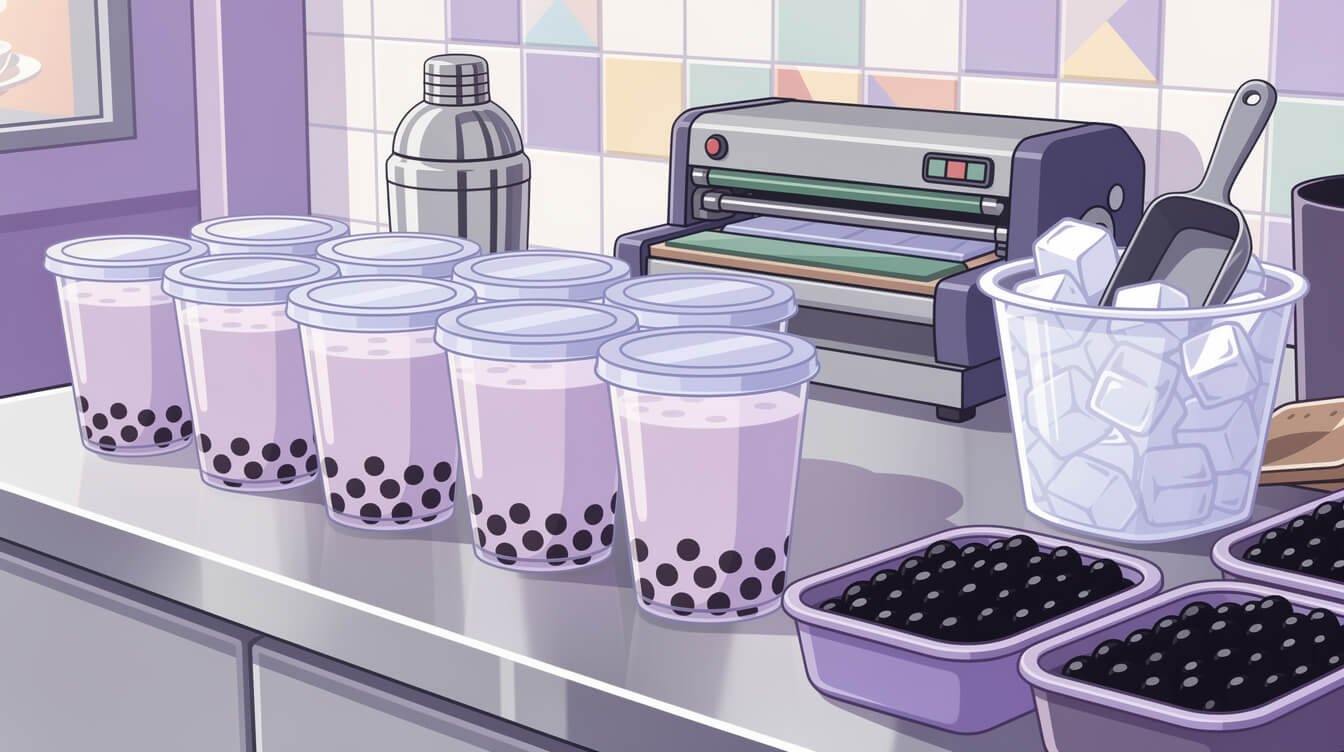
Taiwanese drink shops run on a customisation grammar that trips up almost every visitor. You are not just naming a drink; you are specifying sugar and ice as separate variables. Get this right and a taro bubble tea improves enormously — most defaults are far sweeter than a first-time drinker wants.
Sugar levels
- 全糖 (quántáng) — full sugar. The default. It is a lot.
- 半糖 (bàntáng) — half sugar. The sweet spot for most people, and where taro flavour actually starts to come through.
- 微糖 (wēitáng) — slight sugar, roughly a third.
- 無糖 (wútáng) — no added sugar. Be aware that with taro this can taste flat, because the paste itself is usually pre-sweetened.
Ice levels
- 正常冰 (zhèngcháng bīng) — normal ice.
- 少冰 (shǎobīng) — less ice. Recommended for taro, which dilutes badly.
- 去冰 (qùbīng) — no ice, drink still cold.
- 熱 (rè) — hot. Hot taro milk is genuinely excellent in winter and almost nobody outside Taiwan orders it.
What “taro” gets you at a Taiwanese counter
At a Taiwanese chain, taro bubble tea is usually a family of drinks rather than one item. Expect to see taro milk tea (black tea base, milk, taro), 芋頭鮮奶 (yùtóu xiānnǎi) — taro with fresh milk and no tea at all, which is richer and caffeine-free — and taro with different chew: pearls, pudding, grass jelly, or taro balls dropped straight into the cup. Taro plus taro balls is the move, and it is the one combination almost no overseas shop offers.
Half of Taiwan’s drink vocabulary transfers to every other flavour on the board, so it is worth learning once — our Taiwan bubble tea guide goes deeper on the chains, the regional differences and what to order where.
And if taro-stained loyalty to the pearls at the bottom of the cup is your whole personality, we made something for you: the Pearl Gang Boba Tapioca Kawaii T-Shirt 珍珠幫 is our love letter to tapioca, and it has survived more night market grease-splatter tests than we would like to admit.

Rep the Pearls at the Bottom of the Cup
The Pearl Gang Boba Tapioca Kawaii T-Shirt — a kawaii tribute to Taiwan’s greatest culinary export, printed on soft cotton and made for people who order half sugar, less ice, extra pearls.
How to Make Taro Bubble Tea at Home
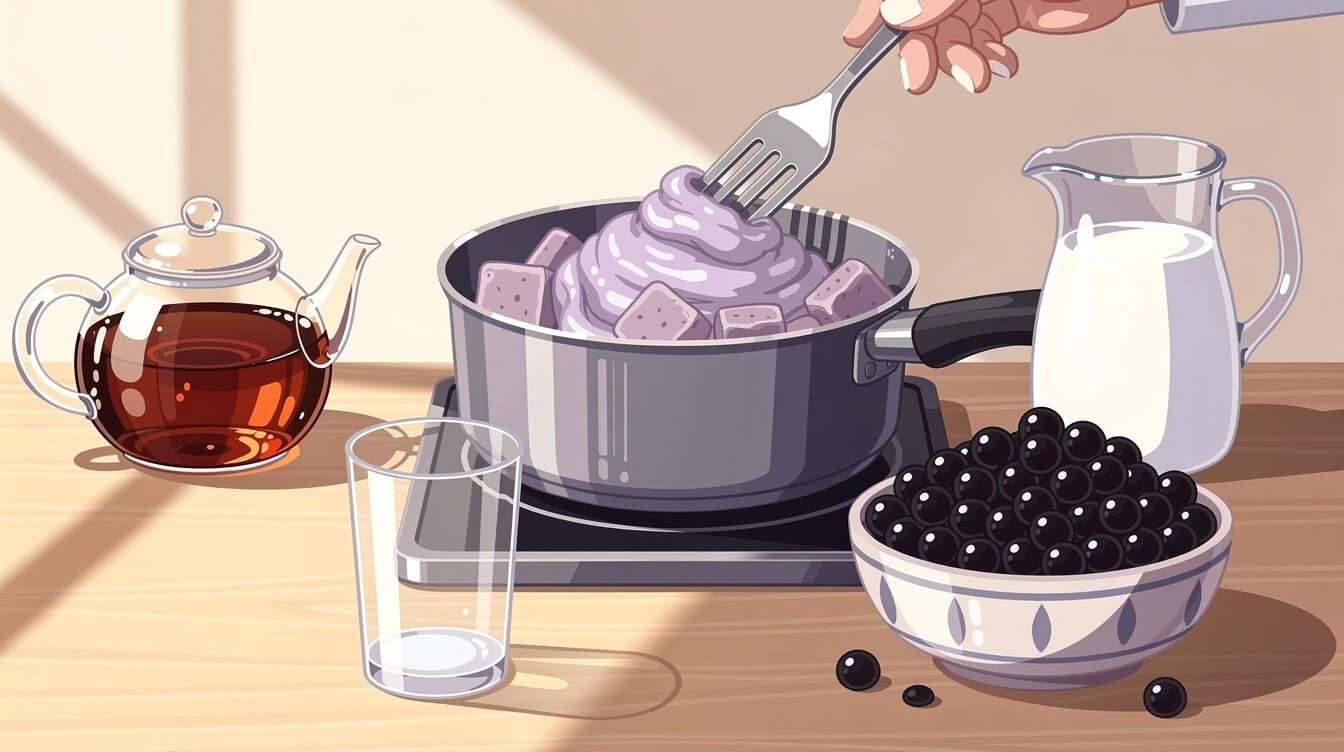
Two versions of taro bubble tea here: the real one with fresh taro, and the honest shortcut with powder. Both make roughly two large cups.
The fresh taro version
You need: about 300g taro (one medium corm), 3 tbsp sugar, 2 tbsp condensed milk or more sugar to taste, 2 heaped tbsp loose black tea or 3 tea bags, 250ml milk or oat milk, 100g dried tapioca pearls, ice.
- Peel the taro — with gloves. This is not optional folklore. Raw taro contains calcium oxalate, which makes bare hands itch badly. Peel it thickly under running water, wearing kitchen gloves, and cut it into 2cm cubes. Cooking destroys the irritant entirely, so this is a prep-stage problem only. Never eat taro raw.
- Steam the cubes for 20–25 minutes until a fork slides through with no resistance. Steaming beats boiling here — boiled taro waterlogs and the flavour leaches out.
- Mash while hot with the sugar and condensed milk. Leave it deliberately lumpy. Those lumps are the entire point and the reason the homemade version beats most shop versions.
- Cook the pearls. Boil plenty of water, drop them in, and follow the packet — usually 20–30 minutes at a rolling boil, then the lid off the heat for another 20 to soften the centres. Drain, rinse, and toss in a spoonful of sugar or syrup so they do not fuse into a brick.
- Brew the tea strong. Double the leaf you would use for a normal cup and steep 5 minutes. It has to survive milk, ice and a mound of starch. Cool it.
- Assemble. Pearls in first, then a generous spoonful of taro paste smeared up the inside of the glass, then ice, then tea, then milk. Stir hard with a fat straw before drinking.
The powder shortcut
Whisk 3 tbsp taro powder into 60ml of hot water until completely smooth — lumps here will not dissolve later. Add 250ml cold milk, stir, pour over cooked pearls and ice. Done in five minutes. It will be brighter purple and sweeter than the fresh version, and now you know exactly why.
Making it taste Taiwanese rather than generic
Three adjustments. Cut the sugar to roughly half what any Western recipe tells you. Use assam or a strong Taiwanese black tea rather than something delicate. And if you can find frozen taro balls at an Asian grocer, boil a handful and drop them in alongside the pearls — that single addition turns a decent homemade drink into the thing you actually miss from Jiufen.
Taro Bubble Tea FAQ
Does taro bubble tea have caffeine?
Whether taro bubble tea has caffeine depends entirely on the base. Taro milk tea built on black or green tea contains caffeine, in the same ballpark as the tea itself once it is diluted with milk and ice. A taro fresh-milk drink or “taro latte” made without any tea contains essentially none. If it matters to you, ask whether there is tea in it — in Taiwan, 芋頭鮮奶 is the tea-free one.
What does taro taste like?
Nutty, starchy and mildly sweet, with a soft vanilla note and a dry finish. Closest comparisons are chestnut, sweet potato and a plain steamed bun. It is a gentle flavour, which is exactly why heavy sweetening buries it.
Is taro the same as ube?
No. Taro is a corm, Colocasia esculenta, pale inside. Ube is a purple yam, Dioscorea alata, vividly purple inside and sweeter with a more floral, almost coconut-adjacent flavour. They are used interchangeably in Western dessert writing and they should not be.
Is taro bubble tea healthy?
It is a dessert drink and it is fair to treat it as one. Taro itself is a decent source of fibre and potassium, but a full-sugar shop cup carries a substantial amount of added sugar plus the syrup on the pearls. Ordering 半糖 or 微糖 makes a real difference, and the fresh-taro versions generally lean less sweet than powder ones.
Why is my homemade taro bubble tea grey?
Because you used real taro and no colouring. That is the correct outcome. If you want it purple without a powder mix, a spoonful of cooked purple sweet potato mashed in will shift the colour naturally.
Where can I get fresh taro bubble tea in Taiwan?
Look for independent drink stands rather than the big chains, check the menu for 鮮芋 or 芋泥, and go earlier in the day. Taichung and the towns around Dajia are a reliable bet, and the taro-ball shops in Jiufen will often blend a fresh cup on request.
Final Thoughts: The Root Beneath the Trend
Taro bubble tea got globally famous as a colour. A purple cup photographs beautifully, and a generation of drink shops worked out that purple sells before anyone asked what the purple was made of. Fair enough — that is how flavours travel.
But the drink is older and better than its own marketing. Behind it sits a root that Taiwanese kitchens have been steaming, mashing, rolling and frying for generations: taro balls chewed on a foggy terrace in Jiufen, taro paste in a bakery bun, soft taro chunks buried under shaved ice in August, a savoury slab of taro cake at breakfast. Taro bubble tea is the newest member of a very old family.
Which is why the grey cup is worth hunting for. Order 半糖, 少冰, look for the flecks, and drink something that tastes like the plant it came from. And if you end up as devoted to it as we are, we have a shirt for that.
A Postcard From Taiwan, Every Week
Culture stories, food deep-dives, travel tips, and first looks at new designs — straight to your inbox. No spam, just Taiwan.

Grab a Free Taiwan Sticker!
Drop your email and we’ll send you a limited-edition Taiwan sticker — plus insider access to new merch drops and island vibes.
No spam. Unsubscribe anytime.