Stinky Tofu Taiwan Guide: What It Is, Why It Smells, and the Five Ways to Eat It
You smell it before you see it. Halfway down a night market lane, a sharp, barnyard funk cuts through the scent of grilled squid and fried chicken, and somewhere ahead a wok of oil is crackling. That’s stinky tofu, Taiwan’s most famous dare. Tourists film themselves gagging at it, and locals queue for it every night of the week.
This stinky tofu Taiwan guide is for the person standing in that lane wondering whether to join the queue. We’ll cover what stinky tofu actually is, why it smells the way it does (and why it tastes much milder), the five ways Taiwan eats it, how to read the menu board and what you should expect to pay in 2026. We’ll also cover the single-serve stinky tofu hot pot that most English guides skip, and give an honest answer on whether it’s vegetarian.
What Is Stinky Tofu?
Stinky tofu (臭豆腐, chòu dòufu) is fresh tofu that has been soaked in a fermented brine until it picks up a strong, pungent smell. It’s then fried, steamed, stewed, grilled or simmered in hot pot. It smells like ripe cheese or old socks, but tastes savory, a little sour and surprisingly mild.
The word is as plain as the food: 臭 means “smelly” and 豆腐 means tofu. In Taiwanese Hokkien it’s tshàu-tāu-hū, and you’ll hear that name shouted at stalls as often as the Mandarin one.
The brine is everything
What makes tofu “stinky” is the brine, called 臭滷 (chòu lǔ), or “stinky marinade.” No two vendors make it the same way, and recipes are closely guarded. Traditional brines commonly include fermented vegetables such as mustard greens, amaranth stems and bamboo shoots, and some vendors add dried shrimp, meat or fermented milk to get the fermentation going. A good brine is kept alive for years and topped up, much like a sourdough starter.
Traditionally, tofu sat in brine for weeks or months. Most stinky tofu today is made more quickly: factories and suppliers soak fresh tofu for roughly a day or two, which is enough to give it the smell without fully fermenting it. That’s why a cube from one stall can taste gentle and one from the next stall can knock you sideways.
Where it came from (and the legend you’ll hear)
Stinky tofu is a Chinese food that came to Taiwan with migrants from the mainland, and it has since become more closely tied to Taiwan than anywhere else. The origin story you’ll hear most often is a legend: a Qing-dynasty scholar named Wang Zhihe (王致和), from Anhui, failed the imperial exam in Beijing, started selling tofu, and found that leftovers he had salted away in a jar had turned pungent but delicious. It’s a charming tale, but there’s no reliable record behind it, so treat it as a story rather than history.
The stinky tofu Taiwan made its own is also quite different from the famous one in Changsha, Hunan, where stinky tofu is fried until it’s black and served with chili. Taiwan’s stinky tofu is golden, comes with sweet-sour pickled cabbage, and has grown into a whole menu of styles. You’ll see that menu in a minute. If you want the 60-second version first, our quick stinky tofu explainer has it.
Why Stinky Tofu Smells Like That (and Tastes Milder Than It Smells)
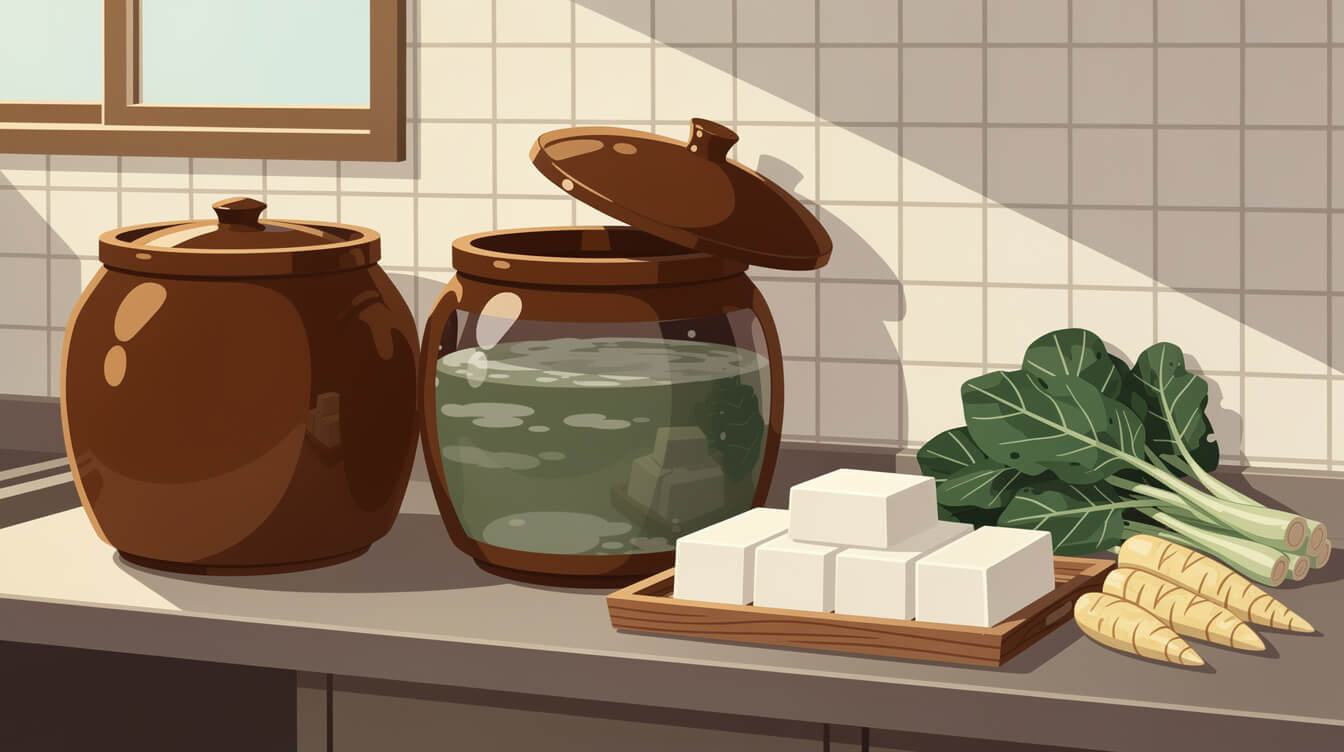
The smell is chemistry, not decay. In 2012, food scientists at Beijing Technology and Business University analyzed fermented stinky tofu and identified 39 volatile compounds responsible for its aroma, published in the journal Molecules. The most abundant was indole, a compound with an intensely fecal smell. It was followed by dimethyl trisulfide and other sulfur compounds that smell like cooked cabbage or onions, plus phenol.
Those compounds come from microbes in the brine breaking down the proteins in the tofu. In Taiwan’s traditional brines, that work is mainly done by bacteria, not mold. A patent describing microbes isolated from ten traditional brines collected around Taiwan lists Bacillus and several Enterococcus species among the main fermenters, and later studies have found a wide variety of lactic acid bacteria in stinky tofu brines too.
Why the taste doesn’t match the smell
Smell and taste aren’t the same thing. The compounds that make stinky tofu reek are highly volatile, so they fly straight off the hot tofu and into your nose, especially next to a deep fryer. In your mouth, what you mostly notice is the savory, slightly sour, almost cheesy flavor of fermented soy. That’s why so many people who pinch their nose for the first bite go back for a second order. Fans compare it to blue cheese, which smells far worse than it tastes for the same reason.
The other trick is the toppings. Pickled cabbage, garlic, soy and chili sauce all add brightness that cuts through the funk. A stinky tofu stall without pickled cabbage is like a hot dog stand without mustard.
Stinky Tofu Taiwan Menu: The Five Ways to Eat It
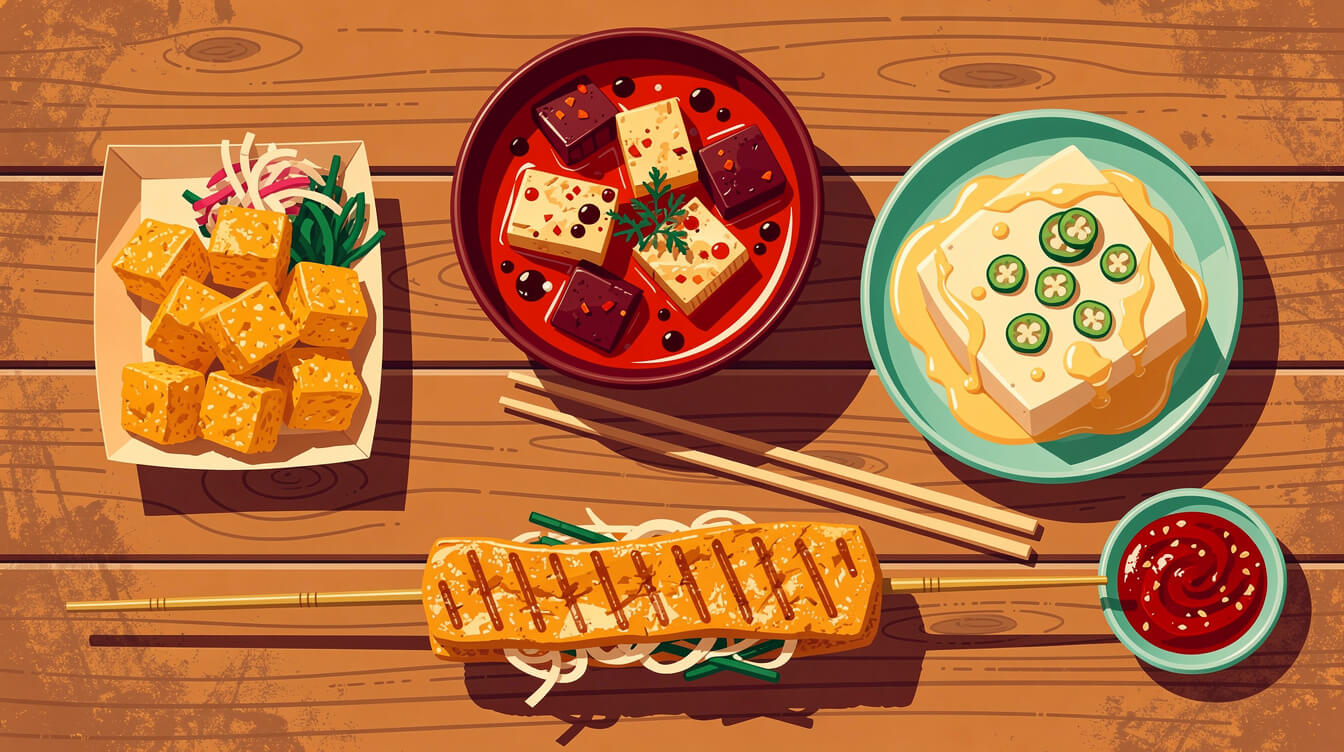
Most English guides list two or three styles. On a real menu board in Taiwan you’ll usually meet five. Here’s the stinky tofu Taiwan actually serves: what each one is, what arrives at the table, and how stinky it’s likely to be.
| Style | On the sign | What arrives | Funk level | Nervous? Start here? |
|---|---|---|---|---|
| Deep-fried | 炸臭豆腐 (or just 臭豆腐) | Crisp golden cubes or slabs, sauce, pickled cabbage | Medium | Yes, the best first try |
| Grilled skewers | 碳烤臭豆腐 / 串烤臭豆腐 | A long slab grilled on sticks, split and stuffed with pickled cabbage | Medium | Yes, a good second try |
| Stinky tofu hot pot | 臭臭鍋 | A single-serve pot with vegetables, meat, and stinky tofu in a savory broth | Medium, spread through the pot | Yes, if you like soup |
| Spicy stewed (mala) | 麻辣臭豆腐 | Soft whole blocks stewed in numbing chili broth, often with duck or pig blood cubes | Medium-high | After a fried one |
| Steamed | 清蒸臭豆腐 | Soft tofu steamed with garlic, chili and sometimes minced pork | High | Save it for last |
1. Deep-fried stinky tofu (炸臭豆腐)
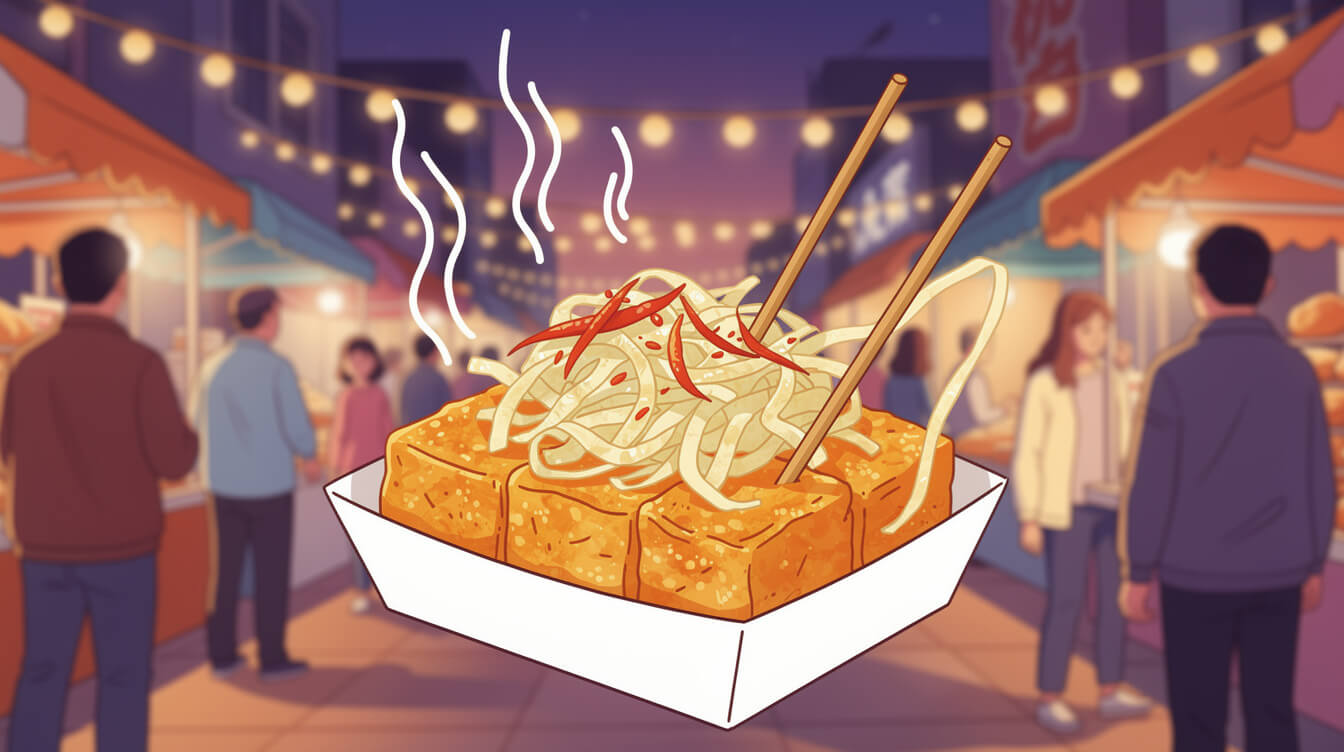
The classic, and the one most people mean when they say “stinky tofu.” The tofu is fried until the outside puffs into a crisp, golden shell and the inside stays soft and steaming. It’s often snipped into cubes with scissors, splashed with a sweet garlicky soy sauce, and buried under a heap of 台式泡菜, Taiwanese pickled cabbage. Despite sharing a name with kimchi, Taiwan’s version is quick-pickled, sweet-sour and only lightly spicy. The hot oil drives much of the smell into the air, so the bite itself is milder than the queue suggests.
2. Grilled stinky tofu (碳烤臭豆腐)
A long slab of tofu is grilled over charcoal or on a hot plate on one or two bamboo sticks, then split open, brushed with sauce and stuffed with pickled cabbage. It stays soft rather than crisp, with a smoky edge. This is the signature of Shenkeng, the “tofu town” we’ll get to below, but you’ll find it at a few night markets too.
3. Stinky tofu hot pot (臭臭鍋)
The one almost nobody writing in English explains, and possibly the most everyday stinky tofu Taiwan has. It’s a single-serve hot pot loaded with vegetables, meat, blood tofu and chunks of stinky tofu. It has its own section below, because it has its own story.
4. Spicy stewed stinky tofu (麻辣臭豆腐)
Whole blocks of tofu simmered in a chili broth until they’re soft and wobbly, usually with cubes of congealed duck or pig blood (鴨血 / 豬血) and pickled mustard greens. Mala means “numbing and spicy,” from Sichuan peppercorns. It’s a winter favorite and a full meal rather than a snack, and the broth softens the funk while the chili adds its own fire.
5. Steamed stinky tofu (清蒸臭豆腐)
For the brave. Steaming doesn’t drive off the aroma the way frying does, so this is the purest, strongest version of stinky tofu. It’s usually topped with garlic, chili and sometimes minced pork, and it’s beloved by long-time fans. Try it once you’re already a convert.
How to Order Stinky Tofu at a Taiwan Night Market
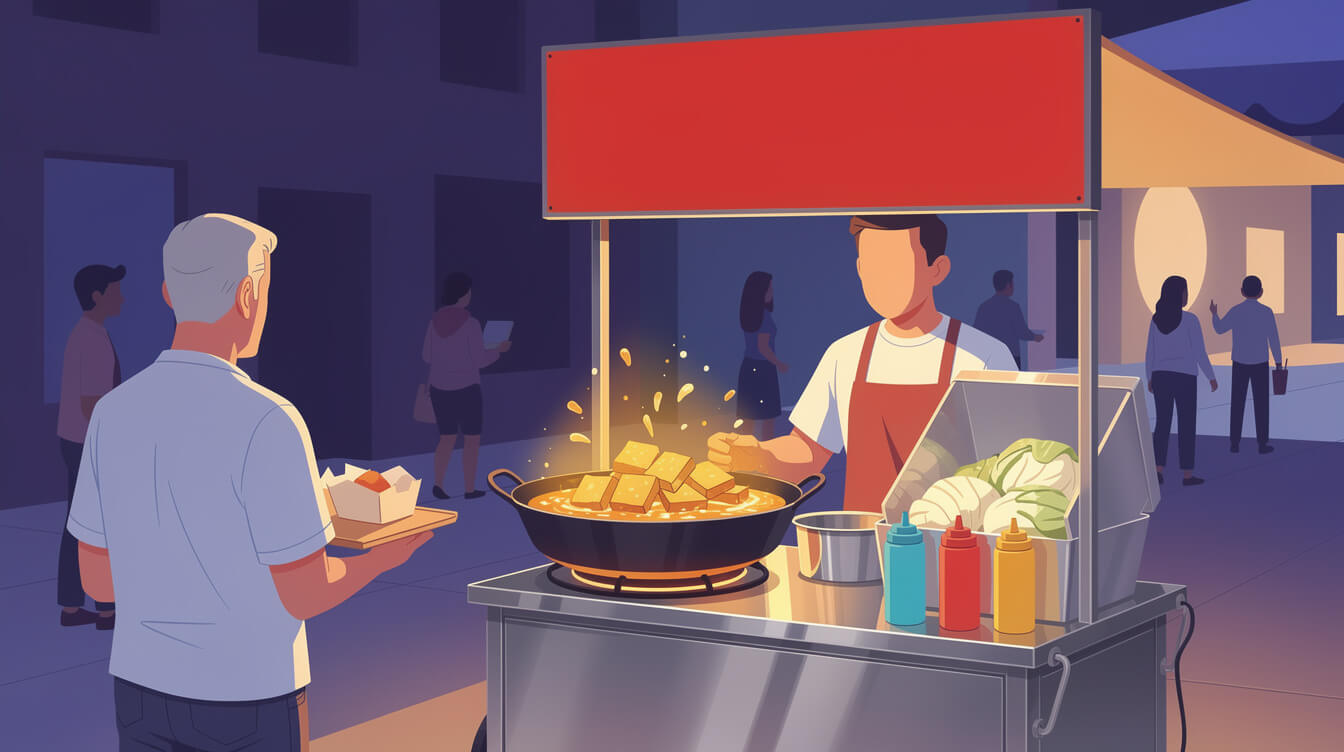
Night markets move fast, and most stinky tofu stalls are one person, one wok and a hand-painted menu board. Here’s how to read the board and order in about ten seconds. (New to night markets in general? Start with our Taiwan night market guide.)
Menu-board decoder
- 臭豆腐 (chòu dòufu): stinky tofu. On its own, it almost always means fried.
- 炸 (zhá): fried · 蒸 / 清蒸 (zhēng / qīngzhēng): steamed · 烤 (kǎo): grilled · 麻辣 (málà): numbing-spicy · 鍋 (guō): pot.
- 小 / 大 (xiǎo / dà): small / large. Some stalls sell by piece count instead.
- 泡菜 (pàocài): pickled cabbage. Usually included; some stalls let you ask for extra.
- 辣 / 不辣 (là / bú là): spicy / not spicy. Say bú là if you don’t want chili.
- 素 (sù): vegetarian. Look for it on the sign or ask (see the vegetarian section below).
The simplest order is to point and say “一份臭豆腐” (yí fèn chòu dòufu), “one portion of stinky tofu.” Add “內用” (nèi yòng) if you’re eating at the stall’s stools, or “外帶” (wài dài) for takeaway. Pay in cash, since many small stalls still don’t take cards.
What stinky tofu costs in 2026
Like most snacks, the stinky tofu Taiwan stalls sell has crept up in price. TVBS reported in August 2025 that a portion that used to cost about NT$50 now usually costs NT$70 to NT$90. Prices over NT$100 are now normal at famous tourist spots. Stinky tofu also made a 2025 ranking of the ten snacks whose price rises Taiwanese diners noticed most. As a rough guide for 2026:
- Fried, grilled or steamed portion at a neighborhood night market: about NT$60 to NT$90.
- Mala stewed portion: about NT$70 to NT$120, more if you add noodles or extras.
- Stinky tofu hot pot (a whole meal with rice): see the hot pot section, but budget well above a snack portion.
- Famous old streets and tourist spots: NT$100 and up. A NT$200 plate of steamed stinky tofu on Shenkeng Old Street went viral in 2024.
Prices vary stall by stall, so treat these as ranges, not quotes.
If you’re nervous: a first-timer’s plan
Order fried, from a busy stall, and eat it hot, standing right there, with plenty of pickled cabbage on every bite. Breathe through your mouth for the first one if you need to. Most people are surprised at how mild it tastes. If you want a souvenir of surviving it, our Stinky Tofu Stink King sticker is a little badge of honor for your water bottle or laptop.
Stinky Tofu Hot Pot (臭臭鍋): Taiwan’s Everyday Version

Walk into a casual hot pot shop almost anywhere in Taiwan and you’ll find 臭臭鍋 (chòu chòu guō, literally “stinky stinky pot”) on the menu. It’s a one-person pot loaded with napa cabbage, mushrooms, sliced pork, pig’s blood rice cake, fried tofu skin, duck blood, pork intestine and, of course, chunks of stinky tofu. It comes with a bowl of rice and is eaten as a cheap, filling lunch or dinner. The broth soaks up the tofu’s flavor, so the whole pot tastes savory and funky, while the tofu itself softens and mellows.
Where it came from
The stinky tofu hot pot is generally traced to Yuanlin, in Changhua County, and to the chain 三媽臭臭鍋 (Sanma Chou Chou Guo), founded there in 1998. As Taiwanese food media tell it, the founder was deep in debt when his mother-in-law, nicknamed “Third Mom” (三媽), backed him to start a small business again. Watching a busy steamed stinky tofu stall at a night market, he wondered what would happen if he turned it into a hot pot, with hot broth and pork intestine for texture. He named the shop after her. Sanma started out selling pots for NT$80, and it’s widely credited with turning the cheap solo pot into a national habit.
What a pot costs now
Not NT$80. On October 1, 2022, Sanma raised every pot by NT$20, which put its cheapest pot, the large-intestine stinky pot, at NT$150. Prices have kept moving since. Budget roughly NT$150 to NT$200 for a chain pot with rice, and check the board for the current price. Night market stinky pots can be a little cheaper.
If hot pot is your thing, our Taiwan hot pot guide covers the whole solo-pot culture, from shacha dipping sauce to winter stews.
Shenkeng: Taiwan’s Tofu Town
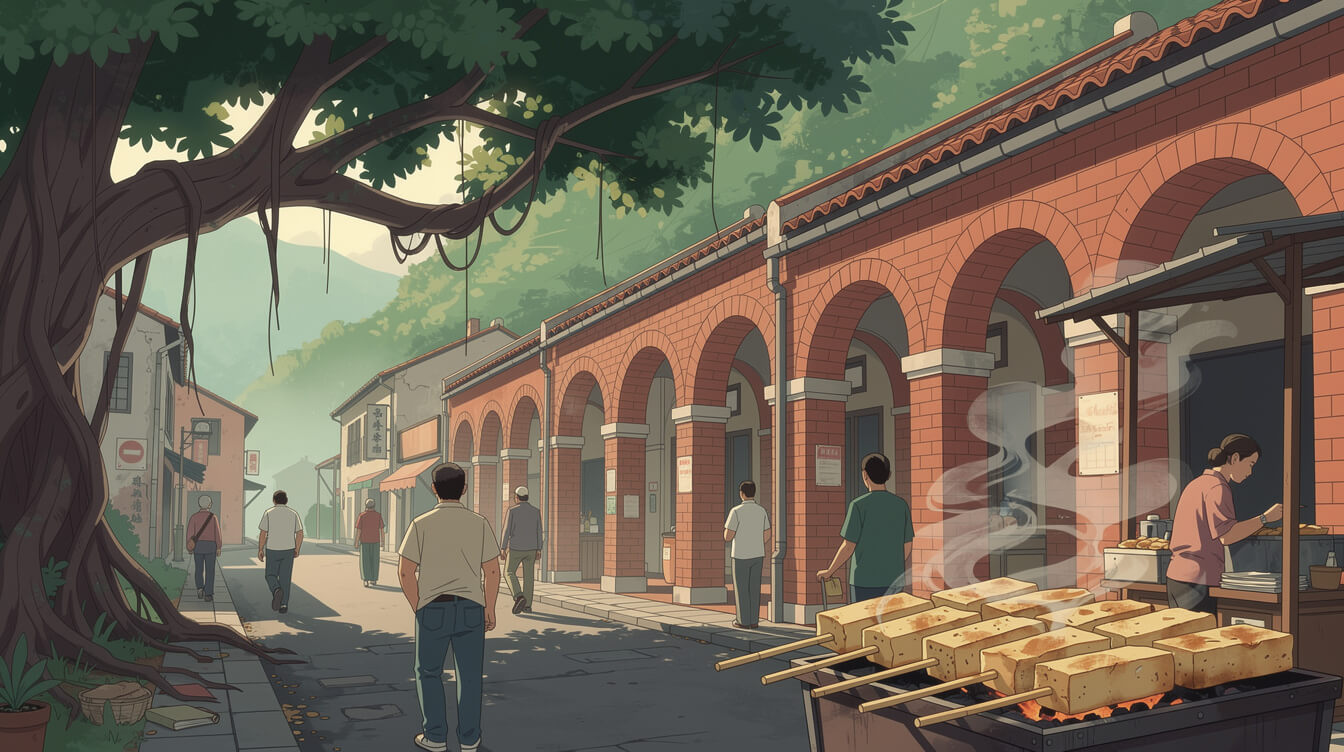
If the stinky tofu Taiwan loves has a capital, it’s Shenkeng (深坑), a small district in the hills southeast of Taipei. Its old street dates back to the Qing dynasty’s Jiaqing era (around 1800), when it was a trading stop on the route between Taipei and Yilan. Red-brick arcades and stone paving still line it today.
Shenkeng’s tofu reputation comes from two things locals always mention: clean, soft local water and tofu made with brine-based coagulant, which gives it a slightly smoky, toasty taste. Tofu is one of the district’s “four treasures,” alongside tea, bamboo shoots and black pork. Today the old street is lined with tofu restaurants and grills loaded with long grilled stinky tofu skewers, Shenkeng’s signature.
Two practical notes. First, it’s a tourist street, so prices run higher than at a neighborhood night market (that NT$200 viral plate was here). Second, it’s busiest on weekends. Go on a weekday afternoon, grab a grilled skewer, and pair it with a walk or a tea stop in the hills.
Back in Taipei, you’ll also find excellent stinky tofu in the night markets. See our guides to Shilin Night Market, Linjiang (Tonghua) Night Market and Nanjichang Night Market for where to start.

Bow Down to the Stinky Tofu King
Survived your first portion? Our Stinky Tofu King mousepad brings a little night-market swagger to your desk, no smell included.
Is Stinky Tofu Vegetarian? It Depends on the Brine
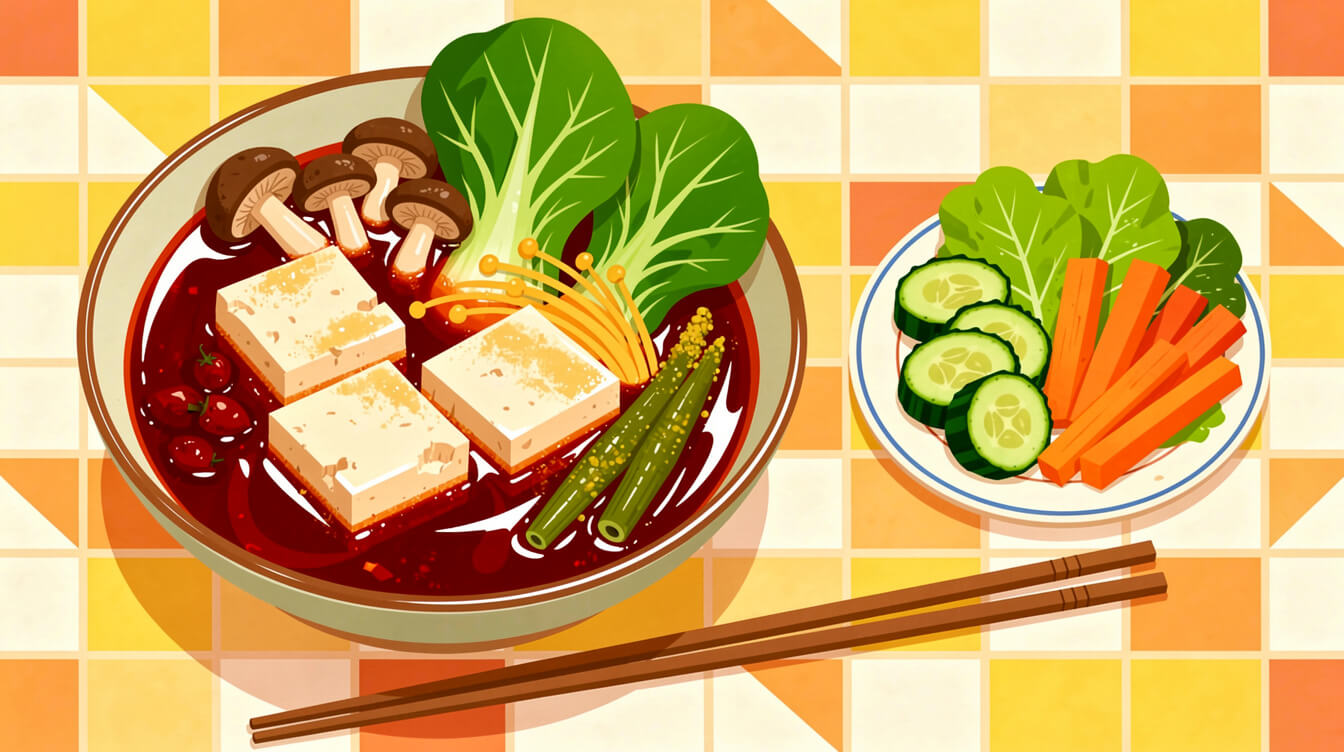
It’s made of tofu, so it must be vegetarian, right? Not necessarily. The answer depends on two things you can’t see:
- The brine. Some vendors use only fermented vegetables. Others add dried shrimp, meat or fermented milk to kick-start or deepen the fermentation. The tofu looks the same either way.
- The cooking. Mala stinky tofu usually comes with cubes of duck or pig blood, and its broth may be meat-based. Hot pots almost always contain meat. Even a fried order may share oil with other foods.
So don’t assume either way. Look for the character 素 (sù, vegetarian) on the sign, or ask: “這是素的嗎?” (zhè shì sù de ma?, “Is this vegetarian?”). Plenty of stalls specialize in vegetarian stinky tofu, especially mala versions, and Taiwan’s large Buddhist vegetarian community means they aren’t hard to find. Nanjichang Night Market’s vegetarian stall 臭老闆 (Smelly Boss) held a Michelin Bib Gourmand from 2018 to 2021, for example.
One nuance few guides mention: Taiwan’s legal vegetarian labels (全素 for vegan, 奶蛋素 for lacto-ovo and so on) apply to packaged food. Street stalls and restaurants aren’t bound by them, so a hand-written 素 at a stall is the vendor’s word, not a certified label. Our vegan Taiwan guide explains the full system, including why “pot-edge vegetarian” (鍋邊素) is a thing.
Stinky Tofu Taiwan FAQ
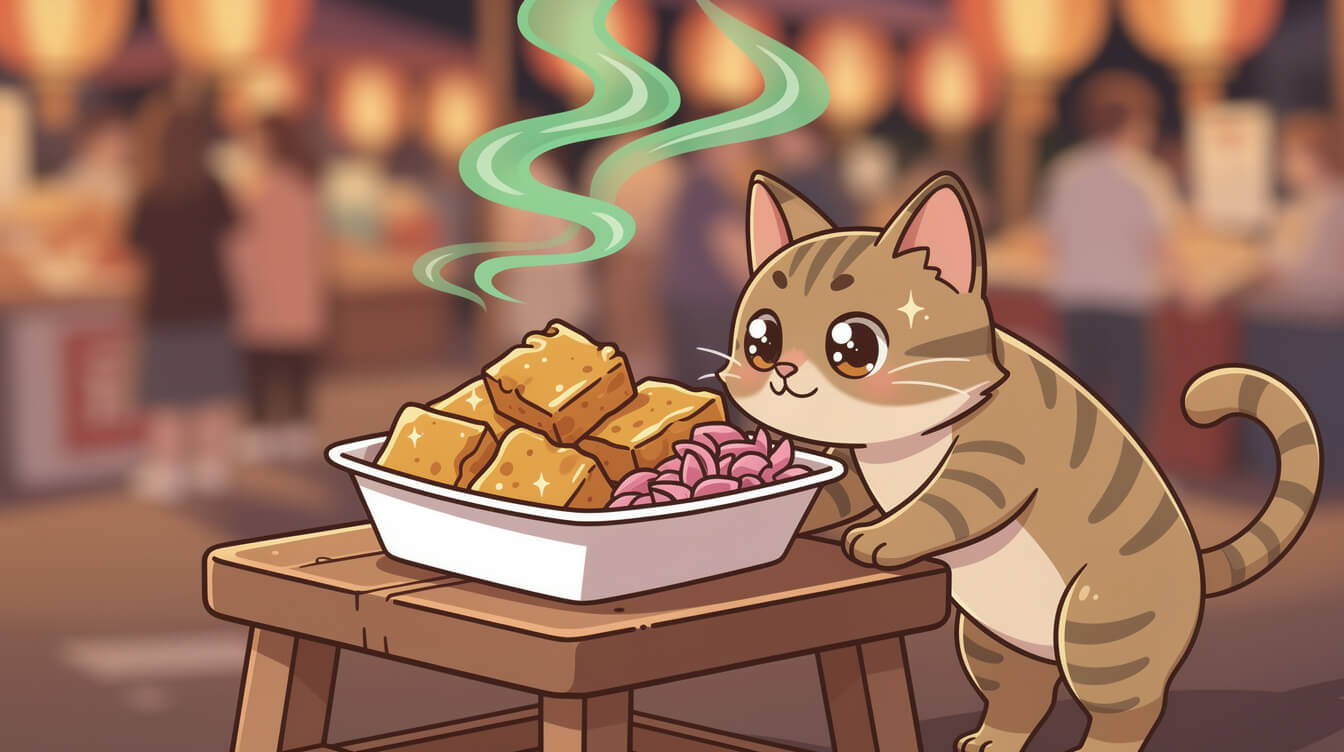
Is stinky tofu mold?
Mostly no. The stinky tofu Taiwan stalls sell gets its smell from a brine fermented mainly by bacteria, not from mold growing on the tofu. Some Chinese fermented tofu products do use mold, which is where the confusion comes from. The tofu you buy at a stall should look clean and smooth, not fuzzy.
How do you say “stinky” in Chinese?
臭, pronounced chòu (falling tone). Stinky tofu is 臭豆腐, chòu dòufu, and in Taiwanese Hokkien it’s tshàu-tāu-hū.
What does “tofu” mean?
Tofu comes from 豆腐 (dòufu). 豆 means bean, and 腐 describes something soft and curdled (it can also mean “rotten,” a fitting coincidence here). So tofu is roughly “bean curd,” which is exactly what it is: soy milk set into soft blocks.
Is stinky tofu safe to eat?
From a busy, reputable stall, yes. It’s an everyday snack across Taiwan, and it’s cooked hot before serving. The risk comes from poorly made home fermentation, and food poisoning cases linked to badly prepared stinky tofu have been reported. Buy from stalls with high turnover, eat it freshly cooked, and don’t try to ferment your own brine without knowing what you’re doing.
What does stinky tofu taste like?
Savory, slightly sour and cheesy, with a crisp shell when fried. It’s much milder than it smells. The sweet-sour pickled cabbage and garlic sauce do a lot of the work.
Where can I try stinky tofu in Taiwan?
You’ll find stinky tofu Taiwan-wide, at almost any night market, plus dedicated shops and hot pot chains. Shenkeng Old Street is the stinky tofu pilgrimage. Our Taiwan street food guide and A–Z of night market eats show where it fits among everything else to try.
Is there stinky tofu outside Taiwan?
Yes, across China, Hong Kong and in Taiwanese restaurants overseas. Styles differ, though. Changsha’s is black, and Hong Kong’s is usually fried and eaten with hoisin or chili sauce. Taiwan’s mix of fried, grilled, mala, steamed and hot pot versions, all with pickled cabbage, is its own thing.
Final Thoughts: Follow Your Nose
Stinky tofu is the rare food where the hardest part is the first ten seconds. Get past the smell and you’ll find a crisp, savory, comforting snack. The stinky tofu Taiwan serves has quietly grown into a whole menu: fried in a paper tray, grilled on a stick in Shenkeng, stewed in mala broth, steamed for the purists and bubbling in a solo hot pot for an easy weeknight dinner.
Start fried, ask for extra pickled cabbage, and work your way down the table above. And when the smell drifts down a night market lane next time, you’ll know exactly what it is and what to order. Still hungry? Stinky tofu’s gentler cousin is douhua, Taiwan’s sweet tofu pudding, and our original stinky tofu postcard has a few more tips for first-timers.
A Postcard From Taiwan, Every Week
Island trips, street food, temple traditions and the little Taiwan details worth knowing, sent straight to your inbox. No spam, and you can unsubscribe anytime.

Grab a Free Taiwan Sticker!
Drop your email and we’ll send you a limited-edition Taiwan sticker — plus insider access to new merch drops and island vibes.
No spam. Unsubscribe anytime.