Did You Know? Taiwan’s Biggest Ginkgo Forest Grew Out of a Tea Field
When the leaves turn in Taiwan, most people picture maple reds in the high mountains. But in late autumn, one hillside in central Taiwan glows a completely different color. It’s ginkgo gold, and it’s growing right in the middle of a tea field.
A forest planted between the tea rows
The spot is Dalunshan (大崙山) in Lugu Township, Nantou County. Lugu is better known as the home of Dong Ding oolong (more on that in our Taiwan oolong tea guide). Local accounts say these slopes were once covered in Moso bamboo. When that bamboo died off around 1990, farmers replanted the hillsides with tea.
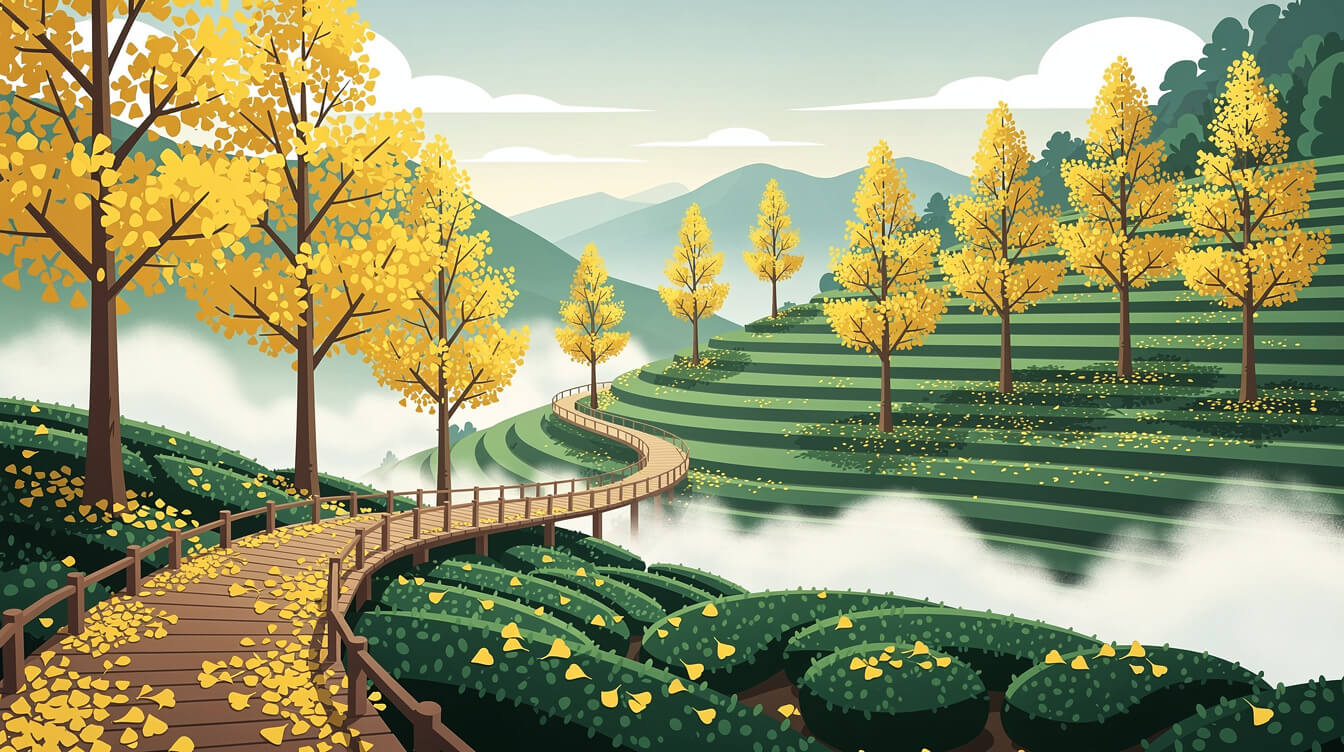
The trouble is that rows of tea bushes don’t hold a steep mountainside together very well. To help, tea farmers joined a government mixed-afforestation program and planted ginkgo trees in between the tea rows, starting in the early 1990s. Three decades later, Dalunshan has roughly 60 to 80 hectares of ginkgo, which travel writers routinely call Taiwan’s largest ginkgo forest. The trees sit at about 1,300 to 1,500 meters, high enough that clouds often roll through the valley below.
So the “foreign-looking” golden forest that people drive up for every autumn exists because of tea. It started as a soil-conservation project, and the gold was a lucky bonus.
When the gold shows up
Ginkgo isn’t native to Taiwan, and it colors best where autumn nights turn cold, which is why Taiwan’s ginkgo groves are up in the mountains. In a typical year the leaves start turning in late October and are fully gold by late November. That makes right now the usual sweet spot. The northeast monsoon can speed things up, though. In 2019, after a dry autumn and big day-night temperature swings, PTS reported that most of Dalunshan’s ginkgo was expected to drop its leaves by early December. Check recent photos before you go.
Fair warning about traffic: the roads up to Xitou and the ginkgo forest are famous for weekend jams. During one long weekend, TVBS reported a 20-kilometer backup. Go on a weekday if you can.
Don’t miss the Ginkgo Bridge next door
Just down the road is the Xitou Nature Education Area (溪頭), about 2,500 hectares of forest at around 1,150 meters. National Taiwan University manages it as an experimental forest. Ginkgo trees line one of its trails, and in 2017 NTU opened a 36-meter timber Ginkgo Bridge (銀杏橋) across the stream there. Civil engineering students designed it, the builders used Japanese cedar grown in the park, and its curves are meant to look like a ginkgo leaf. It replaced a concrete bridge that Typhoon Herb destroyed in 1996. Full-price entry to Xitou has been NT$250 since January 2026.
One thing not to pick up
You’ll see little round seeds on the ground under the trees. Those are ginkgo nuts (白果). Raw ones are toxic and can cause dizziness, nausea and worse, so leave them where they fall.
The takeaway: Taiwan’s biggest ginkgo forest is a tea farm’s soil-saving plan that happened to turn gold. If you’re near Nantou this week, pair it with a cup of local oolong. If you like seasonal trees, our golden rain tree post covers Taiwan’s other autumn-gold tree, and our Taiwan in December guide can help you plan what comes next.
Missing those misty Nantou mornings? Our I Love Nantou tee brings a little mountain-county pride home. Browse Taiwan Merch.

Grab a Free Taiwan Sticker!
Drop your email and we’ll send you a limited-edition Taiwan sticker — plus insider access to new merch drops and island vibes.
No spam. Unsubscribe anytime.