Douhua (豆花): How to Order Taiwan’s Tofu Pudding, Where to Eat It, and How It Differs From Taho
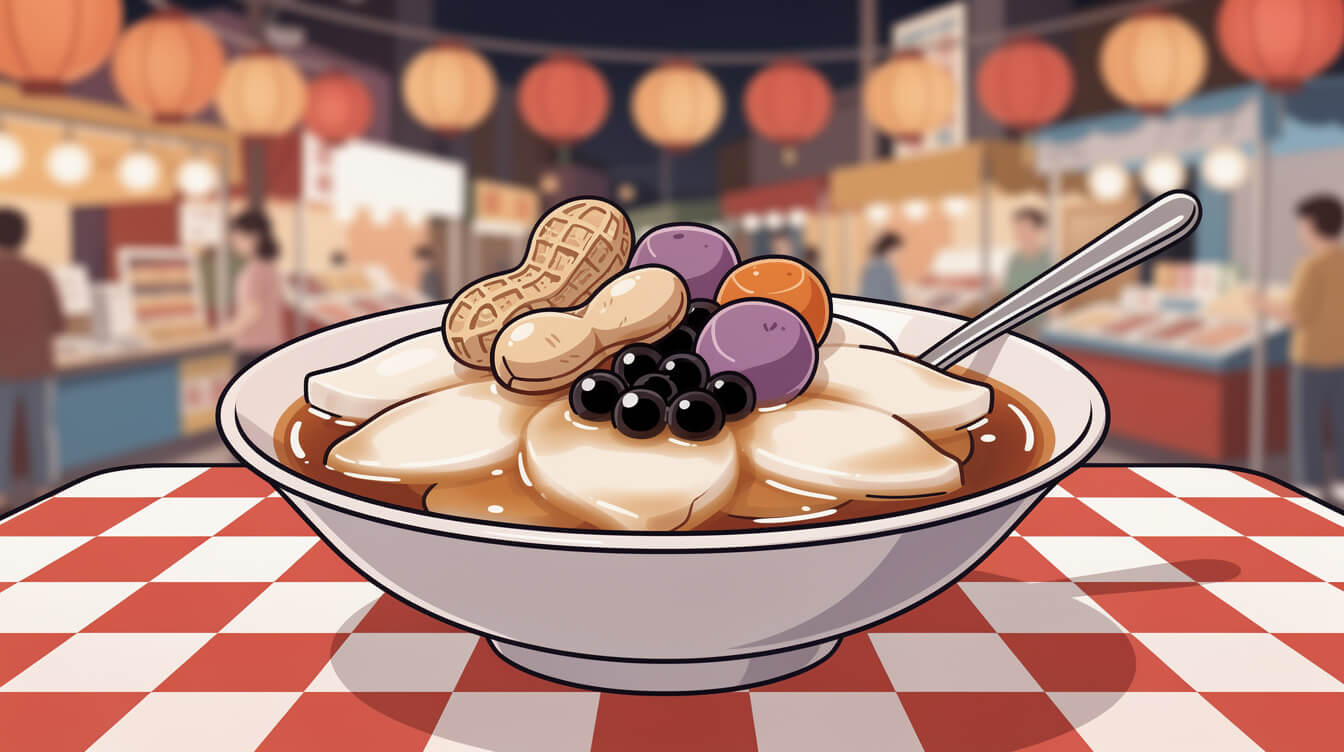
Order a bowl of douhua (豆花) in Taiwan and you’ll get a whole small ritual. You pick a base, choose your toppings from a row of steel tubs, and answer one question: hot or iced? Douhua is tofu pudding, soft soy milk curd so delicate it barely holds its shape. It’s served sweet in Taiwan, and it’s been a dessert shop, night market and roadside-cart staple for generations.
Most English guides stop at “it’s tofu, but sweet.” This one is built for actually eating it. You’ll learn how to order douhua in Taiwan (with the Chinese words for every topping), the regional styles worth a detour, verified shops in five cities, and how douhua compares to Filipino taho, Hong Kong tau fu fa and northern China’s savory “tofu brain.” There’s also a Taiwan-style recipe at the end if you’re missing it from home.
What Is Douhua? Taiwan’s Silky Tofu Pudding

Douhua is fresh soy milk set with a small amount of coagulant into a curd that’s softer than silken tofu, then served in syrup with toppings. The name means “bean flower,” a nod to the way the curd breaks into thin, petal-like layers when it’s scooped.
In Taiwan, douhua is almost always a sweet dessert or snack. The curd itself is barely sweet and tastes gently of soybeans. Everything else comes from what goes on top: brown-sugar syrup, ginger syrup, soy milk, peanuts, beans, chewy balls of tapioca or taro. Think of the curd as a blank canvas and the toppings as the painting.
Is douhua the same as silken tofu?
Close, but no. Both are unpressed soy curds, but silken tofu is set firmer so it can be sliced, packed and cooked. The pudding is set as loosely as possible and is meant to be eaten with a spoon within hours of being made. If silken tofu is a custard you can cut, this is a custard you sip. That’s why a good shop makes it fresh every day and why the texture changes so much from shop to shop.
How it’s made
The method is simple, and that’s why small differences matter. Soybeans are soaked, ground and cooked into soy milk. The hot soy milk is then poured over a coagulant so the proteins gently set. Traditional Taiwanese shops usually use food-grade gypsum (石膏, calcium sulfate), often mixed with a little sweet potato starch (地瓜粉). According to TVBS Health, the starch makes the set curd finer, smoother and more elastic. Some shops use nigari (鹽滷, magnesium chloride from seawater) for a denser, more old-fashioned texture with a faint mineral edge. Modern home recipes often use GDL (glucono-delta-lactone), which is the most forgiving option.
The legend that tofu began with Liu An, a Han dynasty prince, is just that: a legend. What matters in Taiwan is that it’s everyday food, eaten by schoolkids, grandparents and late-night snackers alike. We wrote a short love letter to it in our douhua daily bite. This guide goes much deeper.
How to Order Douhua in Taiwan: Base, Toppings, Hot or Iced
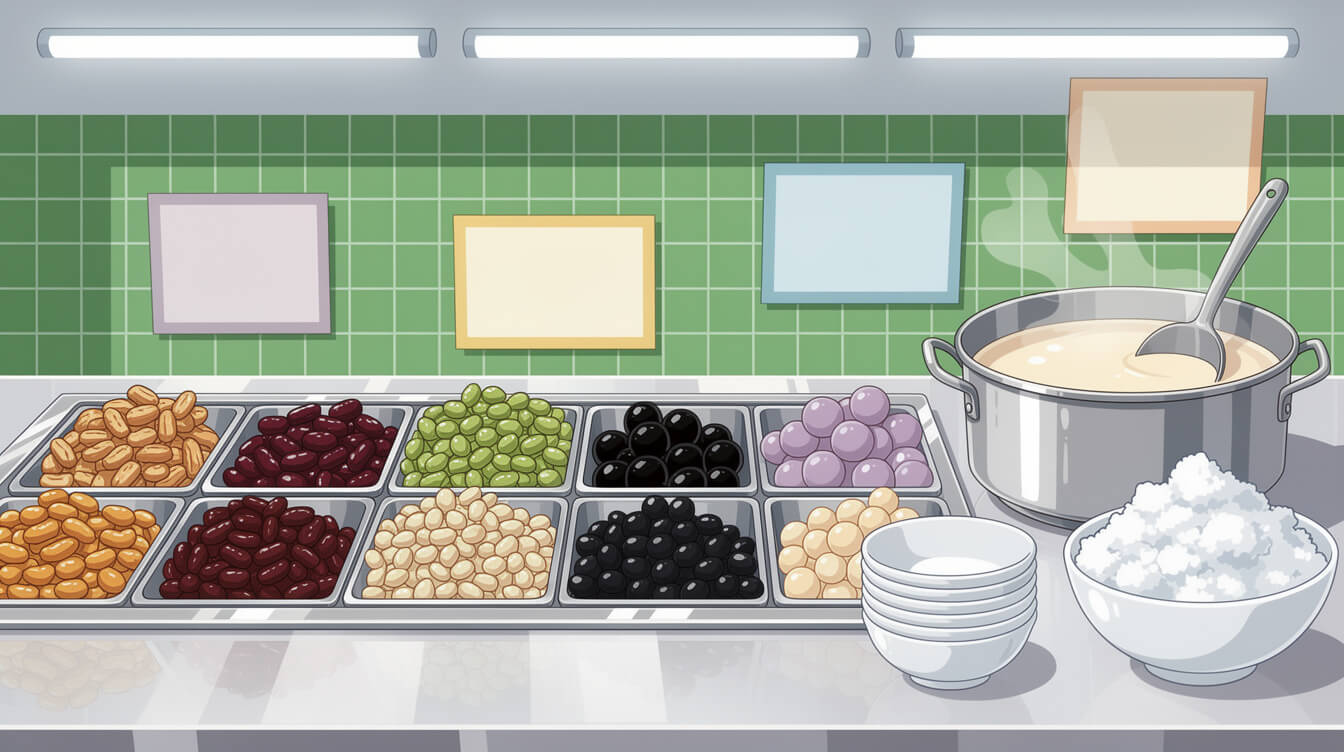
Walk into a Taiwanese douhua shop for the first time and the menu board can look like a wall of characters. Don’t worry. Almost every shop follows the same three-step flow, and once you know it you can order anywhere on the island.
Step 1: Pick your base
Most shops are douhua shops first, but many also sell related bases from the same counter. Point at 豆花 (dòuhuā) for the classic. You’ll often also see 粉粿 (fěnguǒ, chewy starch jelly), 愛玉 (àiyù, jelly fig), 仙草 (xiāncǎo, grass jelly) or 剉冰 (cuòbīng, shaved ice). Some shops let you mix a base, such as half douhua and half grass jelly.
Step 2: Choose your toppings
This is where shops differ. Some sell a bowl with a set number of toppings included, often two or three. Others price each topping separately, and some have fixed combinations on the board. If you’re unsure, point at the tubs and hold up fingers. Nobody minds. The menu words you’ll want are in the next section.
Step 3: Hot or iced?
Say 熱的 (rè de) for hot or 冰的 (bīng de) for iced. In summer, the iced version comes with a scoop of crushed ice or sugarcane-flavored ice slush over brown-sugar syrup. In winter, the same bowl comes warm, often with ginger syrup (薑汁, jiāngzhī). A warm bowl in ginger syrup is one of the best things you can eat on a damp January night in Taipei.
What it costs
Douhua is cheap. At Tongji in Tainan, a plain traditional bowl is listed at NT$40. At Douhua Zhuang in Taipei, a loaded combination with four toppings and sugarcane ice runs about NT$85. Most bowls fall somewhere in between, depending on the shop and how many toppings you add. Bring cash for older shops and carts. Some newer shops take mobile payments.
Handy phrases
- 一碗豆花 (yì wǎn dòuhuā): one bowl of douhua
- 熱的 / 冰的 (rè de / bīng de): hot / iced
- 內用 / 外帶 (nèiyòng / wàidài): eat here / take away
- 少糖 (shǎo táng): less sugar (not every shop can do this, since the syrup is often premixed)
Ordering douhua uses the same muscles as ordering bubble tea. If you’ve already mastered sugar and ice levels, our Taiwan boba tea guide will feel familiar.
Douhua Toppings Explained: A Menu Cheat Sheet

The toppings are where douhua gets personal. Taiwanese people tend to have a “usual,” and comparing combinations is a real conversation topic. Here’s what you’ll find in the tubs.
- 花生 (huāshēng), peanuts. The classic. These aren’t crunchy roasted nuts. They’re slow-cooked until soft enough to crush with your tongue. Many old-school shops serve peanut douhua and nothing else.
- 粉圓 (fěnyuán), tapioca pearls. Small, dark, chewy pearls, the same family as bubble tea’s boba. If you’ve read our guide to making boba pearls, you’ll recognize the chew.
- 芋圓 (yùyuán), taro balls. Chewy balls made from taro and starch, often in purple, orange and yellow (the colors come from taro, sweet potato and pumpkin).
- 紅豆 (hóngdòu), red beans. Sweet, soft azuki beans.
- 綠豆 (lǜdòu), mung beans. Lighter than red beans and seen as cooling in hot weather.
- 薏仁 (yìrén), pearl barley. Plump, slightly chewy grains. Small pearl barley (小薏仁) is a popular douhua add-on.
- 粉粿 (fěnguǒ), starch jelly. Bouncy, translucent cubes, often tinted yellow or brown.
- 湯圓 (tāngyuán), glutinous rice balls. Small plain ones, or the black-sesame-filled kind some shops call 黑心白玉.
- 薑汁 (jiāngzhī), ginger syrup. The winter default in many shops, warming and slightly spicy.
- 黑糖水 (hēitáng shuǐ), brown-sugar syrup. The standard syrup, sometimes cooked over a wood fire for a smoky edge.
- 豆漿 (dòujiāng), soy milk. Used instead of syrup in some places, especially Chiayi (more on that below).
Combinations worth trying
If you freeze at the counter, try one of these. Peanut and tapioca pearls, iced is the night market classic. Taro balls and red beans, hot with ginger syrup is a winter warmer. Peanut, taro, pearl barley and mung bean is a mix that’s hard to get wrong. When Nvidia’s Jensen Huang visits Douhua Zhuang in Taipei, Taiwanese media report that his pick is peanuts, taro, starch jelly and black-sesame rice balls over sugarcane ice. So if you want to eat like a CEO, now you know.
If tapioca pearls are your favorite part of the bowl, you’re in good company. Our Pearl Gang Boba Tapioca T-Shirt is for anyone who adds pearls to everything, douhua included.
Douhua is one of many desserts built on this “base plus toppings” system. Our complete guide to Taiwan desserts covers its cousins, from shaved ice to grass jelly.
Taiwan’s Regional Douhua Styles: Soy Milk, Lemon and Kumquat
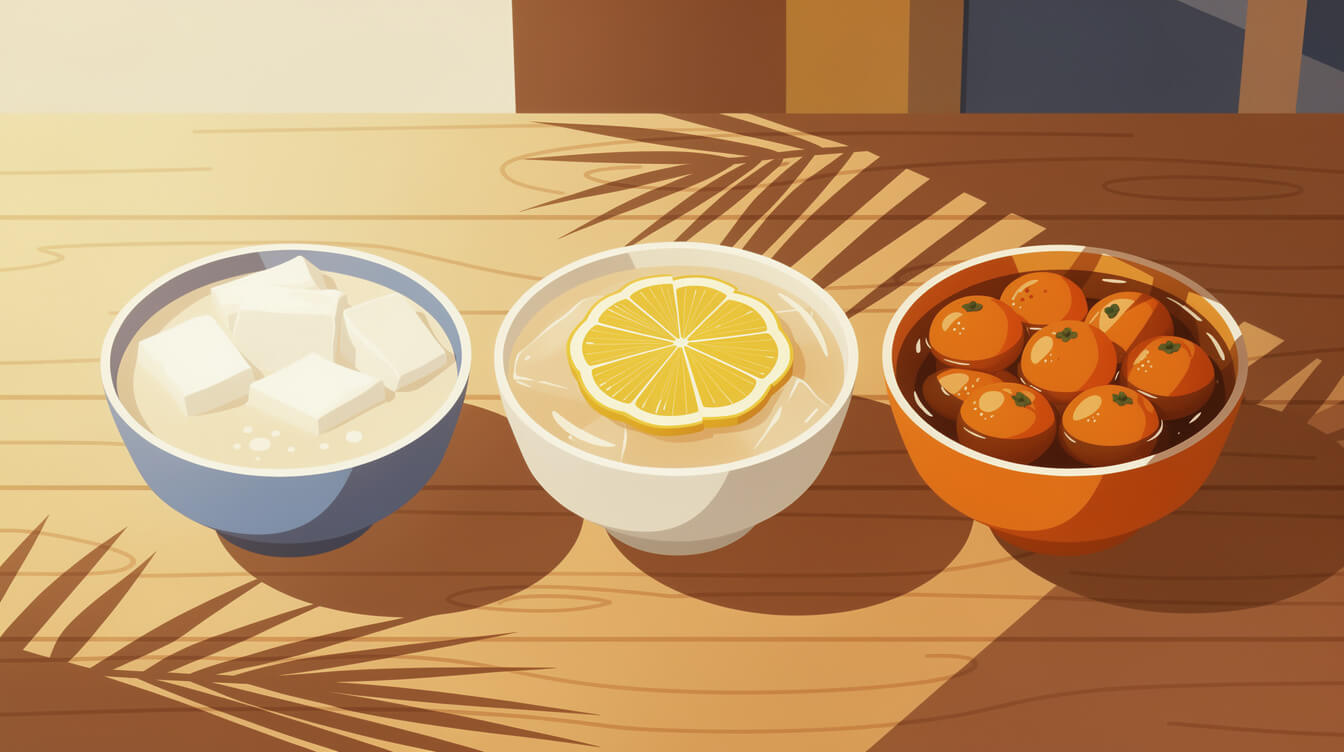
Douhua tastes broadly the same across Taiwan, but a few cities have put their own twist on it. These styles are worth hunting down, and they give you a great excuse to eat douhua in every city you visit.
Chiayi: douhua in soy milk
In Chiayi, douhua is often served in soy milk instead of sugar syrup, so you get soy on soy. Taiwanese food media describe it as a signature Chiayi habit. If you don’t ask for syrup, soy milk is the default pairing in many shops. Try it sweetened or unsweetened, warm or cold, and with classic add-ons like mung beans, pearl barley and peanuts. It’s richer and more savory-leaning than the syrup version, and it makes a surprisingly filling breakfast.
Tainan: lemon douhua in Anping
In Tainan’s Anping district, the long-running shop Tongji (同記安平豆花) lets you add lemon (檸檬) to your bowl. The tart citrus cuts through the sweetness and makes a bright, refreshing summer dessert. One rule to know: the shop’s milk version can’t take lemon. That combination stays off the menu for a reason.
Kaohsiung: kumquat douhua in Yancheng
In Kaohsiung’s old Yancheng district, Wu Family Kumquat Douhua (吳家金桔豆花) started out as a cart and is known for two things. It cooks its curd and brown-sugar syrup over a wood fire, which gives a faint smoky aroma. It also pairs each bowl with whole kumquats (金桔). Bite into one and the sweet-sour kumquat syrup mixes with the silky curd. It’s one of the most distinctive bowls on the island.
Yilan: deep-sea-water douhua
From Jiaoxi in Yilan comes Bai-Shui Douhua (白水豆花). The shop says it makes its curd with spring water from the Snow Mountain range and deep ocean water from Taiwan’s east coast, which acts as a natural nigari-style coagulant, cooked over direct heat. The result is a firmer, more soybean-forward curd than the wobbly gypsum style. It has a branch on Taipei’s Yongkang Street, so you don’t need to travel to Yilan to try it.
Fruit douhua and modern shops
Newer shops have pushed douhua toward fruit. Show Dou Hua (騷豆花) in Taipei’s Da’an district tops its handmade tofu pudding with seasonal fruit such as strawberry, mango or banana. It’s a different experience from the traditional peanut bowl, and it’s great on a hot afternoon.
Where to Eat Douhua in Taiwan: City-by-City Picks
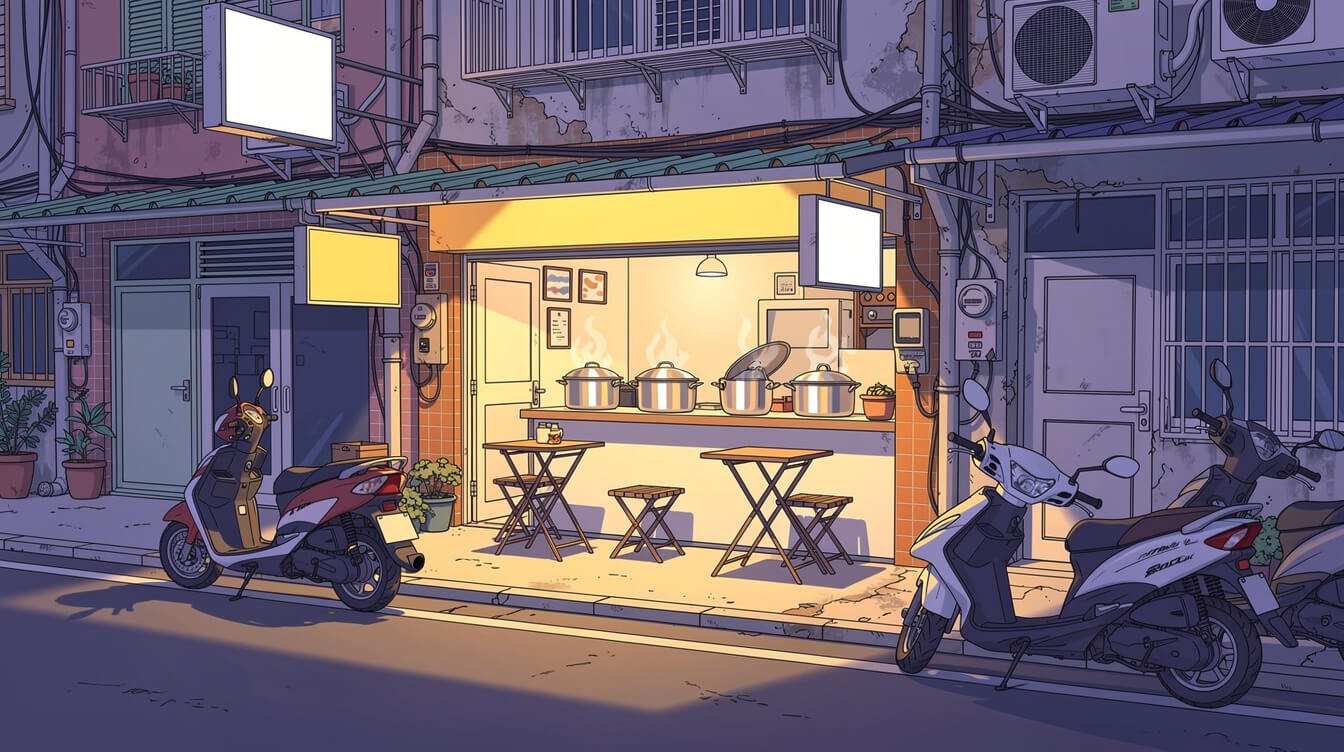
These are well-known, long-running douhua shops in five cities. Addresses and hours come from the shops’ published listings and Taiwanese food media. Small shops change their hours and closing days often, so check Google Maps before you make a special trip.
Taipei
- Douhua Zhuang (豆花莊), No. 49, Ningxia Road, Datong District. It’s near Shuanglian MRT and a short walk from Ningxia Night Market. According to Taiwanese media, the family recipe dates back to 1965, and the shop offers 30-plus toppings. It’s listed as open from 10 a.m. until about 1 a.m., which makes it a perfect after-night-market stop.
- Jiang Ji Dongmen Douhua (江記東門豆花), No. 5, Lane 142, Section 1, Jinshan South Road, Zhongzheng District, inside Dongmen Market. It’s a morning shop, listed as open 7:30 a.m. to 3 p.m. and closed Mondays and Thursdays. It pairs well with a walk to Yongkang Street.
- Bai-Shui Douhua (白水豆花), No. 34, Yongkang Street, Da’an District. It’s listed as open 1 p.m. to 10 p.m. and closed Wednesdays and Thursdays.
- Show Dou Hua (騷豆花), No. 106, Lane 236, Section 1, Dunhua South Road, Da’an District. It’s listed as open 11:30 a.m. to 9 p.m. and closed Mondays. Go here for fruit douhua.
Taichung
- Luo Family Traditional Douhua (羅家傳統豆花), near Tunghai University. This is a roving cart that’s been selling around the area for about 60 years, and it sells only one thing: peanut tofu pudding. The route varies, so locals phone the owner to find out where the cart is. It’s a living piece of the old pushcart tradition.
- Zhongxiao Night Market area. Taiwanese food media point to Zhongxiao Douhua (忠孝豆花, founded 1958) and Tsai Family Douhua (蔡家豆花) inside the night market, with most items around NT$40–50.
Tainan
- Tongji Anping Douhua (同記安平豆花), No. 433, Anbei Road, Anping District. It’s listed as open 9 a.m. to 11 p.m. daily, and there’s a second branch on the same road. Order the plain traditional bowl, then go back for lemon.
Kaohsiung
- Wu Family Kumquat Douhua (吳家金桔豆花), No. 70, Fuye Road, Yancheng District, at the corner of Lainan Street. It’s known for wood-fired bowls with kumquat. Combine it with an evening at Liuhe Night Market.
Yilan
- Bai-Shui Douhua (白水豆花), No. 68, Deyang Road, Jiaoxi. This is the original home of the deep-sea-water style, and it’s an easy stop after a hot spring soak. It’s listed as open 1 p.m. to 10 p.m.
Night markets and everywhere else
You don’t need a famous shop. Almost every night market has a dessert stall selling it, and many neighborhoods have a small shop that’s been ladling it for decades. Look for the giant aluminum pots and the row of topping tubs. For a wider night-market eating plan, see our A–Z guide to Taiwan street food.
Dessert Crawl Approved
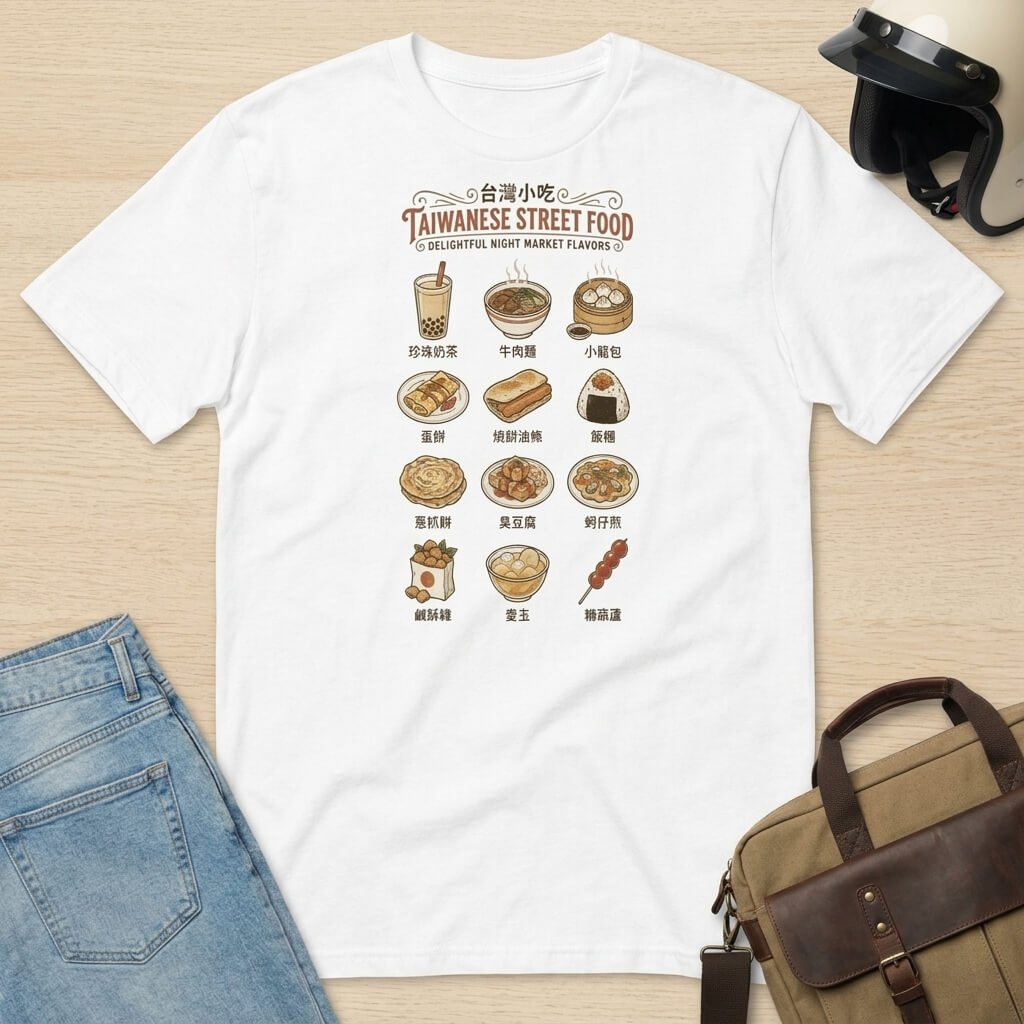
Our Taiwanese Street Food Guide tee is a vintage-poster tribute to the snacks you’ll queue for between dessert stops. Wear it on your next night market crawl, or send it to someone who misses the taste of Taiwan.
Douhua vs Taho vs Tau Fu Fa vs Doufunao
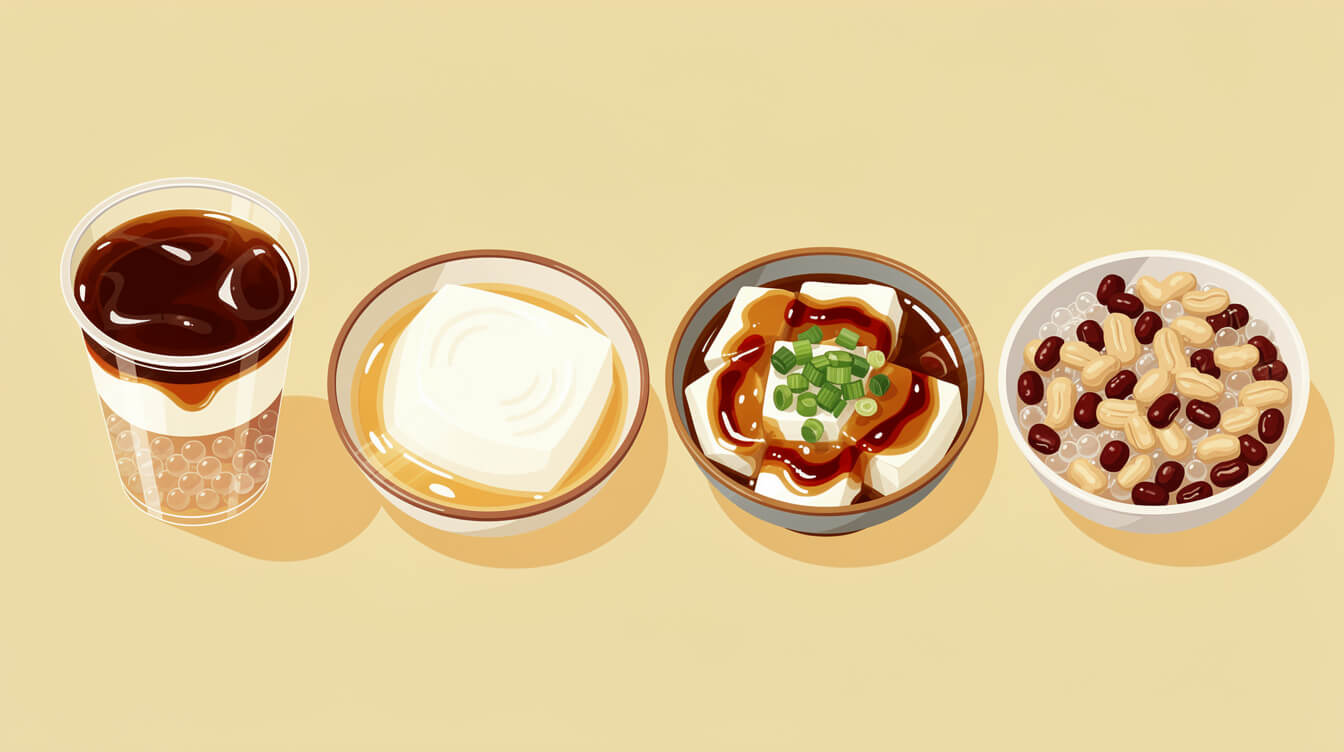
Soft tofu pudding is eaten across Asia, under many names and in very different ways. If you grew up with one version, the others can feel familiar and strange at the same time. Here’s how Taiwan’s douhua compares.
| Name | Where | Sweet or savory | Typical way it’s served |
|---|---|---|---|
| Douhua 豆花 | Taiwan | Sweet | Brown-sugar or ginger syrup (or soy milk in Chiayi) with a choice of toppings like peanuts, pearls, taro balls and beans. Hot or iced. |
| Taho | Philippines | Sweet | Silken tofu layered in a cup with arnibal (caramelized brown-sugar syrup) and small sago pearls. Traditionally sold warm in the morning by street vendors carrying two buckets. |
| Tau fu fa 豆腐花 | Hong Kong, Malaysia, Singapore | Mostly sweet | Served simply with sugar syrup, brown sugar or ginger syrup. Fewer toppings than in Taiwan. |
| Tào phớ / tàu hũ | Vietnam | Sweet | Soft tofu in ginger syrup, sometimes with coconut milk or tapioca pearls. |
| Doufunao 豆腐腦 | Northern China | Savory | “Tofu brain,” eaten warm, often at breakfast, with a thick soy-based gravy, mushrooms or pickles. |
| Sichuan douhua | Southwest China | Savory and spicy | Chili oil, Sichuan pepper, pickled vegetables and peanuts, sometimes eaten with rice. |
Is taho the same as douhua?
They’re close relatives. Both are soft soy curd served sweet with syrup and pearls. The differences are in the details. Taho is usually layered in a cup with arnibal and sago and eaten as a warm breakfast. Taiwan’s version is served in a bowl with a much bigger choice of toppings, and it’s eaten hot or iced at any hour. If you love taho, you’ll feel right at home with a Taiwanese bowl topped with tapioca pearls in brown-sugar syrup.
What about tau fu fa?
Tau fu fa (Cantonese for “tofu flower”) is the same idea with a minimalist approach. In a Hong Kong dessert shop, it often comes in plain syrup or with a little brown sugar sprinkled on top. Taiwan’s version takes the same curd and turns it into a build-your-own bowl.
Why are some versions savory?
In northern and southwestern China, soft tofu is treated as a savory breakfast or street snack, like a warm porridge. In southern China, Taiwan and Southeast Asia, it’s a dessert. You’ll rarely find the savory version in Taiwan, outside of a few shops serving northern Chinese breakfasts.
How to Make Taiwan-Style Douhua at Home
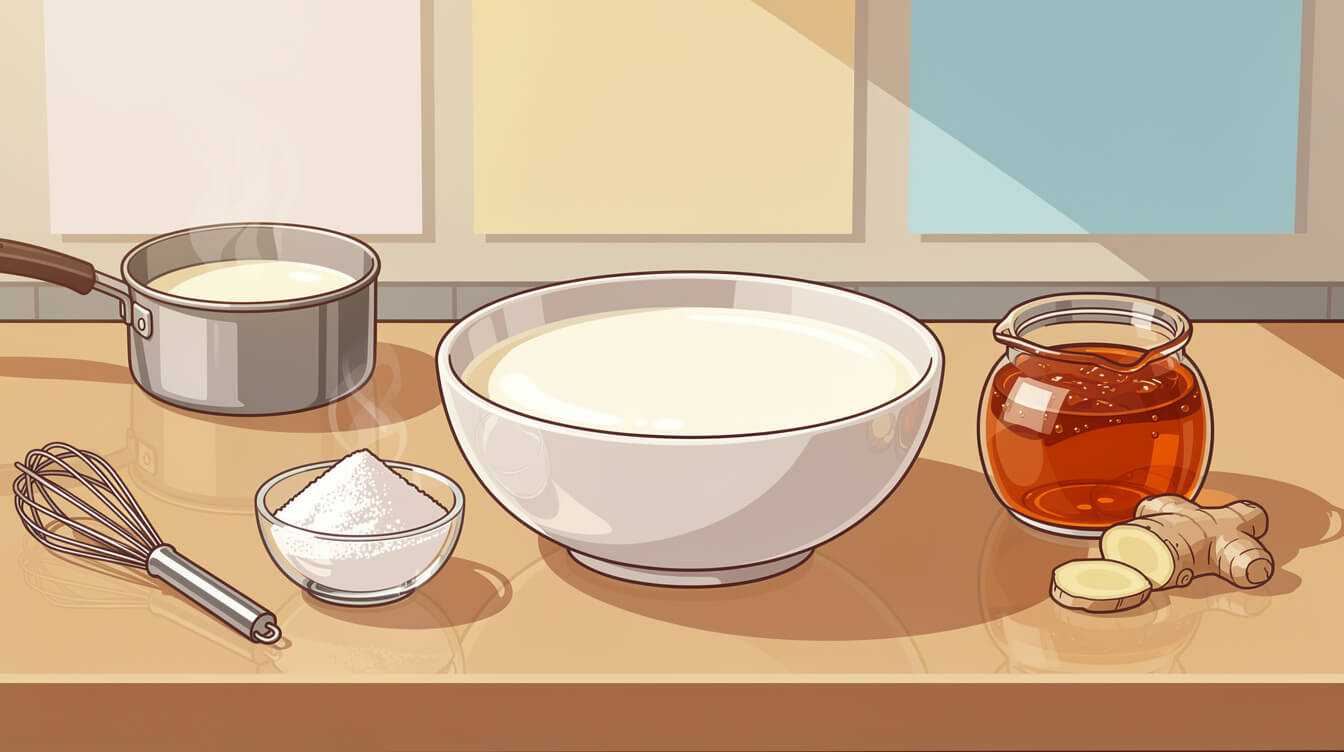
Making douhua at home takes some practice, but you only need a few ingredients. This version follows the traditional Taiwanese shop method: gypsum for the set and sweet potato starch for a smooth, springy curd. Different soy milks and gypsum brands behave differently, so treat these amounts as a starting point and adjust after your first batch.
Ingredients
- 1 liter (about 4 cups) unsweetened soy milk. Use thick, fresh soy milk from an Asian grocery or make your own. Thin carton soy milk often won’t set.
- About 4 g (1 level teaspoon) food-grade gypsum (calcium sulfate), sold as tofu coagulant
- About 10 g (1 tablespoon) sweet potato starch (地瓜粉). Cornstarch works in a pinch.
- About 50 ml (3 tablespoons) cold water
For the brown-sugar ginger syrup: 100 g dark brown sugar, 400 ml water and 4–5 slices of fresh ginger.
Method
- Make the syrup first. Simmer the brown sugar, water and ginger for about 10 minutes, then set it aside. Leave out the ginger for a plain brown-sugar syrup.
- Prepare the coagulant. In a large heatproof bowl or pot, whisk the gypsum and starch into the cold water until there are no lumps.
- Heat the soy milk. Bring it to a gentle boil, stirring so it doesn’t scorch, then simmer for a few minutes. Turn off the heat and let it cool slightly (to about 85–90°C / 185–195°F).
- Pour from a height. Stir the coagulant once more, then pour the hot soy milk into it in one quick, steady stream from about 30 cm (1 foot) up. The force of the pour does the mixing. Don’t stir afterward.
- Cover and rest. Skim off any foam, cover with a towel and leave it undisturbed for 20–30 minutes until set. It should wobble like a soft custard.
- Serve. Scoop thin, wide layers with a flat spoon into bowls. Add syrup and toppings. Serve warm, or chill and add crushed ice.
Troubleshooting
- It didn’t set: the soy milk was too thin or too cool, or you need a little more gypsum.
- It’s grainy or bitter: there was too much gypsum, or it wasn’t fully dissolved. Cut back slightly next time.
- Want an easier option? GDL (glucono-delta-lactone) sets soy milk very reliably and is popular with home cooks. Follow the amount on your package, because brands vary.
For toppings, cook peanuts until very soft, or make your own pearls with our Taiwanese boba pearl recipe.
Douhua FAQ
What does douhua taste like?
The curd tastes mildly of soybeans and is barely sweet. Most of the flavor comes from the syrup and toppings. The texture is the star: silky, cool or warm, and so soft it almost melts.
What does “douhua” mean?
豆 (dòu) means bean and 花 (huā) means flower, so douhua is “bean flower.” The fuller name, 豆腐花 (dòufu huā), means “tofu flower,” and that’s where the Cantonese “tau fu fa” comes from.
Is douhua healthy?
The curd itself is a light, protein-rich soy food. According to TVBS Health, tofu pudding set with gypsum is also a good source of calcium. A dietitian quoted by TVBS News points to the syrup and toppings as the real calorie traps. Ask for fewer toppings and less syrup if you want a lighter bowl.
How many calories are in douhua?
It depends almost entirely on what you add. A plain bowl in light syrup is a modest snack, while a bowl piled with taro balls, pearls and beans in heavy syrup is a full dessert. We haven’t found a reliable standard figure for a Taiwanese shop bowl, so we won’t give you a made-up number.
Is douhua vegan?
The curd, syrups and most toppings are plant-based, so it’s usually a safe choice for vegans. If you’re strict, check any milk-based douhua and creamy toppings. Our vegan Taiwan guide has more tips on eating meat-free.
When is the best time to eat douhua?
Any time. Morning shops serve it with breakfast, dessert shops serve it all afternoon, and late-night spots near night markets keep the pots going past midnight. Go iced in summer and hot with ginger syrup in winter.
Final Thoughts: Your Next Bowl of Douhua
Douhua might be the most humble dessert in Taiwan: soybeans, water, a pinch of gypsum and some syrup. But every shop makes it a little differently, and every person builds their bowl their own way. That’s why it never gets boring. Try peanut tofu pudding from a decades-old cart in Taichung, lemon bowls in Anping, kumquats in Yancheng, and a warm bowl in ginger syrup on a chilly Taipei night.
Next time you’re at the counter, skip the pointing and order like a local: 一碗豆花, pick your toppings, then say 熱的 or 冰的. And if you can’t get to Taiwan right now, make a batch at home. It’s the closest thing to a spoonful of Taiwan you can make in your own kitchen. For more sweet ideas, browse our guide to Taiwan desserts from night markets to cafes.
A Postcard From Taiwan, Every Week
Desserts, night markets, temple stories and the little Taiwan traditions worth knowing, sent straight to your inbox. No spam, and you can unsubscribe anytime.
Grab a Free Taiwan Sticker!
Drop your email and we’ll send you a limited-edition Taiwan sticker — plus insider access to new merch drops and island vibes.
No spam. Unsubscribe anytime.