What Is Crystal Boba? Agar vs Konjac, and the Taiwanese Pearl Behind It
Order a fruit tea in the US and the menu might offer “crystal boba,” “agar boba” or “white pearls” next to the usual tapioca. So what is crystal boba, exactly? The short version: clear, jelly-like pearls that come ready to eat, with a soft, springy bite instead of tapioca’s chew. The longer version is more interesting, because the internet can’t agree on what it’s made of. Half the explainers say agar. The other half say konjac. We went and read the actual ingredient labels on the bags drink shops buy, and the answer surprised us. Here’s what’s really in crystal boba, what it’s called in Taiwan (where most of it is made), how it compares to tapioca and popping boba, and how to order it.
What Is Crystal Boba? The Short Answer
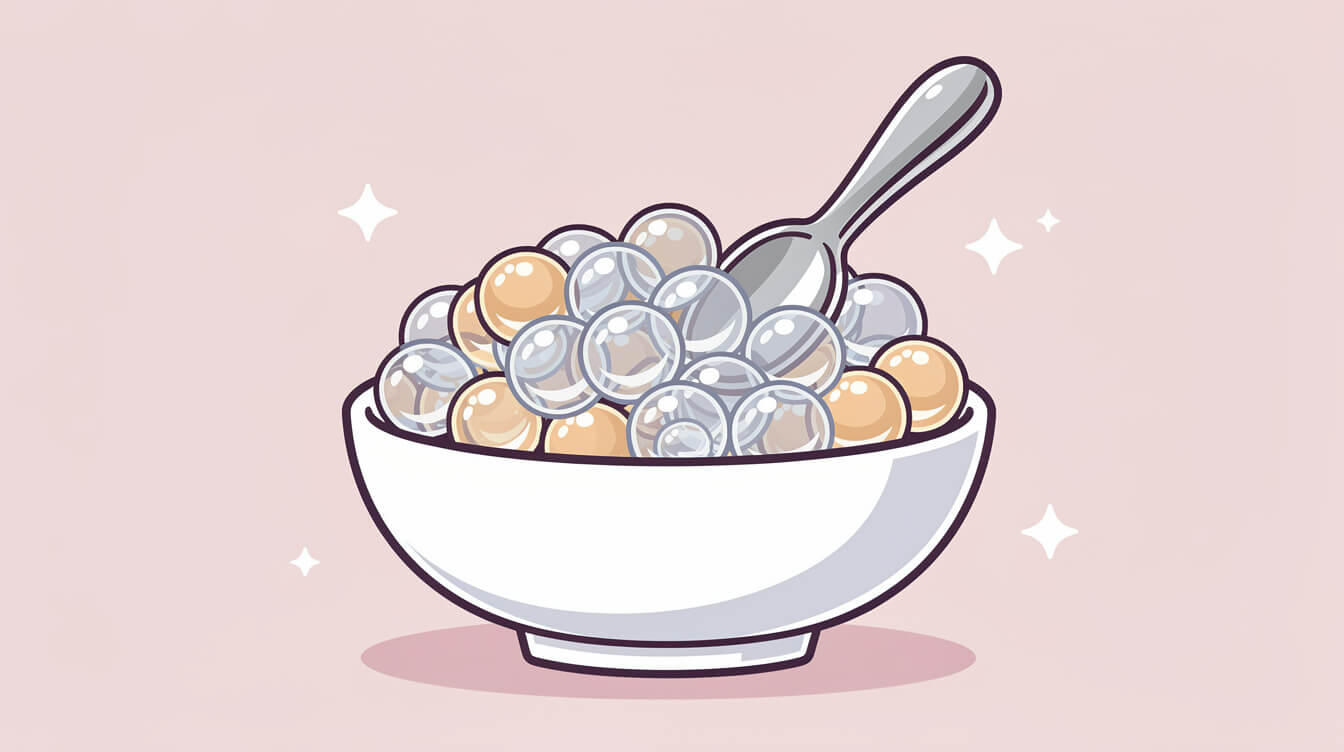
Crystal boba is a translucent, ready-to-eat jelly pearl sold as a bubble tea topping. It’s usually about 1 cm across, packed in sweet syrup, and goes straight from the bag into the cup with no cooking. The texture is somewhere between a gummy and a firm jelly: bouncy and a little crisp at first bite, then soft. It’s sweet but mild, so it picks up the flavor of whatever drink it’s in.
Where tapioca pearls are made from cassava starch and have to be boiled (we cover that whole process in our guide to making boba pearls the Taiwanese way), crystal boba is set with plant-based gelling agents. That’s where the confusion starts.
You’ll see it sold under a handful of names:
- Crystal boba: the most common English name in US shops.
- Agar boba: a name suppliers use, which, as you’re about to see, is often not literally true.
- White pearls: easy to confuse with white tapioca pearls, which are a different product.
- 寒天晶球 (hántiān jīngqiú), or just 晶球 (jīngqiú): the Taiwanese trade name, literally “agar crystal balls.”
Plain crystal boba is clear or pale white. Flavored versions (brown sugar, mango, lychee, matcha and others) are tinted to match. All of them are cold-drink toppings first and foremost.
Agar or Konjac? What Crystal Boba Labels Actually Say
Search “what is crystal boba” and the top results contradict each other. A popular recipe blog says it’s made with agar. A bubble tea chain’s blog says it comes from konjac. Google’s AI answer splits the difference with “agar or konjac.” Nobody shows you a label.
So to settle what is crystal boba once and for all, we read four labels, from the big names that supply US boba shops. Here’s what’s on the bag, quoted from each brand’s own product page or nutrition sheet:
| Product | Gelling agents on the label | Agar listed? | Notes |
|---|---|---|---|
| Bossen Crystal Boba, Original | Carrageenan, konjac powder, sodium alginate, pectin, locust bean gum, guar gum, xanthan gum, gellan gum | No | Product page says “also known as Agar Boba or White Pearls.” Country of origin: Taiwan. |
| Tea Zone Crystal Boba, Original | Konjac powder, carrageenan, gellan gum, sodium alginate, locust bean gum, xanthan gum | No | Also lists calcium hydroxide. Label says “Contains: Soy.” |
| Possmei Original Magic Crystal Boba | Carrageenan, konjac powder, sodium alginate, pectin, locust bean gum, guar gum, xanthan gum, gellan gum | No | 80 kcal per 100 g; 11 g added sugar. |
| Fanale Original Crystal Boba | Same gum list as Bossen | No | 20 kcal per 30 g serving; 3 g added sugar. |
Sources: Bossen, Tea Zone (Lollicup), Possmei nutrition sheet, Fanale nutrition sheet. Labels checked October 2026; brands reformulate, so check the bag you buy.
None of the four lists agar. Every one is built on konjac plus carrageenan, with a supporting cast of other gums. That includes Bossen’s, which the brand itself markets as “Agar Boba.” We couldn’t find a single agar-only crystal boba on retail sale. The agar versions in search results are home recipes.
Why the name says agar but the bag says konjac
Our best read is that “agar” stuck as a name, not a recipe. In Taiwan, the product category is 寒天晶球, and 寒天 (hántiān) is the everyday word for agar. The Taiwanese supplier Sunny Syrup shows how loose that label is: its Chinese-language page files Original Crystal Balls under 寒天晶球 but says they’re made from 蒟蒻 (konjac), 海藻膠 (seaweed gum) and 果膠 (pectin), while its English page for the same product says “made from agar.” One product, two languages, two answers.
Carrageenan is also extracted from red seaweed, the same broad family that agar comes from. So “seaweed gel” isn’t wrong. It’s just not agar.
Agar vs konjac: why it matters
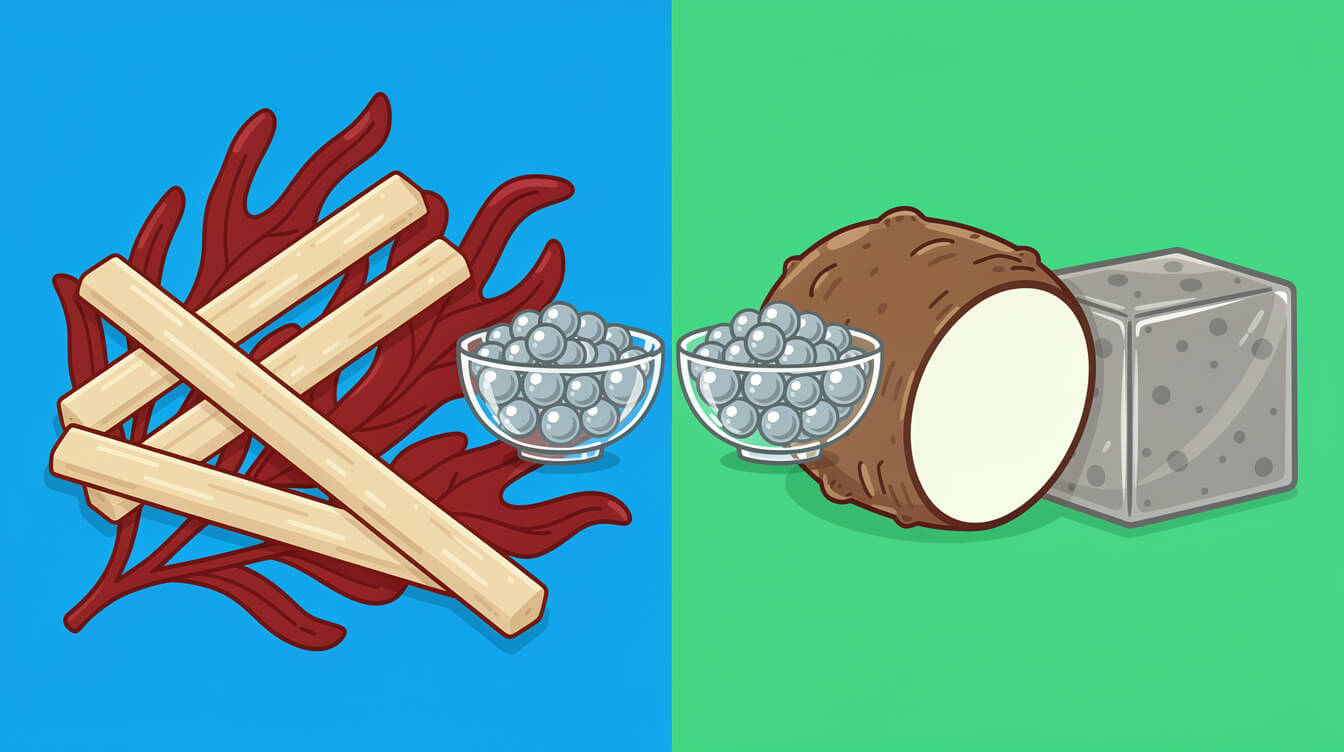
- Agar is extracted from red seaweeds such as Gelidium and Gracilaria. According to the UN Food and Agriculture Organization, a typical agar gel sets at around 32–39°C but won’t melt until about 85°C. That makes it great for home cooks: boil it, pour it, and it sets on the counter.
- Konjac comes from the starchy underground tuber of Amorphophallus plants. Its fiber, glucomannan, forms a tough, heat-stable gel when treated with an alkali (that’s the calcium hydroxide on the Tea Zone label). Blended with carrageenan or xanthan, it forms a softer gel that can loosen with heat. That fits Bossen’s warning that the product “may change texture due to extreme heat” in shipping.
In your mouth, the gum blend is what gives commercial crystal boba its springy, slightly crisp bite. It’s also why it holds up for hours in iced drinks without dissolving. Homemade agar pearls tend to be softer and more brittle. Both are fine to eat. They’re just not the same product, and now you know which one the shop is most likely pouring.
What Crystal Boba Is Called in Taiwan (and Who Makes It)
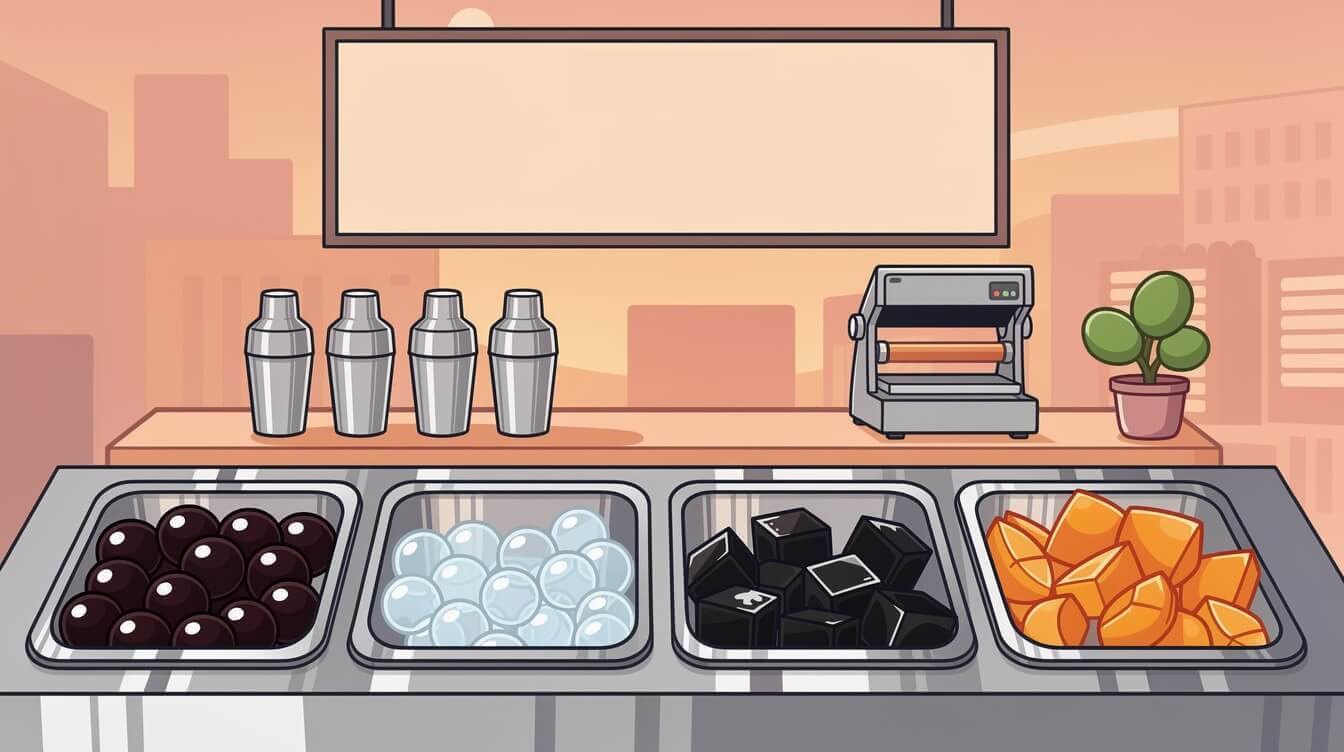
Walk into a Taiwanese drink shop and ask for “crystal boba” and you may get a polite blank look. The word to know is 晶球 (jīngqiú), “crystal ball,” or the full trade name 寒天晶球 (hántiān jīngqiú). That’s the category name Taiwanese suppliers use for the clear pearls, and you’ll see it on chain menus too. COMEBUY, for example, describes one of its apple iced teas as coming with “chewy” 寒天晶球, while the English name on the same menu calls it a Konjac Jelly Apple Ice Tea. Even the shops are bilingual about the agar/konjac question.
The 白玉珍珠 trap
Some English explainers say crystal boba is called 白玉珍珠 (báiyù zhēnzhū, “white jade pearls”) in Taiwan. In our checks, that name means something else. Taiwanese chains use 白玉珍珠 for white tapioca pearls: regular cassava-starch pearls made without the caramel color that turns standard ones black. Milksha (迷客夏), for example, describes its 白玉珍珠 as honey-soaked pearls with no added caramel color, cooked fresh in store every day. Ordering 白玉珍珠 in Taipei gets you chewy white tapioca, not clear jelly. If you want crystal boba, say 晶球.
(If you’re curious why most tapioca pearls are black in the first place, our deep dive into what boba is made out of reads the labels on those too.)
Made in Taiwan, served everywhere
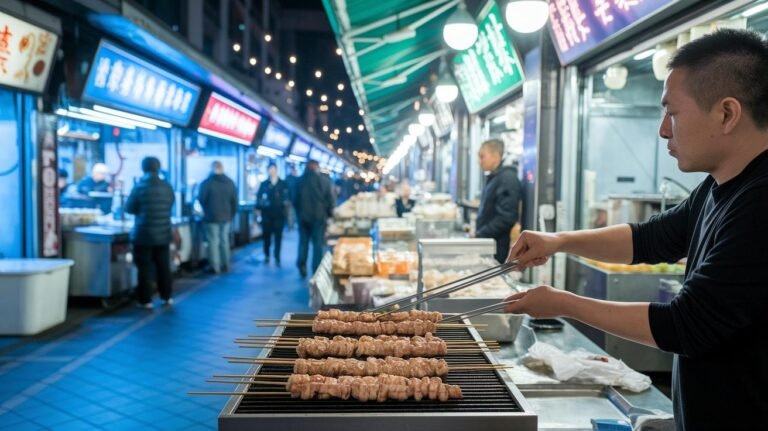
Much of the crystal boba poured in US shops starts out in Taiwan. Bossen lists Taiwan as the country of origin for its crystal boba. Possmei says its toppings are sourced directly from Taiwan. Sunny Syrup, a Taiwanese supplier whose explainer ranks on page one for this question, manufactures crystal boba alongside tapioca and popping boba for drink brands in Taiwan and abroad. It’s one more export from the island’s bubble tea industry, which has spent four decades turning a Taiwanese tea-shop habit into a global supply chain. (Our Taiwan boba tea guide covers how that started.)
Who invented crystal boba? We’d love to tell you, but we couldn’t find two independent sources that agree on it, so we won’t guess. Bubble tea’s own origin story is contested enough. Two Taiwanese tea houses still argue over who came first, a feud we unpack in this bubble tea history piece.
Crystal Boba vs Tapioca vs Popping Boba
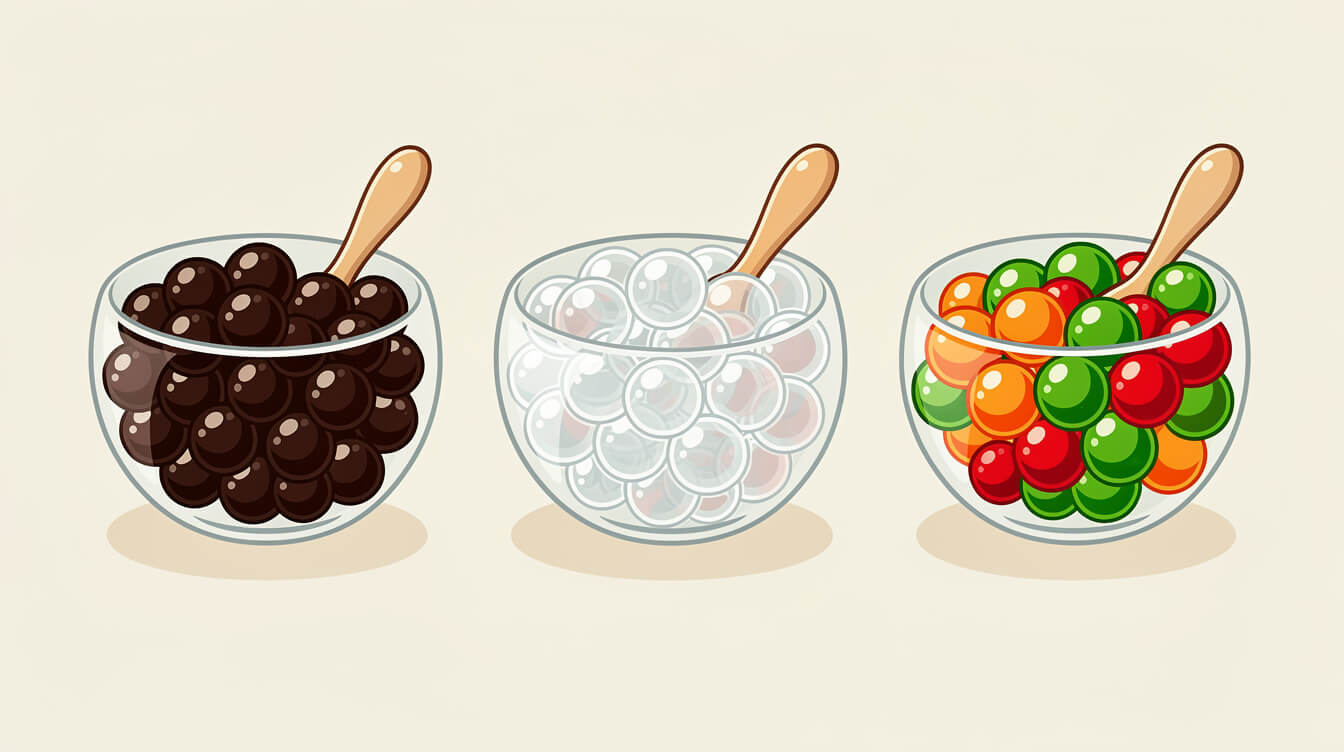
Once you know what is crystal boba, the next question is how it stacks up against the other round toppings. Here’s the comparison for when you’re standing at the counter:
| Tapioca pearls | Crystal boba | Popping boba | |
|---|---|---|---|
| Made from | Cassava (tapioca) starch | Konjac + carrageenan and other gums (some recipes use agar) | Juice inside a thin skin of sodium alginate set with calcium |
| Texture | Dense, chewy, “QQ” | Springy, slightly crisp, jelly-like | Thin skin that bursts into juice |
| Look | Opaque; usually black or brown | Clear or tinted, glassy | Bright, shiny colored spheres |
| Prep | Boiled and rested; best within hours | Ready to eat from the bag | Ready to eat from the container |
| Best in | Milk tea, brown sugar milk | Fruit tea, green tea, slushies | Fruit tea, yogurt drinks, shaved ice |
| Calories | Dry pearls: 358 kcal per 100 g (USDA); cooked pearls absorb water, so less per gram | About 67–80 kcal per 100 g on the labels we read | Varies by brand; check the label |
A word on the “fewer calories” claim
You’ll often read that crystal boba has 64–70% fewer calories than tapioca. Some suppliers say it on their product pages. We couldn’t trace that figure to a lab test or a public database, and it’s easy to get wrong. The USDA figure people quote for tapioca (358 kcal per 100 g) is for dry pearls. Cooked pearls soak up water, so a scoop in your cup carries far fewer calories per gram than that number suggests.
What the labels do show is that crystal boba itself is light: about 67–80 kcal per 100 g on the two nutrition sheets we found. A typical 70 g shop scoop works out to roughly 45–55 kcal. The bigger calorie story in any boba drink is usually the sugar syrup and the milk, not the topping. Ask for less sugar and you’ll save more than any topping swap.
And whichever topping you pick, they’re all cold-drink stars. If your boba habit runs hot in winter, our Powered by Bubble Tea Night Markets Taiwan mug is how we keep the spirit going with a pot of oolong.
Taiwan’s Jelly Family: Where Crystal Boba Fits Next to Aiyu and Grass Jelly
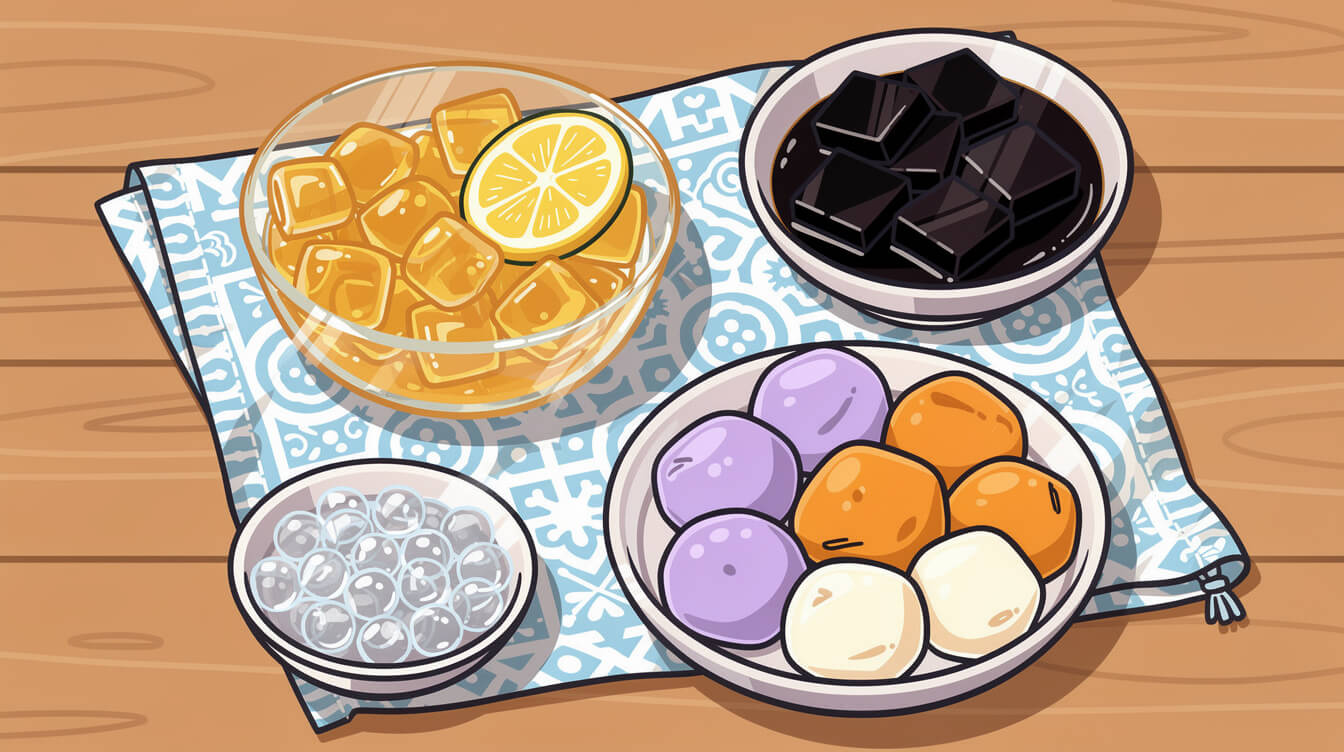
Here’s the part every English explainer skips. Crystal boba didn’t arrive in Taiwan as a strange new idea. It slotted into a dessert culture that has been setting clear and dark jellies, and rolling chewy balls, for generations. If you’ve ever ordered shaved ice or a bowl of 豆花 (douhua) in Taiwan, you’ve already met crystal boba’s cousins. Each one sets in a completely different way, and that’s what makes the family interesting.
Aiyu jelly (愛玉): the one that sets itself
Aiyu jelly comes from the seeds of a climbing fig, Ficus pumila var. awkeotsang, that grows wild in Taiwan’s mountains. You put the seeds in a cloth bag and rub them in cool water. No heat, no added gelling agent. Food scientists have worked out why it sets: the seeds carry pectin plus an enzyme that changes it into a form that cross-links with the calcium and magnesium already in the water. The result is a wobbly, pale-gold jelly, usually served with lemon and syrup. It’s the closest thing to crystal boba in looks, and the opposite in method.
Grass jelly (仙草): the dark one
Grass jelly is made by boiling the dried stalks and leaves of a mint-family herb (Platostoma palustre, often still sold as Mesona chinensis) for hours with a little alkali and starch. It cools into a glossy black jelly with a faintly smoky, herbal bitterness. Drink shops cut it into cubes and add it to milk tea, where it plays the same role crystal boba does in fruit tea: something soft and cool to fish up with a fat straw.
Taro balls (芋圓): the chewy one
Taro balls aren’t jelly at all. They’re a dough of mashed taro or sweet potato kneaded with starch, cut into little pillows and boiled. They sit in the same dessert bowls as the jellies, though, and you’ll often find all four on one shaved-ice menu. If you’ve had our guide to taro bubble tea, you’ve seen how deep Taiwan’s taro habit goes.
So where does crystal boba fit?
If a friend in Taipei asked you what is crystal boba, the best answer might be: the newest, most portable member of this family. Aiyu and grass jelly are traditional and mostly made fresh or by the tub. Crystal boba is factory-made, comes as uniform little pearls, keeps in a sealed pouch and goes into a cup with no prep. It gives a drink shop the clear, cooling bite of aiyu with the convenience of a ready-to-serve topping. No surprise, then, that it’s most at home in a fruit tea, the same clear, cool role aiyu has always played.
Want to explore the rest of the menu? Our guide to Taiwanese desserts covers shaved ice, douhua and the night-market sweets that sit alongside all of these.
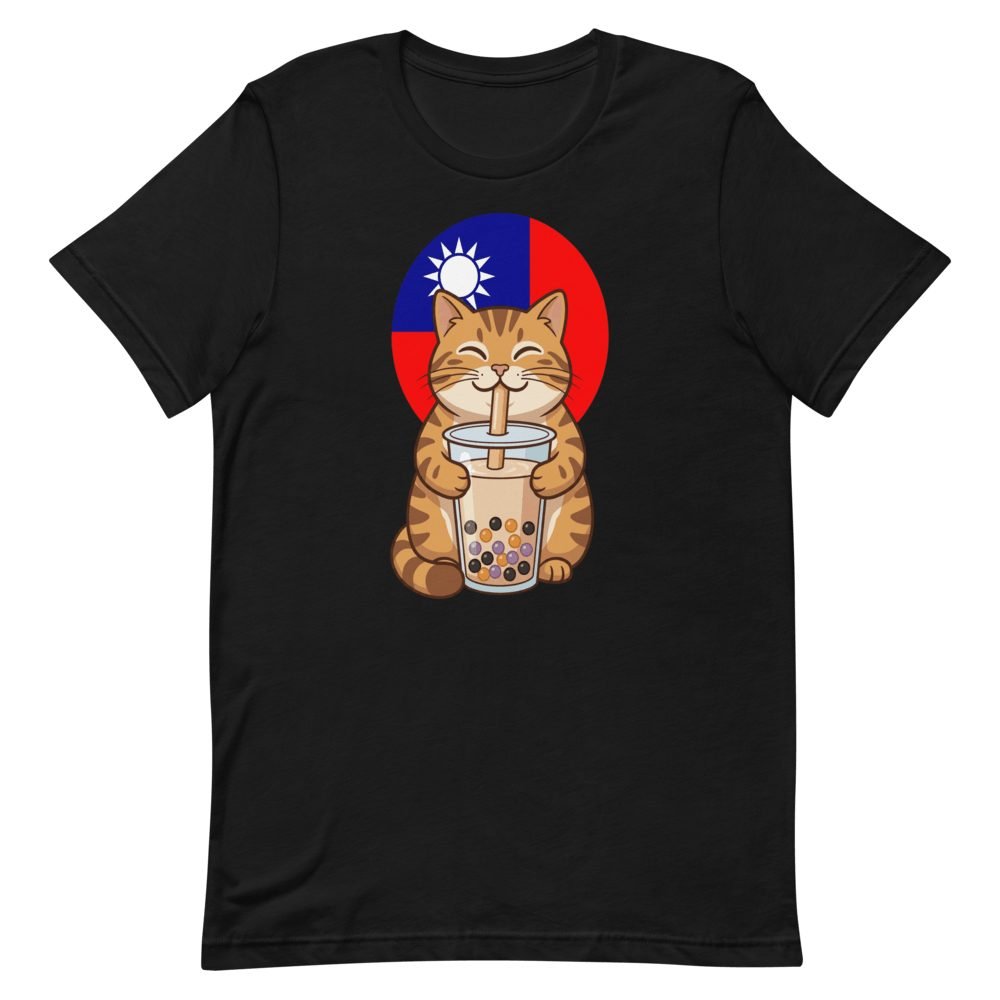
Wear Your Boba Order
Tapioca, crystal or popping, every topping debate ends with a cup in hand. Our Taiwan Boba Tea Cat tee pairs a chubby tabby with Taiwan’s greatest drink, on soft everyday cotton.
How to Order Crystal Boba (in Taiwan and Back Home)
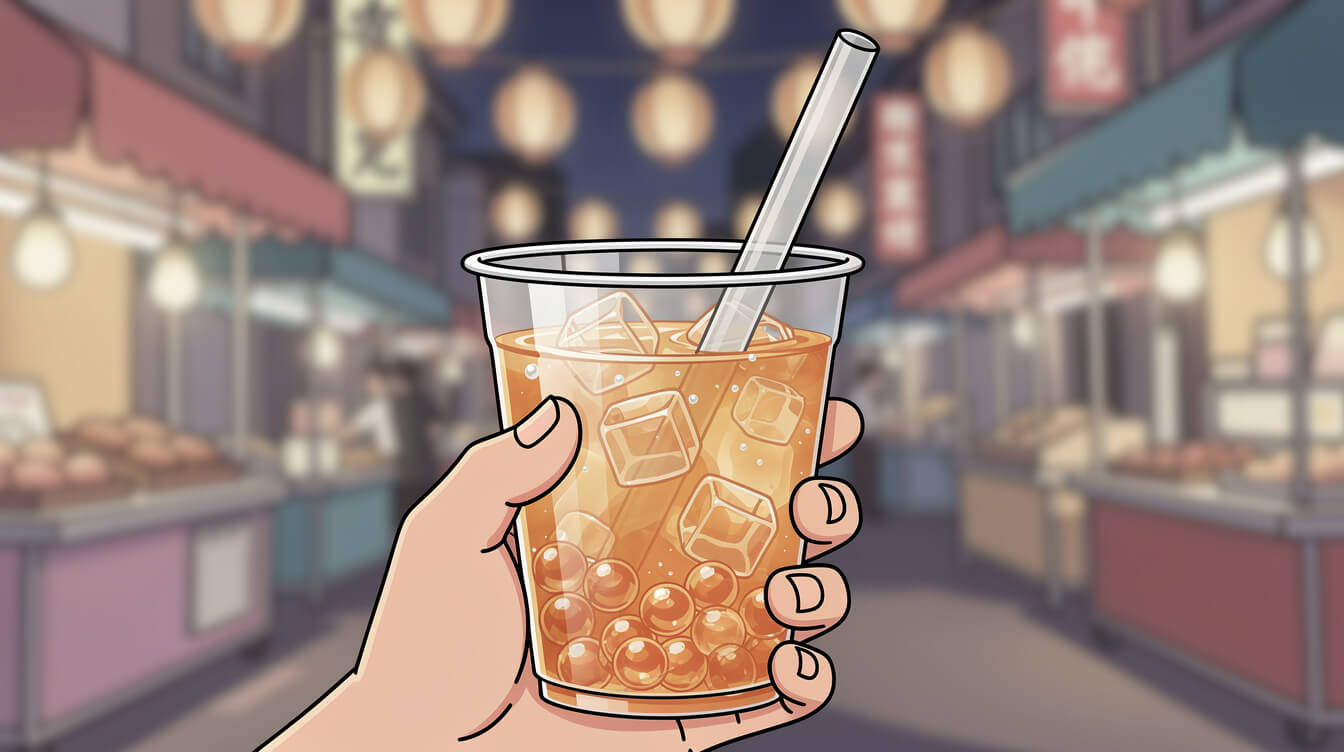
Crystal boba is easy to love and easy to order once you know a few things.
Which drinks it suits
Crystal boba shines in drinks where you want to see it and where its mild sweetness won’t get lost:
- Fruit teas. Passion fruit green tea, lychee oolong, lemon or apple iced tea. The clear pearls look great in a bright cup, and the light bite matches the drink. Our Taiwan fruit tea guide has the best bases to try.
- Plain green or oolong tea. A clean tea lets the texture take center stage.
- Slushies and shaved ice. It stays springy even when everything around it is frozen.
- Milk tea, if you like. Suppliers pair flavored versions with milk tea too. Sunny Syrup suggests brown sugar crystal boba for milk tea and mango for fruit tea. Purists will tell you tapioca still wins in milk tea.
Skip it in hot drinks. The gum blend in commercial crystal boba is designed for cold cups, and Bossen warns its pearls can change texture in extreme heat.
Ordering in Taiwan
Taiwanese drink shops let you customize nearly everything. To add crystal boba, the simplest phrase is:
加晶球 (jiā jīngqiú): “add crystal balls.”
Then pick your sugar and ice levels like a local. Sugar runs from 全糖 (full) through 半糖 (half) and 微糖 (light) to 無糖 (none); ice from 正常冰 (regular) to 去冰 (no ice). If the menu is Chinese-only, look for 晶球 or 寒天 in the toppings list, which is usually printed at the bottom or side of the board. Not every shop carries it. Tapioca, grass jelly and 椰果 (coconut jelly) are more common, so treat crystal boba as a happy find, not a given. For a full walkthrough of the counter, see our guide to what Taiwan actually drinks and how to order it.
One more tip: many Taiwanese chains now print caffeine levels on the cup, and some fruit teas are surprisingly strong. Our explainer on caffeine in boba drinks tells you how to read the labels.
Ordering in the US and elsewhere
- Ask for “crystal boba.” Some shops call it agar boba or konjac jelly.
- If a menu says “white pearls,” ask whether they mean crystal boba or white tapioca. As we saw above, those are different toppings.
- Want to know what’s in it? Ask to see the bag. Most US shops use one of the brands in our label table, and the ingredients are printed right there.
Buying it to use at home
Retail crystal boba comes in sealed bags of syrup. Unopened, Bossen gives its bags a 12-month shelf life. Once open, keep it sealed in the fridge. Bossen recommends finishing it within 48 hours, and Sunny Syrup also says to seal and refrigerate after opening. Expect the pearls to clump a little in the bag. A gentle stir with a slotted spoon separates them. A scoop of 60–80 g per drink is the serving size Bossen recommends.
Crystal Boba FAQ: What Is Crystal Boba Made Of, and Is It Good for You?
What is crystal boba made of?
On the four retail labels we read (Bossen, Tea Zone, Possmei and Fanale), crystal boba is water, sugar or syrup, and a blend of gelling agents led by konjac and carrageenan, plus sodium alginate, gellan, locust bean, guar and xanthan gums, with acids, preservatives and sweeteners. None listed agar. Homemade recipes often use agar instead, which gives a softer, less springy pearl.
Is crystal boba healthier than tapioca?
It’s lighter. The labels we found show about 67–80 kcal per 100 g, and a shop scoop is roughly 45–55 kcal. It’s not a health food, though: it’s sweetened, and several brands add sucralose and acesulfame potassium on top of sugar. The sugar level of the drink itself matters far more than the topping. We’d skip any “X% fewer calories” claim that doesn’t show its working.
Is crystal boba vegan?
None of the four labels we read lists gelatin or any obvious animal ingredient. Konjac, carrageenan and the other gums are plant- or microbe-derived. That said, “no animal ingredients on the label” isn’t the same as a vegan certification, so check the specific brand if it matters to you. Our vegan Taiwan guide covers eating plant-based on the island more broadly.
Does crystal boba contain allergens?
Check the brand. Tea Zone’s original crystal boba label says “Contains: Soy,” and it also lists sodium metabisulfite, a sulfite, which matters if you’re sulfite-sensitive. Shop toppings are also scooped from shared bins, so cross-contact is possible.
Is crystal boba safe for kids?
Small, firm, slippery jelly is a known choking shape for young children, and that’s why regulators watch konjac jellies closely. The US FDA warned about konjac candy in 2001 and keeps an import alert on mini-cup jellies that pose a choking risk. The EU suspended konjac jelly sweets in 2002, then removed konjac from jelly mini-cups and other jelly confectionery in 2003. Taiwan has required small konjac jellies to carry a choking warning since 1 January 2006, with approved wording like 「請細嚼慢嚥,以免噎到」 (“chew slowly so you don’t choke”). These rules target jelly cups and candies, not boba toppings, but the logic carries over. Bossen’s own label says children under 5 should be supervised while eating. For little ones, skip the fat straw and serve pearls with a spoon.
How long does crystal boba last?
Unopened bags last months (Bossen says 12). Once opened, refrigerate and use within about two days. In a drink, it holds its texture for hours, far longer than tapioca, which starts to harden within a few hours of cooking.
Is crystal boba the same as aiyu jelly or nata de coco?
No. Aiyu is a traditional Taiwanese jelly made from fig seeds, and nata de coco (椰果) is a chewy cube made by fermenting coconut water. Crystal boba is a manufactured gum-based pearl. They do share a menu, though, and you can mix them in the same cup.
Final Thoughts: Read the Bag, Not the Name
So, what is crystal boba? It’s the glassy, ready-to-eat pearl that turned Taiwan’s long love of jelly desserts into a grab-and-go topping. It’s lighter than tapioca, sturdier in a cold drink, and very pretty in a cup of passion fruit tea. The part most guides get wrong is the ingredient list. The name says “agar.” The labels on the bags US shops actually buy say konjac and carrageenan, made in Taiwan and shipped worldwide.
Next time you’re at the counter, order it with a fruit tea, ask for 加晶球 if you’re in Taipei, and check the bag if you’re curious. And if crystal boba has you hungry for more of Taiwan’s drink culture, start with our complete Taiwan boba tea guide, then work your way through the island’s dessert menu.
A Postcard From Taiwan, Every Week
Drink-shop secrets, night-market bites and the stories behind Taiwan’s favorite flavors, straight to your inbox. No spam, unsubscribe anytime.

Grab a Free Taiwan Sticker!
Drop your email and we’ll send you a limited-edition Taiwan sticker — plus insider access to new merch drops and island vibes.
No spam. Unsubscribe anytime.