Tamsui Old Street, Taipei: The Food Crawl in Walking Order (A-gei, Iron Eggs and the Sunset Ferry)
Most guides to Tamsui Old Street, Taipei are lists of twenty things to do, with the food squeezed into one paragraph near the end. That’s backwards. People take the Red Line to the end of the line for three reasons: to eat, to watch the sun go down over the river, and to tell their friends they ate a black egg on purpose. This guide is built around the eating. It walks the old street in the order you’ll actually reach the stalls, explains the two snacks Tamsui gave the rest of Taiwan, and times the whole thing so you’re standing at the water when the sky turns orange.
Quick geography note before we start: Tamsui (淡水, also spelled Danshui) is technically a district of New Taipei City, not Taipei proper. Nobody cares. It’s on the Taipei MRT, it’s 40 minutes from Taipei Main Station, and every visitor files it under “Taipei day trip.” So will we.
Getting to Tamsui Old Street, Taipei: Red Line to the End, Plus the Light Rail
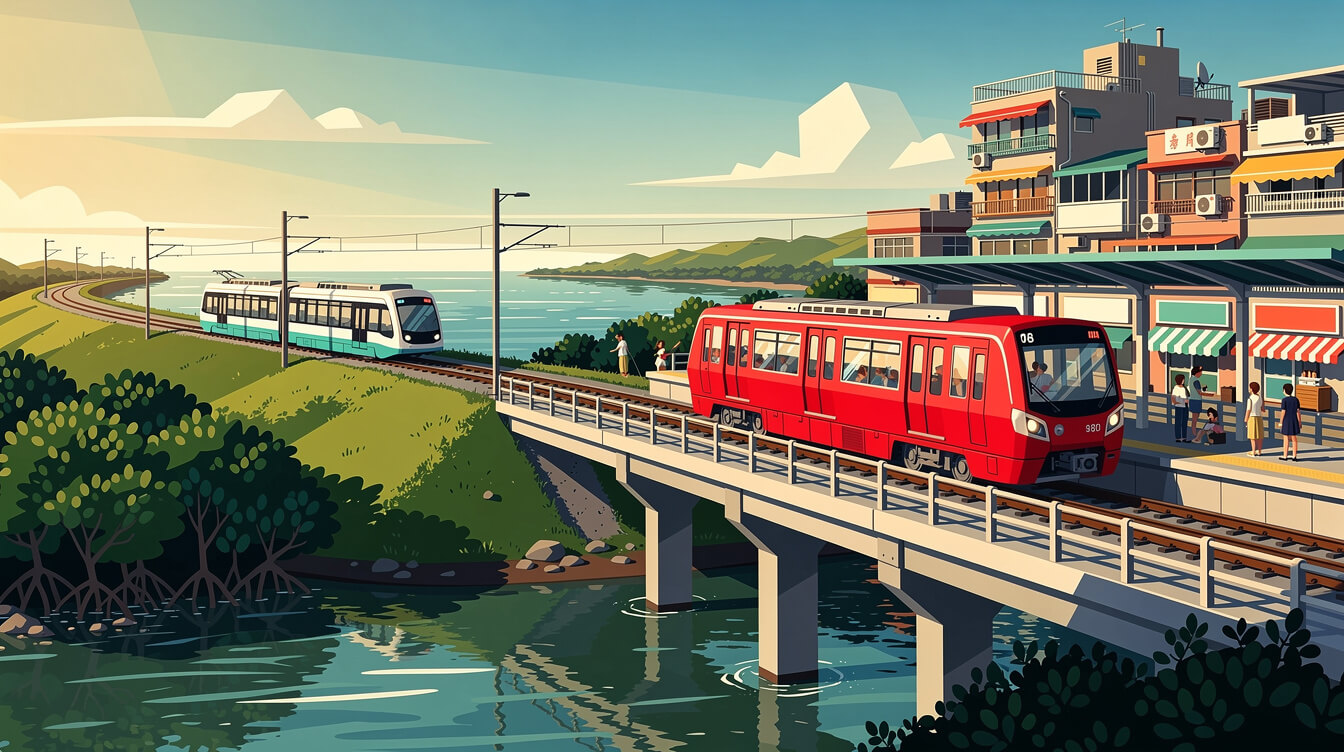
The easy part first. Get on the Red Line (the Tamsui–Xinyi line) heading toward Tamsui and stay on until the train can’t go any further. Tamsui Station is the northern terminus, station R28. From Taipei Main Station the ride is about 40 minutes, a little longer at rush hour if you’re standing. Tap in with an EasyCard and you never need to think about the fare. If the MRT is new to you, our Taipei MRT map guide covers cards, colors and etiquette.
Walk out of the station toward the river and you’re already at the start of the waterfront promenade. The old street runs northwest from here, parallel to the water, for roughly a kilometer and a half. Everything in the food crawl below sits along that line or one lane up the hill.
The Danhai Light Rail: the part most guides skip
Tamsui got a light rail system that changed how you move around the district, and most English guides still barely mention it. The Danhai Light Rail opened its Green Mountain Line in late 2018. Then the Blue Coast Line opened on November 15, 2020, adding three street-level stations, including Tamsui Fisherman’s Wharf.
Here’s the trick: the light rail doesn’t start at Tamsui Station. It starts one stop earlier, at Hongshulin (R27). That gives you a neat loop. Ride the MRT to Tamsui, eat your way up the old street, catch the sunset at Fisherman’s Wharf, then take the light rail back from the wharf to Hongshulin and rejoin the Red Line there. No backtracking along a crowded promenade in the dark. When the Blue Coast Line opened, the Hongshulin-to-Fisherman’s Wharf fare was NT$30.
Three ways to reach Fisherman’s Wharf
- Ferry from the pier by the old street. The most scenic option, covered in the sunset section below.
- Light rail via Hongshulin, best for the trip home.
- Bus or walk. Several local buses run along the river road. Walking takes about an hour from the station, and it’s pleasant only if you’ve got the time.
The Tamsui Food Crawl, in Walking Order
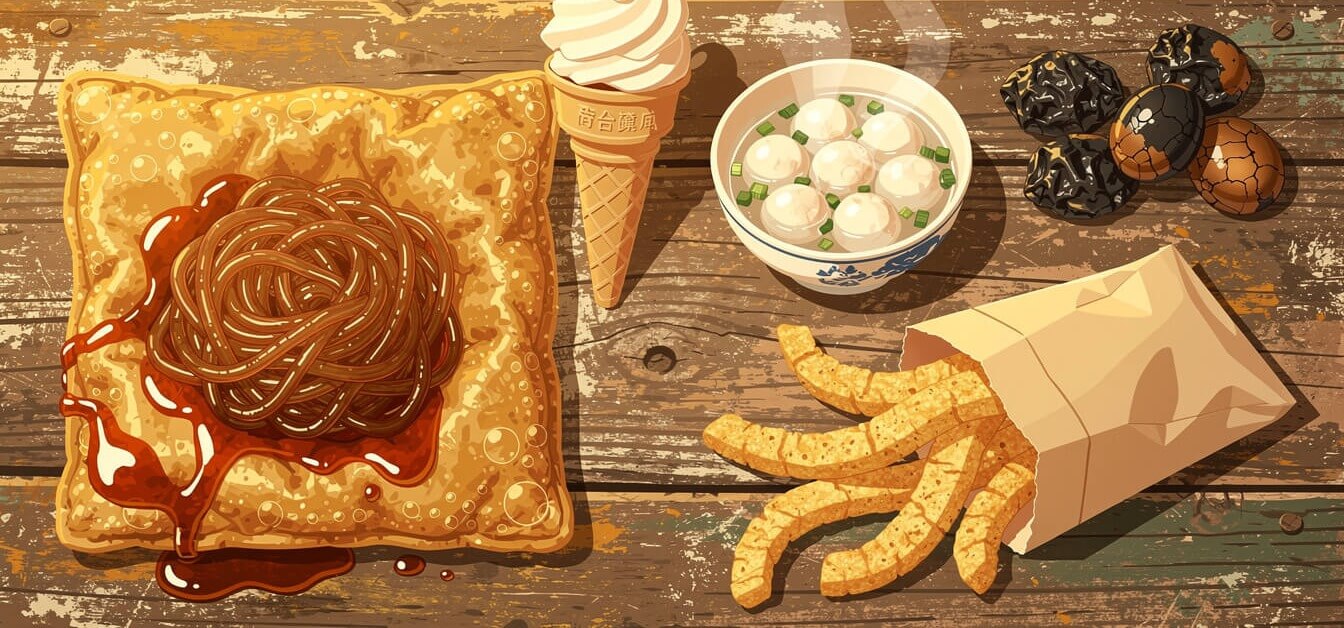
The order matters more than the list. Tamsui’s two signature dishes keep very different hours: a-gei is a breakfast-and-lunch food, while iron eggs and ice cream are all-day snacks. Start in the morning or around noon and you can do the whole crawl in one pass. Start at 4 p.m. and you’ll find the a-gei shutters down.
Here’s the route, from the station end to the fort end:
- Riverside promenade, first stretch. Grab a drink and get your bearings. This is the most crowded section, and the stalls here are the most tourist-priced. Keep walking.
- Zhongzheng Road, the old street proper. The main drag runs one block in from the water. This is where you’ll find the fish ball soup shops, the fish cracker sellers, and the iron egg shops, including the Grandma Iron Egg (阿婆鐵蛋) shop that made the snack famous.
- The ferry pier. Halfway up the street, on the river side. Note where it is now; you’ll be back for the sunset boat.
- Zhenli Street (真理街). Turn uphill. This sloping lane leads toward Aletheia University and is home to Tamsui’s best-known a-gei shops. Eat here.
- Fort San Domingo. Keep climbing and you reach the red fort. History break, and a view down the river mouth.
- Back down to the water for ice cream, castella cake, and the boat to Fisherman’s Wharf.
If you’re short on time, the non-negotiables are one a-gei, one bowl of fish ball soup, and one bag of iron eggs. At most shops, the a-gei and the soup together come in under NT$100. Bring cash. Plenty of the older stalls don’t take cards.
A good rule for any Taiwanese old street: the queue of locals is the review. A short line of people in office lanyards at 12:15 p.m. beats any sign that says “famous.”
If you like this style of eating, our Taipei street food guide and the bigger Taiwan street food overview cover the dishes you’ll meet everywhere else on the island.
A-gei (阿給): The Dish Tamsui Invented
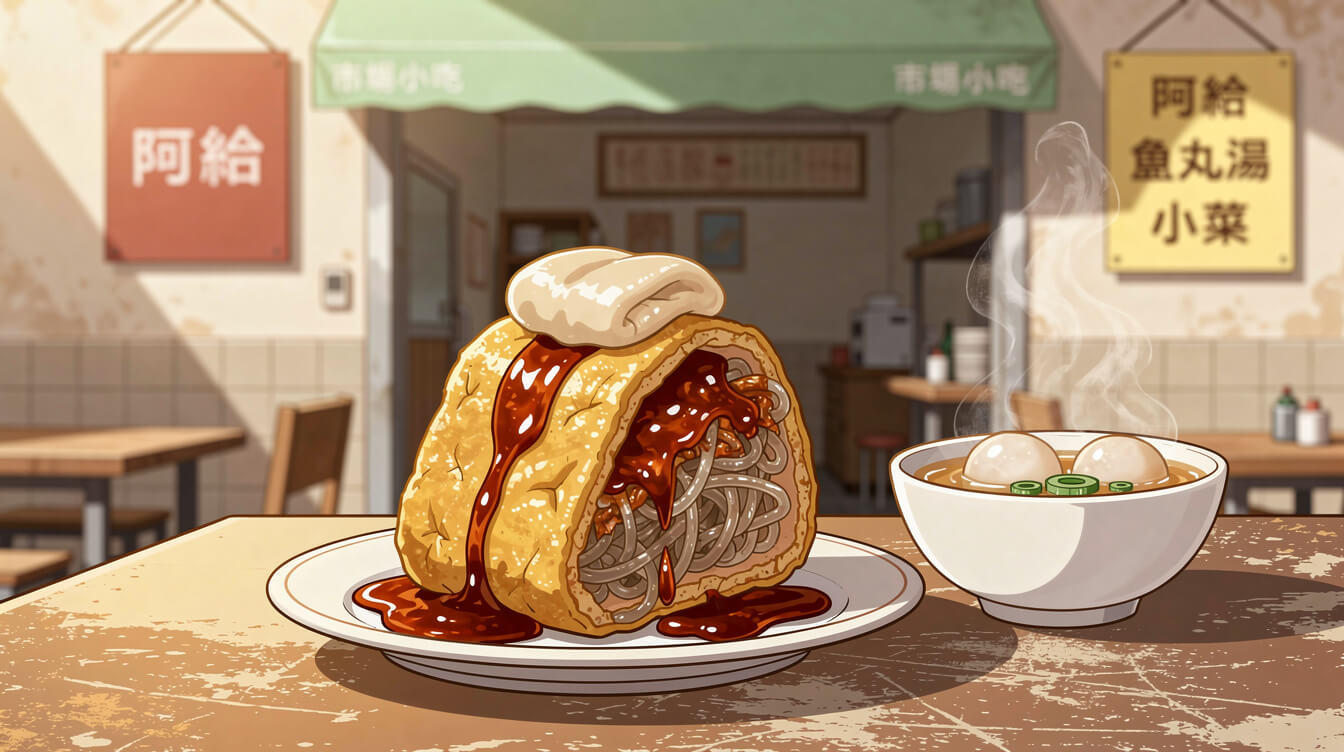
If you eat one thing in Tamsui, make it this. A-gei is a block of fried tofu, hollowed out and stuffed with glass noodles (mung bean vermicelli), sealed at the top with a cap of fish paste, then steamed and served under a sweet-savory red sauce. It’s soft, a little chewy, and much more filling than it looks.
Where the name comes from
The dish has a specific origin story. According to a TVBS food report on the shop, a cook named Yang Zheng Jin-wen (楊鄭錦文) started making it in 1965 at what is now the Lao Pai A-gei shop (老牌阿給) on Zhenli Street. She’d seen an elderly vendor selling tofu stuffed with noodles and developed her own version.
The name came from her customers. Students from the college up the hill, now Aletheia University, asked what it was called. She’d grown up under Japanese-era schooling, so she answered with the Japanese word for fried tofu: abura-age. The students shortened it, and “a-gei” stuck. It’s one of the more charming examples of how Japanese loanwords live on in everyday Taiwanese speech. Our guide to what language is spoken in Taiwan has more of them.
How to order and eat it
- Order a-gei plus fish ball soup. That’s the classic pairing, and most a-gei shops serve both.
- Cut it in half first. Let the steam out and the sauce run into the noodles before you take a bite.
- Go early. These are morning-and-lunch shops. Many sell out or close by mid-afternoon, so check the posted hours on the day.
- Don’t skip the sauce. Each shop guards its own recipe. It’s sweet, a touch spicy, and it’s the point.
Several shops on Zhenli Street now sell a-gei, and locals argue loyally about which is best. Honestly, you won’t go wrong at any shop with a steady line. Eat it sitting down, at a plastic table, with the soup.
Iron Eggs (鐵蛋): How They’re Made and Where to Buy Them
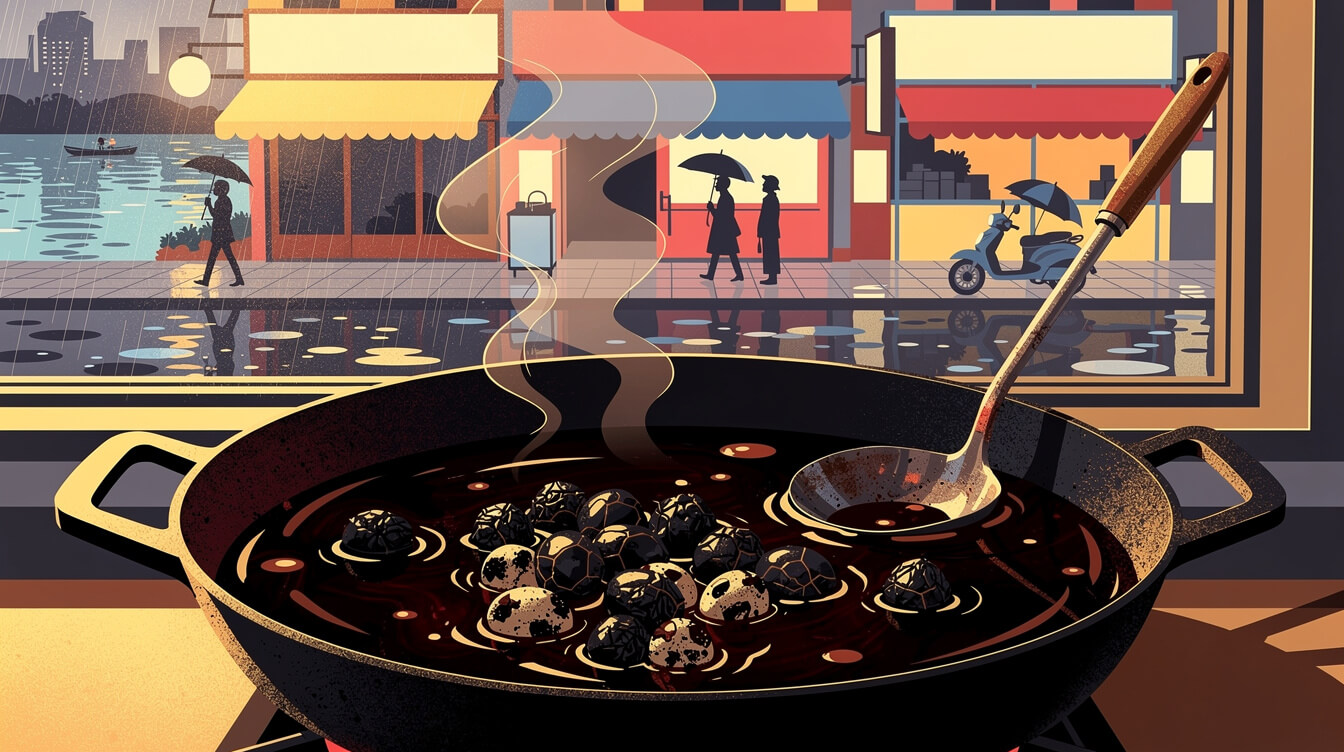
Iron eggs are Tamsui’s other gift to the island. They look like something went badly wrong: small, shriveled, jet-black, with a chewy texture closer to jerky than to a boiled egg. They’re also addictive.
The origin story (and why it varies)
Everybody agrees on the basic plot. A Tamsui food seller kept re-braising unsold soy eggs, again and again, until they shrank, darkened and toughened, and customers ended up loving the result. Rainy days, empty streets and a refusal to waste food usually feature.
The details depend on who’s telling it. Local legend credits a noodle stall owner, Huang Chang-nian (黃張哖), remembered as “A-Po” or Grandma, with inventing them in the 1970s. That’s where the Grandma Iron Egg name comes from. Other accounts credit shopkeeper Yang Bi-yun, who opened the first iron egg store in 1980 and describes recooking soy eggs to keep them warm on a slow day. We’ve told versions of this story in our daily posts on the rainy-day mistake, the stubborn wok and how a stall owner’s mistake became a national snack. The honest answer is that the exact year and the exact hands are folklore. The town is not.
How they’re made
The method is simple and slow. Hard-boiled eggs are simmered in a soy-sauce and spice braise, then air-dried, then braised and dried again. The cycle repeats over several days. Each round drives out water and drives in flavor, until the white turns dense and dark all the way through.
What to buy
- Chicken or quail. Quail iron eggs are bite-sized and the better snack. Chicken eggs are chewier and make a bigger impression.
- Vacuum-packed bags are the souvenir format. They travel well, so buy them on the way out, not on the way in.
- Flavors range from original soy to spicy and black pepper. Ask for a taste if there’s a sample tray.
One practical note for travelers: if you’re flying home, check your destination’s rules on bringing in egg products before you pack a bag of these. Several countries restrict them.
Fish Ball Soup, Giant Ice Cream, and the Rest of the Classics
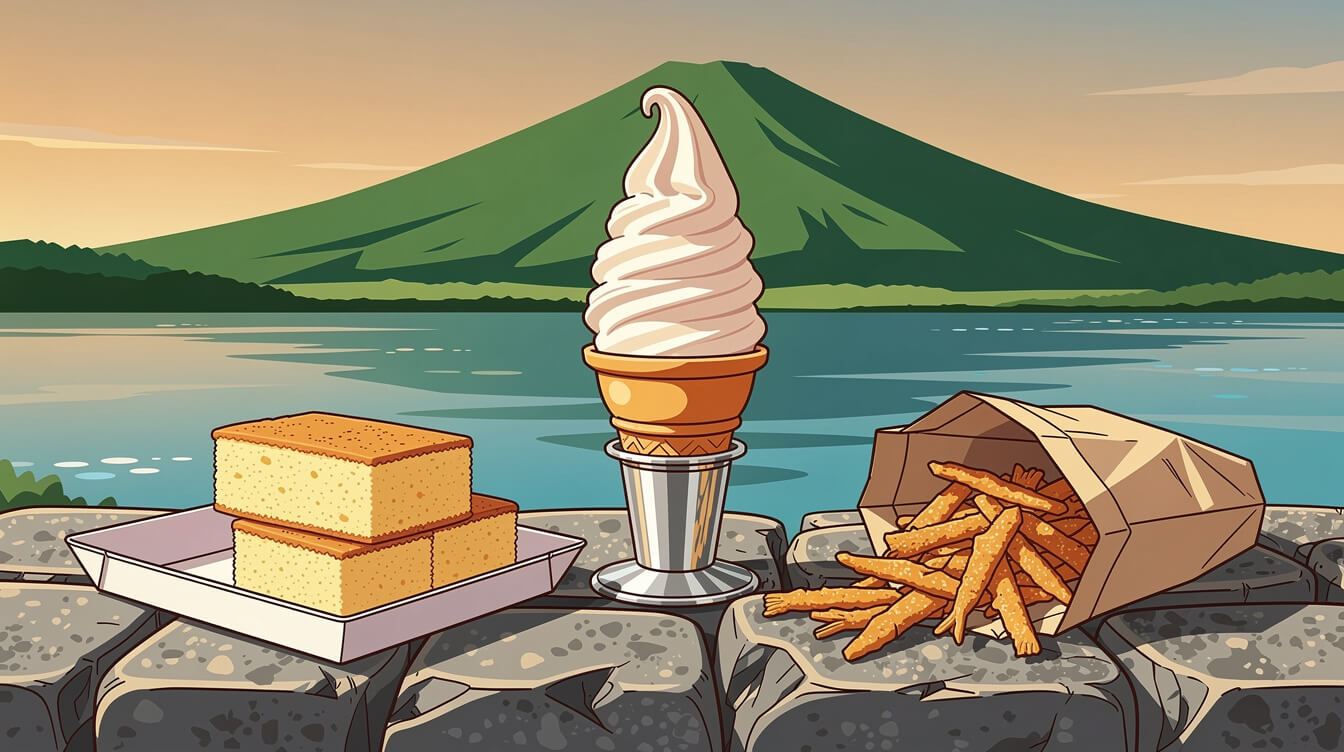
Once you’ve done a-gei and iron eggs, the rest of Tamsui Old Street, Taipei’s most famous riverside snack strip, is a happy free-for-all. These are the classics worth your stomach space.
Fish ball soup (魚丸湯)
Tamsui was a fishing port long before it was a day-trip town, and its fish balls show it. They’re made from a springy fish paste, often wrapped around a small savory pork filling, and served in a clear broth with celery or scallion. A bowl is cheap, light, and the right partner for a-gei. Fish ball shops line Zhongzheng Road, and some have been in business for decades.
Fish crackers (魚酥)
Crispy fried strips of fish paste, sold in big bags. They’re Tamsui’s other classic souvenir snack and a great thing to share on the ferry. If you like the crunchy, savory snack-aisle side of Taiwan, our Taiwan snacks guide has dozens more. Fans of the retro snack shelf will also recognize the mascot on our 乖乖 Guai Guai Taiwan Snack Mascot Retro T-Shirt, a tribute to the coconut corn puff every Taiwanese kid grew up with.
The giant ice cream cone
You’ll see them before you see the stall: towering swirls of soft-serve, about a foot tall, held up for photos along the promenade. They’re more fun than gourmet, and that’s fine. Eat it fast. The river breeze melts them in minutes.
Fresh-baked castella cake
Look for the queue outside a shop pulling huge slabs of sponge cake out of the oven. Old-style castella (古早味蛋糕) is light, eggy and barely sweet, sold by the block or the slice, and best eaten warm. It’s also the easiest snack to carry back to the city.
Sweet treats for the walk
Between the big names you’ll find candied fruit, sweet potato balls, grilled squid and plenty of bubble tea. If you’re building a dessert route, our Taiwan desserts guide covers what to look for.

A Food Crawl You Can Wear
Our Taiwanese Street Food Guide tee is a vintage-poster menu of the island’s best bites. Unlike the iron eggs, it clears customs every time.
Timing It Right: Sunset, Crowds and the Ferry to Fisherman’s Wharf

Tamsui Old Street, Taipei’s favorite riverside escape, faces west across the river mouth toward the Taiwan Strait, which makes it one of the best sunset spots within reach of the city. Plan the day backwards from the sunset and everything else falls into place.
When the sun goes down
In October the sun sets around 5:30 p.m. in northern Taiwan. By late November it’s closer to 5:05 p.m., and in midsummer it’s nearer 6:45 p.m. Aim to be at the water, or on the ferry, about 30 minutes before. On a clear day the sky over Guanyin Mountain across the river goes gold, then pink, then purple.
The ferry
Ferries leave from the pier on the old street. There are two routes worth knowing, both run by Shunfeng Shipping according to New Taipei City’s ferry information sheet, last updated in February 2025:
- Tamsui to Fisherman’s Wharf: NT$100 full fare, NT$50 half fare. Boats run every 15 to 30 minutes depending on weather. Riding out in the late afternoon gets you to the wharf for sunset.
- Tamsui to Bali: NT$40 full fare, a short hop across the river to the Bali side, with its bike paths and its own snack street.
Ferry services pause in bad weather, so check at the pier before you plan around one.
Fisherman’s Wharf
The wharf’s boardwalk and the white Lover’s Bridge are the classic sunset viewpoints. When the light’s gone, walk to the Tamsui Fisherman’s Wharf light rail station and ride back toward Hongshulin.
Beating the crowds
- Weekdays are calmer than weekends, by a long way.
- Late morning to early afternoon is the sweet spot for food. You get the a-gei shops open and the promenade still breathing.
- Weekend sunsets are packed. Go anyway, but find your spot early.
- Rain is common. Northern Taiwan is wet, especially in winter and plum rain season. A rainy weekday in Tamsui is quiet and atmospheric, and it is, after all, the weather that supposedly invented iron eggs.
Beyond the Food: Fort San Domingo and the Old Street’s History

Walk past the a-gei shops and keep climbing, and you’ll reach the reason Tamsui has an old street at all. For four centuries this river mouth was one of the most strategic spots in northern Taiwan, and you can read that story in a single hilltop.
Four flags on one hill
The Spanish built the first fort here in 1628 and named it Santo Domingo. The Dutch rebuilt it in 1644 as Fort Antonio, and their structure is the one still standing. After Tamsui opened as a treaty port, the British took over the fort in 1868 as their consulate and painted it red. That’s why locals call it 紅毛城, the “Fort of the Red-Haired,” an old term for Europeans. The British consulate building next door is a lovely red-brick Victorian with arched verandas. Britain kept the site until 1972. The Republic of China government took ownership in 1980, and the fort opened to visitors in 1984.
Visiting the fort
According to the official Tamsui Historic Sites Museum website:
- Hours: 9:30 a.m. to 5:00 p.m. on weekdays, and 9:30 a.m. to 6:00 p.m. on weekends and national holidays. Ticket sales stop 30 minutes before closing.
- Closed: the first Monday of every month (if that’s a national holiday, it opens and closes the next day instead), plus Lunar New Year’s Eve and Lunar New Year’s Day.
- Tickets: NT$80 full fare. The ticket also covers the Former Qing Dynasty Customs Officer’s Residence (the “Little White House”) and Hobe Fort.
- Free entry for several groups, including seniors 65 and over and New Taipei City residents.
Mackay and Truth Street
The other big name on the hill is George Leslie Mackay, the Canadian Presbyterian missionary who arrived in Tamsui in 1872. He practiced dentistry and medicine and founded Oxford College in 1882. That school’s line of descent runs to today’s Aletheia University, and aletheia is Greek for “truth.” It’s why the a-gei lane is called Zhenli Street, “Truth Street.” So when you eat a-gei on Zhenli Street, you’re eating a Japanese-named dish on a street named for a Greek word, beside a Dutch fort painted red by the British. That’s Tamsui in one bite.
A Half-Day Tamsui Old Street, Taipei Itinerary
Here’s the whole thing as one plan. It works best on a weekday, starting late morning.
- 11:00 Arrive at Tamsui Station on the Red Line. Walk to the river.
- 11:15 Wander Zhongzheng Road. One bowl of fish ball soup if you’re hungry now; otherwise just scout.
- 12:00 Climb Zhenli Street. Lunch is a-gei and fish ball soup at whichever shop has the steadiest local line.
- 13:00 Fort San Domingo and the British consulate. Allow about an hour.
- 14:30 Back down to the old street. Iron eggs to taste, castella to share, ice cream if you must.
- 15:30 Coffee or a drink by the water. Rest your feet.
- 16:30 (Oct to Nov; later in summer) Ferry to Fisherman’s Wharf.
- 17:30 Sunset from the boardwalk or Lover’s Bridge.
- 18:15 Light rail from Tamsui Fisherman’s Wharf to Hongshulin, then the Red Line back to Taipei. Buy your vacuum-packed iron eggs on the way out of the old street, not before.
Want to pair Tamsui with another day out? Shifen Old Street is the other classic old-street trip near Taipei, and Yongkang Street is the in-city version of a food-first walk. For evenings, our Taiwan night market guide picks up where Tamsui leaves off. And for everything else, there’s our guide to things to do in Taipei.
Tamsui Old Street FAQ
Is Tamsui Old Street in Taipei?
Technically, it’s in Tamsui District, New Taipei City. In practice it’s the end of the Taipei MRT Red Line and about 40 minutes from Taipei Main Station, so most visitors treat Tamsui Old Street as a Taipei day trip.
What is Tamsui Old Street famous for?
Food and sunsets. The two signature snacks are a-gei (stuffed fried tofu) and iron eggs, with fish ball soup, fish crackers, castella cake and giant ice cream cones close behind. The river mouth faces west, so sunsets here are some of the best near Taipei.
How much time do I need?
Half a day covers the food crawl, Fort San Domingo and a sunset. Add a couple of hours if you want to cross to Bali by ferry or linger at Fisherman’s Wharf.
Is Tamsui Old Street open every day?
Yes, the street itself is always open, although individual shops keep their own hours and a-gei shops close early. Fort San Domingo closes on the first Monday of each month.
Do I need cash?
Yes, bring some. Many of the older food stalls are cash-only. Small notes and coins make life easier.
Is it better to visit on a weekday or weekend?
Weekdays, if you can. Weekends, especially sunset hours, get very crowded. A weekday visit starting late morning gives you open a-gei shops and a quieter promenade.
Final Thoughts: Eat Tamsui Old Street, Taipei, in the Right Order
Tamsui rewards people who eat with a plan. Arrive while the a-gei shops are open, climb Truth Street for lunch, give the fort an hour, then drift back to the water for iron eggs and cake as the light starts to change. Take the boat out for the sunset and the light rail home. It’s simple, it’s cheap, and it’s one of the best half-days within reach of Taipei.
And when someone back home asks what Tamsui Old Street, Taipei, was like, hand them a bag of iron eggs and let them work it out. The chewing is the story.
A Postcard From Taiwan, Every Week
Old streets, day trips, snack stories and the occasional very good cat, straight to your inbox. No spam, unsubscribe anytime.

Grab a Free Taiwan Sticker!
Drop your email and we’ll send you a limited-edition Taiwan sticker — plus insider access to new merch drops and island vibes.
No spam. Unsubscribe anytime.