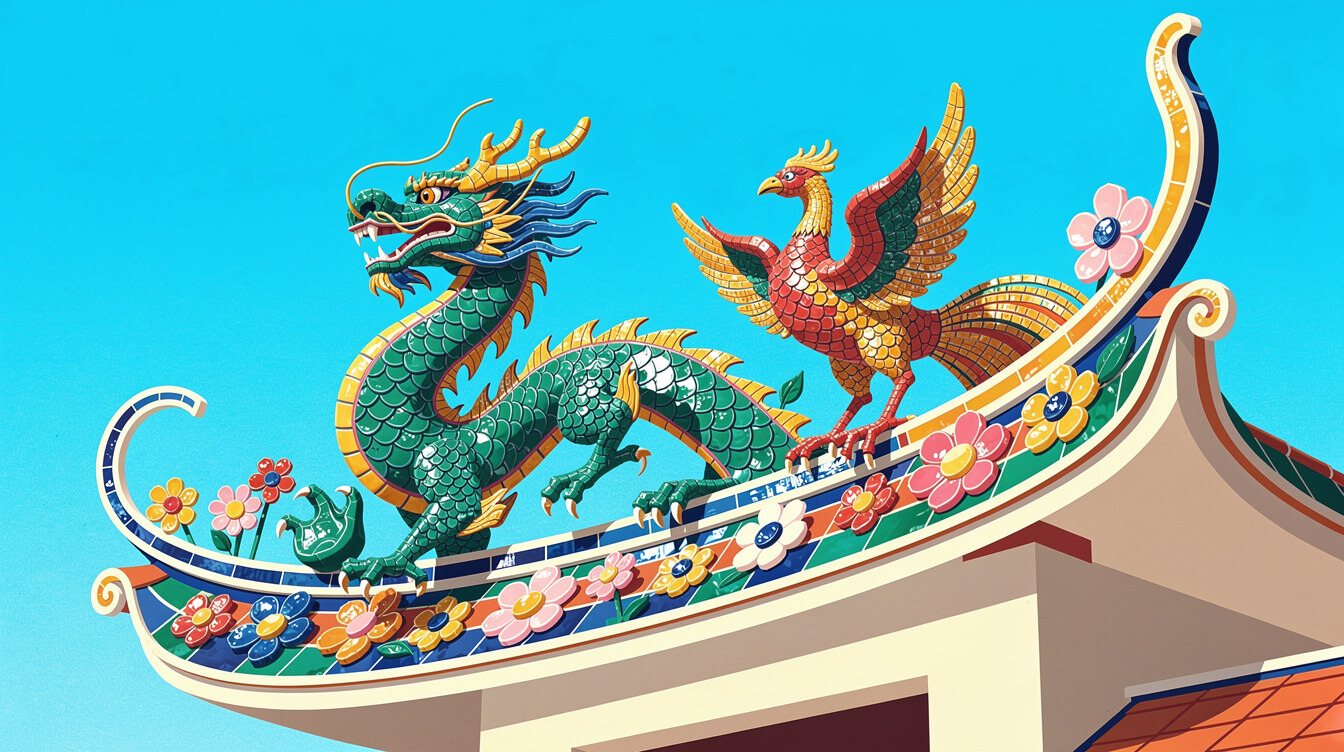
Did You Know? Taiwan’s Temple Dragons Are Made of Broken Bowls
Next time you’re standing outside a temple in Taiwan, skip the incense for a second and look up. Along the roof ridge, dragons coil, phoenixes spread their wings, and whole casts of legendary heroes look like they’re mid-battle, all glittering in the sun. Get closer (or zoom in) and you’ll spot the secret: many of them are made of broken bowls.
Did You Know? It’s Called Jiannian (剪黏): “Cut and Paste”
The craft is called jiannian (剪黏), which literally means “cut and paste.” Artisans take glazed porcelain like rice bowls, plates and vases, break it, and snip the pieces into scales, feathers, petals and armor plates with special pliers. Then they press each shard, one at a time, into a sculpted frame of mortar or concrete. The curve of a bowl becomes the curl of a dragon’s scale, and a vase’s rim becomes the edge of a general’s sleeve.
It’s slow work. It mixes sculpture, mosaic and painting, and a full roof can take from half a year to more than a year to finish. Tainan master Chen San-huo describes starting every piece the same way: by breaking bowls, plates and vases, then letting the color and shape of each fragment decide where it goes.
Why Porcelain on a Roof?
Temple rooftops get hammered by subtropical sun, typhoon rain and salty sea air. Glazed porcelain doesn’t fade the way paint does, so a jiannian dragon keeps its color for decades. The craft came across the strait during the Qing dynasty with temple artisans from southern China. In its homeland the same technique is sometimes called qianci (嵌瓷), “inlaid porcelain.”
Where to See a Masterpiece
One of the most celebrated examples is Jintang Temple (金唐殿) in Jiali District, Tainan. In 1928 the temple brought in master craftsman He Jin-long (何金龍) from Shantou, Guangdong, and his porcelain-shard battle scenes still decorate its walls and corners. The same temple also holds work by Ye Wang (葉王), the “father of Taiwanese koji pottery.” Koji (交趾陶) is jiannian’s sibling craft: small, brightly glazed ceramic figures rather than cut shards. If you’re planning a southern trip, our Tainan guide will help you build a day around it.
Up north, Taipei’s Longshan Temple has spectacular jiannian work on its rooftops too. Bring your phone’s zoom lens.
A Craft Racing the Molds
From the 1980s, lingtang (淋搪), meaning mass-produced molded pieces with a poured glaze, started replacing hand-cut jiannian. It’s faster and cheaper, but every piece comes out the same. Today a few families and masters keep the cut-and-paste tradition alive, and some have started making freestanding 3D pieces for galleries so the art can travel beyond the roofline.
The takeaway: Taiwan’s most dazzling temple art started as kitchen leftovers. Next time you visit a temple, look for the curve of a bowl hiding in a dragon’s scales. And if you love the folk side of temple culture, catch up on the face-painted Eight Generals or our look at why Taiwan has so many temples.
Want a little Taiwan color for your own walls? Shop Taiwan Merch for wall art, tees and gifts inspired by the island’s everyday magic. 🐉

Grab a Free Taiwan Sticker!
Drop your email and we’ll send you a limited-edition Taiwan sticker — plus insider access to new merch drops and island vibes.
No spam. Unsubscribe anytime.