What Is Boba Made Out Of? Real Labels, Taiwanese Names and the 2013 Starch Scandal
Ask the internet what is boba made out of and you get the same three-word answer every time: tapioca, water, sugar. That’s true for the pearls you’d roll in your own kitchen. It’s not the whole story for the pearls in most cups. Flip over a real bag of shop-style boba and the ingredient list can run to sixteen items, including two modified starches, caramel color and a preservative. None of it is scary, and all of it is there for a reason. This guide gives you the short answer first, then reads four real labels line by line. It also covers what Taiwan calls the pearls, why they’re black, the bounce Taiwanese drinkers judge them on, and the 2013 starch scandal that changed how Taiwan polices its tapioca.
What Is Boba Made Out Of? The Short Answer
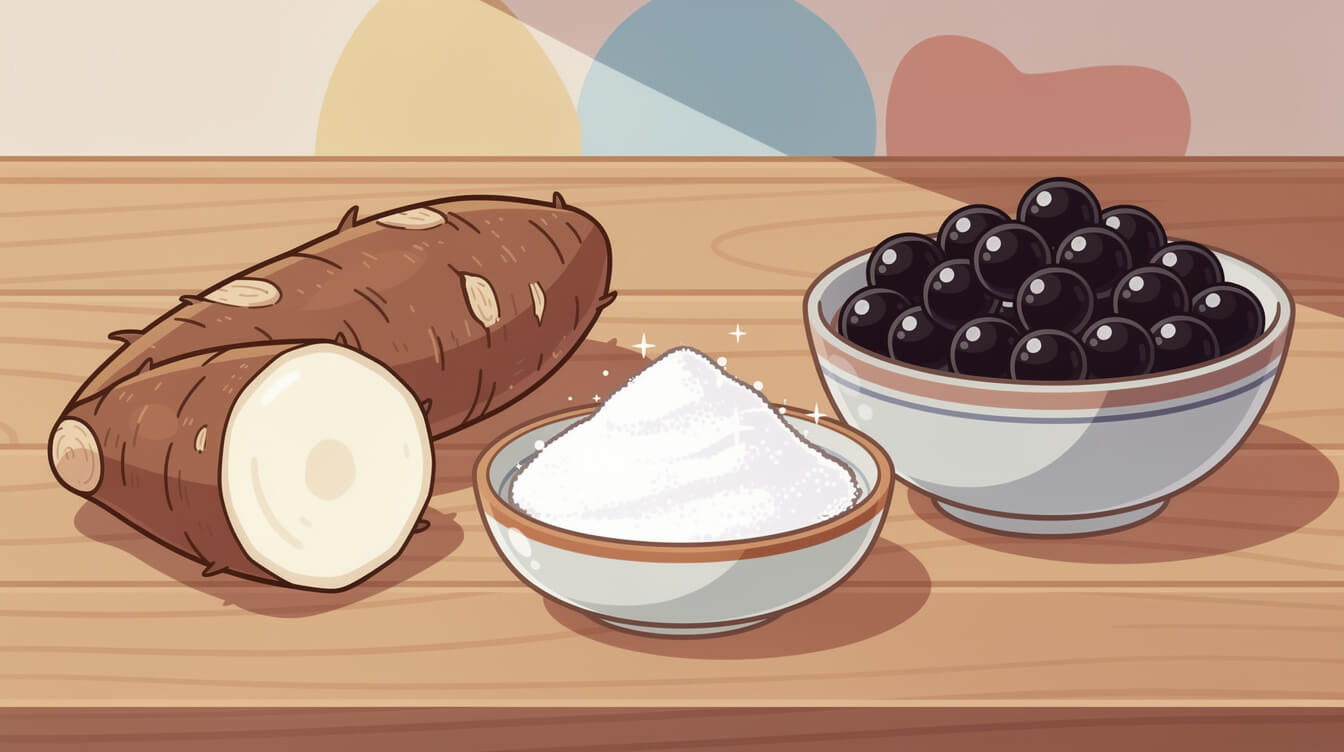
Boba pearls are made from tapioca starch, water and a sweetener. Tapioca starch is extracted from the root of the cassava plant. Mixed with hot water, it turns into a stretchy dough that’s rolled into balls and boiled until chewy. Shop and supermarket pearls usually add caramel color, modified starches, thickeners and a preservative so they survive shipping and cook faster.
That’s the featured-snippet version. Here’s what it leaves out.
- Cassava is the plant, tapioca is the starch. Cassava is a woody tropical root. Tapioca is the fine white starch washed out of it. Boba isn’t made from “tapioca root”. It’s made from the starch of the cassava root.
- Not every pearl is pure tapioca. Taiwanese food writers note that most pearls are tapioca starch, water and sugar, and that some makers blend in potato starch or sweet potato starch. The popular science magazine 科學月刊 says the same thing in its explainer, republished by The News Lens.
- “Boba” can mean the drink or the topping. In the US it usually means the whole drink. In Taiwan, the pearls have their own names, which tell you a lot (more on that in a second).
- Some “boba” contains no tapioca at all. Popping boba and crystal boba are different products made from different gels. We get to them near the end.
So the honest answer to “what is boba made out of” has two halves: what the recipe says, and what the bag says. The recipe is short. The bag is where it gets interesting.
Fen Yuan, Zhenzhu, Bo Ba: What Taiwan Calls the Pearls
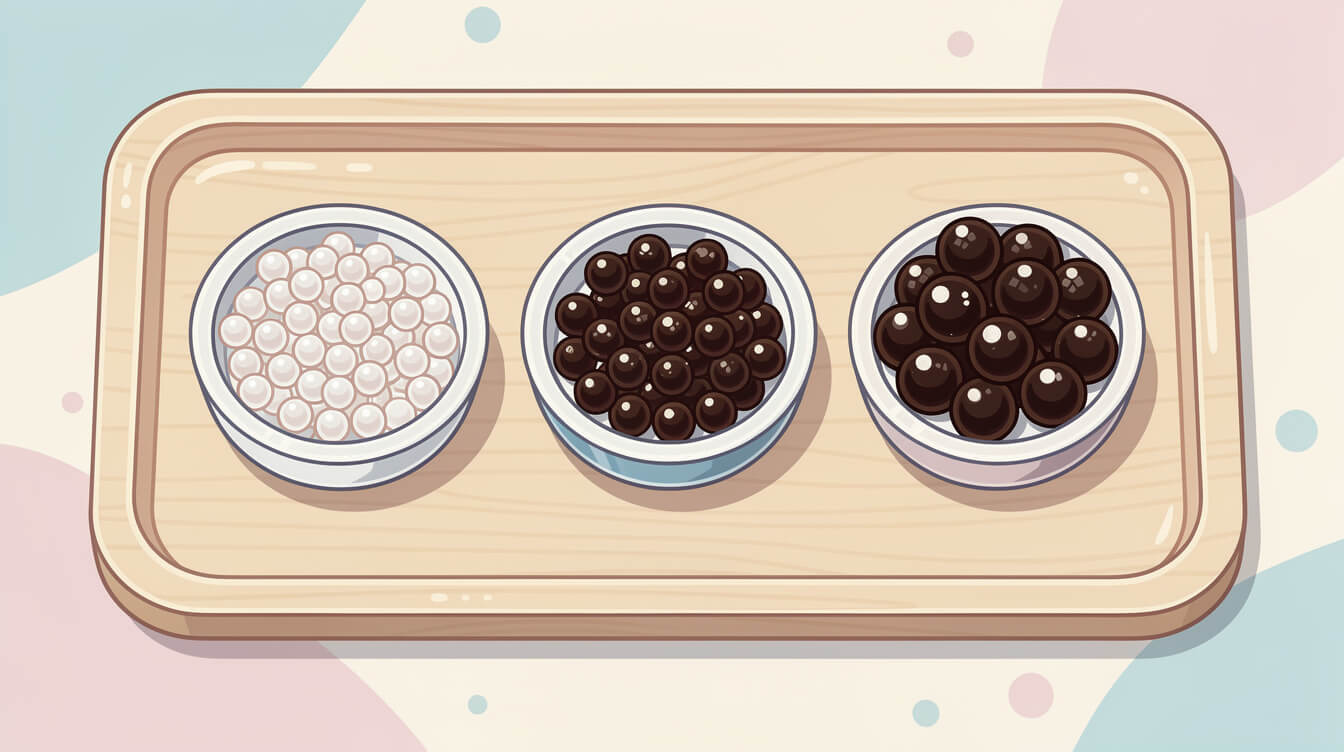
English has one word for the pearls. Taiwan has at least three, and each one marks something different.
- 粉圓 (fěn yuán), “starch rounds”. This is the old, plain name for the ingredient itself. It’s what you’ll see on a dessert-shop menu next to shaved ice, and in the food-safety notices from Taiwan’s FDA, which describe 粉圓 as made mainly from tapioca starch.
- 珍珠 (zhēn zhū), “pearl”. This is the drink-shop name. Pearl milk tea is 珍珠奶茶, or 珍奶 for short. It names the topping once it’s in a cup.
- 波霸 (bō bà). This one means the bigger pearls, and it’s where the English word “boba” comes from. The story behind the name is a good one, and we’ve already told it properly in our guide to making boba pearls the Taiwanese way, so we won’t retell it here.
Why the names matter: if you’re shopping at an Asian grocery, the Chinese on the bag tells you what you’ve got. 粉圓 on a pack usually means dried, plain pearls for desserts. 珍珠 or 波霸 on a pack usually means drink-shop pearls, often already sweetened and colored. And if you’re ordering in Taiwan, most shops let you choose the size: small pearls, regular, or the big 波霸.
The pearls themselves aren’t new. Taiwanese food historian Huang Wan-ling (黃婉玲) writes that early 粉圓 were small and white, a cooling snack eaten in sweet soups long before anyone put them in milk tea. The tea came later. For that half of the story, see our guide to Taichung, the birthplace of bubble tea.
What Is Boba Made Out Of in the Bag? Four Real Labels, Read Line by Line
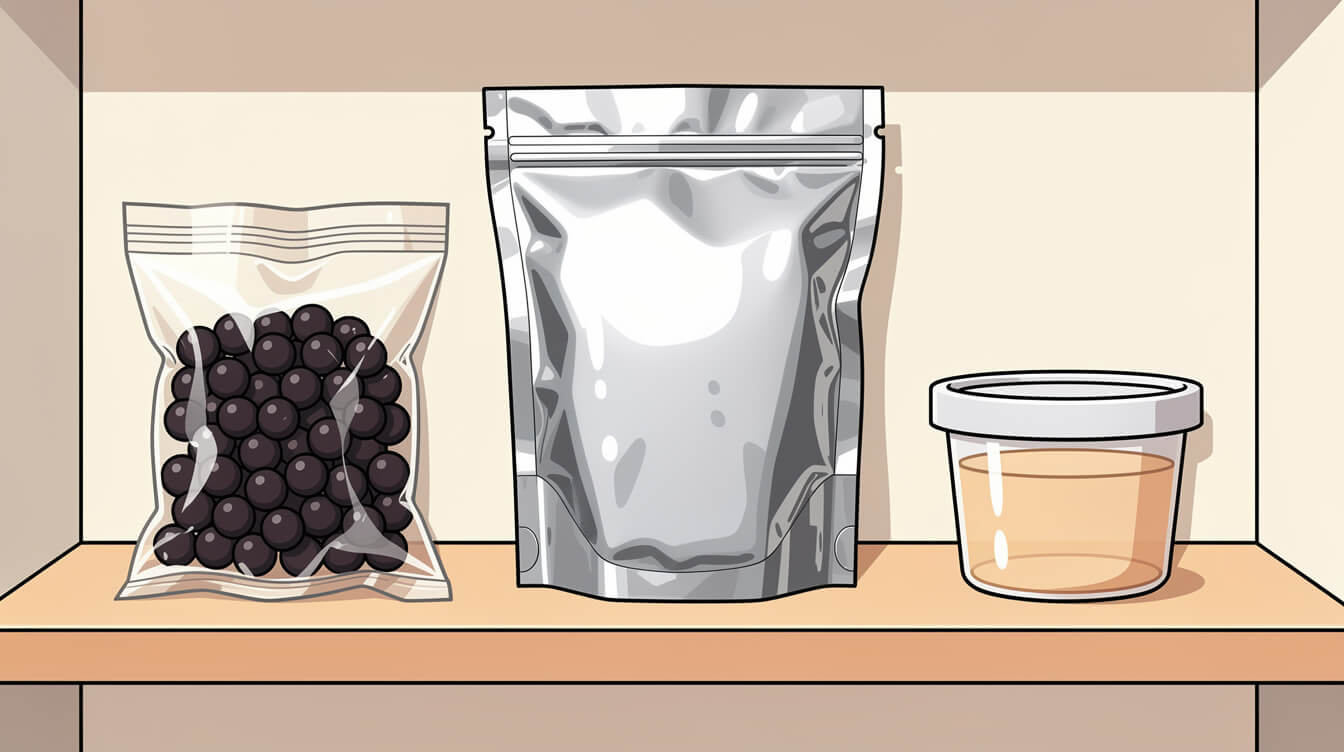
Freshly made pearls go hard within a day or two. But as Food Network’s explainer notes, most boba is made in Taiwan and shipped around the world without refrigeration, so most boba on the market “includes additives”. It never says which ones. So we went and read the labels. These are quoted from the retailers’ product pages as of October 2026. Brands reformulate, so always check the pack in your hand.
1. Quick-cook black pearls (the “5-minute” kind)
Bossen Fast Cook Big Tapioca, sold by a US importer, cooks in about 5 minutes plus 5 minutes’ rest. Its current label lists:
Tapioca starch, water, starch acetate, acetylated distarch adipate, caramel colors, brown sugar flavors, potassium sorbate (preservative), potassium chloride, sodium polyphosphate, sodium acetate (anhydrous), DL-malic acid, sucrose fatty acid ester, sodium carboxymethyl cellulose, carrageenan, ammonium alum, lecithin.
That’s sixteen ingredients. Here’s what they do:
- Tapioca starch and water are still the first two. Water second tells you these are semi-moist pearls, not bone-dry ones. That’s part of why they cook fast.
- Starch acetate and acetylated distarch adipate are modified starches: tapioca or other starch chemically tweaked so the pearl holds its shape and doesn’t turn rock-hard as it cools.
- Caramel colors make it black. Note that there’s no brown sugar here, just brown sugar flavor.
- Potassium sorbate is the preservative. The salts and acids help control texture and shelf life.
- Carboxymethyl cellulose and carrageenan are thickeners that help hold the chew.
2. Classic slow-cook black pearls
Bossen Tapioca Pearls, Large Boba (the 3 kg shop size, country of origin listed as Taiwan) needs a 25-minute boil and a 35-minute steep. Its list is shorter:
Tapioca starch, water, caramel, sorbitol solution, sodium carboxymethyl cellulose, brown sugar flavor, xanthan gum, sodium benzoate, potassium sorbate (as preservative).
Longer cooking means fewer shortcuts. There are no modified starches on this one, just thickeners, caramel and two preservatives. Those two preservatives fit Taiwan’s rules. Taiwan’s FDA permits sorbic acid, benzoic acid and their salts in 粉圓, as food-industry outlet 食力 reported from an FDA briefing in 2019.
3. Ready-to-eat microwave pearls
Bossen Instant Tapioca Pearls come in 50 g pouches. You microwave them for 30 seconds, they have a listed shelf life of 24 months, and the country of origin is Taiwan:
Water, sugar, tapioca starch, acetylated distarch adipate, distarch phosphate, glycerin, brown sugar, caramel, artificial brown sugar flavor, sodium carboxymethyl cellulose, genu pectin, D-glucono-1,5-lactone, xanthan gum, lactic acid.
Look at the order. Water and sugar come before tapioca. These pearls are already cooked and soaked, sitting in syrup. There’s no sorbate, either. Shelf life here comes from sugar, glycerin and acids (lactic acid and glucono-delta-lactone), which keep the pouch hostile to microbes. This is the only one of the four with real brown sugar on the list, and it still uses caramel for color.
4. A supermarket-shelf quick-cook pack
WuFuYuan Tapioca Pearl, Black Sugar Flavor (250 g, “ready in 5 minutes”) is widely stocked by US and UK grocers. Its Walmart listing says it’s manufactured in China, which is a useful reminder that “Taiwanese-style” on the front doesn’t tell you where the pearls were made. The UK listing gives the fullest version:
Tapioca starch (39.14%), water, corn starch, thickener (E1442, E1420, E412), colour (E150d sulphite ammonia caramel), flavouring, preservative (E202), sweetener (E951).
Translated: corn starch blended in with the tapioca, two modified starches (E1442 and E1420) plus guar gum (E412), caramel color, potassium sorbate (E202) and aspartame (E951). The “black sugar flavor” comes from flavoring and a sweetener, not from sugar.
What the four labels add up to
- Tapioca starch is always the base. On three of four labels it’s the first ingredient, and on the fourth it’s third, behind water and sugar.
- All four black pearls are colored with caramel. Brown sugar, when it shows up at all, is mostly flavor.
- Modified starch is common in fast-cook and instant pearls. It’s what lets a pearl cook in 5 minutes and stay soft in a cold drink.
- The faster the pearl, the longer the label. The slow-cook shop pearl has the shortest list of the three tapioca-first products.
None of these are unsafe or unusual. They’re approved food additives doing the jobs you’d expect. But it does mean the honest answer to “what’s in the boba I bought at the store?” is longer than “tapioca, water, sugar”. If you want the three-ingredient version, you’ll have to make it yourself. Our homemade boba pearl recipe walks you through it.
Why Boba Is Black (and What White Pearls Are)
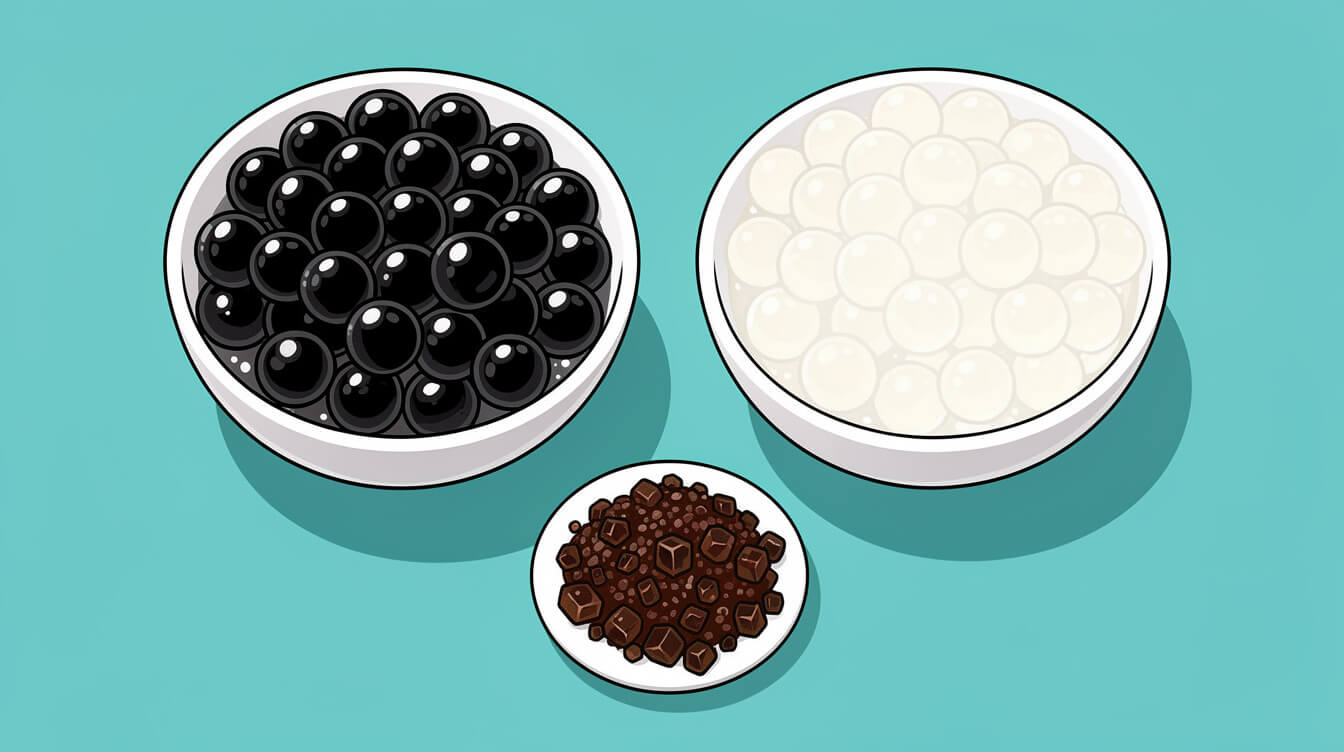
Tapioca starch is pure white. So where does the black come from?
Most English-language explainers say brown sugar. That’s the traditional answer. Taiwan’s public broadcaster PTS described the classic method in 2023: tapioca starch kneaded with 黑糖 (black sugar) into a dough, then machine-cut into rounds. Dark sugar does tint the pearl a warm brown, and it’s how homemade pearls get their color.
But the jet-black pearl in a shop cup usually owes its color to caramel color, and the labels above show it. Taiwanese sources say the same. A TVBS Health piece by dietitian Cheng Han-yu (程涵宇) lists pearl ingredients as starch and sugar, noting that “some add caramel coloring and flavoring”. Food historian Huang Wan-ling writes that today’s 粉圓 are darker because some have caramel added.
Caramel color isn’t a mystery chemical. It’s a family of colorings made by heating sugars, the same thing that colors cola and soy sauce. On EU and UK labels you’ll see it as E150, with a letter for the type (E150d is the sulphite ammonia kind used in cola).
White pearls
White pearls are just pearls without the coloring. In Taiwan, white 粉圓 are the older style, according to Huang Wan-ling, and you’ll still see pale pearls in dessert shops. At US shops, white pearls are sometimes sold as a lighter-tasting alternative. They’re not lower in starch, though, because the starch is the pearl.
One commercial example, Tea Zone White Tapioca Pearls, lists tapioca starch, water, three modified starches, potassium sorbate, flavor, sodium alginate and several processing aids. There’s no caramel color on the label, which is exactly what makes them white. They’re still a processed shop product, though.
Some newer shops also sell flavored and colored pearls, like matcha green, strawberry pink or butterfly-pea blue. They’re the same tapioca dough with a different powder or coloring kneaded in.
The “Q” Factor: Why Taiwan Judges Pearls on Bounce
Ask a Taiwanese friend whether a shop’s pearls are any good and you won’t hear “sweet” or “soft”. You’ll hear “Q”, or “QQ”, or a happy “很Q!”.
Q comes from the Taiwanese Hokkien word khiū (𩚨). The Ministry of Education’s Taiwanese dictionary defines it as describing food that is soft yet elastic and springy, and lists the phrase khiū-teh-teh for food that’s soft, bouncy and properly chewy. Q isn’t hardness and it isn’t stickiness. It’s the push-back: the way a good pearl resists your teeth for a split second, then gives.
The bounce comes straight from the starch. Taiwanese food-science writers at 食力 and 科學月刊 both explain that cooked pearls are naturally Q-elastic because of how tapioca starch behaves once it’s been gelatinized in hot water. They also explain the problem that the commercial labels are solving. Natural starch firms up quickly as it cools, so a pearl that was perfect at the stove turns hard in an iced drink after an hour or two. That’s what the modified starches on the fast-cook labels are for: they keep the Q alive in a cold cup.
It’s also why many shops cook pearls in batches through the day instead of once in the morning. A pearl’s Q has a clock on it. Our Taiwan boba tea guide covers what that means for when to order.
How to judge Q yourself:
- Good: springy and chewy all the way through, slightly translucent at the edge, no hard white dot in the center.
- Undercooked: a chalky white core you can feel.
- Old: firm, dense and a little gritty. These have been sitting too long or got too cold.
- Overcooked: mushy and sticky, the pearls cling together.
And not every Taiwanese tea craving involves pearls. Plenty of locals get their milk-tea fix from a carton of 麥香 from the convenience-store fridge, which is the inspiration for our 麥香 Taiwan Vintage Milk Tea Can tee, a nod to the drink that came before the boba boom.
The 2013 Starch Scandal and How Taiwan Tightened the Rules
If you’ve read anything about what boba is made out of, you may have run into a scary headline about “toxic starch”. Here’s what actually happened, and why it’s a story about Taiwan fixing a problem, not about your drink today.
What happened
In spring 2013, Taiwanese inspectors traced a problem to an unapproved additive in starch products. On May 13, 2013, Taiwan’s Food and Drug Administration published test results confirming maleic acid in starch-based foods. As the Taipei Times reported that month, some makers had used maleic anhydride-modified industrial starch to make tapioca pearls, flat rice noodles and oden (關東煮) chewier. This kind of starch was not among the 21 modified food starches Taiwan had approved. In plain terms, a non-food starch had been used to fake the Q.
Hong Kong’s Centre for Food Safety described it as “abusive use of maleic anhydride during the production of modified starches”, affecting fish paste products, noodles, and taro and tapioca balls.
The ripple effect
Because Taiwan exports pearls worldwide, other regulators acted fast. Singapore’s food authority (then the AVA) tested 66 starch-based products from Taiwan and found maleic acid in 11, most of them tapioca balls for bubble tea, and pulled them from sale. Trade outlet BeverageDaily reported that a later update brought the total to 15.
On the health risk, regulators were measured. Hong Kong’s CFS concluded that “occasional consumption of maleic acid tainted starch-containing foods is not likely to pose any significant health risk”, and Singapore said occasional consumption at the detected levels posed no significant risk. Both noted that long-term exposure to high levels is the concern, and that’s why the material had no place in food.
How Taiwan tightened the law
Taiwan’s legislature moved within weeks. Lawmakers passed an amended Act Governing Food Sanitation on May 31, 2013, and it was promulgated on June 19, 2013. According to Taiwan’s Ministry of Health and Welfare and the Taipei Times, the changes included:
- Much heavier penalties. Fines up to NT$15 million, against an old range the Taipei Times put at NT$30,000 to NT$150,000. It also added prison terms for adding banned substances to food.
- Mandatory registration for food and additive businesses, so regulators know who makes what.
- Full-ingredient labelling for food additives.
The following February the law was renamed the Act Governing Food Safety and Sanitation (食品安全衛生管理法), the name it carries today. Modified food starch is regulated as a food additive in its own class, and packaged foods must list their ingredients and additives in descending order. In 2018 Taiwan updated the official term to 食用修飾澱粉, “edible modified starch”, and trimmed its approved list.
So when you see “modified starch” on a pearl label today, it means an approved food starch on a regulated list. It’s the safe version of the shortcut that caused the 2013 scandal.
Not All “Boba” Is Tapioca: Popping, Crystal and Taro Balls
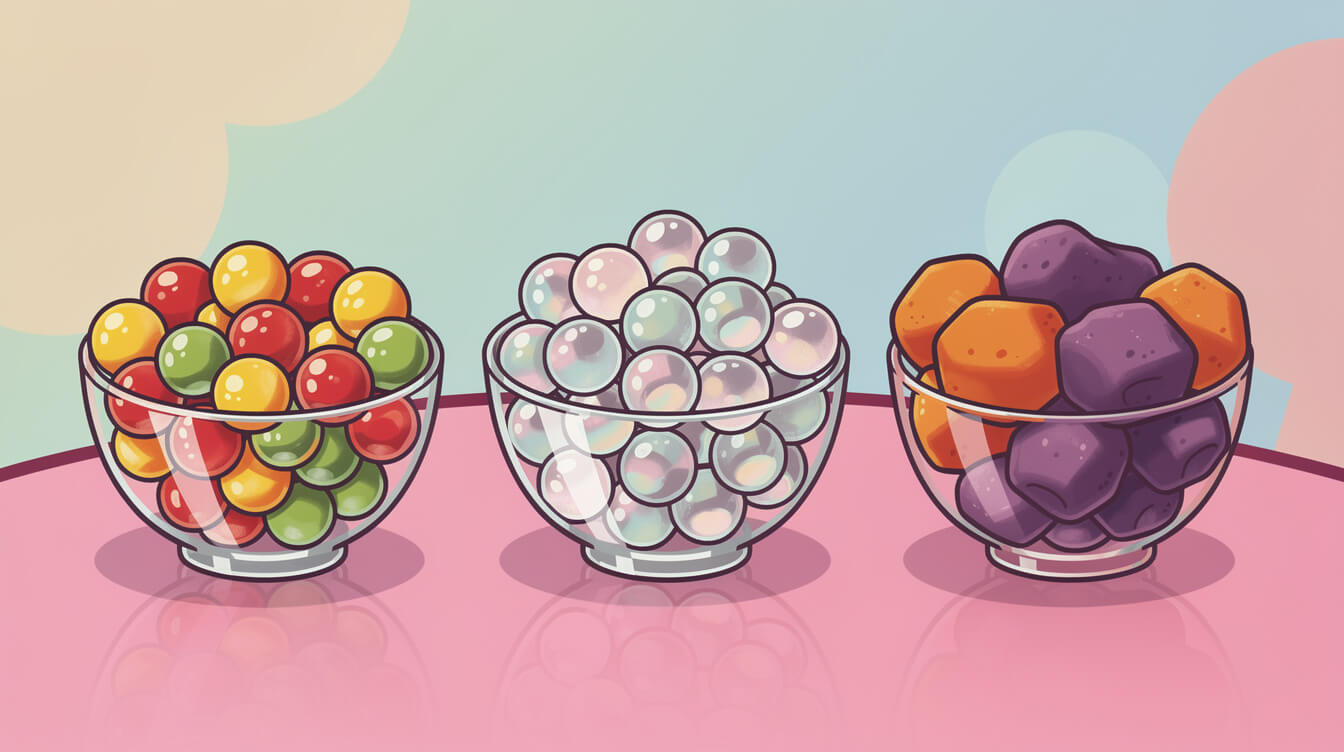
Menus outside Taiwan use “boba” for almost any round topping. Three of the most common aren’t tapioca pearls at all.
Popping boba are juice-filled spheres with a thin, edible skin that bursts when you bite. The skin is a gel, typically made from sodium alginate (from seaweed) setting on contact with calcium. There’s no chewing involved, which is the point.
Crystal boba are clear, glassy pearls with a firmer, jelly-like bite. Here’s the catch: the products sold under that name aren’t all the same thing. Bossen, for example, markets its original crystal boba as “Agar Boba,” yet the ingredient label lists konjac powder and carrageenan and no agar at all, and the other big US suppliers’ labels read the same way (we compare four of them in our crystal boba guide). If texture matters to you, or you’re avoiding one of those ingredients, read the label rather than the menu.
Taro balls (芋圓) are a Taiwanese dessert staple made by kneading mashed taro with starch into soft, chunky pieces. You’ll often find them alongside sweet potato balls in the same bowl. They’re the signature of Jiufen’s dessert shops, and they’ve made the jump into drinks too. Our taro bubble tea guide covers both.

Join the 珍珠幫 (Pearl Gang)
Our Pearl Gang tee is for anyone who orders extra pearls and judges every cup on its Q. Ingredients: cotton, attitude, zero caramel color.
What Is Boba Made Out Of? Your Questions, Answered
Do you chew or swallow boba?
Chew it. The chew is the whole point. That’s the Q. Pearls come up a wide straw fast, so take smaller sips and chew each mouthful before you swallow. Swallowing them whole isn’t how they’re meant to be eaten.
Can you eat the balls in boba?
Yes. The pearls are food, not decoration. They’re cooked starch, usually sweetened, and they’re meant to be eaten with the drink.
What’s the point of the boba balls?
Texture. Taiwanese drink culture prizes contrast, like a cold, creamy tea with something warm-sweet and chewy at the bottom. The pearls also carry flavor: shops steep them in brown-sugar syrup, so each one is a little hit of caramel.
Is boba healthy or unhealthy?
The pearls are almost pure carbohydrate. USDA FoodData Central lists dry tapioca pearls at 358 calories per 100 g, with about 89 g of carbohydrate and almost no protein or fat. You’ll sometimes see “a cup of tapioca pearls has 544 calories”. That’s USDA’s figure for a cup of dry pearls (152 g), not the cooked pearls in your drink, which have absorbed a lot of water. Most of a drink’s calories come from the sugar and milk, so the whole cup matters more than the pearls. A Taiwanese dietitian survey reported by Newtalk in 2021 found 700 ml pearl milk teas from 15 shops ranging from 431 to 925 calories. If you want a lighter cup, cut the sugar level, which every Taiwanese shop lets you pick. For caffeine, see our guide to how much caffeine is in boba milk tea.
Is boba safe for young kids?
Take care with small children. Germany’s Federal Institute for Risk Assessment (BfR) warned in 2012 that pea-sized objects like pearls can be inhaled, “especially by children up to four years”, if sucked up a wide straw. It recommended a clear warning wherever bubble tea is sold.
Did a CT scan really show 100 undigested pearls in someone’s stomach?
That viral 2019 story came from a news report out of Zhejiang, not a published medical case. Live Science reported that doctors were skeptical. A pediatric gastroenterologist it quoted noted that tapioca wouldn’t show up on a CT scan in the first place. Pearls are starch, and your body digests starch. Like anything eaten in large amounts with little water, they could contribute to constipation, but that’s all.
Is boba gluten free?
Tapioca comes from cassava, a root, and contains no gluten. But shop-made pearls, syrups and toppings can be processed alongside wheat ingredients, so if you have celiac disease, ask the shop and check labels rather than assuming.
Is boba vegan?
Plain tapioca pearls are usually plant-based, since they’re starch, water and sugar, but check the label on flavored or instant packs. The drink is where dairy usually comes in, and many shops offer a non-dairy option. Our vegan Taiwan guide covers eating and drinking plant-based on the island.
Final Thoughts: Read the Bag, Then Chew
So, what is boba made out of? At heart, it’s tapioca starch from the cassava root, water and something sweet. That’s a snack Taiwanese families were cooking long before anyone thought to put it in milk tea. The modern pearl adds a few tools to keep that recipe alive across an ocean: caramel for color, approved modified starches to hold the Q in an iced drink, and a preservative so a bag can sit on a shelf.
None of that is a reason to stop drinking it. It’s a reason to read the bag. The short list (tapioca, water, sugar, maybe caramel) tells you you’re cooking something close to what a Taiwanese shop serves. The long list tells you you’ve bought convenience, which is fine on a Tuesday night. And if you want the three-ingredient version, make it yourself: all it takes is a bag of starch, some dark sugar and a pot of boiling water.
Then do what every Taiwanese drinker does with their first sip: ignore the tea for a second, find a pearl, and check its Q.
Want more of the story behind the cup? Start with how bubble tea became Taiwan’s gift to the world, then see what else Taiwan pours in our guide to Taiwanese drinks.
A Postcard From Taiwan, Every Week
Drink-shop secrets, snack stories and the real history behind the foods you love, straight to your inbox. No spam, unsubscribe anytime.

Grab a Free Taiwan Sticker!
Drop your email and we’ll send you a limited-edition Taiwan sticker — plus insider access to new merch drops and island vibes.
No spam. Unsubscribe anytime.