Did You Know? The Salmon on Taiwan’s NT$2,000 Note Has Never Seen the Sea
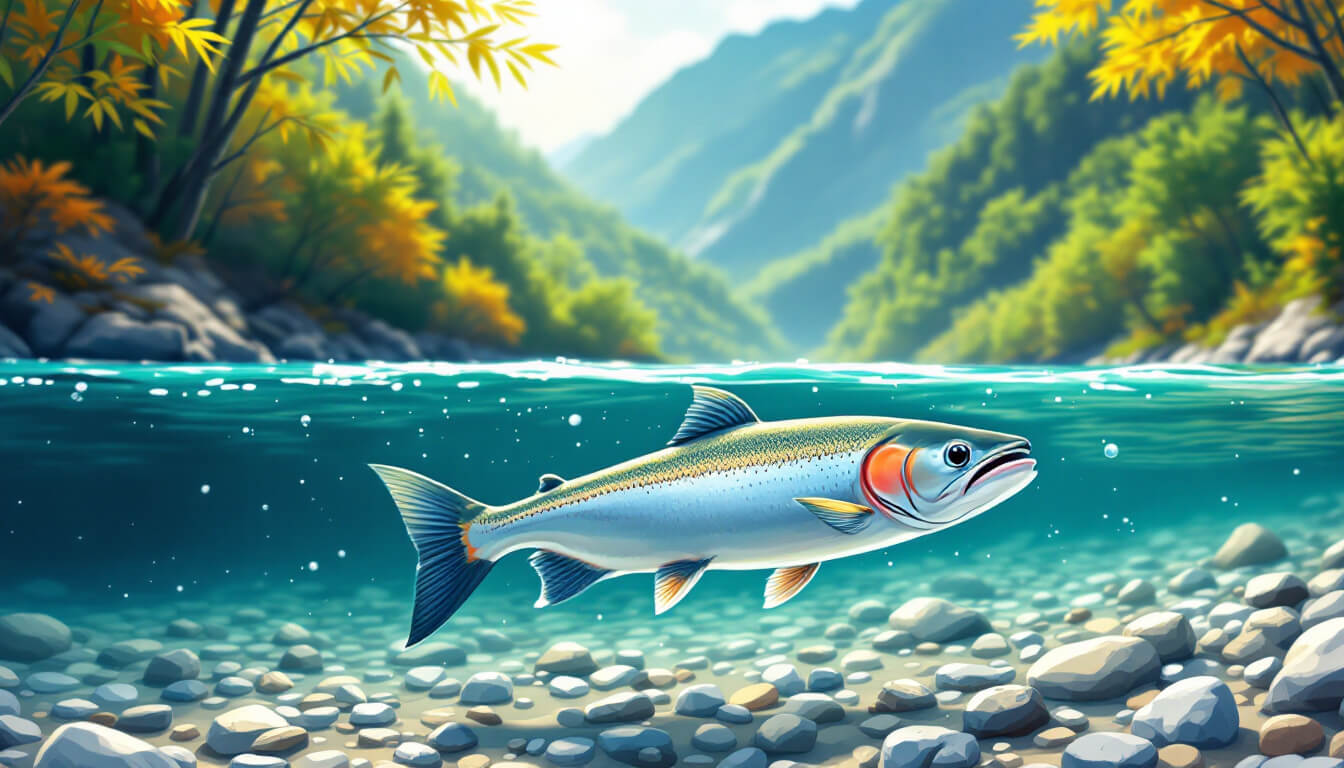
Find a purple NT$2,000 bill — good luck, most people in Taiwan go years without handling one — and turn it over. Behind the ridgeline of Nanhu Mountain, there is a fish. It is a real salmon, it lives in subtropical Taiwan, and not one member of the species has touched saltwater in roughly ten thousand years.
This is the Formosan landlocked salmon, 櫻花鉤吻鮭, and right now is its month. Spawning runs from October into November, and the largest group of spawners — two-year-old females — lays in the second half of October.
A salmon that got shut in
Its ancestors were sea-run cherry salmon that came up Taiwan’s rivers to breed, the way salmon everywhere do. Then the last ice age ended. The lowland rivers warmed past anything a salmon can survive, the road back to the ocean closed behind them, and the fish already upstream were sealed into the cold headwaters permanently. David Starr Jordan and Ōshima Masamitsu described it for science in 1919, from a specimen collected in 1917, and it now carries the name Oncorhynchus masou formosanus. No salmon anywhere in Asia lives further south than this one.
The 17-degree line
The entire wild population fits into Qijiawan Creek (七家灣溪) and its feeder streams, in the upper Dajia River basin at Wuling, inside Shei-Pa National Park — the same protected high country that shelters the Formosan black bear. Wuling sits between roughly 1,740 and 2,200 meters. The creek itself is 15.3 km long and never more than about 12 meters wide. That is the whole natural range of the species: one thin thread of cold water.
The constraint is temperature. The water has to stay below 17°C. That is why an ice-age relict is still alive on an island the Tropic of Cancer runs straight through — go high enough in Taiwan and you reach a climate the rest of the country simply doesn’t have. The eggs go into gravel nests in late October and hatch roughly 20 to 30 days later, in late November.
From about 200 fish to 16,000
Taiwan has been worrying about this fish for a long time. The Japanese colonial government listed it as a natural monument in 1938, though that protection lapsed after 1945. Its habitat became a forest reserve in 1977. Then in 1984, the first systematic survey — led by a National Taiwan University team — counted only around 200 left in the entire country. That same year it was declared a precious and rare species under the Cultural Heritage Preservation Act, which is exactly where its everyday nickname comes from: 國寶魚, the national treasure fish. The 1989 Wildlife Conservation Act listed it as endangered.
Four decades of work later, the annual survey counted 16,020 fish in 2025 — down from the 2023 record of 18,630, but the fifth straight year above 15,000. The IUCN still rates it critically endangered, so this is a rescue in progress, not a finished one. It is becoming a Taiwanese pattern, though: the pheasant-tailed jacana came back the same stubborn way. Since 2017, Shei-Pa and Taroko have been returning salmon to Hehuan Creek, historical habitat inside the traditional territory of the Qalang Atayal, whose elders formed a local National Treasure Fish Patrol to keep watch over them.
Can you actually go and see one?
In the creek, mostly not — Qijiawan is protected water and you don’t get to wade into it. What you can do is visit the salmon ecology center at Wuling, where the fish are on display and the restoration work is explained by the people doing it. Go in autumn and you get the spawning season plus maple color; go in February and you get cherry blossoms and crowds. Either way, pack for it, because Taiwan at 2,000 meters is a completely different country from Taipei — our month-by-month guide has the temperatures.
And if the closest you’re getting to a Taiwanese mountain stream this October is your group chat, we put Taiwan on things you can wear instead. Shop Taiwan Merch.

Grab a Free Taiwan Sticker!
Drop your email and we’ll send you a limited-edition Taiwan sticker — plus insider access to new merch drops and island vibes.
No spam. Unsubscribe anytime.