Formosan Mountain Dog: The 4,000-Year-Old Taiwanese Breed That Indigenous Hunters Saved From Extinction
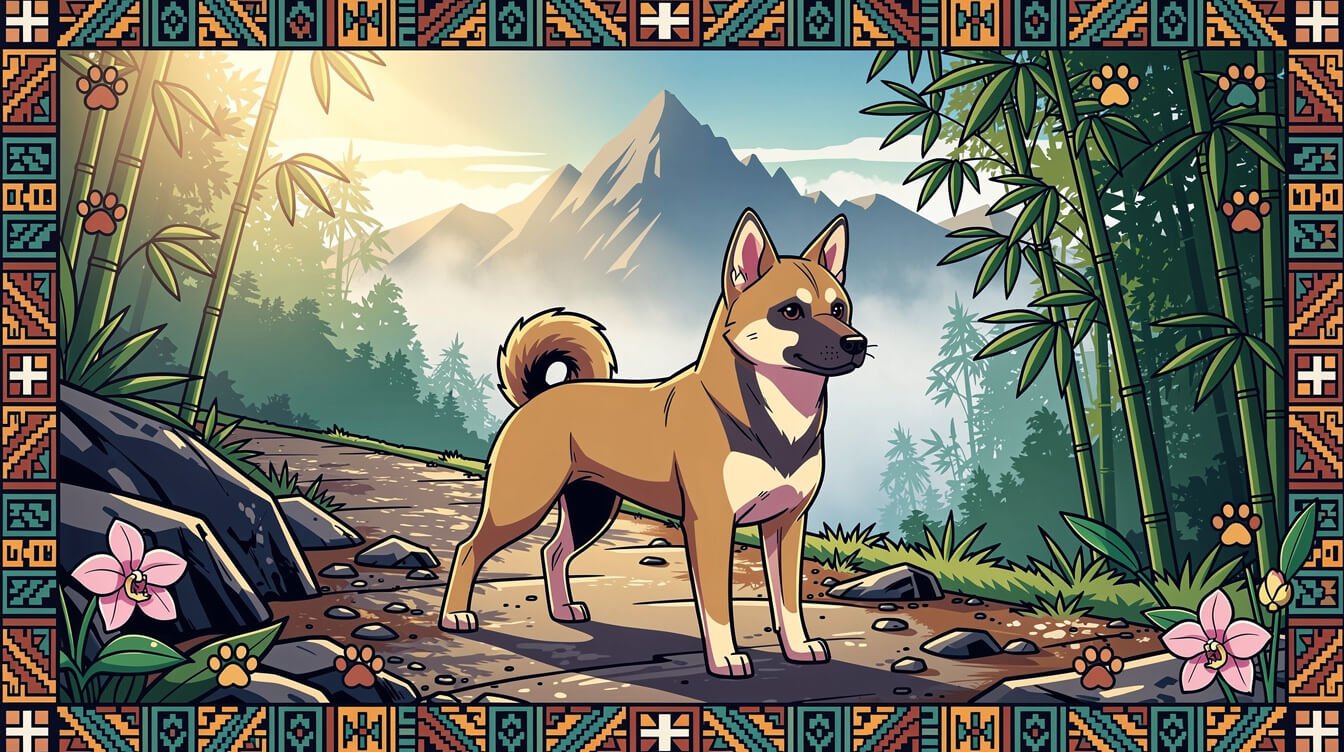
Walk through a mountain village in Nantou or Hualien and you might lock eyes with one — a lean, golden-brown dog with sharp triangular ears, a sickle tail curled tight over its back, and an unmistakably wild expression. That’s a Formosan Mountain Dog (台灣犬, Táiwān quǎn), and it has been walking these mountains alongside humans for at least 4,000 years.
Most people on the island just call it 土狗 (tǔgǒu) — “soil dog.” It’s the kind of casual nickname you give a friend who’s been around forever. And in this case, that’s almost literally true.
An ancient hunting partner
Genetic studies trace the Formosan back to the dogs that arrived with Austronesian-speaking peoples migrating from mainland Asia somewhere around 2000 BCE. They were never bred to be pets. They were bred to be partners — silent, fearless, and tireless enough to flush wild boar through Taiwan’s brutal mountain terrain.
Atayal, Bunun, Paiwan, and other indigenous communities developed deep bonds with these dogs over thousands of years. Hunters slept beside them, ate beside them, and trusted them with their lives. Some villages still maintain that relationship today.
Almost lost forever
Here’s the part that hurts: during the Japanese colonial period (1895–1945), the breed nearly vanished. Crossbreeding with Japanese hunting dogs, German shepherds, and other imported breeds diluted the gene pool so badly that by the 1970s, finding a purebred Formosan in a lowland city was almost impossible.
It took decades of fieldwork by Taiwanese conservationists — most famously veterinarian Dr. Sung Yung-yi (宋永義) and breeder Chen Ming-nan (陳明南) — hiking into remote mountain villages to find dogs that still carried the original lineage. They documented, photographed, and slowly built a breeding program to bring the Formosan back from the edge.
What makes them so distinct
The Formosan is what cynologists call a primitive breed — closer to ancestral dog form than most modern breeds you’ll see at a park. Specifically:
- Triangular pricked ears that stay alert even when the dog is relaxed
- Sickle or curled tail held high over the back
- Almond-shaped eyes in a face that often carries a darker “mask” marking
- Coat colors ranging from solid black to brindle to the iconic golden-tan
- Compact, muscular build — usually 15–20 kg, perfectly sized for mountain trails
They are notoriously intelligent, wary of strangers, and bond intensely with one or two people. A Formosan is not the dog you bring home if you want a furry extrovert who loves every visitor. They are the dog you bring home if you want a four-legged shadow with strong opinions and a 4,000-year résumé.
Finally recognized — in 2015
For most of modern history, the Formosan wasn’t formally recognized by the global dog world. That changed in 2015, when the Fédération Cynologique Internationale (FCI) accepted the Formosan Mountain Dog as breed standard #348. It was a quiet moment of cultural pride for the island — the Taiwan dog finally had paperwork to match its history.
Today, conservationists estimate there are only around 1,000–1,500 purebred Formosans left, mostly in central and eastern Taiwan. You’ll spot mixed-lineage descendants everywhere though — guarding rural temples, dozing outside 7-Elevens, or trotting alongside scooters in mountain towns.
Where to meet one (respectfully)
If you’re visiting Taiwan and want to see Formosans in person, your best bets are mountain villages in Nantou, the indigenous communities of Wulai (Atayal), and the rural areas around Alishan and Taroko. The Taiwan Dog Conservation Center near Puli also hosts educational visits.
One ground rule: never approach a working Formosan without asking the owner first. These are not Labradors. They take their job seriously, and their job is often “guard everything I love.” A polite question goes a long way.
A small dog with a big cultural story
The Formosan Mountain Dog is one of those quiet pieces of Taiwanese identity that doesn’t make it onto the tourist brochures — but absolutely should. Like the cats of Houtong, the leaning postboxes of Zhongshan, and the language patchwork that makes Taiwanese culture what it is, the tǔgǒu is a small thing that tells a much bigger story about the island and the people who shaped it.
If you love Taiwan’s quirky, deeply-rooted cultural details, browse our shop — we celebrate the island’s lesser-known icons through wearable, giftable art.

Grab a Free Taiwan Sticker!
Drop your email and we’ll send you a limited-edition Taiwan sticker — plus insider access to new merch drops and island vibes.
No spam. Unsubscribe anytime.