Yehliu Geopark, Taiwan: The Queen’s Head, the Erosion Clock, and How to Beat the Tour Buses
Most guides to Yehliu Geopark, Taiwan will tell you it is a cape of strange rocks an hour from Taipei, sell you a day tour, and move on. Almost none of them will name the thing you actually came to see, and not one of the pages currently ranking for this park will tell you that the rock in question has lost more than a metre of its neck since 1994 — or show you the measurements.
So let us do that. This guide covers what the Queen’s Head is and how it got that shape, exactly how fast it is eroding and what Taiwanese engineers are doing to slow it down, the three zones of the park and what to look for in each, the real bus routes from Taipei, Keelung and Tamsui as published by the park itself, and the timing trick that decides whether your visit is magic or a shuffling queue behind forty people with selfie sticks.
Ticket prices, opening hours and bus routes below were re-checked against the official Yehliu Geopark site on 24 September 2026. Where a number has a date attached, that is deliberate — this is a place where the numbers change.

Is Yehliu Geopark, Taiwan, worth visiting? The honest answer
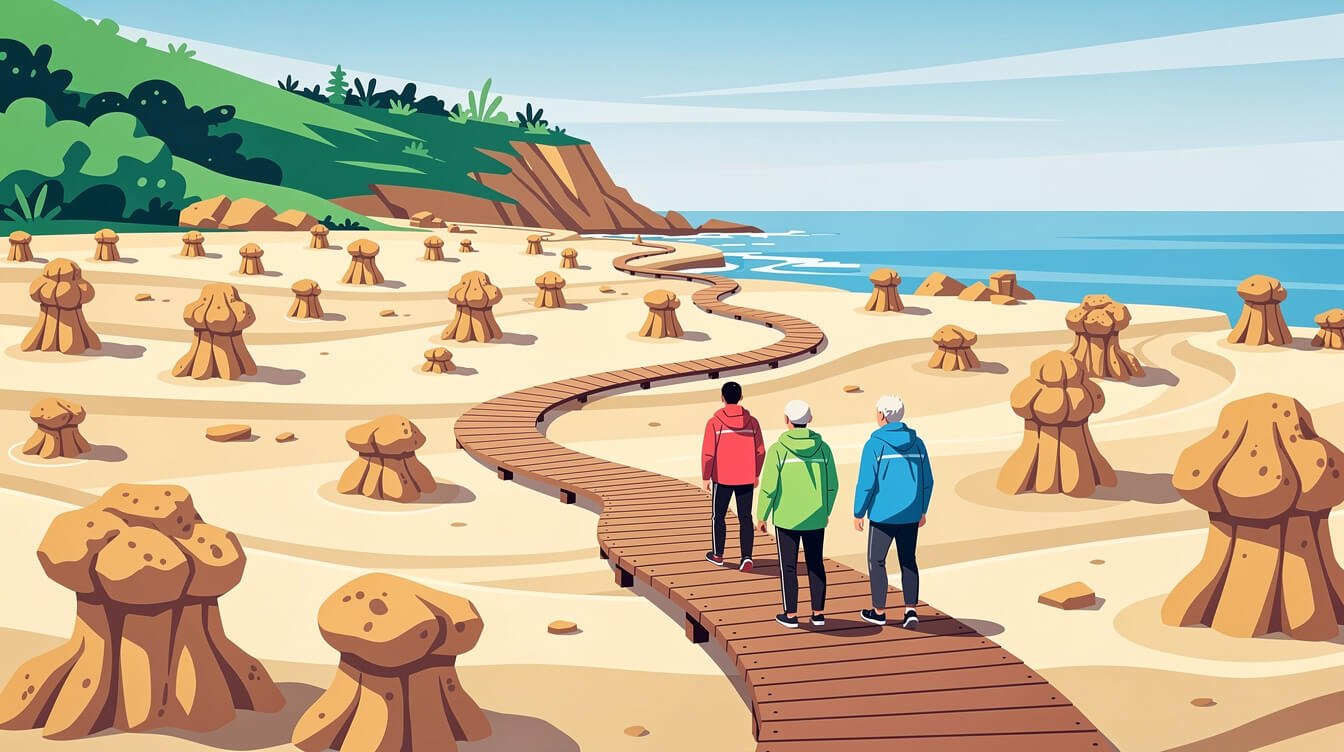
Yes — with two conditions attached. Go early, and do not make it the only thing you do that day.
Here is the part the tour operators skip. Yehliu Geopark, Taiwan, is small. The promontory runs roughly 1,700 metres into the sea, the walkable section is a fraction of that, and a thorough visit takes 60 to 90 minutes. If you have pictured a national park you can lose an afternoon in, recalibrate. It is a compact, extraordinary, slightly surreal rock garden, not a wilderness.
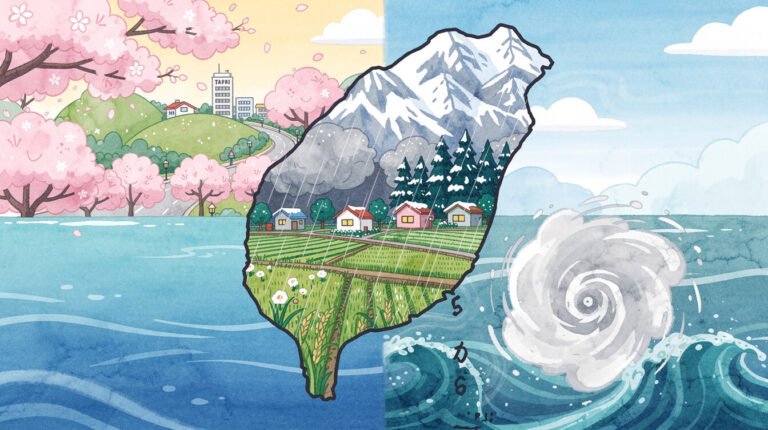
It is also completely exposed. The cape is a bare sandstone platform with essentially no shade and no shelter. In July that means full sun on pale stone with the heat bouncing back up at you. From October through March it means the northeast monsoon coming in off the Pacific with wind and drizzle attached, which — genuinely — is when the place looks its most dramatic, if you bring a shell jacket and accept that your hair is a lost cause. Our region-by-region Taiwan climate guide has the month-by-month detail for the north coast.
And it is busy. Around three million people a year come through, most of them in coaches, most of them between mid-morning and early afternoon. The formations are roped off along a defined route, so at peak times you are not wandering — you are queueing.
Weigh that against what you are looking at. These are hoodoos: top-heavy mushroom-shaped pillars formed because the sedimentary rock here weathers unevenly, the soft layers wearing back faster than the hard nodules sitting on top of them. The bedrock belongs to the Daliao Formation and dates to the Miocene, and the promontory itself was shoved out of the sea by the collision of the Philippine Sea plate and the Eurasian plate. There is nowhere else on the island where the geology performs quite this obligingly. It is worth an hour and a half of anybody’s day. It is just not worth a whole day on its own — which is what the last section of this guide is for.
The Queen’s Head: the rock everyone actually comes for

Walk into Yehliu Geopark, Taiwan, and you will notice a queue forming around a single formation in Zone 2. That is the Queen’s Head (女王頭), and it is the reason Yehliu is on your itinerary whether or not anyone told you its name.
It is a mushroom rock with an unusually long, unusually slender neck and a broad crowned top, and from one specific angle the silhouette reads as a woman’s profile with her hair piled up — most Taiwanese sources describe it as resembling the head of Queen Elizabeth I, which is where the English name comes from. You will also see it compared to the Nefertiti bust in Berlin, particularly in Western travel writing. Both readings work from slightly different angles, which is part of the fun.
Here is the detail almost nobody prints, straight from the park’s own geological notes: the Queen’s Head has not always looked like this. In 1962–63 a joint in the concretion forming the rock’s top fractured and a piece came away, and that break is what left the long graceful neck and the refined profile. The rock is thousands of years old; the face is barely sixty. You are looking at a natural sculpture that was finished within living memory.
Where it is, and how the queue works
The Queen’s Head sits in Zone 2, roughly the middle of the park, which is why so many visitors sprint past the equally strange formations of Zone 1 to reach it. There is a marked photo point, a rope line, and — at peak hours — a genuine single-file queue with a staff member keeping it moving. Nobody is allowed to touch the rock; that has been formally prohibited since 2012.
If the queue looks grim, walk on. Do Zone 3, come back, and you will often find the line has collapsed. The coach groups move as a unit and they move on a clock.
The other queen
There is a second, smaller formation in Zone 1 the park calls the Cute Princess (俏皮公主) — a younger mushroom rock with a thicker neck and a cheekier profile, frequently described as the Queen’s heir apparent. It has no queue. It is, in a quiet way, the better photograph.
Will the Queen’s Head collapse? The erosion clock, in numbers
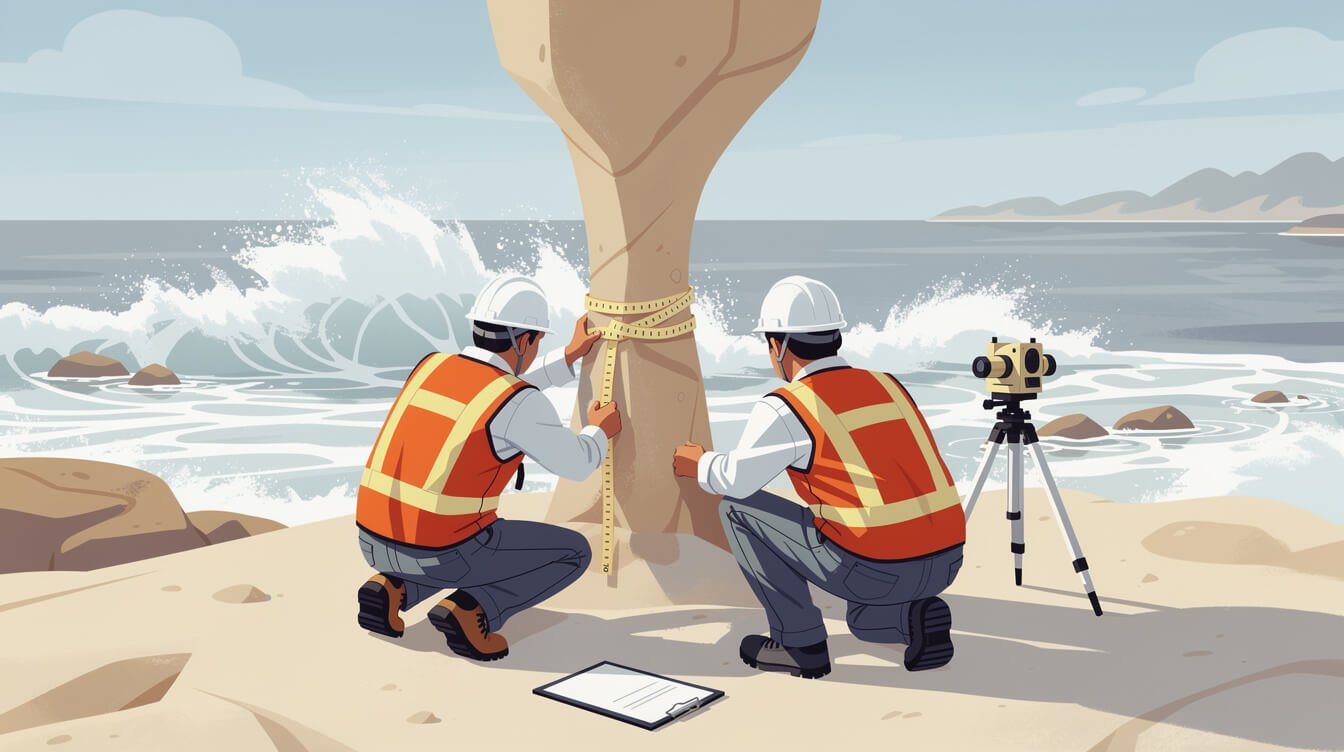
This is the question the park gets asked more than any other, and the honest answer is: eventually, yes, and nobody can tell you when.
What can be said precisely is how fast the neck is thinning, because the authorities have been measuring its circumference for decades. Here is the published series, with years attached — because an undated erosion figure is worthless, and there are a lot of undated erosion figures on the internet.
- 1960s–70s: roughly 220–240 cm
- 2008: 138.27 cm
- 2011: 132.45 cm
- 2013: 129.43 cm
- 2017: 125.01 cm
- 2020: 122.18 cm
- 2021: 120.49 cm
- 2023: 118.3 cm
- October 2024: 116.59 cm — the most recent official measurement
That is a loss of more than a metre of circumference in about three decades, averaging close to a centimetre a year. Salt spray, wind and the monsoon do the work; a slender sandstone neck holding up a heavy stone crown is, structurally speaking, a countdown.
The crack that went viral
In July 2025 a photograph of a long fissure at the back of the Queen’s neck spread across Taiwanese social media with a predictable headline attached. The park’s management and the director of the North Coast and Guanyinshan National Scenic Area Administration, Chen Yu-chuan, responded with the unglamorous truth: it is a natural weathering joint, it has been visible for years, and the monitoring data showed no expansion. Worth knowing before you see a scary photo and assume you have missed your chance.
What is actually being done about it
Two things, and the second one is genuinely interesting.
First, the defensive measure: touching has been banned since 2012, and the rate of weathering over the past decade has measurably slowed compared with the years before. Human hands were doing real damage. Back in 2009 the park spent about NT$1 million on a fibreglass replica of the Queen’s Head so visitors had something they were allowed to touch and photograph up close — a decoy queen, essentially. Replicating her by 3D printing has been floated by the scenic area administration as a way of preserving the current form, but it has not been carried out.
Second, the interesting one: a research team at the National Taipei University of Technology, led by Professor Yu Bing-sheng of the Department of Resources Engineering, has developed what they call a nature-mimicking sandstone strengthening technique. Rather than coating the rock in something that would change how it looks, a liquid consolidant is sprayed on and soaks into the stone, reinforcing it from the inside in a way that imitates how the rock naturally cemented itself in the first place. Comparative monitoring found treated faces weathering at roughly a tenth of the rate of untreated ones, and by the end of 2024 the technique had been extended to three formations in the park.
So: the Queen is not being saved, exactly. She is being given time. Which is a reasonable argument for visiting Yehliu Geopark, Taiwan, this year rather than in ten.
Beyond the Queen: what is in Yehliu’s three zones
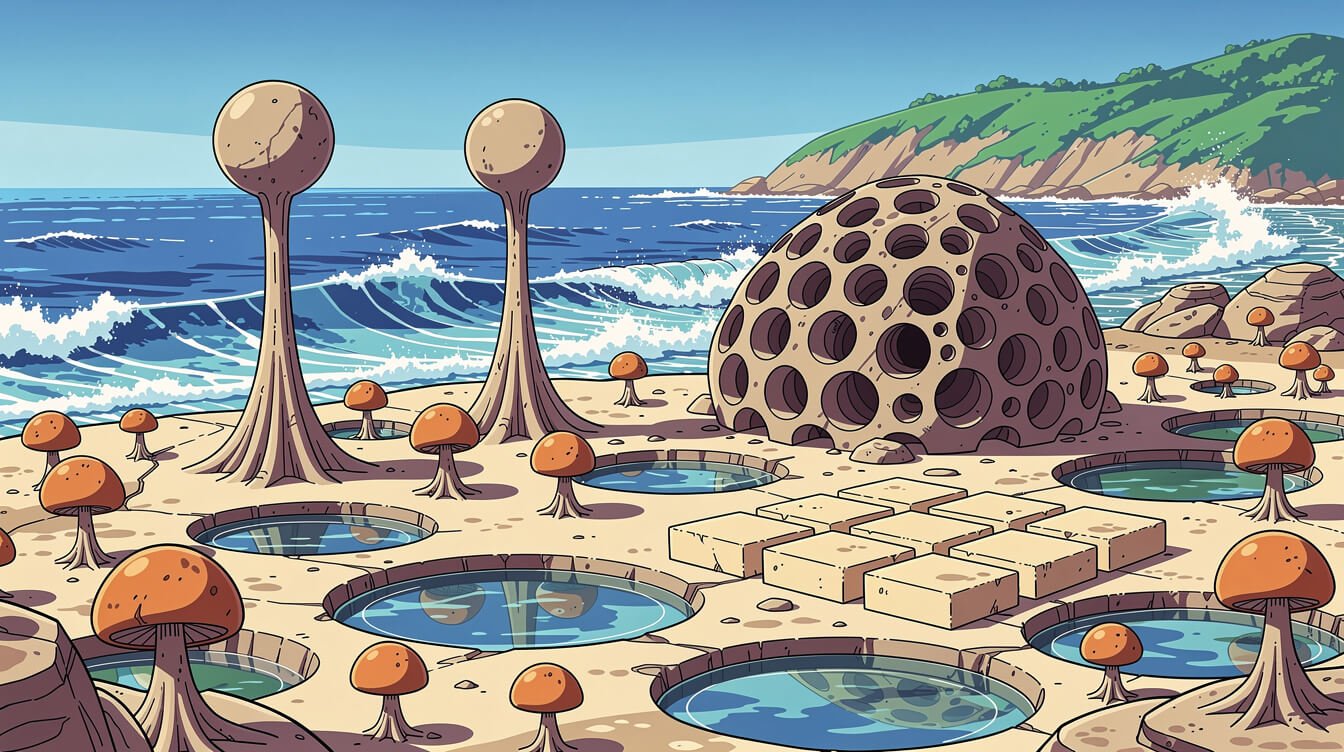
Yehliu Geopark, Taiwan, is laid out in three zones along the cape, and the single biggest mistake visitors make is treating Zones 1 and 3 as the walk to and from the Queen’s Head.
Zone 1 — the mushroom rock nursery
The first stretch is where the geology teaches. You can see mushroom rocks at every stage of their life here: no neck, thick neck, thin neck, and broken neck, all within a few dozen metres of each other. Once you have registered that sequence, the Queen’s Head stops being a curiosity and becomes a specific moment in a process. Zone 1 also holds the candlestick rocks — pillars with a hard stone ball seated in a ring-shaped moat at the top, which form in a way that looks engineered and is not — plus ginger rocks veined with cross-hatched fractures, the Ice Cream Rock, the Heart Rock, fossilised sea urchins, potholes, the Mazu Cave, and the Cute Princess.
Zone 2 — the celebrity zone
The Queen’s Head is here, and so is most of the crowd, but this zone is also home to the Fairy’s Shoe, Elephant Rock, Earth Rock, Taiwan Rock, Dragon Head Rock, and two formations named with the bluntness of a hungry nation: Pineapple Bun Rock and Barbecued Chicken Leg Rock. This is also where the trace fossils are — burrows and tracks left by marine creatures, preserved in the rock face — along with deep sea-erosion trenches cut along the joint lines.
Zone 3 — the one everyone skips
Past the Queen, the path continues onto the exposed outer cape, and the crowd thins dramatically. Zone 3 gives you Tofu Rock, the Marlin Bird Rock, Lover’s Cave, Twenty-Four Filial Piety Mountain, honeycomb rock riddled with hundreds of round hollows, tafoni weathering windows, and the broad wave-cut platform where you can watch the surf work on the stone in real time. It is wilder, windier and emptier, and it is where the light is best in the late afternoon.
One more thing to look for: a statue near the shore honouring Lin Tien-chen, a local fisherman who drowned in 1964 attempting to rescue a student who had fallen into the sea. Yehliu’s rocks are beautiful and the water below them is not friendly. The safety lines exist for a reason.
The cape is also a serious birdwatching site — it is a landfall point for migrants crossing the strait, and the birding community rates overcast, blustery days as the best. If your Yehliu day is grey, you have not been unlucky.
How to get to Yehliu Geopark, Taiwan, from Taipei

The park sits at No. 167-1, Gangdong Road, Yehliu Village, Wanli District, New Taipei City. It is not on the MRT and it is not on the railway. Every route involves a bus, a car, or a tour. These are the routes as published by the park itself.
By bus from Taipei
- Kuo-Kuang Bus 1815 — Taipei Main Station to the Jinshan Youth Activity Center. Get off at the Yehliu stop. This is the classic route and the one most visitors use.
- Keelung Bus 953 (from the NTU Computing Centre), 953 Express (from Taipei Tech) and 1068 (from National Taiwan University) all run toward Jinshan. Get off at the Yehliu Geopark stop.
Allow somewhere in the region of 70 to 90 minutes from central Taipei, plus a short walk from the stop to the gate. Traffic on Provincial Highway 2 is the variable, and it is worst on weekend afternoons.
By bus from Keelung or Tamsui
- From Keelung: Keelung Bus 790 toward Jinshan, alighting at Yehliu; or the 862, which runs the whole north coast between Keelung and Tamsui.
- From Tamsui: Tamsui Bus 716 — this is the Taiwan Tourist Shuttle Crown Northern Coast Line, and it terminates at the Yehliu Geopark stop. It is still running, and it is the most scenic approach by a wide margin. The 862 also serves the Yehliu stop from Tamsui.
By car, and parking
From National Freeway 1 take the Badu interchange, or from National Freeway 3 take the Jijin interchange, then join Provincial Highway 2 heading toward Jinshan. Coming from Taipei via Yangmingshan, the Yangjin Highway drops you at Jinshan and you follow the coast east. Parking at the park runs NT$50 per day on weekdays for a car and NT$30 per hour at weekends; coaches pay NT$150 per entry. Taxis can be arranged at the Visitor Center service desk for the return leg.
By organised tour
Every Taipei day-tour operator sells a Yehliu combination, usually paired with Jiufen and Shifen. It solves the transport problem in one purchase. The trade-off is that you will arrive inside the tour-bus window, which is precisely the window this guide is about to tell you to avoid.
One caveat on all of the above: bus route numbers and timetables in Taiwan do change. The routes listed here match the park’s official transportation page as of 24 September 2026, but check departure times on the day.
When to go: hours, tickets, and the tour-bus window
Opening hours and admission
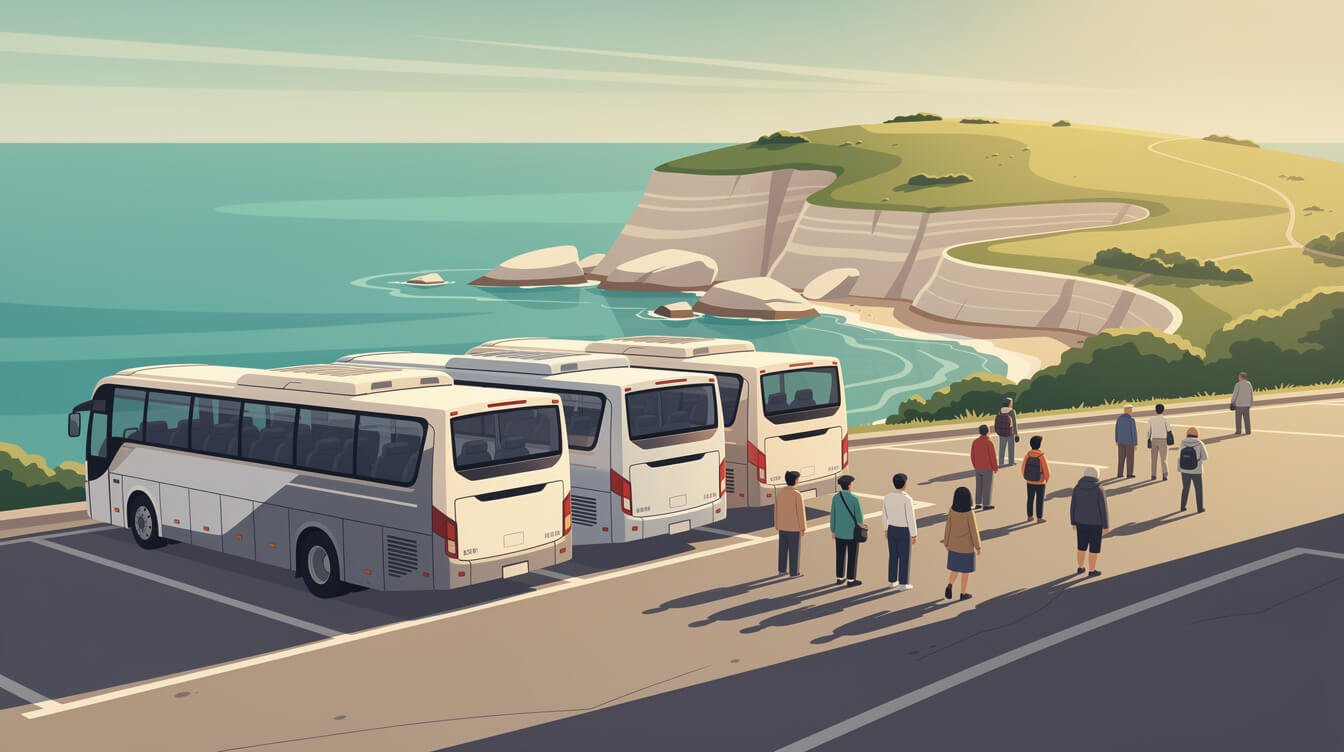
Yehliu Geopark, Taiwan, is open 08:00 to 17:00 year-round, with last ticket sales and last entry at 17:00. In summer that extends to 08:00 to 18:00, last entry 18:00.
Admission, verified on the official site on 24 September 2026:
- Full ticket: NT$120
- Concession: NT$60 — holders of a Taiwanese student ID, children aged 6 to under 12, anyone aged 65 or over regardless of nationality, and International Student Identity Card holders
- Group (30+): NT$96, or NT$48 for student groups
- Free: children under 6, residents of Wanli District, visitors with a disability card plus one companion, and licensed guides and tour leaders
The timing, which is the whole game
Gates open at 08:00. Coach tours leaving Taipei after a hotel breakfast need well over an hour to reach the coast, which puts the first serious wave through the gate mid-morning, and it does not really let up until the afternoon groups have cycled through. The implication is simple and it is the single most useful sentence in this guide: be at the gate at opening. You get the Queen’s Head with a handful of people instead of a queue, you get low golden light raking across the stone, and you are walking back to the car park as the first coaches are unloading into it.
The second-best window is the last ninety minutes before closing, when the coaches have gone and the light on the outer cape in Zone 3 is at its best.
Season, weather and closures
From roughly October to March the northeast monsoon batters this coast with wind and persistent drizzle. It is atmospheric and it is cold in a wet, penetrating way; bring a windproof layer. Summer is hot, humid and entirely unshaded on that pale rock platform — hat, water, sunscreen, no negotiation.
The critical caveat is typhoon season. The park closes whenever the New Taipei City government suspends work and classes, which is the standard trigger during a typhoon warning. If a storm is anywhere near northern Taiwan, check before you travel. Our Taiwan climate guide covers the typhoon calendar in detail.
Rules worth knowing before you are fined
The whole park is a no-drone zone and the penalty for flying one without authorisation starts at NT$300,000. Touching or climbing the formations carries fines up to NT$500,000, and crossing the safety line into the surf zone is also a finable offence. Smoking is banned throughout. None of this is theoretical — the signage is explicit and the staff enforce it.
The one that is only on at night
Once a year the park stays open after dark for Yehliu Stone Light: Night Visit to the Queen (野柳石光・夜訪女王), a projection-mapping and light-sculpture event that runs the Queen’s Head and the surrounding formations through an illuminated show. The 2026 edition was its eighth year and ran from 28 June to 12 July, 18:30 to 21:00, with 3,000 tickets a night across two entry sessions and prices around NT$225 on weekdays and NT$250 at weekends. If your trip lands in early summer, check whether the dates have been announced — it sells out, and almost no English-language guide mentions it exists.
Make it a north-coast day: Yehliu, Jiufen and Shifen
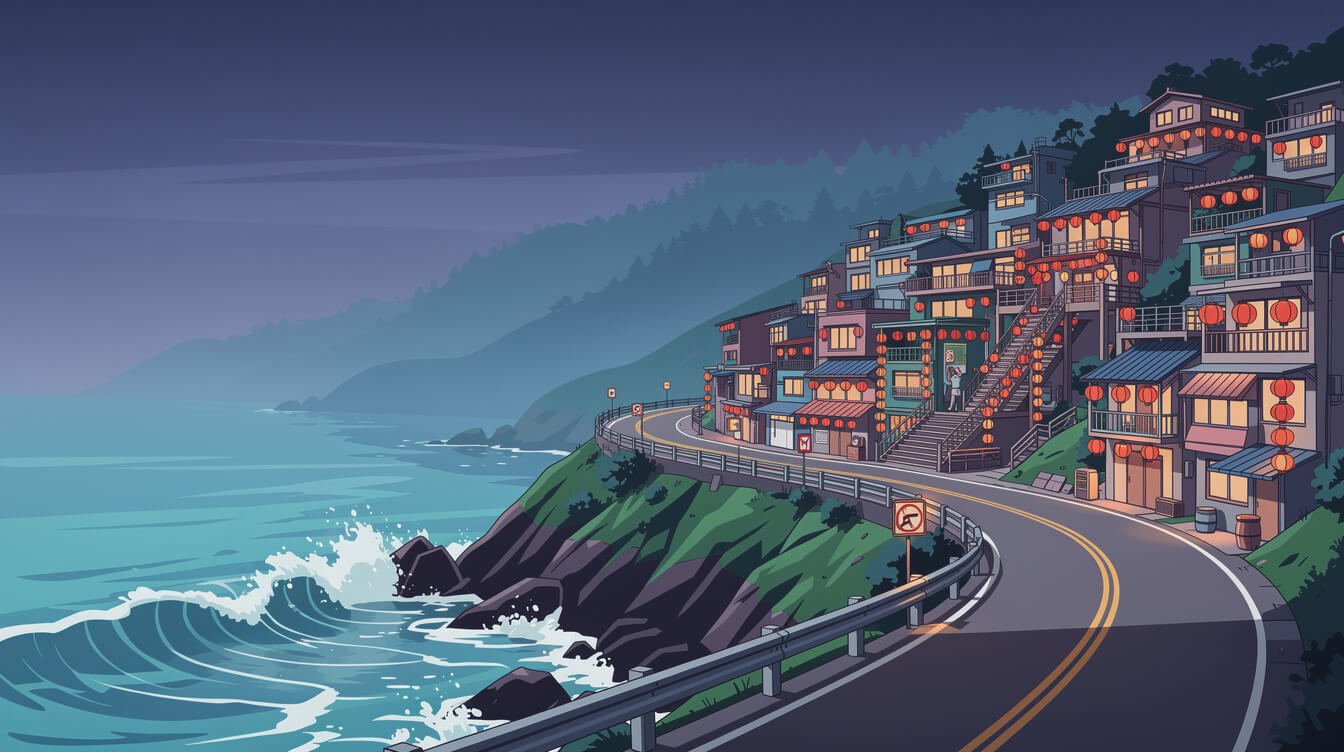
Because Yehliu takes 90 minutes, the only sensible way to visit is as one movement in a longer day. The north coast and the mountains behind it hold three of Taiwan’s most photographed places within an hour of each other, and the order you do them in matters more than most people realise.
The order that works
- 08:00 — Yehliu Geopark. Gate at opening, Queen’s Head with no queue, all three zones, out by 09:30.
- 10:30 — Shifen. Inland into the Pingxi valley for the waterfall and the old street where the trains run between the shopfronts. Our complete guide to Shifen Waterfall covers the approach and the best viewing platforms, and if you want to release a sky lantern this is where you do it — the story of how the sky lantern went from a Qing-dynasty distress signal to a tourist ritual is worth reading first.
- 15:00 — Jiufen. Up the mountain for the late afternoon, and stay for the lanterns coming on at dusk. This is the correct ending to the day, and it is why you do not do Jiufen first. Our Jiufen guide unpacks the gold-rush history, the A City of Sadness connection, and the Spirited Away myth that will not die.
If you are in Taiwan in February, the Pingxi Sky Lantern Festival transforms the middle leg of this itinerary entirely. And if you are still assembling the wider trip, our Taiwan trip planner handles costs, routing and how many days the island actually needs.
Other pairings
Yehliu also slots neatly into a Yangmingshan day — the Yangjin Highway drops over the mountains and lands you at Jinshan, ten minutes from the park — or into a Keelung run for Heping Island and the night market. For a straight comparison of Taiwan’s landscape heavyweights, our Taroko Gorge guide covers the east coast alternative, and Elephant Mountain is the version of this you can do in a morning without leaving Taipei.
A north-coast day like this is the one people frame afterwards. If you want it on a wall rather than just a camera roll, our Jiu-fen Taiwan Night Market Canvas Wall Art captures the red-lantern light on those stacked hillside alleys — the exact view you will be standing in at the end of this itinerary.
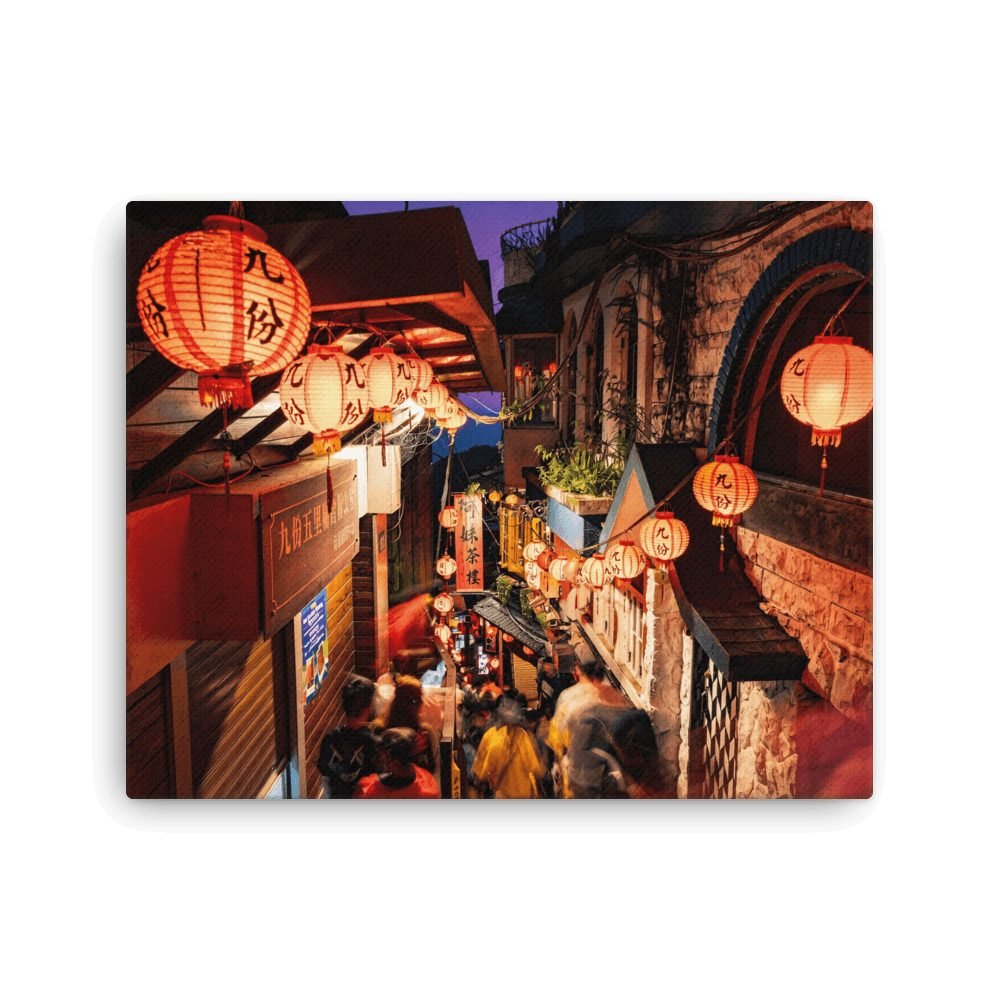
Put the North Coast on Your Wall
Red lanterns, stacked stone alleys, mountain mist — the Jiu-fen Taiwan Night Market canvas is the end of the perfect north-coast day, printed big enough to live with.
Yehliu Geopark Taiwan: frequently asked questions
How long do you need at Yehliu Geopark?
Sixty to ninety minutes covers all three zones at an unhurried pace. Two hours if you are photographing seriously or the Queen’s Head queue is long. It is not a half-day site.
How much is the entrance fee?
NT$120 for a full ticket, NT$60 concession for students, children aged 6 to 11, over-65s and ISIC holders, and free for under-6s, Wanli residents and visitors with a disability card plus one companion. Verified on the official site on 24 September 2026.
What time does Yehliu Geopark open?
08:00, closing at 17:00 year-round with last entry at 17:00, extended to 18:00 in summer. Arriving at 08:00 is the difference between a photograph and a queue.
Is the Queen’s Head going to fall?
At some point, yes. Its neck circumference has gone from around 220 cm in the 1990s to 116.59 cm as of the October 2024 measurement, thinning by roughly a centimetre a year. No geologist will give you a date. Reinforcement work by a Taipei Tech team has cut the weathering rate on treated formations to about a tenth of the untreated rate, so the timeline is being stretched — but it is not being stopped.
Can you touch the Queen’s Head?
No. It has been prohibited since 2012, it is enforced, and the ban is a significant part of why the erosion rate has slowed over the past decade. There is a fibreglass replica in the park for exactly this urge.
Can you get to Yehliu Geopark by MRT?
No. The nearest options are the Kuo-Kuang 1815 or Keelung Bus 953 and 1068 from Taipei, the 790 or 862 from Keelung, or the 716 Crown Northern Coast shuttle from Tamsui. There is no rail connection to the park.
Is Yehliu worth it in the rain?
Often it is better. Grey, blustery weather suits the geology, thins the crowds and is prime time for the migratory birds that make landfall on the cape. Bring a waterproof shell rather than an umbrella — the wind will destroy the umbrella.
Can you fly a drone at Yehliu Geopark?
No. The entire park is a no-fly zone and unauthorised drone operation carries fines starting at NT$300,000. Only government bodies, schools and legal entities on official business can apply for permission.
Final thoughts: go while she is still standing
Yehliu Geopark, Taiwan, is a small place that rewards a specific kind of visitor — the one who turns up at eight in the morning, walks all three zones instead of sprinting to the famous rock, and then gets back in the car and does something else with the rest of the day.
What makes it worth the early alarm is not really the strangeness of the rocks, remarkable as they are. It is that you are watching a process with a visible clock on it. The Queen’s Head got its face in 1962, lost a metre of neck over the following six decades, and is currently being kept upright by a sprayed consolidant developed by engineers in Taipei who decided a rock shaped like a woman’s profile was worth the research budget. That is a very Taiwanese story: pragmatic, slightly obsessive, quietly sentimental about something with no economic purpose whatsoever.
Go early. Bring a jacket. Look at the mushroom rocks in Zone 1 before you look at the famous one, so you understand what you are seeing. And then get up the mountain to Jiufen in time for the lanterns.
A Postcard From Taiwan, Every Week
Culture, food, travel intel and first look at new designs — straight to your inbox. No spam, just Taiwan.

Grab a Free Taiwan Sticker!
Drop your email and we’ll send you a limited-edition Taiwan sticker — plus insider access to new merch drops and island vibes.
No spam. Unsubscribe anytime.