The Taiwan Matsu Islands: Where Taiwan Looks More Like Fujian — Blue Tears, Military Tunnels, and Wild Sika Deer
The Taiwan Matsu Islands are the strangest part of Taiwan you’ve probably never heard of. From the air they look more like a scattering of green knuckles than a single place — 36 islands hurled into the East China Sea, only nine of them inhabited, the closest one sitting just 9 kilometers off the coast of Fujian province in mainland China while the nearest part of Taiwan itself is more than 150 kilometers away. People here speak Mindongyu (Eastern Min, the Fuzhou dialect), build their houses out of granite block in the East Fujian style, and warm up winter nights with rice wine the local distillery aged in old military tunnels. None of it looks like the Taipei you saw on Instagram.
And yet this is one of the most quietly magical corners of Taiwan. Every spring and summer the shoreline ignites in glowing electric-blue waves — the famous Blue Tears bioluminescence — and the rest of the year, the islands trade entirely on their other secret weapons: cathedral-sized sea tunnels carved by soldiers, wild Formosan sika deer that wander the abandoned grasslands, and stone fishing villages so cinematic that Taiwanese honeymoon couples plan whole trips around them. This is the complete guide to visiting the Taiwan Matsu Islands in 2026 — how to get there, what to see, when to go, and why this overlooked archipelago might be the most surprising trip you take all year.
Where the Taiwan Matsu Islands Are — and Why They Look More Like Fujian
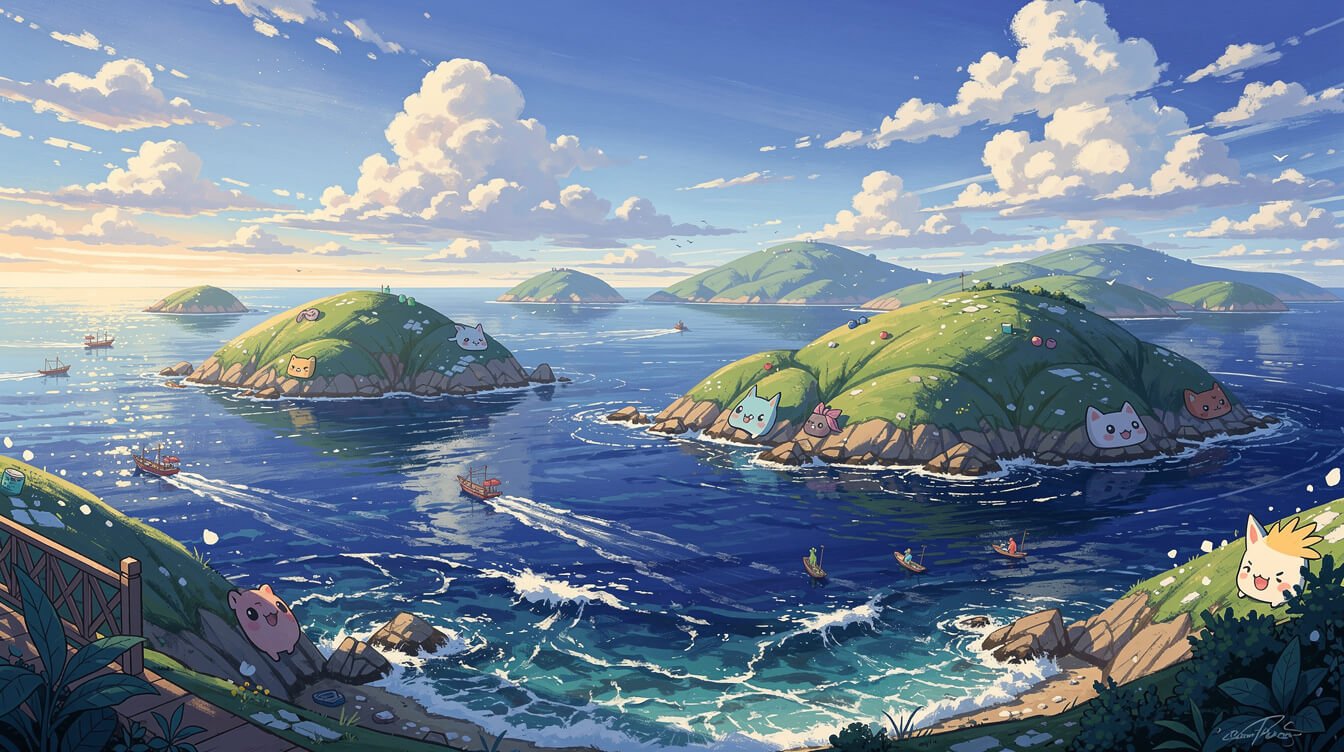
Officially the Matsu Islands are Lienchiang County (連江縣), one of the smallest county-level administrative regions in the Republic of China. The archipelago is split into four township groups — Nangan, Beigan, Juguang (which covers Dongju and Xiju), and Dongyin — but in practice almost all visitors land on Nangan and Beigan, hop across to Daqiu for a day, and if they have extra time, take an overnight ferry up to Dongyin. The population sits at roughly 14,000 people, which means there are days when the sika deer outnumber the humans you’ll see on the road.
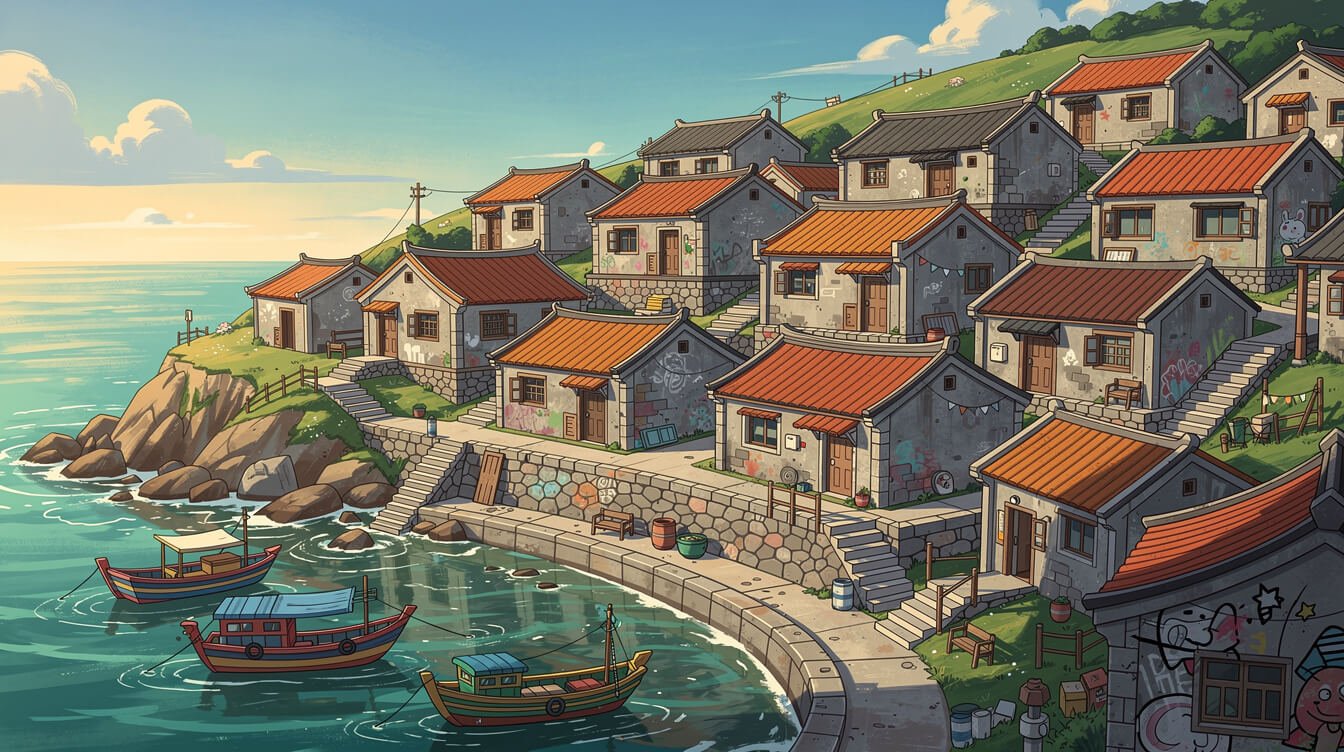
The cultural fingerprint here is what makes the Matsu Islands feel like another country once you arrive. The original settlers were fishermen from Fuzhou across the strait, and the islands quietly absorbed that culture for centuries before mainland politics caught up. You can still hear it: the everyday spoken language across the archipelago is Mindongyu (Eastern Min), not the Hokkien-derived Taiwanese you’d hear in Tainan or the Mandarin of Taipei. You can also see it in the architecture — every village center has the unmistakable East Fujian houses built from local granite, with stepped fenghuoqiang (“fire wall”) gables that look like a row of stylized seahorses against the sky. Most famously, the village of Qinbi on Beigan island is an entire preserved hillside of these stone houses cascading down to a turquoise cove, and it’s the single image most associated with Matsu in tourism brochures.
Politically, this is also where Taiwan’s geography stops making sense. The Matsu Islands were the northernmost front line of the Cold War standoff between the Republic of China and the People’s Republic across the strait — close enough to mainland China that you can see Fujian’s coastline on a clear day. The military presence shaped everything: the tunnels, the lookouts, the abandoned bunkers turned into art galleries, even the famous distillery that ages liquor inside a former weapons cache. For more context on the broader Taiwan-China geography, our Taiwan Strait map guide walks through how all of this fits together.
How to Get to the Taiwan Matsu Islands in 2026
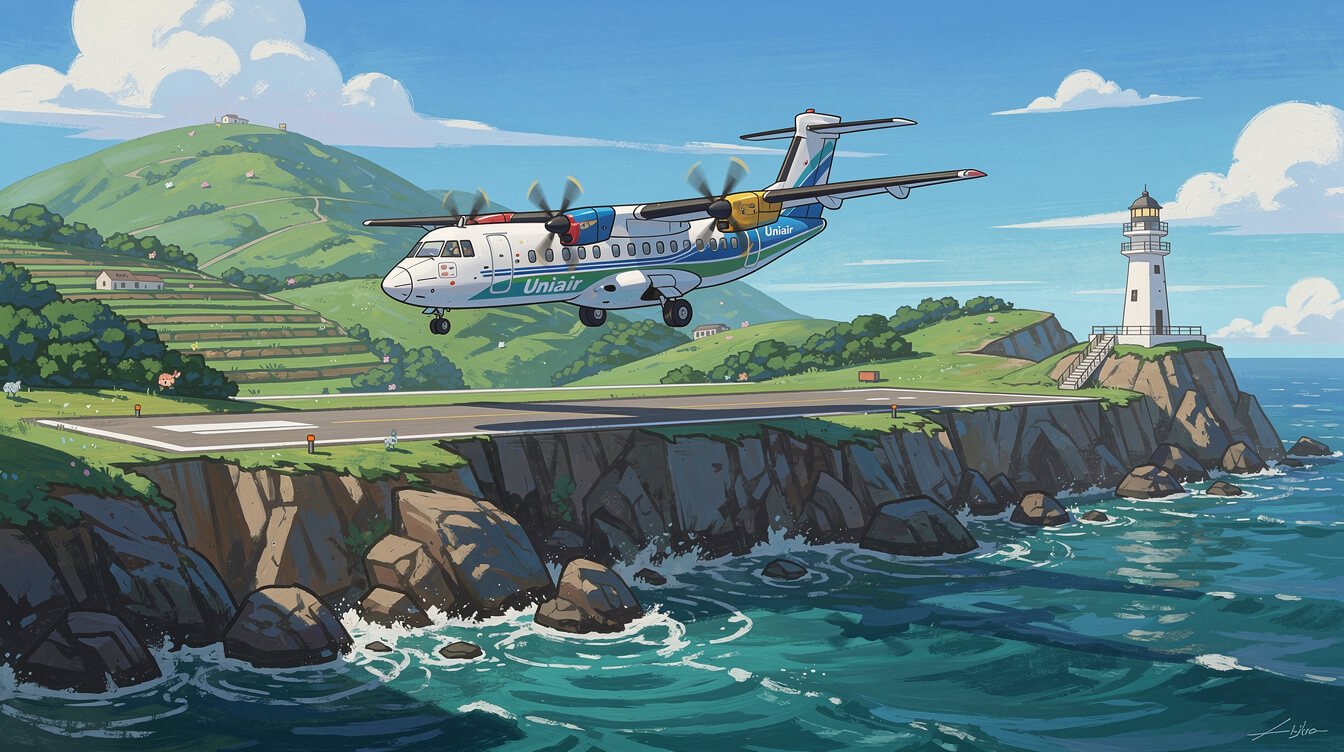
There are exactly two ways to reach Matsu from the rest of Taiwan: a short flight or a long ferry, and which one you pick mostly depends on whether you trust the weather. UNI Air (Uniair, the regional subsidiary of EVA Air) runs the only scheduled flights into the archipelago, departing from Taipei Songshan Airport (TSA) to one of three Matsu airports — Nangan Airport (LZN), Beigan Airport (MFK), and Dongyin’s small Dongyin Airport (although the most reliable schedules are to Nangan and Beigan). Flight time is about 55 minutes, fares typically run between TWD 2,500 and TWD 3,200 one-way, and there are usually four to six daily rotations across the two main islands.
The catch is the weather. Matsu has a notoriously fickle microclimate — heavy sea fog rolls in unannounced, particularly in April, May, and early June — and Uniair will cancel a flight rather than land in low visibility. Locals casually refer to “fog days” the way Taipei residents talk about typhoons. The unofficial rule is: build at least one extra buffer day into either end of your trip if you’re flying. If you only have a fixed three-day window, you may end up stranded on the wrong side of the strait.
The fog-proof alternative is the Taima Star (台馬輪) overnight ferry from Keelung Port on the north coast of Taiwan. It leaves around 9:50 PM and arrives in Nangan around 6 AM the next morning, with onward connections to Dongyin. A standard cabin runs around TWD 1,200, and although it’s a long night at sea, it’s reliable in conditions that ground the planes. There’s also a fast ferry — the Hsin Hua Lung — that connects Nangan, Beigan, and Dongyin in a couple of hours, useful for inter-island day trips. Once you’re on the islands, the easiest way to get around is a scooter rental (TWD 400–500 per day), which you can book at the airport with an international driving permit. Local buses exist but run on island time. For more on how Taiwan’s transportation networks connect across the country, see our Taiwan High-Speed Rail map guide.
Blue Tears: Matsu’s Most Magical Phenomenon
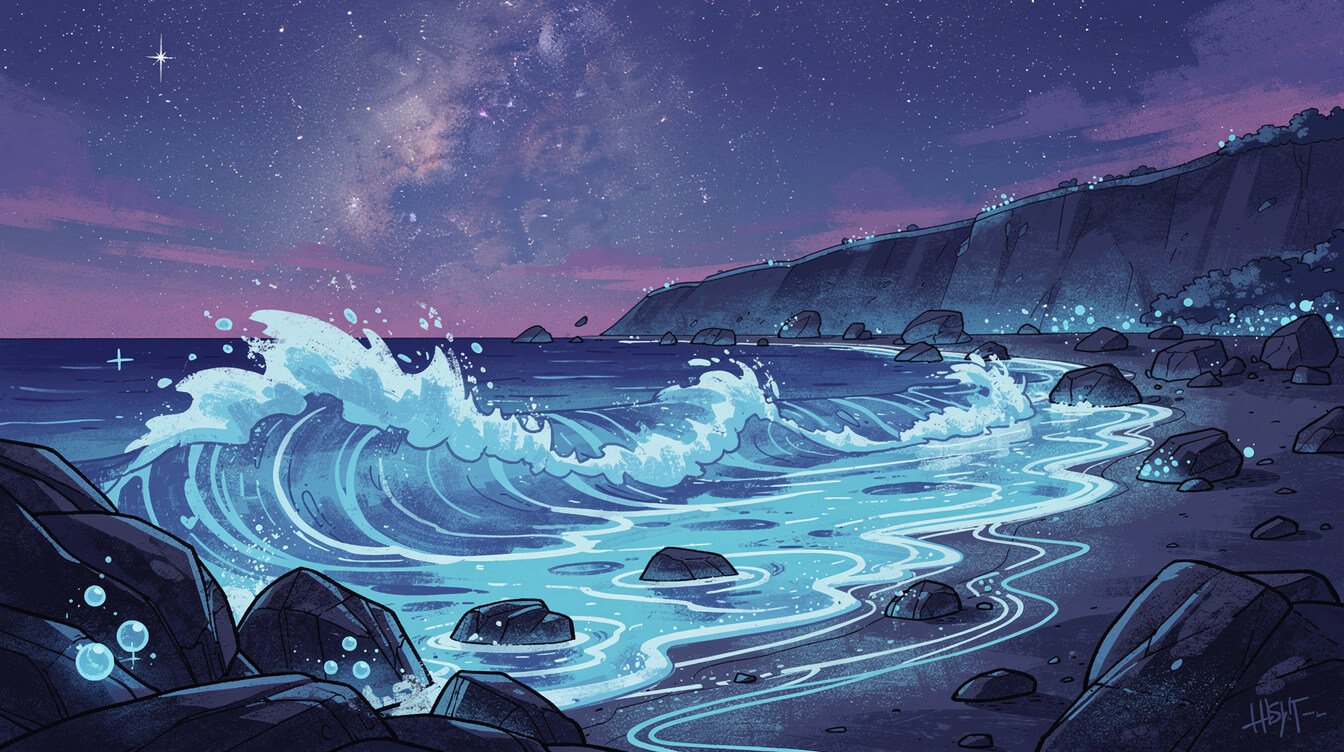
If you have heard of Matsu, this is probably why. Every spring and summer, the dark coastlines of the archipelago light up with electric-blue waves so vivid they look digitally edited. The phenomenon is called Blue Tears (藍眼淚, lán yǎn lèi), and it’s the result of a particular marine dinoflagellate called Noctiluca scintillans — a single-celled plankton that emits cold blue light when disturbed by motion. Drop a stone, drag a stick, watch a wave break: the water ignites like fireworks for a second and then fades back to black.
Matsu isn’t the only place on Earth where Blue Tears occur, but it’s arguably the most reliable. The peak window runs from mid-April through early September, with the strongest displays typically in May, June, and July. Conditions matter: you need a moonless or low-moon night, calm winds, and a beach or rocky cove with no light pollution. Locals recommend checking the lunar calendar before booking — you want the days closest to a new moon.
The best Blue Tears spots on Nangan are Da’ao (大澳) Beach and the area around Beihai Tunnel, which runs nighttime kayak and paddleboard tours through the tunnel itself when the season is active. On Beigan, the coastline around Qinbi village and Qiaozai Beach (橋仔) consistently delivers. For a deep dive into the science and the legend, we’ve already covered Matsu’s most famous trick in detail in our Taiwan Blue Tears guide — read it before you go so you know what to look for.
One quick warning: do not expect every night to deliver. The plankton are wild and the conditions are fickle, and even peak-season visitors sometimes go home empty-handed. The Lienchiang County tourism office posts a daily Blue Tears forecast on their official Facebook page during the season, and most homestays will check it for you in the evening so you know whether to set an alarm.
Beihai Tunnel and the Cold War Legacy

The single most jaw-dropping sight on the Matsu Islands is Beihai Tunnel (北海坑道) on Nangan — a cathedral-sized sea tunnel carved by hand into solid granite cliff between 1968 and 1971 by Republic of China military engineers and soldiers. It was designed to hide patrol boats from spotter aircraft, a 700-meter A-shaped passage tall enough to shelter a small flotilla. Today it’s one of Taiwan’s most photographed attractions and the calmest, eeriest place you’ll see all year.
You can visit Beihai Tunnel two ways. During daylight low tide, there’s a walking platform along the inside of the tunnel that lets you stroll the full length on foot. But the real experience is the nighttime rowboat tour, where a guide poles you slowly through the tunnel in pitch darkness while you trail your hand in the water — and if the season is right, the wake of the boat ignites in glowing blue Blue Tears as you move. It is one of the most surreal travel experiences you’ll have anywhere in Asia. Bookings are made on-site at the tunnel entrance the same day; expect TWD 350 per person, and arrive before sunset to claim a slot.
Beihai isn’t the only military leftover open to visitors. Andong Tunnel (安東坑道) on Dongyin is even bigger — a labyrinth of underground galleries, a pig farm built underground to feed the garrison during siege, and panoramic firing-slit windows looking out at the open sea. Iron Fort (鐵堡, tiěbǎo) on Nangan is a small clifftop pillbox carved into a sea stack with hidden sleeping quarters for the soldiers who manned it. And Dahan Stronghold (大漢據點) is now an open-air museum where you can walk down into preserved barracks. None of this would exist if Matsu hadn’t spent 40 years as a forward military outpost — and now that the soldiers are mostly gone, it’s all yours to explore.
If you want to wear the spirit of Taiwan-island travel before, during, and after your trip, our Formosa Black Bear Taiwan Pride T-Shirt has become a quiet favorite for Matsu trips — the minimalist mountain design pairs well with island weather and won’t wrinkle in a backpack.
The Sacred Side: Mazu Statue and Local Temples
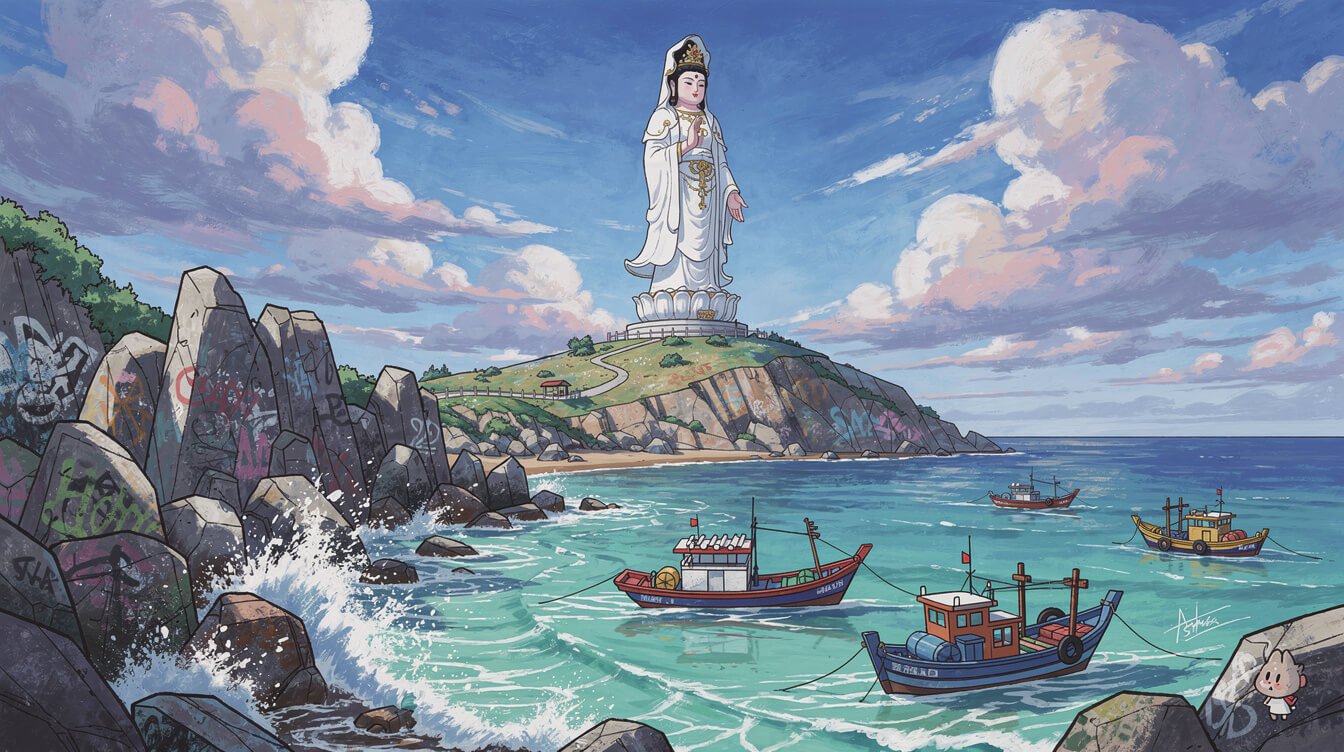
Here is the part most visitors miss: the islands are named after a person. Mazu (媽祖) is the Chinese sea goddess, the protector of fishermen, and one of the most widely worshiped folk deities across coastal China, Taiwan, and the Chinese diaspora. According to local legend, her body washed ashore on Nangan island after she drowned saving her father from a storm at sea — and the small bay where she came to rest is the original Mazu Temple, still standing today in the village of Magang on Nangan. The “Ma” in Matsu is the “Ma” in Mazu. The islands carry her name.
The signature image of Nangan is the Giant Mazu Statue at Tianhou Temple — a 28.8-meter-tall granite figure of the goddess looking out over the bay, surrounded by 365 carved stone panels (one for each day of the year). The number 28.8 is deliberate: it matches the total area of the Matsu Islands in square kilometers. Locals leave offerings of fruit and Kaoliang sorghum liquor at her feet, and weddings are routinely held in the plaza below. It’s free to visit, open daily, and the views from the summit are some of the best on the island.
Around the archipelago there are dozens of smaller folk temples, almost all of them painted in bright primary colors that pop against the granite hillsides. The most cinematic is the small Mazu temple in Qiaozai village (橋仔村) on Beigan — a settlement so small it has more temples than houses, which locals will cheerfully tell you is because every fishing family built their own shrine. If you’re at all interested in folk religion, the Matsu Islands are a living, breathing version of practices that have mostly disappeared from urban Taiwan. For a wider look at religious life on the main island, our Taiwan temples guide sets the broader context.
Daqiu Island and the Wild Sika Deer

Between Nangan and Beigan there’s a small uninhabited island called Daqiu (大坵) — a 0.4 square kilometer green dot that, sometime in the 1980s, the local government decided to repopulate with Formosan sika deer. The military post on Daqiu had been abandoned, the human residents had moved away, and someone proposed turning the island into an eco-tourism experiment. Forty years later, the herd has expanded to roughly 80 deer, and they roam freely across the entire island. You arrive by short ferry from Beigan or Nangan, walk a 90-minute loop trail past the old military bunkers and through grasslands, and the deer come to you. Bring a phone for photos, not snacks — visitors are asked not to feed them.
The boat to Daqiu runs daily during high season (May through October) from Qiaozai Harbor on Beigan and takes about 15 minutes each way. It’s typically TWD 350 round-trip, and most operators give you about two hours on the island, which is more than enough for the trail loop. Combine it with a half-day in Qinbi village and you have one of the most magical days on offer anywhere in Taiwan — stone-house architecture in the morning, wild deer and ocean views in the afternoon. There’s no food, no shop, and no shelter on Daqiu, so pack water and a hat.
One thing to know: the deer are wild, not tame. They’ll let you get within a few meters for a photo, but they’ll also bolt without warning. Move slowly, stay on the trail, and the experience tends to be calm and genuinely magical. This is probably the closest you’ll come in your life to wandering an abandoned island that nature has quietly reclaimed.
What to Eat in the Matsu Islands

The cuisine in Matsu is unlike anywhere else in Taiwan, because it’s mostly Fujianese with strong military-era influences and an oversized dependence on seafood. The headline ingredient is red yeast rice (紅糟, hóng zāo) — a fermented byproduct of the local rice-wine industry that locals use to marinate pork, chicken, and even fried rice. Hongzao chicken (紅糟雞) and hongzao pork (紅糟肉) are on almost every restaurant menu on Nangan, and the dishes have a distinctive sweet-savory depth that you simply cannot replicate elsewhere in Taiwan.
The other Matsu specialty is laobing (老酒麵線), a noodle soup made with thin wheat misua noodles cooked in rice wine, ginger, and sesame oil — eaten as comfort food, postpartum recovery food, and hangover food in roughly equal measure. Add the local fish noodle soup (魚麵線), which uses noodles made entirely from pounded fish paste rather than flour, and you have two dishes that genuinely don’t exist on the main island of Taiwan.
The wildcard is Matsu Kaoliang Liquor (馬祖高粱酒), the local sorghum spirit. The Matsu distillery (closely related to but distinct from the more famous Kinmen Kaoliang) ages its premium bottles inside an old military tunnel, where the cool stable temperature mellows the spirit over decades. Visit the distillery on Nangan for a free tasting — they’ll pour you anything from a fresh 38-proof to a 30-year-aged bottle that costs as much as a flight home. A bottle of Matsu Kaoliang is the single most-purchased souvenir from the islands, and you’ll see Taiwanese visitors leaving the airport with shopping bags full. For more on Taiwan’s wider drinking culture, our Kavalan whisky guide is the natural follow-up.

Heading to Matsu? Wear the Taiwan Pride.
Every Matsu trip starts at Taipei Songshan Airport. Our I Love Taipei Travel Pride Tee is the perfect outfit for your flight out and your fishing village photos when you land.
Best Time to Visit Matsu and Frequently Asked Questions
The best time to visit the Matsu Islands depends almost entirely on what you’re after. If Blue Tears are the reason you’re going, target late April through early August, with the absolute peak typically in May, June, and the first half of July. If you’re more interested in beaches, hiking, and the deer on Daqiu, the summer window from June through September delivers the most reliable weather — warm and dry — but it’s also typhoon season, so check forecasts before locking in flights. The shoulder month of October is a quietly underrated time to go: the worst of the typhoon risk has passed, temperatures are mild, and crowds thin out dramatically.
Winter on Matsu (December through February) is genuinely cold by Taiwan standards — the islands sit right in the path of the northeast monsoon, and the wind off the East China Sea cuts hard. Most visitors avoid it. The other tough window is the plum rains season from late May through mid-June, when fog and drizzle can ground flights for days. If you can be flexible on dates, plan around new-moon nights in the May–July range and you’ll thread the needle perfectly. For a deeper look at Taiwan’s regional climate variations, see our best time to travel to Taiwan guide.
How many days do you need in the Matsu Islands?
Three nights is the absolute minimum — two on Nangan and one on Beigan — and four nights is much better, giving you buffer for fog-delayed flights and a real chance at Blue Tears. Day trips from Taipei are not realistic.
Do I need a visa to visit the Matsu Islands?
No special permit. Matsu is part of Taiwan (Republic of China), so your standard Taiwan entry (visa-free for most Western passport holders for 90 days) covers it. You just need an ID for domestic flights.
Can I see China from the Matsu Islands?
Yes — on a clear day, the coastline of Fujian province is visible from multiple lookouts on Nangan and Dongyin. The closest island, Liang Island, is only 9 kilometers from the mainland Chinese coast.
Is English spoken in the Matsu Islands?
Limited. Younger homestay owners and tour operators often speak some English, but signage, menus, and most older residents speak Mindongyu and Mandarin. Download Google Translate’s offline Chinese pack before you go.
Are the Matsu Islands safe to visit?
Extremely. The military presence is minimal today, crime is virtually nonexistent, and the biggest risk is twisting an ankle on a hiking trail. Solo travelers in particular report it as one of the easiest destinations in Asia.
What should I pack for a Matsu trip?
Layers (the weather shifts fast), a flashlight or headlamp for Blue Tears nights, a power bank for long boat tours, motion-sickness medication for the ferry, and cash — many small homestays and food stalls don’t take cards.
Final Thoughts: Why Matsu Belongs on Your Taiwan Bucket List
The Matsu Islands are not for everyone, and that’s exactly the point. There are no night markets the size of Shilin, no MRT, no 24-hour 7-Eleven on every corner. What you get instead is something Taiwan has very little of left: a place where the original culture still feels intact, where the landscape still feels wild, and where the line between past and present is unusually thin. You walk into a tunnel carved by soldiers in 1968 and ride a boat through it while the water glows blue beneath you. You eat noodles invented by Fuzhou settlers four generations ago in a village where the houses look like they were imported from across the strait. You watch wild deer wander an island that was a military post within living memory.
If you have the flexibility to spare a few days, the Matsu Islands deliver one of the most distinctive trips in Asia — and they’re a four-hour ferry or a 55-minute flight from one of the world’s most underrated capital cities. Go now, before the secret gets out. The Blue Tears are already glowing.
Get More Stories Like This in Your Inbox
Join our weekly newsletter for the deepest dives into Taiwan culture, food, hidden destinations, and the stories most travel guides skip. No spam, just love letters from the island.

Grab a Free Taiwan Sticker!
Drop your email and we’ll send you a limited-edition Taiwan sticker — plus insider access to new merch drops and island vibes.
No spam. Unsubscribe anytime.