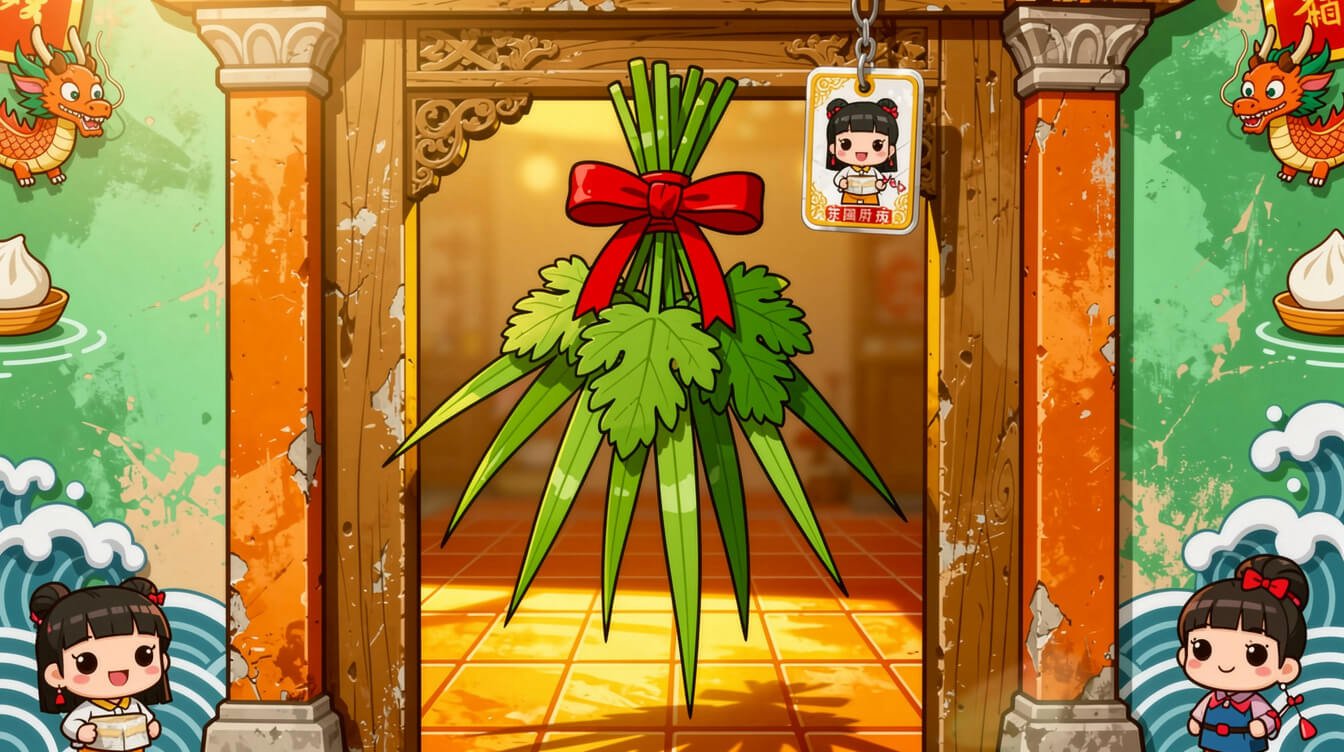
Taiwan Dragon Boat Doorways: Why Mugwort and Calamus Hang Above Every Threshold Today
Walk past any Taiwanese house, temple, or noodle shop today — June 19, the actual day of Dragon Boat Festival (端午節) — and you’ll spot something hanging over the doorway that wasn’t there yesterday: a small bouquet of long green leaves, usually tied with bright red string. Look closer and you’ll see two plants doing most of the work: tall blade-like calamus (菖蒲) and feathery, silver-tinged mugwort (艾草, also called Chinese wormwood). Many homes add three more — pomegranate branches, garlic bulbs, and banyan leaves — to round out what locals call the “five-thread bouquet.”
It’s one of the most visible and least talked-about rituals of Dragon Boat Festival, and it’s been happening above Taiwanese doors for roughly 2,000 years.
What the plants are supposed to do
Old Chinese almanacs marked the fifth day of the fifth lunar month as the start of the most dangerous stretch of the year — the deep heat when “the five poisons” (五毒) emerge: snake, scorpion, centipede, toad, and gecko. Subtropical Taiwan, where the méiyǔ plum rains have just ended and the real heat is rolling in, makes that warning feel less superstitious than it sounds. Mosquitoes explode in June. Snakes do come down out of the hills. Mold blooms on damp walls overnight.
The mugwort-and-calamus bouquet was the original household defense. Calamus leaves were said to resemble a sword — symbolically slicing evil energy at the door. Mugwort, with its dense aromatic oils, was hung to fumigate the entryway. Pomegranate and garlic added their own pungency, and banyan — the most sacred tree in Taiwanese folk religion — invited ancestral protection.
The Madame White Snake connection
If you’ve ever watched a Taiwanese opera or a TVB drama, you know Madame White Snake (白蛇傳) — the millennium-old love story of a snake spirit who transforms into a beautiful woman and marries a young scholar. The pivotal scene happens on Dragon Boat Festival: her husband convinces her to drink realgar wine, the bouquet’s traditional drinking partner, and she briefly reverts to her snake form. The story is the reason both realgar wine and the calamus-sword above the door are still hung today. The plants are there to make sure the snakes — literal and metaphorical — stay outside.
The science isn’t actually nonsense
Here’s the part that surprises people: modern entomology backs up the tradition more than you’d expect. Artemisia argyi, the mugwort species used in Taiwan, contains thujone, camphor, and 1,8-cineole — compounds that are genuinely repellent to mosquitoes, flies, and several beetle species. Calamus root (Acorus calamus) contains β-asarone, which has documented insecticidal activity. Two thousand years before DEET, Taiwanese grandparents were essentially hanging a slow-release insect repellent at the front door at the exact moment the season’s worst pests arrived.
How it actually plays out in Taiwan today
In rural Taiwan and the older neighborhoods of Tainan, Lukang, and Sanxia, the tradition is still everywhere — you can buy a ready-tied bundle for NT$50–100 at any traditional market on the morning of the festival. In Taipei, supermarkets like Carrefour and PX Mart sell pre-made versions next to the zongzi displays. Many families also tuck a smaller bundle into kids’ bedrooms or hang it in the kitchen.
The bouquet stays up until it dries completely — usually a week or two. Some Taiwanese keep the dried mugwort and burn small pinches of it through the summer (it works as natural mosquito incense), or save it for the aijiao footbath, a folk-medicine soak said to ease postpartum recovery.
If you want to do it yourself
You don’t need to be in Taiwan. Mugwort grows as a weed in most of North America and Europe. Cut a small bundle, tie it with red string alongside any tall blade-leafed plant (iris leaves work as a calamus substitute), and hang it above your front door before sunset today. It’s the kind of micro-ritual that takes thirty seconds, costs nothing, and connects you to a chain of households doing the exact same thing across Taiwan, China, Vietnam, and the global diaspora — all marking the same single day on the lunar calendar.
For the rest of the story — the dragon boat races, the white-snake noon, the zongzi that started this whole thing — see our full Dragon Boat Festival 2026 guide, and pair it with today’s noon-water ritual at exactly 12:00 PM for the full at-home version.
The takeaway: The little green bouquet over a Taiwanese door isn’t decoration. It’s a 2,000-year-old combination of folk pharmacy, snake-spirit folklore, and seasonal common sense — and today is the one day a year it goes up.

Grab a Free Taiwan Sticker!
Drop your email and we’ll send you a limited-edition Taiwan sticker — plus insider access to new merch drops and island vibes.
No spam. Unsubscribe anytime.