Did You Know? Taiwan’s Temple Door Gods Get Temps When They Go on Leave
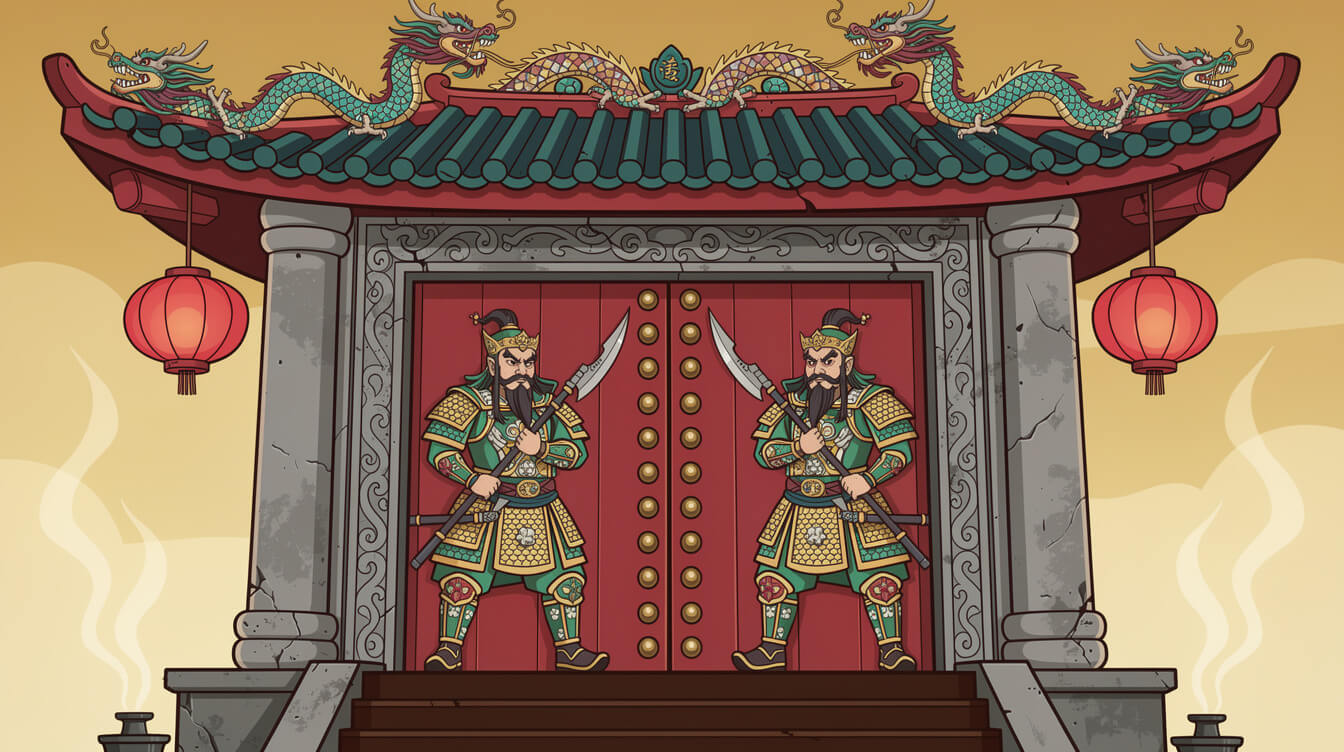
Walk up to almost any temple in Taiwan and before you see a single altar, someone big is already staring you down. Painted on the front doors, often taller than you, two armored figures stand guard with weapons raised. These are the door gods (門神, ménshén), and they have one job: keep the bad stuff out.
Did You Know? The most famous door gods were real generals
The oldest door gods were a mythical pair, Shentu and Yulü (神荼 and 鬱壘). In Han-dynasty China their names or images were painted on peachwood boards and hung on doors to scare off demons.
The pair you’re most likely to see today has a better backstory. According to legend (retold in chapter 10 of Journey to the West), Emperor Taizong of the Tang dynasty was haunted every night by the angry ghost of a dragon king. Two of his generals, Qin Shubao (秦叔寶) and Yuchi Gong (尉遲恭), volunteered to stand guard outside his bedroom door, and the haunting stopped. The emperor slept well but felt bad keeping his generals up all night, so he had their portraits painted on the doors instead. His subjects copied the idea, and the two generals have been working the night shift ever since.
That’s why door gods almost always come in pairs: traditional gates are double doors, so you get one guardian per door.
Not every temple hires the same guards
Door gods come in two broad types. Martial door gods, like Qin and Yuchi, are there to block evil spirits. Civil door gods are scholar-officials whose job is to invite blessings and good fortune in.
And who gets the job depends on the temple. A great example is Lukang Longshan Temple in Changhua, a Buddhist temple dedicated to Guanyin and one of Taiwan’s national monuments. Its five entrances carry ten painted door panels, and you won’t find the Tang generals on them. Instead there are Buddhist guardians: Weituo (韋馱) and Qielan (伽藍), plus the Four Heavenly Kings. The two arched side doors carry civil figures bringing promotion and prosperity (加冠晉祿 and 富貴晉爵).
These panels were painted in 1963 by Lukang’s own artist Guo Xin-lin (郭新林) in a classical Quanzhou style. In 2016, Changhua County officially designated them a protected antiquity. If you’re planning a visit, our Lukang travel guide covers the temple’s famous carved ceiling and the town around it.
When door gods go on leave, they get “acting” replacements
This is our favorite part. By 2017, more than fifty years of sun, humidity and incense smoke had left Lukang Longshan’s door gods badly worn, and the Ministry of Culture’s heritage conservation center stepped in to restore them.
You can’t just unscrew a god from a temple, though. Temple leaders and officials threw moon blocks (擲筊) to ask Guanyin when the door gods could be ceremonially “released” from duty. The answer: the morning of April 12, 2017. After that, the panels were sent two at a time to the conservation center in Tainan.
And the doors weren’t left unguarded. While the originals were away, digitally reproduced copies stood in for them. Local officials called them 職務代理神, which translates as something like “acting-duty gods,” the same term an office uses for the coworker covering your desk while you’re on vacation. In Taiwan, even a god gets a temp.
How to spot them on your next temple visit
- Look before you step. The guardians are painted on the doors themselves, so the best view is from the courtyard, before you go in.
- Check the weapons and costume. Armor and weapons mean martial guards keeping evil out. Officials in court robes mean civil door gods inviting good fortune in.
- Read the temple, then the door. Tang generals at one temple, Buddhist guardians at another: the doors are a clue to whose house you’re entering.
- Mind the threshold. Step over the raised wooden doorsill, never on it. Our Taipei Longshan Temple guide walks through the rest of the etiquette.
Door gods are just one layer of Taiwan’s temple art. If you like this kind of detail, read about the cut-ceramic dragons on temple roofs, why Taiwan has so many temples, and the craftspeople behind them in our guide to traditional Taiwanese crafts.
Bring a guardian home
Every home could use a fierce little guardian at the door. Our Ming General Boba Warrior tee gives you an armored defender in chibi form, standing watch over every last tapioca pearl.

Grab a Free Taiwan Sticker!
Drop your email and we’ll send you a limited-edition Taiwan sticker — plus insider access to new merch drops and island vibes.
No spam. Unsubscribe anytime.