Taiwan Roselle: the Ruby Harvest That Isn’t a Flower
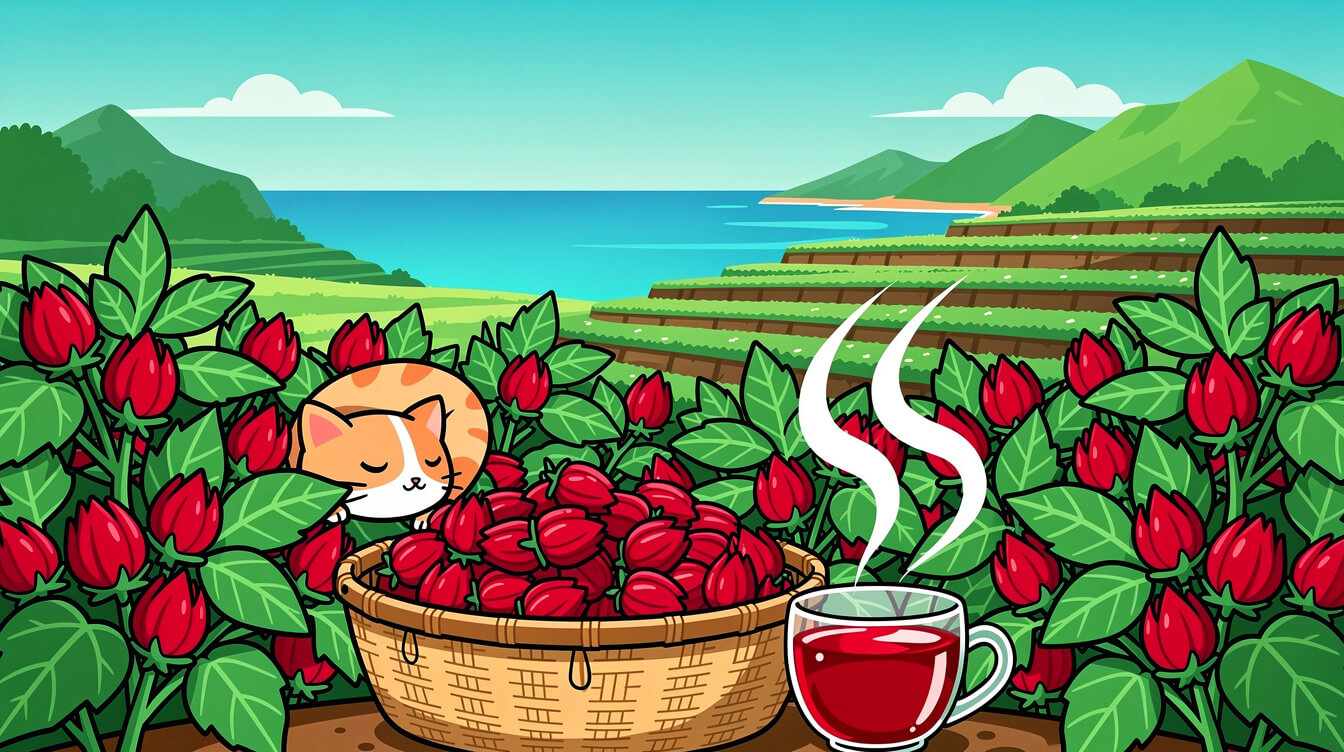
Drive the coast road south out of Taitung City in early October and the terraces start doing something peculiar. The bushes are chest-high and leafy green, and hanging off every branch is a cluster of fat, glossy, impossibly red pods — the colour of boiled sweets. Growers in the area call them 紅寶石, rubies, and the Agriculture and Food Agency’s eastern branch office uses the same word in its own write-ups. 科技大觀園, the government’s science-communication site, goes further and calls the crop 後山紅寶石 — the ruby of the back mountain.
This is 洛神葵, roselle, and the picking has just come round again. The 農業部 lists its production period as October and November; the eastern branch office stretches the harvest to December, and the variety Taitung actually grows can start coming off the bushes in late September. Which makes this week, more or less, the opening of the reddest few months in the Taiwanese agricultural calendar.
What goes in your cup isn’t the flower
Roselle is sold in English as “roselle flower” and in Chinese as 洛神花 — literally “roselle flower”. Both are gently misleading. The plant is a hibiscus, an annual in 錦葵科木槿屬 that can pass two metres tall, and its bloom is brief and fairly plain. What you brew is what’s left standing after the petals go: the 果萼, the swollen scarlet calyx — the cup of sepals wrapped around the developing seed pod. The agency is precise about it: 「洛神葵食用的部位為鮮紅肥厚的果萼」, the edible part is the bright red, thick calyx. The seed core gets pushed out before the calyx is preserved or dried, which is why loose roselle tea looks like a bag of crimson shells rather than anything floral.
And 洛神 is not that 洛神
Here is the detail that catches out even fluent readers. 洛神 is a goddess — the spirit of the Luo River, the subject of Cao Zhi’s third-century 〈洛神賦〉, one of the most celebrated pieces of writing in the language. A deep-red flower named after her makes perfect poetic sense. It simply isn’t what happened. Writing for 科技大觀園, 游均晶 of Chang Gung University states it flatly: the Chinese name is a straight phonetic rendering of the English word “Roselle”, and is 「與曹植名篇〈洛神賦〉無關」 — unrelated to Cao Zhi’s poem. A borrowed sound that landed, by luck, on two characters carrying a goddess. The plant’s alternative names — 洛神葵, 玫瑰茄, 山茄 — are the honest ones.
Three-quarters of the island’s crop, in one county
You will read in plenty of places that Taitung grows 90% of Taiwan’s roselle. The official numbers are less round and rather more interesting. The 農業部’s county-by-county figures for 2025 (民國114年) put Taiwan’s entire roselle planting at 122 hectares — a genuinely tiny crop, smaller than a single large tea estate — of which Taitung holds 92. That is three-quarters of the island’s roselle hectares inside one county, and about two-thirds of the national harvest by weight.
It concentrates further inside Taitung: 金峰鄉, 太麻里鄉, 卑南鄉 and 鹿野鄉. 金峰 and 太麻里 are indigenous townships, and the agency files roselle under 原鄉作物 — homeland crops — in the same breath as millet, which is a thread running through a lot of Taiwan’s east coast. The workhorse variety is 臺東3號, bred at the local agricultural research station: early-ripening, and deliberately short, because a low bush is easier to pick by hand. Nothing about this harvest is mechanised. Roselle also happens to be an unusually cooperative organic crop — the canopy grows dense enough to shade out weeds, and it shrugs off most pests — which is why the eastern branch has spent years steering growers toward organic and traceability certification.
How to meet it
Brewed, roselle is bracingly tart — think cranberry with more edge — and it dyes everything it touches a startling magenta. Taiwan’s most common form isn’t tea at all, though: it’s 蜜餞, the sugar-preserved calyx eaten by the handful, sold in every roadside shop between Taitung and Taimali. Sealed, dried and basically indestructible, it is also one of the smarter things to post home in a care package. If you want it as a drink, ask for 洛神花茶 — and if you want the full east-coast lineup, Taitung’s tea-growing neighbours up the valley are a separate rabbit hole entirely.
Either way, it’s a hot-mug season now. Ours carries the geometric patterning of the same indigenous southeast where the rubies grow — the Taiwan Aboriginal Geometric Pattern mug takes roselle tea very nicely indeed.

Grab a Free Taiwan Sticker!
Drop your email and we’ll send you a limited-edition Taiwan sticker — plus insider access to new merch drops and island vibes.
No spam. Unsubscribe anytime.