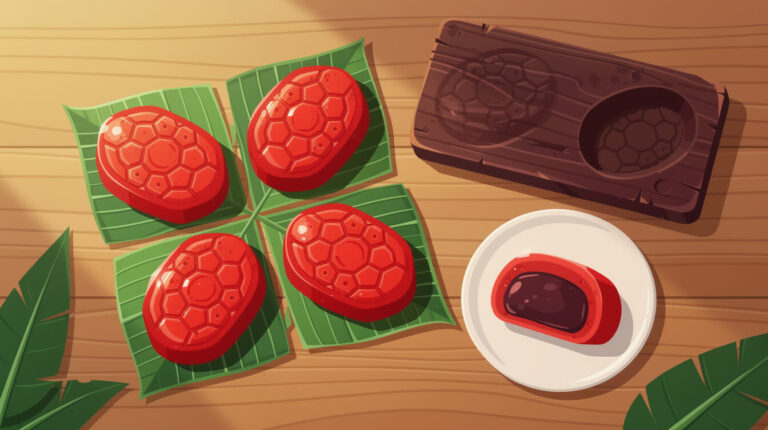
Taiwan Persimmon Cakes Are Dried by a Wind That Got Its Name in 1694
Taiwan’s sweetest autumn snack is not baked, fried or boiled. It is made almost entirely by wind — a specific, named, seasonal wind that shows up in northern Taiwan every autumn and has been irritating locals and delighting farmers for centuries.
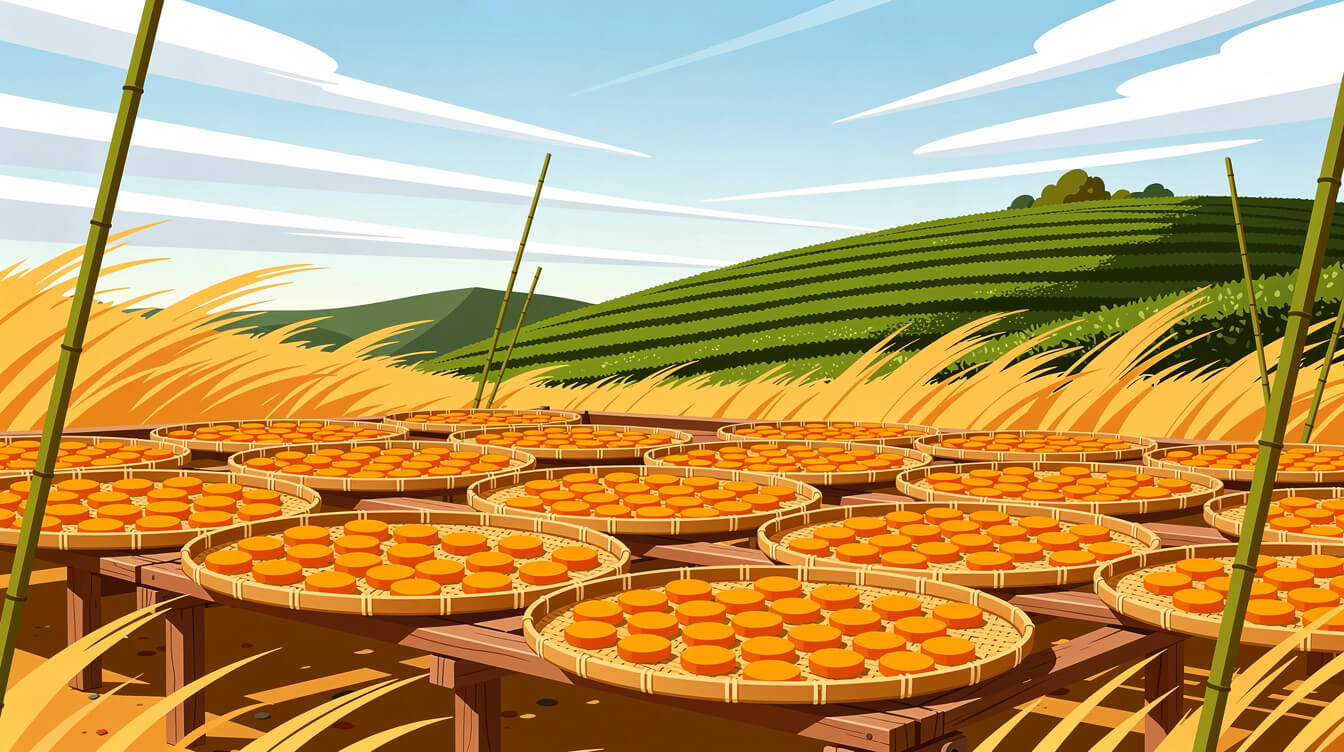
Right now, on the drying terraces of Xinpu in Hsinchu County, the racks are filling up with tens of thousands of peeled orange persimmons on their way to becoming Taiwan persimmon cakes. The season has just opened.
A wind with a Qing-dynasty name
The wind is the 九降風 — the “nine-descending wind.” It is the northeast monsoon, but Hsinchu’s version is severe enough to have earned its own name, and that name is old. It appears in the 臺灣府志, the Taiwan Prefecture Gazetteer, compiled in 1694: 「九月則北風初烈,或至連月,俗稱為九降風」 — “in the ninth month the north wind first turns fierce, sometimes for months on end; it is commonly called the nine-descending wind.”
So the “nine” is not nine days or nine gusts. It is the ninth lunar month — which, this year, does not even begin until October. The farmers are out ahead of the wind’s own namesake, betting correctly that it always arrives early.
Why Hsinchu and nowhere else
Geography does the work. Hsinchu’s alluvial plain opens like a trumpet — the Xueshan Range closing it off to the southeast, the Xiangshan hills to the south, the Hukou tableland to the north. The monsoon gets squeezed through that gap, and across the Taiwan Strait at its narrowest point, roughly 150 kilometres, it accelerates again on the way in. Gusts hit around 20 metres per second, which is typhoon territory.
That is a punishing thing to live under and a magnificent thing to dry food in. As we wrote in our guide to Hsinchu, the same wind is why the city is famous for rice noodles — and it dries grass jelly too. One weather system, three food industries.
How Taiwan persimmon cakes are actually made
Taiwan persimmon cakes — 柿餅 — start as astringent fruit that nobody wants to eat raw. Xinpu grows three varieties for the job: 石柿 (stone persimmon), 牛心柿 (ox-heart persimmon) and 筆柿 (brush persimmon). They are peeled, laid out in grids on wide round bamboo trays, and then alternately sunned, wind-dried and rested for seven to nine days.
The part that cannot be automated is the pressing. Every cake is hand-massaged on a schedule, tray after tray, day after day — it is the step that turns a shrivelled fruit into the dense, chewy, honey-sweet disc with a white bloom of natural sugar on the outside. Rain stops everything; on a wet day the racks simply do not come out.
Like so much Hakka food from these hills, it began as thrift. Unsold astringent persimmons were not thrown away — they were dried, and the by-product turned out to be better than the original.
If you want to see it
The drying farms cluster along 旱坑路 — “Dry Gully Road,” which tells you everything about the local climate — in Xinpu, about an hour from Taipei. The racks go out from roughly mid-September through January, with October to December the peak. The town’s persimmon festival usually lands in mid-October; check the Xinpu Farmers’ Association listing before you travel, and check the forecast too, because a rainy day means empty racks.
The takeaway: Taiwan persimmon cakes are one of the very few foods whose flavour you can trace to a single weather pattern. No wind, no cakes. If you are anywhere near Hsinchu between now and Lunar New Year, the orange grid of trays against green hills is one of the best things on the island to look at — and one of the best things to chew on.
Autumn orange, Hakka hills, and food made by weather — that is the Taiwan we keep putting on t-shirts. Have a look around our collection.

Grab a Free Taiwan Sticker!
Drop your email and we’ll send you a limited-edition Taiwan sticker — plus insider access to new merch drops and island vibes.
No spam. Unsubscribe anytime.