Songshan Cultural and Creative Park: Taipei’s Tobacco Factory Turned Design District
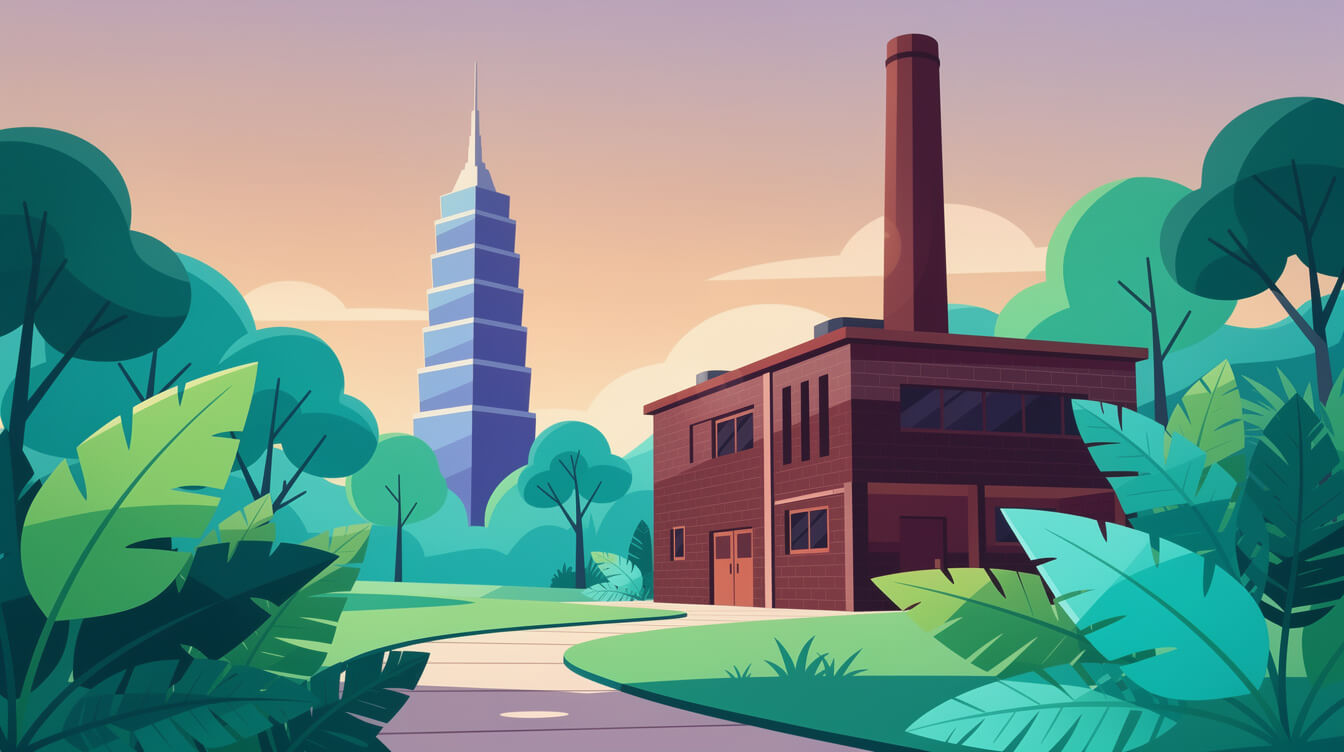
Stand in front of the old boiler house at Songshan Cultural and Creative Park and you can line up two versions of Taipei in a single glance: a squat red-brick furnace that once burned heavy oil to run a cigarette factory, and, rising behind the treeline, the tapering spire of Taipei 101. Eighty years of the city, stacked in one sightline.
That view is the whole argument for coming here. This is not a museum about a tobacco factory. It is a tobacco factory that never stopped working — it just changed industries. The colonnades where women once sorted tobacco leaf now hold design exhibitions. The bathhouse where shift workers ladled hot water over themselves is now a library you pay to sit in. The fire reservoir is a wetland with egrets in it.
This guide covers what the site actually is, how to get there, what it costs in 2026 (several widely-copied guides are quoting prices that are no longer correct), which buildings reward a slow walk, and how to slot it into a Taipei day without wasting the trip.
What Songshan Cultural and Creative Park Actually Is
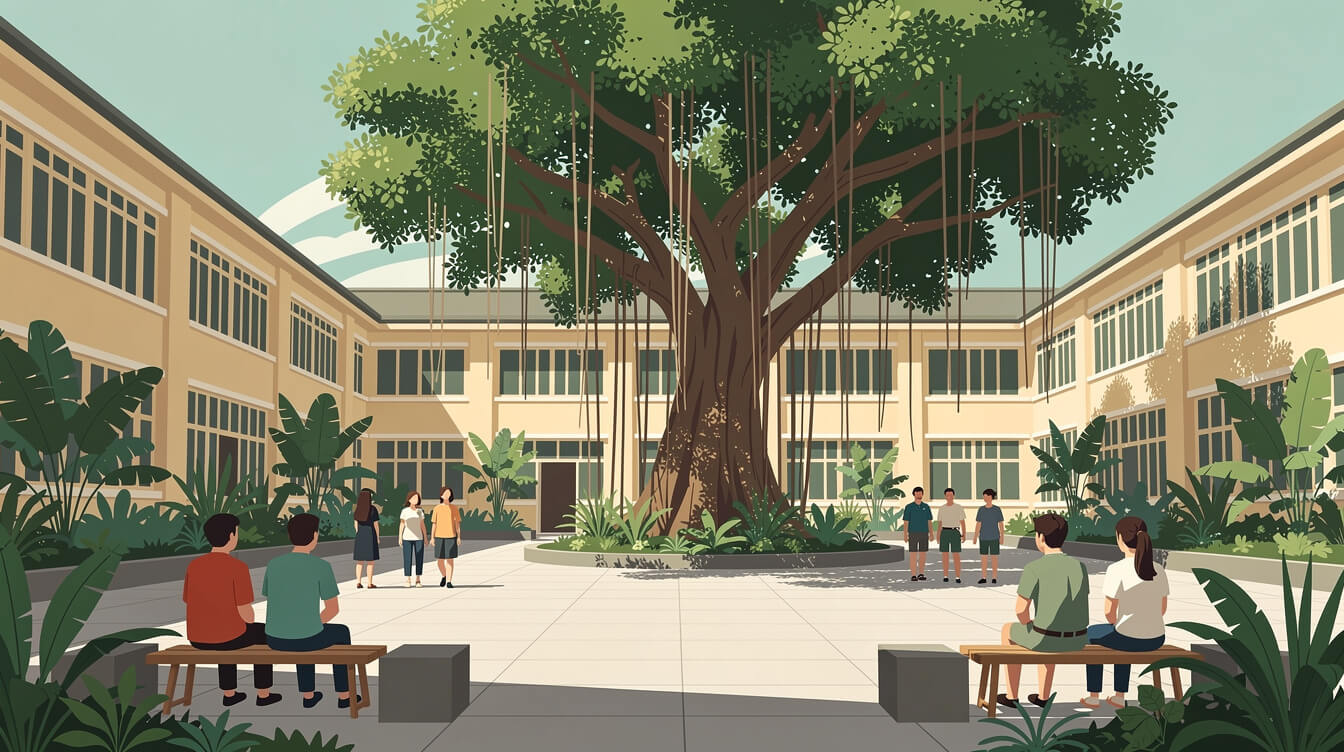
The short version: a 1937 Japanese-era cigarette factory, decommissioned in 1998, listed as a heritage site in 2001, and reopened to the public on 15 November 2011 as a creative-industries campus run by the Taipei Culture Foundation. The grounds are free, open around the clock, and there is no ticket gate. You walk in off the street.
What you find inside is a compound rather than a building — long two-storey halls with strong horizontal lines and rows of tall windows, wrapped around courtyards, a formal garden, a warehouse row, a boiler house with a chimney, and a large reflecting pond. Scattered through those buildings are a design museum, a paid library, design retail, a handful of cafes and restaurants, event halls that host everything from craft fairs to fashion weeks, and a lot of quiet outdoor space where locals eat lunch.
One thing to clear up before you set off
Despite the name, the park is not in Songshan District. It is in Xinyi District, at 133 Guangfu South Road, on the same side of town as Taipei 101. It is also nothing to do with Songshan Airport, which is four kilometres north, or Songshan railway station, which is where you would go for Raohe Night Market. The name is inherited from the tobacco factory, which was named for the district boundaries of the 1930s. Every year a steady trickle of visitors gets on the wrong MRT line because of it.
If you have already read our guide to Huashan 1914 Creative Park, think of this as the other half of the pair — bigger, greener, quieter, and more museum-like. We compare them properly further down.
From Japanese Tobacco Factory to Design District: 1937 to Today
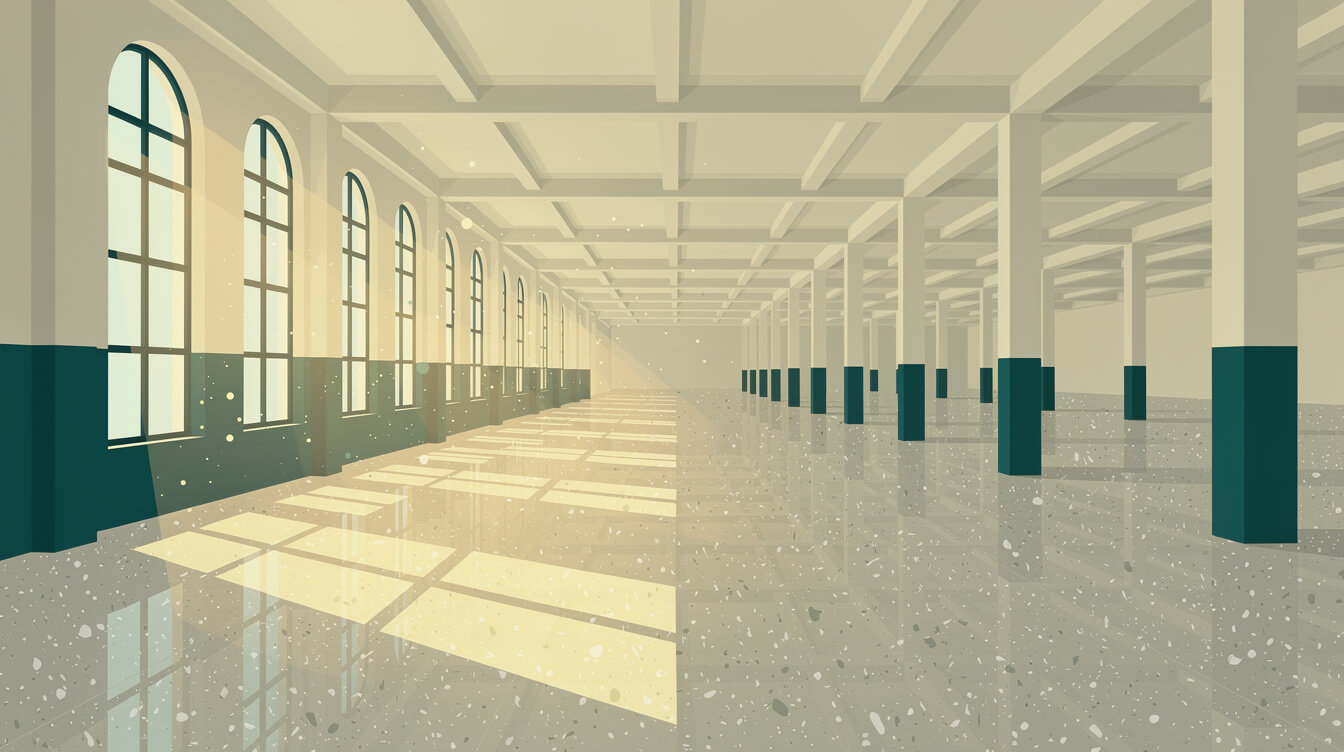
Taiwan’s tobacco monopoly system dates to 1905, and the island’s first Taipei cigarette works opened near the railway station in 1911. By the mid-1930s that plant could not keep up, so in 1937 the Governor-General’s Monopoly Bureau began building a new one out east, on what was then the edge of the city: the Songshan Tobacco Factory.
It was planned as an industrial village rather than a shed full of machines. The layout considered production flow, but it also budgeted generously for staff welfare and kept large areas open for gardens — unusual enough at the time that the site is still cited as a landmark in Taiwanese industrial architecture. The style is Japanese early modernism: horizontal emphasis, restrained detailing, and unfussy, precise construction.
The boiler room, machine repair shop, cigarette factory and work hall were finished in 1939, and cigarette production started that October with roughly 1,200 employees. The office building and inspection room followed in 1940. Start to finish, the complex took three years and three months.
- 1945 — after the war the plant passes to the Taiwan Provincial Monopoly Bureau.
- 1947 — renamed again under the Taiwan Tobacco and Wine Monopoly Bureau. Long Life (長壽) and Xin Le Yuan (新樂園), two brands any Taiwanese grandparent will recognise, were rolled and packed on the second floor.
- 1968 — cigar production begins in a corner of the west factory. A box of 25 Gentleman-brand cigars cost about the same as fifty packs of the cheapest Xin Le Yuan.
- 1987 — peak output. Around 2,000 staff and annual production value of more than NT$21 billion.
- 1998 — production stops and operations merge into the Taipei Tobacco Factory. The site goes quiet.
- 2001 — Taipei City designates it the city’s 99th municipal historic monument. The office building, cigarette factory, boiler room and Warehouses 1 to 5 are the protected structures; the lotus pond, the transport rails and the post-war warehouses fall inside the preservation zone.
- 2011 — reopens on 15 November as a creative park.
That 2001 designation matters more than it sounds. It is the reason the buildings were restored rather than gutted, and the reason you can still see original wooden window frames, unused heritage fire equipment bolted to the walls, and the odd curved wall niches outside the old toilets — which, it turns out, were originally designed as sewage tanks.
Getting There, Opening Hours, and What It Actually Costs
Getting to Songshan Cultural and Creative Park is the easy part — it sits on a Blue Line station’s doorstep.
Address: No. 133, Guangfu South Road, Xinyi District, Taipei.
By MRT (easiest): take the Bannan Line (Blue) to Sun Yat-sen Memorial Hall Station and leave by Exit 5, then walk down Guangfu South Road and turn right onto Songyan Avenue — about 350 metres in total. If you are using a wheelchair or pushing a stroller, take Exit 3 instead for the lift, cross at the Zhongxiao East Road junction, and you are looking at roughly 400 metres. City Hall Station Exit 1 also works: head along Zhongxiao East Road and turn at Lane 553, about 450 metres. Our Taipei MRT map guide has the line colours if you are still getting your bearings.
By bus: routes 204, 278, 282, 288 and 672 stop on Guangfu South Road; 202, 212, 232, 240, 270, 299 and 600 stop on Zhongxiao East Road.
By car: don’t, really. There is no visitor car park on site and driving inside the grounds is banned. The nearest paid parking is under the Taipei New Horizon building or the Taipei Dome.
Hours and prices, checked in September 2026
| Where | Open | Cost |
|---|---|---|
| Outdoor grounds | 00:00–23:59, every day | Free |
| Indoor spaces (general) | 09:00–18:00 | Free to enter the buildings |
| Taiwan Design Museum | Tue–Sun 10:00–18:00 (last tickets 17:30) | NT$100 |
| Not Just Library | Tue–Sun 10:00–18:00 (last tickets 17:30) | NT$100 — same ticket |
| Design Pin (design retail) | 10:00–18:00 | Free to browse |
| Eslite Spectrum Songyan (next door) | Mall 11:00–22:00; 3F bookstore 24 hours | Free |
Three things worth underlining, because a lot of guides get them wrong.
One ticket, two venues. The Taiwan Design Museum and Not Just Library are both run by the Taiwan Design Research Institute, and a single day’s admission gets you into both. You do not buy two tickets. Almost no English-language guide states this plainly, and several imply the opposite.
The price is NT$100, not NT$50. Plenty of otherwise-good articles still quote NT$50 and hours of 9:30–17:30. Those figures are out of date; TDRI’s own pages now list NT$100 general admission (NT$80 for groups of ten or more, free for under-7s, over-65s, and disabled visitors plus one companion) and 10:00–18:00 opening.
Both close on Mondays. This is the single most common wasted trip. The grounds, the cafes and the shops are open on a Monday; the museum and the library are not. They also close over Lunar New Year, Dragon Boat Festival and Mid-Autumn Festival. If the design collection is why you are coming, do not come on a Monday.
The guided tour situation, which is widely misreported
You will read that the park runs free guided tours. True, but they are group bookings only: minimum 15 people, maximum 30, weekdays at 10:00, 13:30 or 16:00, and you have to apply at least seven working days in advance by phone or email. The history-and-architecture tour runs 50 minutes and can be given in Mandarin or English. That is brilliant if you are a school or a company outing and useless if there are two of you.
What solo visitors actually want is the free Songyan Shiguang (松菸拾光) audio guide. It lives on the park’s own website, needs no booking, and walks you through twenty numbered stops — the office building, the conveyor belt, the bathhouse, the Baroque garden and the rest. Load it on your phone at the gate and you have a better tour than most paid ones.
The Buildings Worth Your Time: the Boiler Room, the Baroque Garden and the Warehouse Row
You can loop the whole of Songshan Cultural and Creative Park in forty minutes. These are the stops that repay slowing down for.
The Boiler Room
The factory’s heart. It burned heavy oil to make the steam that drove everything else, and the tall chimney behind it was one of east Taipei’s landmarks long before there were any towers to compete with. Heavy-oil burning stopped in the 1970s and the building was retired. It now houses a coffee roaster, which means you can drink a flat white inside the furnace house and look out at Taipei 101 through the trees — the old landmark and the new one facing each other across seventy years.
That sightline is the shot everybody takes here, and if you want to keep it, our Taipei 101 Taiwan Skyline Sticker puts the same silhouette on your laptop lid for less than the price of the coffee.
The Baroque Garden
The formal garden was laid out in 1958, when factory director Chen Li-tan brought in Lin Yuan-lang, a technician from the Taipei Winery, to design it. It is geometric, and deliberately mixes Chinese and Western garden vocabulary. The centrepiece fountain is a three-tier champagne-tower design that was genuinely unusual in Taiwan at the time — and, being a tobacco factory, it was also plumbed as a firefighting reservoir. Pretty and load-bearing.
The ecological pond
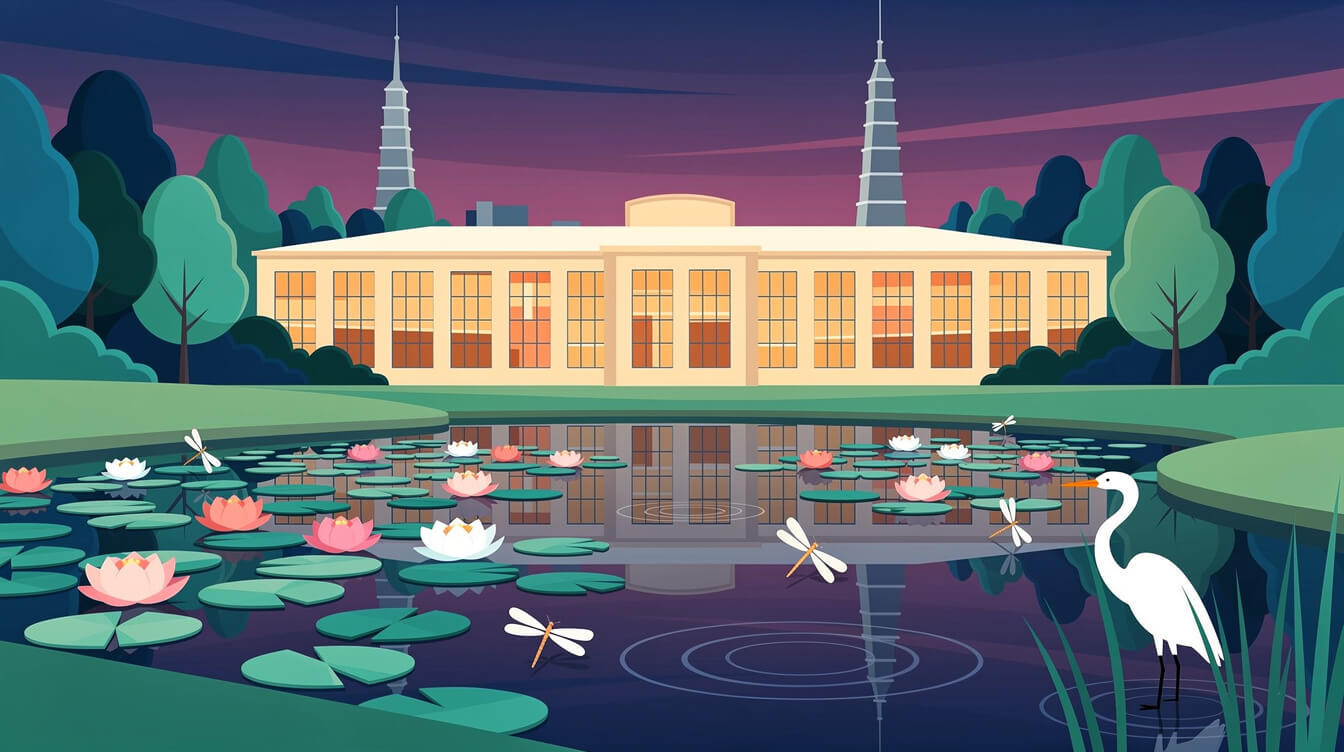
Same logic, bigger scale. The large pond on the eastern side was dug as a fire-water reserve. Today it is one of the few genuine urban wetlands in Taipei, with protected plant species around the margins and egrets that ignore you completely. The park’s own audio guide calls it the emerald of Taipei’s east side, which is the kind of phrase you forgive when you are standing there at dusk.
Warehouses 1 to 5
There were once as many as fifteen warehouses here; five survived. Warehouse 1 held finished product, Warehouses 2 to 5 held raw leaf. Look up above Warehouse 2 and you will see a conveyor belt running to the second floor of the cigarette factory. Inside, that belt is built as a spiral — not for style, but to slow the descent so packed cartons did not smash at the bottom. It is the single best detail on the site and almost nobody points it out.
The Inspection Room
Originally the factory’s guardhouse. After the war, cigarettes were valuable enough that staff were searched here on the way in and on the way out, every shift, to stop them pocketing stock. A heritage building that is really a monument to institutional mistrust.
Two small buildings most people walk past
The bathhouse was built with the factory, fed with hot water piped over from the boiler room, split into men’s and women’s halves, each with a semicircular pool you ladled from. The nursery was a post-war addition — a creche where workers could leave infants with a minder during their shift. It originally stood south of the cigarette factory and was physically relocated to its current spot when the Taipei Dome was built next door. Both are still standing, and both are now open to the public in new guises.
Taiwan Design Museum, Not Just Library, and Design Pin
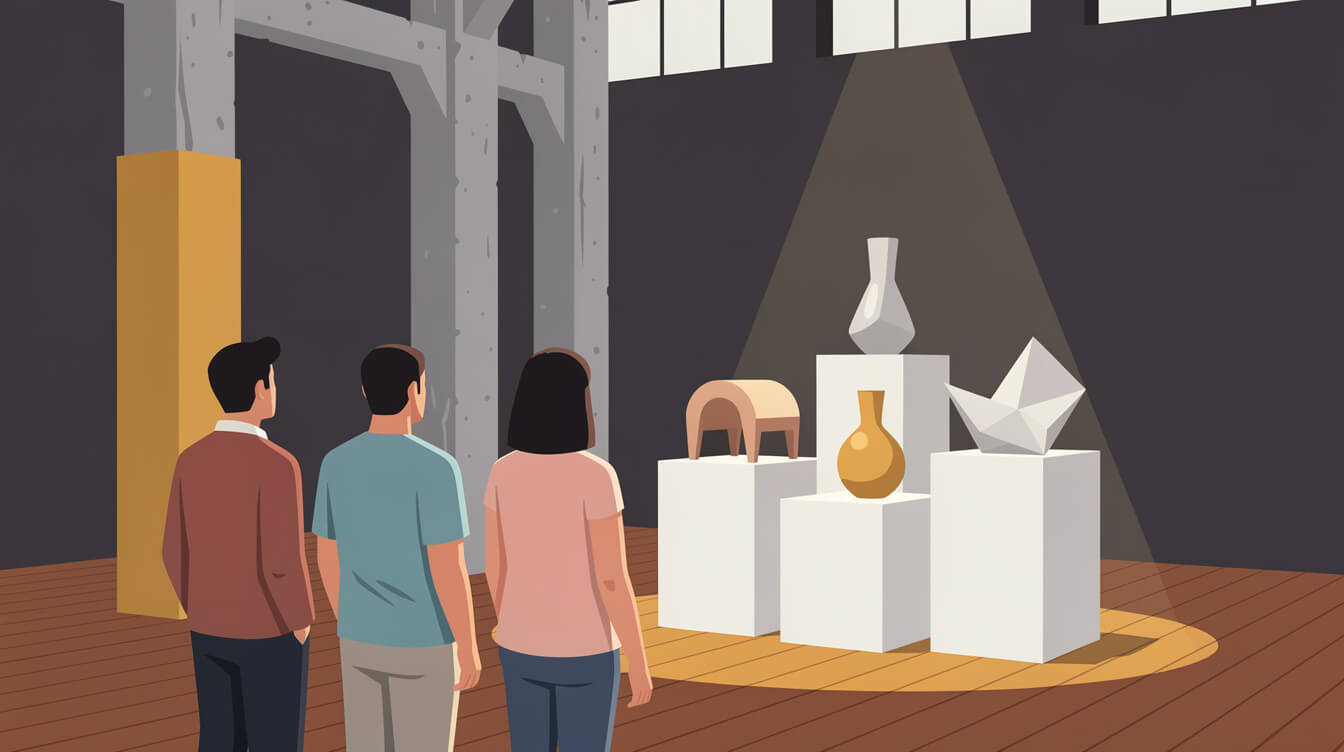
If you only have budget for one paid thing in the park, it is this cluster — and, as covered above, the same NT$100 ticket opens both of the big ones on the same day.
Taiwan Design Museum
Opened in 2011 alongside the park itself, and billed as the first design museum in the Chinese-speaking world. It sits on the ground floor of the west cigarette factory, across four gallery zones, and it does two jobs: it holds a permanent collection of landmark works from Taiwan’s design history, and it rotates temporary shows — award retrospectives, cross-disciplinary themes, international design prizes. The mix means it is worth checking what is on before you go; a strong temporary exhibition can turn a 40-minute visit into two hours. Free Mandarin gallery talks usually run on weekend afternoons, and the TDRI site lists the current schedule.
Not Just Library
The most photographed room in the park, and the most misunderstood. It is a design library built inside the factory’s old bathhouse, and the original tiled bathing pool is still there — you sit in it, surrounded by books, which is the joke in the name. There is a wooden reading area, a tiled bathhouse area, and an outdoor garden the space spills into. You change into indoor shoes at the door. It is a place to spend an hour, not five minutes, and it is emphatically not a public lending library: the ticket buys you the room.
Design Pin
Free, and easy to underrate. Design Pin is a curated retail space in the old office building stocking work from Taiwanese design brands — homeware, stationery, jewellery, small objects. It is the most efficient way in the city to see what contemporary Taiwanese product design actually looks like when it has to survive a price tag, and it pairs well with the museum upstairs of it conceptually: collection, then commerce.
If that side of Taiwan interests you, we have written about the artisan cooperatives keeping traditional craft commercially alive, and about our own collaborations with Taiwanese designers.
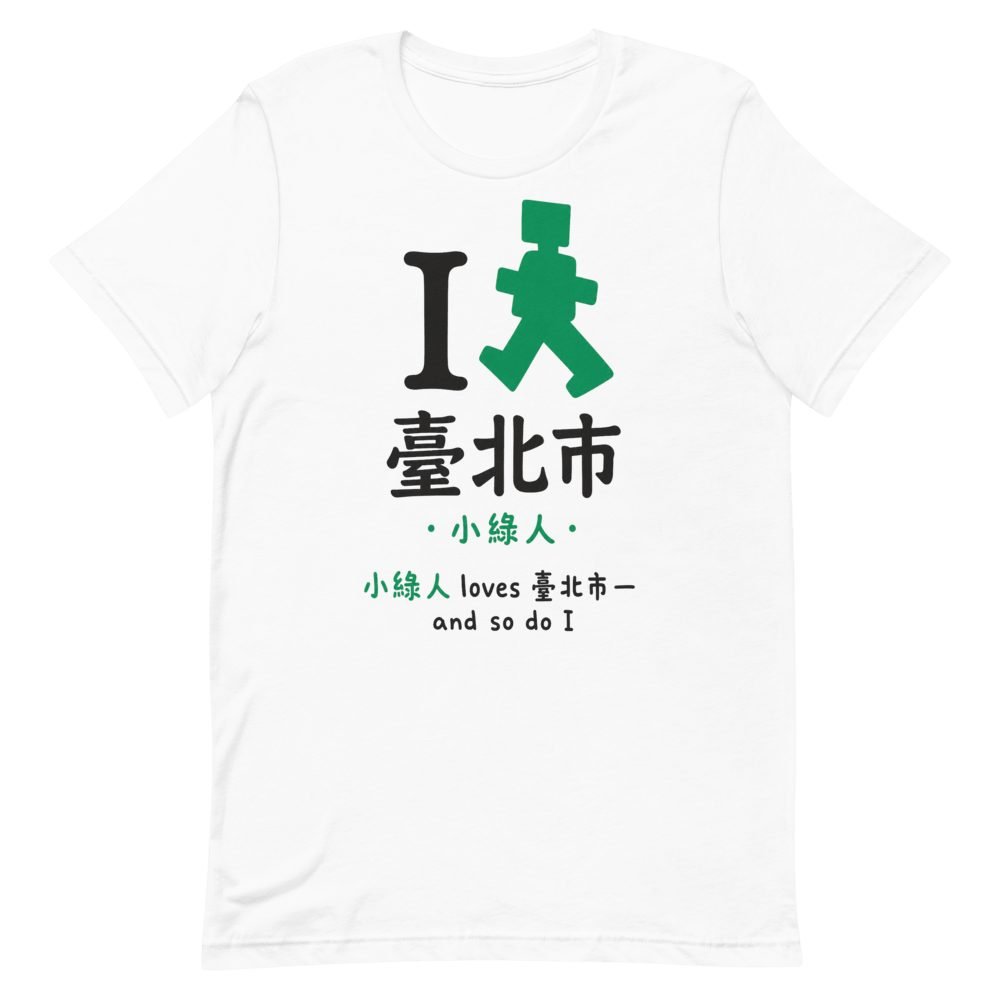
Wear the Best-Known Piece of Taiwanese Design
Taiwan’s greatest design export isn’t in a museum case — it’s on every crosswalk in Taipei. Our Xiaoluren tee puts that striding little green man where he belongs: on you.
Songshan Cultural and Creative Park or Huashan 1914? Picking the Right One
This is the question every Taipei itinerary thread ends on, and we have answered it in full — from the Huashan side — in our Huashan 1914 Creative Park guide. The short version, from this side of the comparison:
- Come here if you want a design museum with a permanent collection, more green space and reflecting pools, a genuinely historic compound to walk, a 24-hour bookstore built into the site, and a quieter afternoon. Also if you are already on the Xinyi / Taipei 101 side of town.
- Go to Huashan if you want maximum shop density in a small radius, big international pop-up exhibitions, craft beer and wine bars, and higher energy per minute.
They are about fifteen minutes apart on the Blue Line, so with a full day you can do both — Huashan in the morning for the shops, here in the afternoon for the museum and the grounds. With three hours, pick one and commit.
Where to Eat and Drink On Site
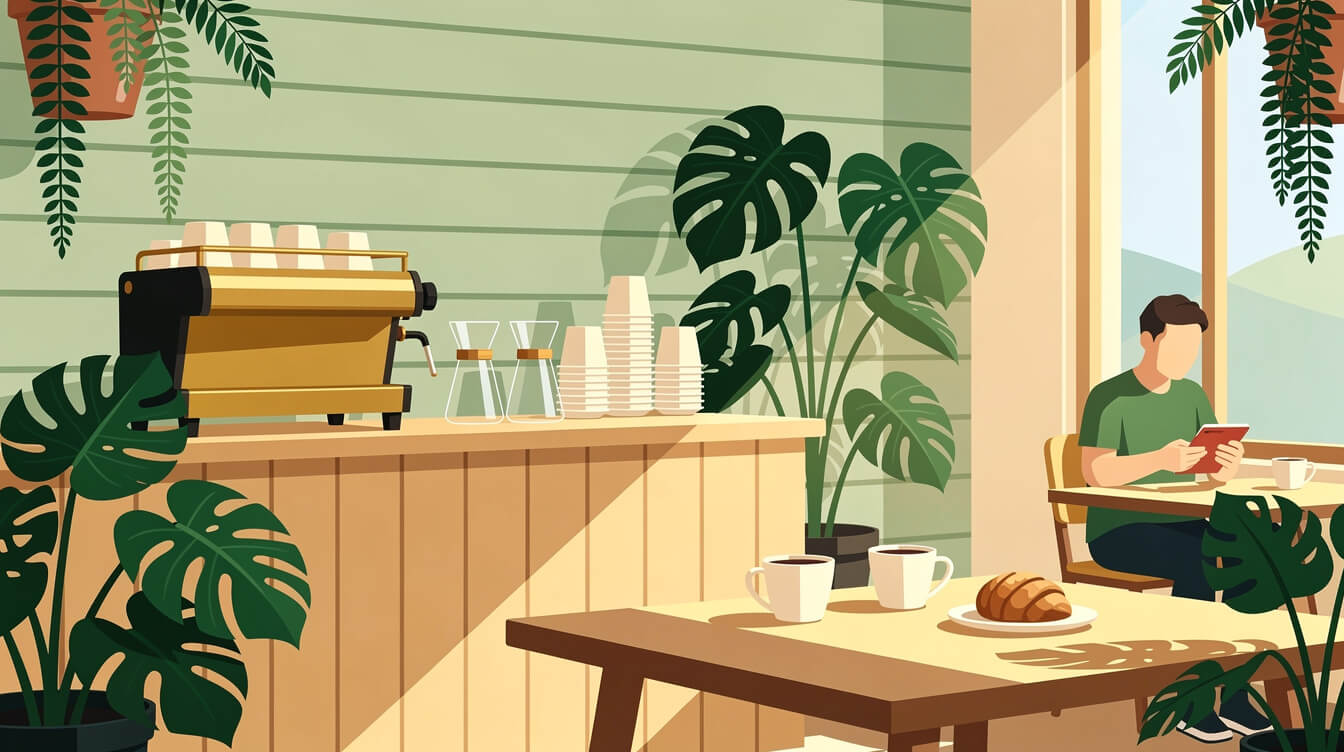
Songshan Cultural and Creative Park is not short of places to eat and drink, and several of them sit inside heritage buildings, which is most of the appeal.
- Coffee in the Boiler Room. A specialty roaster occupies the old furnace house — all-day food, signature coffees, wine, and a light installation after dark. Roughly 11:30–20:30 on weekdays and 11:00–20:00 at weekends, with last orders about 90 minutes before close.
- Coffee in the 1937 nursery hut. A small cafe inside the relocated wooden creche, walls built from overlapping green timber strips, sun coming in sideways. Around 10:00–19:00 on weekdays and until 20:00 at weekends. The nicest room in the park to sit in with a book.
- Proper meals in the Machinery Repair Plant. The old repair shop — once split into welding, machining and carpentry bays — now holds restaurant and event space doing Taiwanese ingredients through French technique. Open late-ish; check ahead, because it takes private bookings.
- A convenience store. There is a FamilyMart on site, roughly 07:00–22:00, which is the honest answer if you just want a cold tea and a rice ball on a bench by the pond.
- Eslite Spectrum Songyan. The Eslite complex went up on the eastern edge of the site in 2013 and has food halls across several floors. Its third-floor bookstore is the last 24-hour Eslite in Taipei — genuinely worth knowing if you are jet-lagged at 3am.
Pairing It With Xinyi, Taipei 101 and Raohe Night Market
The park works best as a half-day anchor with something bolted onto either end.
An important correction first. Many guides suggest combining this with the National Dr. Sun Yat-sen Memorial Hall, since you arrive at its MRT station. As of late September 2026 the memorial hall building is still closed. It shut on 26 February 2024 for the largest renovation in its fifty-plus-year history — a roughly NT$1.63 billion overhaul of the main auditorium, exhibition halls, structure and building services — with completion targeted for the final quarter of 2026. The surrounding Zhongshan Park stays open throughout, so you can still walk the grounds and get the classic Taipei 101 reflection shot from the pond, but do not plan on going inside. Check the hall’s own site before you count on it.
Before: Taipei 101 and the Xinyi shopping district are a twenty-minute walk south-east, or one MRT stop to City Hall and then Xinyi’s elevated walkways. Our Xinyi District guide maps the area, and the broader Taipei attractions guide covers what else is within reach.
Next door: the Taipei Dome now sits immediately east — close enough that the factory’s nursery building had to be physically moved during its construction. If there is a game or a concert on, factor in the crowds on Zhongxiao East Road.
After dark: Raohe Night Market is about two kilometres north-east. The MRT route involves a transfer and is no faster than a ten-minute taxi, so take the taxi — or walk it in half an hour if the weather is behaving. It is one of the most walkable markets in the city, and our Taiwan night market guide has the wider field.
A clean half-day plan
- 14:00 — arrive via Sun Yat-sen Memorial Hall Exit 5. Load the free audio guide.
- 14:15 — loop the grounds: Baroque garden, warehouse row, the spiral conveyor, the ecological pond.
- 15:00 — Taiwan Design Museum, then Not Just Library on the same ticket.
- 16:45 — Design Pin, then coffee in the boiler room as the light goes.
- 18:00 — Eslite Spectrum, or a taxi to Raohe for dinner.
Songshan Cultural and Creative Park FAQ
Is it free to visit?
Yes. The grounds, the courtyards and the buildings themselves cost nothing, and the outdoor areas are open 24 hours. Only the Taiwan Design Museum and Not Just Library charge — NT$100, and one ticket covers both on the same day. Special exhibitions and pop-ups occasionally ticket separately.
Is it closed on Mondays?
The park is not; the museum and the library are. If the design collection is the point of your visit, avoid Mondays, Lunar New Year, Dragon Boat Festival and Mid-Autumn Festival.
How long should I budget?
An hour for a walk-through, two to three hours if you are going into the museum and library, and a comfortable half-day if you add coffee and Eslite.
Is it in Songshan District?
No — Xinyi District, at 133 Guangfu South Road. It is also unconnected to Songshan Airport and Songshan railway station. Get off at Sun Yat-sen Memorial Hall or City Hall on the Blue Line.
Is it worth it in the rain?
Better than most Taipei attractions, actually. The cigarette factory halls, the museum, the library, the retail and the Eslite complex are all indoors and close together, so a wet afternoon here works where a wet afternoon at a night market does not.
Can I get a guided tour as an individual?
Not a live one — the free tours are group-only, minimum 15 people, weekdays, booked at least seven working days ahead. Individuals should use the free 20-stop audio guide on the park website.
Is there parking?
No visitor car park on site, and no driving inside the grounds. Use the paid parking under the Taipei New Horizon building or the Taipei Dome, or take the MRT.
Final Thoughts: Why This One Rewards a Slow Walk
Plenty of cities have turned a dead factory into a cultural quarter. What makes Songshan Cultural and Creative Park worth a slow afternoon is how much of the machine logic survived the conversion. The garden is beautiful and it was a fire reservoir. The conveyor belt spirals because cartons break. The guardhouse became a search post because cigarettes were as good as cash. Nothing here was designed to be charming, which is precisely why it is.
So do the loop slowly, put the audio guide on, and give yourself permission to sit by the pond for twenty minutes doing nothing. Then go and look at what Taiwanese designers are making now, two hundred metres from where their grandparents packed cigarettes twenty to a pack, ten packs to a carton. That continuity is the actual exhibit.
Taiwan Straight to Your Inbox
Get the best of Taiwan — culture, food, design, travel tips — plus exclusive discounts on new drops. One email, once a week, no fluff.

Grab a Free Taiwan Sticker!
Drop your email and we’ll send you a limited-edition Taiwan sticker — plus insider access to new merch drops and island vibes.
No spam. Unsubscribe anytime.