台灣官方語言:比你想像的更複雜(2026 年指南)

Ask Google “what is the official language of Taiwan?” and you’ll get a tidy one-word answer: Mandarin. Done. Move on. Plan your trip.

Except the real story is so much more interesting than that — and getting it right is one of the fastest ways to win over a Taiwanese friend, family member, or shopkeeper. The official language of Taiwan is technically Mandarin Chinese (more precisely, Taiwanese Mandarin or 國語 / Guóyǔ), but Taiwan has no single de jure official language written into law. What it does have is a constellation of co-official “national languages” — Mandarin, Taiwanese Hokkien, Hakka, sixteen Indigenous Formosan languages, the Matsu dialect, and Taiwan Sign Language — all formally recognized under the 2018 National Languages Development Act. Behind that mouthful is forty years of martial-law language suppression, a generational identity battle still playing out at dinner tables, and a quiet revival of tongues that nearly went extinct.

Here’s the full picture: what’s “official,” what isn’t, why it matters, and what to actually say when you visit.

The Short Answer: Taiwan’s Official Language Is Mandarin (But That’s Not the Whole Story)

official language of taiwan

If you stop reading right now, here’s what you need to know: in practice, the official language of Taiwan is Mandarin Chinese. That’s what every government form is printed in, what every TV news anchor speaks, what every elementary school teaches from age six, and what taxi drivers, hotel staff, and 7-Eleven cashiers will default to when they hear your accent. About 83% of Taiwanese can speak Mandarin fluently, and roughly half of Taiwan’s 23 million people now report it as the main language they speak at home.

But here’s where it gets interesting. Taiwan’s constitution does 不是 actually name an official language. The Republic of China’s founding documents — written in 1947 on the mainland — never specified one, and Taiwan never amended them to add it. So Mandarin’s “official” status is what linguists call de facto: it’s official because everyone treats it as official, not because a law says so.

Then in 2018, the National Languages Development Act flipped the script in a quieter but more meaningful way. Rather than crown one official language, Taiwan legally recognized all the languages that have been spoken on the island for centuries — Mandarin, Taiwanese Hokkien (Hoklo), Hakka, the Indigenous Formosan languages, the Matsu dialect of Fuzhounese, and Taiwan Sign Language — as co-equal “national languages” worthy of state protection and funding. It was a small piece of legislation with a huge cultural payload, and it’s the lens through which any honest answer about the official language of Taiwan has to be told.

The Languages of Taiwan: A Quick Overview

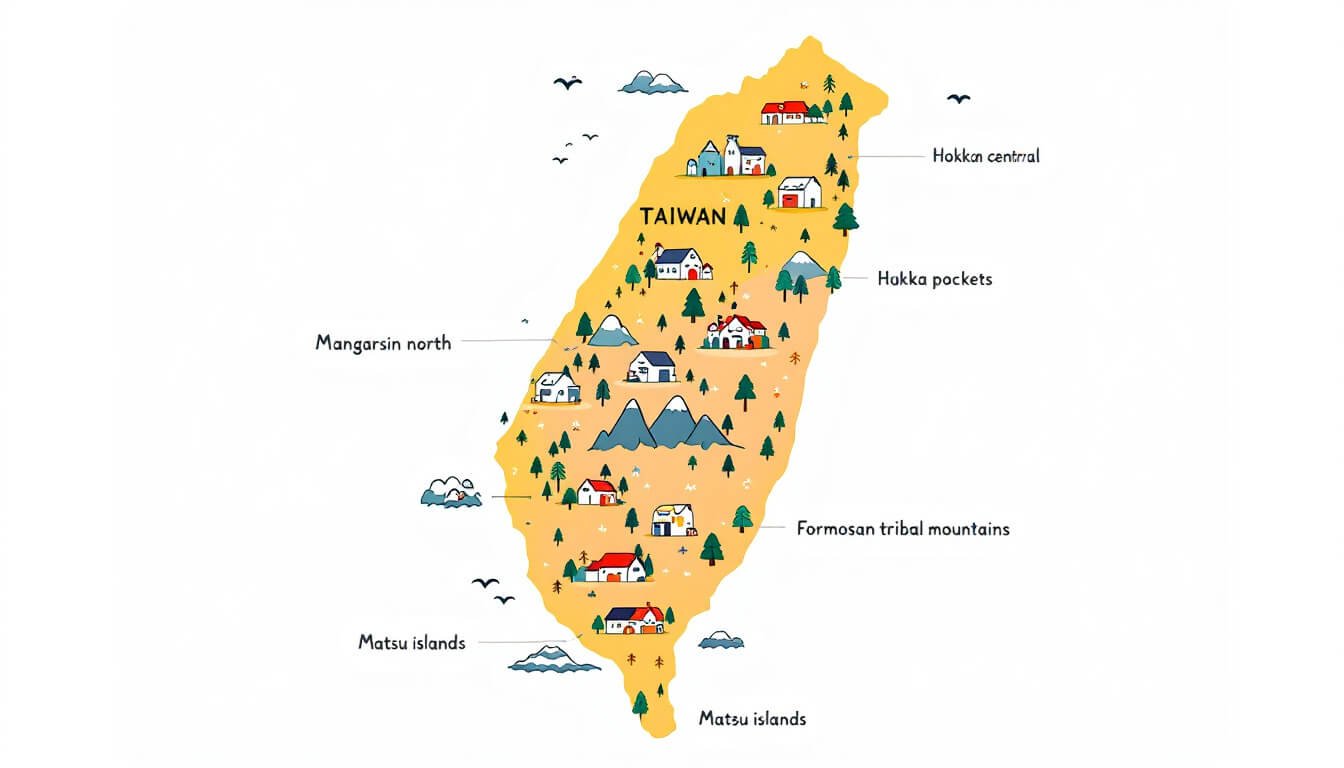
languages of Taiwan map

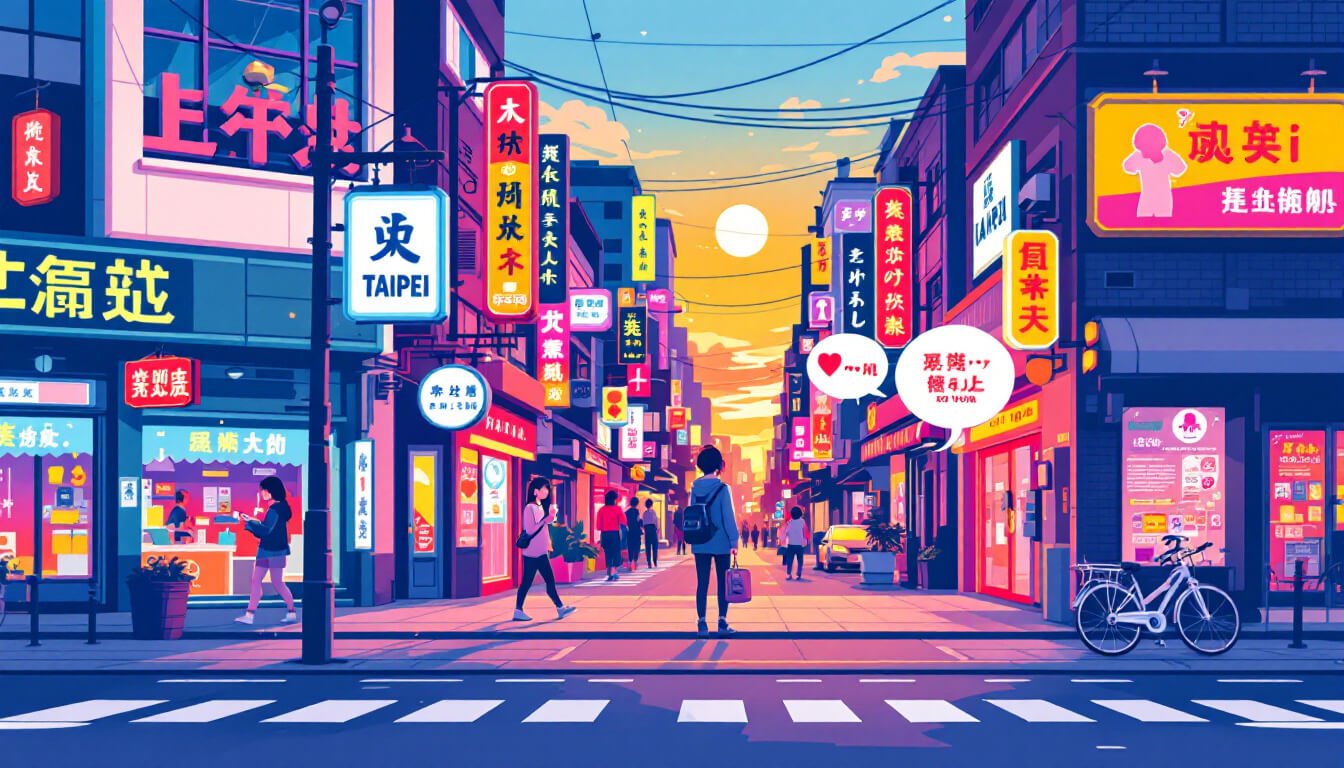
Walk through a Taipei night market on a Friday evening and you might hear five different languages in a single block. Taiwan’s linguistic landscape is one of the densest in Asia per square kilometer. Here’s the working map.

Taiwanese Mandarin (國語, Guóyǔ)

The dominant language. Roughly 83% of Taiwanese speak it fluently and around 50% list it as their primary home language. It uses Traditional Chinese characters (繁體字) — the older, more visually complex set that mainland China simplified in the 1950s. Taiwanese Mandarin also has its own accent, vocabulary, and rhythm, so much so that a Beijing taxi driver and a Taipei taxi driver speaking “Mandarin” can struggle to fully understand each other on slang.

Taiwanese Hokkien (台語, Tâi-gí or Hoklo)

The mother tongue of about 70% of Taiwanese families historically, and still the language you’ll hear in temples, fish markets, traditional opera, and conversations between grandparents and grandchildren. It descends from the Min Nan branch of Chinese spoken in Fujian province, brought to Taiwan by Hokkien settlers starting in the 1600s. It’s tonal (with seven or eight tones, depending who you ask), and it doesn’t have a single standardized writing system — most speakers use it as a spoken language only.

Hakka (客家話, Kèjiā Huà)

The language of Taiwan’s roughly 4 million Hakka people, descendants of migrants from southern China who settled in the hill regions of Hsinchu, Miaoli, and parts of Pingtung. Hakka has its own television channel (Hakka TV), its own designated cultural towns, and its own Basic Act guaranteeing teaching and broadcasting rights.

Formosan Languages

The sixteen recognized Indigenous languages — Amis, Atayal, Bunun, Paiwan, Rukai, Puyuma, Tsou, Saisiyat, Yami (Tao), Kavalan, Truku, Sakizaya, Seediq, Saaroa, Kanakanavu, and Thao — are Austronesian, meaning they’re more closely related to Maori, Tagalog, and Hawaiian than to Chinese. Linguists believe Taiwan is the ancestral homeland of the entire Austronesian language family, which today stretches from Madagascar to Easter Island. We covered this in depth in our guide to Taiwan’s Indigenous peoples.

Matsu Dialect (馬祖話)

A variety of Fuzhounese spoken on the Matsu Islands, an archipelago just off the Fujian coast that is governed by Taiwan. Fewer than 10,000 native speakers, but it’s a recognized national language thanks to Matsu’s distinct cultural identity.

Taiwan Sign Language (台灣手語)

Recognized in 2018 as a full national language with its own grammar and lineage — descended in part from Japanese Sign Language during the colonial period, with influence from Hong Kong Sign Language. Roughly 30,000 deaf users.

For a deeper breakdown of who speaks what and where, see our companion guide to what language they speak in Taiwan.

Why “Taiwanese” vs “Chinese” Matters to the People of Taiwan

Taiwanese identity language

Here’s a phrase that will land you in awkward small talk faster than any other: “So you speak Chinese?”

To a foreign ear it sounds neutral. To many Taiwanese ears it carries decades of political weight. Calling Taiwan’s language “Chinese” implies a particular relationship with the People’s Republic of China across the strait — and that relationship is, to put it mildly, complicated. A growing share of younger Taiwanese identify primarily as Taiwanese, not Chinese. Polling from the National Chengchi University Election Study Center, which has tracked this for decades, has shown the “Taiwanese only” identity at over 60% in recent years, with “Chinese only” hovering in the low single digits.

This is why a lot of locals — especially under 40 — will gently correct you and say they speak Mandarin, not Chinese. Or they’ll say huá yǔ (華語), a more neutral term that refers to “the Chinese language family” without invoking national identity. Or, when speaking among themselves, they’ll just call it 國語 (Guóyǔ), which literally means “national language” without claiming it belongs to any one country.

Hokkien speakers are even more pointed. When older Taiwanese say they’re speaking 台語 (Tâi-gí, “Taiwan-language”), it’s a small linguistic declaration of independence. The word itself stakes a claim: this language is Taiwan’s, not a regional dialect of someone else’s. It’s the same reason you’ll see Hokkien songs dominating Taiwan’s indie music scene and Taiwan’s beloved temple festivals — Hokkien is the language of cultural memory, the one your grandmother sings lullabies in.

None of this means Taiwanese people resent Mandarin. Most are deeply fluent in it, write all their text messages in it, and read all their news in it. It just means that when you ask about the official language of Taiwan, you’re touching a question about identity, sovereignty, and history all at once. Treat it with the curiosity it deserves and people will open up.

The KMT Language Policy: How Mandarin Became Dominant

KMT language policy Taiwan

Mandarin wasn’t always the default language of Taiwan. For most of the island’s history, it wasn’t spoken here at all. Taiwan’s switch to Mandarin is a story of policy — and, for an entire generation, of punishment.

In 1945, when Japan’s 50-year colonial rule ended after World War II, the incoming Republic of China government under the Kuomintang (KMT) took over an island where the lingua franca was Taiwanese Hokkien, with Japanese as the educated second language and Indigenous tongues across the mountains. The KMT, who would soon retreat from the mainland after losing the civil war to the Communists in 1949, brought Mandarin with them — and they wanted it to take over fast.

From the late 1940s through the 1980s, Taiwan lived under martial law (the longest period of martial law anywhere in the world at the time, lasting 38 years from 1949 to 1987). One pillar of that period was a campaign called the National Language Movement (國語運動). Mandarin became the only language allowed in schools, on broadcast radio and television, in government, in the military, and in public life. Children caught speaking Hokkien, Hakka, or any Indigenous language at school were fined, slapped, made to wear humiliating signs around their necks, or forced to write self-criticisms.

An entire generation of Taiwanese grew up watching their grandparents speak Hokkien at home and Mandarin in public — and learning, very young, that one was respectable and one was something to be ashamed of. 台灣文化 still carries the imprint of that policy. Many Taiwanese in their fifties and sixties today have a working-but-rusty Hokkien they’re a little embarrassed about. Many in their thirties grew up barely hearing Hokkien at all. Hakka and Indigenous languages were hit even harder — UNESCO classifies several Formosan languages as critically endangered, with native speaker counts in the dozens.

If you want to wear a small piece of this story, check out our 台灣旗幟圖案中文T卹 — a design that quietly celebrates Traditional Chinese script, the writing system Taiwan kept after the mainland simplified its own. Every time you wear it, you’re flagging the side of the strait that preserved the older characters.

Martial law ended in 1987. The language thaw that followed has been one of Taiwan’s most quietly revolutionary cultural projects.

Hokkien, Hakka, and Indigenous Languages: The Revival Movement

Taiwan indigenous language revival

Once the National Language Movement ended, Taiwan started trying — slowly, awkwardly, sometimes politically — to undo what it had done. The result, three decades in, is one of the most ambitious language revitalization projects in Asia.

Hokkien in schools and pop culture

Since 2001, elementary schools have offered Hokkien (along with Hakka and Indigenous languages) as required “local language” classes — typically one or two hours a week. Hokkien has surged back into music: indie artists like Sunset Rollercoaster, EggPlantEgg (茄子蛋), and the rapper Dwagie all release Hokkien tracks that top the charts. Hokkien-language films and TV dramas, once unthinkable, now win Golden Bell Awards. The language isn’t fully recovered, but it has its swagger back.

Hakka’s quiet renaissance

Hakka got its own dedicated TV channel in 2003 (Hakka TV, fully government-funded) and a 2018 Hakka Basic Act mandating bilingual signs and services in designated Hakka-majority townships. Apps for learning Hakka, Hakka pop bands, and Hakka cuisine festivals have built a whole pipeline of young people reclaiming the language. Many Hakka grandparents are crying tears of joy.

Indigenous languages: the hardest fight

The Indigenous Formosan languages were hit the hardest by the National Language Movement, and several are in critical condition. Kanakanavu and Saaroa each have fewer than ten fluent native speakers. The government’s Council of Indigenous Peoples now runs language nest programs — modeled on New Zealand’s kōhanga reo for te reo Māori — where elders teach toddlers their ancestral tongue in immersion preschools. Indigenous-language exams are required for hiring at certain Indigenous-affairs jobs. Tribal radio stations broadcast in Amis, Paiwan, Atayal, and others.

And in 2017 the government passed the Indigenous Languages Development Act, which recognized all sixteen Formosan languages as national languages — a year before the broader National Languages Development Act formalized the whole system. It was the first time in Taiwan’s history that Indigenous languages had the same legal standing as Mandarin.

Why this revival matters for travelers

You’ll see and hear the revival on every trip. Subway announcements in Taipei now play in four languages: Mandarin, Hokkien, Hakka, and English. High-speed rail does the same. Government services are increasingly multilingual. Bilingual street signs in Indigenous areas are appearing. Pop songs in Hokkien blast from 7-Eleven speakers.

台灣旗幟圖案中文T卹

Wear the Characters Taiwan Kept

Taiwan held onto Traditional Chinese script while the mainland simplified. Our Taiwan Flag Typography tee celebrates the writing system that keeps the island’s linguistic heritage alive — bold blue and red, clean typography, every character a quiet act of preservation.

Language Tips for Travelers: Phrases That Win Hearts

Taiwan travel phrases

You don’t need to be fluent. You need three things: a willingness to try, a friendly tone, and one or two phrases that aren’t from the standard “你好” / nǐ hǎo phrasebook. Here’s what actually works.

Mandarin essentials (the everyday baseline)

  • 你好 (nǐ hǎo) — “Hello.” Universally understood. Fine. Safe.
  • 謝謝 (xièxie) — “Thank you.” Use generously.
  • 不好意思 (bù hǎo yìsi) — “Excuse me / sorry.” More natural and polite in Taiwan than the textbook 對不起 (duìbuqǐ).
  • 多少錢? (duōshǎo qián?) — “How much?” Essential at 夜市.
  • 我要這個 (wǒ yào zhège) — “I want this one.” Point and say. Works everywhere.

Hokkien greetings (the secret weapon)

This is where you graduate from tourist to friend-of-Taiwan. Drop one Hokkien phrase on an older shopkeeper and watch their face light up.

  • 你好 (lí-hó) — “Hello” in Hokkien. Same characters as Mandarin’s nǐ hǎo, totally different sound. Older Taiwanese will warm to you instantly.
  • 多謝 (to-siā) — “Thank you” in Hokkien.
  • 呷飽未? (chiah-pá–bē?) — Literally “Have you eaten?” The Hokkien equivalent of “How are you?” — a way of showing care, not a literal food question.

What not to do

  • Don’t assume people speak English fluently outside Taipei. Younger Taiwanese have studied English for years but are often shy about using it. Smiling helps more than perfect grammar.
  • Don’t lead with “Do you speak Chinese?” — try “Do you speak Mandarin?” or, better, “你會說中文嗎? (Nǐ huì shuō zhōngwén ma?)” with a smile.
  • Don’t assume Taiwan uses Pinyin everywhere — Taiwan officially uses Hanyu Pinyin since 2008, but you’ll still see older Tongyong Pinyin signs in some places. Don’t worry about it; it’s a romanization, not a different language.

Frequently Asked Questions About Taiwan’s Languages

Taiwan languages FAQ

Is Taiwanese the same as Chinese?

No. “Taiwanese” usually refers to Taiwanese Hokkien (台語), which is a distinct spoken language descended from Min Nan Chinese. Mandarin Chinese is a separate language. They share some characters when written, but they are not mutually intelligible when spoken.

Do Taiwan and China use the same writing system?

No. Taiwan uses Traditional Chinese characters (繁體字 / 正體字). Mainland China uses Simplified Chinese (简体字) — a reform introduced in the 1950s. Reading both takes practice. Hong Kong also uses Traditional. Singapore uses Simplified. We dug into the Taiwanese phonetic system Mandarin students grew up with in our Bopomofo guide.

Is English widely spoken in Taiwan?

It’s growing fast. Taiwan launched the Bilingual 2030 initiative in 2018, aiming to make the country functionally bilingual in Mandarin and English by 2030. Most signage in Taipei, Taichung, and Kaohsiung is bilingual. Younger Taiwanese under 30 generally have functional English. Older generations, less so — but they’ll happily use translation apps with you.

What’s the difference between Taiwanese Mandarin and mainland Mandarin?

Same language, different accents, different vocabulary, different writing. Taiwanese Mandarin has a softer, more sing-song delivery, uses many Hokkien-origin slang words (like 揪 / jiū for “to invite friends” or 趴 / pā for “party”), and is written in Traditional characters. Mainland Mandarin has the famous Beijing “er” sound (儿化音), uses Simplified characters, and has its own slang. Speakers from both sides understand each other but immediately know where the other is from.

Do Indigenous Taiwanese people still speak their own languages?

Some do, with effort. Of Taiwan’s roughly 580,000 Indigenous people across 16 officially recognized tribes, fluency rates vary wildly by tribe — the Amis (the largest tribe) have stronger language retention than, say, the Saaroa, who number only a few hundred. Government revival programs are working hard but the road is long.

Can I get by in Taiwan with only English?

Mostly yes, especially in tourist zones, hotels, the MRT, high-speed rail, and 7-Elevens. You’ll have a richer trip if you learn even five Mandarin phrases. You’ll have an unforgettable trip if you learn one Hokkien greeting.

What’s bopomofo and do I need to learn it?

Bopomofo (注音符號) is Taiwan’s phonetic system for teaching Mandarin pronunciation — a 37-symbol set used in elementary schools, on keyboards, and in dictionaries. You don’t need to learn it as a tourist; Pinyin is enough. But it’s a uniquely Taiwanese piece of linguistic culture, and we wrote a whole Bopomofo deep-dive if you’re curious.

The Bigger Picture: Language Is Identity

Here’s the thing about asking what the official language of Taiwan is. The question assumes Taiwan is the kind of country that needs to crown one. But Taiwan, with its complicated history of Indigenous tribes, Hokkien settlers, Japanese colonizers, KMT mainlanders, Hakka migrants, and new immigrants from across Southeast Asia, has spent the past three decades doing something quietly remarkable: refusing to pick.

The 2018 National Languages Development Act wasn’t just legal housekeeping. It was Taiwan saying, in slow motion: every tongue that has been spoken here belongs here. Mandarin and Hokkien. Hakka and Amis. Matsu dialect and Taiwan Sign Language. None of them are less Taiwanese than the others.

So when you visit Taiwan and someone asks what you’ve been learning, tell them you’ve been learning that the official language of Taiwan is — depending on how you count — either one language, or six, or twenty-two. That alone will spark the best conversation of your trip.

For a broader cultural tour of the island, see our Taiwan Culture guide, our look at the linguistic diversity in our Languages of Taiwan overview, and our companion piece on what language they speak in Taiwan.

訂閱台灣商品資訊

訂閱台灣資訊郵件

Weekly stories about Taiwanese culture, hidden food spots, language tidbits, and the artisans behind our merch. No spam, just love letters from the island.

訂閱表格
免費台灣貼紙

免費領取台灣貼紙!

留下您的郵箱,我們將向您發送限量版台灣貼紙——以及搶先了解最新商品發售信息和感受海島風情的機會。.

絕不發送垃圾郵件。隨時可以取消訂閱。.

相關文章

發佈留言

發佈留言必須填寫的電子郵件地址不會公開。 必填欄位標示為 *