Taiwan Noon Water (午時水): Why Taiwanese Queue at Wells at Exactly 12 PM on Dragon Boat Festival
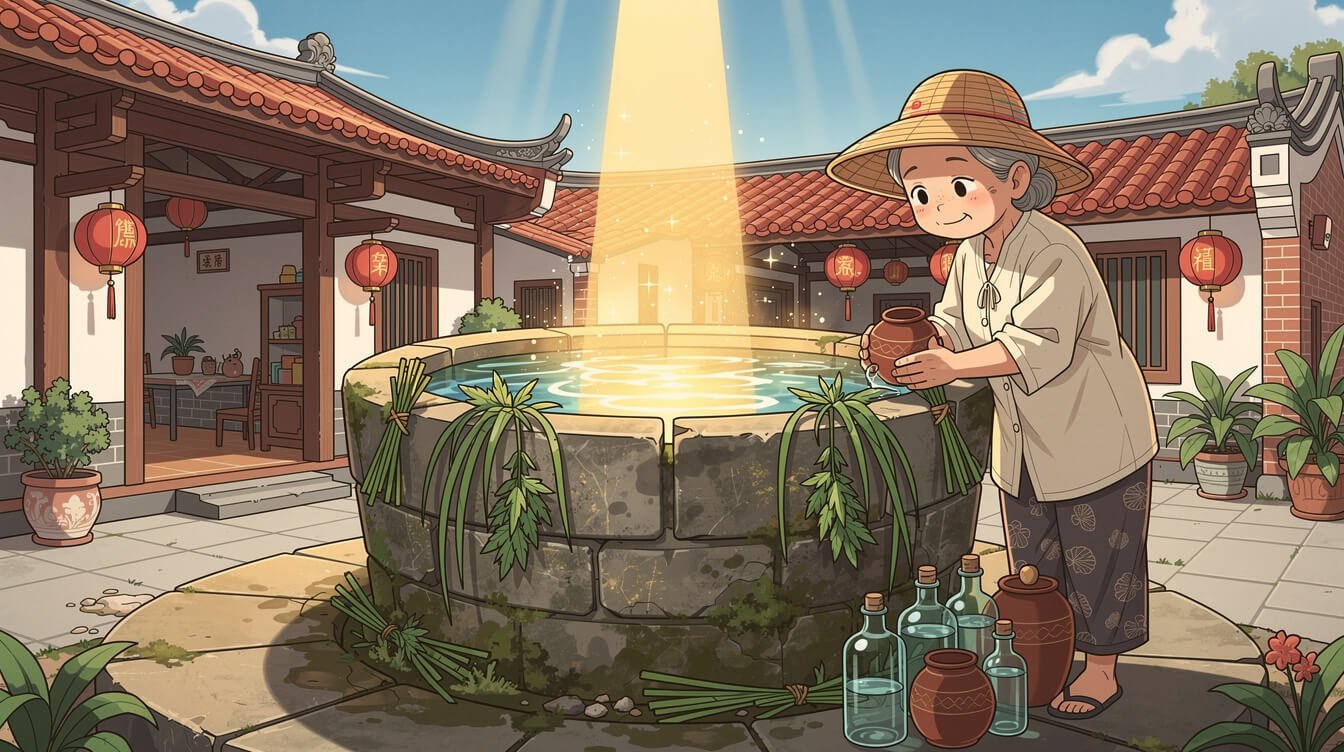
Walk past a 200-year-old well in Lukang next Friday at exactly 11:59 a.m. and you’ll see something strange: a line of locals holding glass bottles, clay jars, and empty soda containers, eyes locked on their watches. At the stroke of noon, they’ll lean in and start drawing water — fast, focused, almost reverent. They aren’t thirsty. They’re collecting wǔshí shuǐ (午時水), or “noon water,” and they only get one shot at it all year.
What is noon water?
Wǔshí shuǐ is water drawn from a well, spring, or river at precisely 12:00 p.m. on the fifth day of the fifth lunar month — Dragon Boat Festival, or Duān Wǔ Jié (端午節). In 2026, that falls on Friday, June 19.
Folk belief in Taiwan holds that at this exact moment — when the sun sits at its highest point on the year’s most “yang” (陽, masculine/solar) day — the yang energy condenses into the groundwater. The water becomes mildly antibacterial, slow to spoil, and (so the old people say) capable of curing summer fevers, settling stomachs, and even improving the quality of homemade wine, vinegar, and soy sauce.
Where Taiwanese still queue for it
The tradition is strongest in central and southern Taiwan, where temple wells become the focal point. Three places to know:
- Lukang (鹿港), Changhua — The historic port town keeps the most photogenic version of the ritual. The Banbian Jǐng (半邊井) or “Half Well” outside the Ding family residence is a postcard favorite, but the working wells are at Tianhou Temple and Longshan Temple.
- Jianan Plain, Tainan — Old farming families still draw from village wells for an entire year’s cooking. If you visit Anping at noon on the 19th, you’ll see clay jars lined up at temple wellheads before the bell strikes.
- Kaohsiung’s Cijin Island — A coastal twist: instead of well water, fishing families collect seawater at noon to pickle salted plums and preserve fish.
The science behind the superstition
Skeptics scoff, but modern microbiologists in Taiwan have actually tested wǔshí shuǐ samples — and the results are quietly interesting. Researchers at National Chung Hsing University have published studies showing that water drawn at solar noon in June has measurably lower bacterial counts in the first 72 hours of storage compared to water drawn at dawn or dusk, likely because the strong midday UV radiation in shallow wells sterilizes the surface layer just before collection.
It’s not magic. But the grandmothers were onto something.
How locals actually use it
- Sealed in clay jars as an emergency “summer cooler” for upset stomachs
- Added to homemade pickles — plum vinegar, fermented mustard greens, salted duck eggs
- Used to brew the year’s first batch of homemade rice wine (a craft still common in Hakka households)
- Dabbed on the foreheads of small children alongside realgar wine markings, to ward off summer illness
Want to catch it this year?
You have five days. If you’re in Taiwan on June 19, Lukang’s Tianhou Temple opens its well to the public from 11:30 a.m. The queue starts forming around 11:00. Bring a glass bottle — locals will tell you metal containers “interrupt the yang energy” (and honestly, the glass version photographs better).
And if you can’t make it to a well? At noon on the 19th, try the egg-balancing trick instead. Same solar moment, same yang energy — just with a hard-boiled egg and a flat floor.
Either way, you’ll be doing what Taiwanese families have done for at least 400 years: pausing at noon, on the year’s most charged day, to catch a little bit of the sun in something you can take home.

Grab a Free Taiwan Sticker!
Drop your email and we’ll send you a limited-edition Taiwan sticker — plus insider access to new merch drops and island vibes.
No spam. Unsubscribe anytime.