Did You Know? The Taiwan Golden Rain Tree Turns October Gold, Then Rose
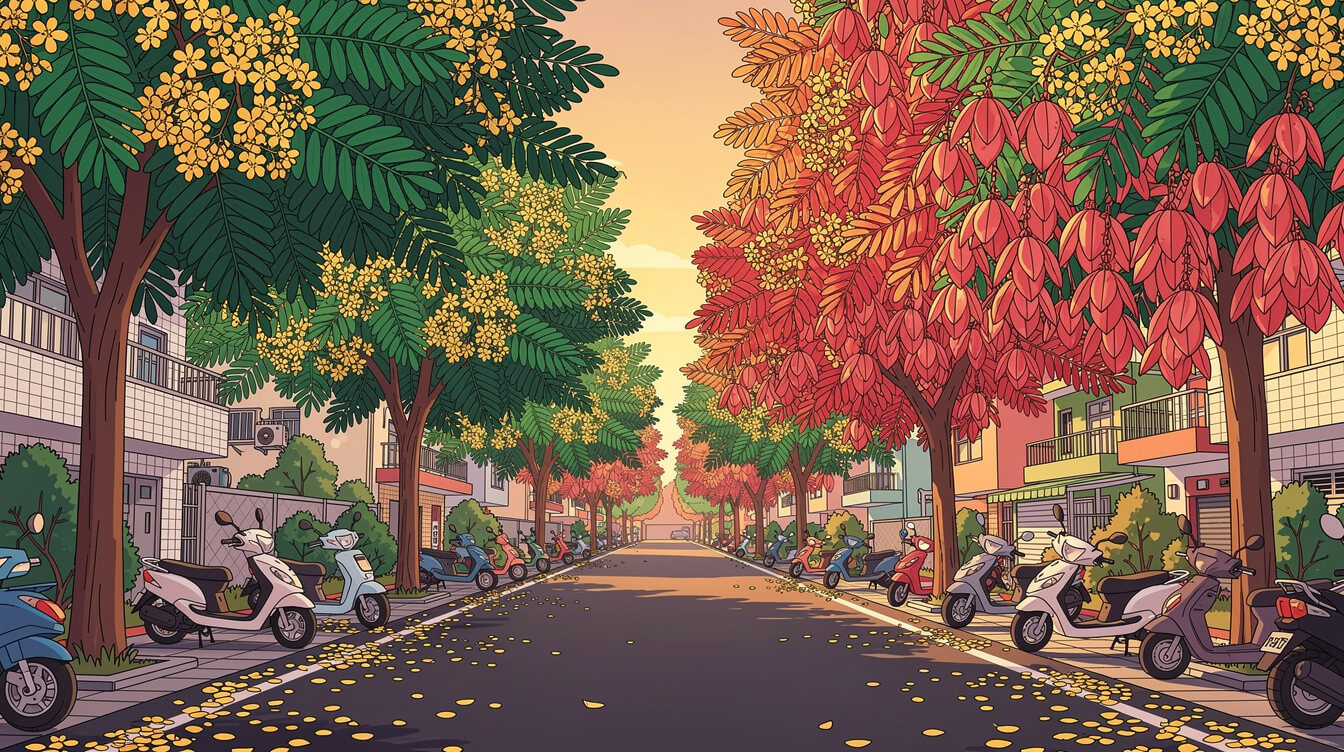
Taiwan does not really do red maples. What it does instead is happening right now, in the first half of October, on ordinary city streets: the 台灣欒樹 — the Taiwan golden rain tree — flips from green to gold, and then, within a few weeks, from gold to rose.
Four colours, one tree
Its nickname in Mandarin is 四色樹, the four-colour tree, and the name is a literal schedule. Deep green feathery leaves all summer. Sprays of tiny buttery-yellow flowers from roughly August into October. Then the flowers give way to papery three-sided seed capsules that come in bright rose-red and fade to red-brown through October, November and December. Finally the capsules dry to tan and drop.
That last stage earns it another name — 燈籠樹, the lantern tree — because the empty capsules hang in clusters like paper lanterns. A third name, 台灣金雨樹, is where the English “golden rain” comes from: when the flowers go over, the petals come down in a yellow drizzle and pool along the kerb.
It grows wild nowhere else on earth
This is the part most people miss. The golden rain tree is endemic to Taiwan — the whole wild population is on this one island. Botanists have gone back and forth on how to rank it: Taiwan’s official species checklists treat it as its own species, Koelreuteria henryi, while the Taiwan Forestry Research Institute describes it as an endemic subspecies, Koelreuteria elegans subsp. formosana. Either way, it is Taiwan’s and only Taiwan’s.
It belongs to the soapberry family, Sapindaceae — which makes it a botanical cousin of lychee and longan. The Forestry Research Institute notes it has ended up on lists of the world’s notable subtropical flowering trees, alongside the Taiwan mountain cherry.
One in every thirteen street trees in Taipei
You do not have to go looking for it. In a 2020 survey of Taipei’s street trees drawn from the city’s open data — about 87,750 trees across 199 species — the golden rain tree came fifth, at 7.6% of the total. Ahead of it: banyan (13.9%), autumn maple (10.8%), camphor (9.5%) and Formosan sweetgum (8.1%).
Camphor sitting two places above it is a nice piece of history in itself — Taiwan once supplied around 80% of the world’s camphor, and the laurels are still shading the streets long after the industry went.
About the red bugs — don’t panic, and don’t spray
If you stand under one of these trees in October you may notice the pavement moving. Those are 紅姬緣椿象, red soapberry bugs, and they are tied to this tree specifically: they feed on its sap and its ripening capsules and lay eggs inside them. Taipei Zoo’s own explainer notes two population booms a year — spring and autumn — timed to when the capsules mature, with an adult life cycle of only about three weeks.
They do not bite, they are not venomous, and they do not harm the tree. Startle one and it releases a smell, and that is the entire threat. Local governments in Taichung and Chiayi have put out public notices asking residents not to reach for insecticide, because the swarm subsides on its own within weeks.
Where to see the best of it
The most famous stretch is Zhongcheng Road in Tianmu, northern Taipei — a couple of kilometres of golden rain trees that the neighbourhood has celebrated with its own autumn tree festival. Outside the capital, the tree is the official county tree of two places at once: Yilan County on the northeast coast, and Chiayi County in the southwest.
If you are planning a visit around it, early-to-mid October is the gold and late October into November is the rose — which lines up neatly with the best weeks of the year to be in Taiwan anyway. It is autumn’s answer to the May snow of the tung blossoms.
The takeaway: Taiwan’s autumn palette is not the crimson everyone expects. It is gold, then rose, then rust — and it is delivered by a tree that exists nowhere else, standing along the kerb outside somebody’s apartment block.
Love this kind of Taiwan detail? We put it on shirts. Shop Taiwan Merch →

Grab a Free Taiwan Sticker!
Drop your email and we’ll send you a limited-edition Taiwan sticker — plus insider access to new merch drops and island vibes.
No spam. Unsubscribe anytime.