Taipei MRT Etiquette: Why No One Eats, Drinks, or Even Sips Water on the World’s Quietest Subway
The first time a friend visits Taipei, they almost always get the same warning at the turnstile: don’t even sip your water in here. Most laugh it off — until they watch a station guard politely tap the shoulder of a teenager unwrapping a sandwich and motion her right back through the gate. The Taipei MRT is genuinely, almost militantly quiet. And the rules that keep it that way are weirder, stricter, and more cultural than any travel guide tells you.
Welcome to the world’s most disciplined subway etiquette, where Section 50 of the Mass Rapid Transit Act says you can be fined NT$1,500 to NT$7,500 (roughly US$45 to US$235) for eating, drinking, chewing gum, or even chewing betel nut inside the paid zone. Not just on the train. The paid zone — meaning the moment you tap your EasyCard at the gate, the no-snack rule kicks in.
What’s Actually Banned (It’s More Than You Think)
- Eating — including a single bite of a pineapple cake or a swallow of a 7-Eleven onigiri
- Drinking — yes, even bottled water, even a sip, even if you’re sweating buckets in August
- Chewing gum — counted as eating
- Chewing betel nut — explicitly named in the law
- Smoking — including vapes and e-cigarettes, of course
- Carrying open liquid containers — capped takeaway boba is fine to carry; uncapped cups are not
What’s allowed: medicine for medical reasons, baby bottles for infants, and a quick swig of water if a station staff member can clearly see you’re about to faint. Otherwise, the rule is universal. Locals don’t even pull out their phones to film the violators — they just stare, and that’s usually enough.
Why Taipei Built a Subway That Treats Snacks Like Contraband
The Taipei Metro opened its first line in 1996, and the city had a chance most subway systems never get: it could decide what kind of place this new infrastructure would feel like. The planners had seen what happened in Tokyo (orderly, but sticky with spilled coffee), New York (rats, food wrappers, the perfume of decades), and Hong Kong (jam-packed and noisy). Taipei went a different direction. They wrote the no-eating-or-drinking rule into the actual MRT Act, posted bilingual reminders on every platform pillar, and trained staff to enforce it from day one.
Thirty years later, the result is a transit system that’s regularly ranked among the cleanest in the world, with one of the lowest crime rates of any major-city subway anywhere. The stations don’t smell. The floors don’t stick. The walls don’t have stains. Tourists from Bangkok and Berlin and Boston ride it for the first time and ask, half-joking, if there’s been a recent deep clean. There hasn’t. It’s just always like this.
The Quiet Spillover: How MRT Manners Shape Taipei Life
Here’s the part that surprises outsiders: the etiquette doesn’t stop with snacks. On the escalators, Taipei locals stand on the right and walk on the left — a rule so universally observed that breaking it draws gentle ahem-sounding from behind. On the platforms, queues form in painted yellow boxes flanking each door, and people genuinely wait their turn even when a train is packed. Phone calls happen in low voices, often with a hand cupped over the mouth. The pink "priority seats" (博愛座) stay empty for the elderly, pregnant women, and people with disabilities — even when the rest of the car is standing-room-only.
It’s not magic. It’s a feedback loop that started with one rule about food and bloomed into a whole civic vibe. The MRT became a kind of daily classroom for what Taipei aspires to be: clean, considerate, and quietly proud. You feel it the second you step off the platform and back into the chaos of a Shilin night market — like a small reset for your nervous system.
What to Do (and Not Do) on Your First Ride
- Finish your bubble tea before you tap in — there are usually trash bins right outside the gates for exactly this reason
- Cap your water bottle and tuck it away — carrying is fine, drinking is not
- Keep your voice low — full-volume conversations stand out hilariously
- Stand right, walk left on escalators — non-negotiable
- Let elderly riders take the priority seats — even if there are clearly enough empty ones
- Tap your EasyCard or iPASS — paying cash for single-ride tokens is fine but slower; the rechargeable EasyCard is what every local uses
The MRT also makes it easy to reach almost everything worth seeing in the city — Taipei 101, the best Taipei experiences, the night-market street food trails, the temples, the riverside parks. Five lines, 131 stations, all under one tap-in fare. It’s the spine the whole city runs on.
And honestly? After a week of riding it, the no-snacks rule stops feeling restrictive. It starts feeling like a small daily gift — a 20-minute pocket of calm between a busy morning and a chaotic afternoon. The kind of thing you remember about Taipei long after the food coma fades.
Wear Taipei’s Quietest Rule
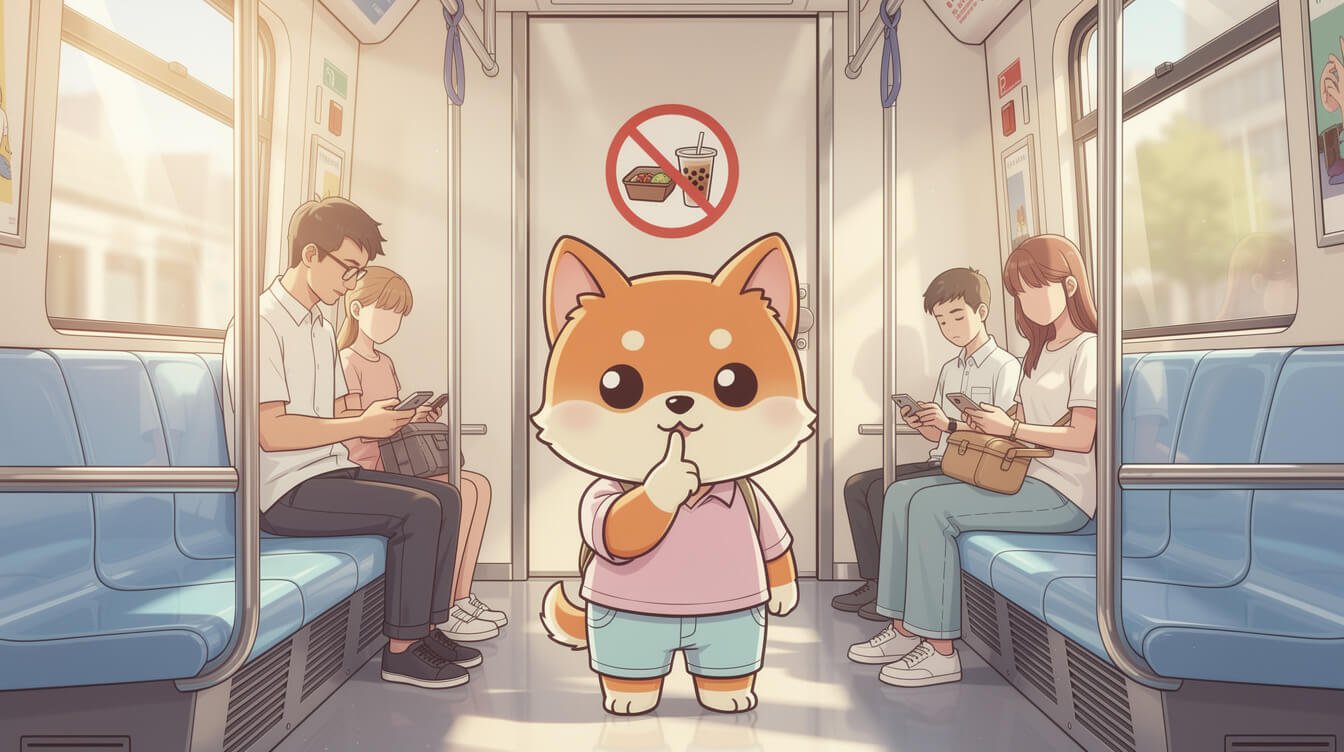
Locals don’t say shush on the MRT. The walls do. Our Please Speak Softly tee turns Taipei’s most iconic transit-etiquette sign into wearable everyday humor — featuring a wide-eyed Shiba Inu making the universal "quiet, please" face. Soft cotton, unisex fit, instantly recognizable to anyone who’s ridden the Bannan line.
So next time you’re in Taipei, finish the boba outside the gate. Tuck the water bottle. Smile at the silence. You’re not just following a rule — you’re plugged into one of the quiet superpowers that makes this city work.
Grab a Free Taiwan Sticker!
Drop your email and we’ll send you a limited-edition Taiwan sticker — plus insider access to new merch drops and island vibes.
No spam. Unsubscribe anytime.