Taiwan Typhoon Season 2026: The Travelers Guide to Riding Out the Storm
Ask anyone who’s lived in Taiwan about taiwan typhoon season and you’ll get a strangely affectionate answer. A weary smile. A story about taping nothing to the windows (because nobody does that here) but raiding the 7-Eleven for instant noodles like the world’s ending. A passionate defense of fēngfēng jià — the “typhoon day off” that mayors declare with the gravity of a presidential address. A complaint about a leaking apartment, followed instantly by gratitude that the reservoirs will refill.
Typhoons aren’t just weather here. They’re a cultural rhythm, a public-holiday lottery, an agricultural lifeline, and occasionally a tragedy. If you’re planning a 2026 trip to Taiwan between May and November — or you’re already on the island when one rolls in — this is the guide locals would write for you. We’ll cover when typhoon season actually peaks, why Taiwan’s geography makes it both a magnet and a shield, how the island prepares, the storms that shaped its modern memory, what to do as a traveler when a warning hits, and the surprising paradox at the heart of it all: Taiwan needs typhoons more than it admits.
When Is Typhoon Season in Taiwan?
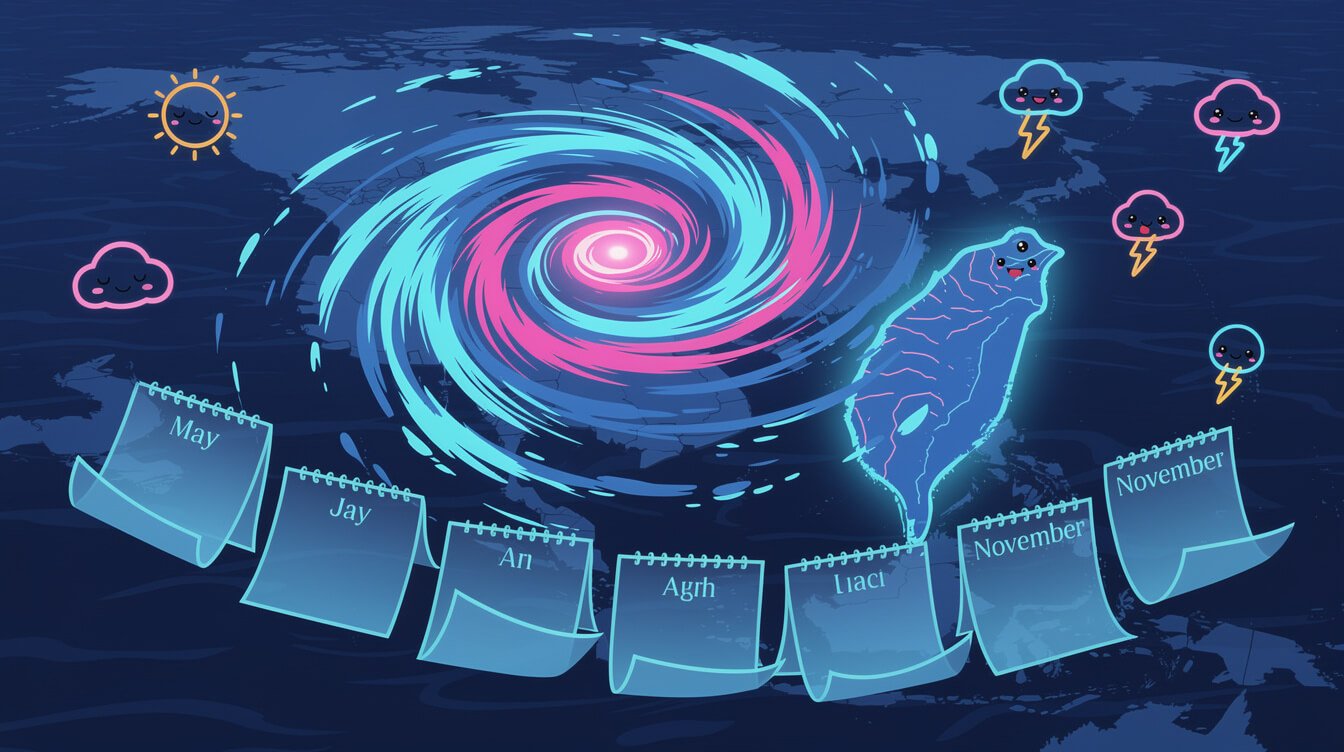
Officially, the Central Weather Administration (CWA) defines Taiwan’s typhoon season as May through November, but that window hides the real story. Of the roughly 27 tropical cyclones that form in the Western Pacific each year, a typical year brings three to four direct landfalls or close passes over Taiwan, and the overwhelming majority cluster in just three months: July, August, and September.
August is the peak. CWA records over the last two decades show August and September together account for more than half of all typhoon impacts on the island. May and June typhoons exist but tend to be weaker and faster-moving, often brushing past rather than locking in over Taiwan. October storms can still be ferocious — Typhoon Megi in 2016 hit in late September and lingered into October with sustained winds over 200 km/h — but they thin out quickly after Halloween.
The shape of the season is shifting, too. Climate scientists at Academia Sinica have been tracking a clear pattern over the past decade: fewer storms overall, but the ones that do form are stronger, wetter, and slower. A slow typhoon is a brutal typhoon. Morakot in 2009 stalled over southern Taiwan for two and a half days and dumped nearly 3,000 mm of rain in some mountain villages — more than the annual rainfall of most Western European cities, in 60 hours.
If you’re choosing when to visit, the practical takeaway: April, late November, and December are the safest months. If you’d rather travel during summer, lean toward early July before the peak ramps up, and have flexible plans. For a deeper breakdown of which month suits your trip style, our complete month-by-month guide to the best time to travel Taiwan walks through every variable.
How Typhoons Form and Why Taiwan Is So Exposed
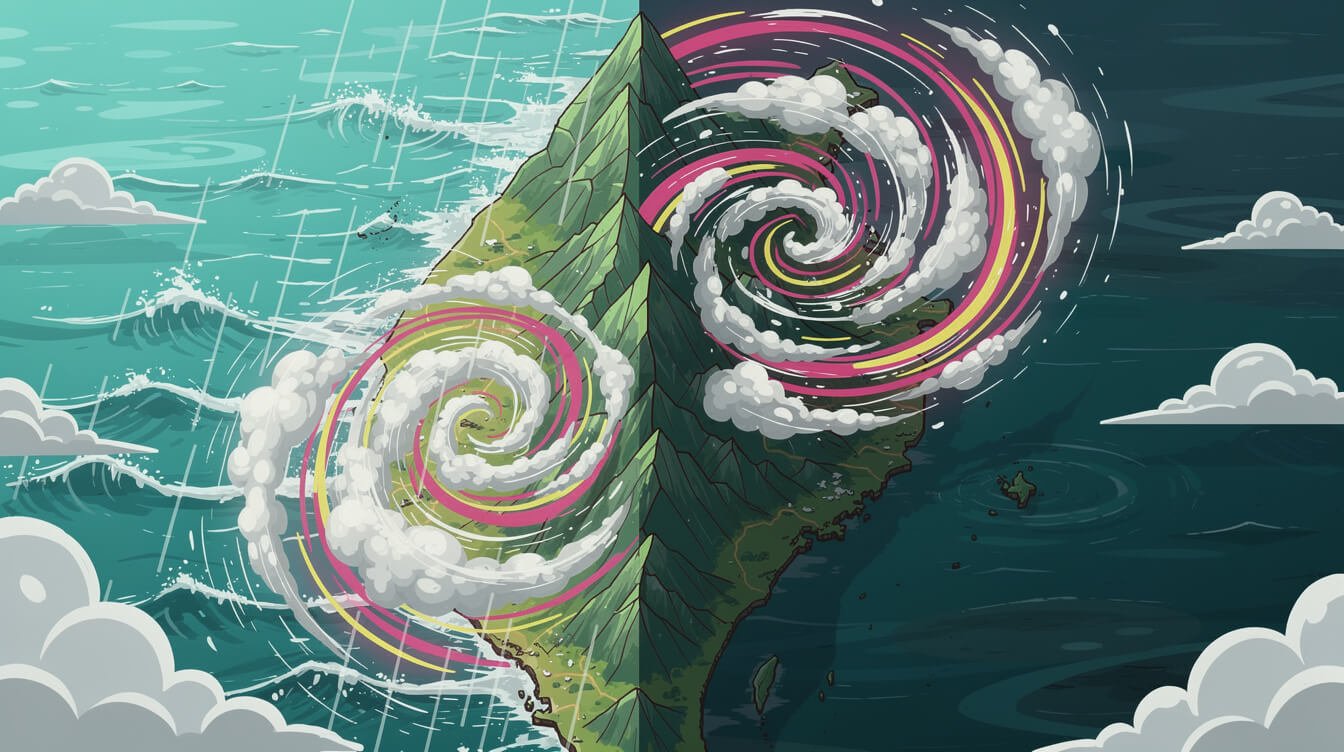
Typhoons are the Pacific cousin of hurricanes — same physics, different ocean, different name. They form over a band of unusually warm ocean called the Western Pacific warm pool, where surface temperatures regularly exceed 28°C in summer. Warm water evaporates, rises, condenses into towering thunderclouds, and the rotation of the Earth nudges that rising column into a spin. Once a tropical depression organizes itself enough to sustain winds above 118 km/h, it gets promoted to typhoon status by the Japan Meteorological Agency, which acts as the regional naming authority.
Most Western Pacific typhoons are born somewhere between the Philippines and the Mariana Islands, then track north and west. Taiwan sits directly in the bowling alley. The island’s position — at the northern edge of the deep-water warm pool, right on the typical curve where storms swing from west-northwest to north — means it gets brushed, hit, or hammered roughly four times a year while the South China Sea swallows the rest.
But Taiwan’s geography doesn’t just receive typhoons. It actively shapes them. The Central Mountain Range, which rises to over 3,900 metres at Yushan and runs the length of the island like a spine, acts as both a shield and a rain amplifier. As a typhoon approaches the east coast, the mountains force its moisture-laden eyewall to climb. Air can’t go through rock, so it shoots straight up. That violent uplift wrings the water out of the storm and dumps it on the eastern slopes — Hualien, Yilan, and the Taitung counties.
This is why the east takes the punishment. Hualien and Taitung can record 1,000+ mm of rain in a single typhoon event while Taipei, sheltered on the leeward western side, sees a fraction of that. The same mountain wall that breaks up the typhoon’s structure also tends to weaken its wind speeds dramatically as it crosses the island. A category-4 storm hitting Hualien can emerge over the Taiwan Strait as a much weaker system. Bad luck for the east. Geographic mercy for Taipei, Taichung, and Kaohsiung.
The asymmetry matters for trip planning. If you’re committed to visiting Taroko Gorge, Taitung’s coast, or the indigenous villages of the eastern slopes during peak season, build a 24–48 hour buffer into your itinerary. Our 2026 guide to Taroko Gorge after the earthquake covers what’s open and which approaches stay safer.
Fēngfēng Jià — The Typhoon Day Off Taiwan Genuinely Loves

Nothing captures the Taiwanese relationship with typhoons better than 颱風假 (fēngfēng jià), literally “typhoon vacation.” It’s the unofficial national holiday Taiwanese people would never trade for an extra public bank holiday, partly because nobody knows when it’s coming until 10 p.m. the night before.
Here’s how it works. Every city and county in Taiwan has its own mayor or county magistrate, and each one has the legal authority to declare a typhoon day off — closing schools, government offices, and most private businesses within their jurisdiction. The decision is made based on CWA wind-speed and rainfall forecasts, and there are official thresholds (sustained winds above 14 m/s plus heavy rain warnings), but the call is fundamentally political. Mayors who declare an unnecessary day off get mocked for ruining productivity. Mayors who fail to declare a justified one get crucified online when commuters end up trapped in floods.
The drama plays out live on Taiwan’s news channels. By around 9 p.m., reporters camp outside city government buildings. Twitter (now X), Threads, and PTT light up with running comparisons of which city has decided and which is still “considering it.” Taipei tends to wait the longest because Mayor Chiang Wan-an, like his predecessors, knows whatever he calls will be second-guessed for weeks. When a mayor finally announces, the city erupts — students celebrate, parents groan because now they have to entertain bored kids, office workers high-five over chat apps. The next morning’s news invariably features one mayor who got it wrong: either the storm was milder than feared, or much worse, and the wrong call becomes a meme within hours.
The cultural rituals around the day off are just as specific. Taiwanese people don’t really tape windows — newer Taipei apartment glass is rated for typhoon-force winds, and the older buildings have iron security bars that double as wind breaks. What they do is stockpile, and the stockpile has its own canon: instant noodles (specifically Wei Lih Vegetarian or Uni-President Master Kong beef), frozen dumplings, onigiri and bento boxes from the local 7-Eleven, fresh fruit (typhoons mean shortage spikes, so prices jump for a week after), and bottled water in case municipal supply gets cloudy. The pre-typhoon 7-Eleven run is a uniquely Taiwanese genre of urban photography. If you’re curious about the cultural depth of these stores, our guide to Taiwan convenience store culture explains why the conbini is the true civic hero of typhoon week.
For travelers, the day off is a gift you didn’t ask for. Museums, theme parks, and most attractions will close. Public transport is usually suspended once winds cross a threshold. But cafes, KTV joints, hot spring resorts, and shopping malls in safer districts tend to stay open. It’s the perfect day to lean into the rhythm rather than fight it.
The Storms That Shaped Modern Taiwan
Every Taiwanese family has a typhoon story. Some are funny — a grandfather who lost a window-mounted air conditioner that flew across a neighborhood. Some are devastating. A handful have permanently altered the island’s infrastructure, politics, or even its landmarks.
Typhoon Morakot (August 2009) is the storm by which all other modern typhoons in Taiwan are measured. A category-2 in raw wind terms, Morakot stalled over southern Taiwan and dumped what is still one of the highest single-event rainfall totals ever recorded anywhere in the world — 2,777 mm at Alishan over three days. The mountain village of Xiaolin in Kaohsiung was buried by a landslide that killed nearly 500 people in minutes, most while sleeping. National recovery took years, the Ma Ying-jeou government’s slow response sparked a political crisis, and Taiwan’s mountain-risk early-warning systems were rewritten from scratch in its aftermath.
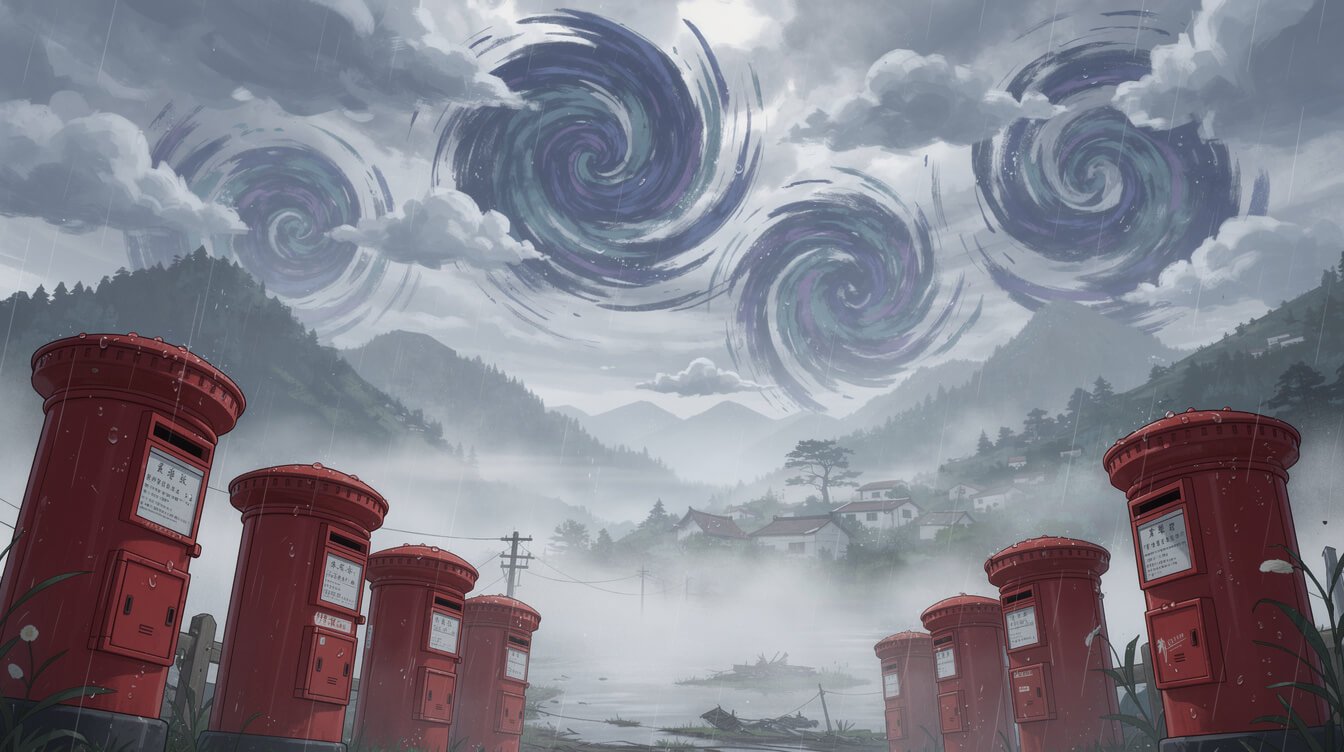
Typhoon Soudelor (August 2015) didn’t kill at Morakot’s scale but it reshaped one Taipei neighborhood permanently. As Soudelor’s winds tore through the Zhongshan district, two postboxes on Longjiang Road got hit by falling signage and ended up bent at a perfect cartoon angle. Within 48 hours they were a national-news landmark. Chunghwa Post made a commemorative postmark. A slogan trended: “歪腰也要正能量” — “even bent at the waist, stay positive.” We covered the whole accidental-landmark story in our deep dive on Taiwan’s leaning postboxes.
Typhoon Saola (August 2023) brushed northern Taiwan with category-5 intensity in the open ocean before veering toward Hong Kong. Schools closed, but Saola’s most lasting effect was political: it triggered a viral national debate about whether mayors were over-cautious, because the storm never actually hit as hard as forecast. The “boy who cried typhoon” question now haunts every borderline call.
Typhoon Gaemi (July 2024) made landfall in Yilan as a strong category-3, leaving four dead and triggering massive flooding in Kaohsiung. It was the strongest typhoon to hit Taiwan in eight years and reignited the climate-change conversation about slower, wetter storms.
Typhoon Khanun (August 2023) and Typhoon Fung-wong (October 2025) were the most recent reminders that Taiwan’s typhoon era is far from quiet. Fung-wong in particular re-traumatized the eastern coast with another bout of catastrophic Hualien rainfall less than two years after the 2024 earthquake there.
The Paradox: Why Taiwan Actually Needs Typhoons
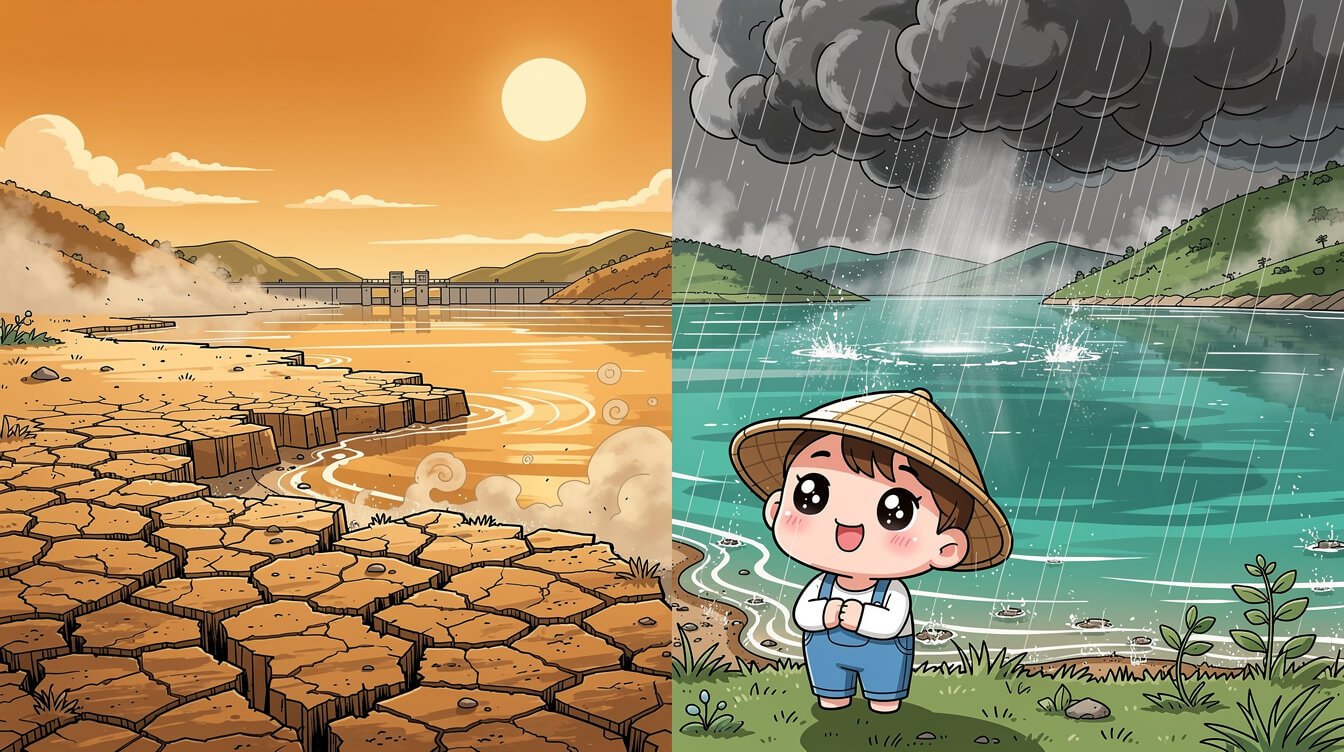
Here’s the part that surprises first-time visitors. Despite the death toll, the property damage, the airport chaos and the agricultural losses — Taiwan needs its typhoons. Without them, the island runs dry.
Taiwan gets roughly 2,500 mm of rain per year on average, which sounds enormous. But the geography distributes that rain absurdly unevenly. Roughly 80% falls between May and October, mostly in the form of plum rain (méiyǔ) followed by typhoons. Without those summer monsoons and storms, the dry winter and spring would leave Taiwan’s 23 reservoirs catastrophically low by April or May.
This is exactly what happened in 2021, the year of Taiwan’s worst drought in 56 years. The previous year, 2020, was the first typhoon-free year for Taiwan since record-keeping began in 1964. Not a single tropical cyclone made landfall. At first, the news cycle treated it as a public-health miracle — fewer deaths, fewer evacuations, no chaos. Then the reservoirs started dropping. The Sun Moon Lake water level fell so far that an old village submerged decades earlier briefly resurfaced. Major reservoirs like Shimen dropped below 10% capacity. The semiconductor industry, which uses staggering volumes of ultrapure water at TSMC’s fabs, started panicking publicly. Farmers in Chiayi had to abandon entire rice crops because irrigation was rationed. Hsinchu went on tap-water restrictions for the first time in living memory.
The 2021 drought ended only when the méiyǔ season finally delivered and a few weak summer typhoons brushed past. Farmers across central and southern Taiwan publicly thanked the storms. Op-eds ran in major newspapers reframing the typhoon as a “necessary ally.” It’s a peculiarly Taiwanese piece of climate philosophy: the same force that destroys also sustains. You can’t simply will the typhoons away.
Plum rain season — the méiyǔ front that drenches Taiwan from mid-May to mid-June — is the other half of this water-supply equation. We unpacked the cultural side of méiyǔ in our guide to Taiwan’s plum rain season. Together, plum rain and typhoons account for the vast majority of the island’s freshwater each year.
As a Traveler — Should You Cancel Your Trip?
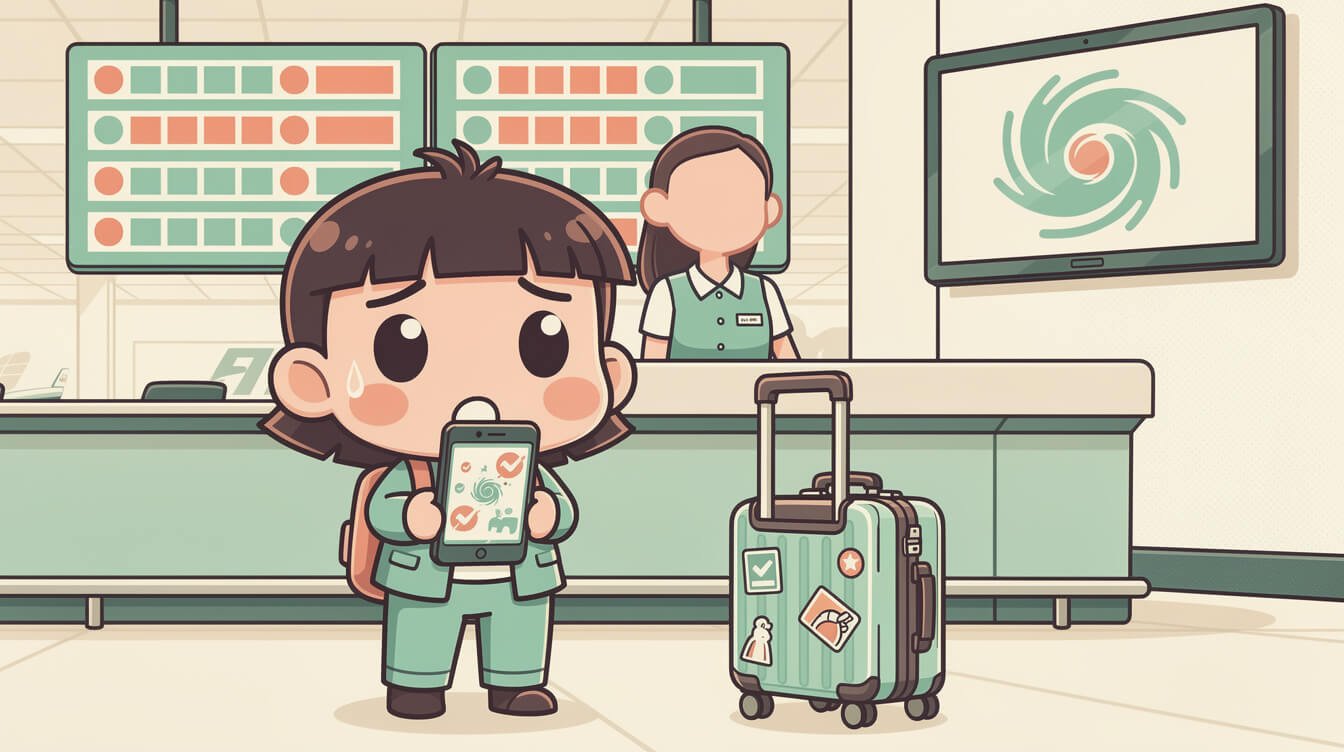
Short answer: almost never cancel pre-emptively, but build flexibility into your itinerary if you’re traveling between July and September.
The longer answer involves understanding how Taiwan actually handles a typhoon in real time. The Central Weather Administration issues warnings in two stages. A Sea Warning goes up roughly 24 hours before tropical-storm-force winds are expected within 100 km of Taiwan’s coast — this affects shipping and ferries to outlying islands like Penghu, Kinmen, and Matsu, but is mostly invisible to land-based tourists. A Land Warning follows roughly 18 hours before those winds are expected to actually hit land. That’s the moment to start checking flight statuses and revising plans.
Flight cancellations rarely happen more than 12 hours in advance. Taoyuan International (TPE) stays open through most direct typhoon hits — its runways are oriented to handle high crosswinds, and only the most violent storms actually close it. But individual airlines (especially regional carriers like EVA, China Airlines, Tigerair Taiwan and Starlux) start cancelling and rebooking when winds cross thresholds for their fleet. If your flight is in the 24 hours before or after a forecast Taiwan landfall, check the airline app obsessively, not the airport’s general status.
The High Speed Rail (HSR) and Taiwan Railways (TRA) usually run normal service unless winds genuinely crack their operational thresholds. When they do suspend, the suspension is sudden and total: a train that left Taipei at noon may be stuck in Hsinchu at 1 p.m. with everyone disembarking. Don’t book a same-day connection through the western corridor on a borderline typhoon day. If you need to know more about the rail network, our complete Taiwan high-speed rail guide covers the network and timing buffers.
Hotel policies vary, but most reputable international chains in Taipei and Kaohsiung will waive cancellation fees once a Land Warning is officially issued for the relevant region. Smaller boutique hotels and homestays in eastern Taiwan (where typhoons hit hardest) tend to be more flexible too — they live with this every year. Use the Land Warning as your trigger to call, not the rumor of a storm three days out.
Travel insurance is worth it for July–September Taiwan trips. Read the fine print on “named storm” exclusions — most policies cover trip interruption from typhoons only if the policy was purchased before the storm was named. If you’re booking your trip ten days out and Typhoon Yagi-Junior is already on the satellite, it may be too late. Also check that your visa-free entry window has enough buffer to absorb a 2–3 day flight delay if you get stuck.
What to Do When a Typhoon Hits While You’re There

You’ve landed safely. The Land Warning is up. Your hotel is in Ximending or Da’an. Your flight home is in three days. What now? The honest answer: it’s going to be one of the more unforgettable, low-pressure days of your Taiwan trip. Here’s how locals actually spend them.
The hot spring run. Beitou and Yangmingshan above Taipei, Wulai to the south, Jiaoxi over in Yilan, and the volcanic springs of Guanziling further south — all stay open during typhoons (assuming roads aren’t closed) and many travelers will tell you a hot spring soak while the windows rattle from typhoon winds is the most uniquely Taiwanese experience they’ve ever had. Our guide to Taiwan’s hot springs covers every major region. Most resorts will check road conditions for you before confirming a booking.
KTV. Singing rooms are open 24/7, soundproofed, and stocked with the snacks and drinks you need to survive a four-hour storm. Cashbox, Holiday, and Partyworld are the chains. There’s a reason Taiwanese people emerged from the 2021 lockdown era still singing — KTV is muscle memory here. The full cultural breakdown is in our deep dive on Taiwan KTV. A great companion piece to that day, frankly, is wearing something cozy and unmistakably Taiwanese — our Taiwan MRT Please Speak Softly tee features the bilingual cat-cartoon courtesy poster that any local will immediately recognize from the Taipei Metro, which makes for a great hot-pot-and-typhoon-day uniform.
Indoor museums and malls. The National Palace Museum in Shilin stays open in all but the most extreme conditions. So do the Taipei Fine Arts Museum, the Mitsui Outlet at Linkou, Eslite Spectrum in Xinyi, and the basement floors of Taipei 101. The food courts at any of these will be running. If you have small kids in tow, Taipei Children’s Amusement Park’s indoor zones and the Miniatures Museum near Songjiang Nanjing MRT will keep them busy for hours.
The stockpile run. Even if your hotel has room service, do at least one 7-Eleven or FamilyMart run just for the experience. Pick up onigiri, a tea egg, a microwave bento, a steamed bao, and at least one bag of unfamiliar Taiwanese chips (Want Want shelly senbei, Ku Shun Chee dried beef strips, or anything Cha Cha brand). Use the touch-screen kiosks to order Hi-Life coffee. This is anthropology disguised as snacks.
Cinema. Mainstream multiplexes like Showtime, Vieshow, and Ambassador Theatres stay open. Many show English-language films with Chinese subtitles. A 3-hour blockbuster in a heated theatre while the storm rages outside feels exactly as comforting as it sounds.
What absolutely NOT to do. The deaths in modern Taiwan typhoons almost universally happen in the same handful of scenarios: people going to beaches to “see the surf” (massive waves and rip currents kill several spectators every year), hikers caught on mountain trails as flash floods sweep down ravines, drivers attempting flooded underpasses or rural roads, and surfers thinking they can ride pre-storm swell. Every single one of those is a hard no during any Land Warning. The official advice from Taiwan’s emergency services is brutally simple: stay indoors, stay above ground, don’t go near water of any kind, and don’t drive unless your life depends on it.
Frequently Asked Questions About Taiwan Typhoons
Will my flight definitely get cancelled if there’s a typhoon?
No. Even direct hits often see only a 6–12 hour window of cancellations as the storm passes. Most flights operate normally before and after. If your flight is on a typhoon day, check the airline app every 2 hours rather than panicking 48 hours out.
Is Taipei or Hualien safer during typhoon season?
Taipei, by a wide margin. The Central Mountain Range shields Taipei from the worst of every storm coming from the east or south. Hualien and Taitung take direct landfalls. If you’re flexible on itinerary, weight your time toward Taipei and the western corridor in July–September.
How do I read CWA typhoon warnings?
CWA’s website (cwa.gov.tw) is available in English. The two warning tiers to watch are Sea Warning (海上警報) and Land Warning (陸上警報). Both are accompanied by a category number (Light, Medium, or Strong) and a forecast track. The track is updated every three hours.
What apps should I have on my phone?
Three essentials: CWA Weather (official, English-friendly), Windy (excellent global typhoon visualization), and Disaster Prevention Information Public Cloud (the official emergency alert app — set it to English in settings). Together they cover forecasts, tracking, and government push alerts.
Can I get a refund on my hotel if there’s a typhoon?
Most international chains will waive cancellation fees once a Land Warning is officially issued for the region. Boutique hotels in eastern Taiwan are usually flexible too. Call rather than email — agents have discretion that the booking websites don’t.
Do typhoons mean I should pack differently?
A compact umbrella that survives 60 km/h winds (Senz, Blunt, or any vendor at a Taipei MRT station), waterproof shoes or quick-dry sandals, and at least one quick-dry change of clothes you can stuff in a day bag. Skip the cheap convenience-store umbrellas — they invert on the first gust.
Final Thoughts — Living With Taiwan’s Wild Weather
Visit Taiwan in typhoon season and you’ll come home with stories nobody else has. The novelty of an entire city deciding to take Tuesday off because the mayor said so. The improbable comfort of a steaming hot spring during a 200 km/h wind. The communal weirdness of a fully packed 7-Eleven at 11 p.m. as everyone realizes they forgot to buy bottled water. The slow drip-feed of CWA updates becoming the most-watched television in the country.
If there’s a single lesson from a hundred years of living with these storms, it’s the one Taiwan keeps writing into its modern cultural vocabulary: respect the weather, prepare without panicking, and let the rhythms of the island carry you through. The same storms that knock down trees fill the reservoirs that water the rice paddies that feed the night markets that make Taiwan, well, Taiwan.
However your trip lines up with the season, build a buffer, watch the CWA, and remember that the locals around you have ridden out far worse, with humor still mostly intact.

Stuck Inside? Wear Your Taiwan Love
Typhoon-day uniforms call for soft cotton tees that mean something. Our Taiwan-themed apparel and home goods are designed by people who actually love this island — from MRT etiquette cats to night-market boba prints.
Taiwan Culture, Delivered Weekly
Get our best stories on Taiwanese culture, food, festivals, and travel hacks — plus first dibs on new merch drops. No spam, just the good stuff.

Grab a Free Taiwan Sticker!
Drop your email and we’ll send you a limited-edition Taiwan sticker — plus insider access to new merch drops and island vibes.
No spam. Unsubscribe anytime.