Did You Know? Taiwan’s Oldest Salt Fields Are Paved With Broken Pottery
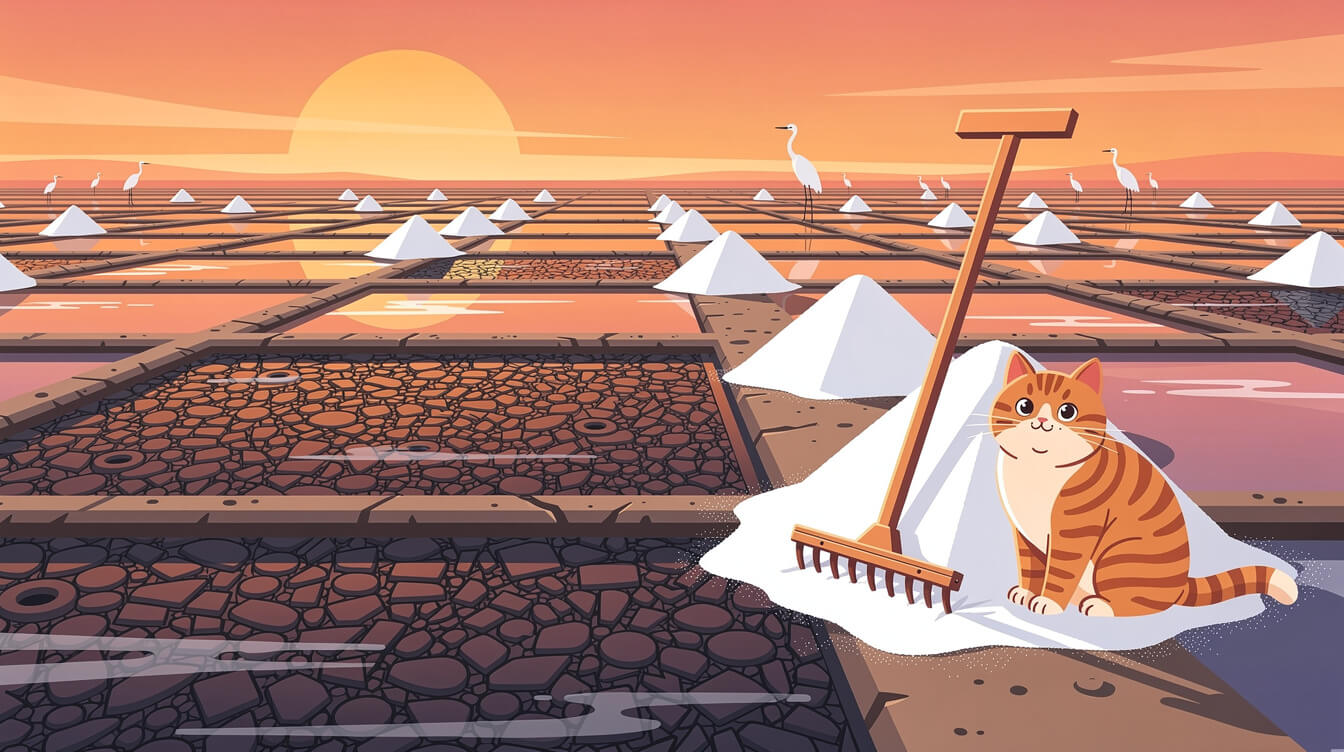
Picture a salt field in southern Taiwan. You’d probably expect bare mud or smooth concrete. The oldest surviving pans actually look like a giant broken-pottery mosaic, and the dark shards are what keep the salt white.
338 Years of Salt From the Sun
Taiwan’s salt story goes back to 1665. That year Chen Yonghua (陳永華), the chief strategist of the Zheng regime, opened salt fields along the old Taijiang lagoon. Workers let seawater into shallow pans and the sun evaporated it into salt. For the next three centuries the southwest coast between Tainan and Chiayi was salt country: flat, sunny, dry for half the year, with the sea right next door.
It ended in 2002. Qigu Salt Field (七股鹽場) brought in its last harvest, and with it Taiwan’s 338 years of hand-made sun-dried salt came to a close. Labor costs had simply outgrown what a rake-and-basket industry could earn.
Why Broken Pottery?
The prettiest relic is Jingzaijiao Tile-Paved Salt Field (井仔腳瓦盤鹽田) in Beimen, Tainan. Salt makers moved here in 1818, and it is the oldest tile-paved salt field still standing. They didn’t leave the pan floors as bare earth. They paved them with shards of broken clay jars, set like a jigsaw.
The tiles did two jobs. Crystals didn’t stick to the soil, so the harvest came up cleaner. And the dark ceramic soaked up the sun’s heat, which gave fine, bright-white grains. A small, practical fix is why these fields look like folk art today.
Why October Matters
Salt makers worked to the rain, not the calendar. The big season (大汛季) ran from March to May, when the sun was strong and rain was rare. Summer brought downpours and typhoons, so the pans went quiet. Then, from October, the rain eases and raking starts again. That kicked off the “small season” (小汛季), which lasted until the following March. So right about now, the old salt calendar is waking up.
Where the Salt Lives On
- Jingzaijiao is now a restored demonstration field. You can walk the dikes, try a salt rake and stay for sunset, when the wet tiles turn the pans into a mirror of the sky.
- Qigu Salt Mountain (七股鹽山) is a climbable white hill of salt left over from the industry, about 15 km to the south. If you’re there in winter, the black-faced spoonbills are feeding in the wetlands next door.
- Your kitchen. The table salt Taiyen (台鹽) makes in Taiwan today comes from its plant in Tongxiao, Miaoli. It still starts as seawater, but membranes have replaced the sun.
The takeaway: Some of Taiwan’s most photogenic landscapes are working tools. Those shimmering mosaic pans were a 200-year-old trick for whiter salt.
Planning a trip down south? Add the salt coast to your Tainan itinerary. And if you’d like to bring some of that sun-baked southern Taiwan energy home, browse the Taiwan Merch shop.

Grab a Free Taiwan Sticker!
Drop your email and we’ll send you a limited-edition Taiwan sticker — plus insider access to new merch drops and island vibes.
No spam. Unsubscribe anytime.