Taiwan Lunar New Year: What Actually Happens on the Island, Day by Day
Ask ten travel sites when Taiwan Lunar New Year happens and you will get two different answers, both of them printed with total confidence. One set tells you the holiday runs 4–10 February 2027. The other tells you New Year’s Day is Saturday 6 February 2027. Neither is wrong. They are describing two different things, and the gap between them is where most visitors’ plans quietly fall apart.
This guide is about what actually happens on the island — the shutdown nobody warns you about, the dishes on the reunion table and why each one is there, the midnight scramble at the temple doors, and the fifteen-day arc that ends with lanterns going up over a railway town in the mountains. Not “Chinese New Year explained.” What Taiwan, specifically, does.
When Taiwan Lunar New Year Actually Falls in 2027
Here is the distinction that fixes everything. There is the lunisolar date — the actual turn of the year, fixed by the moon — and there is the government holiday block, which is a labour-law construct built around it. They overlap. They are not the same.
The lunisolar date first. 初一, the first day of the first lunar month, falls on Saturday 6 February 2027. That is the moment the year turns, and 2027 is 丁未 — the Year of the Fire Goat. The eve, 除夕, is therefore Friday 5 February 2027, and the eve matters more than the day: it is when the reunion dinner happens and when the island is at its most completely itself.
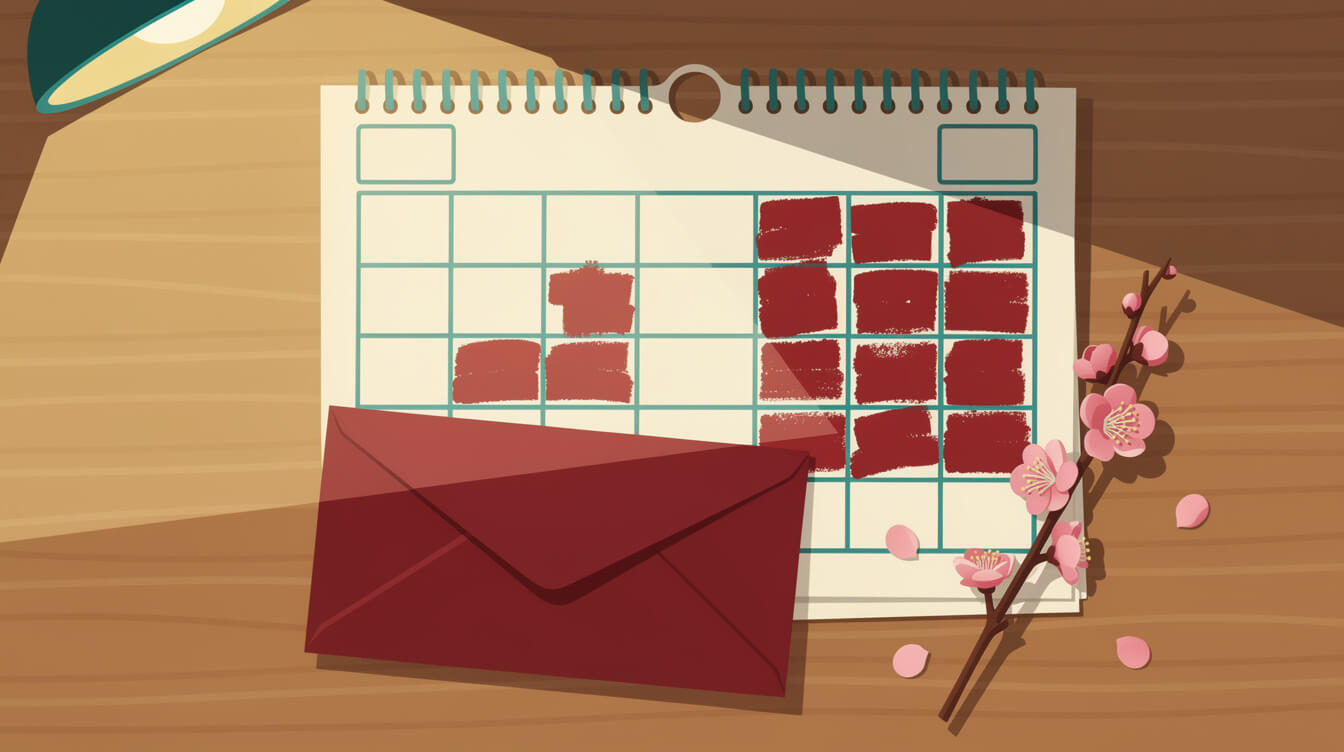
Now the holiday block. Taiwan’s Directorate-General of Personnel Administration schedules the 2027 Lunar New Year break as a continuous seven days, Thursday 4 February through Wednesday 10 February. Notice that it opens a full day before 除夕 and runs four days past 初一. That is not an error and it is not generosity. It is 補假, the make-up-day rule, doing its work.
補假 exists because 初一 and 初二 land on a Saturday and a Sunday in 2027. A public holiday that falls on a weekend does not simply evaporate — it is paid back on a working day. For most holidays the make-up day comes after. For Lunar New Year the rule is deliberately looser: the make-up may be taken on the preceding or the following working day, whichever produces the better break. In 2027 the calendar uses both directions at once — a bridging day on the Thursday in front, make-up days on the Tuesday and Wednesday behind — and the result is an unbroken Thursday-to-Wednesday run.
The practical upshot: if you are booking flights or trains, the dates that govern your trip are 4–10 February, not 6 February. If you are asking a Taiwanese friend when the new year is, they mean the 6th. Both are correct, and now you know which one to use when. For the rest of the year — all nine long weekends and the full set of make-up days — we have mapped the whole thing in our complete guide to Taiwan’s 2027 public holidays.
The Island Shuts Down: What Closes and What Stays Open
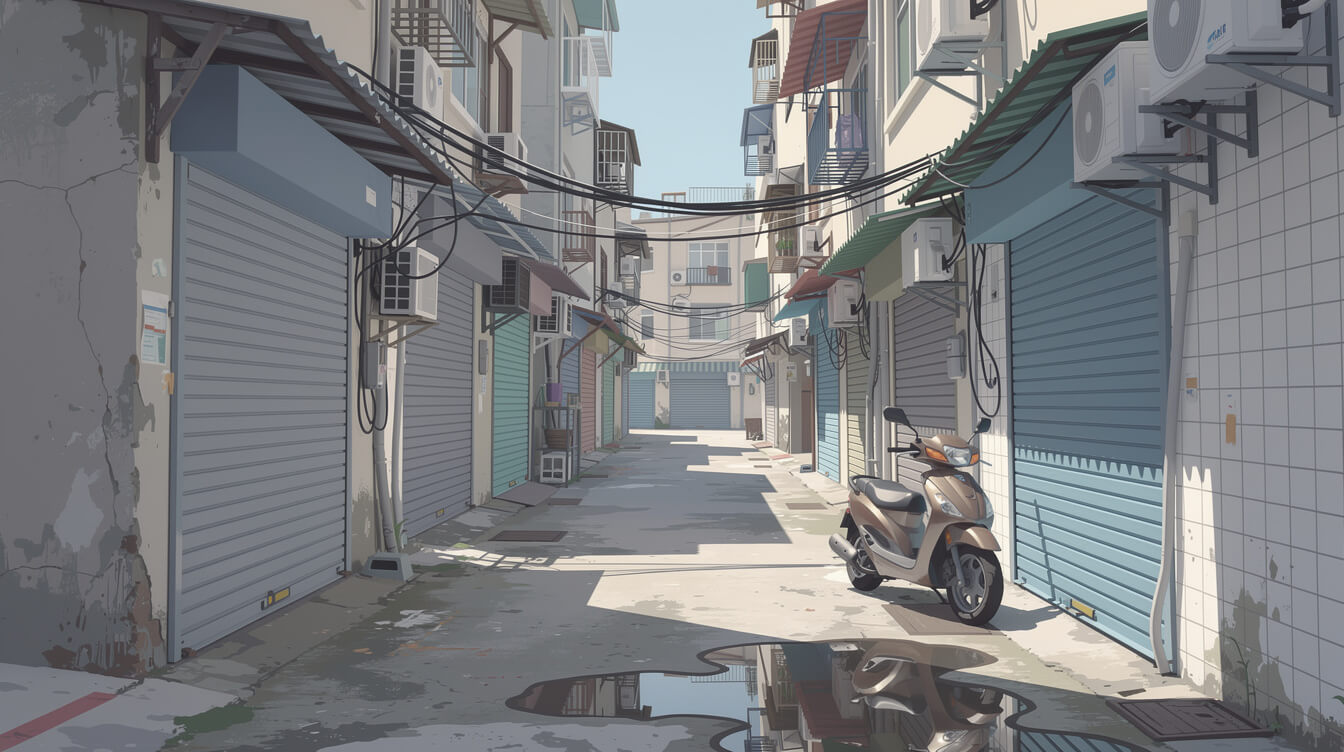
This is the part that blindsides people, and it is worth being blunt about it: for several days, Taiwan closes. Not “reduced hours.” Closed. Taiwan is a country where you can buy a hot meal at four in the morning on a Tuesday, which makes the contrast genuinely disorienting if you arrive unprepared.
The mechanism is simple. An enormous share of Taiwan’s food and retail economy is family-run, and Lunar New Year is the one week of the year those families are unambiguously off. The owner of your favourite beef noodle shop is not staffing it at a holiday premium — he is three hours south at his mother’s table. There is no corporate rota to fall back on, because there is no corporation.
What reliably closes
- Independent restaurants and street-food stalls — the heart of Taiwanese eating, and the hardest hit. Many shut from 除夕 and reopen around 初五.
- Banks, post offices and government offices — for the entire block. Change money before you fly.
- Clinics and most pharmacies — hospital emergency departments stay open, but your neighbourhood clinic will not be.
- Small shops, laundries, barbers, repair shops — and barbers deliberately so, for reasons we will come to.
- Traditional markets — the morning wet markets go quiet almost entirely.
What stays open
- Convenience stores. Taiwan’s chains run through the holiday, and during those few days they stop being a convenience and become infrastructure. Hot food, ATMs, coffee, bill payment, everything.
- Temples. Not merely open — this is their peak week of the year.
- Department stores, malls and cinemas. These lean into the holiday with new-year sales, because a family with a week off and red envelopes to spend is the whole point.
- Major tourist sites and the transport network. High-speed rail, the metro systems and intercity buses all run — heavily, and heavily booked.
- Some night markets, partially. The bigger tourist-facing ones usually keep a core of stalls running; neighbourhood markets often do not.
And one more thing happens that no closure list captures: the entire country moves at once. Taipei empties westward and southward as people travel to home towns, and the trains going that way are booked out weeks ahead. If your plan involves the west-coast rail corridor on 除夕 or 初一, book the moment the window opens or do not count on it.
If this is making you reconsider your timing, that is a reasonable response — and the weeks either side are genuinely lovely. Our guide to visiting Taiwan in December covers the quieter run-up months, when everything is open and the mountains are at their clearest.
圍爐: The Reunion Dinner, and What Every Dish Means
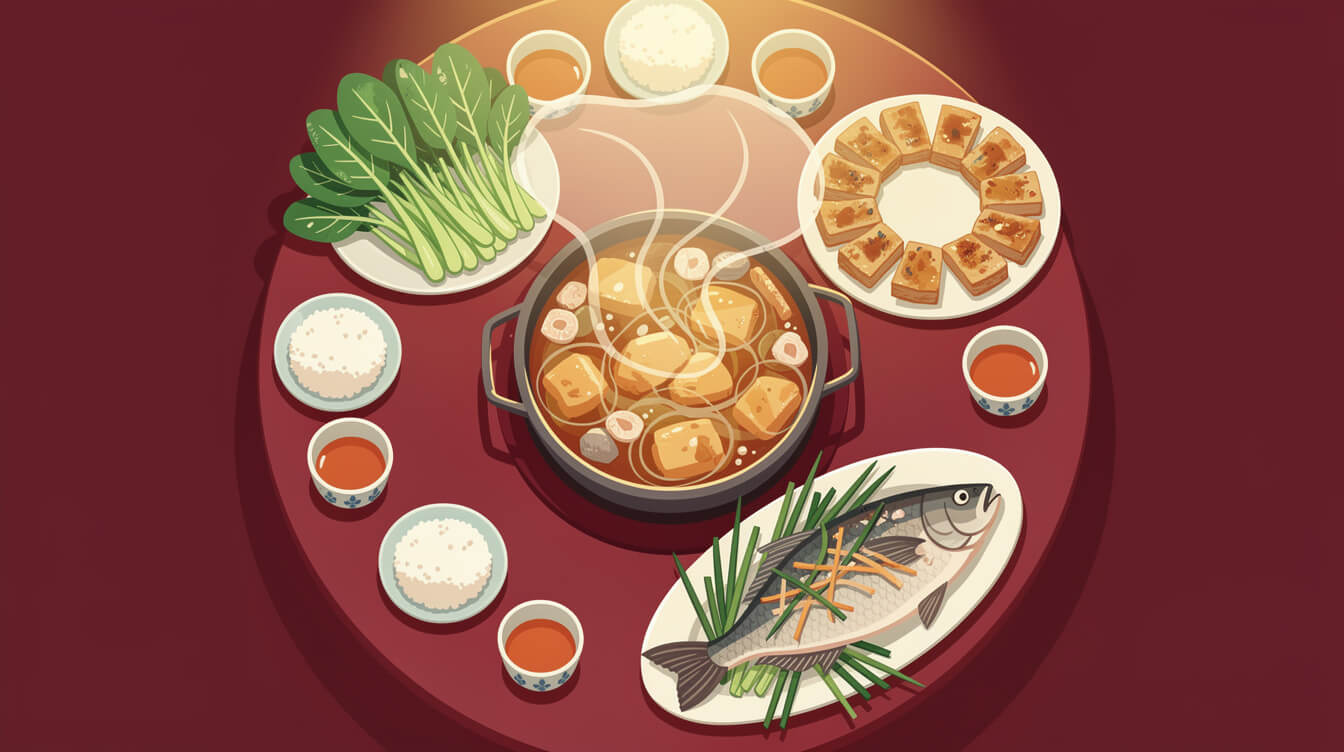
If you only understand one thing about Taiwan Lunar New Year, make it 圍爐 — literally “surrounding the stove.” On the evening of 除夕, families gather around a single hotpot at the centre of a round table. The pot is not incidental; the whole occasion is named for it. The heat in the middle, everyone drawn around it, nobody leaving early. That is the image the entire holiday is built on.
What makes this table worth understanding is that almost nothing on it is arbitrary. Taiwanese new-year food runs on wordplay — a dish earns its place because its name sounds like something you want more of. Once you hear it, you cannot unhear it.
The dishes and the reasons
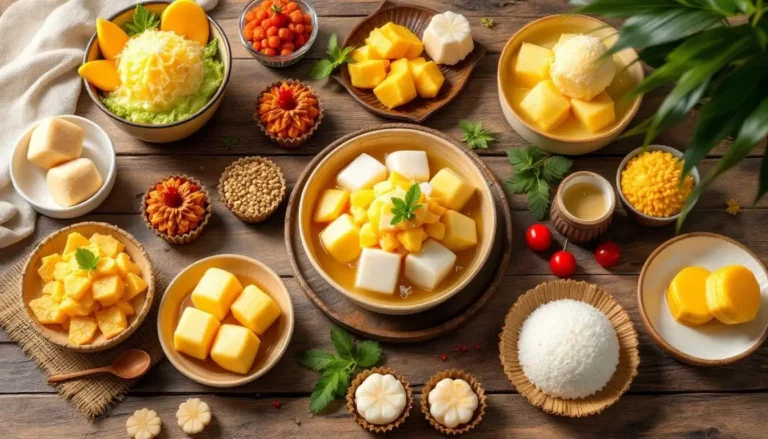
- 長年菜 — “long-year vegetable,” a whole mustard green, cooked and eaten unbroken, leaf and stem in one piece. You are not meant to cut it, and in many households you are not meant to bite it short either. Length equals longevity, and the eating of it is a small physical act of wishing your parents a long life. This dish is the one most distinctively Taiwanese thing on the table.
- A whole fish, served head and tail intact — and deliberately not finished. 魚 (fish) sounds like 餘 (surplus), so leaving some signals 年年有餘: a surplus carried into every year. Clearing the plate defeats the purpose.
- 年糕, sticky rice cake. 糕 sounds like 高, high — so the wish is to rise higher each year, in income, in grades, in height if you are small.
- 蘿蔔糕, turnip cake, pan-fried until the edges crisp. In Taiwanese, turnip (菜頭) sounds like 好彩頭 — good fortune, a good omen at the start of things.
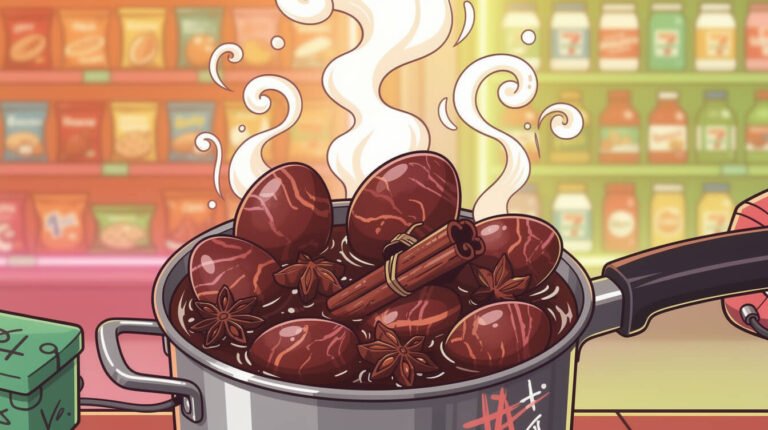
- 佛跳牆 — “Buddha jumps over the wall,” a layered pot of dried seafood, pork, taro, mushrooms and quail eggs that takes days to assemble. The name claims the aroma would tempt a monk over a monastery wall to break his vows. It is the showpiece, and it is the dish most likely to have been simmering at the back of the kitchen since the day before.
- Dumplings and spring rolls, shaped to resemble old ingots and gold bars respectively. The symbolism here is not subtle and nobody pretends otherwise.
There is a quiet piece of hardware behind a lot of this. The 大同電鍋 — the Tatung rice cooker, that round steel appliance in essentially every Taiwanese kitchen and in a great many diaspora kitchens too — is what steams the 年糕, holds the 佛跳牆 at temperature and keeps rice going for a table of fourteen. It is the most unglamorous and most indispensable object in the room. We put it on a shirt, affectionately, as our Taiwan Tatung Rice Cooker Cat T-Shirt — which tends to be recognised instantly by anyone who grew up with one humming on the counter.
One more custom worth knowing, because it explains the mood after dinner: 守歲, “guarding the year.” Families stay up late on 除夕, traditionally as a way of extending their parents’ lives. In practice this now means television, card games, snacks and a lot of talking — and it is why the streets outside are so startlingly quiet while every apartment window is lit.
年貨大街: Where Taiwan Shops Before the Shutdown
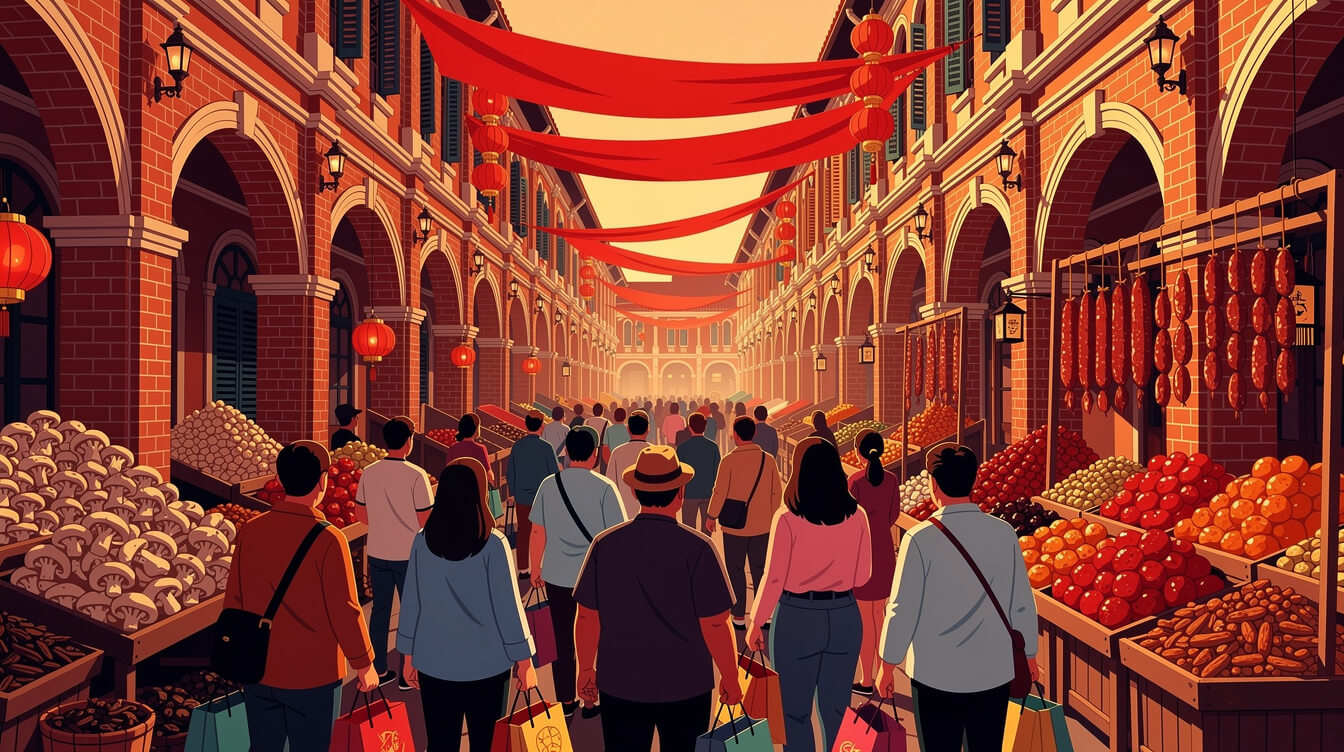
Before the island closes, it stocks up — and it does so somewhere specific. The 年貨大街, the “new year goods street,” is a pre-holiday market that takes over a historic shopping lane for roughly the fortnight before the holiday. The most famous is on Dihua Street in Taipei’s Dadaocheng, a street of arcaded early-twentieth-century shophouses that has traded in dried goods and medicinal herbs for well over a century.
What is for sale is specific to the season: dried mushrooms, dried scallops and squid, cured sausage, candied fruit and melon seeds, nuts, preserved plums, nougat, tea. These are the raw materials of the reunion table and of the sweets tray that sits out for visitors through the whole fortnight. It is also the easiest place in Taiwan to understand the holiday with your hands rather than your eyes — the stalls are stacked to shoulder height and sampling is, in normal years, aggressively encouraged.
Taipei manages the crush by pedestrianising the street. As Taiwan News reported via CNA for the 2022 market, cars and scooters were barred from the historic stretch from noon until 10pm on weekends, with the market running from mid-January until the second day of the official holiday block. The exact dates shift with the lunar calendar each year, but the pattern holds: it opens around a fortnight out, it peaks in the final weekend, and it keeps going a day or two into the holiday itself.
Go on a weekday afternoon if you want to actually see anything. Go on the final weekend if you want the spectacle and do not mind moving at the speed of the crowd. Either way it is the best souvenir shopping of the year — and if you want the broader picture of what is worth carrying home, we have a full guide to Taiwanese souvenirs and keepsakes.
搶頭香: The Midnight Race for the First Incense
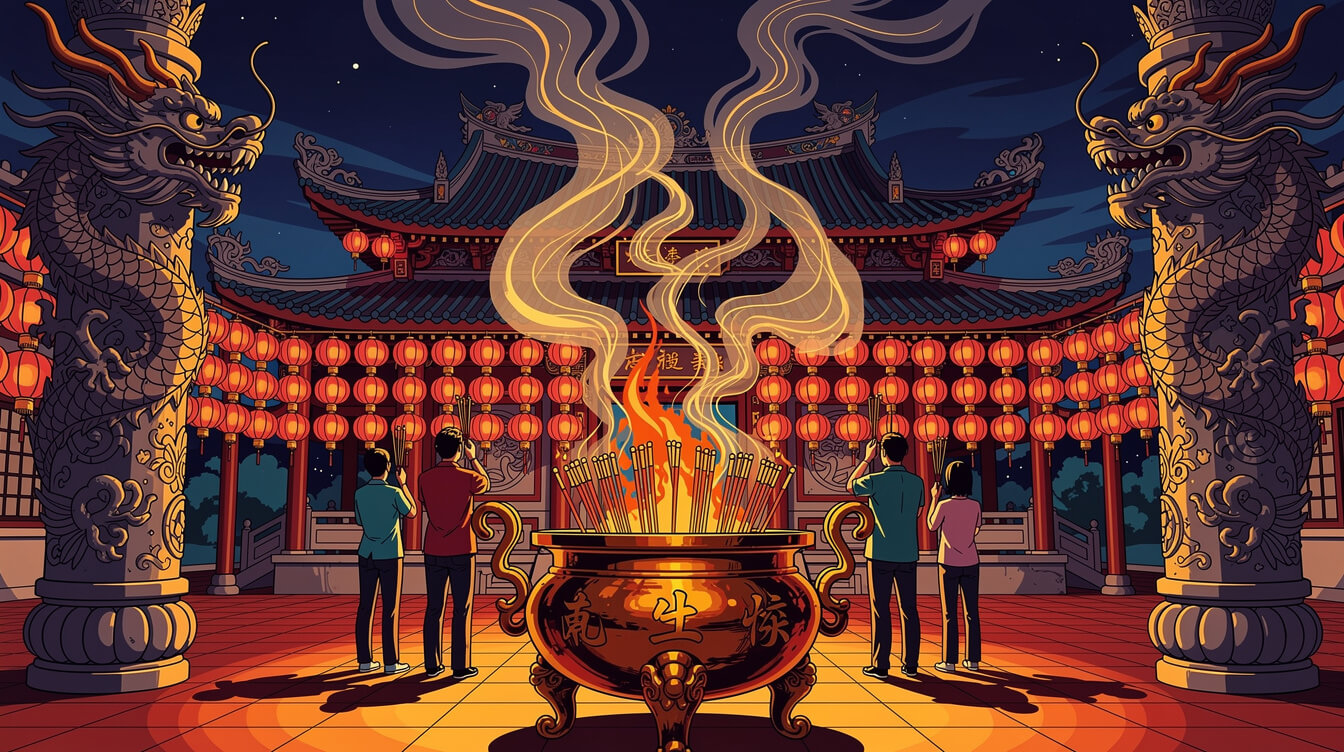
While the rest of the island is indoors guarding the year, something much louder is building at the temples. 搶頭香 — “snatching the first incense” — is the custom of being the very first person to place incense in the main burner once the new year turns. The first stick of the year is held to carry the year’s best fortune, and the competition for it is real.
What actually happens: crowds build in the temple forecourt through the late evening of 除夕. The main doors are shut. At the turn of midnight they open, and people run. At the larger temples this is a genuine surge of hundreds of people, which is why major temples now manage it formally — staggered entry, marshalled lanes, sometimes a ballot or a designated first-incense holder instead of a free-for-all. It has been, at various points in Taiwan’s history, chaotic enough to injure people.
If you want to witness it, Taipei’s Longshan Temple is the obvious anchor — it is the most visited temple in the city, it runs all night at new year, and it is extraordinarily photogenic under that volume of smoke and lantern light. Read our complete guide to Longshan Temple before you go, particularly the section on how to actually offer incense without getting the sequence wrong.
A note on etiquette, because this is a live religious observance rather than a show: it is entirely normal for visitors to participate, and nobody will mind you being there. Do not stand in the path of the surge at midnight if you are not part of it, do not photograph people mid-prayer at close range, and follow whatever the temple volunteers in marked vests tell you. They are managing a crowd, not gatekeeping.
Day by Day: 初一 to 初五, and the Rules Nobody Writes Down
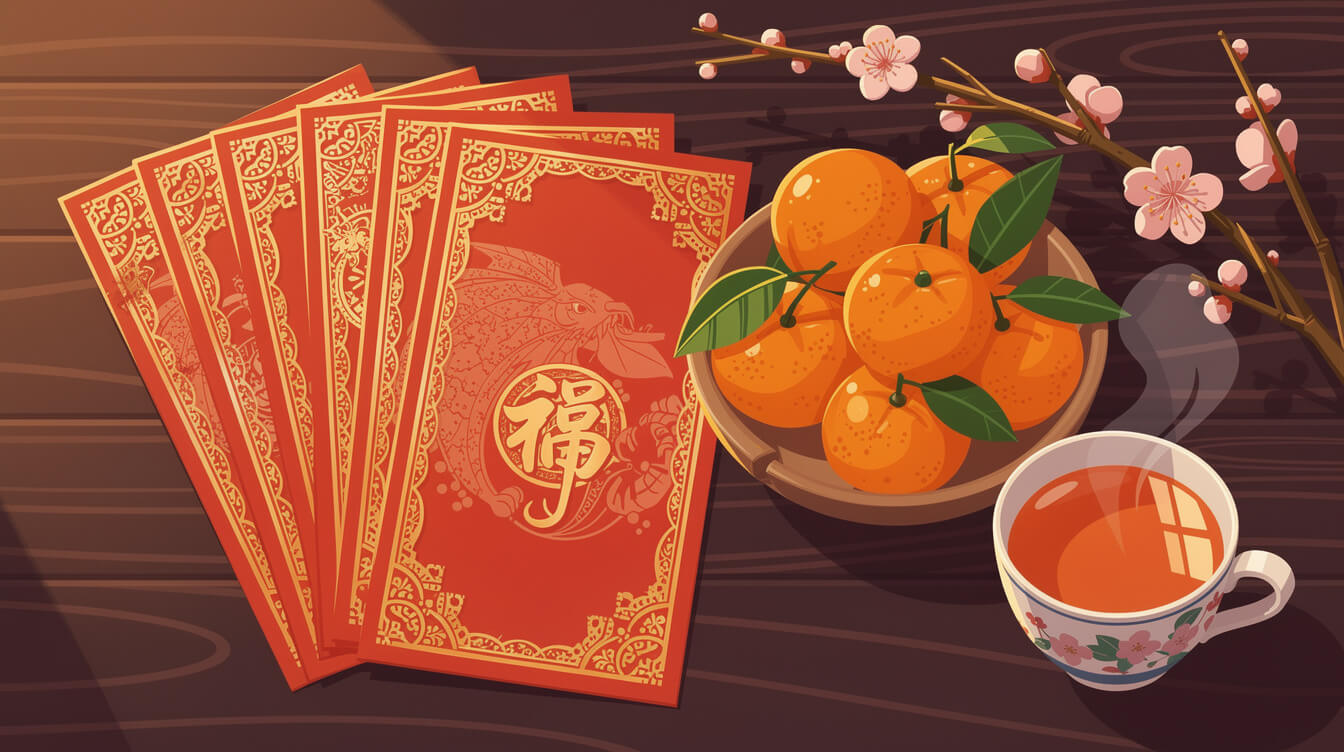
The days after 除夕 each have their own character, and locals navigate them without thinking. Here is the shape of the week.
- 初一 (Sat 6 Feb 2027) — the new year proper. Temple visits, new clothes, and 走春, the first outing of the year: a deliberate first walk out of the house, often to a temple or a scenic spot, to start the year in motion.
- 初二 (Sun 7 Feb) — 回娘家, the day married daughters return to their parents’ home, traditionally with husband and gifts in tow. For a lot of families this is the warmest day of the lot.
- 初三 — traditionally a day to stay in and sleep. Folk custom frames it as an inauspicious day for visiting, which has been widely and cheerfully reinterpreted as official permission to do nothing at all.
- 初四 — 接神, welcoming the household gods back after their trip to report on the family at the end of the old year.
- 初五 — 開工, the day businesses reopen, often with firecrackers and an offering to 財神, the god of wealth. This is when the shutters start going back up and your noodle shop returns.
The taboos, and the logic underneath them
The first day carries a dense set of prohibitions. They look arbitrary until you notice that most run on homophones — the same wordplay that governs the dinner table. Taiwan News, drawing on lists from TVBS and Business Weekly, sets out ten commonly observed on 初一:
- No haircut, no hair-washing. 髮 (hair) sounds like 發 (to prosper). Cutting it cuts your fortune; washing it sluices the money out. This is why barbers are shut and why they are slammed in the days before.
- No laundry, no sweeping, no taking out rubbish. The first day is held to be the water god’s birthday, so washing offends. Sweeping and binning literally throw the household’s fortune out of the door.
- No collecting debts — bad for the finances of both parties for the year ahead. Settle up before 除夕 and enter the year clean.
- No sleeping in or napping. Being found in bed by a new-year visitor is said to confine you to bed all year.
- No swearing or cursing. Speak well and you will speak well all year.
- No sharp objects — scissors, needles, nail clippers. Cutting things cuts off future wealth.
- Do not lose your temper. Self-explanatory, and arguably the most useful one on the list.
- Do not turn off all the lights on the night of the first day, especially where household deities are honoured. The year should begin lit.
- Do not break anything. If something does break, the remedy is specific: wrap the pieces in red paper or cloth, place them under the household altar, and say 歲歲平安. The trick is that 歲 (year) is a homophone of 碎 (to shatter) — so the phrase converts “it broke” into “peace, year after year.” An entire worldview in four characters.
- Never an odd amount in a red envelope. Good things come in pairs. Even sums such as NT$200, NT$600 or NT$800 are the norm, and the number four is avoided outright — 四 sounds like 死, death. The same applies to gifts: a box of pineapple cakes or a basket of fruit should come in twos, sixes, eights or twelves.
Nobody observes all ten with equal seriousness. Plenty of younger Taiwanese will tell you it is superstition and then still decline to wash their hair on 初一, because why risk it. Treat them as the texture of the week rather than a compliance checklist — and if you are a guest in someone’s home, simply follow your host.
On 紅包 specifically: the envelope is given downward and outward — working adults to children, to their own parents, to employees. You are not expected to produce them as a visitor, though a small even-numbered gift for your host is always right. The full etiquette, including which gifts are quietly disastrous in Taiwan, is in our guide to Taiwanese gift-giving rules and taboos — worth five minutes before you hand anybody anything.
The decorations, and the one that is upside down on purpose
In the run-up, doorways get 春聯: red paper strips brushed with couplets in black or gold ink, pasted down both sides of the door frame and across the top. Red repels misfortune; the couplets state the year’s wish out loud.
Then there is the diamond of red paper bearing a single character, 福 — fortune — and it is very often hung deliberately upside down. The pun is lovely: 倒 means “inverted,” and it sounds like 到, “to arrive.” An upside-down 福 reads aloud as “fortune has arrived.” If you see one and assume somebody hung it wrong, you have just been had by a thousand-year-old joke.

Wear the Food You Just Read About
Twelve icons of Taiwanese eating on one vintage poster print — the night-market canon that shows up on tables all year, new year included. A soft landing for anyone who misses the island.
How Taiwan Lunar New Year Ends: The Arc to 元宵節
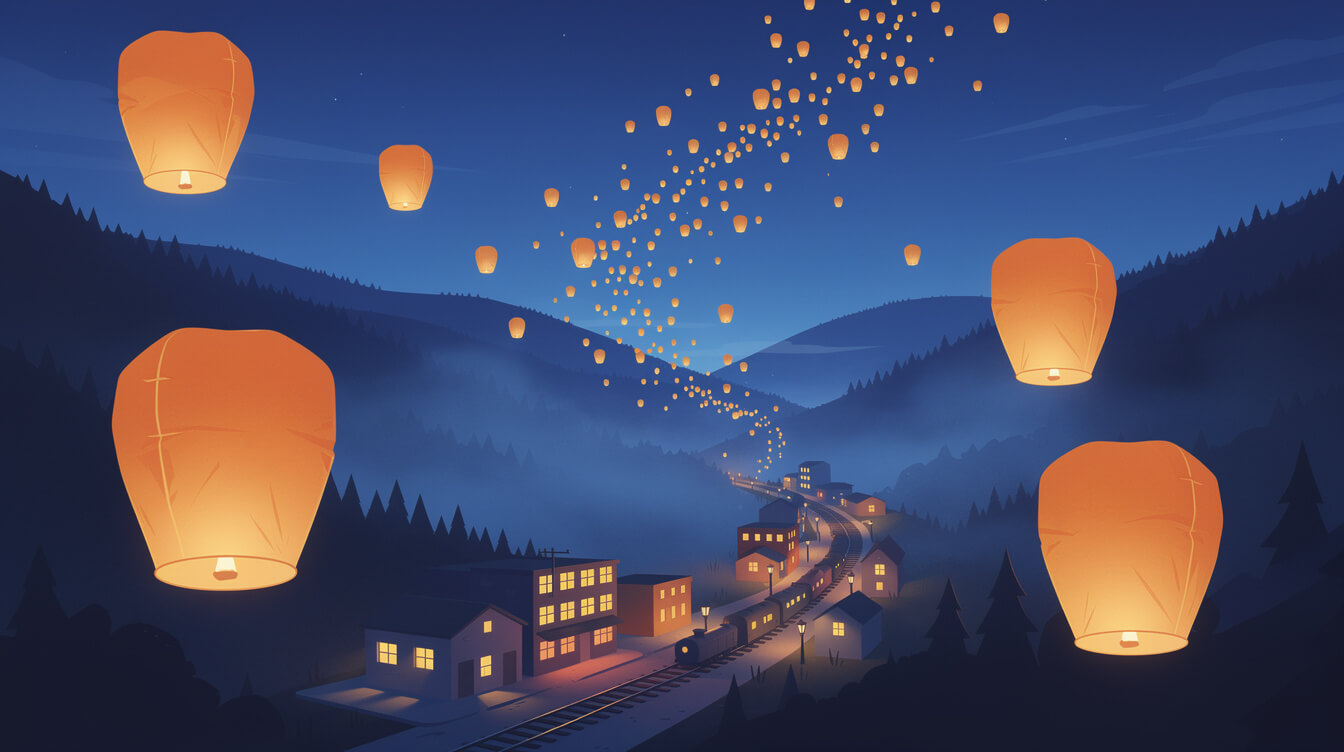
The holiday block ends on 10 February, but the new year does not. Lunar New Year is a fifteen-day season, and it closes on the fifteenth day with 元宵節, the Lantern Festival — the first full moon of the year. In 2027 that falls on Saturday 20 February.
By then everyone is back at work and the shutters are long since up, so 元宵節 has an easier, more public feel than the family-facing days at the start. People eat 湯圓 — glutinous rice balls in sweet soup, round because roundness means wholeness and family reunion — and go out to look at lanterns.
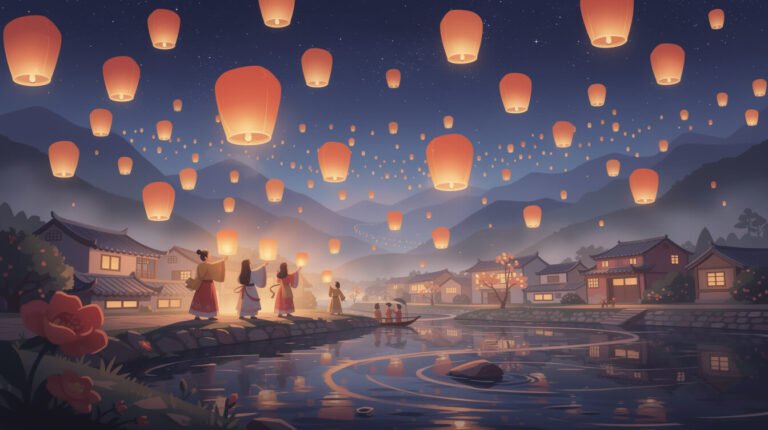
Taiwan does lanterns on a scale that is hard to prepare for. The national Taiwan Lantern Festival is a huge travelling installation event that moves between cities each year. But the one everybody pictures is Pingxi, a former coal-mining town strung along a single-track railway line in the hills of New Taipei, where thousands of paper sky lanterns are released into a narrow mountain valley at once. It is genuinely one of the great sights in Asia, and it is also a logistical event — the trains in are packed and the timing of the releases matters. Our Pingxi Lantern Festival guide covers the dates, the colour meanings and how to actually get there and back.
Taiwan Lunar New Year: Frequently Asked Questions
Is it called Lunar New Year or Chinese New Year in Taiwan?
In Mandarin, Taiwanese people overwhelmingly say 農曆新年 (lunar-calendar new year) or 春節 (spring festival). In English both “Lunar New Year” and “Chinese New Year” are in circulation, but “Lunar New Year” has become the common preference — partly because the same lunisolar date is celebrated across Korea, Vietnam and much of Southeast Asia with their own distinct traditions. If you are unsure which to use, Lunar New Year is the safe and accurate choice.
Is Lunar New Year a good time to visit Taiwan?
It is an extraordinary time to experience Taiwan and a difficult time to travel in it. You get the temples at full intensity, the lantern season and a side of the culture that is invisible the rest of the year. You also get closed restaurants, booked-out trains, peak accommodation prices and a domestic population all moving at once. If it is your first visit to Taiwan, come at another time. If it is your third, come for this.
Will I be able to eat?
Yes, but you will need to adjust. Convenience stores, hotel restaurants, department-store food halls, chain restaurants and the larger tourist night markets carry the week. Independent neighbourhood places are the ones that close. Checking opening hours the day before rather than the morning of saves a lot of walking.
What should I bring if I am invited to a Taiwanese family’s home?
Fruit, pineapple cakes, tea or good biscuits — in an even quantity, and never four of anything. Avoid clocks, sharp objects, umbrellas and anything in white or black wrapping. You are not expected to hand out red envelopes unless you are a working adult giving to the children of the house, in which case an even amount in a proper red envelope is the form.
How far ahead do I need to book?
Domestic transport for 除夕 and the first days sells out as soon as booking opens, which is typically weeks in advance. International flights into Taiwan over the holiday are expensive and full in both directions, because the diaspora is coming home at the same time. Treat the 4–10 February 2027 block as a hard constraint and book around it.
What animal year is 2027?
The Year of the Goat, beginning 6 February 2027 and running to 25 January 2028. In the sixty-year cycle it is 丁未, the Fire Goat.
Final Thoughts
The thing that strikes most visitors about Taiwan Lunar New Year is not the red, or the noise, or the food — it is the inversion. For one week, the most relentlessly convenient country in the world stops being convenient, because something matters more. The shutters come down on a thousand noodle shops so that a thousand families can sit around one pot.
Once you see the week that way, the details stop being trivia. The unbroken mustard green is a wish for your mother’s long life. The fish you leave unfinished is a bet on next year being abundant. The upside-down 福 on the door is a pun that has outlived every dynasty that ever tried to govern this island. None of it is decoration. All of it is argument — about what a year should be for.
Whether you spend the holiday in a Taipei temple forecourt at midnight or in a kitchen on the other side of the world steaming 年糕 in a rice cooker your mother gave you, the fifteen days work the same way. 新年快樂.
A Postcard From Taiwan, Every Week
Festivals worth timing a trip around, food worth crossing the island for, and the stories behind the designs. One email a week, no hard sell.

Grab a Free Taiwan Sticker!
Drop your email and we’ll send you a limited-edition Taiwan sticker — plus insider access to new merch drops and island vibes.
No spam. Unsubscribe anytime.