Taiwan Ginger Duck Season Just Opened — and the Name Doesn’t Mean “Mother Duck”
Walk past the same corner in Taipei in July and again in October, and one of the shopfronts will have changed state completely. In July it was a shuttered metal roller door with nothing behind it. In October there is a gas burner on every table, a wall of steam at the doorway, and a queue out front. The shop did not open. It reopened — the way it does every autumn.
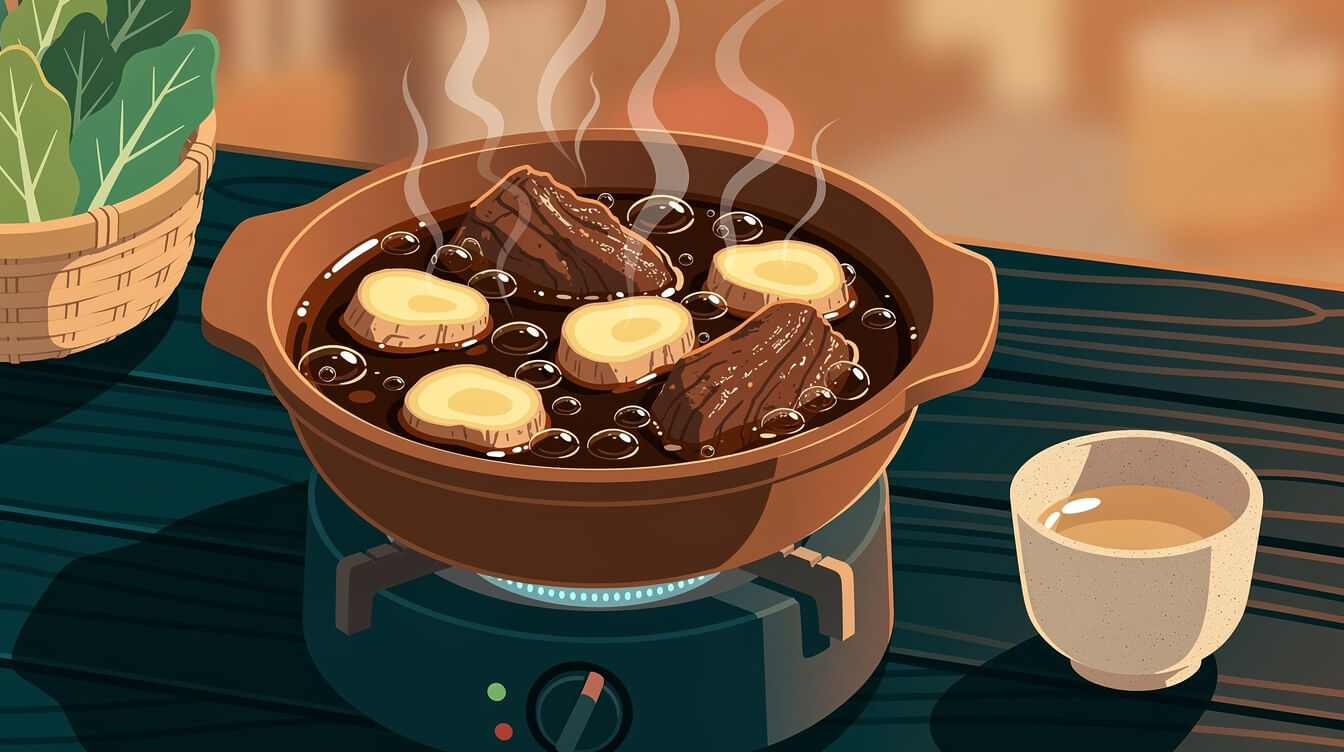
This is 薑母鴨 season. The dish is one of Taiwan’s most literal cold-weather rituals: duck simmered for hours in black sesame oil, rice wine and a bank of fiercely aromatic old ginger, eaten out of a shallow clay pot over a live flame while the northeast monsoon starts pushing down the island.
The name doesn’t say “mother duck”
Read 薑母鴨 character by character and the obvious parse is 薑 (ginger) plus 母鴨 (female duck). That isn’t it. The split falls differently: 薑母 + 鴨 — and 薑母 describes the ginger, not the bird. It means mature ginger, left in the ground long past the tender young-ginger harvest. Writing in 食尚玩家, the food writer 鞭神老師 (李廼澔) puts it at around ten months in the soil, lifted the following year alongside the new shoots that grew off it. That is the rhizome you want: dense, fibrous, and hot enough to carry a pot for three hours.
The duck, meanwhile, is usually male. Drakes have tougher meat and coarser fibre — a flaw in a quick stir-fry, and exactly the point in something that simmers all evening. It holds its shape instead of shredding into the broth.
The duck on the sign is not the duck in the pot
Nearly every 薑母鴨 signboard carries the same bird: a glowering black duck with a bright red, warty face. That is the red-faced Muscovy, 紅面番鴨. Look into the kitchen, though, and the birds are white.
食尚玩家 explains the swap as plain economics. The white red-faced Muscovy that Taiwanese farms raise today reaches market in roughly 16 weeks against 22 for the black bird, eats less feed getting there, and finishes about twice the size. The black duck lost on the spreadsheet. It stayed on the signs because it looks more formidable, and a formidable animal reads as 補 — nourishing, restorative, worth the money. The sign is selling a feeling, and the feeling outlived the bird.
Why the shutters come down in spring
Ginger duck is bound so tightly to the cold half of the year that a great many shops simply don’t trade in the warm one. A 2026 piece in Storm Media, gathering accounts from shop staff and operators, describes the standard shape: open through autumn and winter, trade until around the start of April, then pull the shutters down. One operator’s claim was that the dense winter months cover the entire year’s costs on their own. Several places keep their cooks on half pay right through the dead months rather than lose them — an experienced hand on the pots in November is worth more than a summer’s saving on wages.
So the shutters work as a calendar. Taiwan keeps a few of these. Silver grass announces the same turn from a hillside, and persimmon cakes announce it from a drying rack. Ginger duck is the one that announces it from a street corner.
Your move
If you’re on the island: the pots are on. Order the duck, add 高麗菜 and 鴨血 and 豆皮 to the broth as you go, and finish with 麵線 dropped into what’s left — that last bowl, thickened with sesame oil and three hours of ginger, is the part regulars actually come for. If you’re somewhere else, the home version needs only four things you can get anywhere: a duck, a lot of old ginger, toasted sesame oil, and rice wine.
Either way, it’s sweater weather now — and ours has the whole island printed on it. Our Taiwan Illustrated Map crew neck is built for exactly this stretch of the year.

Grab a Free Taiwan Sticker!
Drop your email and we’ll send you a limited-edition Taiwan sticker — plus insider access to new merch drops and island vibes.
No spam. Unsubscribe anytime.