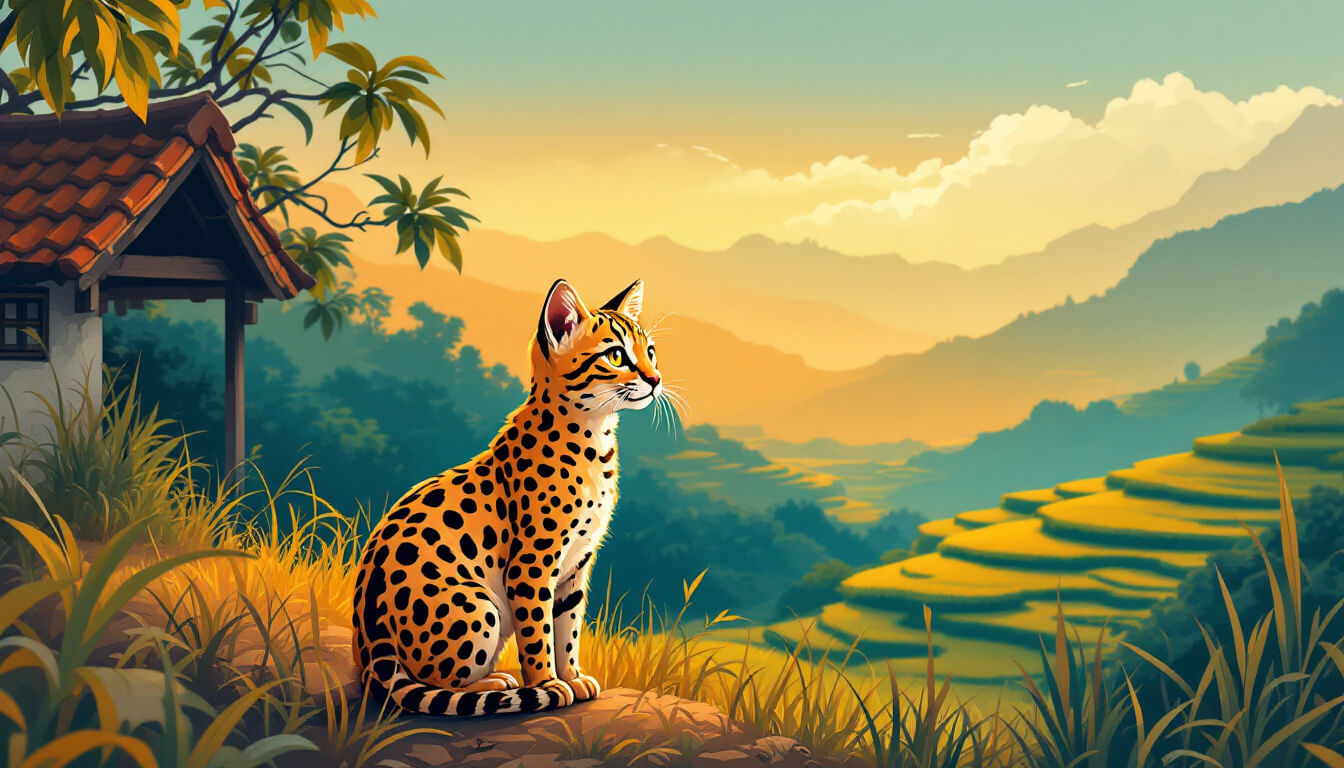
The Taiwan Leopard Cat Lives in the Low Hills, Not the Mountains — and That’s Exactly the Problem
Here is a fact that surprises almost everyone, including people who grew up in Taiwan: the island has exactly one wild cat species left. Not a dozen. One. And the Taiwan leopard cat — 石虎, literally “stone tiger” — does not live where you would expect a rare wild animal to live.
First, the one that didn’t make it
Taiwan used to have two wild cats. The other was the Formosan clouded leopard, and its ending is sobering. Between 1997 and 2012, researchers ran camera traps at more than 1,450 sites, from the coastline all the way up to 3,796 metres. Thirteen years. Not one photograph. The clouded leopard was declared extinct in 2013, having last been reliably seen in 1983.
That leaves the Taiwan leopard cat as the island’s only remaining native feline — and there are somewhere between 468 and 669 of them, with some estimates putting the figure under 500.
The surprising part: it’s a lowlander
When we wrote about the Formosan black bear, the story had a comfortable shape to it: big animal, deep mountains, protected interior, population counts finally moving in the right direction. Taiwan is genuinely good at looking after its high country.
The Taiwan leopard cat got the other half of the island. It lives below 800 metres — in the low, folded, farmed foothills. Tea terraces. Betel palm groves. Rice paddies. Country roads. The back of somebody’s orchard. Stable populations survive in just three counties — Miaoli, Taichung and Nantou — with only scattered records from Hsinchu, Changhua, Yunlin, Chiayi and Tainan.
That is the whole problem in one sentence. A species that lives in the mountains can be protected by drawing a line around a national park. A species that lives in the Hakka hill country has to share its home with roads, farms and chicken coops. Roadkill is the constant threat, and it also chops the habitat into pieces too small to move between, which slowly drains the gene pool. The population is now small enough that a single leopard cat killed on a road in Changhua in January 2026 was reported as national news.
The good news is a bag of rice
Here is where it gets genuinely lovely. Farmers in the Fongshuwo community of Miaoli grow 石虎米 — “leopard cat rice” — without pesticides or chemical fertiliser, specifically so the fields stay liveable for the cats. It is sold through Taiwan Blue Magpie Tea, named for another native species you may remember from our piece on the Taiwan blue magpie.
Alongside it, the Forestry and Nature Conservation Agency and Miaoli County now make payments to farmers who keep their land leopard-cat-friendly, and volunteers help upgrade chicken coops — because a cat that can’t get at the chickens is a cat the farmer has no reason to resent. Coexistence, funded properly. Miaoli passed its own leopard cat conservation ordinance back in 2019.
How to tell one from next door’s cat
Spots, not stripes. Two white stripes running up the forehead between the eyes. And the giveaway: a white spot on the back of each small, rounded ear. If you are ever driving through the Miaoli hills at dusk, that is what to slow down for.
The takeaway: Taiwan’s most endangered cat isn’t hiding deep in the wilderness. It is living in the farmland at the edge of town, which makes saving it everybody’s job rather than a park ranger’s. Buy the rice, slow down on the hill roads.
We have a serious soft spot for Taiwan’s cats — the wild ones and the ones running Houtong. You’ll find that affection all over our collection.

Grab a Free Taiwan Sticker!
Drop your email and we’ll send you a limited-edition Taiwan sticker — plus insider access to new merch drops and island vibes.
No spam. Unsubscribe anytime.