Fengjia Night Market Taiwan: The Insider’s Guide to Taichung’s 1.5-Kilometer Food Wonderland
If you ask any Taichung local where they take an out-of-town friend on the very first night, the answer is so reflexive it barely needs words: Fengjia Night Market. Stretched across 1.5 kilometers of curving lanes in the city’s Xitun District, this is the night market that put central Taiwan on the food-tourism map — a 60-year-old food carnival that started feeding hungry college students in the 1960s and grew into what many Taiwanese still argue is the largest night market in the country.
Fengjia Night Market Taiwan (逢甲夜市, Fēngjiǎ Yèshì) is also one of the few Taiwanese night markets where the question isn’t “what should I try?” but “how do I possibly try everything before I burst?” This is the guide we wish someone had handed us on our first visit — origin story, walking route, signature stalls, the iconic snacks invented right here, and the timing tricks that turn a chaotic crush into the food crawl of your life.
How Fengjia Night Market Taiwan Grew From a College Snack Run Into a 1.5-Kilometer Food Wonderland
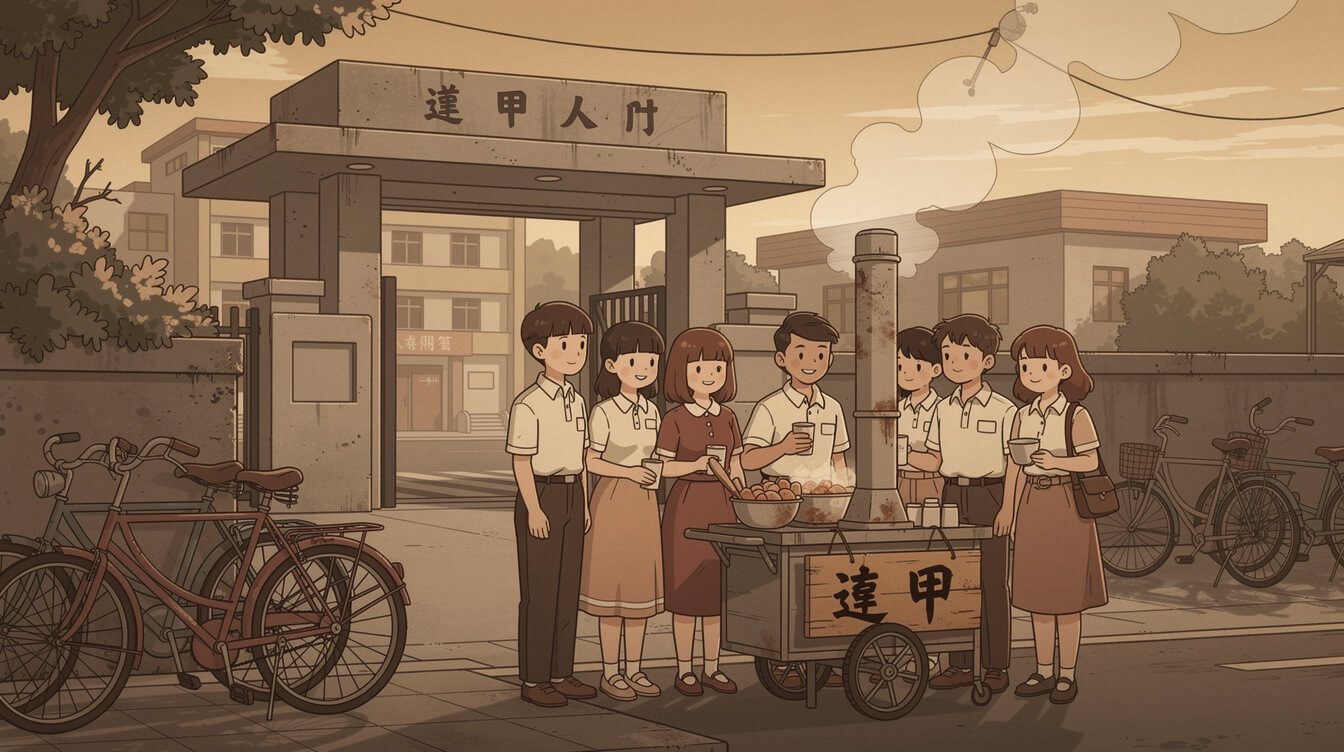
Every legendary night market has an origin story, and Fengjia’s begins in 1961, when Feng Chia College (now Feng Chia University, 逢甲大學) opened its doors in then-quiet farmland on the northwest edge of Taichung. Students needed cheap, fast food between classes and after dark, and a handful of vendors set up small carts along Wenhua Road (文華路) right outside the front gate. By 1963 — the year almost every account marks as the market’s official founding — the cluster had become a recognized street stall scene with its own evening rhythm.
What followed is the unplanned, organic growth pattern that makes Taiwanese night markets so different from purpose-built tourist strips. As the student body multiplied, vendors spread up and down Wenhua Road and spilled west onto the main thoroughfare, Fuxing Road (福星路). The narrow alleys between the two became the connective tissue, packed with hole-in-the-wall stalls that experimented constantly because their core customers were broke college kids who were always game for something new.
That student-driven culture is still the secret ingredient. Fengjia Night Market churns out trends faster than any other market in Taiwan — the snack that goes viral on Instagram one summer might not exist by the next. In 2015, the Taiwanese Ministry of Economic Affairs commended Fengjia for its management, tourist-friendliness, and sustainable practices, formalizing what locals had known for decades: this isn’t just a market, it’s a working laboratory for what modern Taiwanese street food looks like.
Today, Fengjia is widely credited with annual revenues of around NT$10 billion, putting it in the running for largest night market in the country — a title Taipei’s Shilin Night Market also claims. Depending on how you measure (foot traffic, stall count, footprint, revenue), both sides can make the case. What’s beyond debate is that Fengjia is the unquestioned king of central Taiwan and the reason a lot of travelers add a Taichung stop they otherwise wouldn’t.
How to Get to Fengjia Night Market From Taipei, Taichung, or the High-Speed Rail
Fengjia sits in Xitun District, on Taichung’s northwest side, well away from the old Taichung Train Station downtown. It’s a 15–25 minute taxi ride from most central hotels and roughly 30 minutes from the high-speed rail. The route you pick depends on where you’re starting from.
From Taipei (and the rest of the west coast)
Take the Taiwan High-Speed Rail (THSR) from Taipei Main Station to Taichung HSR Station. The journey is about 55 minutes on a non-stop service. If you’ve never used the HSR before, our complete guide to riding the THSR walks through pre-booking discounts, station layouts, and which class to pick.
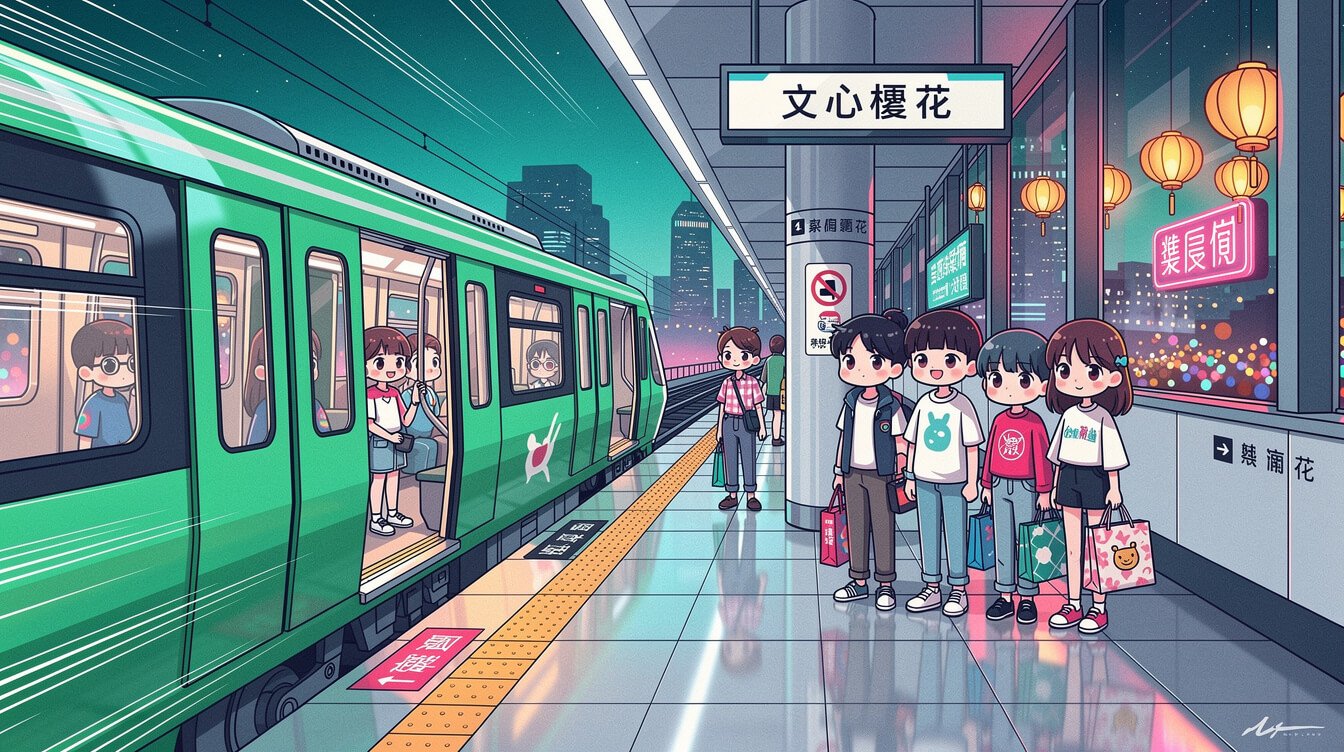
At Taichung HSR Station, transfer to the green-line MRT at the connected Xinwuri Station. Ride seven stops to Wenxin Yinghua Station — that’s the official Fengjia stop on the green line. From the exit, it’s a flat 10-minute walk north to the southern edge of the market. Total HSR-plus-MRT travel time from Taipei is around 90 minutes, which makes Fengjia genuinely doable as a Taipei day trip if you’re committed.
From central Taichung
From the old Taichung Train Station area, the cheapest option is city bus #25 or #45 — both leave from stops near the station, take about 30 minutes, and end at the “Dingnanzai Xitun Rd.” stop right beside the market. You’ll swipe an EasyCard, the same contactless card that works for the Taipei MRT, every bus in Taiwan, and a surprising number of convenience-store snacks. A taxi from Taichung Station costs roughly NT$200–250 and takes 15–20 minutes outside rush hour.
From elsewhere in Taichung
If your hotel is near Taichung City Hall, take the green MRT line north to Wenxin Yinghua Station. If it’s near the Calligraphy Greenway, a YouBike rental and a 25-minute ride along Liming Road gets you there with the bonus of arriving slightly less hungry. Scooter rentals are abundant in Taichung if you have an International Driving Permit — just know that parking near Fengjia on a Saturday night requires the patience of a Buddhist monk.
The Fengjia Night Market Map: A 1.5-Kilometer Loop, Not a Single Street
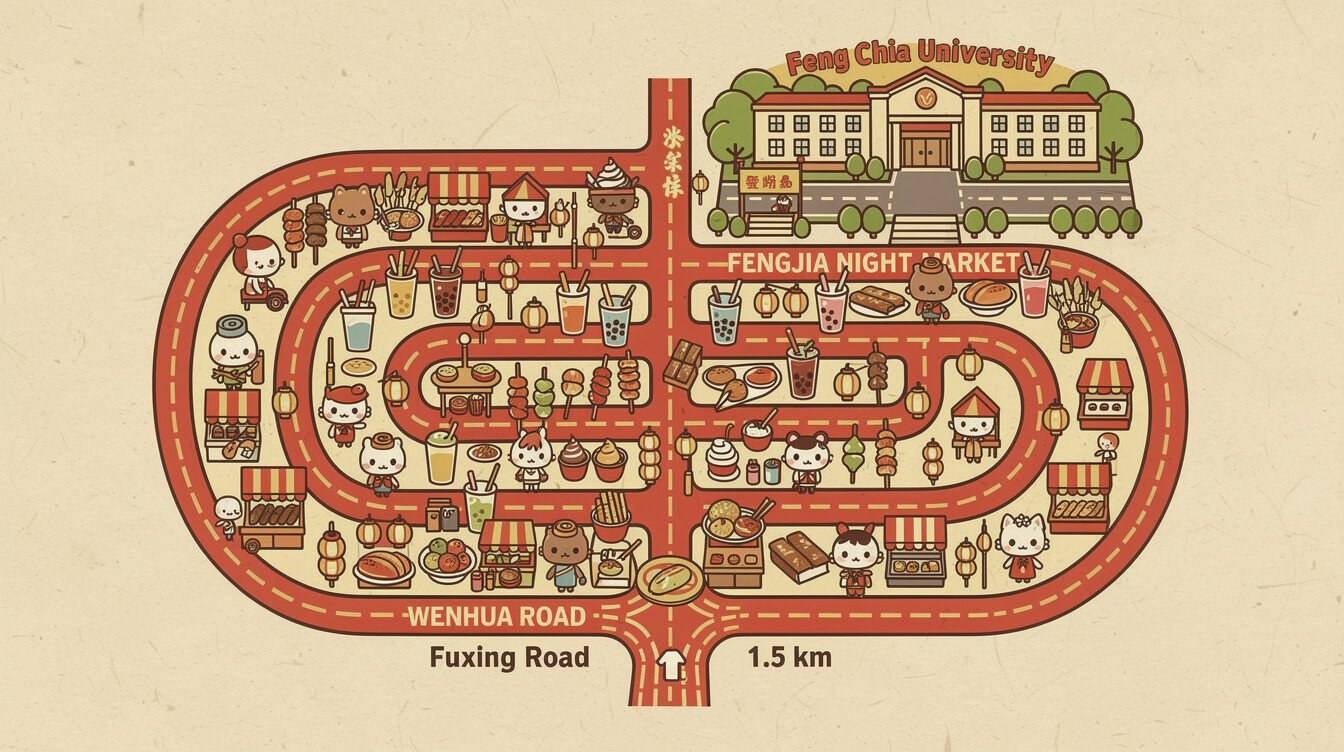
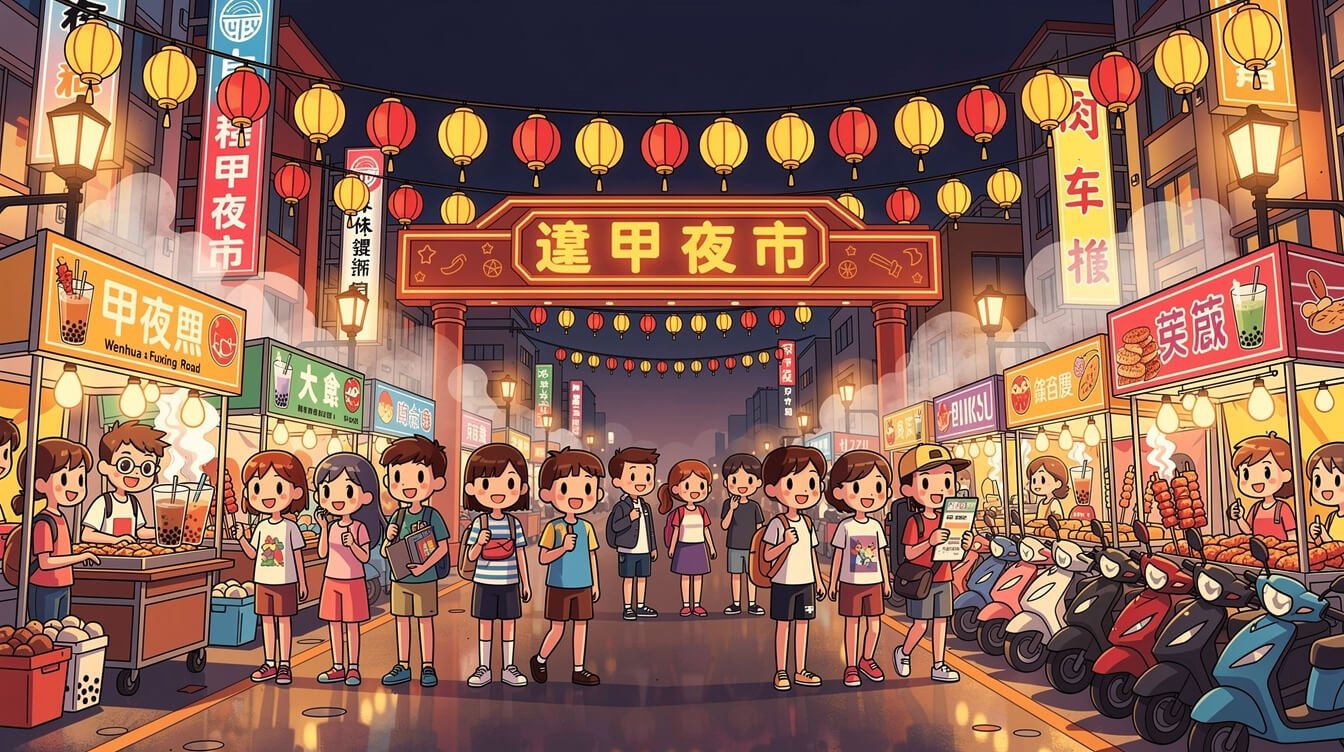
One reason first-time visitors get overwhelmed at Fengjia is that they assume it’s a single street to walk down. It isn’t. Fengjia is essentially a fat lozenge — a 1.5-kilometer loop bounded by two parallel arteries, Wenhua Road (文華路) on the east and Fuxing Road (福星路) on the west, joined at the north end by Feng Chia University and at the south end by the main intersection where the famous neon archway gate stands.
The dense magic, though, happens in the dozens of tiny alleys that connect the two roads in between. Locals don’t walk Fengjia as a straight line — they wander it as a loop, ducking in and out of side streets, doubling back when something smells too good to pass up.
The first-timer’s walking route
- Start at the main entrance gate at the Fuxing-Wenhua intersection. You’ll know it: a tall neon archway, the smell of grilled corn, and a takoyaki stand with an enormous octopus on its sign on your right.
- Walk north up Wenhua Road, the slower-moving and more food-dense of the two main arteries. This is where you’ll find most of the legendary signature stalls.
- Detour into the alleys at least three times. The cluster of lanes between Wenhua and Fuxing is where Taichung locals do their actual eating.
- Loop back south on Fuxing Road, which carries more of the apparel, accessories, and games stalls — a useful palate cleanser when your stomach needs a break.
- End back at the main gate, ideally with a hot-cold tangyuan dessert in hand.
If you’re trying to fit a Taichung night market crawl into a broader trip, our roundup of Taipei street food is the natural companion read — though Taichung’s flavors lean noticeably sweeter and more experimental than what you’ll find in the capital.
What to Eat at Fengjia Night Market: The Stalls Locals Actually Line Up For
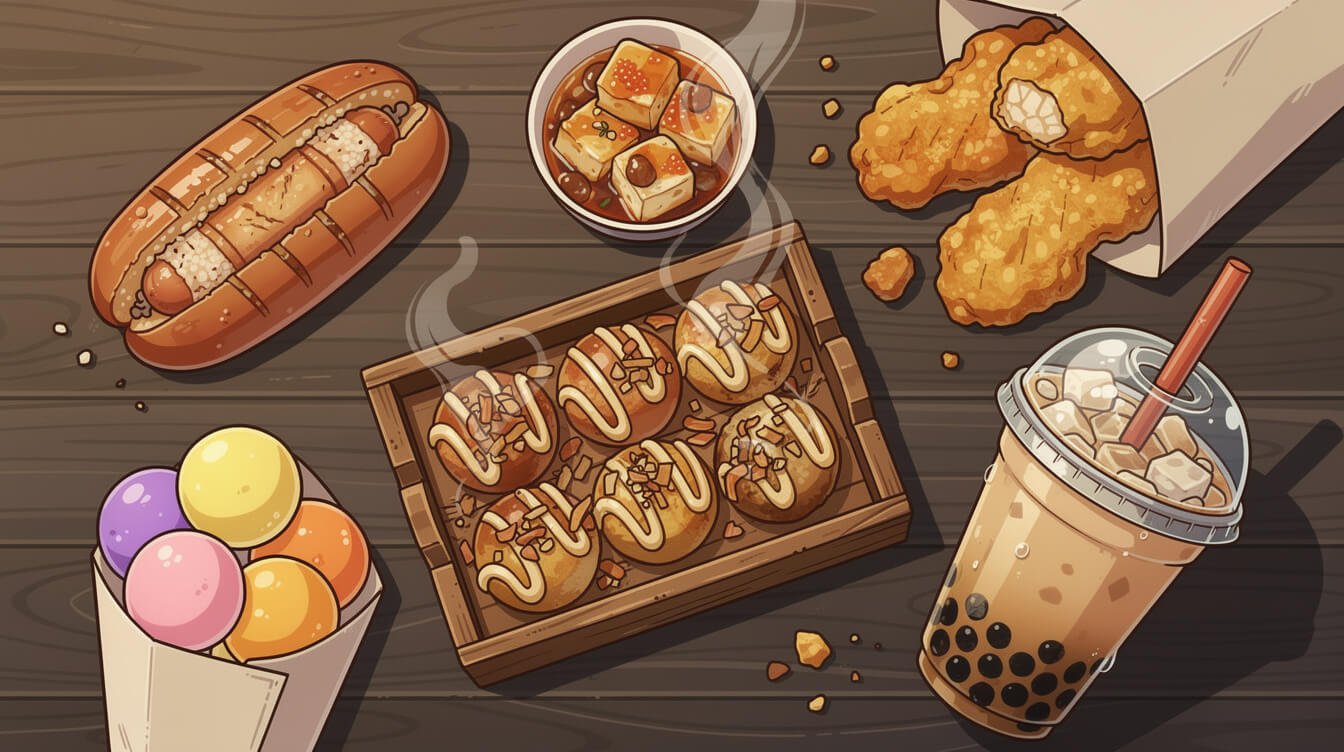
You could come to Fengjia every night for a month and still discover new stalls. But for first-timers, there are a handful of legendary names with lines that don’t lie. Here’s the rotation locals will actually defend.
- 日船章魚小丸子 (Risshipun Takoyaki) — Right at the main intersection under a giant octopus sign. Japanese-style takoyaki balls, cabbage and a chunk of octopus inside, doused in teriyaki, mayo, and bonito flakes that dance from the heat. The Fengjia branch is the original flagship.
- 繼光香香雞 (Jiguang Xiang Xiang Ji) — Bite-size fried chicken seasoned with plum powder, basil, or wasabi. This isn’t just a Fengjia stall — it’s a chain that grew out of Taichung and now has outlets across Asia. The Fengjia location remains the busiest.
- 二水山泉臭豆腐 (Ershui Mountain Spring Stinky Tofu) — Fengjia’s signature stinky tofu, served crab-roe style with a pungent fermented broth and a side of pickled cabbage. If you’ve been avoiding stinky tofu, our deep dive on Taiwan’s smelliest street food explains why this is the version to convert you.
- 御品元冰火湯圓 (Yu Pin Yuan Binghuo Tangyuan) — Hot-cold tangyuan. Glutinous rice dumplings filled with molten black sesame paste, served on shaved ice with peanut powder. The temperature contrast alone is reason enough to come to Taichung.
- 炳叔烤玉米 (Bingshu Grilled Corn) — Slow-grilled sweet corn brushed with sweet-savory soy glaze, a 30-year Fengjia institution. Wait time can hit 40 minutes on weekends; locals consider this normal.
- 明倫蛋餅 (Ming Lun Dan Bing) — A Fengjia-perfected version of Taiwanese breakfast egg crepe. The corn-and-cheese variant is the order locals refuse to compromise on.
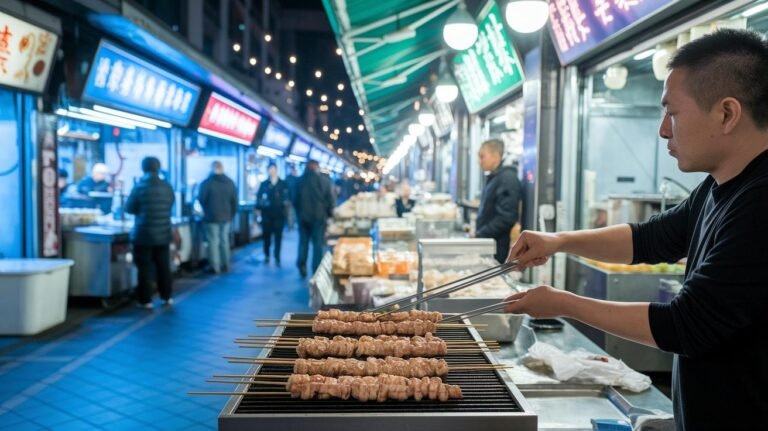
- 阿華黑輪 (A-Hua Black Wheel Oden) — Skewered fish cakes simmered in a smoky soy broth. Walk-up, point, eat over the counter, walk away with sauce on your chin.
Speaking of which — if you want a wearable cheat-sheet of every Taiwanese street food you should hunt down on this trip, our Taiwanese Street Food Guide T-Shirt turns the whole night market canon into a vintage food-poster design you can wear to the market itself. (Yes, locals will absolutely point at it and start recommending more stalls.)
Three Iconic Taiwanese Street Foods Born or Perfected at Fengjia Night Market
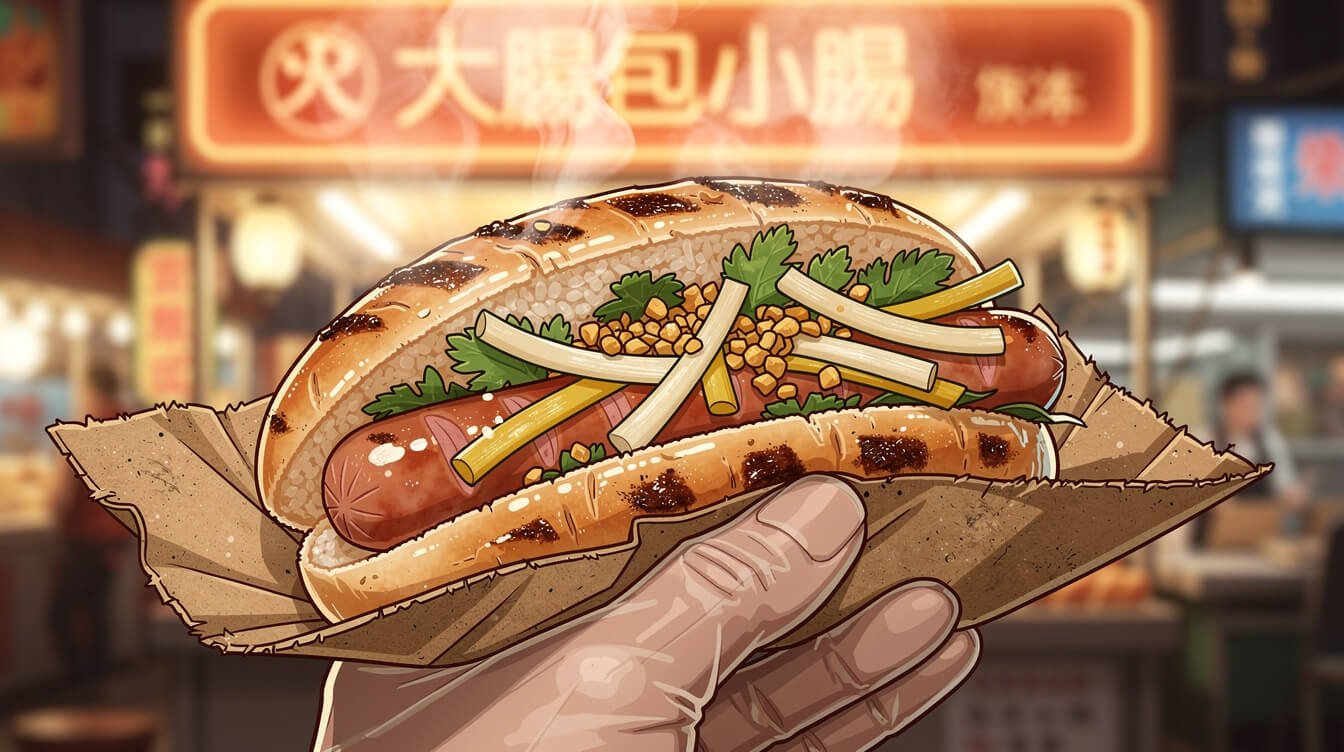
Most night markets in Taiwan serve the same canonical street foods. Fengjia is one of the rare ones that actually invented some of them. Three are worth a section of their own.
1. 大腸包小腸 — Big Sausage in Little Sausage
The most famous “did Fengjia really invent this?” claim. Da Chang Bao Xiao Chang (literally “big intestine wraps small intestine”) is a grilled glutinous-rice sausage sliced lengthwise and stuffed with a smaller pork sausage, then loaded with garlic, cilantro, pickled daikon, basil, and crushed peanuts. The combination of textures — chewy rice exterior, snappy meat interior, sharp pickle, crunchy peanut — became the standard against which every other Taiwan night market sausage is measured.
The stall most often credited with formalizing it, 官芝霖大腸包小腸 (Guan Zhi-Lin), has operated at Fengjia since the late 1990s and still pulls a queue every night. Whether it was truly invented here or merely perfected here is a debate Taichung uncles will happily have with you over a bottle of Taiwan Beer.
2. The hot-cold tangyuan dessert format
御品元冰火湯圓 (Yu Pin Yuan) helped popularize the now-Instagram-famous practice of serving piping-hot glutinous rice balls — traditionally a winter food — on a bed of shaved ice with peanut powder and sweet syrup. It’s a textbook example of Fengjia’s appetite for breaking food rules: a hot dessert eaten over ice, in the height of Taiwan summer, somehow making perfect sense.
3. The Jiguang fragrant chicken empire
繼光香香雞 (Jiguang Xiang Xiang Ji) launched in Taichung in 1973 and grew up at Fengjia. Today it’s a multi-country fried-chicken empire with branches in Hong Kong, Singapore, Japan, the US, and Canada. The Fengjia branch isn’t just a stall — it’s effectively the company’s spiritual flagship, and the seasoning options (basil, plum, wasabi, garlic) here remain the boldest you’ll find anywhere.
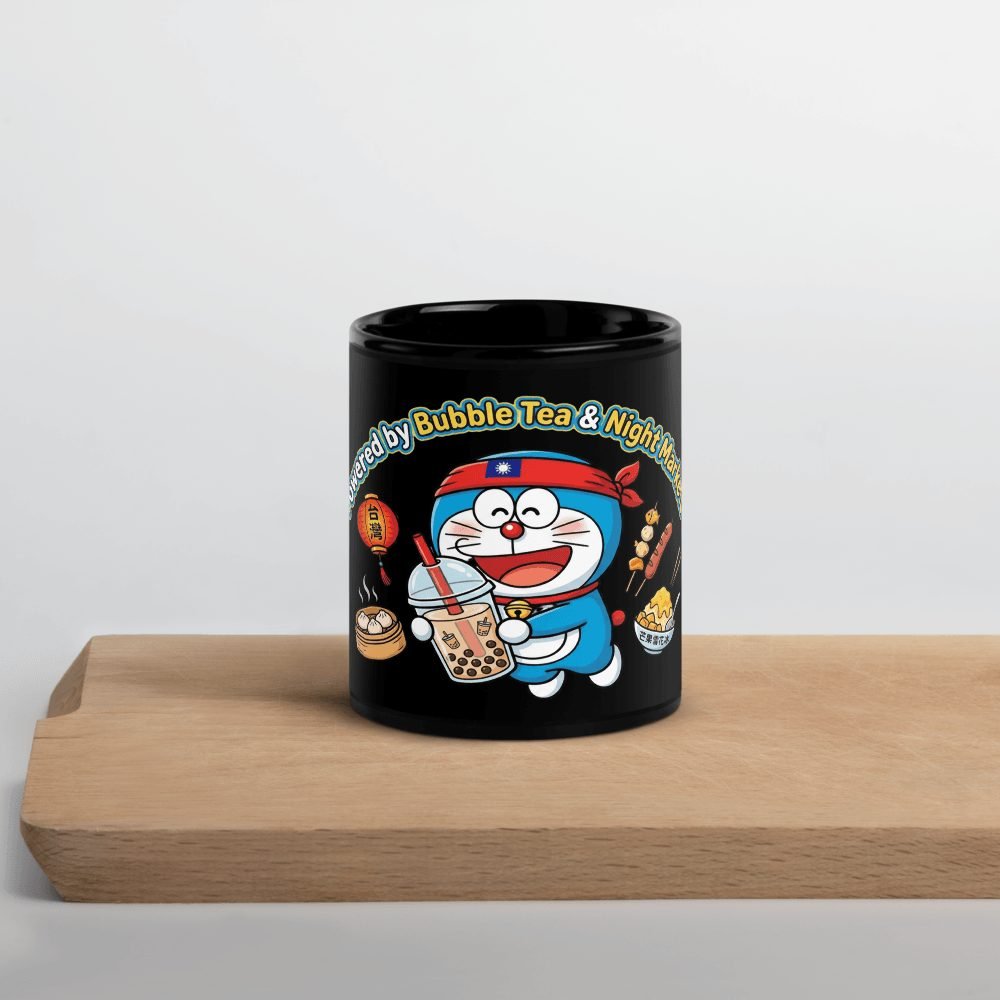
Powered By Bubble Tea & Night Markets
If your weekends are basically just an excuse to walk the next night market in Taiwan, this Doraemon-style mug is the closest thing to a personality test you can drink coffee from.
When to Visit Fengjia Night Market: Crowds, Open Hours, and the Best Day of the Week
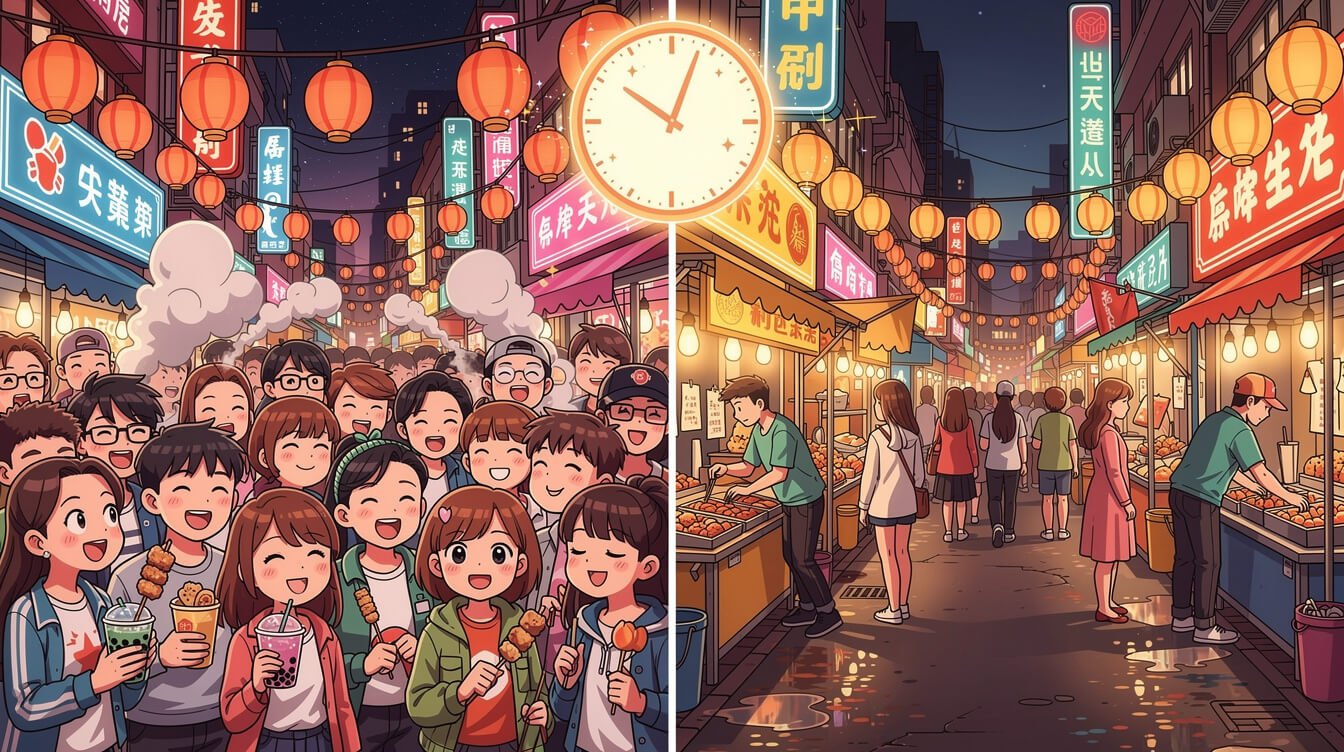
Fengjia is technically open every single day of the year, but the experience varies wildly depending on when you show up. Here’s the local cheat sheet.
Open hours
Vendors start setting up around 3 pm and most stalls are running by 5 pm. The market hits its peak between 7 pm and 10 pm and slowly winds down between midnight and 1 am, though a handful of late-night stalls keep going until 2 am on weekends. There are no fixed closing days — even Lunar New Year only quiets it down for a single night.
Weeknight vs weekend
If you have the choice, come on a Tuesday, Wednesday, or Thursday evening between 6 and 8 pm. Most stalls are open, lines are walkable, and you can actually navigate the alleys without being shoulder-to-shoulder. This is when locals come.
Friday and Saturday nights from 7 to 11 pm are when Fengjia genuinely earns its “largest night market in Taiwan” claim. Foot traffic on a peak Saturday is estimated at 200,000 to 400,000 visitors. It’s a once-in-a-lifetime spectacle if you’ve never seen a Taiwanese night market at full chaos, but you’ll spend more time waiting than chewing.
Sunday nights are an underrated sweet spot — busier than midweek, calmer than Saturday, with a slightly more local crowd because Taichung students are getting ready for the school week.
Seasonal timing
Fengjia is covered enough that rain doesn’t kill it, which matters during Taiwan’s plum-rain season in May and June and the typhoon-adjacent humidity of late summer. Winter nights (November–February) are crisp and pleasantly cool — December and January are actually our favorite months to visit, paired well with a cup of milk tea to warm your hands. For a broader sense of when the weather works in your favor, our guide to the best time to travel to Taiwan breaks down the calendar month by month.
Fengjia Night Market Taiwan FAQ
Is Fengjia Night Market really bigger than Shilin?
By footprint, foot traffic, and revenue, Fengjia is often quoted as the largest. By stall count, Shilin’s older history of registered vendors usually wins. The honest answer: both are top-three contenders, and the “biggest” title depends entirely on what you’re measuring.
How much should I budget for a meal?
Most signature stalls charge between NT$40 and NT$120 (roughly US$1.30 to US$4) per item. A meaningful crawl through six or seven stalls — plus a bubble tea and a dessert — typically lands at NT$400 to NT$600 per person. Bring cash; while some bigger stalls now accept LinePay and JKO Pay, the smaller ones don’t.
Is Fengjia good for vegetarians?
Better than most. 一心素食臭豆腐 (Yi Xin Vegetarian Stinky Tofu) is a long-running fully vegetarian stand, and dozens of stalls will happily skip the meat on tangyuan, scallion pancakes, dan bing, takoyaki without bonito, and grilled corn. Look for the green 素 (sù) sticker that marks vegetarian-friendly vendors across Taiwan.
Can I drink the bubble tea anywhere I want?
Yes, but never on the MRT or HSR — eating and drinking on Taiwan’s metros is enforced with surprisingly steep fines. Finish your drink before you tap in. If you’ve fallen in love with the format, our Taiwan boba tea ordering guide covers exactly what to ask for at the source.
Is the night market safe at night?
Extremely. Taiwan ranks among the safest countries in the world (currently fourth), and Fengjia in particular is one of the most policed, well-lit, family-friendly spaces in Taichung. Petty pickpocketing is the only real concern, and even that is rare. See our deeper read on why Taiwan is so safe if you want the data behind the vibe.
How does Fengjia compare to other Taiwanese night markets?
Fengjia is the loudest and most experimental. Taipei’s Raohe Night Market is the most photogenic and the easiest to walk in one straight pass. Shilin Night Market is the largest by sheer reputation. Ningxia Night Market is the most food-focused, no clothing or arcade clutter. Fengjia’s defining trait is its restless creativity — what’s trending nationally usually appeared here first.
Final Thoughts: Why Fengjia Hits Different Than Every Other Taiwan Night Market
Every Taiwanese night market has a personality, and Fengjia’s is the loud, curious, ever-evolving cousin who refuses to settle down. Shilin is the older sibling that grew up with the country; Raohe is the photogenic one everyone takes home; Ningxia is the food snob; Fengjia is the one inventing the next thing while the others are still arguing about the last one.
That’s the real reason it’s worth a trip to Taichung. Yes, you’ll eat extraordinarily well. Yes, the big sausage in little sausage really is best here. But the deeper magic of Fengjia is that it’s a working museum of how Taiwanese street food actually evolves — fueled by a perpetual rotation of college students, ambitious vendors, and a city that has never stopped being hungry. Come once, eat too much, and start planning the return trip before you’ve finished your shaved ice. Welcome to Taichung.
More Taiwan, Straight To Your Inbox
Weekly stories about Taiwanese food, culture, and the artisans behind our merch — plus subscriber-only drops on new tees and prints.
Grab a Free Taiwan Sticker!
Drop your email and we’ll send you a limited-edition Taiwan sticker — plus insider access to new merch drops and island vibes.
No spam. Unsubscribe anytime.