Did You Know? Taiwan’s Five-Colored Bird Sounds Like a Monk Drumming
Walk through almost any leafy park in Taipei in spring and you’ll hear it: ko, ko, ko, ko, steady and hollow, like someone tapping a wooden temple block. Look up and you might catch the culprit. It’s a chubby green bird with a rainbow painted on its head, and it lives in Taiwan and nowhere else on Earth.
Meet the Taiwan barbet (Psilopogon nuchalis). Locals know it as 五色鳥 (wǔsè niǎo), the “five-colored bird.”
Five Colors, One Very Round Bird
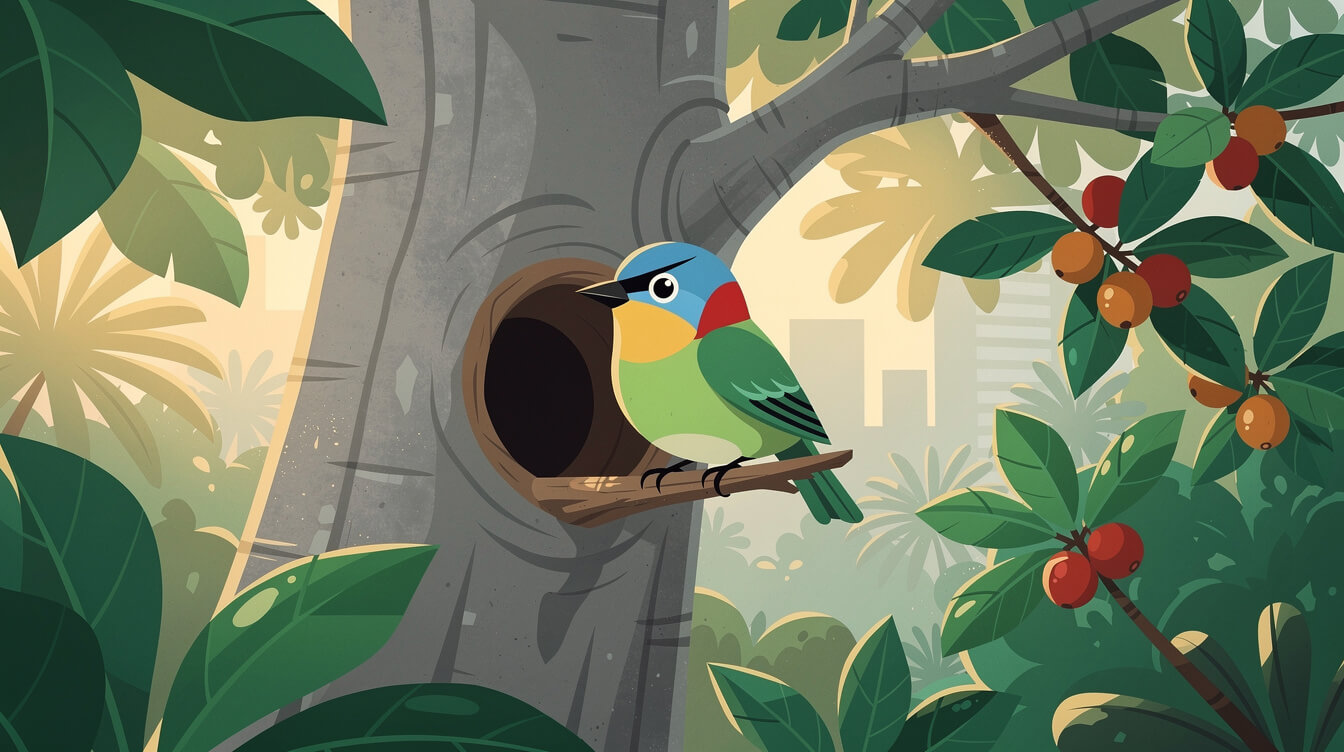
The name isn’t a stretch. The body is bright leaf-green. The head carries the other four colors: a blue face, a yellow forehead and throat, a red spot in front of each eye with a red patch on the back of the neck, and a thin black eyebrow stripe. Put it all together and you get something that looks like a kid colored it with a brand-new pack of markers. It’s about 20 cm long, round-bodied, short-tailed and big-headed. Honestly, it’s built like a plush toy.
The “Flowery Monk”
Its other nickname is even better: 花和尚 (huā héshàng), the “flowery monk,” or hue-á huê-siūnn in Taiwanese. That steady ko-ko-ko call sounds just like a monk striking a 木魚, the wooden-fish percussion block you hear during Buddhist chanting. So you get a monk in a very colorful robe, keeping time in the treetops.
Here’s the seasonal twist. The drumming is mostly a breeding-season song, and breeding runs from about April to August. In November the flowery monk goes quiet. It spends the cooler months alone, sitting very still among thick leaves and eating fruit. That’s why so many people have heard a barbet but never actually seen one.
Not a Woodpecker (But It Digs Like One)
Because it carves its nest holes into tree trunks, the barbet is often mistaken for a woodpecker. Its thick beak isn’t made for hammering into healthy wood, though. It works best on soft, partly rotted dead wood, where it chisels out a neat round entrance and a deep, bag-shaped chamber below. Old barbet holes later become homes for other animals, which makes this little bird a quiet landlord of the forest.
That creates a very modern problem. City parks tend to tidy away dead branches, and that leaves barbets with fewer places to dig. Taiwanese researchers who have monitored urban barbets alongside nests in Yangmingshan National Park found that city chicks die more often. Their best explanation is that tidy, uniform park planting draws too few insects, and insects are the protein the parents need to raise their young. The fix is refreshingly low-tech: leave a little messy nature in place.
A Name That Traveled to Japan
The 五色鳥 name dates from the Japanese colonial era. In Japanese, goshikidori traditionally referred to Taiwan’s barbet. When Japanese ornithologists updated their bird-family names in 2019, they named the entire Asian barbet family ゴシキドリ科 after the bird that’s commonly called goshikidori. So one Taiwanese bird gave its name to a family that ranges across much of tropical Asia. Not bad for something that mostly sits still and eats figs.
It’s in good company, too. Taiwan’s endemic birds already include the Taiwan blue magpie, which won the national bird vote. And if you like your urban wildlife slightly ridiculous, don’t miss Taipei’s “big dumb bird”.
The takeaway: Next spring, when you hear wooden-block tapping in a Taiwanese park, look for the dead branch, not the temple. A flowery monk is probably home.
Love Taiwan’s mountains and the wildlife that lives in them? Our Yangmingshan retro park poster tee is a love letter to Taipei’s backyard volcano park. You can find more nature-inspired designs at Shop Taiwan Merch.

Grab a Free Taiwan Sticker!
Drop your email and we’ll send you a limited-edition Taiwan sticker — plus insider access to new merch drops and island vibes.
No spam. Unsubscribe anytime.