Taiwan Pingxi Lantern Festival 2026: Dates, Lantern Colors, and How to Release Your Own Wish
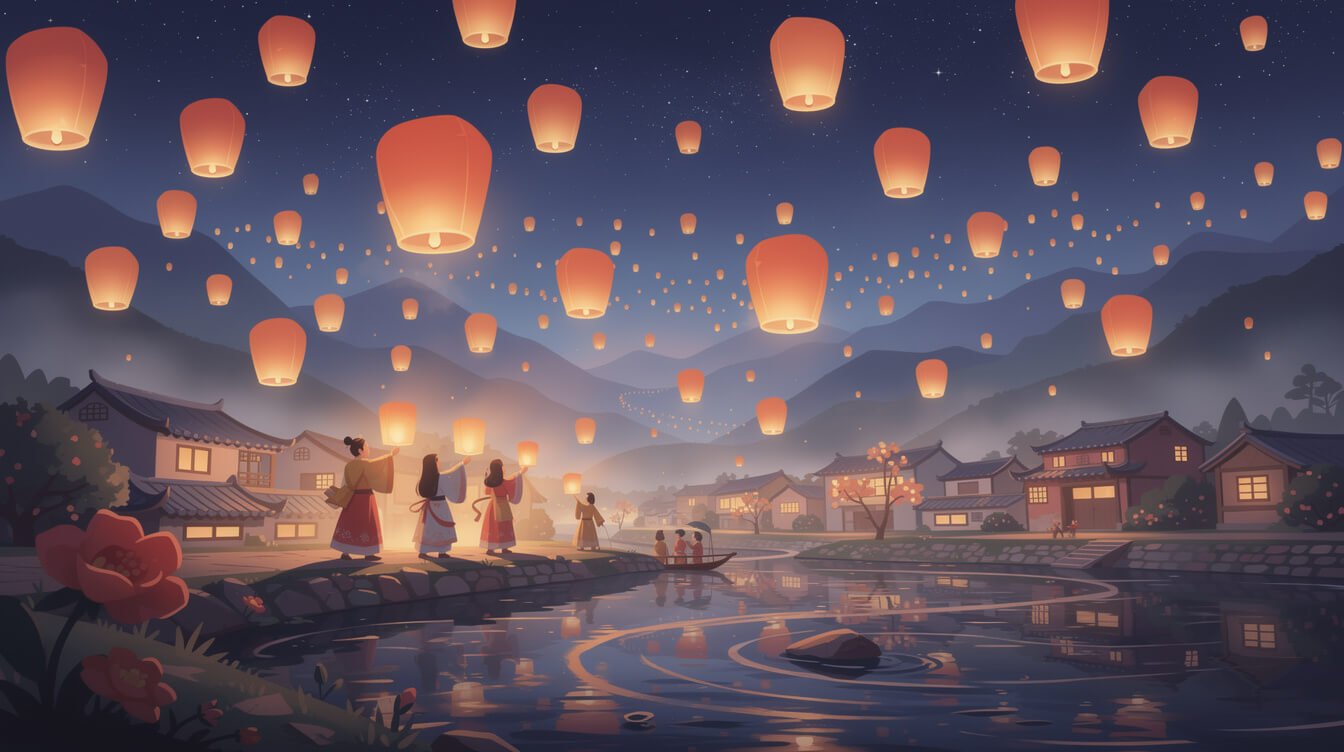
If you only have time to experience one Taiwanese festival in your life, make it the Taiwan Pingxi Lantern Festival. Every year, on the 15th night of the Lunar New Year, thousands of glowing paper lanterns lift off from a tiny former coal-mining town in the mountains of New Taipei City and drift, slowly, into a sky so dark you’ll forget you ever lived under city lights. CNN, the Discovery Channel, and National Geographic have all called it one of the most beautiful festivals on earth. Reader’s Digest put it on a list of forty things to see before you turn forty. The locals just call it home.
This guide is for the traveler who wants more than dates and ticket prices. We’ll cover the exact 2026 schedule, of course — but we’ll also dig into the bandit-era origin story most travel blogs gloss over, the secret meaning of each lantern color (it involves a Taiwanese Hokkien pun), how to actually get to Pingxi without losing your mind in the crowd, the proper way to release a lantern, and the quiet conservation effort that’s quietly reshaping the festival from the inside.
By the end, you’ll know more about Pingxi than ninety percent of the people standing next to you on the tracks.
When Is the 2026 Taiwan Pingxi Lantern Festival?
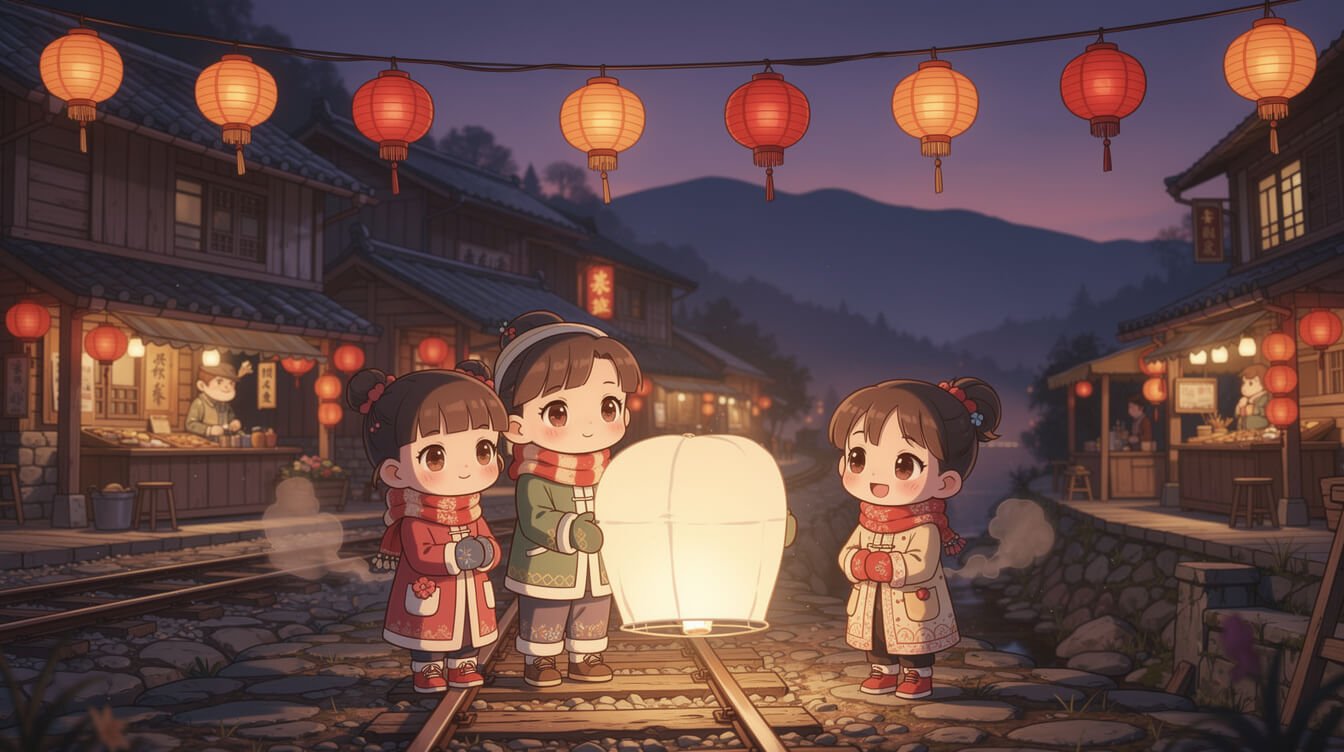
The Pingxi Sky Lantern Festival is locked to the lunar calendar, not the Gregorian one — which means the date drifts every year and catches first-time visitors off guard. The official date is the 15th day of the first month of the lunar calendar, which marks the very end of Lunar New Year celebrations across the Chinese-speaking world.
In 2026, the New Taipei City Tourism and Travel Department has scheduled the festival across two release dates at two separate venues:
- Friday, February 27, 2026 — Mass release at Pingxi Junior High School (Nanshan Village)
- Tuesday, March 3, 2026 — Mass release at Shifen Sky Lantern Square (about 6 km north of Pingxi on the same train line)
The two-date format isn’t a quirk — it’s a crowd-control strategy. Pingxi District has fewer than 5,000 permanent residents and a single mountain road in, so spreading the official releases across two nights lets the local government cope with the 100,000+ visitors who descend on the area every year. Each evening, around 200 lanterns are released in coordinated waves of 100 at a time, with the first wave usually going up around 6:30 PM and the second around 8:00 PM.
Here’s the part most guides bury at the bottom: you don’t actually need to wait for the official dates to release a lantern. Lantern shops in Pingxi and Shifen sell to walk-up customers year-round, and you can light one off the railway tracks any night of the year. The official festival is the spectacle; visiting in the off-season is the intimate version. If you’re planning a longer trip, our guide to the best time to travel to Taiwan breaks down how Lantern Festival fits into Taiwan’s wider seasonal calendar.
The Bandit-Era Origin Story Most Travel Guides Skip
Walk through Pingxi today and you’ll see paper lanterns hanging from every shop awning, every restaurant window, every gift stall. What you probably won’t see is any explanation of why they’re here, specifically, in this remote mountain valley and not in some flashier Taiwanese city.
The story starts in the early 19th century, during the late Qing dynasty. Pingxi sat at the edge of Han Chinese settlement in northern Taiwan, hemmed in by steep ridges, rivers, and forest. It was beautiful country and also frighteningly lawless. Bandits routinely raided the small villages tucked into the hills, particularly after harvest season when food and money were briefly worth stealing.
So Pingxi’s villagers developed a survival routine. When raids were rumored or detected, entire families would flee their homes and take refuge deeper in the mountains. They would stay hidden for days, sometimes weeks, waiting for the bandits to move on. The problem was knowing when it was safe to come back. Sending a runner down to the village was dangerous; the bandits might still be there.
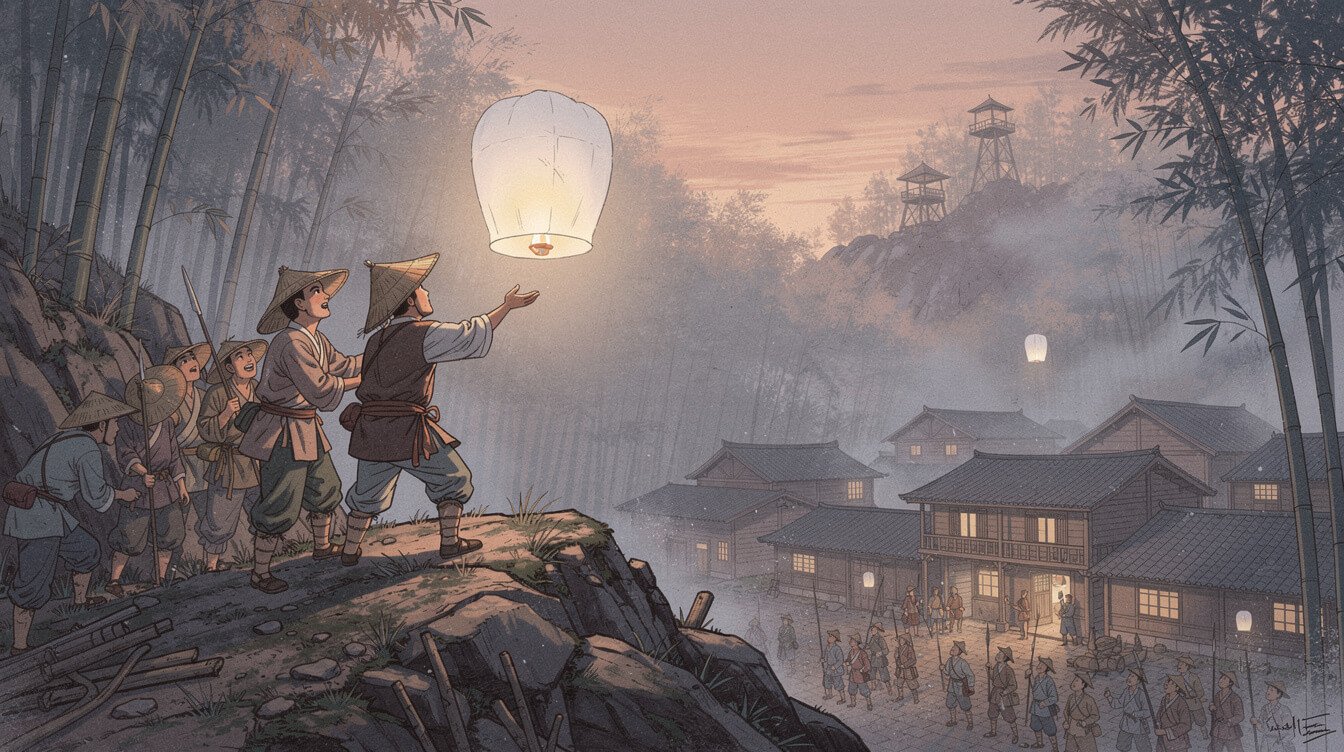
The solution was elegant: send a scout, alone and on foot, to scope out the village from above. If the village was safe, the scout would release a paper lantern — a small balloon of waxed rice paper held up by a candle flame — into the night sky. Anyone watching from the high refuge could see it for kilometers. The lantern meant come home.
This signaling tradition became woven into the Lantern Festival, which already marked the end of Lunar New Year. By the mid-19th century, the message had inverted. The lanterns no longer said come home; they said I am home, and I am safe, and here is what I wish for in the year ahead. By 1999, when the New Taipei government turned the local tradition into a formal international festival, the story had been polished smooth — but the bandit-era roots are still there in the bones of the celebration. Every lantern you watch rise is, in a small way, a 200-year-old all-clear signal.
What Each Lantern Color Means (and the Hokkien Pun That Started It All)

Walk up to any lantern stall in Pingxi or Shifen and you’ll see eight color options laid out in a fan, like a paint chip wheel for your future. Most travel blogs list the colors and call it a day. They miss the language joke that’s hiding underneath the whole tradition.
In Taiwanese culture, the word for sky lantern is tiān dēng (天燈). In Taiwanese Hokkien — the language most Pingxi locals grew up speaking at home — those characters sound almost identical to tiān dīng (添丁), which means “to add a son to the family.” For centuries, releasing a lantern was a way of literally launching a wish for male children — a son to inherit the farm, help with the harvest, carry the family name. The pun is the whole reason the festival became associated with wishes in the first place. The colors came later.
Here’s what each color means at a modern Pingxi lantern stall:
- Red — Health and good fortune. The default for first-timers and the most popular by a wide margin.
- Pink — Love, romance, and marriage. Couples buy these constantly; you’ll see more pink than any other color on Valentine’s Day weekend.
- Yellow / Gold — Wealth and money. Tied to traditional Chinese gold ingots and prosperity symbolism.
- Blue — Career success, ambition, and a clear-headed year ahead.
- Green — Peace, harmony, and good health for family. Often chosen by elders releasing on behalf of children.
- Purple — Academic success. Students preparing for Taiwan’s brutal university entrance exams gravitate to this one.
- White — A bright future, clarity, and new beginnings. Common with travelers, expats, and people starting over.
- Orange — Luck and joy. The most playful, casual choice on the wheel.
The eight-color rainbow lantern — a single lantern divided into eight panels, one per color — is the showstopper. It costs the most (around NT$200), takes the longest to write on, and is the easiest to photograph. If you’re only releasing one lantern in your entire life, this is the one.
How to Get to Pingxi for the Festival
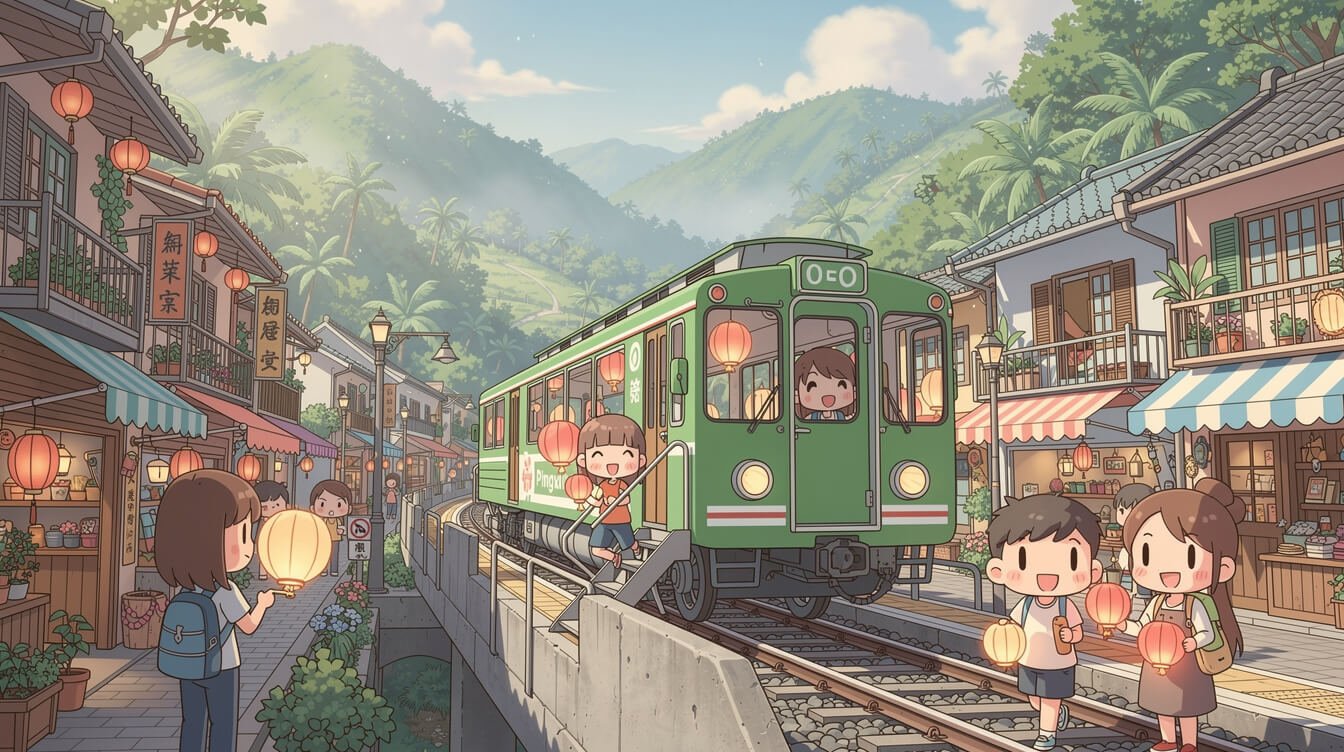
Pingxi sits about 45 km east of central Taipei, tucked into the mountains of New Taipei City. There is no metro line to Pingxi and the access roads are narrow. On festival nights, traffic into the valley is closed off entirely and you have exactly three good ways in.
1. Free Festival Shuttle (the easiest option)
On official festival nights, the New Taipei City government runs free shuttle buses from Muzha MRT Station (Wenhu Brown Line), Mucha, and sometimes Keelung Bus Terminal. Buses start running around 1:00 PM and continue until late evening. Show up with your photo ID, queue, ride. Round trip takes about 75 minutes each way in normal traffic, longer at peak. This is the option most locals choose, and the option most international visitors should default to.
2. Pingxi Line Train (the scenic option)
The Pingxi Line is a charming single-track diesel train that runs through the mountains from Ruifang to Jingtong, stopping at Shifen, Pingxi, and a handful of tiny stations along the way. To reach it, take any northbound train from Taipei Main Station to Ruifang, transfer to the Pingxi Line, ride about 25 minutes to either Shifen or Pingxi. Total journey: around 90 minutes from Taipei. On festival nights the train is packed — standing-room only — but the ride through the mountains is genuinely magical. See our Taiwan train map guide for the full rail context.
3. Taxi or Private Driver (the comfortable option)
Expect to pay NT$1,200–1,800 each way from central Taipei, and expect significant delays getting back out after the release. Many drivers refuse the route on festival nights altogether because of the road closures and traffic. If you’re traveling with elderly family members or kids who can’t handle the shuttle queue, this is worth it — but book it through your hotel or a reputable app, not from a street hail.
One pro tip from experienced Pingxi-goers: arrive by 3:00 PM at the absolute latest. The official release happens after dark, but the village fills up by mid-afternoon and the queue for festival registration (you need a wristband for the mass release) closes early. If you arrive at 6 PM hoping to release with the official wave, you’ll be watching from the sidelines.
How to Release Your Own Lantern, Step by Step
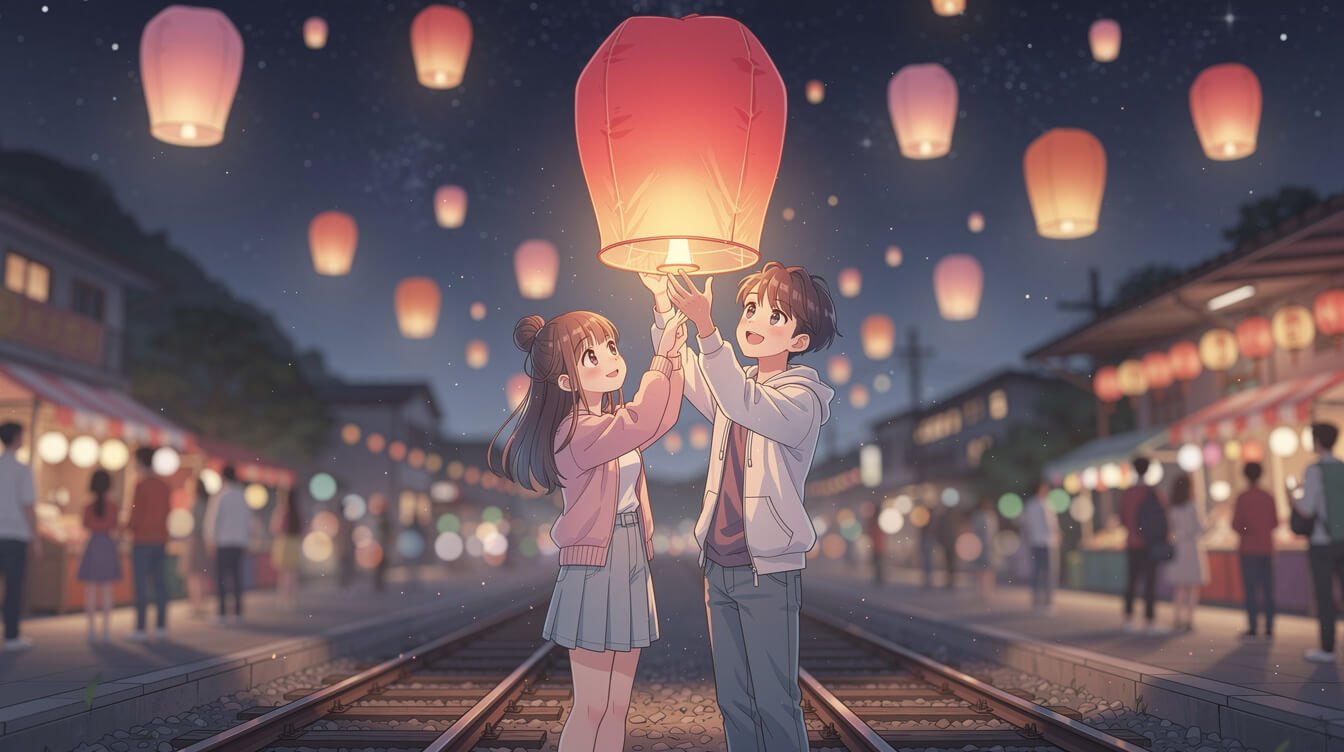
Releasing a sky lantern looks effortless when you see it in a photo. In person, it involves a folded sheet of waxed paper, a small wire frame, a candle, an open flame near your face, and a strong updraft. Here’s how it actually goes.
Step 1: Buy your lantern
Lantern stalls line both sides of the railway tracks in Pingxi and Shifen. Single-color lanterns run NT$150, the eight-color rainbow runs NT$200. Each stall comes with brushes, ink, and helpers who’ll guide you through the writing process — most speak basic English and a few are surprisingly fluent.
Step 2: Write your wish
Use the calligraphy brush to write four traditional Chinese phrases on the four flat panels of the lantern. If you can’t write Chinese, ask the stall helper — they’ll happily transliterate your wish or suggest common four-character phrases (財源滾滾 “may money roll in,” 身體健康 “good health,” 闔家平安 “family safety”). Each panel corresponds to a specific kind of wish; the color you chose decides the theme.
Step 3: Pose for photos
Before you light it, the helpers will hold the lantern open for you to photograph from every angle. Take more shots than you think you need. Once it’s lit, you have about 90 seconds before it’s gone.
Step 4: Light and release
The helper lights the wax block suspended inside the lantern. Hot air begins to fill the paper. You hold the four bottom corners of the lantern open, feeling the tug of the rising air. When the helper says release — usually with a countdown — you let go simultaneously. The lantern rises, slowly at first, then faster, joining whatever else is in the sky that night.
If you want a piece of the festival to keep after the candle burns out, our Pingxi Lantern Festival Taiwan Night Sky Wall Art captures the exact moment dozens of lanterns rise above the Pingxi mountains — printed on museum-grade canvas so you can hang the night you remembered on a wall in your own home.
Step 5: Watch
Stand on the tracks and don’t move for the next five minutes. The lantern climbs fast — within 30 seconds it’s already 50 meters up. Within two minutes you’ll lose track of which one was yours. That is the whole point.
Beyond Pingxi: Shifen, Jingtong, and the Mining Heritage Trail
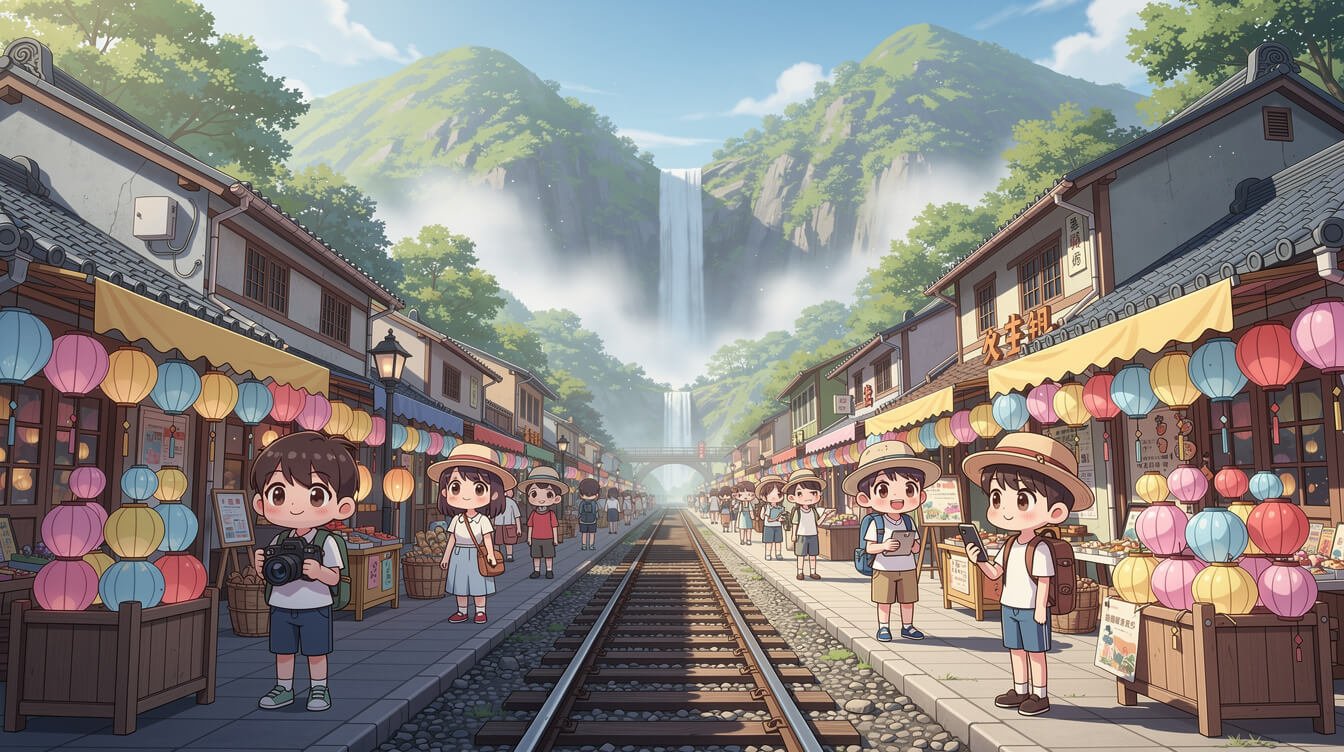
The single best mistake you can make at the Lantern Festival is treating Pingxi as a one-stop visit. The Pingxi Line strings together six small mountain towns, each one a window into a chapter of Taiwan’s history. If you have the time, ride the whole line.
Shifen (十分)
Three stops east of Pingxi and the only village whose Old Street has the train running right down the middle of it — shops, lantern stalls, and grilled-sausage vendors lined up on both sides of an active rail line. A train rolls through every 30 minutes and everyone scrambles to clear the tracks at the last second. Shifen Waterfall, a 40-meter cascade widely considered Taiwan’s most scenic, is a 20-minute walk north of the station. The mass lantern release on March 3, 2026 happens here.
Jingtong (菁桐)
The terminus of the Pingxi Line and the most photogenic village on it. Jingtong was a coal-mining boomtown in the 1920s and 1930s; the wooden Japanese-era station and the ruined coal-washing structure on the hill above it are unchanged from the colonial period. The shops along Jingtong Old Street sell bamboo wish tubes — write a wish on a strip of paper, slide it inside, hang the tube on a wall outside the station. Hundreds of these tubes form a kind of living wishing wall.
Pingxi Old Street (平溪老街)
The heart of the festival itself. Wooden Japanese-occupation shophouses from the 1930s and 40s line a narrow street that runs underneath the elevated train track. Restaurants serve mountain pork sausage, deep-fried sweet potato balls, and Taiwan beer; vendors sell every imaginable lantern variation. The street stays open until well past midnight on festival nights.
If you can extend the day into a multi-stop loop, the natural pairing is Jiufen, an old gold-mining town just one stop north on a parallel rail spur. Jiufen’s lantern-strung Old Street is the one many travelers mistake for the lantern festival itself (it’s not — it’s an entirely different town with permanent decorative lanterns). For a full Taipei-area itinerary that includes Pingxi, our guide to things to do in Taipei stitches it all together.
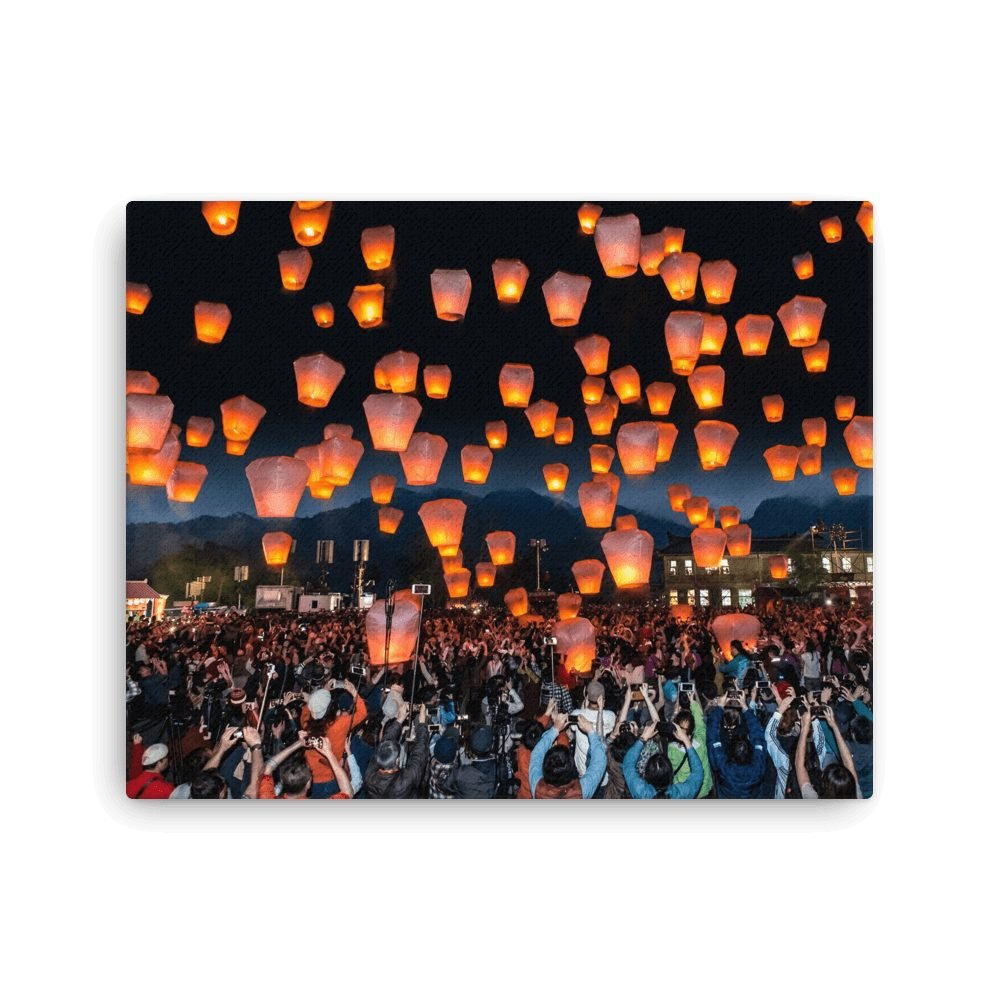
Hang the Pingxi Sky on Your Wall
Bring home the magic of the lantern festival with our Pingxi Lantern Festival Night Sky Wall Art — a museum-grade canvas print of hundreds of paper lanterns rising over the Pingxi mountains. The kind of art that turns a hallway into a memory.
The Environmental Question — And How Taiwan Is Trying to Fix It

It would be dishonest to write about the Pingxi Lantern Festival without mentioning the question that everyone with a smartphone eventually asks: where do those lanterns go after they disappear?
The honest answer: most of them come down. Each lantern’s paper envelope is consumed by the candle within a few minutes, leaving behind a wire bamboo frame and a metal hanger. Some of these frames drift far on the wind. Some land on rooftops in Pingxi village. A small but real fraction land in the forested mountains that surround the valley, and in the streams that feed the local water supply. There have been wildfire scares — though never a major fire directly attributable to a Pingxi lantern, thanks largely to the wet mountain climate.
The good news is that Taiwan has been quietly engineering its way out of the problem for over a decade. The New Taipei City government runs a year-round lantern bounty program: villagers and certified hikers are paid roughly NT$30 (about $1 USD) for every lantern frame they recover from the mountains and turn in for proper disposal. The program has recovered hundreds of thousands of frames over the years and turned lantern-cleanup into a small side income for the local community.
The festival has also moved aggressively toward biodegradable lanterns. Most lanterns sold in Pingxi today use rice paper that decomposes within months and bamboo (or rice husk) frames in place of wire. The newest generation, developed in partnership with National Taiwan University, uses lanterns that break down completely within 100 days of landing — leaving nothing but plant fiber on the forest floor.
Is it perfect? No. Old-stock lanterns with wire frames still circulate, especially with outside-the-festival vendors. But the trajectory is real. The festival is not the unconsidered spectacle some Western articles still describe; it’s actively being reshaped by the community that hosts it. If you want to do your part as a visitor, buy your lantern from a stall that explicitly says biodegradable (環保 or 可分解) — they cost the same.
Frequently Asked Questions About the Taiwan Pingxi Lantern Festival
Can I release a lantern any time of year, or only during the festival?
Year-round. Lantern stalls in Pingxi, Shifen, and Jingtong sell to walk-up customers every day of the year, and the railway tracks at Shifen Old Street are the most popular spot for off-season releases. Visiting on a non-festival weeknight is the only way to experience Pingxi without the crowds.
How much does it cost to release a Pingxi sky lantern?
NT$150 for a single-color lantern, NT$200 for the eight-color rainbow lantern. The price includes the brushes, ink, and a helper who’ll walk you through the entire writing and release process. There is no separate entry fee for the official festival; the lanterns are the only thing you pay for.
Is the Pingxi Lantern Festival safe?
Yes — Taiwan is consistently ranked among the four safest countries in the world, and Pingxi is no exception. The crowds get genuinely dense on official festival nights (100,000+ visitors squeezed into a small mountain valley), so keep an eye on children and avoid the very front of the release zone if you don’t want hot wax dripping near you. Wear closed-toe shoes; the tracks are uneven.
What’s the difference between the Pingxi Lantern Festival and the Taiwan Lantern Festival?
The Pingxi Lantern Festival is a sky lantern release in one specific village. The Taiwan Lantern Festival is a much larger national event with stationary, ground-based lantern displays — usually animated and tied to the Chinese zodiac animal of the year. In 2026, the national Taiwan Lantern Festival is hosted by Chiayi from March 3 to 15. Both happen in the same calendar window but they’re entirely different experiences.
Can I visit Pingxi as a day trip from Taipei?
Easily. The round trip from central Taipei is about 3 hours of travel time on the train. Leave Taipei after lunch, spend the afternoon in Pingxi Old Street, release a lantern at dusk, catch the late train back. A full evening day trip works on any night of the year, and the 7-day Taiwan itinerary shows how to fit it into a longer route.
Should I do the official festival night or visit on a regular weekend?
If you want the spectacle of mass lanterns rising in coordinated waves, the official Feb 27 or Mar 3 dates are unbeatable — and unforgettable. If you want a quieter, more personal experience where you can take your time with the lantern stall, hike to Shifen Waterfall in the daylight, and release a single lantern at dusk into a sky you can actually see, come on any other weekend. Both versions are worth doing once.
Final Thoughts: Why Pingxi Stays With You
The Taiwan Pingxi Lantern Festival is one of those rare cultural events that delivers exactly what the photos promise and then quietly hands you something else, too. The photos promise a sky full of glowing wishes. What you actually get is the soft tug of hot air on rice paper, the weight of a brush in your hand, the four characters you chose for your wish, and the strange small silence that falls over the crowd in the half-second before the helper says release.
You also get the rest of the story — the bandit-era scouts releasing lanterns to say come home, it’s safe, the Hokkien pun that turned a signal into a wish, the mining town that quietly reinvented itself around a 200-year-old tradition, and the local conservation effort that’s slowly rebuilding the festival from the inside out. Most travelers leave Pingxi with a photo of a glowing sky. The ones who read first leave with something better: a story to tell, four characters they hand-painted onto a paper lantern, and the soft conviction that they participated in something real.
If 2026 is your year to go, plan around February 27 or March 3, book your shuttle bus early, and write a wish that’s specific enough to mean something. The mountains will take care of the rest.
Get More Taiwan Stories in Your Inbox
Join thousands of Taiwan fans getting weekly travel tips, culture stories, food guides, and new merch drops delivered straight to your inbox — free, no spam, unsubscribe anytime.

Grab a Free Taiwan Sticker!
Drop your email and we’ll send you a limited-edition Taiwan sticker — plus insider access to new merch drops and island vibes.
No spam. Unsubscribe anytime.