Taiwan Iron Eggs: How a Rainy-Day Mistake at a Tamsui Noodle Stall Became the Island’s Chewiest Souvenir Snack
Walk into any 7-Eleven, FamilyMart, or Hi-Life in Taiwan and you’ll find them sitting near the tea-egg pot: small vacuum-packed bags of wrinkled, almost-black eggs called iron eggs (鐵蛋, tiědàn, or thih-nn̄g in Hokkien). They look like tiny lumps of coal. They’re chewy enough to give your jaw a workout. And they exist today only because of one stubborn grandmother in Tamsui who refused to let her unsold inventory go to waste during the rainy season.
The Rainy Tamsui Origin Story
Tamsui (淡水), the old port town at the northern tip of New Taipei City, sits where the Tamsui River meets the Taiwan Strait. It’s beautiful — sunset boardwalks, red brick lanes, the 19th-century Fort San Domingo — but it’s also wet. Northern Taiwan’s plum rain season dumps weeks of drizzle on Tamsui every May and June, and the rest of the year isn’t much drier.
In the late 1960s, a woman named Huang Chang-nian (黃張哖) — known to locals as Ah-Po, or “Grandma” — ran a small noodle and tea-egg stall by the Tamsui ferry pier. Tea eggs (茶葉蛋) were her side dish: regular chicken eggs simmered all day in a soy-sauce, star-anise, and tea-leaf broth.
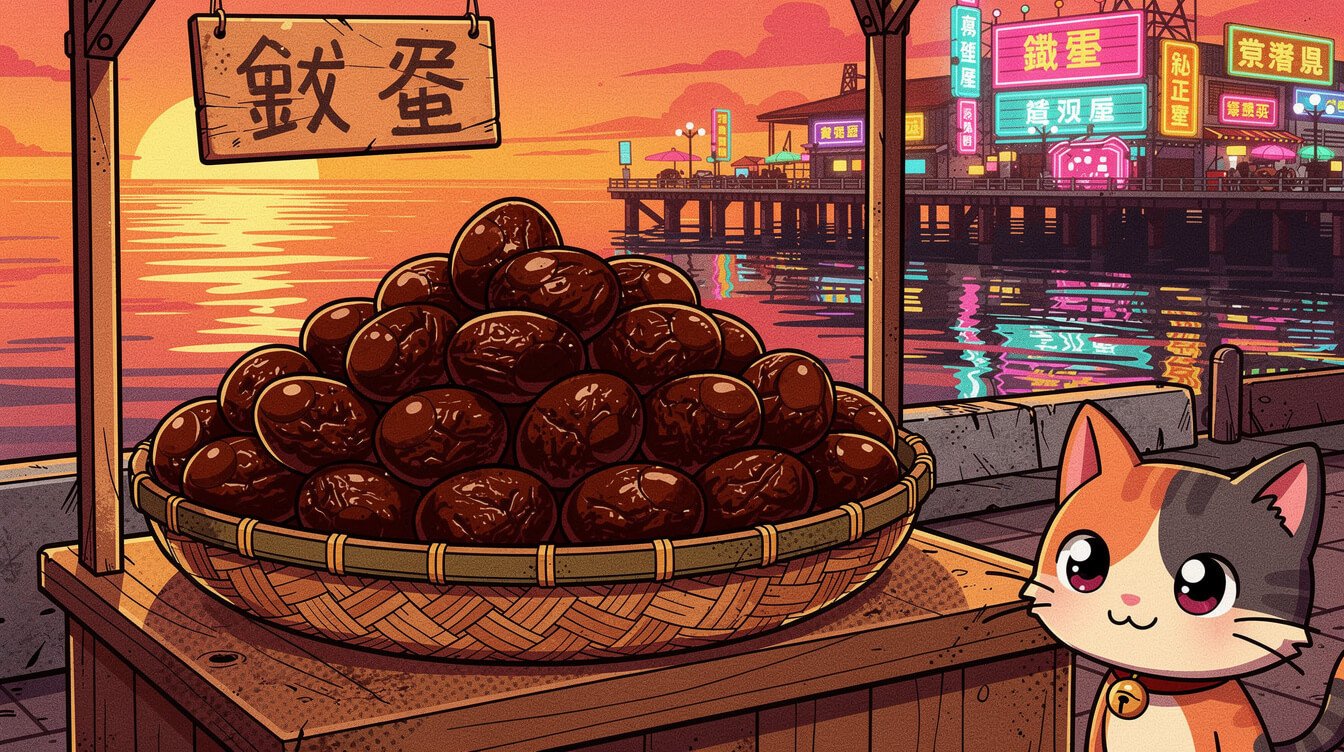
The problem: when it rained for days, foot traffic at the pier dried up. Ah-Po didn’t have a fridge worth the name, and she refused to throw out unsold eggs. So she did the only thing she could think of — she kept simmering them. Day after day, the eggs cooked down in the soy broth, then were lifted out to air-dry, then thrown back in the pot the next morning. After about a week of this cycle, the eggs had shrunk to maybe half their original size, turned almost black, and developed a leathery, wrinkled skin and a dense, intensely savory interior.
Customers tried them and went wild. The texture was unlike anything else — hard but yielding, deeply chewy, packed with concentrated five-spice umami. Ah-Po stopped selling regular tea eggs entirely. Her stall became known as 阿婆鐵蛋 (Ah-Po Iron Eggs), and by the 1980s, vacuum-packed bags of her iron eggs were being shipped to convenience stores across Taiwan.
What Makes an Egg “Iron”
Real iron eggs are made through a process that takes at least seven days:
- Simmer in a broth of dark soy sauce, five-spice powder, star anise, cinnamon, ginger, rock sugar, and black tea leaves — sometimes with a splash of Kaoliang liquor — for several hours.
- Air-dry in a cool, ventilated space (a fan helps) for the rest of the day.
- Repeat for seven to ten days, until the egg has shrunk by 30–50% and the white has turned a deep mahogany brown.
Quail eggs are popular too — they shrink to the size of a marble and are sold by the bag as a beer snack. Either way, the key is that slow loss of moisture: it’s what gives iron eggs their signature chew and their alleged “iron” hardness. They’re not actually metal-hard — you can bite through them — but they put up a fight, and your jaw will know about it the next day.
How Locals Actually Eat Them
Iron eggs are a snack, not a meal. You’ll find them:
- At the convenience store — a 4-pack of mini iron eggs ($1–2 USD) is the classic late-night beer pairing alongside Taiwan’s legendary 7-Eleven snack aisle.
- On the Tamsui Old Street — buy them fresh from Ah-Po’s original stand near the ferry terminal, often still warm from the broth.
- As an Omiyage-style gift — vacuum-packed iron eggs are one of Taiwan’s most popular edible souvenirs because they keep for months without refrigeration.
- On road trips — Taiwanese drivers stockpile them for long highway drives the way Americans grab beef jerky.
The flavor is rich and slightly sweet from the rock sugar, with a long savory finish. They’re best eaten cold, straight from the bag, with a cold Taiwan Beer to cut the salt. Some people also dice them into fried rice or stir them into porridge — but purists insist that’s a waste of a good iron egg.
One Tip Before You Try Them
If you’re new to iron eggs, start with the quail-egg version. They’re smaller, more tender, and easier on the jaw than the chicken-egg ones, which can feel like chewing through a savory rubber ball if you’re not used to it. Tear the corner of the vacuum pack, fish one out, and bite slowly — let the spice and soy hit before you commit to the texture. By the third egg, you’ll either be a lifelong fan or you’ll quietly hand the bag to a friend. There is no middle ground.
Either way, you’re tasting a piece of Taiwanese snack history — invented by accident, perfected by patience, and now sold in every convenience store from Tamsui to Kenting.
Bring the convenience-store snack vibe home
If iron eggs and a cold Taiwan Beer at midnight is your love language, our Taiwan-themed apparel will feel right at home in your closet — including a retro Hi-Life convenience store tee for the true 7-Eleven loyalists.

Grab a Free Taiwan Sticker!
Drop your email and we’ll send you a limited-edition Taiwan sticker — plus insider access to new merch drops and island vibes.
No spam. Unsubscribe anytime.