Xiaoliuqiu, Taiwan: Sea Turtles, Ferries and What’s Changed in 2026
There’s a small coral island off Taiwan’s southwest coast where the sea turtles swim through the harbor while you wait for your ferry, and where snorkelers don’t ask whether they’ll see one, just how many. That’s Xiaoliuqiu (小琉球, Xiǎo Liúqiú), also called Liuqiu or Lambai Island. It’s a 25- to 30-minute boat ride from Donggang in Pingtung County, small enough to circle by scooter in under an hour, and home to some of the easiest turtle encounters in Asia.
Most Xiaoliuqiu guides online were written for summer and haven’t been updated. This one covers how the island works right now: real 2026 ferry fares and winter timetables, the public boat that’s currently out of service, the turtle rules people keep getting fined under, and the intertidal zones that close to everyone on December 1. Let’s go.
Xiaoliuqiu at a Glance: Taiwan’s Coral Island
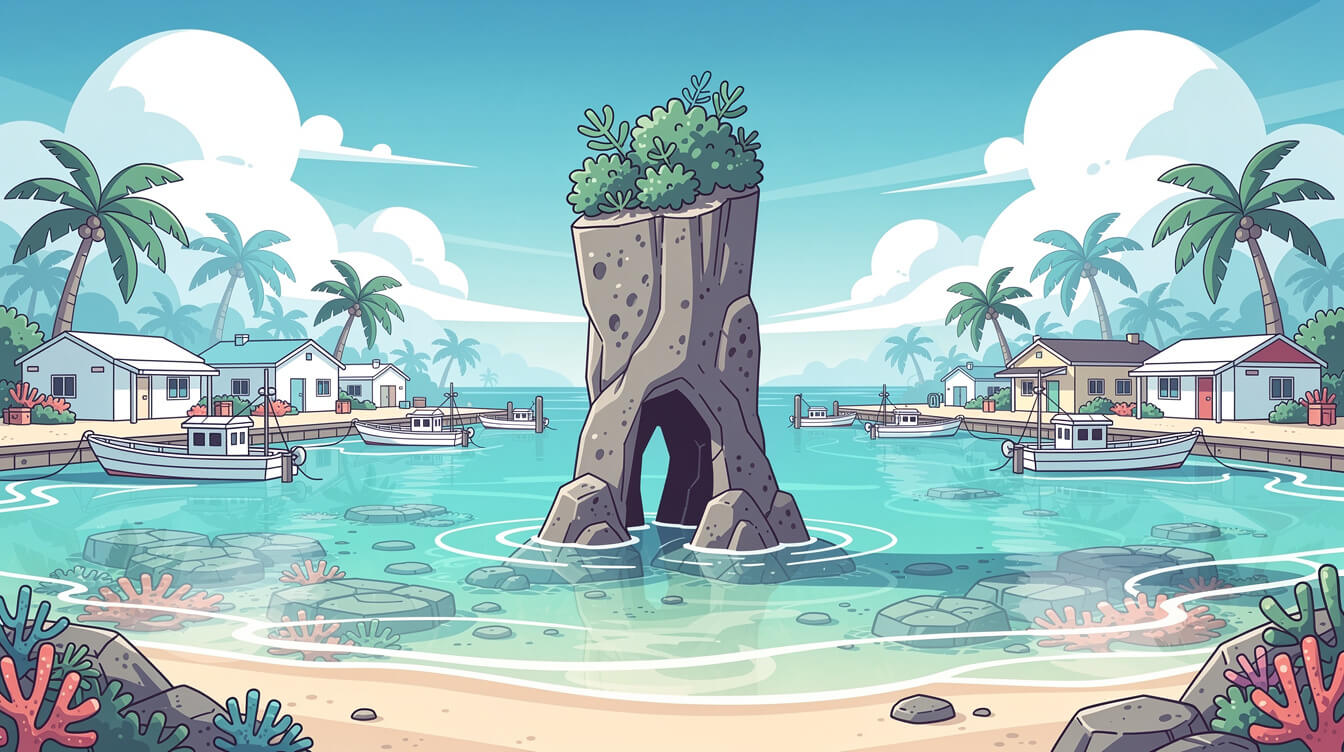
Xiaoliuqiu is a raised coral reef island about 8.9 nautical miles from Donggang Harbor. Taiwan’s Tourism Administration calls it the only coral reef island among Taiwan’s offshore islands. You can see the coral everywhere: the cliffs, caves and famous Vase Rock are all old reef limestone, pushed up out of the sea and carved by waves. The island covers just 6.8 square kilometers.
About 12,100 people live on Xiaoliuqiu (12,094 in October 2026, by Taiwan’s household registration count). They share it with more than a million visitors a year, so day-trip crowds are real, especially on summer weekends.
| Quick fact | Xiaoliuqiu |
|---|---|
| Chinese name | 小琉球 (Little Liuqiu); officially 琉球嶼, Liuqiu Township |
| Other names | Lambai, Lamay, Lamey, and (historically) Golden Lion Island |
| County | Pingtung |
| Area | 6.8 km² (2.6 sq mi) |
| Population | 12,094 (October 2026) |
| Ferry from | Donggang (東港), 25–30 minutes |
| Best known for | Green sea turtles, coral caves, Vase Rock, sunsets |
It’s not “Turtle Island”
Xiaoliuqiu is Taiwan’s turtle island in spirit, but don’t call it Turtle Island when you’re asking for directions. That name belongs to Guishan Island (龜山島) off Yilan, on the opposite side of Taiwan, which is named for its shape. (We cover that one in our Yilan travel guide.) And the “Liuqiu” name has nothing to do with Okinawa, even though Japan’s Ryukyu Islands are written with the same characters. “Little Liuqiu” is just a historical nickname that stuck.
A short, dark history
The island’s older European name, Golden Lion Island, comes from a Dutch ship. In 1622 the Gouden Leeuw (Golden Lion) wrecked on Xiaoliuqiu’s reefs, and its crew was killed by the islanders. A second Dutch wreck in 1631 ended the same way. In 1636, the Dutch East India Company sent a punitive expedition with Han Chinese and indigenous allies. Historians record that islanders who hid in a cave were trapped there and smoked out over several days. Around 300 people died, hundreds more were captured, and within a few years the island’s original population had been removed entirely.
Today, a lot of tours point to Black Devil Cave (烏鬼洞) as the site. Its name comes from a local legend about Black slaves who once lived in it. Historians treat that story as folklore, and it isn’t certain which cave was the 1636 site. It’s worth knowing that history before you walk through the caves. They’re beautiful, but they aren’t only a photo stop.
How to Get to Xiaoliuqiu (2026 Ferries, Fares and Buses)

Every trip to Xiaoliuqiu ends with a ferry. Most travelers go to Kaohsiung first, then to Donggang, then across the water.
Step 1: Get to Donggang
- From Taipei or anywhere north: take the High Speed Rail to Zuoying Station in Kaohsiung.
- From Zuoying, take the Taiwan Tourist Shuttle 9127D. It runs from Zuoying HSR Station to the Donggang ferry pier stop (東琉線碼頭). The 2026 timetable has the first bus at 08:00 and the last at 17:30, about every 30 minutes. The ride takes about 50 minutes, and a full fare is NT$122. The last bus back to Zuoying leaves the pier at 18:43.
- By taxi or rideshare: handy with luggage or a group. Expect around NT$1,000 or more from central Kaohsiung.
- From Kenting or Taitung: it’s usually easier to take the train to a Pingtung station, then a taxi to the pier. Our Kenting National Park guide pairs nicely with a Xiaoliuqiu detour.
Coming from the city? Our Kaohsiung guide covers where to stay the night before an early ferry.
Step 2: Take the ferry
Ferries from Donggang take 25–30 minutes. These are the official fares listed by the Liuqiu Township office (updated October 2026):
| Boat | One way (adult) | Round trip (adult) | Lands at |
|---|---|---|---|
| Private ferries (joint service, Tai Fu, Lan Bai) | NT$250 | NT$450 | Baisha Harbor (白沙) |
| Public township boat | NT$200 | NT$380 | Dafu Harbor (大福) |
Things the older guides won’t tell you:
- The public boat is out of service right now. The township boat, 琉興號, ran aground on October 22, 2026 and is being repaired. Until the end of the year, Dafu Shipping is covering its early and late runs: 07:00 from the island and 18:45 back to it. Those runs use Yanpu Harbor, not Donggang, and the stand-in boat can’t carry scooters. For most visitors, that means booking the private ferries to Baisha.
- Winter timetables are in effect. The first boats leave Donggang between about 07:00 and 07:20. The last sailings leave at 16:30 or 16:50, depending on the company. The last boats back from the island leave around 17:15–17:20. If you’re on a day trip, that last boat is your deadline.
- Bring your passport. Real-name boarding has been required since August 2025, so you’ll need ID to buy a ticket.
- Round-trip tickets usually lock you into one company. Check which company you bought from before you head to the pier for the return trip.
Getting around Xiaoliuqiu
Xiaoliuqiu is small. The coastal loop is about 12 km. You can walk it in around three hours or ride it in well under an hour. Your options:
- Scooter (the default): rental shops meet every ferry at Baisha Harbor. The island had about 7,200 rental scooters in late 2025, roughly 1,200 of them electric. A regular gas scooter legally requires a valid motorcycle license. For most foreign visitors, that means an International Driving Permit endorsed for motorcycles. Wear the helmet, even if you see locals skipping it.
- Micro electric scooters (微型電動二輪車): these small, slow e-scooters need no driver’s license. Riders must be at least 14, and the scooter must be plated and insured. Since September 2026, rental shops must show proof of insurance and teach you how to ride before handing over the keys. That’s a good sign you’re dealing with a legit shop.
- Island bus 601: since January 1, 2026, the island loop bus has run as part of the Taiwan Tourist Shuttle network. A one-day pass costs NT$100. It’s a great option if you don’t ride.
- Walking: Baisha village, Vase Rock and Zhongao Beach are all an easy walk from the main pier.
Sea Turtles on Xiaoliuqiu: Where to See Them (and the Rules)

The turtles are the reason most people come, and they deliver. Unlike many turtle destinations, where you see them only in nesting season, Xiaoliuqiu has turtles that live and feed around the island all year. Nearly all of them are green sea turtles (綠蠵龜). You’ll often spot them from land at Vase Rock or in the harbors, grazing on algae just below the surface.
How many are there? Taiwan’s turtle photo-ID project, Turtle Spot Taiwan (海龜點點名), worked with Academia Sinica to match 7,233 photos sent in by snorkelers and divers between 2010 and 2024. They identified 709 individual turtles across the database, and Xiaoliuqiu is where most of those photos are taken. Every turtle can be recognized by the scale pattern on its face, a bit like a fingerprint. We dug into what that research revealed in our green sea turtle story. It covers the December 2025 “winter nest” on Hanbanwan Beach and the 17 nests there that year.
Best places to see turtles
- Vase Rock (花瓶岩) and Baisha Harbor: the easiest land-based spotting on the island. Look down from the seawall at high tide.
- Zhongao Beach (中澳沙灘): the big beach next to the main pier. It’s a good snorkeling entry on calm days.
- Shanfu Harbor (杉福漁港) and the west coast: calmer water when the wind blows from the northeast.
- Hanbanwan (蛤板灣, “Venice Beach”): the main nesting beach. If you visit in season, give any marked nest a wide berth.
The turtle rules (and why people keep getting caught)
Green sea turtles are protected under Taiwan’s Wildlife Conservation Act. Touching, holding, chasing or feeding them can mean up to one year in prison or a fine of up to NT$300,000. That applies to foreign visitors too. This isn’t a theoretical risk. In 2026 alone there were reported cases in April and July at Vase Rock, and in October two foreign tourists were escorted back to Taiwan by the coast guard after a turtle incident.
How close is too close? The two official sources actually disagree. The Ocean Conservation Administration’s guidance asks for at least 1.5 meters, while the Dapeng Bay National Scenic Area’s turtle-watching guide says at least 5 meters. Follow the stricter one: stay 5 meters back. It’s also better for your photos, because turtles act naturally when nobody is crowding them.
- Don’t touch, ride, hold or “help” a turtle, even for a second.
- Don’t block a turtle swimming up to breathe. Never hover directly over one.
- Don’t use flash, and don’t feed them.
- Choose a snorkel operator that keeps groups back and briefs everyone first.
A guided snorkel tour is the best choice if you’re not a strong swimmer. Guides know the currents, which change fast around the island. Bring a long-sleeve top so you can skip the sunscreen, which is kinder to the coral. Our Taiwan Flag Athletic Design Women’s Rash Guard (and the men’s geometric version) covers your arms and back for long sessions floating with the turtles.
Things to Do on Xiaoliuqiu: Caves, Rocks and Sunsets
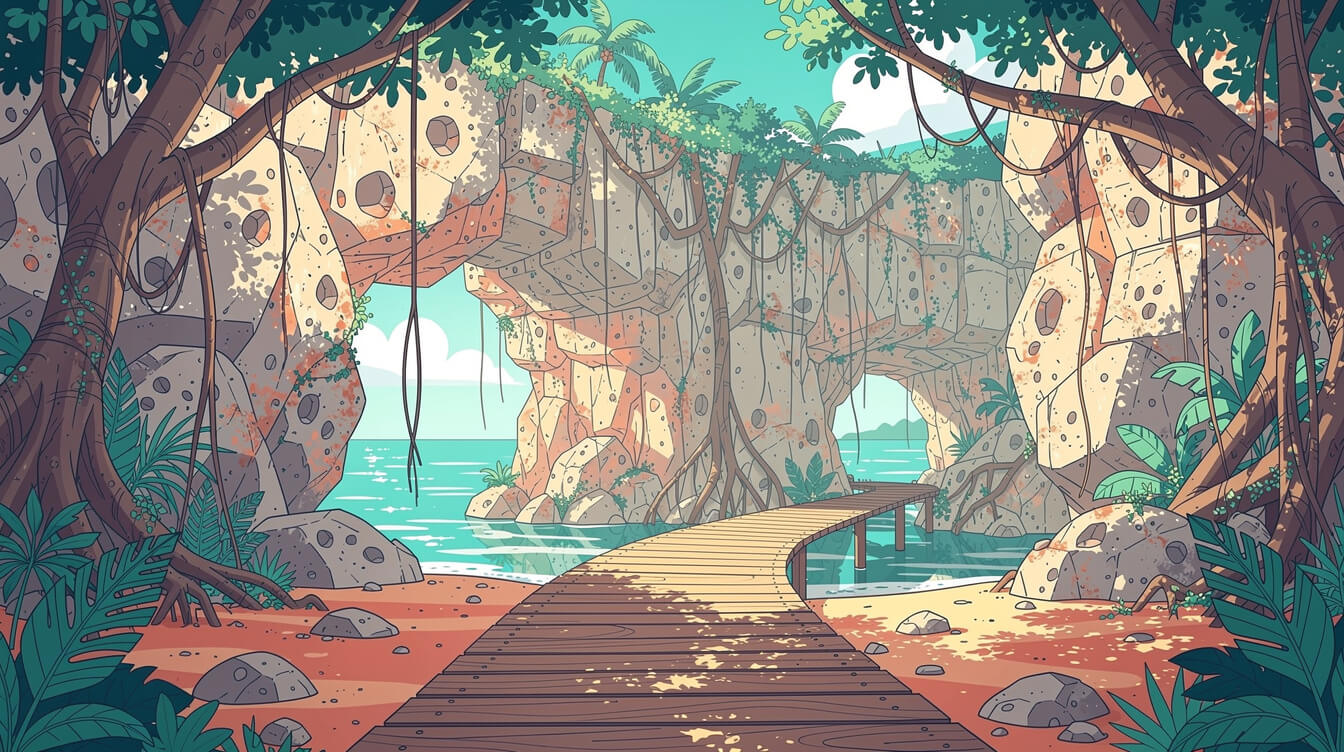
Once you’ve met the turtles, Xiaoliuqiu’s coral landscape is the next big draw. A loop of the island hits most of it in a day.
The three-cave combo ticket
Three of the island’s main sights share a single ticket: Beauty Cave (美人洞), Wild Boar Trench (山豬溝) and Black Devil Cave (烏鬼洞). A full ticket costs NT$120 and a half-price ticket costs NT$80. Students, seniors 65+ and children qualify for half price, and kids under 6 enter free. Opening hours are 07:00–17:30 in summer and 07:30–17:00 in winter. Keep your ticket, because you’ll show it at each site.
- Beauty Cave: a coastal boardwalk through raised coral rock, with sea views and tide pools. It’s the most scenic of the three.
- Wild Boar Trench: a shady walk through a narrow coral gorge, with banyan roots draped over the walls. It feels a little like a jungle movie set.
- Black Devil Cave: a series of low, twisting coral caves. It’s the most atmospheric of the three, and it’s linked to the island’s 1636 history (see above). Watch your head.
Free sights worth stopping for
- Vase Rock (花瓶岩): the island’s icon. It’s a coral pillar about 9 meters tall, eroded narrow at the base and topped with greenery. Come at high tide for turtles and at low tide for the rock pools.
- Shanfu Ecological Corridor (杉福生態廊道): a short walk through coral forest that runs down to the shore.
- Guanyin Rock (觀音石) and the western tip: rock formations and pavilions with wide sunset views.
- Biyun Temple (碧雲寺): one of the island’s best-known temples, on a hill above the village.
- Liuqiu Lighthouse: a white lighthouse on the island’s high ground, a quick stop on a scooter loop.

Sunsets
Xiaoliuqiu faces the Taiwan Strait to the west, so sunsets are a nightly event. The west side of the island, around Sunset Pavilion and the coast near Shanfu, has the clearest view. In winter the sun sets early, between about 17:10 and 17:40 depending on the month. That’s right when the last ferries leave, so day-trippers usually have to choose between sunset and the boat. That’s one more reason to stay overnight.
On the water
Besides snorkeling, Xiaoliuqiu is a big freediving and scuba hub. The water gets deep close to shore and turtles show up on almost every dive. You can also try SUP, kayaking or a glass-bottom boat. Book with an operator who checks the sea conditions on the day, because wind direction decides which side of the island is calm.
The Intertidal Zones: Guided Only, and Closed From December 1

At low tide, Xiaoliuqiu’s reef flats drain into a maze of tide pools. You’ll find sea cucumbers, crabs, snails, starfish and small reef fish. Walking them used to be a free-for-all. It isn’t anymore, because trampling was damaging the reef.
Here’s how it works now:
- Four regulated zones: Shanfu (杉福), Yuchengwei (漁埕尾), Duzaiping (肚仔坪) and Hanbanwan (蛤板灣). Since July 2025, all four charge a NT$60 entry fee per person. The core area at Lobster Cave (龍蝦洞) is off-limits.
- Guides are mandatory. You can only enter with a licensed guide, and each zone allows a maximum of 300 people at a time.
- Timing follows the tide. Sessions run within about four hours either side of low tide, as published by Taiwan’s Central Weather Administration. Your guesthouse or guide will know the day’s slots.
- The seasonal closure: every year from December 1 to March 31, the intertidal zones close to everyone so the reef can recover.
If you’re reading this in November and want to walk the reef, go in the next two weeks. After that, the zones won’t reopen until April 1. Wear water shoes, don’t flip rocks, and don’t take anything home, not even a shell.

Still Thinking About Those Turtles?
Xiaoliuqiu, Kenting, Donggang tuna and the best mango shaved ice in the south all live in one county. Our I Love Pingtung tee (屏東) is for everyone who came home from the far south with salt in their hair.
What to Eat on Xiaoliuqiu (and in Donggang)
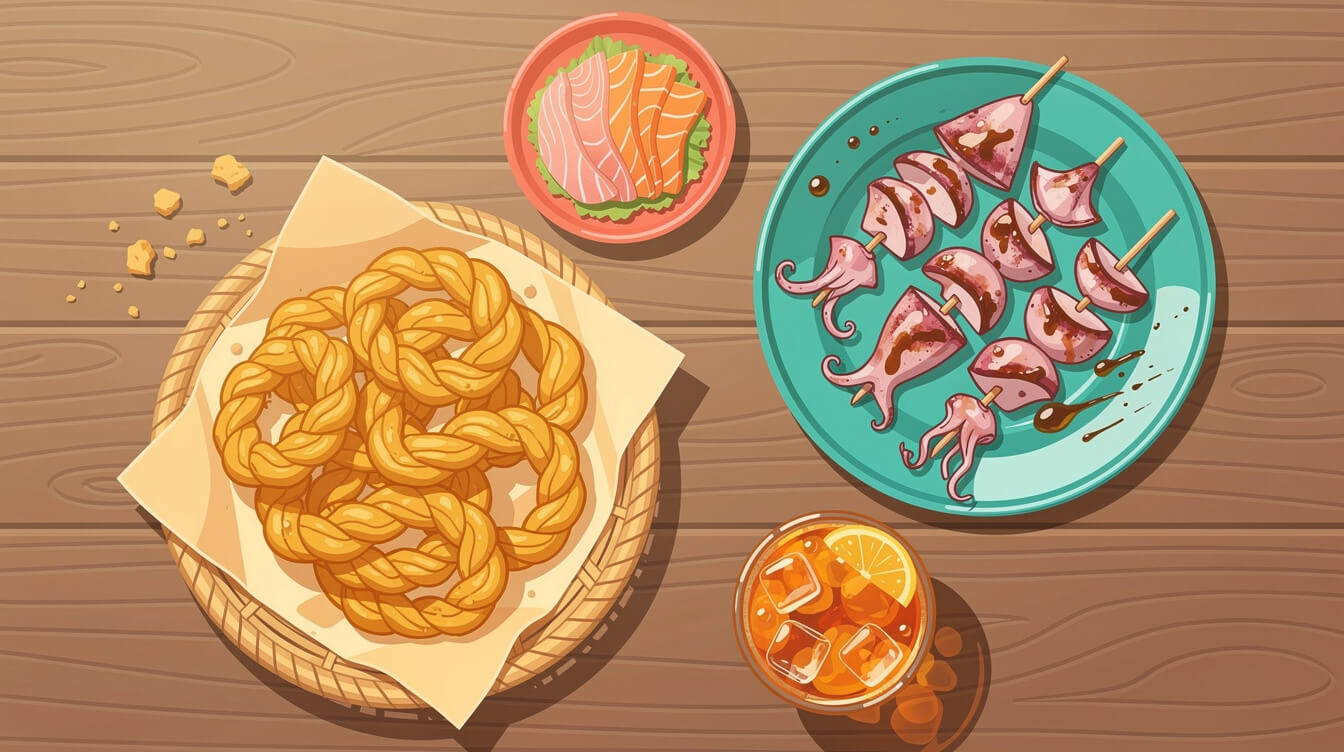
Xiaoliuqiu is a fishing island first and a tourist island second, so the food leans toward the sea and toward snacks you can carry back on the ferry.
- Hemp flower rolls (麻花捲, máhuā juǎn): the island’s signature souvenir. They’re crunchy twisted fried-dough sticks in flavors from classic brown sugar to seaweed and spicy. Shops around Baisha village let you taste before you buy. They’re the thing everyone on the return ferry is carrying.
- Seafood: grilled squid, fresh fish and seafood fried rice turn up at simple eateries all over Baisha and Dafu. Order by pointing at what looks fresh. Prices are usually listed by weight or by plate.
- Dried cuttlefish and fish snacks: another classic take-home.
- Shaved ice and drinks: it’s still southern Taiwan, so shaved ice and bubble tea shops are easy to find around the main village.
Save room for Donggang
Leave time on your way back. Donggang is one of Taiwan’s great fishing towns, and its “three treasures” (東港三寶) are bluefin tuna, sakura shrimp and oilfish roe. The Huaqiao Fish Market (華僑市場), a short walk from the ferry terminal, is the place for a sashimi lunch. Bluefin tuna is a spring specialty here, but the market is worth a stop any time of year. Donggang is also home to one of southern Taiwan’s most famous temple festivals, which we explain in our guide to Taiwan’s temples and religion.
When to Visit Xiaoliuqiu: Summer Crowds vs. Quiet Winter
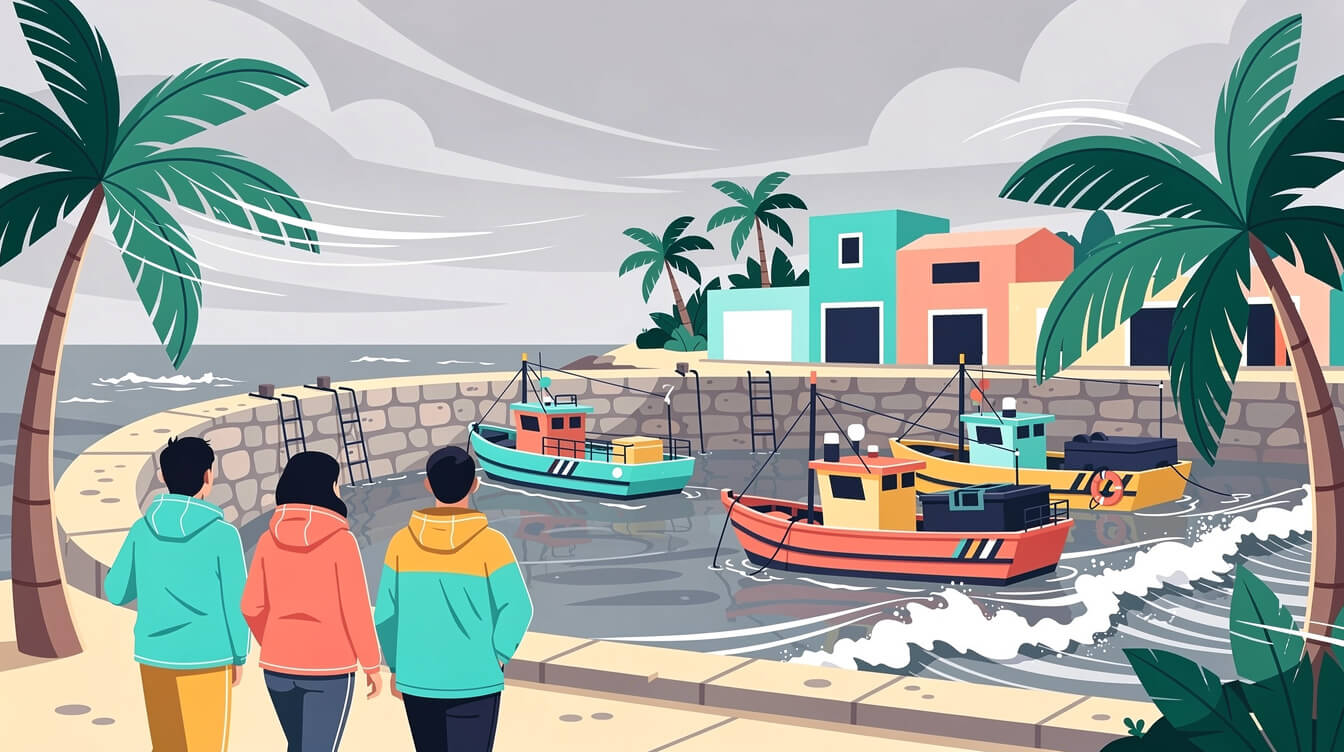
There’s no bad season for turtles on Xiaoliuqiu. They’re there all year. But the island feels very different depending on when you visit.
Summer (May–September)
This is peak season: warm water, long days and the busiest ferries. Weekends and school holidays bring a lot of day-trippers, so book rooms ahead. Summer is also the wet season in southern Taiwan. Kaohsiung, the nearest official climate station, averages 377–512 mm of rain a month at the height of summer, and typhoons can cancel ferries for a day or two at short notice. Turtle nesting also happens in this season.
Winter (November–March)
Winter is the secret season. The far south is the driest part of Taiwan in winter: Kaohsiung averages under 35 mm of rain a month from November to March, with only about three rainy days a month. Average air temperatures are around 24.5°C in November and 20–21°C in January and February. The Ocean Conservation Administration measured an average sea temperature of about 25°C around the island in November 2025, so a thin wetsuit or long-sleeve rash guard is plenty for snorkeling. On the mainland, the northeast monsoon makes the north coast cold and gray. Xiaoliuqiu sits in its shelter on the southwest side.
The trade-offs: the intertidal zones close December 1, the last ferries leave around 17:15, and wind can still make one side of the island choppy. Typhoons can occasionally hit even in November (Typhoon Fung-wong stopped all sailings on November 11–12, 2025). Check the ferry companies’ pages the morning you travel. If the north is gray and cold, though, this is one of the best places in Taiwan to get some sun. Planning a winter trip? Our Taiwan in December guide has the whole-island picture.
The Wang Ye festival (every three years)
Every three years, Xiaoliuqiu holds its own Welcoming the Royal Lords ceremony (迎王平安祭典). It’s a week of processions, temple rituals and a royal boat sent off to carry away misfortune, with roots in the same Wang Ye tradition as Donggang’s famous boat burning. The last one ran from September 3 to 9, 2024. That was unusually early, since it’s usually held in late autumn. The next one is due in 2027. The temple sets the dates, so check closer to the time.
Xiaoliuqiu FAQ
Is Xiaoliuqiu worth visiting?
Yes, especially if seeing a wild sea turtle up close is on your list. Xiaoliuqiu is one of the most reliable places in the world for it, and you can get there from Kaohsiung in about two hours. If you mostly want empty beaches, Penghu or Green Island may suit you better.
Can you do Xiaoliuqiu as a day trip?
Yes. Take an early 9127D bus from Zuoying and a morning ferry, and you’ll get five or six hours on the island. In winter, though, the last boats back leave around 17:15–17:20, before sunset, so staying one night is much more relaxed.
How much is the ferry to Xiaoliuqiu?
Private ferries from Donggang to Baisha cost NT$250 one way or NT$450 round trip for adults. The cheaper public boat (NT$200/NT$380) is out of service after running aground in October 2026, with partial cover from Yanpu Harbor until the end of the year.
Do I need a license to rent a scooter on Xiaoliuqiu?
For a regular gas scooter, yes. You need a valid motorcycle license, which for most foreign visitors means an International Driving Permit endorsed for motorcycles. Micro electric scooters need no license. Riders must be 14 or older, and the scooter must be plated and insured. You can also use the 601 island bus with a NT$100 day pass.
How close can you get to the sea turtles?
Official guidance ranges from 1.5 meters (Ocean Conservation Administration) to 5 meters (Dapeng Bay National Scenic Area). Stay at least 5 meters back. Touching or harassing a turtle can bring a fine of up to NT$300,000.
Can I visit the intertidal zones in winter?
No. The four regulated intertidal zones close to everyone from December 1 to March 31 every year. The rest of the year you need a licensed guide, a NT$60 entry fee and a slot within the tide window.
Is there an entry fee for Xiaoliuqiu itself?
No. There’s no island-wide visitor fee in 2026. You pay for the ferry, the three-cave combo ticket (NT$120) if you want it, and the NT$60 intertidal fee.
Final Thoughts: Slow Down, Stay the Night
Xiaoliuqiu is at its best when you stop treating it like a checklist. Rent a scooter or grab a bus pass, find a seawall at high tide, and wait. A turtle will come up to breathe within a few minutes. Stay for the sunset you’d miss on a day trip, eat seafood with your feet still sandy, and buy more hemp flower rolls than you think you need.
Just give the turtles their five meters. They were here first. If you’re building a bigger trip around the south, see our Taiwan beach guide and our Taiwan travel itinerary guide. Our Green Island guide covers Taiwan’s other great snorkeling island.
A Postcard From Taiwan, Every Week
Island trips, street food, temple traditions and the little Taiwan details worth knowing, sent straight to your inbox. No spam, and you can unsubscribe anytime.

Grab a Free Taiwan Sticker!
Drop your email and we’ll send you a limited-edition Taiwan sticker — plus insider access to new merch drops and island vibes.
No spam. Unsubscribe anytime.