Kinmen’s Wind Lions Point Northeast — and Nobody Can Agree How Many There Are
Kinmen has almost no forest and a great deal of wind. The islanders’ answer, a few centuries ago, was to carve lions.
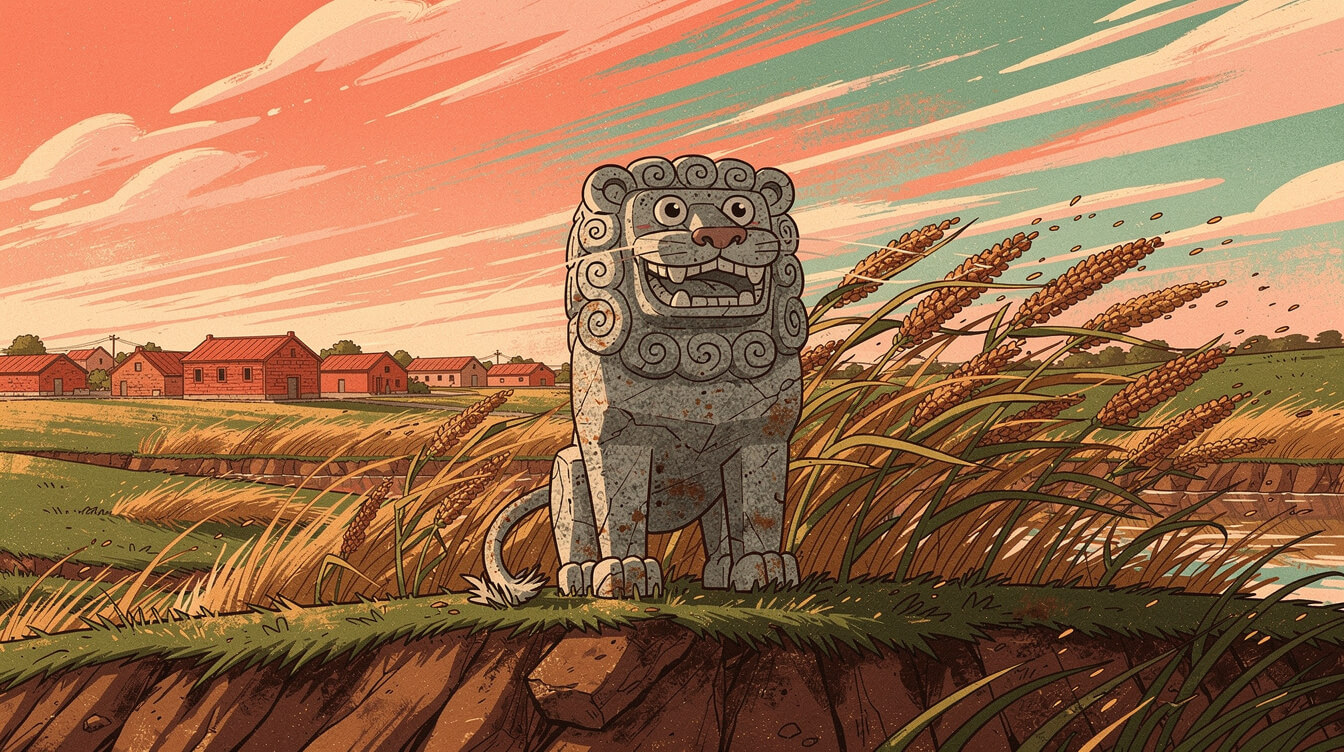
Dotted around the island are squat, grinning, hand-chiselled stone guardians called 風獅爺 — fēng shī yé, the wind lion lords. Locals often shorten it to 石獅爺, stone lion lords. They stand at the edge of a village, square up to the horizon, and glare. And as of this month they are back on the busiest shift of their year.
The wind they were carved for arrives in October
Kinmen sits out in the Taiwan Strait with no mountains to hide behind, and the numbers are blunt. The Kinmen Daily, the county government’s own paper, puts the northeast wind there at up to nine months of the year — and from October through to the following March the average wind speed runs over four metres per second. Not the gusts. The average.
So while the rest of Taiwan is still debating whether summer has actually ended, Kinmen’s wind season has already clocked in. If you want the island-by-island, month-by-month version of that, we mapped it in our region-by-region climate guide.
Here’s the part most visitors never hear: the wind problem was man-made
Kinmen was not always bare. The Ministry of the Interior’s heritage records set out three waves of deforestation: heavy logging going back to the Yuan dynasty to fuel salt production, then 鄭成功 — Koxinga — felling the island’s timber for warships in the mid-1600s, and after 1663 a clearance that took what was left and abandoned the ground.
By 1683, 康熙22年, the ministry’s own wording is 「當時林木幾已全無、風害嚴重」: the trees were essentially all gone and the wind damage was severe. Once life on the island steadied again, villagers started putting up wind lions to pin the wind down.
Which makes Kinmen’s most beloved folk guardian something slightly unexpected — a monument to an environmental problem people created for themselves, and then had to pray their way out of.
A wind lion is also a compass
They are not placed casually. Village wind lions go up at the north or northeast corner of the settlement, positioned 「與金門最盛行且最強的東北風相對峙」 — standing off against Kinmen’s most prevailing and strongest northeast wind. Others ride the roof ridge, sit on top of a wall, or are set flush into brickwork so you could walk past one without noticing.
Find a wind lion and you have found where the weather comes from. Stand behind it and you are standing where the village wanted to be: in the lee.
It is the same instinct that posts an earth god at the corner of a rice field — a small guardian stationed exactly where trouble enters. Taiwan is extremely good at this, which is part of why the island has more temples than convenience stores.
And nobody can agree how many there are
Here is the genuinely fun bit. The Kinmen county government counts 68 surviving wind lions — 41 in Jinsha, 13 in Jinhu, 8 in Jinning, 6 in Jincheng. The Ministry of the Interior’s national religious-culture map says the figure has 「超過百座」, passed a hundred.
Both are government sources. Both are published. They differ by more than thirty statues, because “wind lion” turns out to be a fuzzy category: do the roof-ridge ones count? The ones mortared into a wall? The modern ones carved for visitors to photograph? Nobody has settled it, and after three hundred years nobody seems especially bothered.
The size range is just as wide. The tallest, at 安岐 (Anqi), stands about 3.78 metres — taller than the wall it is guarding. The smallest on the ministry’s list is a wall-set lion at 瓊林 (Qionglin) measuring 28 by 21 centimetres. Same job description, roughly one-thirteenth the height.
Today’s takeaway
Kinmen’s wind lions are not souvenirs with a backstory bolted on. They are working infrastructure, pointed northeast, built because the trees were gone — and from October to March they are doing exactly the job they were carved for. Taiwan does this with wind more than you would expect: Hsinchu dries its persimmons in a seasonal gale that has had its own name since 1694.
The rest of Kinmen’s story — the cannon shells beaten into kitchen knives, the sorghum liquor, the tunnels — is in our full Kinmen island guide. And if the idea of a local deity doing practical, slightly funny protective work appeals more than a trip to the Strait in a 4 m/s headwind, our Mazu’s Scooter Blessings hoodie is cut from the same cloth — and it is hoodie weather on Kinmen from today until March.

Grab a Free Taiwan Sticker!
Drop your email and we’ll send you a limited-edition Taiwan sticker — plus insider access to new merch drops and island vibes.
No spam. Unsubscribe anytime.