Kaohsiung, Taiwan: The Complete 2026 Guide to Taiwan’s Southern Capital (Districts, Food, Day Trips)
Everyone who talks about Taiwan starts with Taipei. Then they mention Taichung, maybe Tainan, and if they’re feeling generous they’ll throw in Hualien. Kaohsiung, Taiwan — the country’s second-largest city, biggest port, and southern capital — usually gets a shrug and a “yeah, we should go there sometime.” That is the entire premise of this guide: sometime is now.
Kaohsiung punches like a first city. It has an MRT that costs almost nothing, a harbor bigger than the entire Port of Los Angeles, an art center the size of six football fields, and weather that stays wearable-tee warm from November through April while the north is stuck under grey drizzle. This is the neighborhood-by-neighborhood, day-trip-by-day-trip, HSR-in-and-out guide to Taiwan’s southern capital — the one that treats Kaohsiung as a legitimate destination, not Taipei’s shadow.
Why Kaohsiung: The Case for Taiwan’s Southern Capital
The short answer for why you should put Kaohsiung on your Taiwan itinerary: it is warm, cheap, uncrowded, and full of exactly the kinds of things people fly to Taiwan for in the first place. The longer answer starts at the harbor.
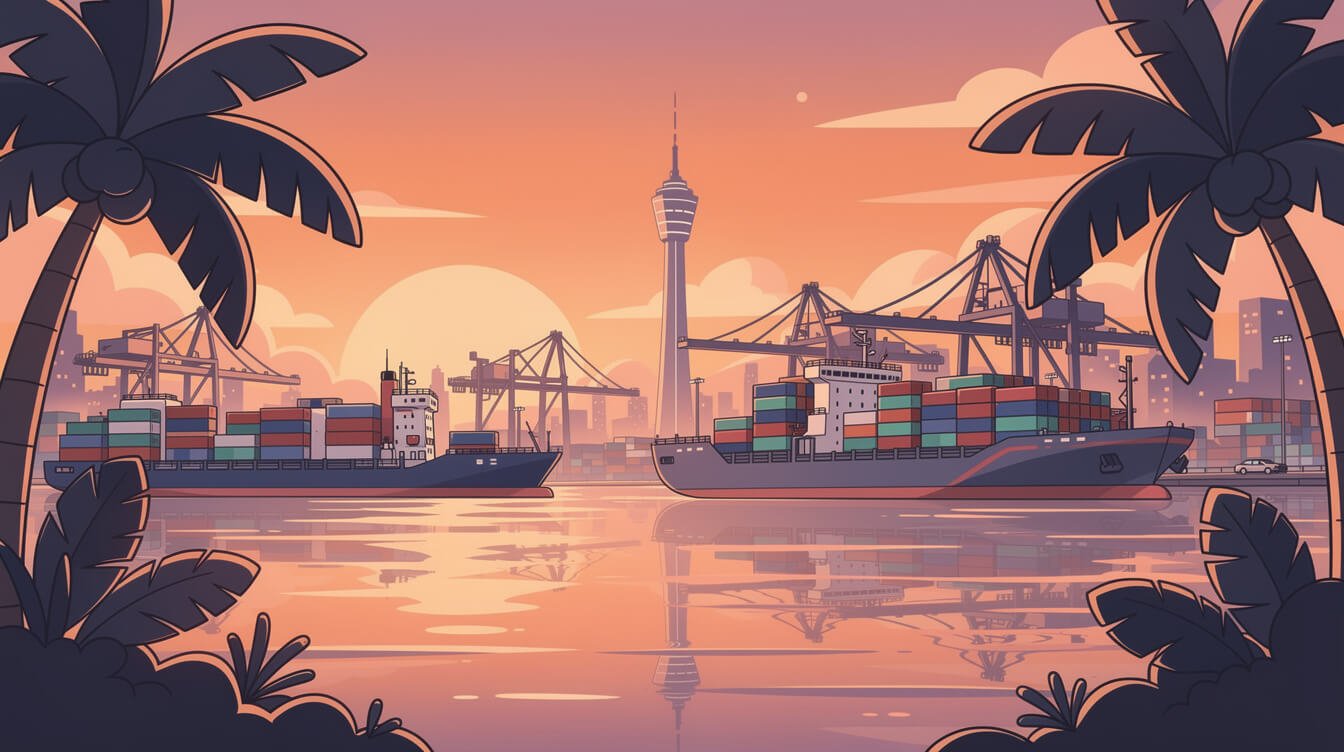
Kaohsiung Port (高雄港) handles more than ten million shipping containers a year and has been the reason the city exists since the Dutch built a trading post here in the 1600s. That heritage shows up everywhere — in the seafood, in the warehouse-turned-gallery districts, in the way Yancheng’s old streets still smell faintly of salt and diesel. A city built by cargo and fish tastes different from a city built by government ministries. Kaohsiung tastes different.
Three practical reasons this trip works:
- The weather. Kaohsiung sits at 22.6° N — closer to Manila than Tokyo. From November through April, daytime highs sit at a T-shirt-friendly 24–28°C while Taipei is under 15°C rain. Summer (June–September) is stinking hot and humid, so plan accordingly, but shoulder season here is the best weather any Taiwan city offers.
- The prices. A bowl of Kaohsiung beef noodle soup runs NT$120–150. A night at a decent boutique hotel in Yancheng is NT$1,800–2,500. A full ride across the city on the KMRT is NT$45. Compared to Taipei’s Da’an or Xinyi districts, you’re spending roughly 20–30% less on the same quality.
- The crowds. There aren’t any. Elephant Mountain in Taipei has a queue. Cijin’s black-sand beach on a Wednesday afternoon has three people and a lifeguard. Even Liuhe Night Market — Kaohsiung’s most famous — feels calm next to Shilin.
Kaohsiung also happens to be the gateway to Kenting (Taiwan’s beach south), Foguang Shan (the largest Buddhist monastery in Taiwan), and Meinong (Hakka countryside). If your Taiwan trip is longer than seven days, basing the second half in Kaohsiung instead of shuttling back to Taipei saves you three train rides and unlocks half the island.
Kaohsiung vs Taipei: What the South Does Differently
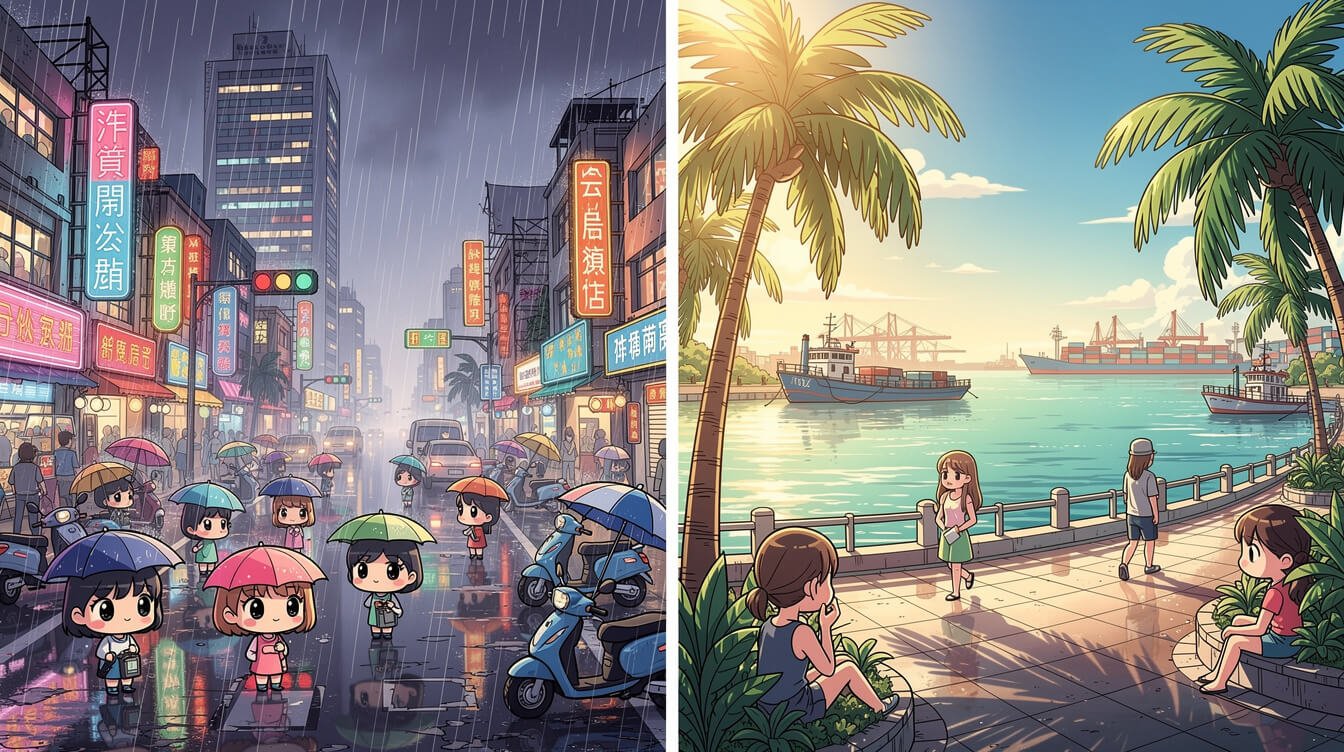
Locals will tell you Taiwan has two personalities, and the border between them is somewhere around Miaoli. Above it: the north — polite, hurried, drizzly, expensive. Below: the south — louder, slower, sunnier, cheaper. Kaohsiung is the south’s capital and it wears the identity proudly.
A few of the differences that matter for a traveler:
Pace and volume
Taipei’s default MRT etiquette is silence. Kaohsiung’s default is a running conversation, usually in Taiwanese Hokkien rather than Mandarin. Vendors call across the aisles at Liuhe Night Market. Grandmas offer you seats they haven’t been asked to give up. The whole city runs one register warmer.
Food emphasis
Taipei’s food scene is famous for beef noodle soup, xiao long bao, and bubble tea (invented in Taichung but perfected in the capital’s chains). Kaohsiung’s is famous for milkfish porridge, danzi noodles, papaya milk, and everything the harbor pulls up — squid, oysters, clams, shrimp. Southerners eat more seafood, more sugar in savory dishes, and treat mango shaved ice like a religion. If you’re eating your way through Taiwan, expect our Taiwan traditional food guide to skew north; Kaohsiung deserves its own bibliography.
Money
Rough rule of thumb: everything except imported wine costs 20–30% less in Kaohsiung than in Taipei. The gap is biggest on housing (a NT$40k Xinyi studio is a NT$22k Yancheng studio) and smallest on branded coffee (Starbucks is Starbucks). Restaurants, taxis, night market food, boutique clothes — all noticeably cheaper.
Climate
Taipei averages 172 rainy days a year. Kaohsiung averages 91. If you visit November through April, this is the biggest single difference in your trip — you will spend more time outside than you would in the north, and you will not need an umbrella.
The 6 Districts You Actually Need to Know
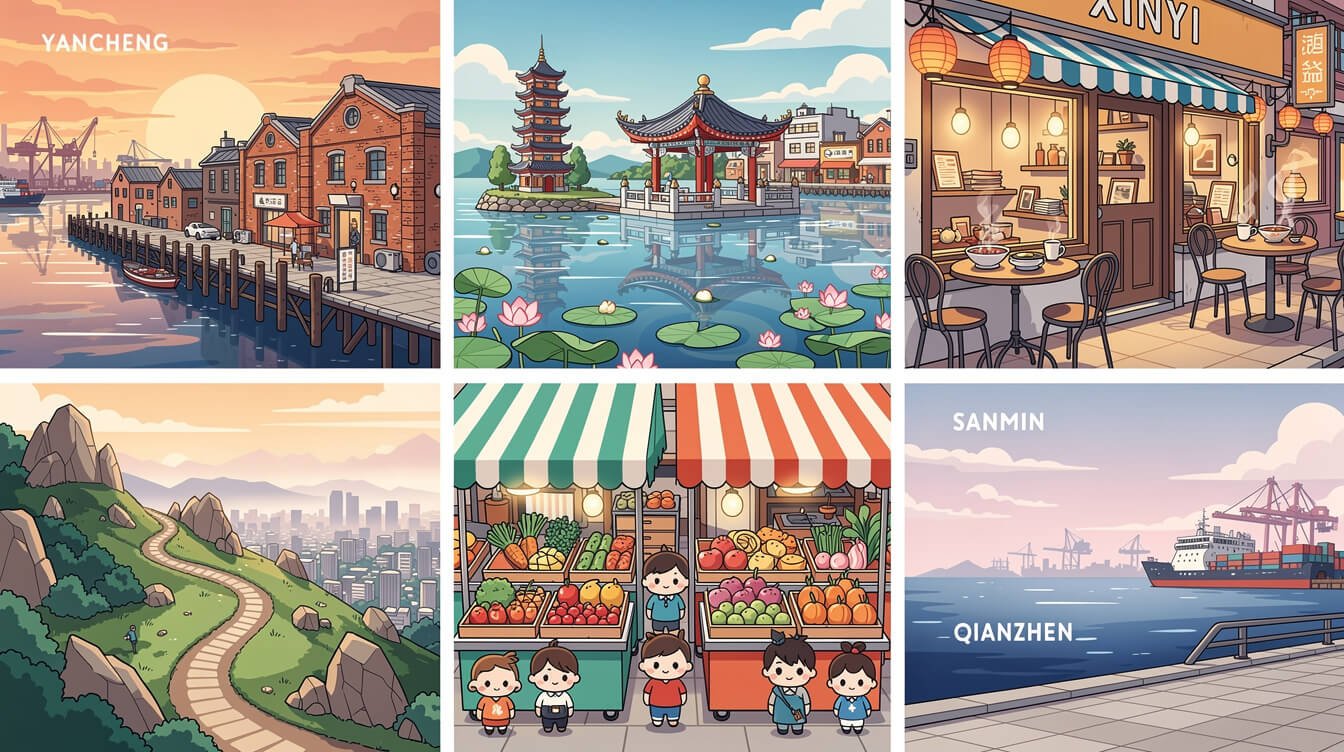
Kaohsiung is technically split into 38 administrative districts, which is unhelpful. Ignore 32 of them. Here are the six that matter for a first-time visit.
Yancheng (鹽埕區) — Old Harbor
The oldest port district, wrapped around the mouth of the Love River. This is where Pier-2 Art Center, the ferry terminal to Cijin, and the best boutique hotels live. Yancheng feels like a scaled-down Osaka: former warehouses turned into galleries, cafés wedged into 1950s apartment blocks, and small izakayas that stay open till 2 AM. Base yourself here if you want to walk out the door and be somewhere interesting.
Zuoying (左營區) — Transit and Temples
Home to Zuoying Station, where the HSR from Taipei drops you 94 minutes after boarding at Taipei Main. Also home to Lotus Lake (蓮池潭), the Dragon and Tiger Pagodas, and Kaohsiung’s most Instagrammable temple sequence. Stay here if you’re doing day trips and want the shortest walk to the train.
Sanmin (三民區) — Local Kaohsiung
North of the harbor. This is where regular Kaohsiung people live and eat. Ruifeng Night Market — the local favorite over the more touristy Liuhe — is here. So is Kaohsiung Arena and the underrated Kaohsiung Museum of History. Not many tourists sleep in Sanmin; you should eat here.
Qianzhen (前鎮區) — Modern Waterfront
The newer district, built on reclaimed land south of the port. Dream Mall (once the largest shopping mall in Asia), Kaohsiung Software Technology Park, and the newer high-rise condos. Come here for the Kaohsiung Music Center and the Kaohsiung Exhibition Center. Skip for lodging unless you have a conference.
Xinxing (新興區) — Nightlife and Food Streets
The commercial center, wrapped around the Formosa Boulevard MRT station (where the Dome of Light lives). Liuhe Night Market is here. So are most of the city’s late-night bars, the biggest concentration of beef noodle soup shops, and the Sanmin Street clothing bazaar. Loud, cheap, fun.
Gushan (鼓山區) — Mountain and Beach
The western hills. Home to Monkey Mountain (Chai Shan / Shoushan), a genuine hiking day out with wild macaques and a sunset lookout over the harbor. Also the launch point for Cijin Island ferries. Gushan gives you the closest thing Kaohsiung has to “get out of the city” without leaving the city.
Kaohsiung Food: What Not to Miss
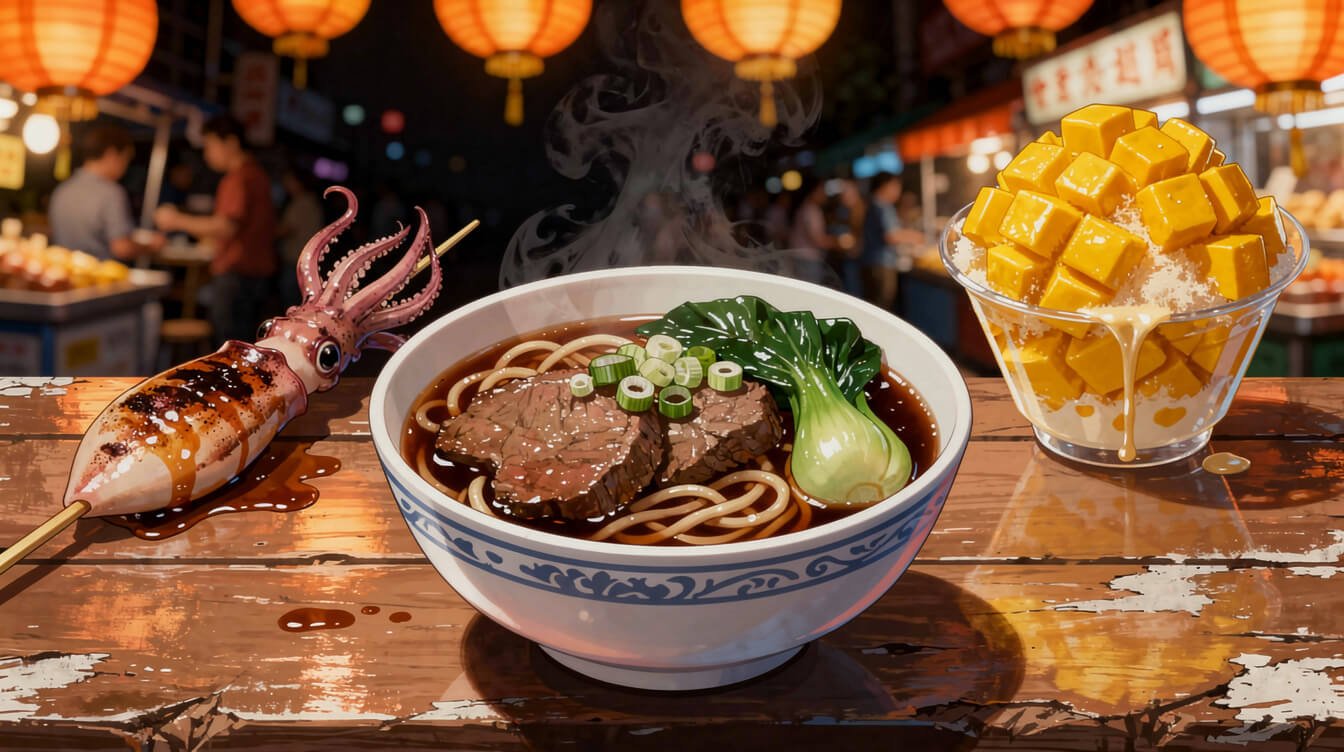
You could eat every meal in Kaohsiung for a week and never repeat a dish. Here is the minimum viable list.
Milkfish porridge (虱目魚粥)
The regional breakfast, served at every dawn stall in Yancheng. Milkfish is farmed in ponds south of the city and its belly is the sweetest, fattiest cut in the fish. A bowl runs NT$60–90 and is genuinely one of the best breakfasts in Asia. Try Ah Ang’s Milkfish (阿昂鮮魚湯) near Yancheng MRT — no English sign, blue plastic stools, opens at 5:30 AM.
Kaohsiung-style beef noodle soup (紅燒牛肉麵)
Southern beef noodle soup runs sweeter and richer than the northern chili-tomato style. Broth simmered with rock sugar, soy, and a heavy hand of star anise. The most famous spot is Kang Le (港嘟牛肉麵大王) near Formosa Boulevard MRT.
Danzi noodles (擔仔麵)
Technically a Tainan invention, but Kaohsiung serves it well too. A tiny bowl of wheat noodles topped with minced pork, shrimp, garlic broth, and a sliced hard-boiled egg. Costs about NT$50 and functions as either an appetizer or a snack.
Papaya milk (木瓜牛奶)
Blended fresh papaya and whole milk over ice. Sounds boring; is genuinely one of the great drinks of humanity. Sold everywhere. The temple of it is Kaohsiung Wanluan (高雄萬巒木瓜牛奶) at the corner of Liuhe Night Market — NT$80 for a huge cup.
Ruifeng Night Market (瑞豐夜市)
The night market locals actually go to. Bigger than Liuhe, less English signage, cheaper, and open only Tuesday, Thursday, Friday, Saturday, and Sunday. Open 6 PM to midnight. Priority stops: grilled squid on a stick, oyster omelet (蚵仔煎), stinky tofu, mango shaved ice. Take the Red Line MRT to Kaohsiung Arena Station and follow the crowd.
Liuhe Night Market (六合夜市)
The tourist night market, packed onto a single street next to Formosa Boulevard MRT. Open nightly. Better for visitors who want everything walkable and English menus, worse for prices and authenticity than Ruifeng. Do at least one dinner here for the atmosphere.
Sanwei Street (三多路)
Not a market — a strip of restaurants that gets loud after 10 PM. This is where locals eat when they don’t want a night market. Beer, oysters, salted crispy chicken, and rice wine at plastic tables under fluorescent lights.
Pier-2 Art Center, Dome of Light, Love River: The Artistic Kaohsiung
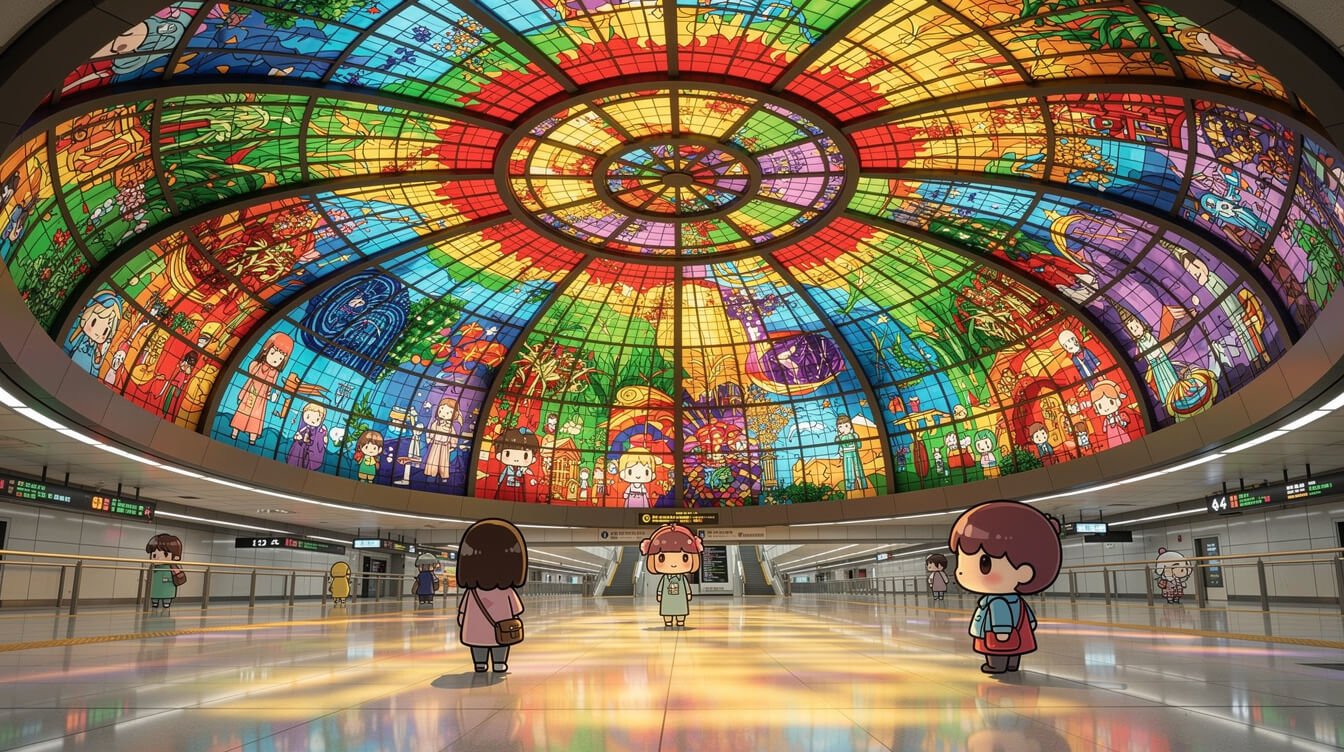
The lazy version of this guide would send you to Taipei 101 and stop. Kaohsiung’s actual gift is contemporary art at a scale nobody expected from a port city. If you’re the kind of traveler who plans days around galleries, save a full day for the Yancheng-to-Weiwuying art corridor.
Pier-2 Art Center (駁二藝術特區)
Twenty-five converted dockside warehouses along the Love River, spread over four zones. Free entry; individual exhibitions charge NT$100–250. Home to permanent street-art installations, rotating shows, indie cinemas, and about forty small design studios. Come on a Saturday afternoon, stay for the sunset, walk to Yancheng for dinner. A morning here is the single most Kaohsiung-ish thing you can do in Kaohsiung.
Dome of Light (光之穹頂)
The stained-glass ceiling of Formosa Boulevard MRT station is the largest single-piece glass artwork in the world — 4,500 panels, 30 meters across. Designed by Italian artist Narcissus Quagliata over four years. Free to see; you just tap through the MRT gates. Best photography light is 11 AM to 1 PM when the overhead sun powers the glass. Free “light shows” (lights dance to music) run at 11 AM, 3 PM, and 7 PM daily.
Love River (愛河)
The 12-km river that winds through central Kaohsiung was heavily polluted through the 1990s and has been steadily cleaned up. Today it’s Kaohsiung’s postcard: illuminated bridges after dark, riverside cafés, and a NT$120 tourist gondola ride that runs 30 minutes down and back. Not as electric as Seoul’s Han River or Tokyo’s Sumida, but genuinely pleasant, and the walk from Pier-2 to the Confucius Temple takes about 40 minutes with photo stops.
Weiwuying / National Kaohsiung Center for the Arts (衛武營國家藝術文化中心)
Opened in 2018, this is the world’s largest performing arts center under a single roof — 141,000 square meters of curved white shell built over a former military base. It houses a 2,236-seat opera house, a concert hall, a playhouse, a recital hall, and a huge outdoor amphitheater. Even if you don’t see a show, come for the architecture (free to walk through until 10 PM) and the surrounding Weiwuying Metropolitan Park.
If you love the harbor city so much you want to take a piece of it home, our Kaohsiung Harbor Aerial View Wall Art captures exactly the port-and-crane silhouette you’ll see on the ferry to Cijin — the one image that reads “Kaohsiung, Taiwan” more than any temple or MRT stop ever could.
Day Trips From Kaohsiung: Cijin, Foguang Shan, Kenting, Meinong
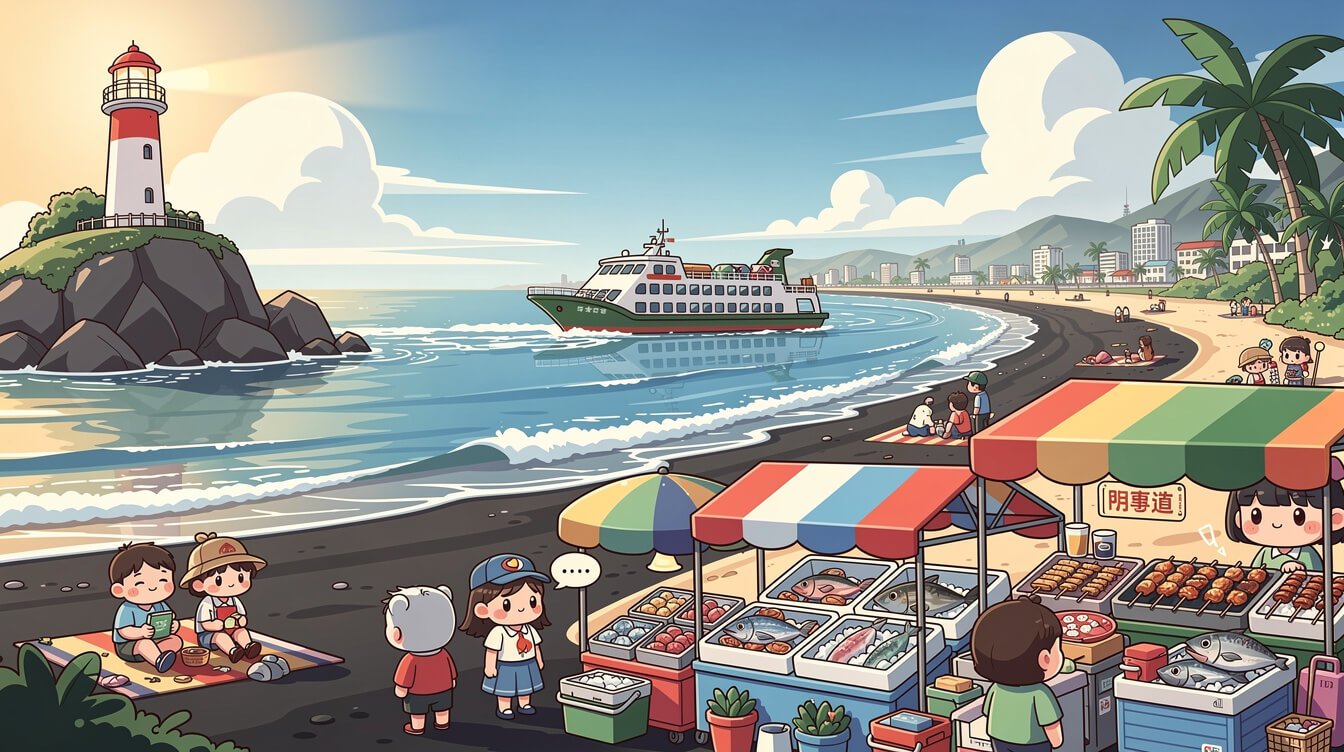
The best case for basing your southern-Taiwan itinerary in Kaohsiung isn’t the city itself — it’s how easy it is to leave and come back.
Cijin Island (旗津) — half day
A 10-minute NT$30 ferry from Gushan Ferry Pier drops you on Kaohsiung’s outlying island. Cijin has a black-sand beach, a Qing-dynasty lighthouse, a Star Tunnel through the mountain, and the country’s cheapest fresh-seafood strip — a whole grilled squid runs NT$120. Rent a bike (NT$100/hour) and lap the island in an hour. Full itinerary in our Cijin Island Taiwan guide.
Foguang Shan Buddha Museum (佛光山佛陀紀念館) — full day
The largest Buddhist monastery in Taiwan, 45 minutes east of Kaohsiung by bus. Home to the 108-meter Great Buddha statue (currently the second-tallest bronze Buddha in the world), a museum complex with eight pagodas, and a working monastery that serves free vegetarian meals to visitors. Free entry. Take Kaohsiung Bus E02 from Zuoying HSR Station; runs every 30 minutes.
Kenting National Park (墾丁國家公園) — full day or overnight
Taiwan’s beach south, 2 hours by bus from Kaohsiung. Warm water year-round, coral reef snorkeling, the actual southernmost point of Taiwan (Eluanbi Lighthouse), and Kenting Night Market. Doable as a long day trip; better as an overnight. Bus 9188 from Kaohsiung Main Station is the fastest.
Meinong Hakka Town (美濃) — half day
A traditional Hakka village 40 minutes east of Kaohsiung, famous for oil-paper umbrellas, tobacco farms turned into museums, and Hakka cuisine (heavier, saltier, cabbage-forward). Rent a scooter or an electric bike and lap the village in half a day. Almost no other tourists.
Sun Moon Lake — full day (long)
Doable as a very long day trip via HSR to Taichung then bus, but honestly stay a night — see our Taiwan travel itinerary guide for how to slot it between Kaohsiung and Taichung on a longer loop.
Getting to Kaohsiung: HSR, Airport, Bus — Plus the Local MRT
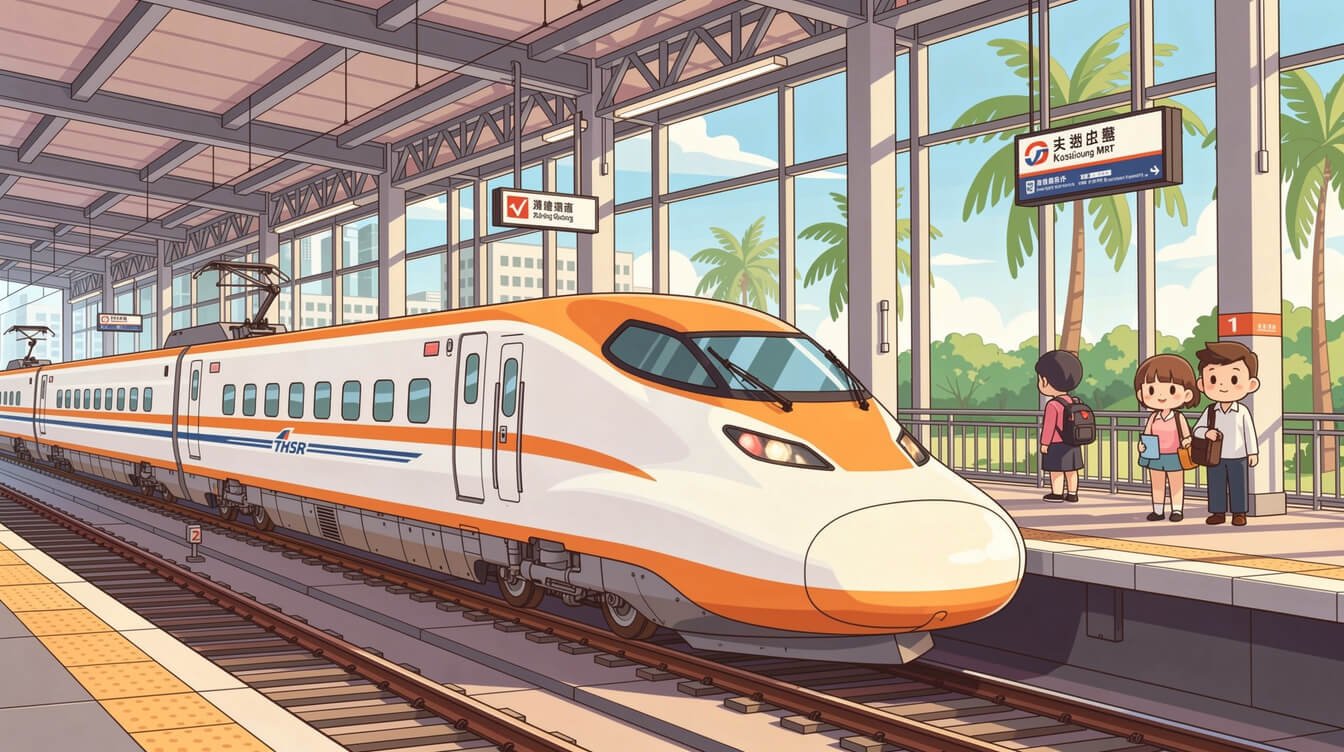
The four ways in, ranked by usefulness.
HSR from Taipei — 94 minutes, NT$1,490 standard
The Taiwan High Speed Rail is the single best way to get to Kaohsiung. Departures every 10–30 minutes from Taipei Main Station; Zuoying Station is the terminus. Business class (NT$1,970) has slightly bigger seats and free snacks; standard class is fine. Book a specific reserved seat if you’re traveling on weekends. Full breakdown of routes, fare classes, and booking tips in our Taipei to Kaohsiung HSR guide. See also our Taiwan High-Speed Rail map guide for the full network.
Kaohsiung International Airport (KHH) — direct flights from Hong Kong, Bangkok, Seoul, Manila
Kaohsiung has its own international airport 20 minutes south of the city center. Direct flights from most East and Southeast Asian hubs. If you’re arriving from HK or Bangkok, flying straight to Kaohsiung saves you the Taipei transit. The KMRT Red Line connects the airport to the city center in 25 minutes for NT$40.
TRA (regular train) — 4.5 hours, NT$843
The scenic old railway. Cheaper than the HSR, three times as slow, but hugs the west coast and gives you a running window view of rice paddies, temples, and small stations. Worth it once for the view; otherwise take HSR.
Highway bus — 5 hours, NT$550
Cheapest option. Fine if you want to sleep the whole ride and don’t mind arriving at 5 AM.
Kaohsiung MRT (KMRT) — Red and Orange Lines
Kaohsiung’s local metro has two lines that cross at Formosa Boulevard: Red Line runs north-south (airport to Zuoying), Orange Line runs east-west (Sizihwan to Weiwuying). Basically every place worth visiting is on one of these two lines, which is a huge quality-of-life difference from Taipei’s five-line labyrinth. Fares NT$20–65. A day pass is NT$180 and worth it. YouBike stations sit outside almost every MRT stop.
Where to Stay: Zuoying vs Yancheng vs Xinxing
Three neighborhood strategies depending on what you want out of the trip.
Zuoying — best for transit and day trips
Base here if you’re doing multiple HSR runs or Foguang Shan / Sun Moon Lake day trips. Zuoying HSR station is on the Red Line, so you also get direct MRT access into the city. Fewer bars and cafés within walking distance, but a much shorter train morning. Mid-range hotels here run NT$2,000–3,000 a night.
Yancheng — best for atmosphere
The old harbor district — walkable to Pier-2, the Love River, the Gushan ferry to Cijin, and about forty coffee shops. Boutique hotels in restored 1960s buildings run NT$1,800–2,800. This is where I’d stay if it were my first trip. See the Alfa Kaohsiung, Grand Hi-Lai (a step up), or the many small guesthouses on Xinle Street.
Xinxing — best for nightlife and food
Around Formosa Boulevard MRT — Liuhe Night Market at your doorstep, most beef noodle soup shops within a 10-minute walk, and cheap business hotels everywhere. NT$1,500–2,200 gets you a clean-and-boring room in a great location. Don’t expect quiet.
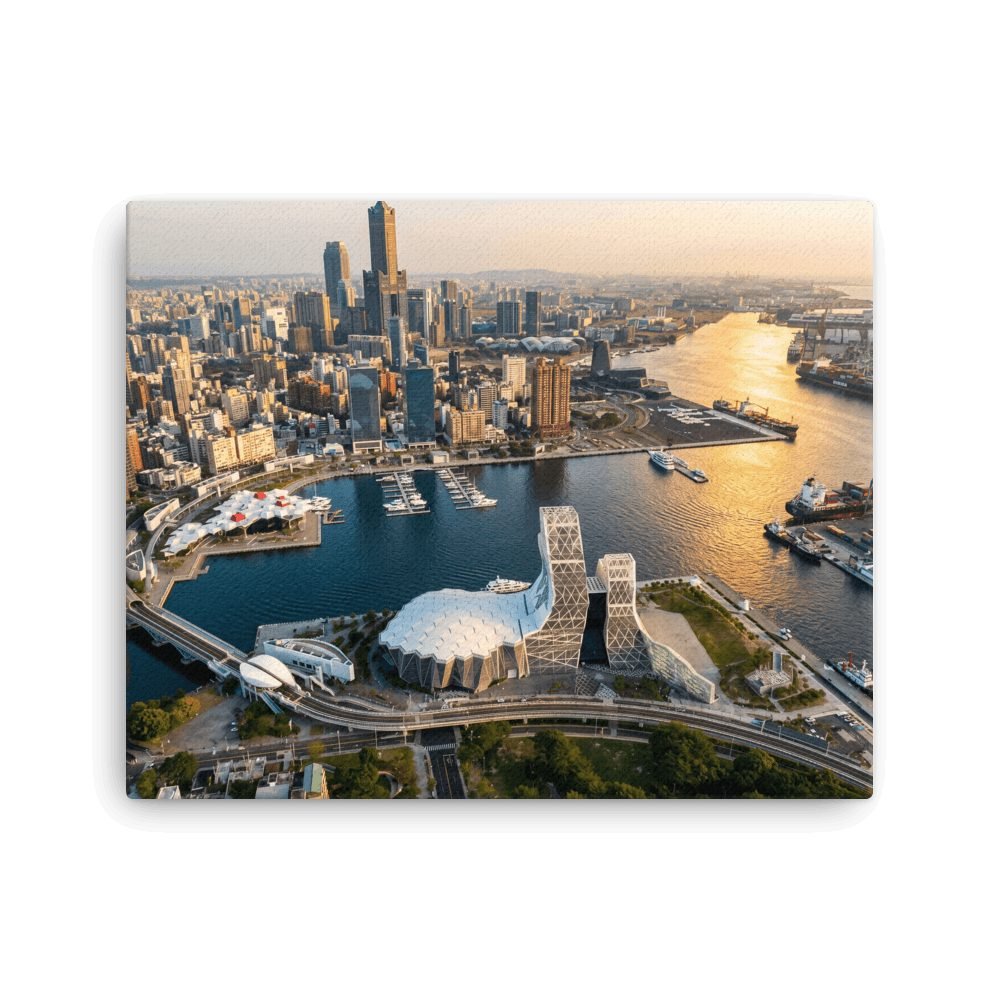
Take the Harbor Home
Our Kaohsiung Harbor Aerial View wall art captures Taiwan’s southern port skyline — cranes, cargo ships, 85 Sky Tower — in a single premium print you’ll actually want on your wall.
Kaohsiung FAQ: Everything Else
How many days do I need for Kaohsiung?
Two full days minimum if you want to see Pier-2, Cijin, one night market, and the Dome of Light. Three days if you want to add a Foguang Shan or Meinong day trip. Four to five days if you’re using Kaohsiung as a base for Kenting.
What’s the best time of year to visit Kaohsiung?
November through March. Dry, warm (22–28°C days), and mostly cloudless. April and October are also good but hotter. Summer (June–September) is 33°C+ and humid, with typhoon risk peaking August–September. See our best time to travel to Taiwan month-by-month guide for the full seasonal breakdown.
Is Kaohsiung safe?
Yes — same as everywhere in Taiwan, which is genuinely one of the safest countries in Asia for visitors. Solo travelers, women traveling alone, night market wandering after midnight — all fine.
Do people speak English in Kaohsiung?
Less than in Taipei. Younger service workers and hotel staff usually speak conversational English; older night-market vendors do not. Google Translate camera mode handles menus fine. Learn “xie xie” (thank you) and you’re set.
Cash or card?
Cash for night markets, small restaurants, and taxis. Card for hotels, chain restaurants, and modern shops. Get an EasyCard at the MRT — it works on buses, MRT, YouBike, most 7-Elevens, and Family Marts. Load NT$500 to start.
Can I use the same EasyCard I got in Taipei?
Yes. It’s the same national card. Works on the KMRT, KMRT buses, and Kaohsiung YouBikes without any additional registration.
Final Thoughts: Kaohsiung Is a First City in Disguise
Kaohsiung is what Taiwan looks like when you take away the political capital and let a port and a harbor do the talking. It is warmer, cheaper, louder, sunnier, and — in a lot of the small ways that make a trip work — easier than Taipei. If you’re planning your first Taiwan trip and mapping out how to split your days, don’t spend eight in the north and two in the south. Spend five and five. Rent a bike in Cijin. Eat breakfast under a plastic stool at Ah Ang’s. Watch the light show under the Dome. Take the HSR out and back.
Kaohsiung, Taiwan is not Taipei’s shadow. It’s the other half of the country most travelers never quite get to. Go see the other half.
More Taiwan, Straight to Your Inbox
Get our best Taiwan culture, food, and travel guides every week — plus early access to new drops from the Taiwan Merch shop.
Grab a Free Taiwan Sticker!
Drop your email and we’ll send you a limited-edition Taiwan sticker — plus insider access to new merch drops and island vibes.
No spam. Unsubscribe anytime.