Taiwan Danbing: The Chewy Egg Crepe That Quietly Conquered American Breakfast
Did you know? Every morning across Taiwan, somewhere between five and six million people start their day with a folded, palm-sized egg crepe called danbing (蛋餅). It is so woven into Taiwanese mornings that nobody thinks twice about it. Then in 2024, danbing quietly slipped into American food media — Trader Joe’s stocked a frozen version, Bon Appétit and NYT Cooking published recipes within months of each other, and Brooklyn brunch lines started forming around tiny breakfast shops selling it for ten dollars a fold. The chewy little crepe Taiwan invented in the 1950s had finally gone global.
And almost no one outside the island knew where it came from.
What danbing actually is (and isn’t)
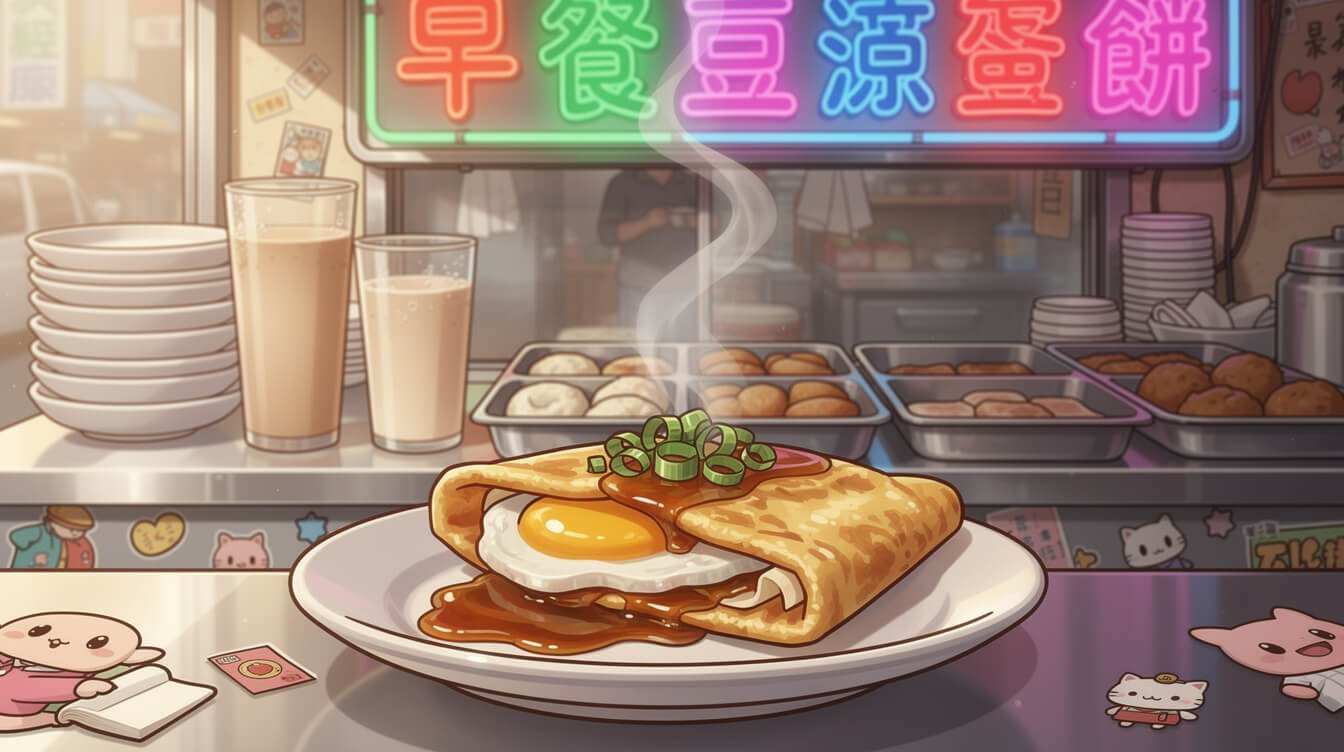
The literal translation of 蛋餅 is “egg pancake,” which is, frankly, terrible marketing. It’s not a pancake. It’s a thin, slightly chewy wheat-flour wrapper rolled around a freshly fried egg, finished with a glossy drizzle of sweet soy sauce (醬油膏) and a scatter of scallions. Picture a crepe with the bite of fresh udon and the umami of a Japanese tamago sando, then fold it in half twice and slice it into bite-sized rectangles.
What separates a Taiwanese danbing from a Chinese scallion pancake (蔥油餅) — its closest cousin — is texture. Mainland scallion pancakes are crispy and flaky. Taiwanese danbing skins are chewy on purpose, with a higher gluten content and a thinner roll. That chew is the whole point. Locals will travel across town for a 古早味 (gǔ-zǎo-wèi, “old-time flavor”) shop that still makes the batter-style danbing from scratch every morning with flour, water, and chopped scallions, instead of the machine-rolled wrappers most modern shops use.
A 1950s reinvention nobody planned
Danbing didn’t exist in this form anywhere before Taiwan invented it. The story starts in the late 1940s, when waves of mainland Chinese soldiers and refugees brought northern-style wheat foods — scallion pancakes, soy milk, fried dough sticks — to an island that until then ran almost entirely on rice. By the 1950s and 60s, Taiwanese cooks in early 永和豆漿 (Yonghe Soymilk)-style breakfast shops were thinning the scallion pancake batter, shrinking it, wrapping it around eggs, and serving it with the bottled sweet soy that was already a staple in Taiwanese kitchens. The result was something that belonged to neither side of the Strait. It was unambiguously, deliciously, Taiwanese.
That shop format — the all-day 早餐店 (zǎo-cān-diàn, “breakfast shop”) open from 5 AM to 11 AM, with menus full of danbing, soy milk, turnip cake, sandwich-press toasties, and rice burgers — is one of the few uniquely Taiwanese restaurant categories. There are an estimated 15,000 breakfast shops on the island, more than there are 7-Elevens. If you want to understand why Taiwanese morning food culture hits so different, the danbing is where you start.
How locals order it
Walk into any breakfast shop and the default order is 蛋餅加蛋 (dànbǐng jiā dàn) — “danbing with an extra egg” — at around NT$30–50 (US$1–1.60). The folded crepe arrives sliced into 4–6 bite-sized pieces with a pair of disposable chopsticks. From there it gets personal. Some of the standard add-ins:
- 玉米 (corn) — sweet, slightly buttery, weirdly perfect with egg
- 起司 (cheese) — a melted slice of orange American-style cheese is non-negotiable for school kids
- 鮪魚 (tuna mayo) — the canned-tuna-and-mayo combo that owns Taiwanese sandwich shops
- 培根 (bacon) — thin-cut, crispy
- 九層塔 (Thai basil) and 蘿蔔糕 (turnip cake) — the regional and old-school options
Pair it with a glass of 豆漿 (dòu-jiāng, hot or cold soy milk), pay with cash, drop your tray in the return rack, and you’ve eaten breakfast the way the island has for seventy years.
How it ended up on American menus
Danbing’s slow burn in the United States started with Taiwanese-American chefs taking it seriously. Win Son in Brooklyn — opened by Trigg Brown and Josh Ku in 2016 — was an early one. Bao by Kaya in Chicago, Pine & Crane in Los Angeles, and a wave of Taipei-adjacent brunch pop-ups in Queens followed. Then in 2024, Trader Joe’s released a “Taiwanese Scallion Pancake” frozen product clearly modeled on danbing skins, and Bon Appétit, NYT Cooking, and Food52 all published danbing-forward recipes within roughly six months of each other. By spring 2025, it was on enough menus that Eater ran a “what is danbing” explainer.
For a snack that’s seventy years old at home, “newly trending in America” is a strange compliment. But it tracks with how bubble tea, beef noodle soup, and pineapple cakes all rolled out internationally — slowly, then suddenly, once a generation of diaspora chefs and food media decided it was time.
Where to eat one in Taiwan
If you find yourself in Taipei, three names worth seeking out for the platonic-ideal danbing:
- 軟食力 Soft Power (Da’an district) — the 古早味 batter-style benchmark, with a crackly-crisp edge and pillowy interior. Cash only.
- 四海豆漿大王 (multiple locations) — the classic all-night soymilk-and-danbing chain, open into the small hours.
- 阜杭豆漿 Fuhang Soy Milk (Huashan) — technically more famous for its 燒餅 sesame flatbread, but the danbing here is the version most foreign food writers fall in love with.
One tip: locals consider 7 AM “late.” The good shops sell out their best danbing batter by 9, and the regulars who beat you to the front of the line are not going to be sympathetic.
The takeaway
Danbing is a small, cheap, deeply Taiwanese reinvention that took half a century to leave the island, then went global without quite getting credited for it. The next time you see “Taiwanese scallion pancake with egg” on an American brunch menu for $14, you’ll know: it’s a 1950s Taipei breakfast crepe that 6 million people on the island ate this morning for about a dollar fifty. And the chewy texture is the whole point.
Love Taiwan’s street food culture?
Wear it. Our Taiwanese Street Food Guide tee features a vintage poster of the island’s most iconic eats — including the humble danbing.
Grab a Free Taiwan Sticker!
Drop your email and we’ll send you a limited-edition Taiwan sticker — plus insider access to new merch drops and island vibes.
No spam. Unsubscribe anytime.