Shilin Night Market Taiwan: The Insider’s Guide to Taipei’s Biggest Night Market (Beyond the Tourist Traps)
If you’ve spent more than a few hours in Taipei, someone has already told you to go to Shilin Night Market Taiwan — the sprawling, neon-soaked, oyster-omelette-scented mothership of Taiwanese street food. It’s the biggest night market in the country, arguably the most famous night market in Asia, and the single most photographed pile of stinky tofu on Instagram. It also has a reputation problem: locals whisper that it’s “gone touristy,” foodies swear Raohe is better now, and half the guides online read like they were written by someone who spent 45 minutes there before Ubering back to their hotel.
This is not that guide. This is the insider’s map — where to eat, where to get fleeced, what to skip, how much to actually spend, and why Shilin, despite the crowds, still deserves a spot on your Taipei itinerary. We’re going to walk you through the underground food court that most tourists miss entirely, decode which stalls have Michelin nods and which ones just have loud signage, and pair your visit with three nearby attractions that turn a two-hour snack run into a proper Taipei evening.
Shilin Night Market: From Local Secret to Global Icon
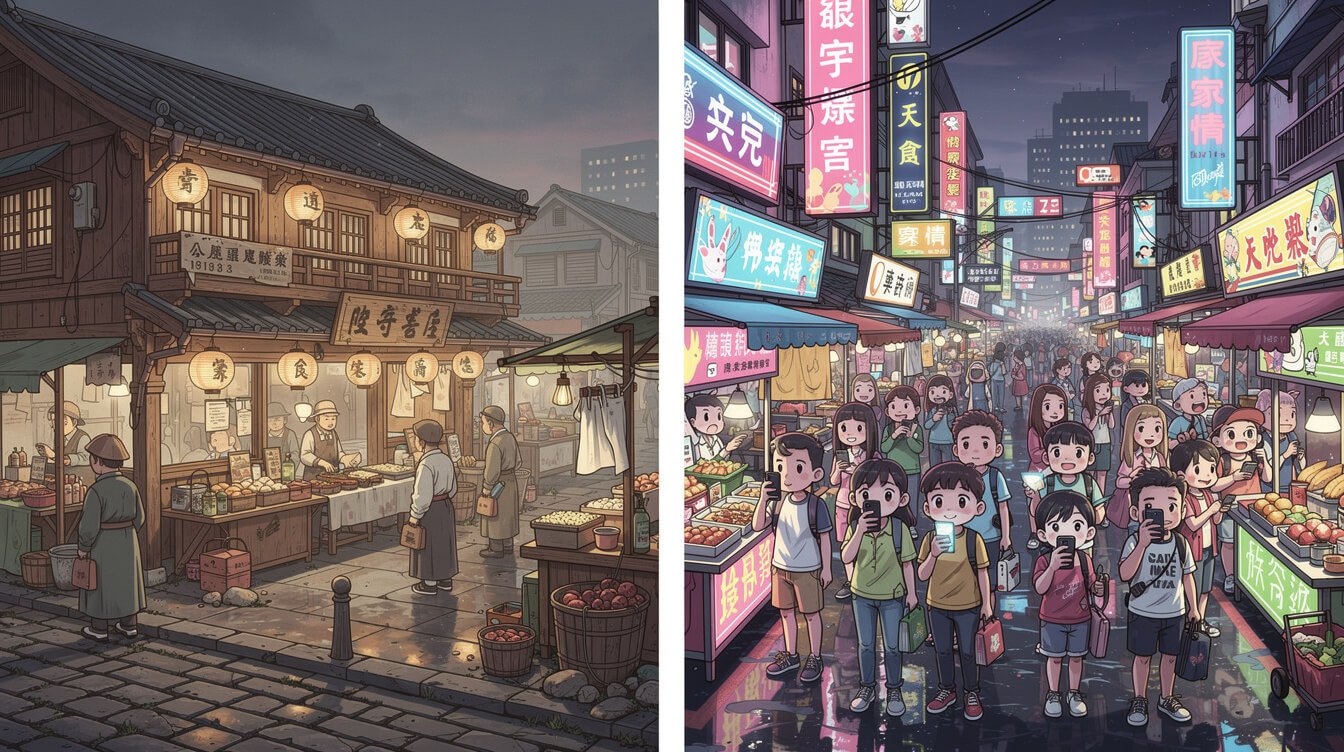
Long before Shilin Night Market showed up on every “Top 10 Things to Do in Taipei” list, it was just a wholesale produce market — Shilin Market — built in 1899, when Taiwan was still under Japanese rule. Farmers from the surrounding hills of what is now Shilin District brought vegetables, fish, and fruit down into the settlement to sell. When the day-market vendors packed up at sunset, a different crowd showed up: hawkers with portable stoves, cooks with woks strapped to bicycle carts, and students from the surrounding schools who wanted something cheap and hot to eat before curfew. The night market wasn’t a marketing decision. It was a natural side effect of a busy trading spot that never really wanted to close.
By the 1950s, the food side of the operation was bigger than the produce side. By the 1970s, Shilin was so iconic that Taiwanese pop songs name-dropped it. The old market building — the wooden one with the tiled roof and the slightly haunted vibe — held the food court until October 2002, when the whole complex was demolished for redevelopment. For nine years, the food court operated out of a temporary tent city on a plot near Jiantan MRT. In 2011, the new permanent building opened, and the vendors moved into the underground level where they still sizzle today.
Two things changed everything: the opening of Jiantan and Shilin MRT stations in 1997, and the explosion of Taiwanese street food on YouTube in the mid-2010s. Suddenly a market that had served students and shift workers was hosting bachelorette parties from Seoul, food vloggers from Singapore, and cruise-ship day-trippers who had exactly ninety minutes to “do Shilin.” The vendors adapted. Prices at the front-facing stalls crept up. Signage went bilingual, then trilingual. Some legacy stalls got squeezed out, and a wave of Instagram-optimized concept stalls moved in — think giant swirled soft-serve towers and light-up drink cups.
Here’s the honest read: Shilin today is a real Taiwanese night market wearing tourist-attraction clothes. The bones are authentic. The oyster omelettes are still oyster omelettes. But you need a strategy, or you’ll end up paying NT$250 for a mediocre skewer three meters from the MRT exit while a NT$60 version of the same thing sizzles four blocks deeper into the market.
The Underground Food Court: Taipei’s Hidden Eating Paradise
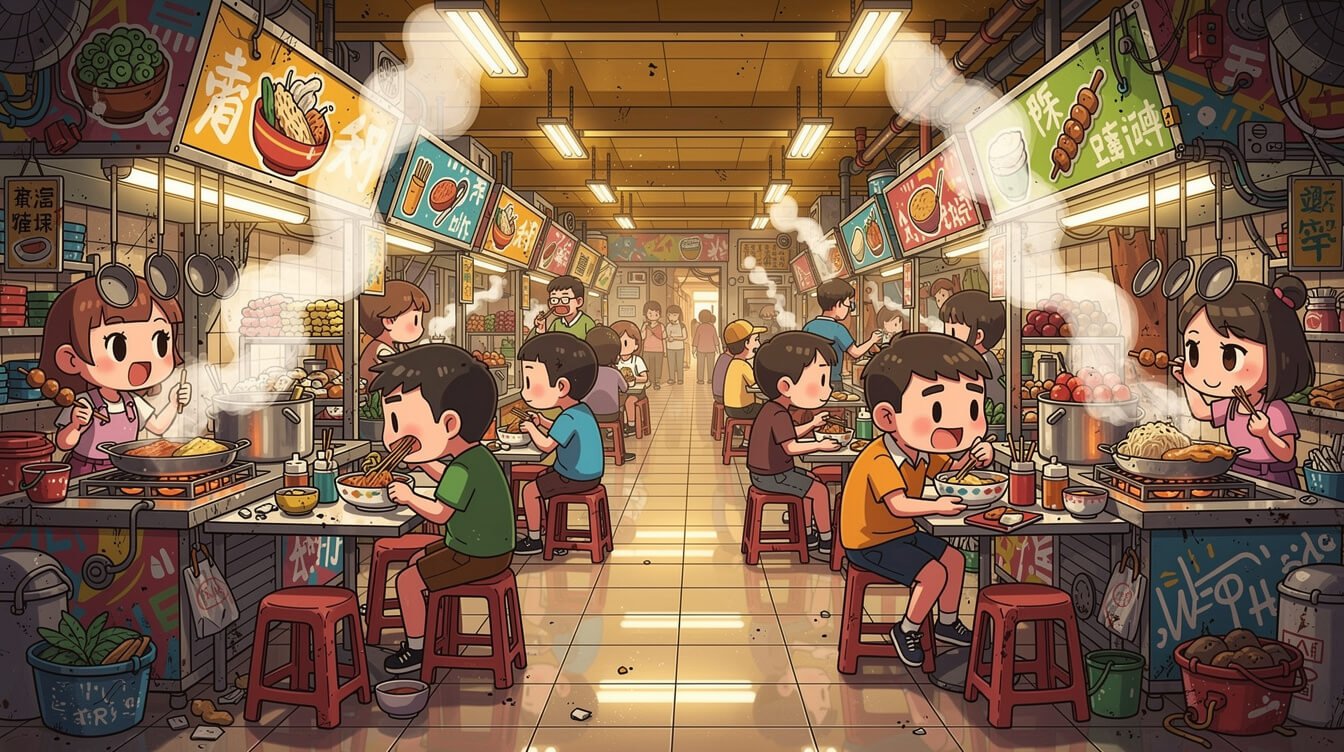
Ask a first-time visitor to describe Shilin Night Market, and they’ll describe the street-level maze — the row of open-front food stalls along Dadong Road, the neon banners, the vendors calling out prices. Very few will mention the food court. That’s because the food court is underground, tucked below the main market hall on Jihe Road, and if you don’t know to look for the escalator, you’ll walk right past it.
You want to look for it. The underground food court is where 539 stalls sit shoulder-to-shoulder in a fluorescent-lit basement, and it’s the closest thing modern Shilin has to a time machine. This is the direct descendant of the original 1913 market’s food section — the vendors who got displaced when the old wooden building was demolished were rehoused here in 2011. Many of the stalls trace their family recipes back three or four generations. Prices in the underground food court run roughly 20–30% lower than the street stalls above, and the crowd tilts heavily local: office workers grabbing dinner on the way home, Shilin residents doing their standing weekly rotation, elderly regulars who have been eating at the same stall since before the current building existed.
The layout is intentionally chaotic. There are no clear “sections” — instead you’ll drift past a stinky tofu vendor next to a squid vermicelli operation next to a shaved ice shop next to a stall selling XXL pork chops the size of your forearm. Stools are plastic, shared, and often sticky. Air conditioning is a rumor. But if you want to eat like a Shilin regular, this is the room.
Pro tip: come between 6:30 and 8:00 PM if you want any hope of a stool during peak season. After 8:00 the underground floor becomes a controlled shove, and by 10:00 PM some of the best stalls sell out. If you show up at midnight — Shilin runs until 1–2 AM — you’ll get elbow room but slimmer choices.
Local Favorites vs Tourist Traps: What to Actually Eat
Here’s the eater’s cheat sheet, sorted by “definitely order this” and “you’re paying tourist tax.” No hedging.
Order without hesitation:
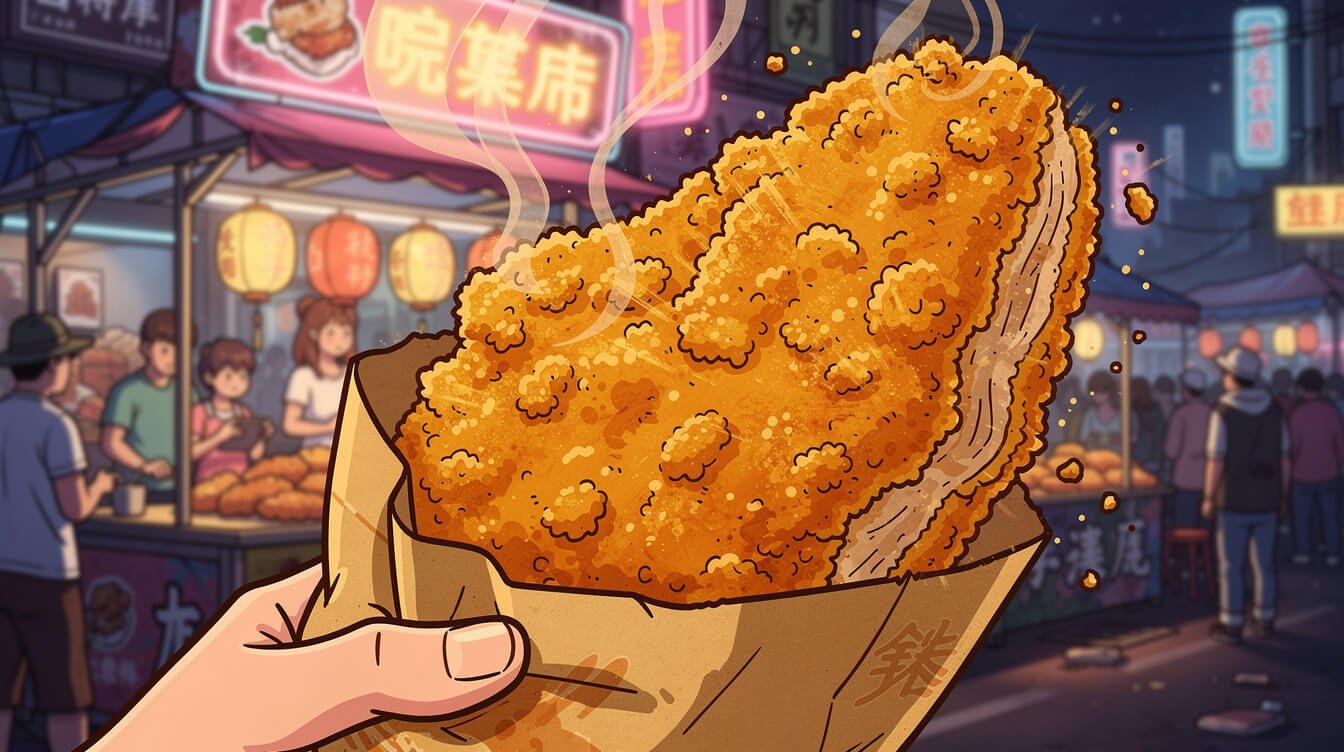
- Hot-Star Large Fried Chicken (豪大大雞排) — the founding location of the chicken cutlet chain that’s now global. The cutlet is still comically large, the peppery spice mix is still house-made, and yes, the line is worth it. NT$85–95.
- Ay-Chung Flour-Rice Noodles (阿宗麵線) — thickened intestine noodle soup, best eaten standing on the curb with a plastic spoon. Not the flashiest bowl, but it’s on the Bib Gourmand list for a reason.
- Shilin Sausage in a Big Sausage (大腸包小腸) — a sticky-rice sausage split open and stuffed with a pork sausage, garlic, and pickled cabbage. Weird, delicious, and impossible to eat elegantly.
- Oyster Omelette (蚵仔煎) — the underground food court has three or four legendary versions. Look for the line of locals.
- Lemon aiyu jelly — the market’s traditional refreshment, made from wild fig seeds. Cheaper than any bubble tea and infinitely more Taiwanese.
Approach with skepticism:
- Giant novelty drinks in light-up cups — you’re paying NT$200 for NT$50 of tea and NT$150 of Instagram.
- Any stall within 30 meters of the MRT exit with no visible menu prices — this is where the overcharging happens. If prices aren’t posted, ask before ordering.
- English-only menus with photographs of every dish — often means tourist markup. Not always, but often.
- The “authentic Taiwan snack sampler” for NT$500 — you could buy the same items separately for NT$180.
The identification trick locals use: follow the students. Shilin sits next to Ming Chuan University, Shih Chien University, and a cluster of high schools. If a stall has a queue of Taiwanese kids in school uniforms, it’s price-competitive and portion-honest. If the queue is 90% people with roller luggage, the markup is real.
For a broader tour of what to look for at every major market on the island, our Taiwan night market food guide breaks down the seven street eats you should master before you land.
Beyond Food: Games, Fashion & Shopping at Shilin
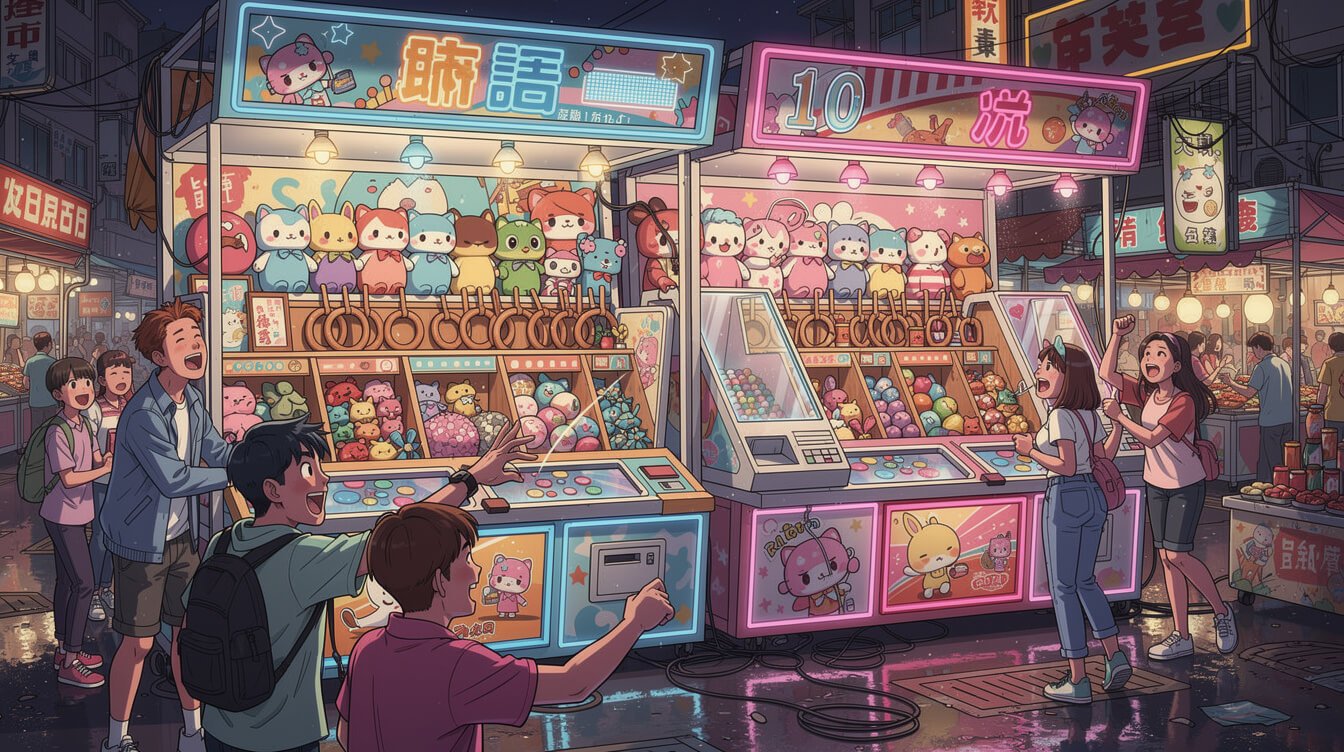
Shilin is often shorthand for “night market food,” but food is maybe 60% of what the market actually does. The remaining 40% is the reason Taiwanese teenagers rank it above Raohe or Ningxia — the games, the arcades, and the sheer volume of cheap fashion.
Walk east from the main food area, cross Wenlin Road, and you enter the game alleys. Ring-toss, dart-balloon, bottle-tumble, digital shooting galleries, retro pachinko machines that pay out in plush toys the size of a small dog — this whole ecosystem exists because it’s essentially free entertainment at NT$50 a play. Weekday nights the alleys are packed with high schoolers on dates. Weekend nights the same alleys are packed with twenty-somethings who never grew out of them. Foreign visitors often walk past these lanes entirely, which is a genuine miss — they’re a purer slice of local youth culture than anything you’ll find in Ximending.
The fashion side runs parallel: streetwear stalls, K-pop and J-pop bootleg merch, ten-dollar accessories, and racks of the flowy printed dresses that dominate Taiwanese summer street style. Quality is uneven and sizing runs small, but the pricing is honest — NT$300–500 for a tee, NT$500–800 for a dress. Don’t bargain aggressively; margins here are already thin. If you see something you like at a fair price, just buy it.
Two Shilin oddities that make the market genuinely one-of-a-kind: the Modern Toilet themed restaurant (yes, you sit on toilets and eat curry out of miniature toilets — a decades-old Taiwanese pop-culture staple, not a tourist gag), and the Modern Toilet Ice Cream stand next door. Absurd? Yes. Also 20 years old and still absolutely a Taiwanese teenage rite of passage.
How Much to Budget for a Night at Shilin
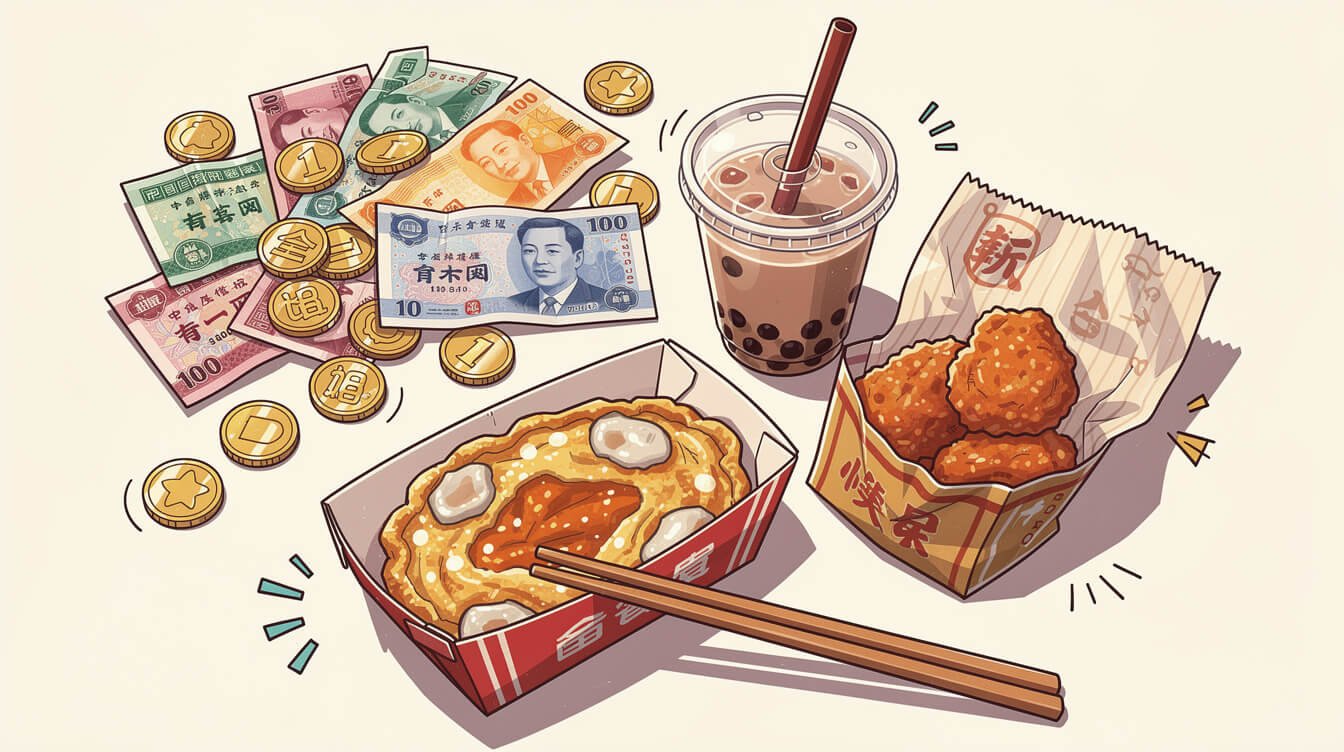
Real numbers, not vague “cheap eats” talk. Here’s what a typical evening actually costs, in New Taiwan Dollars (NT$1 ≈ US$0.03 as of mid-2026):
The Minimalist Grazer (NT$300 / ~US$9)
Two food items + one drink. One savory (oyster omelette NT$80), one snack (Shilin sausage NT$60), one drink (aiyu jelly NT$40). Add a small mango shaved ice for the road (NT$80). You’ve eaten well.
The Full Foodie (NT$650–800 / ~US$20–24)
The itinerary most first-timers want. Hot-Star cutlet (NT$95), Ay-Chung noodles (NT$70), oyster omelette (NT$80), stinky tofu (NT$70), pepper bun (NT$65), a proper bubble tea (NT$70), shaved ice at the end (NT$150). You’ve officially “done” Shilin.
The Group of Four Splitting Everything (NT$2,000 total / NT$500 each / ~US$15pp)
The best strategy if you’re with friends. Order one of everything, share every plate, save room for a second round.
Games / entertainment add-on: NT$100–300 depending on how competitive you get with the ring toss. If you’re bringing kids, budget more — the plush prizes are absurdly winnable.
Shopping add-on: If you fall for a night-market tee or a set of accessories, another NT$500–1,500. Speaking of night-market apparel, our Taiwan Boba Tea Cat T-Shirt is exactly the kind of playful, food-culture-forward piece you’d wish the Shilin stalls sold — designed by us in the same kawaii-meets-street-art spirit that makes Shilin feel the way it does.
Payment tip: Bring cash. Small bills — NT$100s and NT$500s. Some larger stalls now take LINE Pay or credit cards, but the underground food court is 90% cash-only, and pulling out a NT$1,000 note for a NT$60 skewer will earn you a very slow eye-roll.
Nearby Attractions to Pair With Your Visit

Here’s a bit of Taipei geography that a lot of guides miss: Shilin District isn’t just the night market. It’s home to three of the city’s most important cultural sites, all within a NT$150 taxi or a short bus ride. Stack them into your day and Shilin stops being a single-purpose food run.
National Palace Museum (故宮博物院) — one of the world’s great collections of Chinese imperial art, moved from Beijing’s Forbidden City to Taipei during the civil war. The famous Jadeite Cabbage lives here. Give yourself 3 hours minimum. Bus R30 runs from Shilin MRT to the museum in about 15 minutes. Close by 5:00 PM, so hit it before the market.
Chiang Kai-shek Shilin Official Residence (士林官邸) — the sprawling former garden home of the ROC’s founding leader and Madame Chiang. It’s a rare quiet-and-beautiful spot inside Taipei, with a rose garden, orchid house, and the surprisingly modest Presidential home itself. Free entry to the gardens, small fee for the house. A 10-minute walk from Shilin MRT.
Zhishan Cultural and Ecological Garden (芝山文化生態綠園) — a small park built on top of a Neolithic archaeological site. Way underrated. Bring hiking shoes and go at golden hour.
The pairing that works best: National Palace Museum in the afternoon → walk down to Shilin Residence for the sunset garden hour → dinner and games at Shilin Night Market. You’ve just had one of the best days a first-time Taipei visitor can have without leaving one district. For more Taipei planning ideas, our complete Taipei attractions guide maps the rest of the city.
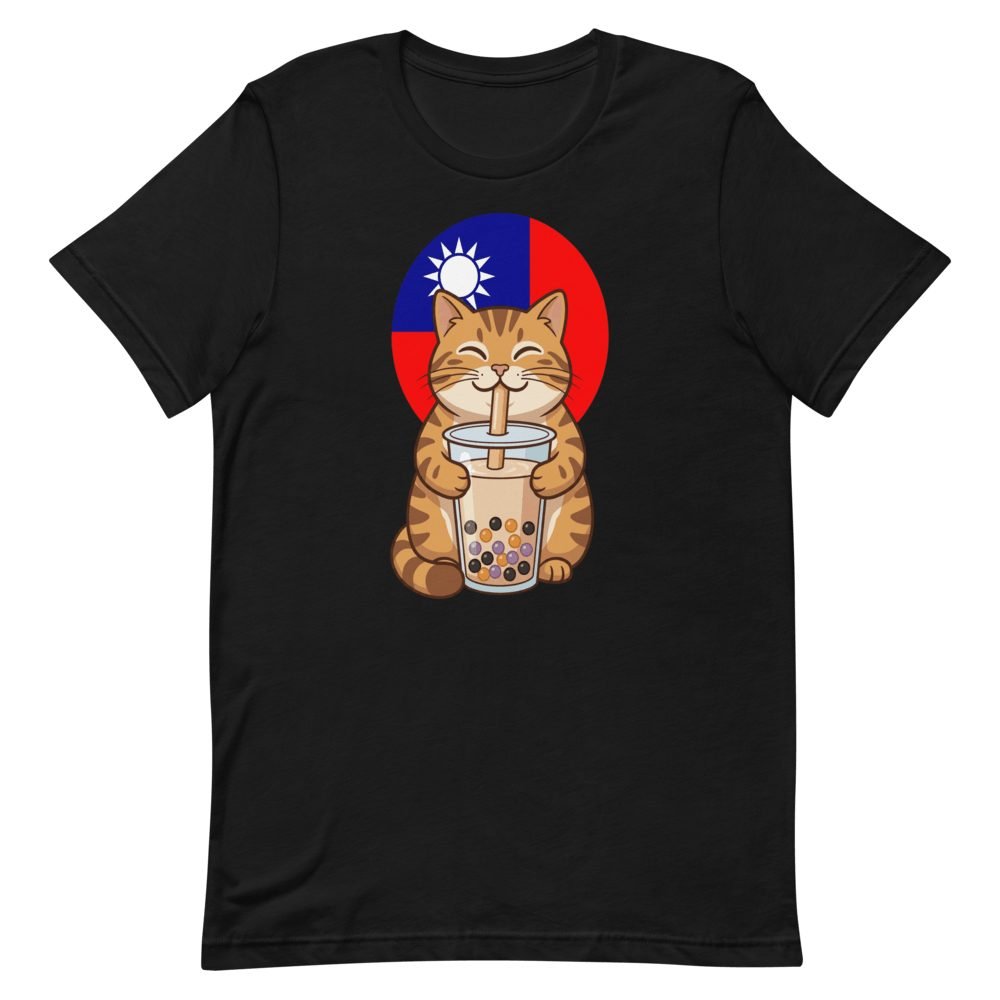
Bring the Night-Market Vibe Home
Our Taiwan Boba Tea Cat T-Shirt bottles up exactly the kind of playful Taiwanese pop-culture energy you feel walking through Shilin at 9 PM. Soft cotton, kawaii-forward, and every purchase supports independent Taiwan-inspired design.
Getting There, Best Times & Survival Tips
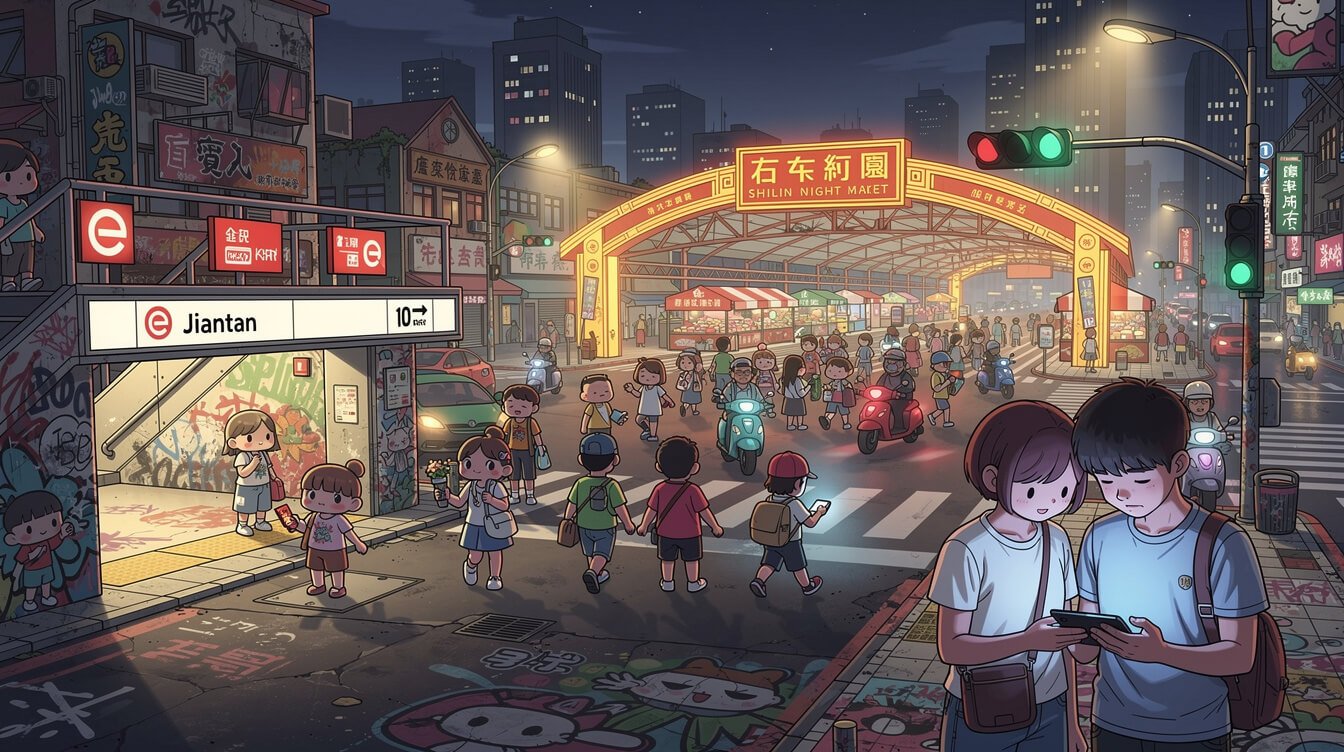
The MRT trick nobody tells you: Shilin Night Market is not at Shilin MRT station. It’s a 15-minute walk from Shilin station, but only a 2-minute walk from Jiantan MRT (Exit 1), one stop further north on the Tamsui–Xinyi red line. Get out at Jiantan. Cross Zhongshan North Road at the light. You’re already inside the market.
Best days to go: Tuesday through Thursday, if you have the flexibility. Weekends turn the market into a shove-fest, especially the underground food court. Sundays after 10 PM start to quiet down.
Best time to arrive: Anywhere from 6:00 PM to 7:30 PM is the sweet spot. Vendors are fully open, food is hot and fresh, crowds are manageable. After 8:30 PM the volume ramps hard.
What to wear: Comfortable shoes. Taipei summers are humid enough that any linen shirt will do — save the outfit for Ximending. In winter (December–February), bring layers; the outdoor stalls are exposed.
Bathrooms: There’s a public restroom on the second floor of the market building (above the food court) and a few in the surrounding 7-Elevens. The underground food court’s toilets are functional but tight — visit before you eat, not after.
Payments: Cash-first. Small bills. Some Instagram-forward stalls take LINE Pay. Almost none take Apple Pay reliably.
Language: Point-and-nod works fine at most stalls. If you want to try Mandarin, “zhè ge yī fèn” (this one, one portion) plus a smile gets you 90% of the way.
What to skip if you only have 90 minutes: the shopping alleys. Come back another night if you want to browse. Ninety minutes is barely enough for the underground food court and a lap of the main food street.
Frequently Asked Questions About Shilin Night Market
Is Shilin Night Market open every day?
Yes. Vendors start opening around 4:00 PM, hit full swing by 6:30 PM, and most stay open until 1:00–2:00 AM. Some individual stalls take Mondays off, but the market as a whole runs seven nights a week.
How long should I spend at Shilin Night Market?
Two hours is the honest minimum for food only. Three to four if you want to include games, shopping, and a proper sit-down at a shaved-ice place. Pair it with the National Palace Museum in the afternoon and you have a full 6–8 hour outing.
Is Shilin the best night market in Taipei?
Depends what you want. It’s the biggest and most varied, but Raohe is more compact and arguably has a higher food-per-square-meter density. Ningxia is where serious Taipei foodies go for the deepest cultural roots. Tonghua/Linjiang Street feels the most local. Our take: hit Shilin once for the scale, then rotate through the others on later trips.
Is Shilin Night Market safe?
Extremely. Petty theft is essentially unheard of. The biggest risk is losing your friends in the crowd. Keep phones on wrist straps if you’re actively filming; otherwise walk normal.
Do I need to speak Mandarin?
No. Most stalls have English signage, and menus increasingly show pictures. Pointing works. Prices are usually posted; if they aren’t, ask before ordering.
Can vegetarians eat at Shilin Night Market?
Yes, but you have to know where to look. The underground food court has several dedicated vegetarian stalls, and many street-level stalls will do a veggie version of oyster omelette or shaved ice on request. The lemon aiyu jelly, pepper buns (if you request cabbage-only filling), and various shaved ice options are safe defaults.
Is Shilin Night Market worth visiting if I’ve been to Raohe?
Yes, but adjust expectations. Raohe is denser and cleaner-vibed. Shilin is bigger, more chaotic, and has more non-food activity. Think of Shilin as the full theme-park version and Raohe as the boutique version.
Final Thoughts: Why Shilin Still Matters
Every time a well-known travel writer publishes a “Shilin is over, go to Raohe” hot take, a Taipei local shrugs and heads back to Shilin. The market gets a lot of grief for being commercialized, and some of it is deserved. But the fundamental thing is still true: this is where 15,000+ people on a busy night come together to eat food that was invented for exactly this setting — food that doesn’t quite make sense in a restaurant, that needs the crowd and the humidity and the flickering fluorescent light to taste right.
Go with a plan. Skip the front row, dive into the underground food court, follow the students, keep cash in your pocket, and give yourself time to just stand and watch the flow of it. That’s what Shilin Night Market Taiwan is — not a checklist item, not a set of dishes to photograph. It’s an evening. Treat it like one, and it’ll still be one of the best you spend in Taipei.
Get Taiwan in Your Inbox
Weekly notes from Bali on Taiwanese food, festivals, and finds — plus first dibs on new Taiwan Merch drops. No spam, ever.
Grab a Free Taiwan Sticker!
Drop your email and we’ll send you a limited-edition Taiwan sticker — plus insider access to new merch drops and island vibes.
No spam. Unsubscribe anytime.